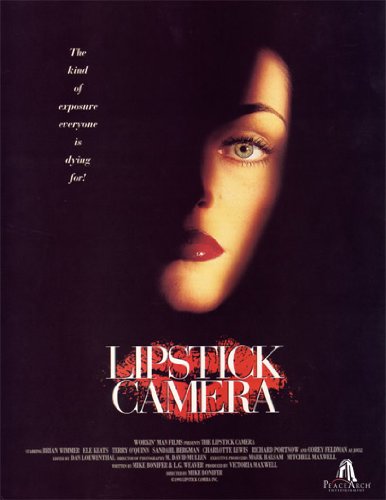
Cinemax Friday: Lipstick Camera (1994, directed by Mike Bonifer)


Omy Clark (Ele Keats) is an aspiring journalist who wants to work with the world famous videographer, Flynn Dailey (Brian Wimmer).  When she shows up at Flynn’s studio and marvels at how much power the filmed image can wield, Flynn blows her off.  While Flynn is busy ignoring Omy, Lily Miller (Sandahl Bergman) drops by and tries to hire Flynn to film her and her husband, Raymond (Terry O’Quinn), making love.  When Flynn heads out to the Miller residence, Omy tags along as an uninvited guest.  She happens to have a tiny camera that she stole from her best friend, Joule (Corey Feldman, sporting a beard and a beret).  Omy plants the camera in Lily’s bedroom.  Later, when Flynn, Omy, and Joule all return to the Miller house to retrieve the tiny camera, they discover that Lily has been murdered and that Raymond is a communist war criminal who fled East Germany following the collapse of the Berlin Wall.

Lipstick Camera has an intriguing premise and, even in 1994, it was trying to say something about media manipulation and what is today referred to as being “fake news.”  You could say that it was a film that was ahead of its time.  You could also say that it’s a complete mess or that it’s an erotic thriller that is neither erotic nor thrilling and you would be just as correct.  The main problem with the film is that almost every plot development is set in motion by Omy being either extremely self-absorbed or extremely stupid.  When she’s not manipulating Joule (who is not too secretly in love with her), she’s stalking Flynn and carelessly losing an expensive camera that didn’t even belong to her in the first place.  And she, of course, is meant to be our hero!

In the 90s, former teen idol Corey Feldman was one of the mainstays of late night Cinemax.  Even during his Cinemax years, Feldman would occasionally give a good performance.  Lipstick Camera was not one of those occasions.  In Lipstick Camera, Feldman wears a beard and a beret and spends a lot of time in a room that’s full of computer monitors and TV screens and that’s the extent of his characterization.  He does get a dramatic death scene, in which Joule appears to be determined to stave off the grim reaper by giving a monologue of Shakespearean proportions but otherwise, this is Corey Feldman at his worst.  Faring slightly better is Terry O’Quinn, who, at least, gets to deliver his lines in a light German accent.

With its focus on the media and communist war criminals, Lipstick Camera is an example of a direct-to-video film that tried to be about something more than just sex and murder.  (Though, this being a DTV film, there is one brief sex scene that takes place in front of a TV that’s showing a video of a fireplace.)  Unfortunately, nobody involved seems to know what that something was supposed to be.

Lisa Reviews An Oscar Nominee: Romeo and Juliet (dir by George Cukor)


You know the story that’s told in this 1936 film already, don’t you?

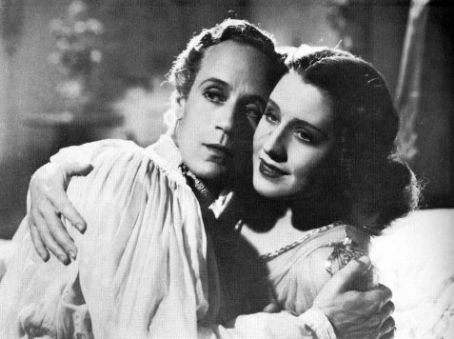
In the city of Verona, Romeo Montague (Leslie Howard) has fallen in love with Juliet Capulet (Norma Shearer).  Normally, this would be cause for celebration because, as we all know, love is a wonderful thing.  However, the House of Capulet and the House of Montague have long been rivals.  When we first meet them all, they’re in the process of having a brawl in the middle of the street.  There’s no way that Lord Capulet (C. Aubrey Smith) will ever accept the idea of Juliet marrying a Montague, especially when he’s already decided that she is to marry Paris (Ralph Forbes).  Things get even more complicated with Juliet’s cousin, Tybalt (Basil Rathbone), kills Romeo’s best friend, Mercutio (John Barrymore).  Romeo then kills Tybalt and things only grow more tragic from there.

It’s hard to keep track of the number of films that have been made out of William Shakespeare’s tale of star-crossed lovers and tragedy.  The plot is so universally known that “Romeo and Juliet” has become shorthand for any story of lovers who come from different social sects.  Personally, I’ve always felt that Romeo and Juliet was less about love and more about how the rivalry between the Montagues and the Capulets forces the young lovers into making hasty decisions.  If not for Lord Capulet throwing a fit over his daughter’s new boyfriend, she and Romeo probably would have split up after a month or two.  Seriously, I’ve lost track of how many losers I went out with in high school just because my family told me that I shouldn’t.

Producer Irving Thalberg spent five years trying to get MGM’s Louis B. Mayer to agree to greenlight a film version of Romeo and Juliet.  Mayer thought that most audiences felt that Shakespeare was above them and that they wouldn’t spend money to see an adaptation of one of his plays.  Thalberg, on the other hand, thought that the story would be a perfect opportunity to highlight the talents of his wife, Norma Shearer.  It was only after Warner Bros. produced a financially successful version of A Midsummer Night’s Dream that Mayer gave Romeo and Juliet the go ahead.

Of course, by the time the film went into production, Norma Shearer was 34 years old and a little bit too mature to be playing one of the most famous teenagers in literary history.  Perhaps seeking to make Shearer seem younger, Thalberg cast 43 year-old Leslie Howard as Romeo, 44 year-old Basil Rathbone as Tybalt, and 54 year-old John Barrymore as Mercutio,  (In Barrymore’s defense, to me, Mercutio always has come across as being Verona’s equivalent of the guy who goes to college for ten years and then keeps hanging out on the campus even after dropping out.)

In short, this is the middle-aged Romeo and Juliet and, despite all of the good actors in the cast, it’s impossible not to notice.  There were few Golden Age actors who fell in love with the authenticity of Leslie Howard and Basil Rathbone is a wonderfully arrogant and sinister Tybalt.  Norma Shearer occasionally struggles with some of the Shakespearean dialogue but, for the most part, she does a good job of making Juliet’s emotions feel credible.  As for Barrymore — well, he’s John Barrymore.  He’s flamboyant, theatrical, and a lot of fun to watch if not always totally convincing as anything other than a veteran stage actor hamming it up.  The film is gorgeous to look at and George Cukor embraces the melodrama without going overboard.  But, everyone in the movie is just too old and it does prove to be a bit distracting.  A heart-broken teenager screaming out, “I am fortune’s fool!” is emotionally powerful.  A 43 year-old man doing the same thing is just not as effective.

Despite being a box office failure (it turned out that Mayer was right about Depression-era audiences considering Shakespeare to be too “arty”), Romeo and Juliet was nominated for Best Picture of the year, the second Shakespearean adaptation to be so honored.  However, the award that year went to another big production, The Great Ziegfeld.

Gunshy (1998, directed by Jeff Celentano)


Burned-out writer Jake Bridges (William L. Petersen, a year or two before CSI) comes home one day to discover his wife in bed with another man.  Jake, who is already suffering from an epic case of writer’s block, goes to Atlantic City and tries to drink his troubles away.  When the bitter Jake gets into a bar fight, he’s saved by Frankie (Michael Wincott).  Frankie takes Jake back to his house, where Jake meets Frankie’s girlfriend, Melissa (Diane Lane).  Jake also discovers that Frankie works as a debt collector for a local mob boss, Lange (Michael Byrne).

Frankie and Jake strike up an unexpected friendship.  Jake wants to experience what it’s like to be a real tough guy.  Frankie wants to improve his vocabulary.  Frankie agrees to take Jake with him when he makes his collections on the condition that Jake recommend a book to him.  Soon, Jake is pretending to be a gangster and Frankie is reading Moby Dick.  Frankie shows Jake how to be intimidating.  Jake explains the symbolism of Ahab’s quest to Frankie.  They become good friends, with the only possible complication being that Jake is falling in love with Melissa.

For a low-budget neonoir that, as far as I know, never even got a theatrical release before being released to video, Gunshy is surprisingly good.  The plot may sometimes be predictable but Petersen and especially Wincott give good performances and they both play off of each other well.  Diane Lane is undeniably sexy but also bring a fierce intelligence and a sense of wounded dignity to the role of Melissa.  This is a love triangle where you want things to work out for all three of the people involved.  The rest of the cast is full of familiar faces.  Keep an eye out for everyone from R. Lee Ermey to Meat Loaf.  Director Jeff Celantano keeps the story moving and proves himself to be adept at balancing scenes of violence with scenes where Frankie and Jake simply discuss their differing views of the world.

An unjustly obscure film, Gunshy is a 90s film that deserves to be rediscovered.


Dilemma (1997, directed by Eric Larsen)


Delfina, a precocious ten year-old, desperately needs a bone marrow transplant.  Unfortunately, the only available donor is Rudy Salazar (Danny Trejo), a sociopath who is currently sitting on Death Row.  (We’re told that Rudy is the only possible donor because both he and Delfina are “half-Mexican, half-Greek.”  I’m not a medical expert but I imagine there’s probably more to finding a donor than just that.  And, even if it was that simple, surely Rudy and Delfina are not the only two people of Mexican-Greek ancestry living in Los Angeles.)  Lydia Cantrell (Sofia Shinas), who works for the governor, arranges for Rudy’s death sentence to be commuted to life in prison in return for him donating his marrow.  At the hospital, Rudy stages a violent escape and soon, he and his old gang are on a rampage.

It falls to renegade Detective Quin Quinlan (C. Thomas Howell) to track down Rudy and bring his rampage to an end.  The only catch is that Rudy has to be captured alive because Delfina still needs that transplant.  Complicating matters is that Quinlan really enjoys shooting the bad guys.

If the plot of Dilemma sounds familiar, you may be one of the handful of people who remember an old Michael Keaton/Andy Garcia film called Desperate MeasuresDesperate Measures may have had the same plot as Dilemma (along with a bigger budget and bigger stars in the cast) but it didn’t have Danny Trejo.  Trejo appears without his trademark mustache and he really plays up the idea that Rudy Salazar is one evil dude.  Rudy’s so evil that he even laughs at shooting people in the back.  When a member of his gang is wounded in a shootout and begs, “Don’t leave me, dawg!,” Rudy takes one look at him and says, “You’re of no use to me.”  Only Danny Trejo can make a line that work.  With the rest of the cast not making much of an effort one way or the other, Danny Trejo is the best thing about Dilemma and one of two reasons to watch the movie.  The other reason is to watch in amazement as both the police and the criminals fire thousand of bullets at each other without ever having to stop and reload their guns.  Luckily, they’re all terrible shots who only have good aim when its convenient for the plot.

There’s no dilemma about skipping this one.

Lisa Reviews An Oscar Nominee: Sounder (dir by Martin Ritt)


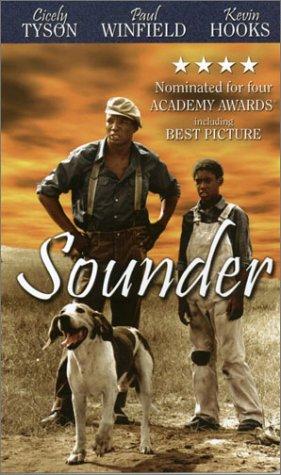
The 1972 film Sounder follows the Morgans, a family of black sharecroppers living in 1930s Louisiana.

When we first see Nathan Lee Morgan (Paul Winfield) and his young son, David Lee (Kevin Hooks), they’re hunting.  Accompanying them is their loyal dog, Sounder.  As they hunt, two things become very obvious.  Number one, David Lee is a good father who is doing his best to provide for his family under the most difficult circumstances possible.  Number two, the family is desperately poor.  When Nathan finally gives in to temptation and steals a ham to feed his family, the local Sheriff (James Best) shows up at the farmhouse the next day and arrests him.  Nathan is taken away to prison and one of the deputies even shoots Sounder.

Fortunately, Sounder survives and so do the Morgans.  Under the stern but loving leadership of their mother, Rebecca (Cicely Tyson), the Morgan children manage to bring in the season’s crops.  Unfortunately, having to work out in the fields doesn’t leave much time for David Lee to get an education.  When he does go to school, he and the other students listen as a middle-aged, white teacher reads to them from Huckleberry FInn.

After the wounded Sounder finally returns to the Morgan family and recovers from his wounds, David Lee decides that he wants to go to the prison and see his father.  Unfortunately, the sheriff refuses to even tell the family where Nathan has been incarcerated.  None of the white authority figures in town care that the Morgans are struggling or that they’ve managed to bring in the crops themselves.  None of them cares or seems to even understand that David Lee is missing his father.  The sheriff presents himself as being a reasonable man and is never heard to the use the n-word.  Instead, he and every other white person in town refers to David Lee as being “boy,” diminishing everything that he’s done since his father was arrested.

David Lee finally figures out the location of a prison that might (or might not) currently be housing his father.  It’s several miles away.  Accompanied by Sounder, David Lee sets out to make the long journey to the prison.  Along the way, he discovers another school and a far more empathetic teacher named Camille (Janet MacLachlan).  David Lee is forced to make a decision that will effect not only his future but also the future of his family.

Sounder is a heartfelt film.  It’s a film that’s less interested in telling a story with a traditional beginning and end as opposed to just sharing scenes of everyday life.  In this case, it’s the life of family that manages to survive despite it often seeming as if the entire world is arrayed against them.  The film was based on a book that pretty much centered around the dog.  The movie, on the other hand, is more about the family and, despite the fact that the film is still named after him, the dog is pretty much superfluous to the plot.  That said, Sounder still plays an important role because, just as Sounder survives being shot at and remains loyal to the people that he loves, the Morgans survive whatever adversity is tossed at them.  Watching the film, the viewer is very much aware that life is never going to be easy for the Morgans but, at the same time, it’s impossible not take some comfort in the fact that they have each other.  Paul Winfield and Cicely Tyson both give strong performances as the resilient Nathan Lee and Rebecca and the entire film is the type of movie that’ll inspire tears even as it inspires happiness.

At the Oscars, Sounder was nominated for Best Picture, where it provided a gentle contrast to the other nominees, Cabaret, Deliverance, The Emigrants, and The Godfather.  Paul Winfield and Cicely Tyson were nominated for Best Actor and Best Actress, making 1972 the first year in which black performers were nominated in both of the lead categories.  (It was also the first year in which more than one black actress was nominated for Best Actress as Tyson ended up competing with Lady Sings The Blues‘s Diana Ross.)  In the end, Tyson lost to Cabaret‘s Liza Minnelli while Winfield lost to The Godfather‘s Marlon Brando.  And, of course, The Godfather also went on to deservedly win the award for Best Picture.

The Perfection, Review By Case Wright


perfection

Let me begin by writing that I love watching Netflix and I REALLY love livetweeting with Lisa and the rest of the Shattered Lens staff. We can coordinate times well and it’s easy to sync up.  This time, I was given the movie choosing authority and perhaps it will be my last.  I heard that The Perfection was a bit gory, but I figured come on, this is Shattered Lens- we Rocktober the October over here with our Horrorthon!  When I saw that Steven Weber was in it, I felt like ok, this is going to be like a Tales From the Crypt experience.  Well……….not so much.

The Perfection has trashy components to it and some cheaply built sets and the director REALLY wants you to know that they splurged and actually filmed in China! The best way to describe The Perfection is as an unaware, pretentious, and boring episode of Tales From the Crypt.  It had the victim goes to victimizer TFTC theme and the over the top gore, but it was always trying to be serious and important when it was just an overly long TFTC episode without any humor.

The plot is pretty straight-forward: Charlotte is a prodigy Cellist who left her art to care for her dying mother for ten-years.  When she tries to return to her life, she finds that a younger classmate Lizzy has attained the Cello fame that she sought.  She sees her old Mentor Anton (Steven Weber) and Charlotte is now the clear has-been.  Charlotte executes a plan to destroy Lizzy forever.  Charlotte meets Lizzy, seduces Lizzy, drugs Lizzy, and convinces Lizzy to chop her hand off.  Yep, another Hollywood girl meets girl, girl drugs girl, girl gets girl to chop her hand off story.  The Perfection was actually the original script for Love Actually.  The “To Me You Are Perfect” scene was just going to be Andrew Lincoln throwing severed hands at people – “To Me you are a perfect…Target” *throws hand at Juliet*.

Just when you think this movie will be a fun version of Black Swan it takes a turn for the dumb, gross.  Yes, I get that this was made by a post-Weinstein Miramax and it was showing how fame could encourage and condone horrible behavior, but it was done with so much exposition that it really caused the film to jerk from long explanations to gore and long explanations to gore and long explanations to trying a Subway Cold Cut Combo – even terrible movies get hungry.

I’m not sure if I should spoil this piece of trash or not.  It’s really not worth your time. Instead of watching this film you could eat a sandwich, do your taxes, plot revenge. However, it is nice to see that Steven Weber is still working – there’s that.


When Justice Fails (1999, directed by Allan A. Goldstein)


In New York City, two men have been murdered in the same ritualistic way.  Both of the men were accused rapists who beat the system, getting their charges dismissed due to legal technicalities.  When detectives Tom Chaney (Jeff Fahey) and Rod Lambeau (Carl Marotte) discover that assistant D.A. Katy Wesson (Marlee Matlin) was the prosecutor on both of the dead men’s cases, she becomes their number one suspect.  However, Chaney has his doubt about her guilt, especially after he goes on a few dates and starts sleeping with her.  Katy is an enigma with a traumatic childhood and penchant for picking up men in nightclubs but is she a murderer?  Other suspects include a creepy artist named Josh (Charles Powell), who also works as the deaf Katy’s interpreter, and Katy’s overdramatic mother (Monique Mercure).

That a direct-to-video thriller from 1999 would be a rip-off of Basic Instinct is not a shock.  Almost every thriller released between 1992 and 2000 was at least partially cloned from Basic Instinct.  What sets When Justice Fails apart is that it’s probably the only Basic Instinct clone to actually feature it’s two main characters discussing the ending of Basic Instinct post-coitus.  (For the record, Chaney thinks that the final shot means that Sharon Stone was the murderer while Katy says that the ice pick showed that the director was playing a joke on the audience.)  I guess When Justice Fails deserves some credit for being willing to so directly acknowledge the film that inspired it but, when you’re a mediocre film, you probably don’t want to intentionally remind audiences that they could be watching something better.

When Justice Fails actually gets off to a good start, with Jeff Fahey playing another one of his driven loners and Marlee Matlin really committing to the role of the film’s femme fatale.  The movie even manages to avoid the usual awkwardness that comes from having a hearing character repeating everything that a deaf character either signs or writes down.  The early scenes have a Law & Order feel to them, with Chaney and Lambeau interviewing witnesses on the busy streets of New York and also talking to a world-weary coroner.  It would have been a surprise if Stephen Hill had suddenly shown up and said, “Your case is weak and this trial could drag on through election day.  Make him an offer.  Man 1.  Depraved indifference.”

Unfortunately, once Chaney sleeps with Katy, the movie becomes increasingly implausible and goes downhill.  There just aren’t enough suspects to generate any suspense over who the murderer is ultimately going to turn out to be.  The surprise at the end is only a surprise because it didn’t occur to Chaney to run a routine background check on one of his suspects, something that I would think most cops would do at the start of a murder investigation.  Marlee Matlin is a terrific actress who is always interesting to watch but When Justice Fails ultimately fails to be very memorable.

Lisa Reviews An Oscar Nominee: Tender Mercies (dir by Bruce Beresford)


The other day, on this very site, I mentioned that the 1983 film Tender Mercies was one of the films that David Lynch turned down.  

In his memoir, Room to Dream, Lynch wrote that he was sent the film’s script while he was looking for a project to serve as his follow-up to The Elephant Man.  Lynch wrote that he liked the script, which was written by Horton Foote (who had previously won an Oscar for adapted To Kill A Mockingbird), but that Lynch also felt that it just wasn’t the right project for him at the time.  Tender Mercies was eventually directed by Bruce Beresford and Lynch mentioned that he felt that Beresford did a “brilliant” job.

After I posted the article, it occurred to me that Tender Mercies is not a film that’s as well-known as it deserves to be.  It received five Oscar nominations, including one for Best Picture.  Robert Duvall won his first (and, to date, only) Oscar for playing the lead role.  It’s an acclaimed film but it also plays it in a rather low-key style, particularly when compared to some of the other films that were released in the early 80s.  (1983 may have been the year of Tender Mercies but it was also the year of Scarface, Flashdance, Return of the Jedi, and Risky Business.)  As such, it’s a film that’s been a bit overshadowed over the years.

Tender Mercies takes place in rural Texas.  Mac Sledge (Robert Duvall) is a former country-western star whose career has collapsed due to his alcoholism and his own self-destructive behavior.  One morning, a hungover Mac wakes up in a roadside motel.  Not having any money on him, Mac asks the motel’s owner — Rosa Lee (Tess Harper), who lost her husband in Vietnam — if he can work at the motel in return for a room.  Rosa Lee agrees, on the condition that Mac not drink while he’s working.

As the days pass, Mac and Rosa Lee grow closer and Mac becomes a surrogate father to Rosa Lee’s young son, Sonny (Allan Hubbard).  Eventually, Mac and Rosa Lee marry and Mac becomes an accepted member of the community.  However, Mac remains troubled.  His ex-wife, Dixie (Betty Buckley), has built a career on singing the songs that he wrote for her but she refuses to consider anything new that he’s written.  His teenage daughter (Ellen Barkin) stops by the motel and announces that she’s running away to get married.  There’s tragedy but there’s also hope and forgiveness.

Tender Mercies is a simple but affecting film about a good man who is struggling to deal with the fact that he was once a very bad man.  What makes Tender Mercies interesting is what doesn’t happen.  The first time I saw it, I spent the entire movie expecting Mac to fall off the wagon and break everyone’s heart.  Instead, Mac manages to keep his promise to his new family but what he discovers is that being sober doesn’t automatically exempt one from pain or guilt.  He still has to deal with sadness and disappointment but now, he has to do it without using alcohol as a crutch.  Instead of getting his strength from booze, he now gets it from love.

It’s a wonderfully sweet movie, featuring naturalistic performances from Harper, Hubbard, and especially Robert Duvall.  It seem appropriate that, after making his film debut as Boo Radley in a film written by Horton Foote, Duvall would win his first Oscar for another film written by Foote.  Duvall plays Mac as a plain-spoken and weary soul who is still just enough of a romantic to find some sort of redemption in the world.  It’s a great performance and it’s a good film and I’d suggest checking it out if you ever need a good cry.

Lisa Marie’s 10 Worst Films of 2019


Well, I guess it’s finally that time!

It’s time for me to finally post my picks for the best (and worst) of 2019.  This is something that I do every year.  Usually, I manage to do it before the third week of January but I’ve been running behind.  I’ll be posting my film, television, book, and music picks throughout today and maybe into tomorrow, depending on how long it takes me to narrow down my choices.

Let’s start with my picks for the 10 worst films of 2019!  Below are my picks for the worst.  Some of you will agree and some will disagree.  In the end, what truly matters is that I’m right.

(Also be sure to check out my picks for 2018, 2017201620152014201320122011, and 2010!)

10. The Upside (dir by Neil Burger)
9. Glass (dir by M. Night Shyamalan)
8. X-Men: Dark Phoenix (dir by Simon Kingberg)
7. The Kitchen (dir by Andrea Berloff)
6. The King (dir by David Michod)
5. Miss Bala (dir by Catherine Hardwicke)
4. The Dirt (dir by Jeff Tremaine)
3. Backdraft 2 (dir by Gonzalo López-Gallego)
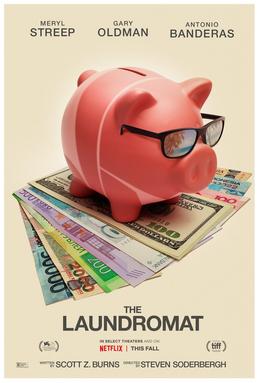
2. The Laundromat (dir by Stephen Soderbergh)
1. After (dir by Jenny Gage)


Goin’ South (1978, directed by Jack Nicholson)


Jack Nicholson was not an overnight success.

Nicholson was 17 years old when he first came to Hollywood in 1954.  Looking to become an actor, Nicholson toiled as an office worker at the MGM cartoon studio, took acting classes, and went to auditions.  It would be four years before he even landed his first role, the lead in the Roger Corman-produced The Cry Baby Killer.  When that film failed to become a hit, Nicholson spent the next ten years doing minor roles and occasionally starring in a B-picture.  He auditioned for some big parts, like Benjamin Braddock in The Graduate, Buck Barrow in Bonnie and Clyde, and Guy Woodhouse in Rosemary’s Baby, but his big break continued to allude him.  By 1969, Nicholson was so disillusioned with acting that he was planning to instead pursue a career as a director.  However, before Nicholson officially retired from the acting game, he received a call from the set of Easy Rider.  Depending on who you ask, Rip Torn, who had previously been cast in the role of alcoholic George Hanson, had either quit or been fired.  Bruce Dern, the first choice to replace Torn, was busy filming They Shoot Horses, Don’t They?  Nicholson agreed to step into the role and the rest is history.

Easy Rider may have made Jack Nicholson one of the world’s biggest film stars but he never lost his ambition to direct.  In 1971, he made his directorial debut with Drive, He Said, a film about campus unrest.  At the time, the film flopped at both the box office and with critics and quickly sunk into obscurity.  (It has subsequently been rediscovered and, in some cases, positively reevaluated.)  After the failure of Drive, He Said, it would be another seven years before Nicholson again got a chance to direct.

Nicholson’s second film as a director, Goin’ South, is a comedic western.  Nicholson plays Henry Lloyd Moon, an unsuccessful outlaw who used to ride with Quantrill’s Raiders.  When Moon is captured in Longhorn, Texas, he is sentenced to be hanged.  Fortunately, for Moon, Longhorn has a special ordinance.  Any man condemned for any crime other than murder can be saved from the gallows if a local woman agrees to marry him and take responsibility for his good behavior.  As a result of this ordinance, Longhorn is populated almost exclusively by single women and reformed outlaws.

While standing on the gallows, the cocky Moon is stunned to discover that none of the women want to marry him.  Finally, an old woman emerges from the crowd and announces that she’ll become Moon’s wife.  When Moon hops off the gallows and thanks her, the woman drops dead.  Fortunately, another, younger woman, Julia Tate (Mary Steenburgen, making her film debut), steps forward.

Once they’re married, the lecherous Moon discovers that Julia is a virgin and that the only reason she married him was so she could force him to work in the secret gold mine that’s hidden underneath her property.  The railroad will soon be taking over the land and Julia wants to get all of the gold before she leaves town for Philadelphia.  Though Julia, at first, wants nothing to do with Moon, he eventually wears her down through sheer persistence and the two fall in love.

Complicating matters is Deputy Towfield (Christopher Lloyd), who is upset because he feels that Julia was meant to be his wife.  Also, the members of Moon’s former gang (including Danny DeVito and Veronica Cartwright) show up at Julia’s house and discover the truth about the mine.

Goin’ South gets off to a good start.  The scene on the gallows, where Moon waits for someone to marry him and save his life, is genuinely funny and Nicholson and Steenburgen have a playful chemistry for the first hour of the movie.  Nicholson leers even more than usual in this film but the script is written so that the joke is always on Moon.  Much of the film’s humor comes from Moon always overestimating both his charm and his cleverness.  However, once Moon and Julia finally consummate their marriage, the movie loses whatever narrative momentum it may have had and gets bogged down with the subplots about Towfield and Moon’s gang.  There are funny moments throughout but the story gets away from Nicholson and the film is reduced to a series of set pieces, none of which build up to much.

Not surprisingly, Nicholson gets good performances from his cast, which is largely made up by the members of his 1970s entourage.  Along with Danny DeVito and Christopher Lloyd, longtime Nicholson associates like Tracey Walter, Ed Begley Jr., Richard Bradford, Jeff Morris, and Luana Anders all appear in small roles.  John Belushi plays the tiny role of Deputy Hector.  (Goin’ South was actually the first film in which Belushi was cast, though production didn’t actually begin until after Belushi had finished working on National Lampoon’s Animal House.)  Unfortunately, despite all of the good performances, the script doesn’t do much to develop any of the characters.  Belushi especially feels underused.  (Because Belushi had moved on to Animal House by the time the film went into post-production, Nicholson ended up dubbing several of Belushi’s lines himself.)

Drive, He Said was largely considered to have failed at the box office because Nicholson remained behind the camera so he took the opposite approach with Goin’ South.  Nicholson is in nearly every scene and he gives one of his broadest performances.  It works for the first half of the film, when Moon is constantly trying to get laid and failing every time.  But, during the second half of the movie, Nicholson’s failure to reign in his performance works to the film’s detriment.  When the movie needs Nicholson to be romantic, he’s still behaving like a horny cartoon. Whenever he looks at Mary Steenburgen, it seems as if his eyes should be popping out of his head, Tex Avery-style.  He’s an entertaining cartoon, but a cartoon nonetheless.  As a result, Goin’ South is often funny but it still feels very inconsequential.

Like Drive, He Said, Goin’ South was both a critical and a box office flop and it temporarily turned Nicholson off of directing.  It would be another 12 years before he would once again step behind the camera.  In 1990, Nicholson directed The Two Jakes, the sequel to one of his best films, Chinatown That would be Nicholson’s last film as a director.  Nicholson acted for another 20 years, following the release of The Two Jakes.  To date, he made his final screen appearance in 2010, with a supporting role in James L. Brooks’s How Do You Know.  Nicholson has disputed claims that he’s officially retired, saying that he’s instead just being more selective about his roles.  Even though it’s been ten years since we last saw him on screen, Jack Nicholson remains an American icon and a living legend.