An Offer You Can Do Whatever You Want With #21: Carlito’s Way (dir by Brian De Palma)


It’s been a week so I guess it’s time for me to get back to reviewing mob movies, right?  Usually, I do my best not to take such a long break in-between reviewing films — especially when it’s a themed-series of reviews — but I just got busy this week.  It happens.  Luckily, even when we get busy, the movie’s remain ready to be watched and reviewed.

Last week, I reviewed Scarface and The Untouchables, two gangster films from Brian De Palma.  It only seems right to return to my look at the gangster genre by considering another Brian De Palma film.  Released in 1993, Carlito’s Way reunites De Palma with Scarface’s Al Pacino.  In Scarface, Pacino played a Cuban named Tony who was determined to get into the drug trade.  In Carlito’s Way, Pacino plays a Puerto Rican named Carlito who is desperate to escape the drug trade.

Carlito’s Way opens with Carlito getting released from prison in 1975.  He’s spent the past five years serving time on a drug conviction.  Originally, Carlito was sentenced to 30 years but his friend and attorney, David Kleinfeld (Sean Penn), managed to get the conviction thrown out on a technicality.  Now a free man, Carlito finds himself torn between two options.  He can either get involved, once again, in the drug trade or he can go straight.  Returning to his life of crime will mean once again doing something that he’s good at but it will also require him to deal with people who he can’t stand, like the sleazy Benny Blanco (John Leguizamo).  Going straight will mean escaping from New York with his girlfriend, a dancer named Gail (Penelope Ann Miller).  The problem is that it takes money to start a new life and there are people in New York who have no intention of allowing Carlito to leave.

Of the three De Palma-directed gangster films that I’ve recently watched, Carlito’s Way is probably the weakest.  De Palma has always been a frustratingly uneven director and Carlito’s Way contains some of his worst work and some of his best.  For instance, there’s a brilliant sequence where Carlito goes to a hospital to get revenge on someone who betrayed him and it is perhaps one of DePalma’s best set pieces.  But then there’s other scenes where DePalma’s trademark style feels rather empty and counterproductive.  Just when you’re starting to sympathize with Carlito’s predicament, DePalma will suddenly toss in a fancy camera trick and remind you that you’re just watching a film and that Carlito Brigante is just a character in that film.  That technique worked well in the satiric Scarface and the mythological Untouchables but it often feels unnecessary in Carlito’s Way.  

Al Pacino plays Carlito and, like DePalma’s direction, the end result is a bit uneven.  On the one hand, Pacino and Penelope Ann Miller have a likable chemistry, even if Carlito and Gail don’t really make sense as a couple.  On the other hand, this is one of those films where Pacino does a lot of yelling.  Sometimes it works and sometimes, it’s just too theatrical to be effective.  It’s hard not to compare Pacino’s performance here with his slyly humorous work in Scarface.  Tony Montana yelled because he genuinely enjoyed getting on people’s nerves.  The way that Tony expressed himself told us everything that we needed to know about the character.  Carlito yells because that was Al Pacino’s trademark at the time the film was made.

The best thing about the film is Sean Penn’s performance as David Kleinfeld.  Kleinfeld is one of the sleaziest character to ever appear in a movie and Penn seems to be having a good time playing him.  (Watching the film, I found myself wishing that Penn was willing to have that much fun with all of his roles.)  Penn doesn’t make Kleinfeld into a straight-out villain.  Instead, he portrays Kleinfeld as being a somewhat nerdy guy who thought it would be fun to pretend to be a gangster and who has snorted too much cocaine to understand the amount of trouble that he’s brought upon himself.  Just check out Penn in the scene where he’s dancing at a disco.  There’s a joy to Penn’s performance in Carlito’s Way that you typically don’t see from him as an actor.  He’s actually fun to watch in Carlito’s Way.

It’s a flawed film but fortunately, the movie’s good moments are strong enough to help carry the audience over the weaker moments.  The movie often threatens to collapse under the weight of its own style but it seems like whenever you’re on the verge of giving up on the film, De Palma’s kinetic camerawork will calm down enough to allow you to get at least mildly invested in Carlito’s predicament or Sean Penn’s amoral dorkiness will create an amusing moment and you’ll think to yourself, “Okay, let’s keep giving this a chance.”  Carlito’s Way may not be an offer that you can’t refuse but it’s still fairly diverting.

Previous Offers You Can’t (or Can) Refuse:

  1. The Public Enemy
  2. Scarface (1932)
  3. The Purple Gang
  4. The Gang That Could’t Shoot Straight
  5. The Happening
  6. King of the Roaring Twenties: The Story of Arnold Rothstein 
  7. The Roaring Twenties
  8. Force of Evil
  9. Rob the Mob
  10. Gambling House
  11. Race Street
  12. Racket Girls
  13. Hoffa
  14. Contraband
  15. Bugsy Malone
  16. Love Me or Leave Me
  17. Murder, Inc.
  18. The St. Valentine’s Day Massacre
  19. Scarface (1983)
  20. The Untouchables

Film Review: M.O.M. Mothers of Monsters (dir by Tucia Lyman)


“Where were the parents?”

That’s what we ask ourselves after every school shooting, isn’t it?  Because the perpetrators are usually not around to explain themselves, there’s a tendency to look to the shooter’s parents and to demand to know how they could have allowed things to get so out of control.  The assumption almost always is that the parents were negligent.  If only the shooter’s mother or father had done a better job, we’re led to believe, the tragedy could have been prevented.  It’s human nature.  When faced with an unspeakable tragedy, people need someone to blame.

Of course, an actual examination of the history of most school shooting does reveal some bad parents but it also reveals parents who did their best under difficult circumstances or who were as fooled by their children as everyone else in the world.  Yes, there are the parents who gave their obviously unstable children guns.  But there are other parents who tried to get their children help and who tried to be tough disciplinarians and who sincerely believed that that their children were doing better in school or life or whatever.  And if a parent does suspect that their child is a sociopath, what are they to do?  Are they supposed to stop loving that child and cast them away?  Too often, the trauma of violence leads people to seek out easy answers but often times, those easy answers are not there.  We forget that no one sets out to raise a monster.

M.O.M. Mother of Monsters is a found footage film that attempts to explore some of these issues.  Abbey Bell (Melinda Page Hamilton) is a single mom who suspects that her 16 year-old son, Jacob (Bailey Edwards), might be a psychopath.  So, she plants hidden cameras around her house and she obsessively films their every interaction.  She says that she’s doing it so that she can prove that her son is dangerous and also so she can help all of the other mothers out there who are struggling to raise psychotic children.

And yes, Jacob is certainly obnoxious.  He’s frequently angry and he makes inappropriate jokes about killing people.  He spends a lot of his time locked away in his room and he throws a fit when Abbey tries to take away his Playstation.  He’s casually racist and he listens to loud and angry music and he’s a habitual liar.  From the time he was 6 years-old, he’s been drawing disturbing pictures.  The question, though, is whether he’s the next school shooter or if he’s just a 16 year-old boy.

Not helping matter is that Abbey herself seems to be even more unstable than her son.  Abbey gets as mad at her own mother as Jacob does at her and she continually talks about whether or not evil is hereditary.  Throughout the film, there are dark hints about an incident that occurred before Jacob was born.  When we’re told that Abbey majored in psychology, we find ourselves wondering if she’s trying to use Jacob an his bed behavior to justify her own fears and obsessions.  Who is the bigger threat, Jacob or Abbey?  The film keeps you guessing all the way up to its violent conclusion.

The first two thirds of M.O.M. works pretty well.  Though I’m usually not a fan of the found footage genre, M.O.M. actually comes up with a believable justification for the constant filming.  It also makes good use of its low budget, setting almost all of the action in one claustrophobic house.  Bailey Edwards and especially Melinda Page Hamilton do a great job playing the two main characters and the film keeps you guessing as to whether Abbey is right to be concerned or if she’s projecting her own instability onto her son.

Unfortunately, the final third of the film features a plot twist that just didn’t work for me.  While I imagine that it will work for some people, it was just a bit too implausible for me to accept and the twist’s clumsy execution took me out of the film’s carefully constructed reality.  The film went from being an intriguing character study of two damaged people to just being another found footage thriller.  As such, the film’s final disturbing image didn’t quite have the power that it perhaps would have if not for that final twist.

That said, the first part of the film was undeniably effective and that’s enough for me to recommend it.  If nothing else, this film identities Tucia Lyman as a director to watch out for.  According to the imdb, this was first narrative feature film and she did a good job using the familiar rules of the found footage genre to tell an intriguing story.  I look forward to her second film.

Cinemax Friday: Demolition High (1996, directed by Jim Wynorski)


A group of terrorists take over a high school and announce that, unless their demands are met, they will launch a nuclear missile at a nuclear power plant which I guess will cause double the nuclear destruction.  Since they already have a nuclear missile, it feels like also threatening to blow up the power plant is definite overkill.  With the school now full of terrorists and explosives, it’s up to one student to kill the terrorists one-by-one and save his classmates.  It’s Die Hard in a High School (cool!), with the Bruce Willis role being taken on by … COREY HAIM!

That bit of casting tells you both why Demolition High doesn’t work and also why anyone would be watching this direct-to-video “action” film in the first place.  The 25 year-old Haim plays Lenny Slater, a high school student who knows Kung Fu because he grew up in the Bronx.  His father (played by Alan Thicke!) moves to a small town, both to become a police chief and to hopefully keep Lenny from getting into any more trouble.  Lenny’s all trouble, though, and terrorist leader Luther (the great Jef Kober) is about to discover that he’s invaded the wrong high school.

If I had watched this film in the 90s or even the early aughts, I would have laughed at how bad Corey Haim is as an action hero but today, knowing all we know about his life and how Hollywood essentially enabled his worst tendencies and then abandoned him when he become too self-destructive to work, it’s not as easy to watch an obviously troubled actor who has gone from being a big star to appearing in a direct-to-video Die Hard rip-off.  Trying to disguise the fact that he’s too old to be playing a high school student, Haim wears a flannel shirt and an earring and has a bowl cut.  Whenever he talks to his classmates, you expect him to say, “How do you do, fellow kids?”  As heavily edited as the fight scenes are, it’s still obvious that Haim had no idea how to throw a punch.  On the plus side, even while obviously addled by drug abuse, Corey Haim was still a better actor than Stephen Seagal.

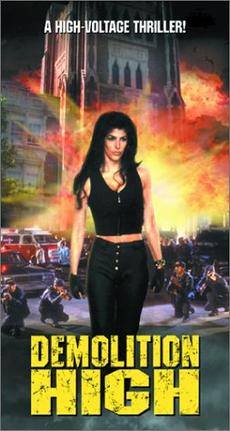
Demolition High is pretty dumb but it was directed by Jim Wynorski so at least there’s some inside jokes.  Gerrit Graham and Dick Van Patten both have small roles and Alan Thicke gets to tell an FBI agent to “Think with your heart, not with your badge.”  Wynorski also cast Melissa Brasselle as Tayna, a sexy terrorist who wears black leather.  He deserves some credit for that.  (When the film was released on video, Brasselle was featured on the cover, not Haim.)  Some of the techniques that Lenny uses to take out the terrorists are creative, if never really plausible.  In this case, Lenny is helped by the stupidity of the terrorists.  It’s not every evil terrorist who is clumsy enough to stumble head first into a table saw.

Demolition High was apparently successful enough to be followed by a sequel, Demolition U.  I’ll look at the movie tomorrow.

Disaster on the Coastliner (1980, directed by Richard C. Sarafian)


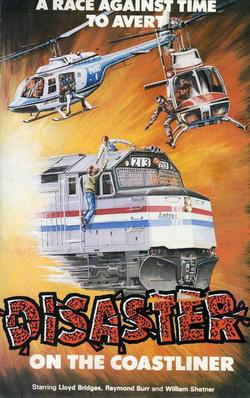
A completely computerized passenger train is traveling across the country, with the Vice President’s wife as one of the passengers.  When Jim Waterman (Paul L. Smith), a man who blames the railroad for the death of his family, manages to hijack the train he plans to ram into a locomotive until his demands a met.  He wants railroad president Estes Hill (Raymond Burr) to take responsibility for the crash that killed his wife and children.  With Waterman determined to crash the two trains, it falls to dispatchers Al Mitchell (Lloyd Bridges) and Roy Snyder (E.G. Marshall) to try to figure out a way to stop the collision.  Helping them out on the train is a con artist named Stuart Peters (William Shatner!) who may be wanted by the police but who is still willing to do whatever it takes to save his fellow passengers.

Disaster on the Coastliner is an above-average made-for-TV disaster movie.  Even though it was obviously made for a low-budget and that the majority of the money was probably spent on securing the B-list cast, there are enough shots of the train careening on the tracks to bring happiness to the hearts of most disaster movie fans.  The cast is full of the type of people who you would typically expect to find in a movie like this, people like Raymond Burr, Lloyd Bridges, and William Shatner.  Bridges, interestingly enough, gives the same performance here that he gave in Airplane! and when he starts ranting about how everything’s computerized, he sounds like he could be reciting dialogue from that film.  The only difference is that Airplane! was a comedy while Disaster On The Coastliner is meant to be a drama.  Raymond Burr also does a good job hamming it up as the president of the railroad.  He spends most of the movie sitting behind his desk and looking annoyed, which was pretty typical of Burr in the years after Perry Mason and Ironside. 

For a lot of people, the main appeal of this film will be seeing what William Shatner was doing in between Star Trek movies.  This is a typical early 80s Shatner performance, when he was still trying too hard to win that first Emmy but also when he had just starting to develop the self-awareness necessary to poke fun at his own image.  Shatner really digs into the role of a conman with a heart of gold.  He delivers his lines in his trademark overdramatic style but, in scenes like the one where he sheepishly discovers that a door that he’s been pounding on was unlocked all the time, Shatner actually seems to be in on the joke.  Shatner also did his own stunts in this film, including one where he had stand on top of a speeding train.  In his autobiography, Shatner wrote that he wasn’t even wearing a safety harness in the scene so give it up for Bill Shatner.  That took guts!

Fast-paced and agreeably unpretentious, Disaster On The Coastliner is an enjoyable runaway train movie.


The Gladiator (1986, directed by Abel Ferrara)


A serial killer known as The Skull is prowling the dark streets of Los Angeles.  Driving a customized death car, he chases down other motorists and forces them into fatal accidents.  Though the police aren’t convinced that the Skull’s real, Rick Benton (Ken Wahl) knows that he’s out there.  Rick was teaching his younger brother (Brian Robbins) how to drive when the Skull chased them down and ran them off the road.  His brother was killed.  Rick spent several days in a coma.  Even after the police try to convince him that he was the victim of a drunk driver, Rick suspects that he and his brother were deliberately targeted.

Rick is a car guy, himself.  After attending a support group for people who have lost loved ones to drunk drivers, Rick decides to take the law into his own hands.  He modifies his pickup truck and then takes to the streets, tracking down drunk drivers and ramming them off of the road.  He then calls the police, letting them know where they can pick up the drunks.  Rick is careful to never actually hurt anyone but Lt. Frank Mason (Robert Culp) still isn’t happy that there’s a vigilante out there, taking the law into his own hands.

With all of Los Angeles wondering about the identity of the vigilante that the media has dubbed “The Gladaitor,” Rick prepares to track down the Skull.

The Gladiator was directed by Abel Ferrara, who brings his trademark style to the film.  Rick is not just a vigilante with a super truck.  He’s also a man who is clearly still in mourning and who deals with his own feelings of guilt by tracking down unsafe drivers.  When he realizes that someone is deliberately killing other drivers, he becomes grimly obsessed with tracking down the Skull and, in typical Ferrara fashion, it often seems as if his quest for vengeance might leave him as unhinged as the man he’s trying to stop.  Though Rick is clearly the fim’s hero and all of the drunks that he stops are obnoxious and deserving of what they get, Ferrara doesn’t blindly celebrate Rick’s actions.  Some of the people who treat the Gladiator as a folk hero are just as dangerous as the ones that Rick is taking off the streets.

It helps the film that both the Skull’s death car and Rick’s vigilante pickup are pretty cool.  Who wouldn’t want to own a truck that can fire projectiles at bad drivers?  In typical Ferrara fashion, almost all of the action takes place at night and the chase scenes are excitingly filmed.  Though the cars and the stunts may be the main reason to watch the film, Ken Wahl still does a good job with the title role and fans of Brian DePalma and RoboCop will enjoy the presence of Nancy Allen, cast here as a radio talk show host who is also Rick’s girlfriend.

The Gladiator is an effective car chase thriller.  Watch it and drive safely.

Film Review: Becky (dir by Jonathan Milott and Cary Murnion)


Becky is a fairly intense thriller, featuring two actors who you normally wouldn’t expect to appear in a film about a 13 year-old girl savagely attacking and killing a group of criminals in the woods.

For example, Kevin James is best-known for starring in The King of Queens and for playing Paul Blart: Mall Cop.  He’s a member of the Adam Sandler stock company and almost his entire career has involved playing goofy but lovable manchildren.  In Becky, he plays Dominick, a member of the Aryan Brotherhood who has escaped from prison and, along with a group of other fugitives, is desperately searching for a key that will apparently unlock something that will lead to a race war.  Over the course of the film, Dominick murders several people.  He orders his associates to kill children.  He tortures a man with a branding iron and he taunts an interracial couple.  He has a big bushy beard and a swastika tattooed on the back of his saved head.  In other words, this isn’t the Kevin James movie to show your grandma.

And then you have Joel McHale.  Joel McHale is best-known for hosting The Soup and playing Jeff Winger on Community.  In Becky, McHale plays another character named Jeff.  This Jeff is the father of an angry 13 year-old girl named Becky (played by Lulu Wilson).  Jeff wants to have a nice weekend up at the lake with Becky and he’s hoping that he can get Becky to accept the fact that Kayla (Amanda Brugel) is going to be her new stepmother.  Needless to say the weekend does not go well.  Not only does Becky resent Kayla but Dominick and his crew show up at Jeff’s cabin, searching that key.

While Dominick is holding her family hostage, Becky is hiding in the woods and picking Dominick’s men off one-by-one.  As Kayla explains it, Becky is unstoppable because she’s “a vindictive 13 year-old girl.”  The majority of the film is taken up with scenes of Becky coming up with creative ways to kill people who are a lot bigger than her.  It turns out that everything from an art pencil to a ruler can be turned into a deadly weapon.  (Of course, sometimes, a lawn mower works just as well.)  Becky is the type who will scream over the corpse of someone who she has just killed.  It’s not because she’s upset over what she’s done.  It’s because she’s so pissed off.  And believe me, I could relate.  I was a pissed off 13 year-old too.  Luckily, I never had to kill anyone with my art supplies so let’s all be happy about that.

Becky is a bit of throwback to the grindhouse films of the past.  There’s even a scene that plays a very obvious homage to the ending of the original I Spit On Your Grave.  There’s a lot of violence.  There’s a huge amount of gore.  If you’ve ever wanted to see what an eye looks like when it’s literally hanging out of its socket, this is the film for you.  There are some moments of very dark humor as well.  Lulu Wilson gives a fierce performance as Becky and, In general, the film’s well-directed.  The first 20 minutes of the movie are actually rather brilliant, with scenes of Becky dealing with school bullies alternating with scenes of Dominick killing people in prison.

That said, the film itself runs out of gas long before the final scene.  A huge part of the problem is that Domenick and his associates are all way too stupid to really be a legitimate threat to Becky and, as a result, there’s not much suspense as to whether or not Becky will be able to kill them.  (It was hard not to unfavorably compare the buffoonish, easily outwitted Neo-Nazis in this film with the legitimately terrifying ones that appeared in Green Room.)  As well, for all the film’s violence and it’s homages to the grindhouse, it oddly allows two characters to survive the film despite the fact that there was no reason for the film’s villains to keep them around.  Their survival reminds you that you’re just watching a movie and it takes you out of the moment.  You realize that if the movie doesn’t have the guts to kill the two of them, then it’s probably not going to have the guts to really surprise us further down the road.

I have to admit, I really wanted to like this film, if just because I was intrigued by the against-type casting of Kevin James and Joel McHale.  I may not care for the majority of Kevin James’s films but I’ve always felt that he was a good actor.  Joel McHale, as well, has always been a personal favorite of mine and, like James, he’s a better actor than he’s often given credit for being.  I was hoping that both of them would get a chance to shock viewers by brilliantly playing against type.  But McHale is stuck playing a character who is just too wimpy to be sympathetic and Kevin James, bless him, often seems to be trying too hard to project menace.  True menace has to feel natural.  Once it becomes obvious that you’re trying to be menacing, then you’re not.  Dominick is a Sid Haig role being played by Kevin James.  Despite (or perhaps because of) the goofy appeal of such an idea, it just doesn’t work.

Despite its flaws, Becky is a well-shot, quickly paced film and it has enough entertaining moments to be watchable if not entirely satisfying.  If you’re looking gore, this film has what you’re looking for and, as any horror fan can tell you, there’s certainly nothing wrong with that.  The film doesn’t quite work but still, directors Jonathan Milott and Cary Murnion do a good enough job that I look forward to seeing where they do next.


Marooned (1969, directed by John Sturges)


Imagine The Martian or Apollo 13 without any humor or narrative momentum and you’ve got an idea what Marooned is like.

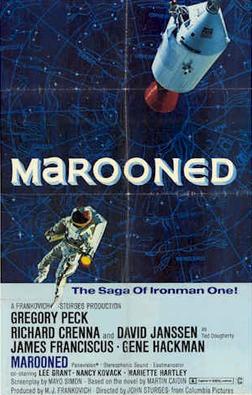
Three American astronauts (played by Richard Crenna, Gene Hackman, and James Franciscus) are returning to Earth after serving on an experimental space station when the engine to their spacecraft fails.  Now stuck in orbit around the Earth, they only have two days before they run out of oxygen.  While flight commander Crenna tries to keep everyone calm and make sure that all the proper procedures are followed, Gene Hackman yells at NASA and demands to be rescued.

Down on Earth, the head of NASA (Gregory Peck) says that there’s nothing that can be done.  There’s no way to get a rescue mission set up quickly enough to save the lives of the astronauts.  Both the President and David Janssen disagree with him.  Janssen demands to be sent into space immediately, regardless of the dangers, so that he can bring America’s astronauts home.

Marooned is a painfully slow movie that went into production at the height of the space race and which was released just a few weeks before the first successful moon mission.  Because it was made at a time when there were still many who claimed that NASA was a waste of money, the movie goes out of its way to explain that, even though the astronauts are probably going to die in space, NASA is in no way to blame.  Richard Crenna absolves NASA of blame after being told that a rescue mission isn’t feasible.  Gregory Peck holds a press conference, where he gives a lengthy speech about why space exploration is still important.  The movie is very detailed in showing that NASA is staffed by personality-free professionals, which might have boosted confidence in NASA but which also leads to a dull story.  You’ll notice that I haven’t referred to anyone in this film by the names of their characters.  That’s because their names don’t matter because, other than Gene Hackman and David Janssen, none of them is really distinguished by any sort of identifiable personality.  Hackman chews the scenery while Janssen plays another surly character who seems like he has a permanent hangover.  I wouldn’t trust Janssen to pilot a spaceship.

Marooned won an Oscar for its Special Effects, which were probably impressive back in 1969 but which are dull by modern standards.  Winning that Oscar meant that Marooned would eventually earn the distinction of being the only Oscar winner to be featured on Mystery Science Theater 3000.  On MST 3K, it aired under the title Space Travelers, which is a perfectly generic name for a perfectly generic film.


Footsteps (1972, directed by Paul Wendkos)


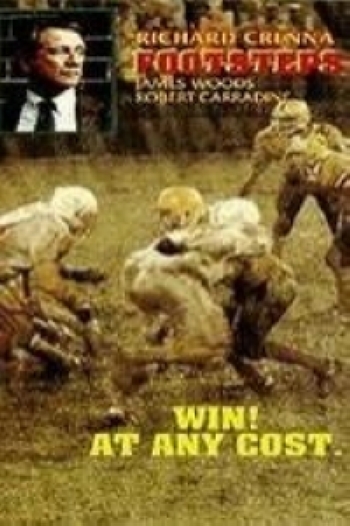
Paddy O’Connor (Richard Crenna) is a former football player-turned-coach whose record of success has been overshadowed by his own arrogance and heavy drinking.  O’Connor has such a bad personal reputation that he’s found himself unemployable.  Only one man is willing to give him a chance.  Jonas Kane (Clu Gulager) played football with Paddy and he’s now coaches for a small college.  Kane may not like O’Connor but he knows that O’Connor might be the key to turning around his team’s fortunes and, at the same time, saving Kane’s job.  Kane hires O’Connor to serve as a his defensive coordinator.

At first, O’Connor’s cockiness rubs people the wrong way.  It’s not until O’Connor moves offensive player J.J. Blake (Bill Overton) to defense that the team starts to win.  And once the team stars to win, everyone’s problems with O’Connor disappear.  Kane can only watch helplessly as O’Connor moves in on his girlfriend (Joanna Pettet), knowing that he owes his job to O’Connor remaining at the school.

However, when Blake gets a concussion, O’Connor is forced to decide whether or not to let him play.  Boosters like Bradford Emmons (Forrest Tucker) want Blake to play, regardless the risk.  The NFL scouts, who are looking for the next number one pick, want to see Blake on the field.  Blake says he wants to play but O’Connor can tell that he’s lying about the extent of his injury.  With everyone breathing down his neck and a syndicate of gamblers pressuring O’Connor to shave points so that the spread pays off, O’Connor has to decide what to do.

Though this made-for-TV movie may not be as well-known as some other films, it’s one of the best movies ever made about college football.  Though it may be short (only 74 minutes), it still examines all of the issues that have always surrounded college football.  Despite not getting paid for their efforts, the players risk serious and permanent injury during every game, just on the slight hope that they might someday make it to the NFL.  The coaches, who are supposed to be looking after the players, are more interested in padding out their win-loss record and hopefully moving onto bigger and better-paying jobs.  Meanwhile, aging alumni and boosters demand that the team win at all costs, regardless of what happens to the men on the field.  Footsteps intelligently explores all of those issues and suggests that the risks are ultimately not worth the rewards.

Along with an intelligent script, Footsteps is helped by a talented cast.  Crenna and especially Gulager both give excellent performance as the two rival coaches.  Al Lettieri (Sollozzo from The Godfather) plays one of the gamblers.  Beah Richards plays Blake’s mother, who makes the mistake of believing O’Connor when he says that he’s going to always have Blake’s best interests at heart.  Ned Beatty has a small role as another assistant coach who is forced to make an important decision of his own.  Keep an eye out for Robert Carradine and James Woods, both of whom have tiny roles.

As far as I know, Footsteps has never officially been released on DVD.  I saw it late one night on the Fox Movie Channel.

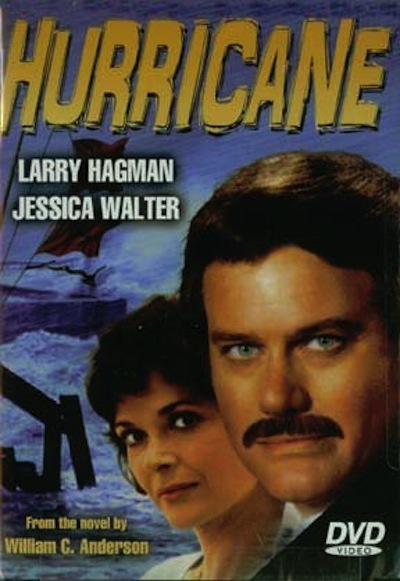
Hurricane (1974, directed by Jerry Jameson)


Hurricane Hilda is crashing down on the Gulf Coast and everyone in its path is about to get all wet.  While Will Geer and Michael Learned try to warn everyone about the approaching hurricane, coast guard pilot Martin Milner observes the storm from the air and tires to rescue everyone in its path.  Some people listen and some people don’t.  Milner’s own father, played by Barry Sullivan, ends up getting stranded in a cabin while Larry Hagman and Jessica Walter play a married couple on a boat who find themselves sailing straight into the storm.  On temporarily dry land, Frank Sutton (a.k.a. Gomer Pyle’s Sgt. Carter) plays a homeowner who refuses to evacuate because he’s convinced that he knows everything there is to know about hurricanes.  He and the neighbors have a drunken party while waiting for the storm.  When Patrick Duffy and his wife announce that they’re heading for safety, Sutton demands that they come in and have a beer with him.  When Hilda finally makes landfall, some survive and some don’t.

Hurricane is a by-the-numbers disaster movie.  It was made after The Poseidon Adventure and during the same year as The Towering Inferno and it hits all the usual disaster movie beats.  Survival is determined by karma, with Hilda going after anyone who was too big of a jerk during the first half of the movie.  It’s predictable stuff but it does feature footage from an actual hurricane so it’s at least not too dragged down by any of the bad special effects that always show up in made-for-TV disaster films.

This is one of those films where the cast was probably described as being all-star, even though most of them were just TV actors who needed a quick paycheck.  Seen today, the film feels like a MeTV reunion special.  Years before they played brothers in Dallas, both Larry Hagman and Patrick Duffy appeared in Hurricane, though neither of them shares any scenes.  Will Geer and Michael Learned were starring on The Waltons when they appeared in this movie and they’re in so few scenes that they probably shot their scenes over a weekend before returning to Walton’s Mountain.  The best performance is from Frank Sutton, who died of a heart attack just a few weeks after this movie aired.  He’s a convincing hothead, even if he doesn’t have Gomer around to yell at.

Hurricane may be bad but it’s still not as terrible as most made-for-TV disaster movies.  People who enjoy watching TV actors pretending to stare at a tidal wave of water about to crash down on them will find this film to be an adequate time waster.

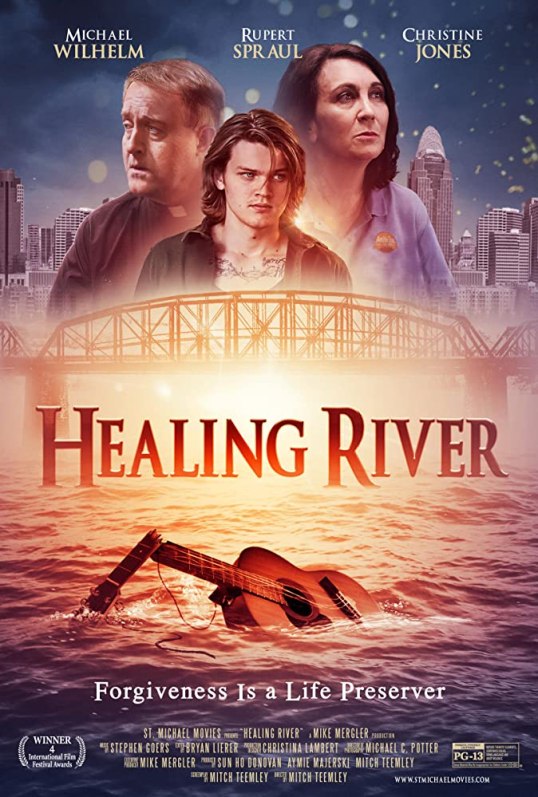
Film Review: Healing River (dir by Mitch Teemley)


Ingrid Ambelin (Christine Jones) owns a coffee shop in Cincinnati.  She has one son, a responsible young man named Michael (Spencer Lackey), and she also tends to think of herself as being a mother figure to everyone who works for her.  She’s the type of boss who keeps an extra set of clothes in the backroom, just in case one of her cashiers makes the mistake of coming to work in something that Ingrid considers to be too revealing.  (Actually, to be honest, that’s the sort of thing that would drive me crazy if I worked for Ingrid.)  Ingrid is old-fashioned but she means well.

Alec McCortland (Rupert Spraul) is a musician and a drug addict, someone who has never had anyone willing to look out for him.  Alec is the type who frequently goes to rehab but always relapses as soon as he gets out.  He’s angry but he’s also young.  In fact, he’s young enough that, when he accidentally drives his car straight into Michael, he’s tried as a juvenile.

At first, Ingrid is outraged that Alec will not be tried as an adult.  She forms a support group that meets in the basement of her church.  At first, Father Peter (Michael Wilhlem), who also happens to be Ingrid’s brother and Michael’s uncle, feels that the group will help her overcome her anger but instead, he watches as Ingrid and the group become obsessed with getting revenge.  In fact, when Ingrid catches Alec again breaking the law, she reports him and gets him thrown in jail.

And then, something unexpected happens.  At the urging of her brother, Ingrid finally visits Alec in prison and, as the two of them talk, Ingrid comes to realize that Alec is not the demon that she assumed he is and Alec finally starts to come to terms with his guilt over the death of Michael.  To the shock of her family and her employees, Ingrid comes to forgive Alec.  She works to try to reunite Alec with his father.  And when Alec is up for release, she volunteers to serve as his legal guardian….

I’m a big fan of the concept of forgiveness.  At the same time, I also know just how difficult it can be to truly forgive anyone, much less someone who has committed a heinous an act as Alec does in this film.  Therefore, I was curious to see how Healing River would handle the topic and I have to say that I was pleasantly surprised.  Healing River is a film that celebrates forgiveness and shows why forgiveness is necessary but, at the same time, it also doesn’t pretend as if forgiveness is easy.  For the most part, it takes an honest approach to the concept of forgiveness.  It’s portrayed as being important but it’s also not portrayed as being a magical elixir.  Even after Alec and Ingrid get to know each other and grow close, there’s still a lot of pain to be dealt with.

It helps that, as opposed to a lot of other inspirational films, Healing River has a little bit of an edge.  No one in the film, including Ingrid, is presented as being a saint.  The characters actually curse and I was glad they did because what mother wouldn’t curse while trying to explain how she feels about the death of her son?  Far too often, films like this seem to be set in a fantasy world that’s specifically designed not to challenge the target audience’s beliefs.  Healing River, however, takes place in the real world and, in the real world, people curse when they’re in pain.

There are a few scenes where the film’s low-budget does become a bit of a distraction.  An early scene featured a Hebrews-related pun that made me cringe.  (“Hebrews …. she brews.”)  There’s a narrative development in the third act that feels a bit clumsy.  It’s a flawed film, as most films are.  But it’s a sincere film and it’s a film that honestly explores both why forgiveness is important and why it’s also so difficult.