A Cry For Help (1975, directed by Daryl Duke)


Harry Freeman (Robert Culp) is a radio talk show host in California who specializes in abusing his listeners.  They call in and they tell Harry their problems and their opinions and then Harry tells them that they’re stupid and whiny.  Despite (or maybe because of) his abrasive style, Harry is very popular.  Everyone on the California coast listens to him in the morning.

When a depressed teenage girl named Ingrid (Elayne Heilveil) calls his show and says that she’s going to kill herself, Harry doesn’t taker her seriously and tells her to go ahead and do it.  It’s only after he hangs up on her that he realizes that she might have actually been telling the truth.  When Harry calls the cops to tell them about the call, they treat him in much the same way that he treated Ingrid.  They refuse to take him or Ingrid seriously.

Not getting any help from the police, Harry turns to his listeners.  He asks them to help him track down Ingrid and to keep her from harming herself.  The film alternates between scenes of Ingrid meeting people throughout the day and then Harry in his studio, taking calls from those people.  Since Ingrid is no longer listening to Harry’s show, she has no idea that people are looking for her and it becomes a race against time to find her before she carries out her plans.

A Cry For Help is largely a showcase for Robert Culp, a talented actor whose career was often harmed by his own independence and reputation for being abrasive.  That reputation made him the perfect choice to play Harry and Culp gives a terrific performance as a not particularly nice man trying to do the right thing for once.  Interestingly, the film keeps it ambiguous as to whether Harry has really had an attack of conscience or if he’s just trying to save Ingrid for the publicity and the ratings.  Even at the end of the film, it’s hard to know if Harry was really worried about Ingrid ending her life or if he was just looking to promote himself.

Along with Culp, the film’s cast is a who’s who of 70s television actors.  Among those who Ingrid and Harry deal with during the day: Michael Lerner, Bruce Boxlietner, Ken Swofford, Chuck McCann, Julius Harris, and Gordon Jump.  Seeing Jump in the film was especially interesting since he would later star in another production about the potential power of radio, WKRP In Cincinnati.

A Cry For Help is a suspenseful made-for-TV movie from 1975.  It’s never been released on DVD but it is on YouTube.

Cease Fire (1985, directed by David Nutter)


Tim Murphy (Don Johnson, with a huge mustache) is a Vietnam vet who is still haunted by his actions during the war. As a result, he can’t hold down a job, he’s abusive to his wife, and he’s woken up in the middle of the night by constant nightmares.  One day, at the unemployment office, he meets another vet named Luke (Robert F. Lyons) and the two of them bond over their shared experiences.  While Tim tries to come to terms with what happened during the war, his wife Paula (Lisa Blount) tries to keep the household together.

Barely released in 1985, Cease Fire is a largely but unfairly forgotten Vietnam film.  According the film’s imdb page, Don Johnson once told an interviewer that he couldn’t even remember starring in a film called Cease Fire.  That piece of trivia sounded too good to be true and, after doing a google search, I have not been able to come across any interviews where Johnson says that.  In fact, in an interview with the AV Club, Johnson says that he filmed Cease Fire in Miami shortly after doing his first audition for Miami Vice.  According to Johnson this was in the early stages of Miami Vice‘s development, before Michael Mann was even attached to the project.  Since Miami Vice premiered (with Mann producing and Johnson starring) in 1984, that probably means that Cease Fire was filmed in either 1982 or 1983.  Considering that it was a low-budget and talky film about a very unpopular war, it is not surprising to discover that it sat on the shelf for a few years before finally being released in order to capitalize on the sudden stardom of its main actor.

Even though both take place in Miami and feature Don Johnson as a Vietnam vet, Miami Vice and Cease Fire are as different as night and day.  Cease Fire is a low-key and muted character study of a traumatized man who is struggling to face what happened in the past.  There’s not much action but there is a lot of talking.  Some of the dialogue is clumsy and obvious but both Don Johnson and Robert F. Lyons give good performance as the traumatized vets and Cease Fire is honest enough to admit that, even if he does take a few steps in the right direction, Tim still has a long road ahead of him.  Cease Fire, which never got a DVD release but which is available on Amazon Prime, is a sincere look at the reality of PTSD and the struggle that many vets face when they first return home.  It’s not a perfect movie but it’s saved by its own good intentions and Johnson’s sincere performance in the main role.

Cease Fire was also the first film to be directed by David Nutter.  Nutter is today probably best known for directing several episodes of Games of Thrones, a show that has even less in common with Cease Fire than Miami Vice.

Repo Jake (1990, directed by Joseph Merhi)


Jake (Dan Haggerty) is a former Marine and sock car racer from Minnesota who comes out to Los Angeles in search of a new beginning.  A fan of John Wayne, the laid back Jake always tries to do the right thing.  His first day in L.A., he thwarts a purse snatching and gets a girlfriend named Jenny (Dana Bentley).  He also gets a job as a repo man.  He repossesses cars from people who aren’t paying their bills and he always does it with a polite smile on his face.  He’s the nicest repo man around but that doesn’t keep him from getting on the wrong side of some of the people he meets.  When he repossesses the car of a local pornographer, the mob demands that Jake take part in an illegal demolition derby.  If he wins, he’ll live.  If he loses, both he and everyone who matters to him will die.

Haggerty’s genial presence is the best thing about Repo Jake, a low-budget movie that would probably be unwatchable without him.  Haggerty’s so likable that he makes scenes work even when they shouldn’t.  My favorite moment was when he walked in on a sleazy photographer trying to manipulate a model into posing topless. “I’m here to repossess your car and I’m pissed off,” Jake politely says before knocking the photographer across the room.  If you didn’t know who Dan Haggerty was, you might think that the producers just grabbed a real repo man off the streets and made him the star of their movie.  With his big beard and his mellow vibes, Haggerty was a legitimate Hollywood character.  Though he found fame playing Grizzly Adams on television, he was arrested in 1984 for selling cocaine to an undercover police officer and his career never really recovered.  Haggerty went from being a TV star to appearing in movies like Repo Jake.

The plot of Repo Jake is pretty dumb and nearly impossible to follow.  It never makes sense that Jake would be forced to take part in the demolition derby.  Actually, nothing about the movie makes sense but a lot of cars get wrecked, a helicopter gets repossessed, and Dan Haggerty knocks a purse snatcher through a store window and it’s all so stupid and Jake’s so friendly that the end result is actually pretty cool.  Repo Jake is saved by the sheer likability of Dan Haggerty.  It’s hardly a good movie but, at the same time, it’s not a terrible way to spend 90 minutes of your life.

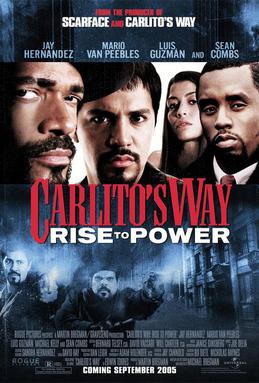
An Offer You Can Refuse #22: Carlito’s Way: Rise To Power (dir by Michael Bregman)


After you watched Carlito’s Way, you may have asked yourself, “Gee, I wonder how Carlito came to power in the first place?  I wonder what he was like when he was young….”

Now, keep in mind, you may have asked yourself that.  I did not ask myself that.  To be honest, I didn’t really care.  Carlito’s Way pretty much told me everything that I needed to know about Carlito’s past.  Just the fact that people on the street respected him as soon as he got out of prison and that everyone was trying to get him to restart his life of crime told me that Carlito was obviously a big deal in the past.  So, I didn’t really need a prequel.

But, obviously, the people behind the 2005 film, Carlito’s Way: Rise to Power, disagreed.  I guess I can understand their logic.  When you’ve got a hit film, it’s only natural to try to do a follow-up.  And when the first film ends with the main character dying, you really don’t have much choice but to do a prequel.  And let’s give credit where credit is due.  Long before the movies were made, Carlito Brigante was the main character of two novels written by Edwin Torres.  Carlito’s Way: Rise To Power is based on the first of those novels and Torres reportedly said that he appreciated that the prequel stuck close to what he had written.  So, it’s not like they just made up this film’s plot out of thin air.

That said, it’s still not a very good film.  It takes place in the 60s, with young Carlito (Jay Hernandez) working his way up the ladder in New York’s drug chain.  His partners, who he met in jail, are Earl (Mario Van Peebles) and Rocco (Michael Kelly).  When they’re release from jail, they find themselves in the middle of drug war between Hollywood Nicky (Sean Combs) and the Bottolota Family, led by Artie (Burt Young).  The three friends play the two sides against each other while also dealing with all of the usual betrayals and random violence that one normally expects to find in a movie like this.  Luis Guzman shows up, playing a coke-snorting hitman named Nacho.  It’s a bit disconcerting since Guzman played a different character in Carlito’s Way but it’s still always good to see Luis Guzman.

Anyway, the main problem with Carlito’s Way: Rise to Power can be seen in the casting of the main characters.  Carlito’s Way had Al Pacino, Sean Penn, and John Leguizamo.  Rise To Power has Jay Hernandez and Mario Van Peebles.  Whatever gritty authenticity the film may be aiming for vanishes as soon as Mario Van Peebles looks straight at camera and smiles at his reflection.  As for Jay Hernandez, he’s a likable actor but he’s the exact opposite of intimidating.  You’d probably say yes if he asked you to prom but he does’t exactly come across like someone who could take over the New York drug racket.  When Sean Combs is the most dangerous person in your movie, you’re looking at trouble.

Director Michael Bregman attempts to imitate a bit of Brian De Palma’s style from the first film and Jay Hernandez does his best to sound Pacino-like in his voice-over narration but the end result is flat and predictable.  This is an offer that you can refuse.

Previous Offers You Can’t (or Can) Refuse:

  1. The Public Enemy
  2. Scarface (1932)
  3. The Purple Gang
  4. The Gang That Could’t Shoot Straight
  5. The Happening
  6. King of the Roaring Twenties: The Story of Arnold Rothstein 
  7. The Roaring Twenties
  8. Force of Evil
  9. Rob the Mob
  10. Gambling House
  11. Race Street
  12. Racket Girls
  13. Hoffa
  14. Contraband
  15. Bugsy Malone
  16. Love Me or Leave Me
  17. Murder, Inc.
  18. The St. Valentine’s Day Massacre
  19. Scarface (1983)
  20. The Untouchables
  21. Carlito’s Way

Demolition University (1997, directed by Kevin Tenney)


Terrorists have taken over the local power and water plant and are threatening to poison the water supply if their demands are not meant.  Among those that they are holding hostage is a group of college students who were on what would have otherwise been the most boring field trip of their lives.  While Colonel Gentry (Robert Forster) tries to negotiate with the terrorists, one college student, Lenny Slater (Corey Haim), takes matters into his own deadly hands.  Lenny also finds time to ask track star Jenny (Ami Dolenz) to go to the homecoming dance with him.

How many times can the exact same thing happen to the same person?  That’s what you might expect Lenny Slater to ask as he finds himself sneaking around and taking out terrorists one-by-one.  Demolition University is a sequel to Demolition High, with Lenny Slater now in college and a member of the school’s football team.  What’s strange is that, even though Haim is playing the same character from the first film, no one mentions the events of Demolition High.  No one mentions that Lenny not only blew up his old school but he saved the entire midwest from being bombed into a nuclear ash heap.  When Lenny tries to tell Prof. Harris (Laraine Newman!) that it’s obvious that terrorists have taken over the power plant, she ignores him because he has a history of playing pranks.  But he also has a history of tracking down and killing terrorists!  I would listen to him.

Demolition High wasn’t good but it was watchable.  Demolition University is just dull.  Haim actually gives a better performance here than he did in the first film, if just because it’s easier to buy him as a college student instead of as a high school student.  But he’s actually barely in the film.  Most of the running time is taken up with Robert Forster trying to negotiate with the leader of the terrorists.  That’s kind of cool because Robert Forster was the man but the movie still seems like what Die Hard would have been if it had just been two hours of Paul Gleason standing outside the tower while Bruce Willis killed people offscreen.  Even when we do get Lenny fighting the the terrorists, the action scenes feel flat and interchangeable.  There’s nothing to really distinguish them from every other 90s action film that you’ve ever seen.

Demolition University has higher production values than Demolition High and it actually looks like a real movie but it’s just not much fun.  I’m not surprised that there was never a Demolition Grad School.

An Offer You Can Do Whatever You Want With #21: Carlito’s Way (dir by Brian De Palma)


It’s been a week so I guess it’s time for me to get back to reviewing mob movies, right?  Usually, I do my best not to take such a long break in-between reviewing films — especially when it’s a themed-series of reviews — but I just got busy this week.  It happens.  Luckily, even when we get busy, the movie’s remain ready to be watched and reviewed.

Last week, I reviewed Scarface and The Untouchables, two gangster films from Brian De Palma.  It only seems right to return to my look at the gangster genre by considering another Brian De Palma film.  Released in 1993, Carlito’s Way reunites De Palma with Scarface’s Al Pacino.  In Scarface, Pacino played a Cuban named Tony who was determined to get into the drug trade.  In Carlito’s Way, Pacino plays a Puerto Rican named Carlito who is desperate to escape the drug trade.

Carlito’s Way opens with Carlito getting released from prison in 1975.  He’s spent the past five years serving time on a drug conviction.  Originally, Carlito was sentenced to 30 years but his friend and attorney, David Kleinfeld (Sean Penn), managed to get the conviction thrown out on a technicality.  Now a free man, Carlito finds himself torn between two options.  He can either get involved, once again, in the drug trade or he can go straight.  Returning to his life of crime will mean once again doing something that he’s good at but it will also require him to deal with people who he can’t stand, like the sleazy Benny Blanco (John Leguizamo).  Going straight will mean escaping from New York with his girlfriend, a dancer named Gail (Penelope Ann Miller).  The problem is that it takes money to start a new life and there are people in New York who have no intention of allowing Carlito to leave.

Of the three De Palma-directed gangster films that I’ve recently watched, Carlito’s Way is probably the weakest.  De Palma has always been a frustratingly uneven director and Carlito’s Way contains some of his worst work and some of his best.  For instance, there’s a brilliant sequence where Carlito goes to a hospital to get revenge on someone who betrayed him and it is perhaps one of DePalma’s best set pieces.  But then there’s other scenes where DePalma’s trademark style feels rather empty and counterproductive.  Just when you’re starting to sympathize with Carlito’s predicament, DePalma will suddenly toss in a fancy camera trick and remind you that you’re just watching a film and that Carlito Brigante is just a character in that film.  That technique worked well in the satiric Scarface and the mythological Untouchables but it often feels unnecessary in Carlito’s Way.  

Al Pacino plays Carlito and, like DePalma’s direction, the end result is a bit uneven.  On the one hand, Pacino and Penelope Ann Miller have a likable chemistry, even if Carlito and Gail don’t really make sense as a couple.  On the other hand, this is one of those films where Pacino does a lot of yelling.  Sometimes it works and sometimes, it’s just too theatrical to be effective.  It’s hard not to compare Pacino’s performance here with his slyly humorous work in Scarface.  Tony Montana yelled because he genuinely enjoyed getting on people’s nerves.  The way that Tony expressed himself told us everything that we needed to know about the character.  Carlito yells because that was Al Pacino’s trademark at the time the film was made.

The best thing about the film is Sean Penn’s performance as David Kleinfeld.  Kleinfeld is one of the sleaziest character to ever appear in a movie and Penn seems to be having a good time playing him.  (Watching the film, I found myself wishing that Penn was willing to have that much fun with all of his roles.)  Penn doesn’t make Kleinfeld into a straight-out villain.  Instead, he portrays Kleinfeld as being a somewhat nerdy guy who thought it would be fun to pretend to be a gangster and who has snorted too much cocaine to understand the amount of trouble that he’s brought upon himself.  Just check out Penn in the scene where he’s dancing at a disco.  There’s a joy to Penn’s performance in Carlito’s Way that you typically don’t see from him as an actor.  He’s actually fun to watch in Carlito’s Way.

It’s a flawed film but fortunately, the movie’s good moments are strong enough to help carry the audience over the weaker moments.  The movie often threatens to collapse under the weight of its own style but it seems like whenever you’re on the verge of giving up on the film, De Palma’s kinetic camerawork will calm down enough to allow you to get at least mildly invested in Carlito’s predicament or Sean Penn’s amoral dorkiness will create an amusing moment and you’ll think to yourself, “Okay, let’s keep giving this a chance.”  Carlito’s Way may not be an offer that you can’t refuse but it’s still fairly diverting.

Previous Offers You Can’t (or Can) Refuse:

  1. The Public Enemy
  2. Scarface (1932)
  3. The Purple Gang
  4. The Gang That Could’t Shoot Straight
  5. The Happening
  6. King of the Roaring Twenties: The Story of Arnold Rothstein 
  7. The Roaring Twenties
  8. Force of Evil
  9. Rob the Mob
  10. Gambling House
  11. Race Street
  12. Racket Girls
  13. Hoffa
  14. Contraband
  15. Bugsy Malone
  16. Love Me or Leave Me
  17. Murder, Inc.
  18. The St. Valentine’s Day Massacre
  19. Scarface (1983)
  20. The Untouchables

Film Review: M.O.M. Mothers of Monsters (dir by Tucia Lyman)


“Where were the parents?”

That’s what we ask ourselves after every school shooting, isn’t it?  Because the perpetrators are usually not around to explain themselves, there’s a tendency to look to the shooter’s parents and to demand to know how they could have allowed things to get so out of control.  The assumption almost always is that the parents were negligent.  If only the shooter’s mother or father had done a better job, we’re led to believe, the tragedy could have been prevented.  It’s human nature.  When faced with an unspeakable tragedy, people need someone to blame.

Of course, an actual examination of the history of most school shooting does reveal some bad parents but it also reveals parents who did their best under difficult circumstances or who were as fooled by their children as everyone else in the world.  Yes, there are the parents who gave their obviously unstable children guns.  But there are other parents who tried to get their children help and who tried to be tough disciplinarians and who sincerely believed that that their children were doing better in school or life or whatever.  And if a parent does suspect that their child is a sociopath, what are they to do?  Are they supposed to stop loving that child and cast them away?  Too often, the trauma of violence leads people to seek out easy answers but often times, those easy answers are not there.  We forget that no one sets out to raise a monster.

M.O.M. Mother of Monsters is a found footage film that attempts to explore some of these issues.  Abbey Bell (Melinda Page Hamilton) is a single mom who suspects that her 16 year-old son, Jacob (Bailey Edwards), might be a psychopath.  So, she plants hidden cameras around her house and she obsessively films their every interaction.  She says that she’s doing it so that she can prove that her son is dangerous and also so she can help all of the other mothers out there who are struggling to raise psychotic children.

And yes, Jacob is certainly obnoxious.  He’s frequently angry and he makes inappropriate jokes about killing people.  He spends a lot of his time locked away in his room and he throws a fit when Abbey tries to take away his Playstation.  He’s casually racist and he listens to loud and angry music and he’s a habitual liar.  From the time he was 6 years-old, he’s been drawing disturbing pictures.  The question, though, is whether he’s the next school shooter or if he’s just a 16 year-old boy.

Not helping matter is that Abbey herself seems to be even more unstable than her son.  Abbey gets as mad at her own mother as Jacob does at her and she continually talks about whether or not evil is hereditary.  Throughout the film, there are dark hints about an incident that occurred before Jacob was born.  When we’re told that Abbey majored in psychology, we find ourselves wondering if she’s trying to use Jacob an his bed behavior to justify her own fears and obsessions.  Who is the bigger threat, Jacob or Abbey?  The film keeps you guessing all the way up to its violent conclusion.

The first two thirds of M.O.M. works pretty well.  Though I’m usually not a fan of the found footage genre, M.O.M. actually comes up with a believable justification for the constant filming.  It also makes good use of its low budget, setting almost all of the action in one claustrophobic house.  Bailey Edwards and especially Melinda Page Hamilton do a great job playing the two main characters and the film keeps you guessing as to whether Abbey is right to be concerned or if she’s projecting her own instability onto her son.

Unfortunately, the final third of the film features a plot twist that just didn’t work for me.  While I imagine that it will work for some people, it was just a bit too implausible for me to accept and the twist’s clumsy execution took me out of the film’s carefully constructed reality.  The film went from being an intriguing character study of two damaged people to just being another found footage thriller.  As such, the film’s final disturbing image didn’t quite have the power that it perhaps would have if not for that final twist.

That said, the first part of the film was undeniably effective and that’s enough for me to recommend it.  If nothing else, this film identities Tucia Lyman as a director to watch out for.  According to the imdb, this was first narrative feature film and she did a good job using the familiar rules of the found footage genre to tell an intriguing story.  I look forward to her second film.

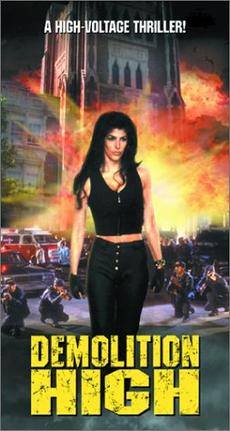
Cinemax Friday: Demolition High (1996, directed by Jim Wynorski)


A group of terrorists take over a high school and announce that, unless their demands are met, they will launch a nuclear missile at a nuclear power plant which I guess will cause double the nuclear destruction.  Since they already have a nuclear missile, it feels like also threatening to blow up the power plant is definite overkill.  With the school now full of terrorists and explosives, it’s up to one student to kill the terrorists one-by-one and save his classmates.  It’s Die Hard in a High School (cool!), with the Bruce Willis role being taken on by … COREY HAIM!

That bit of casting tells you both why Demolition High doesn’t work and also why anyone would be watching this direct-to-video “action” film in the first place.  The 25 year-old Haim plays Lenny Slater, a high school student who knows Kung Fu because he grew up in the Bronx.  His father (played by Alan Thicke!) moves to a small town, both to become a police chief and to hopefully keep Lenny from getting into any more trouble.  Lenny’s all trouble, though, and terrorist leader Luther (the great Jef Kober) is about to discover that he’s invaded the wrong high school.

If I had watched this film in the 90s or even the early aughts, I would have laughed at how bad Corey Haim is as an action hero but today, knowing all we know about his life and how Hollywood essentially enabled his worst tendencies and then abandoned him when he become too self-destructive to work, it’s not as easy to watch an obviously troubled actor who has gone from being a big star to appearing in a direct-to-video Die Hard rip-off.  Trying to disguise the fact that he’s too old to be playing a high school student, Haim wears a flannel shirt and an earring and has a bowl cut.  Whenever he talks to his classmates, you expect him to say, “How do you do, fellow kids?”  As heavily edited as the fight scenes are, it’s still obvious that Haim had no idea how to throw a punch.  On the plus side, even while obviously addled by drug abuse, Corey Haim was still a better actor than Stephen Seagal.

Demolition High is pretty dumb but it was directed by Jim Wynorski so at least there’s some inside jokes.  Gerrit Graham and Dick Van Patten both have small roles and Alan Thicke gets to tell an FBI agent to “Think with your heart, not with your badge.”  Wynorski also cast Melissa Brasselle as Tayna, a sexy terrorist who wears black leather.  He deserves some credit for that.  (When the film was released on video, Brasselle was featured on the cover, not Haim.)  Some of the techniques that Lenny uses to take out the terrorists are creative, if never really plausible.  In this case, Lenny is helped by the stupidity of the terrorists.  It’s not every evil terrorist who is clumsy enough to stumble head first into a table saw.

Demolition High was apparently successful enough to be followed by a sequel, Demolition U.  I’ll look at the movie tomorrow.

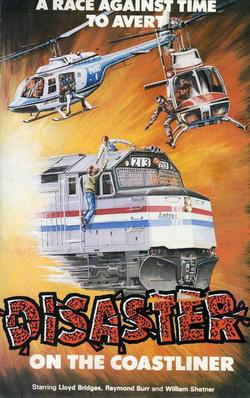
Disaster on the Coastliner (1980, directed by Richard C. Sarafian)


A completely computerized passenger train is traveling across the country, with the Vice President’s wife as one of the passengers.  When Jim Waterman (Paul L. Smith), a man who blames the railroad for the death of his family, manages to hijack the train he plans to ram into a locomotive until his demands a met.  He wants railroad president Estes Hill (Raymond Burr) to take responsibility for the crash that killed his wife and children.  With Waterman determined to crash the two trains, it falls to dispatchers Al Mitchell (Lloyd Bridges) and Roy Snyder (E.G. Marshall) to try to figure out a way to stop the collision.  Helping them out on the train is a con artist named Stuart Peters (William Shatner!) who may be wanted by the police but who is still willing to do whatever it takes to save his fellow passengers.

Disaster on the Coastliner is an above-average made-for-TV disaster movie.  Even though it was obviously made for a low-budget and that the majority of the money was probably spent on securing the B-list cast, there are enough shots of the train careening on the tracks to bring happiness to the hearts of most disaster movie fans.  The cast is full of the type of people who you would typically expect to find in a movie like this, people like Raymond Burr, Lloyd Bridges, and William Shatner.  Bridges, interestingly enough, gives the same performance here that he gave in Airplane! and when he starts ranting about how everything’s computerized, he sounds like he could be reciting dialogue from that film.  The only difference is that Airplane! was a comedy while Disaster On The Coastliner is meant to be a drama.  Raymond Burr also does a good job hamming it up as the president of the railroad.  He spends most of the movie sitting behind his desk and looking annoyed, which was pretty typical of Burr in the years after Perry Mason and Ironside. 

For a lot of people, the main appeal of this film will be seeing what William Shatner was doing in between Star Trek movies.  This is a typical early 80s Shatner performance, when he was still trying too hard to win that first Emmy but also when he had just starting to develop the self-awareness necessary to poke fun at his own image.  Shatner really digs into the role of a conman with a heart of gold.  He delivers his lines in his trademark overdramatic style but, in scenes like the one where he sheepishly discovers that a door that he’s been pounding on was unlocked all the time, Shatner actually seems to be in on the joke.  Shatner also did his own stunts in this film, including one where he had stand on top of a speeding train.  In his autobiography, Shatner wrote that he wasn’t even wearing a safety harness in the scene so give it up for Bill Shatner.  That took guts!

Fast-paced and agreeably unpretentious, Disaster On The Coastliner is an enjoyable runaway train movie.


The Gladiator (1986, directed by Abel Ferrara)


A serial killer known as The Skull is prowling the dark streets of Los Angeles.  Driving a customized death car, he chases down other motorists and forces them into fatal accidents.  Though the police aren’t convinced that the Skull’s real, Rick Benton (Ken Wahl) knows that he’s out there.  Rick was teaching his younger brother (Brian Robbins) how to drive when the Skull chased them down and ran them off the road.  His brother was killed.  Rick spent several days in a coma.  Even after the police try to convince him that he was the victim of a drunk driver, Rick suspects that he and his brother were deliberately targeted.

Rick is a car guy, himself.  After attending a support group for people who have lost loved ones to drunk drivers, Rick decides to take the law into his own hands.  He modifies his pickup truck and then takes to the streets, tracking down drunk drivers and ramming them off of the road.  He then calls the police, letting them know where they can pick up the drunks.  Rick is careful to never actually hurt anyone but Lt. Frank Mason (Robert Culp) still isn’t happy that there’s a vigilante out there, taking the law into his own hands.

With all of Los Angeles wondering about the identity of the vigilante that the media has dubbed “The Gladaitor,” Rick prepares to track down the Skull.

The Gladiator was directed by Abel Ferrara, who brings his trademark style to the film.  Rick is not just a vigilante with a super truck.  He’s also a man who is clearly still in mourning and who deals with his own feelings of guilt by tracking down unsafe drivers.  When he realizes that someone is deliberately killing other drivers, he becomes grimly obsessed with tracking down the Skull and, in typical Ferrara fashion, it often seems as if his quest for vengeance might leave him as unhinged as the man he’s trying to stop.  Though Rick is clearly the fim’s hero and all of the drunks that he stops are obnoxious and deserving of what they get, Ferrara doesn’t blindly celebrate Rick’s actions.  Some of the people who treat the Gladiator as a folk hero are just as dangerous as the ones that Rick is taking off the streets.

It helps the film that both the Skull’s death car and Rick’s vigilante pickup are pretty cool.  Who wouldn’t want to own a truck that can fire projectiles at bad drivers?  In typical Ferrara fashion, almost all of the action takes place at night and the chase scenes are excitingly filmed.  Though the cars and the stunts may be the main reason to watch the film, Ken Wahl still does a good job with the title role and fans of Brian DePalma and RoboCop will enjoy the presence of Nancy Allen, cast here as a radio talk show host who is also Rick’s girlfriend.

The Gladiator is an effective car chase thriller.  Watch it and drive safely.