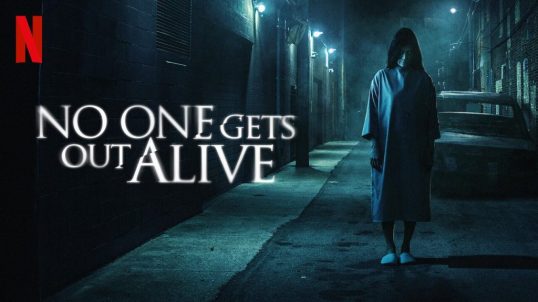
No One Gets Out Alive is a film set in the worst place on Earth. I’m talking, of course, about Cleveland, Ohio.
Still haunted by the death of her mother, Ambar (Cristina Rodlo) has arrived in Cleveland and is looking for a fresh beginning. She hasn’t gotten off to a great start as she’s stuck in a go-nowhere job at a sweatshop. Fortunately, her cousin, Beto (David Barrera), is willing to help Ambar get a better paying job, even though he barely knows her. Unfortunately, Ambar needs a legal ID to get that new job and, as an undocumented immigrant, she doesn’t have one. A co-worker offers to hook her up with a fake ID but it’s going to cost far more money than Ambar has.
As serious as that is, Ambar has an even bigger problem to deal with. She’s recently moved into an apartment. It’s a big apartment in an old building and the only other tenants are two mysterious women from Romania. However, her landlords — Red (Marc Menchaca) and his brother, Becker (David Figiloil) — both seem kind of weird. As Red explains it, Becker is a “little off” but Becker has apparently taken care of Red for his entire life. Personally, I wouldn’t ever rent an apartment from either Red or Becker as they both give off that “sneaking into your apartment and stealing your underwear” vibe but desperate times, I guess.
Even if one could overlook the creepiness of Red and Becker, there’s also the fact that the apartment itself is obviously haunted. Ambar is constantly hearing strange noises and seemingly disembodied conversations. She occasionally sees figures in the shadows. When she takes a shower, a mysterious woman appears on the other side of the shower curtain but promptly vanishes as soon as the curtain is opened. That’s pretty messed up.
But what can Ambar do? She’s in the country illegally so she’s not going to risk calling the police. Beto turns out to be pretty ineffectual. (As a Texan, I appreciated the fact that the movie featured a well-intentioned but thoroughly useless character named Beto.) Maybe in another city, she could find some place better to live but Ambar’s in Cleveland. Haunted pervy death house is as good as anyone can hope for in Cleveland! Ambar is trapped in a place where no one gets out alive.
No One Gets Out Alive is one of those horror films where no one ever seems to turn on the lights. Every single scene in the film is dark and overcast. When Ambar goes outside, the sky is always cloudy. When Ambar returns to her apartment, the lighting is always dim. It creates a properly ominous atmosphere but, at the same time, it also makes it difficult to actually see what’s happening in a few scenes. After a while, the film’s washed-out color scheme and shadowy cinematography goes from being ominous to actually being kind of annoying.
But, if you can overlook or, at least, tolerate the film’s overly drab visual style, No One Gets Out Alive has its effective moments. The apartment building is a nicely creepy location and, even if some of the scares are a bit generic, they still often work. Cristina Rodlo is sympathetic in the role of Ambar and the character’s status as an undocumented immigrant adds an interesting subtext to her being at the mercy of the building’s inhabitants. Without any legal status, there’s nothing she can do once it becomes apparent that Red and Becker have an agenda of their own. Her pursuit of the American dream becomes a nightmare once she realizes that, living in Cleveland without any legal ID, she might as well not exist.
No One Gets Out Alive is one of those films that starts out a bit slow but it improves as it goes. Though I wish someone had turned on the lights, it’s an effective horror film that you can find on Netflix.
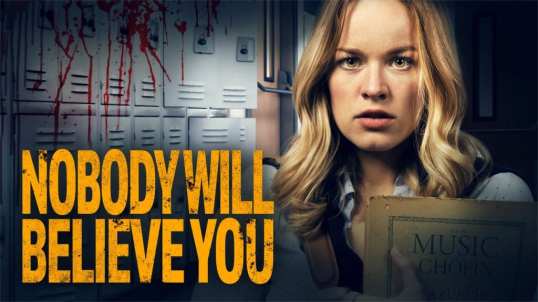
Last night, I turned over to the Lifetime Movie Network and I watched Nobody Will Believe You (a.k.a. Pretty Little Victim).
Why Was I Watching It?
This was actually my second time to watch Nobody Will Believe You. I also watched it back in July but, for whatever reason, I didn’t review it despite the fact that I enjoyed the film. I guess I must have been busy or sick in July, who knows? Anyway, when I saw that it was going to be airing on the Lifetime Movie Network on Thursday night, I decided to rewatch it so that I could finally get around to writing this review!
What Was It About?
Melanie (Jenna Rosenow) and her daughter, Hannah (Emily Topper), have moved to a new town and, for Hannah, that means starting at a new school! From the very first day, it’s obvious that Hannah is going to struggle to fit in. Hannah may be nice but her classmates definitely are not. The cheerleaders are bitchy. The jocks are toxic. Her best friend is alienated. There’s a mysterious man who occasionally shows up and menacingly waves around a taser. The only good news is that the friendly guidance counselor (John William Wright) wants to hire her to teach his daughter how to play the piano! What could possibly go wrong?
What Worked?
I enjoyed Nobody Will Believe You because it did what every good Lifetime film does. It shamelessly and openly embraced the melodrama. Seriously, every possible thing that could happen to Hannah did happen to Hannah. No sooner was Hannah getting rejected by the cheerleaders then she was saving the most popular girl in school from a falling printer. No sooner had Hannah’s phone been hacked than someone was trying to frame her for murder. It was such a nonstop collection of incidents that it quickly became clear to me that the film was self-aware when it came to its status as a Lifetime film. It understood why the audience was watching and it was determined to give us exactly what we wanted. At its best, the film worked as both a tribute to and a parody of the typical Lifetime movie.
What Did Not Work?
Obviously, for the film’s plot to work, Hannah had to be extremely naïve and trusting. And, let’s be honest, it is true that some people are easily tricked. Not everyone has the streetwise instincts of a suburbanite who has watched several hundred Lifetime films. However, even with that in mind, it was sometimes hard to accept that Hannah could be as totally naïve as she often was. Watching the movie, you sometimes got the feeling that, even if Hannah survived, she was destined to grow up to be one of those people who ends up sending their life savings to Aruba because someone contacted them on Facebook, claiming to be Garrett Hedlund.
“Oh my God!” Just Like Me Moments
When I was growing up, my family used to move a lot so I definitely could relate to Hannah’s nervousness about having to start all over again at an entirely new school. And, when I was in high school, I got along famously with our guidance counselor. If I hadn’t broken my ankle, maybe he would have asked me to teach his daughter to dance. Of course, if Lifetime films have taught me anything, it’s that being hired to teach anyone anything is automatically going to lead to tragedy.
And of course, that brings us to….
Lessons Learned
Don’t teach. Don’t offer to help anyone. Reject any and all offers of mentorship. It’s just going to lead to trouble.
No, wait a minute. That’s not right. Let’s try that again.
Half Shark….
Half Octopus….
All Killer!
There, that’s it! That’s our Sharktopus!
Produced by the legendary Roger Corman, Sharktopus originally aired on the SyFy channel in 2010. It tells the story of S-11, a creature that is half-shark and half-octopus. How exactly did S-11 come to exist? Well, blame the government! The government wanted a new weapon and apparently, it didn’t bother them that the weapon would have no practical use beyond going rogue and killing civilians. Dr. Nathan Sands (Eric Roberts, the one and only) created the sharktopus with the help of his daughter, Nicole (Sara Malakul Lane). When S-11 swims off on its own and starts eating human beachgoers, Nicole teams up with mercenary Andy Flynn (Kerem Bursin). Nicole and Andy think that they’ve been sent to destroy S-11 but it turns out that Nathan has other plans.
Let’s just state the obvious. This is the greatest film ever made. Okay, well …. maybe it’s not the greatest. Some people would probably say that it’s not even that good but I think they’re overthinking things. What it comes down to is that there really aren’t as many films out there about shark/octopus hybrids as you might think. When it comes to this very specific genre of horror films, Sharktopus is the best.
This is a film that understands why the audience is watching. We’re watching because we want to see Sharktopus action! So, while the film does contain its fair share of scenes of Nicole and Andy searching the ocean, the majority of the film is still made up of Sharktopus attacks. You don’t really get to know any of the victims, though I did feel bad for the gentleman who shouted, “Oh no! Not like this!” as he was pulled down to the ocean by S-11’s tentacles, but that’s okay. It’s all about the Sharktopus, a creature that is so ludicrous that it’s impossible not to like it.
Another thing that’s impossible not to like is the fact that Eric Roberts is in this film. The last time I checked, Roberts had a total of 641 acting credits listed on the imdb. He’s appeared in every type of films — from Oscar-nominated prestige films to low-budget faith-based films to Lifetime films to …. well, films like Sharktopus. But regardless of the film, Roberts always seems to be trying his best or, at the very least, he comes across like he’s genuinely amused by the absurdity of it all. Roberts has a lot of fun in Sharktopus, playing his mad scientist character with a twinkle in his eye and a barely suppressed evil smile. Dr. Sands takes genuine pride in his creation and it’s kind of hard not to get caught up in his enthusiasm.
Sharktopus is a fun movie. It’s a low-budget and deeply silly epic and it you can’t enjoy the sight of shark/octopus hybrid creeping across the beach than I don’t know what to tell you. In fact, Sharktopus was popular enough with SyFy audiences that it would return for a whole series of films in which it battled hybrid monsters. Go Sharktopus!
On a final note, keep an eye out for Roger Corman while watching this film. He plays a man on the beach who watches as a treasure seeker is dragged off to the ocean. When he realizes that she dropped a valuable coin while being taken away, Corman walks out on the beach and grabs it for himself. Hopefully, he sold that coin and used the money to go on a nice vacation. If anyone’s earned it, it’s Roger Corman!
When six interchangeable college students spend the weekend at an abandoned mansion, strange things start to happen. First, the caretaker disappears. Then, the students start to disappear, one-by-one. “We should call the police!” Sarah (Linda West) says, once it becomes apparent that more than half of the cast has vanished without a trace.
However, there’s already a cop on the scene.
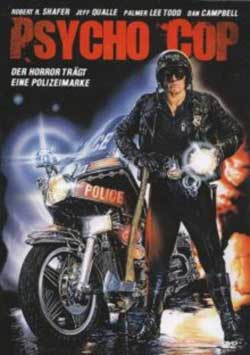
Unfortunately, that cop is Joe Vickers (Robert R. Shafer), an escapee from the local mental institution who subsequently became a member of the California Highway Patrol. He drives a squad car and sometimes a motorcycle. He wears a uniform. He carries handcuffs and he uses cop lingo. He’s a CHiP with an attitude and no one would ever mistake him for Ponch or Jon Baker. He’s also a Satanist, who likes to draw pentagrams in the dirt and kill anyone who comes across his path. We may see six interchangeable college students but Joe Vickers sees six blood sacrifices and, while the students search for each other, Vickers hunts them down.
Psycho Cop was one of the many, low-budget slashers to come out in the 80s. It attempts to mix the wilderness mayhem of Friday the 13th with the quippy villainy of A Nightmare on Elm Street but the movie never comes anywhere close to being as memorable as either one of those films. The main problem is that Joe Vickers is not a very interesting killer. His one-liners are forgettable and, in this film at least, Robert R. Shafer is one of the least intimidating killers in the history of the genre. He has the right build to be menacing but, whenever he speaks, his weak voice ruins whatever element of danger may have been present. Even his attempt at an evil smile comes across as being more goofy than creepy. As opposed to the Maniac Cop films, Psycho Cop also doesn’t do much with the idea of Vickers being a cop. It’s just a uniform that he happens to be wearing, much like the masks worn by Jason Voorhees and Michael Myers. A film like this is only as strong as its villain and Vickers, to put it gently, is not Freddy Krueger.
Psycho Cop was followed by a sequel called Psycho Cop Returns, which not only made Vickers being a cop a key part of the film’s plot but which also featured Shafer returning in the lead role and giving a much stronger performance. (It helps that Vickers doesn’t speak much in Psycho Cop Returns.) Because the sequel had all of the nudity and the blood that was missing from the tame first film, it was frequently aired on Cinemax and Showtime in the 90s, developed a cult following, and was released on DVD and blu-ray by Vinegar Sydrome in 2017. The first film, on the other hand, has never been released on anything other than VHS and it’s so obscure that several reviewers assumed that the title of Psycho Cop Returns was meant as a joke, a play on how every slasher film released in the early 90s was a sequel.
No, it’s no joke. Psycho Cop does exist. It’s just not every good. If you’re dying to see a killer cop film, Maniac Cop is still the one to go with.
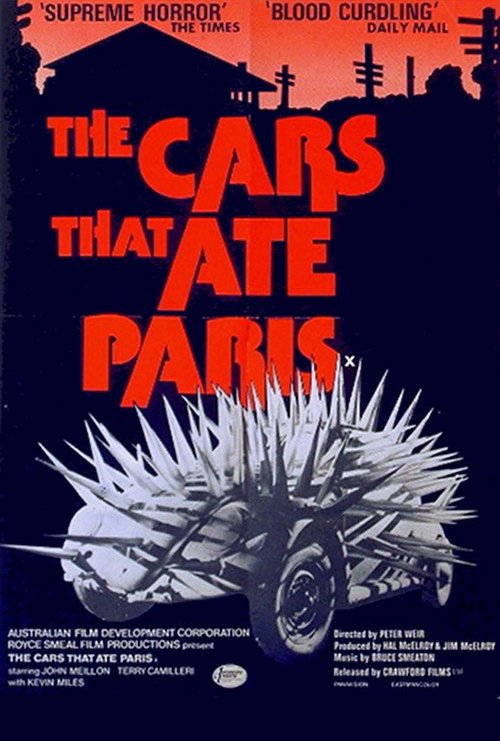
Taking place in a vaguely futuristic world, the 1974 Australian film, The Cars That Ate Paris, opens with an attractive and impossibly happy couple going for a drive in the countryside and getting killed in a truly horrific car accident, one that apparently was deliberately set up.
Meanwhile, two brothers — Arthur (Terry Camilleri) and George (Rick Scully) — are traveling across Australia, in search of work. Everywhere they go, they see long lines of desperate people looking for a way to make money, suggesting that the economy has basically collapsed. George does the driving, largely because Arthur’s license was taken away after he accidentally killed a pedestrian. Arthur is struggling with both the guilt and a phobia of cars in general.
That phobia only gets worse after Arthur and George are involved in a automotive accident of their own. George is killed but Arthur survives. Taken to the small, rural town of Paris, Arthur is adopted as a bit of a mascot by the town’s seemingly friendly mayor, Len Kelly (John Mellion). At first, Arthur is relieved to have survived but he soon comes to realize that the residents of Paris have no intention of ever letting him leave.
Paris, it turns out, is a bit of a strange place. The entire economy is based on collecting scrap metal from the many cars that crash within the city limits. The local hospital is full of car crash victims, the majority of whom end up getting lobotomized and used as test subjects for the local doctor. Indeed, the only thing that kept Arthur from a similar fate was that the mayor assured everyone that Arthur’s phobia of driving has rendered him “harmless.” (And just to make sure that Arthur doesn’t lose that phobia, he’s sent to a psychologist who spends nearly the entire session showing him grotesque pictures of car accident victims.) Though the mayor continually talks about how Paris represents the “pioneer spirit” that made Australia great, the town’s teenagers don’t seem to be too impressed with the place. They spend all of their time driving around in cars that they’ve modified into small tanks. (Their leader drives a compact car that has been covered in metal spikes, transforming it into a motorized porcupine.) Arthur wants to escape the town but can he conquer not only his own fears but also avoid being killed by the citizens who have adopted him?
The Cars That Ate Paris is a rather uneven film. It gets off to a good start and the town is memorably creepy but, once Arthur had been adopted by the mayor, it starts to drag and not much happens until the teens finally get around to turning on their elders during the final fifteen minutes of the film. Arthur is a frustratingly passive character and his car phobia never really feels credible. The film attempts to mix horror, science fiction, and satire but it comes across as being rather disjointed. Thematically, it’s probably most interesting as a precursor to the Mad Max films, having been inspired by the same Australian car culture that inspired George Miller. In fact, The Cars That Ate Paris almost feels like a prequel to the Mad Max films. One half expects a young Mel Gibson to pop up at the end, wearing Max’s patrolman uniform and shaking his head at the madness of it all.
That said, the film features a few striking images and Paris is a memorably desolate town. This really isn’t that surprising, given that The Cars That Ate Paris was directed by Peter Weir. This was Weir’s first feature film, though he had previously directed several shorts, and the film very much comes across as being the work of a talented artist who was still learning how to use those talents to tell a compelling story. In the end, Peter Weir’s involvement is the main reason to watch The Cars That Ate Paris. The film doesn’t really work but it does provide a chance to see an early effort from someone who would eventually become one of the most interesting directors of his time.
In 17th Century France, Louis XIII (Graham Armitage) may be king but it’s the devious Cardinal Richelieu (Christopher Logue) who holds the power. Richelieu has convinced that king that every walled city in France should have its walls blown up, the better to keep track of what’s actually happening within the city. Unfortunately, for Richelieu, Louis XIII promised the Governor of Louden that he would never harm any structure in the city, leaving its walls untouchable. While Louis XIII concentrates on throwing outdoor parties where murdering protestant is the main source of entertainment, Richelieu searches for an excuse to destroy the walls of Loudon.
Along with being frustrated by the fact that Loudon retains its walls, Richelieu is also upset that the unofficial leader of the city is Ubrain Grandier (Oliver Reed), a decadent priest who has not only criticized the discipline of clerical celibacy but who has also publicly opposed the Cardinal’s efforts to increase his own political power. Grandier has made it clear that, as long as he’s in control, the walls of Loudon will never came down and the people of Loudon, fearful of the plague that is ravaging the world outside of the walls, support him.
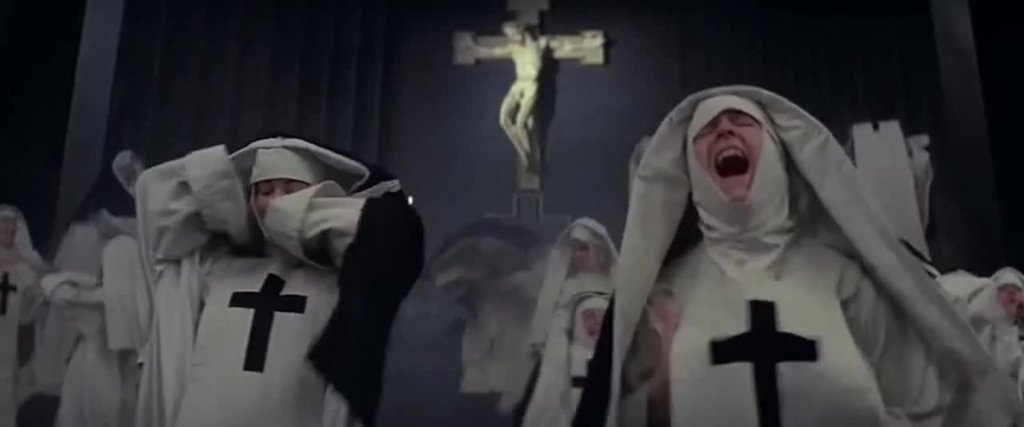
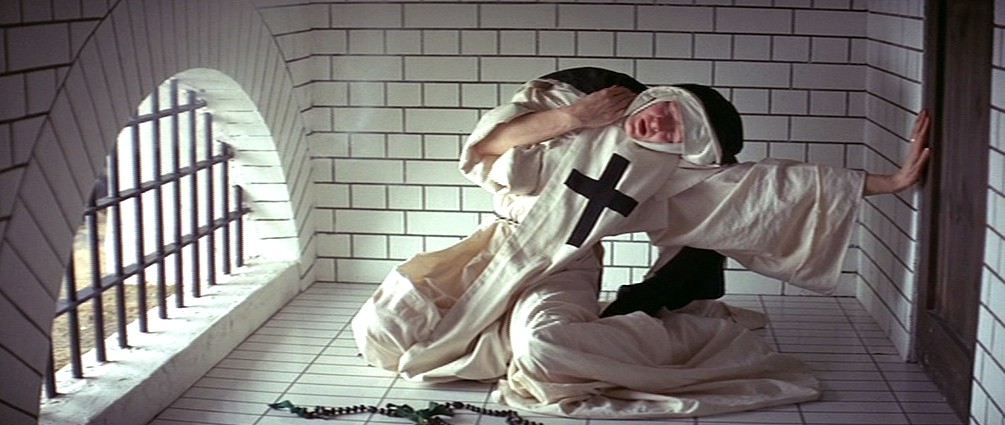
Among Grandier’s many admirers is Sister Jeanne des Agnes (Vanessa Redgrave), a hunchback who is also the abbess of the local convent. Having become sexually obsessed with Grandier, Agnes requests that he become the confessor of the convent. When Grandier refuses, it sets off a chain reaction that eventually leads to Grandier being accused of worshipping the Devil and “bewitching” Sister Agnes and several other nuns. With the arrival of Father Barre (Michael Gothard), a fanatical witch hunter, the city of Loudon descends into darkness and decadence.
Directed by the infamous (and, let’s just admit it, brilliant) Ken Russell and first released in 1971, The Devils is not an easy film to see. When the film was originally released in Britain, it was controversial for its uncompromising depiction of 17th century torture and its combination of religion and sexual imagery. (This, of course, was a recurring theme in almost all of Russell’s work.) The British censors demanded a few minor cuts before agreeing to approve the film for release. While the British censors focused on the scenes of violence, Warner Bros. also removed several sexually explicit scenes, the most infamous of which was a sequence in which a group of naked nuns sexually defiled a statue of Christ. Also removed was a scene of a priest masturbating while watching the nuns and finally, a scene in which Sister Jeanne masturbated with a charred femur bone. Russell was not happy with the changes and, needless to say, he was even more upset when Warner Bros. removed an additional three minutes before releasing the film in the United States.
In the U.S., The Devils was even more controversial than it had been in the United Kingdom and, while many critics praised it as being a powerful attack on hypocrisy, others described it as merely being pornographic. Despite the cuts that were made, the American version of The Devils was slapped with an X rating and Warner Bros. attempted to distance itself from the controversy that had developed around the film. As of this writing, The Devils has never been given a proper Region 1 DVD or Blu-ray release. It’s rare that ever shows up on any streaming platforms. Even YouTube has only a handful of scenes. If you want to watch The Devils in America, you’re going to have to track down a VCR player and watch it on VHS. And, even then, you’ll only be seeing the version that was cut for the U.S.
Will Ken Russell’s original, uncut version ever be seen in America? It’s a question that many film students have asked themselves. In 2002, a 117-minute edition of The Devils played in London, featuring some of the footage that was cut from the film’s original release. However, that version is still considered to be incomplete and it’s certainly not available here in the United States. The Devils does occasionally show up on Shudder, which is how I saw it earlier this year. Of course, the Shudder version was the cut American version, which Russell repeatedly disowned.
Watching the film, I could understand Russell’s anger. It wasn’t just that scenes had been cut out of the film. It was that the scenes were often edited out with such a lack of finesse that it made the film seem disjointed. Russell was a director known for his hallucinatory and deliberately over-the-top style. When the film abruptly cuts away from showing us its most shocking images, it feels antethical to everything that Russell was about as a filmmaker. On the one hand, it’s easy to say, “Who cares if a scene of Vanessa Redgrave masturbating with a charred femur bone has been removed from the film? Who wants to see that?” But if you watch The Devils, it becomes apparent that it’s not about what would be pleasant to see. Indeed, in many ways, The Devils is meant as a deliberate attack on the senses, one in which shocking imagery is used to awaken the audience from their complacency. As such, the controversy about how the film was cut is not about what’s acceptable. Instead, it’s about the fact that Russell has created a world where it somehow makes total sense that Sister Jeanne would pick up the femur and make use of it. By editing the scene so that it abruptly ends with Jeanne merely looking at the bone, Warner Bros. forced The Devils to not be true to itself.
And yet, despite all of that, The Devils remains a powerful and disturbing film, a hallucinatory collection of nightmarish images and haunting scenes. The excessive stylization that was Ken Russell’s trademark is perfect for this story of an entire community caught up in a frenzy of paranoia and repression. Though a period film (and based on a true story), Russell’s Loudon resembles an alien landscape, an almost expressionistic city of pristine walls and dirty streets. Vanessa Redgrave’s twisted nun stalks through the film like an ominous spirit, both wanting and hating Grandier at the same time. When the “possessions” begin, the possessed finally have the excuse to do what they truly want and to live just as wantonly as the men who previously controlled their lives. Because they’ve come to believe that they’re no longer responsible for their own actions, they can indulge in every depravity. But with Louis XIII casually murdering protestants for sport at his estate and Richelieu manipulating church policy to his own ends, the film asks why the people’s actions are more worthy of condemnation than the actions of the people who rule them.
The Devils has reputation for being blasphemous. It is, of course, nothing of the sort. After I watched the film, I did a little research and I was not surprised to discover that Ken Russell was a practicing Catholic because only a Catholic could make a film that both celebrated what the Church could be while also condemning it for so often falling short. While Richelieu represents the people who use religion as a vehicle for their own drive for power and Sister Jeanne and the witch-hunter Father Barre represents the fanatics who use church doctrine to justify their own madness, it is the sinner Father Grandier who represents what the Church should be. It is Grandier who is ultimately forced to put his own life at risk to protect the people of Loudon.
Is The Devils are horror film? Some would probably argue with my claim that it is. They would probably claim that it’s a historical drama with a heavy political subtext, However, for me, the imagery itself is disturbing enough to justify calling The Devils a horror film. The possessed of Loudon eventually prove themselves to be as mad as any of the infected people from George Romero’s The Crazies and the torture that Grandier suffers is frightening specifically because it’s all based on fact. There really was a town named Loudon that had walls. There really was a priest named Grandier who was accused of practicing witchcraft and who suffered the most vile torture as a result.. The Devils is a film about people driven made by a combination of repression and fanaticsm. It’s a horror film because it’s true and, needless to say, the madness that possessed Loudon didn’t die out in the 17th Century. It’s continued into the present day.
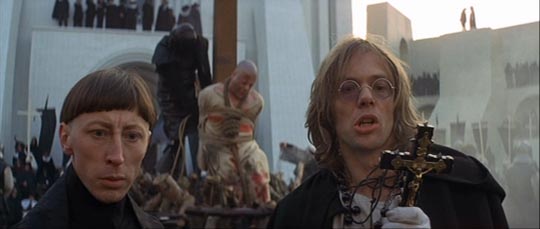
Oliver Reed may seem like an odd choice to play a priest but he gives one of his best performances as the charismatic but foolishly cocky Grandier. Vanessa Redgrave is frightening as the disturbed Sister Jeanne and British actor Murray Melvin is alternatively sympathetic and pathetic as a priest who comes to believe in Grandier’s innocence. For me, though, the film is stolen by Michael Gothard, who plays the fanatical witch hunter, Father Barre. With his long hair and his glasses, Father Barre bears a definite resemblance to John Lennon and the film portrays him as being the 17th century equivalent of a rock star, an arrogant and sensual man who encourages people to indulge in their most secret desires so that he can then declare them to be possessed and in need of an exorcism. Gothard had a magnetic screen presence, allowing him to steal scenes from even formidable talents like Oliver Reed and Vanessa Redgrave. Gothard would go on to play the silent assassin in the James Bond film, For Your Eyes Only and was, again, memorably threatening. Sadly, Gothard took his own life in 1992.
Someday, perhaps the full unedited version of The Devils will be available. Until then, even the edited version retains its power to shock, disturb, and make you think. Today, more than ever, its portrait of hypocrisy and mass madness feels relevant. The modern age is still ruled by hysteria and paranoia and our leaders are still looking for any excuse to take down any walls that might protect us from having to submit to their will. How different is Sister Jeanne from the people who are currently hurling accusations on social media? How different is Father Barre from the the people who were are currently told have all the answers? We may no longer burn people at the stake but we’ve found new ways to silence voices of dissent. The film may have been set in 17th Century France and first released in 1971 but Ken Russell’s masterpiece is all about the modern age. The Devils in not an easy film to watch or find but it is more than worth the effort to track down.
Why do aliens always molest people in trailer parks/rural areas? Is it a slumming thing? I get that they’d wanna send the big guns to take over everything like a gigantic bomber, but the lure of the trailer park and its inhabitants aren’t really interesting to me and haven’t gotten into interstellar travel or even bent a wormhole. Also, if you’re an alien, why wait? I get it if you’re sending semi-autonomous drones like we do to Mars, but again our drones would be WAY more interested in a Martian city rather than fatty Martians drinking Pabst Blue Ribbon.
There’s the whole lost time thing. First, if you were to lose time because they’re going at the speed of light, you’d come back thousands of years later. Why would it be great for the aliens? By the time the Greys got back here, we humans would be 10000 years in the future and we’d all be dead or extremely advanced or maybe even beyond these particular aliens. In fact, their alien homeland might be extinct when they return home because of their fancy-pants super-luminal travel and nonchalant disregard of basic relativity. Go ahead and visit alien varmints, you’d come back and we’d have our own flyin’ saucers you little smug alien bitches! Teach you to probe us and bother people in the Berkshires!
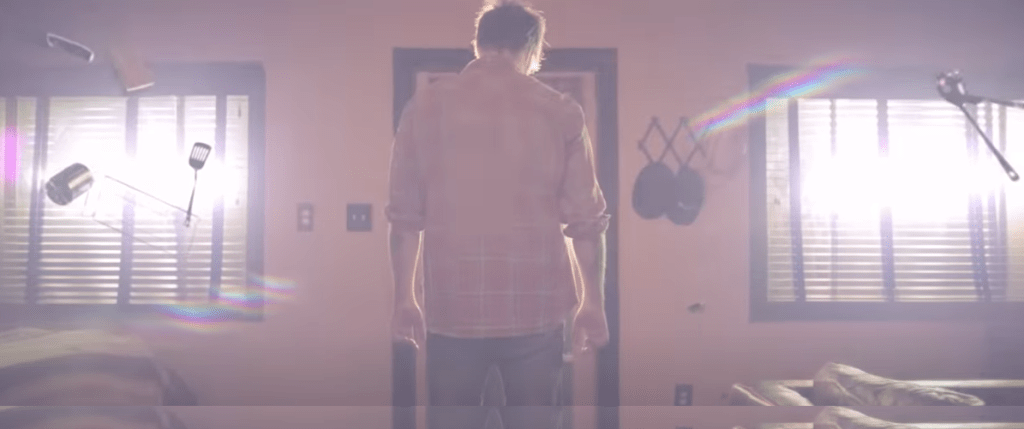
This short on Dust answers the question: what happens when you get abducted and have your memory wiped. John, the quasi-protagonist, more like creepy hermit is building his very own personal trailer park. John always reachin for the stars with his feet on the ground! John has no one, but his trusty dog Jet who is much more interesting than John.
John sees a cloud in the sky that looks kinda weird and he takes a photo. Later that night, it’s aliens!!!! He does the floaty thing, but hits record on his phone. All could think was I really don’t wanna see this guy probed; my YouTube algorithms will never be the same.
He wakes up and his hands are burned and his phone shows a recording of 9 Minutes. It’s mostly him running around a lot. His dog, Jet, appears dead and they left John this……
Damn Weird Aliens! The dog comes back to life as a robo-dog?
The short had a couple of quick thrills and it’s fun to see the take on the alien abduction genre. Maybe, he’ll paint with acrylic? Please let it be so!!!!
Hi there and welcome to October! This is our favorite time of the year here at the Shattered Lens because October is our annual horrorthon! For the past several years (seriously, we’ve been doing this for a while), we have celebrated every October by reviewing and showing some of our favorite horror movies, shows, books, and music. That’s a tradition that I’m looking forward to helping to continue this year.
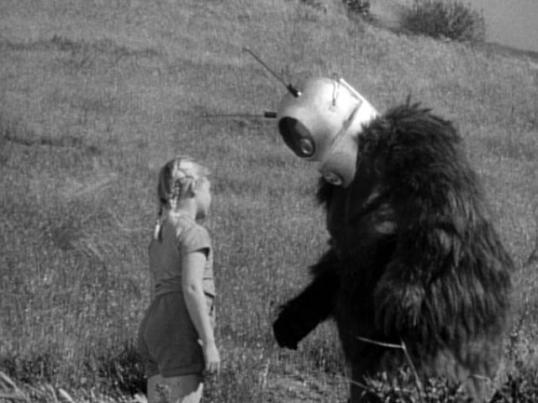
Today’s horror film is a true classic of its kind, the 1953 science fiction epic Robot Monster.
Now, I should admit that this is not the first time that I’ve shared Robot Monster in October. I share it every year and, every year, YouTube seems to pull the video down in November. That sucks because Robot Monster is one of those weird films that everyone should see. So, I’m going to share it again. And, hopefully, YouTube will let the video stay up for a while.
As for what Robot Monster is about…
What happens with the Earth is attacked by aliens? Well, first off, dinosaurs come back to life. All of humanity is killed, except for one annoying family. Finally, the fearsome Ro-Man is sent down to the planet to make sure that it’s ready for colonization. (Or something like that. To be honest, Ro-Man’s exact goal remains a bit vague.)
Why is Ro-Man so fearsome? Well, he lives in a cave for one thing. He also owns a bubble machine. And finally, perhaps most horrifically, he’s a gorilla wearing a diver’s helmet. However, Ro-Man is not just a one-dimensional bad guy. No, he actually gets to have a monologue about halfway through the film in which he considers the existential issues inherent in being a gorilla wearing a diver’s helmet.
Can humanity defeat Ro-Man? Will Ro-Man ever get his intergalactic supervisor to appreciate him? And finally, why are the dinosaurs there?
Despite the film’s reputation for being borderline incoherent, most of those above questions actually are answered if you pay attention to the first few scenes of Robot Monster. In fact, one could even argue that Robot Monster is maybe a little bit more clever than it’s often given credit for. Of course, it’s still a zero-budget mess of a film but it’s also undeniably fun and, in some sections, unexpectedly dark. If you’ve never seen it before, you owe it to yourself to set aside an hour and two minutes in order to watch it. You’ve never see anything like it before.
Finally, I should note that Robot Monster’s hero was played by George Nader, who actually did go on to appear in several mainstream films. Despite his good looks and talent (which may not be obvious in this film but which he did have), George Nader struggled to get starring roles in Hollywood, where he was often dismissed as just being a member of Rock Hudson’s entourage. (It’s been theorized that Nader struggled because the studios feared that giving him too big of a role would lead to the gossip magazines writing about Nader’s relationship with Hudson, though the two were just friends. Nader was in a relationship with Hudson’s private secretary, Mark Miller, from 1947 until Nader’s death in 2001.) Nader finally left Hollywood and went on to have a pretty successful career in Europe. He was perhaps best known for playing secret agent Jerry Cotton in a series of films in the 60s.
Bad Girl takes place in rural Australia. A family has just bought a new home. Peter (Ben Wispear) and Michelle (Felicity Price) are minor celebs, the type whose houses are often featured in magazines. They have a 17 year-old, adopted daughter named Amy (Sara West). When the film begins, Amy is the bad girl of the title. She has a bad attitude, she dressed in all black, she considers smoking crack as soon as they arrive at the news house, and she’s continually told that she’s being given “one more chance.” Amy takes one look around the house and decides that she doesn’t want that chance. Soon, she’s trying to run away.
Fortunately, it appears that Amy has made a new friend! Chloe (Samara Weaving) says that she lives next door. Chloe appears to be everything that Amy isn’t. Chloe is polite. She’s respectful. She doesn’t smoke crack cocaine. She doesn’t try to run away. She doesn’t regularly threaten to commit suicide. I mean, is she even a teenager!? At first, Peter and Michelle are happy that Chloe is Amy’s friend. Chloe might just be the good influence that Amy needs. But — wait a minute! What if …. what if Chloe is the bad girl!?
Well, you can probably already guess the answer to that one. Here’s one thing that I’ve learned from both the movies and real life: anyone who appears to be perfect is secretly screwed up. Chloe appears to be such an idealized friend that she might as well have psycho written across her forehead. In other words, it’s no spoiler to tell you that Chloe has an agenda of her own and soon, Amy is going to be faced with the unenviable task of trying to convince her parents that the perfect girl is actually the bad girl.
There’s a lot about Bad Girl that’s predictable and the parents aren’t particularly sympathetic. Even though Amy has, admittedly, given them reason to be concerned, they’re still way too quick to side against her as far as I’m concerned. It’s totally possible that may have been intentional on the part of the filmmakers but it still makes it difficult to really care about what happens to Peter and Michelle.
That said, Bad Girl does work when it just focuses on the relationship between Amy and Chloe. They have an interesting dynamic. Chloe wants to live what she believes Amy’s life to be while Amy secretly wants to be the person who she initially believes Chloe to be. However, neither Amy nor Chloe are really who everyone assumes that they are. Trapped out in the middle of nowhere, Amy and Chloe have both built up fantasies about what life is like out in the rest of the world. The only difference is that Amy, for all of her problems, can tell the difference between reality and fantasy while Chloe is so determined to live the fantasy that she’s willing to destroy reality. Sara West and Samara Weaving both do a great job of bringing Amy and Chloe to life. In fact, they do such a good job acting opposite each other that you kind of regret that their friendship is going to have to end. You find yourself wishing that all of their fantasies could have come true.
Bad Girl has its flaws but it worth watching for the performances of West and Weaving.
What’s an Insomnia File? You know how some times you just can’t get any sleep and, at about three in the morning, you’ll find yourself watching whatever you can find on cable or Netflix? This feature is all about those insomnia-inspired discoveries!
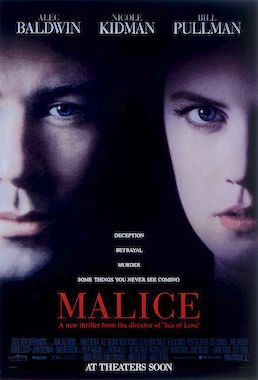
If you were having trouble getting to sleep last night around 12 midnight, you could have turned over to the Cinemax and watched the 1993 thriller, Malice. And then you could have spent the next few hours trying to figure out what you just watched.
Seriously, there’s a lot going on in Malice. The screenplay is credited to Aaron Sorkin and Scott Frank and while it has enough overly arch dialogue and untrustworthy women to plainly identify it as being a product of Sorkin’s imagination, it’s also filled with a mini-series worth of incidents and subplots and random characters. This is also one of those films where no one can simply answer a question with a “yes” or a “no.” Instead, it’s one of those movies where everyone gets a monologue, giving the proceedings a rather theatrical feel. It’s the type of thing that David Mamet could have pulled off. (Check out The Spanish Prisoner for proof.) Harold Becker, however, was a far more conventionally-minded director and he often seems to be at a loss with what to do with all of the film’s Sorkinisms (and, to be fair, Frankisms as well).
The film starts out as a thriller, with a serial rapist stalking a college campus and Prof. Andy Safian (Bill Pullman) becoming an unlikely suspect. Then it turns into a domestic drama as Andy and his wife, Tracy (Nicole Kidman), talk about starting a family. Then Andy meets a brilliant surgeon named Jed Hill (Alec Baldwin) and the film turns into a roommate from Hell story after Jed moves in with them. Then it becomes a medical drama after a mistake by Dr. Hill leaves Tracy unable to have children. Then it returns briefly to the campus rapist story before then turning into a modern-day noir as Andy discovers that Tracy has secrets of her own. (Whenever one watches a film written by Aaron Sorkin, you can practically hear him whispering, “Women are not to be trusted….” in the background.) Even as you try to keep up with the plot, you find yourself distracted by all of the cameos. George C. Scott glowers as Jed’s mentor. Anne Bancroft acts the Hell out of her role as a drunken con artist. Peter Gallagher is the lawyer you distrust because he’s Peter Gallagher. Tobin Bell shows up as a handyman. Gwynneth Paltrow, in one of her first roles, plays dead convincingly
It’s a big and busy and messy film and it too often mistakes being complicated for being clever. Bill Pullman is a likable hero but you have to be willing to overlook that the script requires him to do some truly stupid things. Nicole Kidman is always well-cast as a femme fatale but again, the script often lets her down.
Surprisingly enough, it’s Alec Baldwin who comes out of the film unscathed. Watching Baldwin in this film, it’s hard to believe that he’s the same actor who has since become something of a bloated self-parody. Yes, he’s playing an arrogant character (which is pretty much his trademark) but, in Malice, he actually brings a hint of subtlety and wit to his performance. Baldwin does very little bellowing in the film, despite playing a role that one would think would naturally appeal to all of his bellowing instincts. Malice is a mess but it’s nice to see the type of actor that Alec Baldwin once was.





 Through the Shattered Lens