McBain (1991, directed by James Glickenhaus)


In the year 1973, Bobby McBain (Christopher Walken) was an American POW, fighting for his life in a North Vietnamese prison camp that was run by a general so evil that he wore a necklace of human ears.  Luckily, on the last day of the war, McBain was rescued by Roberto Santos (Chick Vennerra).  When Bobby asked how he could ever repay Santos, Santos gave him half of a hundred dollar bill and told him that someday, Santos would give him the other half.  McBain swears that he will be ready when the day comes to get the other half.  I guess he’s like Caine in Kung Fu, waiting for the chance to snatch the pebble from his master’s hand.

15 years later, McBain is a welder in New York.  One day, while sitting in a bar, he watches as Santos is executed on live television after a failed attempt to overthrow the dictator of Colombia.  Shortly afterwards, McBain is approached by Santos’s sister (Maria Conchita Alonzo), who asks McBain to help her finish Santos’s revolution.  McBain tells her a long story about attending Woodstock and then reunites with his Vietnam War buddies, Frank (Michael Ironside!), Eastland (Steve James), Dr. Dalton (Jay Patterson), and Gil (Thomas G. Waites).  After killing a bunch of drug dealers, stealing their money, and harassing Luis Guzman, the gang heads for Colombia.

I wonder how many people have watched this movie over the years with the expectation that it would be a live action version of the famous Rainier Wolfcastle film that was featured in several episodes of The Simpsons.  Unfortunately, this movie has nothing to do with the Simpsons version of McBain.  (Sorry, no “Bye, book.”)  Instead, it’s just another strange and overlong action film from director James Glickenhaus.  The film mixes scene of total carnage with dialogue that often seems to be going off on a totally unrelated tangent, like McBain’s musings about what Woodstock ultimately stood for.  Walken doesn’t seem to be acting as much as he’s parodying his own eccentric image.  Walken takes all of his usual quirks and trademark vocal tics and turns them up to 11 for this movie.

Even though the movie is twenty minutes too long, it still feels like scenes are missing.  Alonzo leaves Colombia on a mule and then is suddenly in New York.  (The mule is nowhere to be seen.)  We don’t actually see Walken recruiting the majority of his team.  Instead, they just show up in his house.  Once the action moves to Colombia, it turns out that overthrowing the government is much simpler than it looks.  While the rebels lay down their lives while attacking the palace, McBain and his crew pretty much stroll through the movie without receiving even a scratch.  Maybe welders should be put in charge of all of America’s foreign policy adventures.  It couldn’t hurt.

With its hole-filled plot and confusingly edited combat scenes, McBain isn’t great but 80s action enthusiasts should enjoy seeing Michael Ironside and Steve James doing their thing.  Others will want to see it just for Christopher Walken’s characteristically odd performance.  He may not be Rainier Wolfcastle but, for this movie, Christopher Walken is McBain.
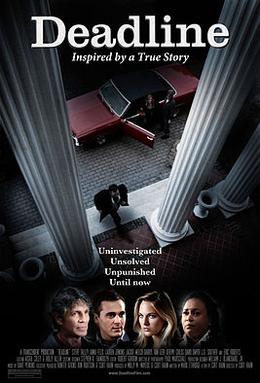
The Eric Roberts Collection: Deadline (dir by Curt Hahn)


In the year 1993, a black teenager named Wallace Sampson was shot and murdered in the small town of Amos, Alabama.  The murderer was never caught.  In fact, according to most people in the town, the murder was never even really investigated.  The town’s white leaders, many of whom were members of the Ku Klux Klan, swept the murder under the rug.

20 years later, Trey Hall (Lauren Jenkins) is determined to solve Wallace’s murder.  Trey may be the daughter of the richest man in town but, as she puts it, she was practically raised by Wallace’s mother, Mary Pell Sampson (Jackie Welch).  Mary Pell Sampson is the long-time maid of Trey’s father, Everett Hall (David Dwyer).  When journalist Matt Harper (Steve Talley) comes down from Tennessee to do a story on another murder, Trey tells him that he should totally ditch the recent murder and instead investigate the older murder.  Matt, who is currently in the process of being cancelled due to a poorly written headline, decides that he wants to investigate and report on the death of Wallace Sampson.  His editor agrees, on the condition that he work with the older and more cynical Ronnie Bullock (Eric Roberts).

While investigating Wallace’s murder, Matt has to deal with his own very messy personal life.  His fiancée, Delana (Anna Felix), wants to call off the wedding because Matt is too obsessed with work.  His father (J.D. Souther) is dying of cancer but can still find the time to scold Matt for ending a sentence with a preposition.  Finally, Matt is not happy about having work with Ronnie, who is an old school reporter who travels with a gun and who has little use for the demands of society.  When Matt accuses Ronnie of being racist, Ronnie angrily corrects him.  When Matt accuses Ronnie of being sexist, Ronnie just shrugs.  It’s really the type of thing that only Eric Roberts could pull off.

Deadline is loosely based on a true story and it’s certainly a well-intentioned film.  Unfortunately, the majority of the performances feel amateurish, the pace is rather slow, and the bad guys are so obviously evil that the film itself feels a bit cartoonish.  (If only all murderers were as easy to pick out as they are in this film….)  It suffers from the same problem that afflicts a lot of films about civil rights in the South, in that the black characters are often pushed to the background and left undeveloped while the film focuses on the nobility of rich white liberals.  Again, the intentions are good but the execution leaves a bit to be desired.

That said, Eric Roberts is well-cast as Ronnie Bullock and, whenever he’s onscreen, he brings some much-needed energy to the film.  In some ways, Ronnie is a cliché.  He’s the cynical, politically incorrect journalist who, deep down, still believes in doing the right thing.  But Roberts manages to bring some nuance to both the character and the film.  The viewer will be happy every time that Roberts steps into a scene.  Eric Roberts’s performance is the highlight of the film and the best reason to see Deadline.

Previous Eric Roberts Films That We Have Reviewed:

  1. Star 80 (1983)
  2. Blood Red (1989)
  3. The Ambulance (1990)
  4. The Lost Capone (1990)
  5. Love, Cheat, & Steal (1993)
  6. Love Is A Gun (1994)
  7. Sensation (1994)
  8. Doctor Who (1996)
  9. Most Wanted (1997)
  10. Mr. Brightside (2004)
  11. Six: The Mark Unleased (2004)
  12. Hey You (2006)
  13. In The Blink of an Eye (2009)
  14. The Expendables (2010) 
  15. Sharktopus (2010)
  16. Miss Atomic Bomb (2012)
  17. Lovelace (2013)
  18. Self-Storage (2013)
  19. Inherent Vice (2014)
  20. Rumors of War (2014)
  21. A Fatal Obsession (2015)
  22. Stalked By My Doctor (2015)
  23. Stalked By My Doctor: The Return (2016)
  24. The Wrong Roommate (2016)
  25. Stalked By My Doctor: Patient’s Revenge (2018)
  26. Monster Island (2019)
  27. Seven Deadly Sins (2019)
  28. Stalked By My Doctor: A Sleepwalker’s Nightmare (2019)
  29. The Wrong Mommy (2019)
  30. Her Deadly Groom (2020)
  31. Top Gunner (2020)
  32. Just What The Doctor Ordered (2021)
  33. Killer Advice (2021)
  34. The Poltergeist Diaries (2021)
  35. My Dinner With Eric (2022)

Catching Up With The Films of 2022: Wrong Place (dir by Mike Burns)


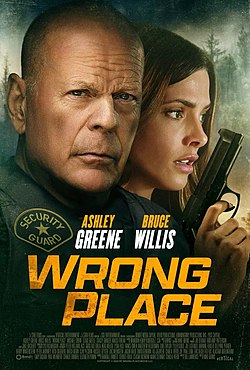
After his wife is killed in a car crash, former police chief Frank Richards (Bruce Willis) takes a job as a security guard for a small town convenience store.  It’s not really a demanding job.  As we see in one montage, Frank spends most of his time playing solitaire.  However, one evening, Frank steps out back to have a cigar and he just happens to catch meth dealer Virgil Brown (Massi Furlan) executing a man.  Frank promptly disarms and arrest Virgil.

Virgil’s son, Jake (Michael Sirow), is not happy about this.  Knowing that Frank is the only eyewitness who can testify against Virgil at his trail, Jake heads off to kill Frank.  However, when Jake arrives at Frank’s cabin, he discovers that it is inhabited by Frank’s daughter, Chloe (Ashley Greene), and her girlfriend, Tammy (Stacey Danger).  Jake tries to take Chloe and Tammy hostage but Chloe turns out to be a lot tougher than he assumed.  Chloe is waiting to hear whether or not she’s cancer-free and, as she explains to Jake, she has nothing to lose by risking her life and fighting him.  And while Jake is certainly dangerous and quick to fire his gun, he’s also not the most competent criminal to ever come out of the backwoods of Alabama.  If you’re guessing that this leads to several scenes of various characters chasing each other through the woods and shooting at each other, congratulations!  You’re right!

This was one of the last films that Willis made before announcing his retirement last year.  Watching the film, it’s easy to see that Willis was struggling a bit.  There’s none of the swagger that viewers typically associate with Bruce Willis and he delivers many of his lines in a flat monotone.  That said, this film is still a better showcase for Willis than American Siege or Fortress: Sniper’s Eye.  Indeed, in the early scenes with his soon-to-be-deceased wife, Willis feels a bit like the Willis of old.  Even if Bruce Willis was struggling to remember his lines, his eyes still revealed a lot of emotional depth.  In the scenes where he and his wife discuss getting older and mention how scary it is to be sick, the dialogue carries an extra resonance.  If nothing else, the role of a decent man who will do anything to protect his family seems like a more appropriate final role for Willis than the various crime bosses that he played in some of his other ’22 films.

Unfortunately, Wrong Place gets bogged down with the whole hostage subplot.  There’s only so much time that you can spend watching people yell at each other before you lose interest.  Ashley Greene, Stacey Danger, and Michael Sirow all give convincing performances but the film itself falls into a rut.  When Jake is first introduced, he seems like he could be an interesting villain.  He doesn’t really know what he’s doing but he’s determined to impress his father.  (Sadly, it’s pretty obvious that Jake’s father will never be impressed with anything Jake does, regardless of what it may be.)  Jake’s incompetence makes him even more dangerous because it also makes him impulsive and quick to anger.  Unfortunately, the film doesn’t do much with his character.  Once the action kicks in, he just become another generic backwoods villain.

I get the feeling that the director meant for Wrong Place to be more than just another action film.  The film moves at its own deliberate pace and, even after the hostage situation has concluded, the film still goes on for another ten minutes.  One gets the feeling that the director wanted to make a sensitive film about the relationship between a headstrong daughter and her old-fashioned father.  But, because this film was also a low-budget action film, he also had to toss in some backwoods meth dealers.  The film has some moments of unexpected emotional honesty, many of them curtesy of Ashley Greene.  But, in the end, it keeps getting bogged down with endless scenes of people running through the woods with guns.  The end result is an uneven film but at least Willis gets to play a hero again.

January Positivity: Seven Days Away (dir by Josiah David Warren)


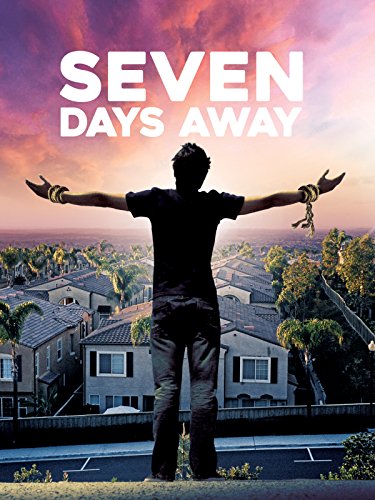
Clayton (Josiah David Warren) is the religious kid who everyone dreads getting in to a conversation with.  He’s the type of kid who accepts a ride from one of his friends and then starts to give everyone a hard time for drinking and driving and….

Actually, wait a minute …. drinking and driving sucks!

So, Clayton is actually totally correct to tell his friends to put down the beer cans while they’re driving.  They, of course, just laugh him off and call him “church boy.”  One accident later, Clayton’s friend is dead and Clayton is more determined than ever to go down to Mexico and do missionary work.  Everyone tells him that it’s dangerous to go down to Mexico.  Everyone knows that Clayton’s father died while serving as a missionary.  But Clayton and another group of friends still head down to Mexico.

Unfortunately, it turns out that Clayton’s other friends may not be drunk drivers but they’re still not all that interested in evangelizing in Mexico.  They especially get angry when Clayton insists that they accompany him to the local church.  Clayton finally gets annoyed with all of them and he decides to wander off on his own.  Of course, that’s always a mistake.  No sooner has Clayton turned down the wrong street than he’s been kidnapped.

Clayton finds himself tied up in an old barn and being held prisoner by a group of human traffickers.  They’re convinced that Clayton is rich and they continually call his mother and demand that she send them some money.  Meanwhile, Clayton soon realizes that he’s not the only person behind held prisoner in the barn.  He also comes to realize that the desert surrounding the barn is full of dead bodies.

Noticing that his kidnappers are always drinking and smoking, Clayton tells them that they shouldn’t.  When they demand to know why not, Clayton quotes Corinthians.  That goes over about as well as you might expect.

Seven Days Away attempts to mix the faith-based genre with the action genre.  When Clayton isn’t preaching or quoting the Bible, he’s running through the desert and trying not to get shot.  Unfortunately, the film doesn’t really work as an action film.  The film uses some hand-held camerawork to try to generate some suspense but, at this point, the whole hand-held thing is such a cliché that it actually inspires more laughs than gasps of terror.  The soundtrack is remarkably muddy and it’s often difficult to understand just what exactly anyone is saying.  Even by the standards of the low-budget faith genre, the acting is amateurish.  As a film, it just doesn’t come together.  The fact that the film’s director also played the lead role was perhaps a bit of the problem.  It’s hard not to feel the film would have had a better chance at success if he had just concentrated on doing one thing as opposed to everything.

I guess the best thing you can say about a film like this is that it was well-intentioned.  Watching it brought back memories of the days leading up to Spring Break, when the campus would be full of stories about students who got drunk while partying in Mexico and subsequently vanished.  I have to admit that I never had a lot of sympathy for the students in those stories.  Sometimes, you just have to use a little common sense.

Cool as Ice (1991, directed by David Kellog)


Johnny Van Owen (Robert “Vanilla Ice” Van Winkle) is a rapper who travels across the country on his big yellow motorcycle, with his loyal crew traveling behind him.  When one of the motorcycles is damaged, Johnny and the crew pull into a repair shop owned by Roscoe (Sidney Lassick) and Mae (Dody Goodman).  Even though their repair shop looks like something out of Pee Wee’s Playhouse, Mae says that Roscoe can fix anything.

Johnny says it’s all cool because he’s got his eye on Kathy Winslow (Kristin Minter), an honors student who is about to leave for college and who is dating Nick (John Haymes Newton).  Johnny is so in love with Kathy that he rides his motorcycle in front of her while she’s riding a horse and she nearly breaks her neck as a result.  Johnny doesn’t apologize because Johnny’s cool as ice.  Instead, Johnny renames Kathy “Kat” and then takes one look at Nick and says, “Drop that zero and get yourself a hero.”  Just to make sure there’s no confusion how Johnny feels about his romantic rival, he also calls Nick “Dick.” Later, Johnny performs a rap just for Kat and Kat agrees to go on a date with him to an abandoned construction site.

Kat’s father (Michael Gross) is in the witness protection program but, when he and Kathy appear on the news, he’s spotted by two gangsters who kidnap Kat’s younger brother.  Kat’s father assumes that Johnny must be working with the gangsters so Johnny has to clear his name by defeating the gangsters and performing the rap to end all raps.

Cool As Ice was an attempt to update the old Elvis formula with infamous white rapper Vanilla Ice in the place of the King of Rock and Roll.  The end result was a box office flop that hastened the demise of Vanilla Ice’s career.  (At the same time the film came out, some journalists dug into Ice’s background and discovered that he wasn’t a gangster from Miami but instead he was a douchey ex-jock from Lake Highlands, Texas.)  Even today, it’s still surprising to see what a terrible actor Vanilla Ice truly was.  The role doesn’t demand that he do much, other than smirk and rhyme a few insults but Vanilla Ice wasn’t even up to successfully doing that.  Most musicians at least have enough stage presence that they can get by onscreen, even if they don’t have a large amount of range.  Vanilla Ice is a blank onscreen.  It doesn’t do Vanilla Ice any favors that he’s surrounded by people who actually can act, like Michael Gross, Kristin Minter, and Sidney Lassick.  Even John Haymes Newton, playing the stock bad boyfriend role, gives a better and more sympathetic performance than Vanilla Ice.

I went into this movie knowing that it would be bad but I had no way of preparing myself for just how bad it was.  It’s almost so bad that it’s watchable, though for all the wrong reasons.  Watching Vanilla Ice in this movie, I saw why grunge (and not poppy white boy rap) replaced hair metal as the 90s favorite music.

Book Review: Godzilla: The Official Guide To The King Of The Monsters by Graham Skipper


Do you like Godzilla?

You better!  Seriously, for over 60 years, Godzilla has been the rightful king of the monsters and not even a few less-than-perfect films have been able to knock him off of his throne.  He started out as a symbol of the nuclear age, a prehistoric monster brought back to life by man’s arrogance and war-like nature.  He eventually became mankind’s protector but then deciding that he no longer cared for mankind. And then, like many international stars, he ended up making movies for the American studios.  It’s an epic story and it’s hard not to like the big monster at the center of it.  If, for some reason, you don’t like Godzilla, maybe Graham Skipper’s new book, Godzilla: The Official Guide To The King of the Monsters, will change your mind.

Godzilla: The Official Guide To The King of the Monsters is exactly what the title says.  It’s a guide to all of Godzilla’s adventures, from his first appearance in the 50s all the way through his animated films and the current American version.  (Perhaps not surprisingly, the 1998 version of Godzilla is only afforded a few paragraphs.)  Helpfully, Skipper divides his overview into ears, so you can see how Godzilla changed as he moved from studio to studio.  Skipper also takes a look at Godzilla’s existence outside of the movies, as a comic book mainstay and an occasional television guest star.  The book is written with a lot of obvious affection for Godzilla in all of his incarnations and reading it will remind you of why Godzilla’s films — yes, even Son of Godzilla — are so much fun to begin with.  Skipper includes a lot of trivia, some of which was new to even me.  Such as, did you know that Luigi Cozzi re-edited and colorized the original 1954 Gojira for a 1970s release in Italy?

The book is also heavily-illustrated, featuring a lot of shots from the films and behind-the-scenes pictures of Godzilla and all of his colleagues.  As I read the book, it occurred to me that, as goofy as Jet Jaguar was, it’s still nice that Godzilla had a friend.  As well, as I looked at the pictures, it occurred to me that, even in the later films when Godzilla had been transformed from a truly fearsome symbol of the nuclear age to a somewhat goofy rubber monster, there was still an undeniable majesty to him as a creation.  Even at his worse, Godzilla still looks like a king.

I picked up a copy of this book on the day after Christmas and I’m glad I did.  Not only does it celebrate Godzilla but it also provides me with a guide because, over the next 12 months, I hope to watch every Godzilla film that’s ever been made.  (I’ve seen the majority but, as this book reminded me, there’s still a few that I missed.)  For the record, I still think that Godzilla vs Destoroyah is the best of the Godzilla films but who knows?  Maybe my mind will have been changed by December.

Humanity has survived a lot over the past few years and I’m happy to say that Godzilla has survived with us.  Graham Skipper’s Godzilla helps to explain why.

Retro Television Reviews: Making of a Male Model (dir by Irving J. Moore)


Welcome to Retro Television Reviews, a feature where we review some of our favorite and least favorite shows of the past!  On Sundays, I will be reviewing the made-for-television movies that used to be a primetime mainstay.  Today’s film is 1983’s Making of a Male Model!  It  can be viewed on YouTube!

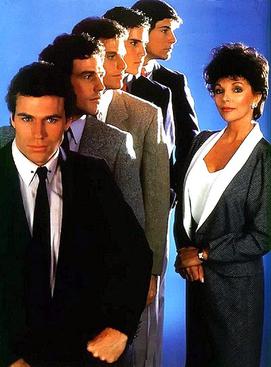
While visiting the set of an outdoor shoot in Nevada, high-powered modeling agent Kay Dillon (Joan Collins) spots a ranch hand named Tyler Burnett (Jon-Erik Hexum).  Tyler is tall, athletic, handsome, and polite.  When Kay asks Tyler if he’s ever modeled, Tyler scoffs at the idea.  Him?  A model?  He’d rather stay in Nevada and work on the ranch.  However, when the girl he likes turns him down because he doesn’t have any money, Tyler reconsiders Kay’s offer.

Before you can say Midnight Cowboy, Tyler is walking around Times Square while dressed like a cowboy.  At first, Tyler is resistant to Kay’s suggestions on how to improve his look.  He doesn’t want anyone messing with her ear or trimming his eyebrows.  But, after a humiliating meeting with a photographer who tells him that he just doesn’t have the right look, Tyler agrees to let Kay turn him into a male model.  Not only does she fix his look but she also takes him to bed.

Soon, Tyler is one of the country’s most well-known faces.  He branches out into commercials, using his sex appeal to sell products to the men who want be him.  And yet, Tyler still feels lost.  He’s not sure if Kay actually loves him or if she’s just using him.  Meanwhile, his roommate, Chuck Lanyard (Jeff Conaway), is a former model who is now hooked on drugs and who constantly warns Tyler that all models are washed up by the time they hit 35.  Tyler becomes disillusioned with his life as a model but is he capable of giving up the fame and the money and returning to Nevada?  Or is he destined to follow in Chuck’s footsteps and head down a path of drugs and self-destruction?

Welcome to the world of decadence, 80s style!  Making of a Male Model is one of those films where the synthesizer-heavy soundtrack plays through every scene and the only thing more dramatic than the line readings is the hair and the shoulder pads.  It’s all a bit silly, none more so that when Tyler and Kay go to a costume party.  Kay dressed up like Cleopatra.  Tyler wears a cowboy hat.  One random extra wears an oversized headpiece with two gigantic eyes painted at either end.  It’s not so much Studio 54 as much as it’s Studio 54 as imagined by someone who has heard of the place but never visited.  It’s decadent but it’s never quite authentic.  The film captures the joy of not only looking good but also knowing that you look good but it never captures the tedium that can go into being on a shoot.  It’s a film about the reality of modeling that never bothers to get that real but so what?  You don’t watch a film called Making of a Male Model because you’re looking for reality.

Joan Collins appears to be having fun in the role of Kay.  John-Erik Hexum, who was a real-life model, gives a rather stiff performance in the role of Tyler.  He looks good but he struggles whenever he has to show any emotion beyond being slightly annoyed.  If anyone really stands out in the cast, it’s Jeff Conaway.  Conaway brings a bit of genuine sadness to his role but you’ll guess what’s going to happen to Chuck long before it actually does.  Finally, Kevin McCarthy (the actor, not the Congressman) plays one of Kay’s business rivals.  He doesn’t get to do much but it’s always nice to see Kevin McCarthy playing yet another sophisticated but ruthless businessman.

In the end, the film doesn’t have anything surprising to say about the world of modeling and Tyler is never that interesting of a protagonist.  However, there’s just enough 80s melodrama and 80s fashion to keep things watchable.

Catching Up With The Films of 2022: White Elephant (dir by Jesse V. Johnson)


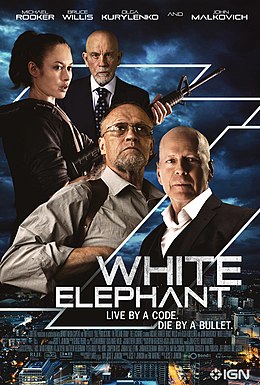
White Elephant is not that bad.  In fact, for a B-action movie it’s actually pretty good.  If nothing else, it featured one of Michael Rooker’s best performances.

It’s important to start out this review by making that clear because I think a lot of people are going to be tempted to judge this film based solely on the fact that this was one of the last films that Bruce Willis made before his family announced that he would be retiring from acting due to health reasons.  When the big story was published in the L.A. Times about Willis’s recent struggles and how those struggles led to him accepting countless roles in straight-to-video fare like American Siege, several people who worked on White Elephant were quoted, with many saying that Willis always did his best but that he was definitely not the Willis that they all remembered.  The film’s director, action maestro Jesse V. Johnson, publicly stated that he would not make another film with Willis because “the arrangement felt wrong” and that Willis deserved a better end to his career.

And it must be said that Bruce is obviously not himself in White Elephant.  As with many of his recent films, Bruce is cast as a villain in this piece.  He’s a crime lord named Arnold and he spends the majority of his time taking meetings and giving order to his underlings.  Eventually, he does pick up a gun and fire it but there’s very little of the cocky attitude and swaggering charisma that made Bruce Willis into a superstar.  He still has the physical presence to play a tough guy.  Bruce Willis still looks intimidating and the film uses him sparingly, never allowing us to spend too much time focusing on how different he seems from the Bruce Willis who starred in Die Hard and Pulp Fiction.  One never gets the feeling that Bruce is being deliberately exploited in White Elephant, that alone sets it above some of the other recent films that have featured Willis.  But, at the same time, Arnold is a fairly generic bad guy.

Fortunately, the majority of the film follows Michael Rooker in the role of a far more interesting criminal.  Rooker plays Gabe Tancredi, a former Marine turned hitman.  He’s about as ruthless as they come but he still has enough of a code of ethics that he realizes that he can’t kill a police officer named Vanessa (Olga Kurylenko), no matter how much Arnold wants her dead.  Ordered to kill her, Gabe instead protects her, which leads to Arnold sending all of his men after them.  It leads to several shootouts and explosions as Gabe puts his life at risk to finally do the right thing.

It’s a simple story but it’s told well.  Jesse V. Johnson started out as a stuntman and he clearly knows his way around an action scene and the final shootout in genuinely exciting.  The film is also helped by Michael Rooker, who brings a good deal of unexpected depth to the role of Gabe.  Even though Rooker obviously knew that White Elephant was a B-movie, he still refuses to phone in a single minute of his performance and, instead, he turns Gabe into a surprisingly complex killer.  Gabe’s relationships with his agent Glen (John Malkovich), his protegee Carlos (Vadhir Debrez), and Vanessa are all genuinely interesting.  I especially liked the early scenes between Rooker and Debrez, in which the two actors wonderfully play off of each other and we get the feeling Carlos is almost like a son to Gabe.  Of course, being genre savvy, we know that Carlos is eventually going to be assigned to take Gabe down but, because their friendship seemed so real, we find ourselves dreading that confrontation.  White Elephant is a B-movie but, much like last year’s Corrective Measures and Gasoline Alley, it’s a B-movie with a heart.

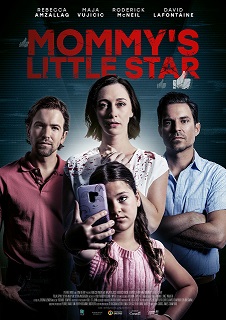
What Lisa Marie and Megan Watched Last Night #225: Mommy’s Little Star (dir by Curtis Crawford)


Last night, my sister Megan and I watched Mommy’s Little Star on the Lifetime Movie Network!

Why Were We Watching It?

For the past week and a half, I’ve been visiting my sister Megan and her family.  This is kind of our holiday tradition.  Everyone gets together for Christmas and then, from Christmas Day to New Year, Megan and I catch up and bond and talk about how we’re feeling about the past year and what we’re hoping to get out of the upcoming year.  Plus, we watch a lot of TV and movies!

I’ve always loved watching movies with my family and I especially love Lifetime movies.  (Unfortunately, I haven’t gotten to watch as much Lifetime as usual this year.)  So, when I saw that the Lifetime Movie Network was broadcasting something called Mommy’s Little Star, I literally fell on my knees and begged Megan to stay up and watch it with me.

What Was It About?

12 year-old Olivia (Maja Vujicic) thinks that she’s found a way bring her parents back together.  She’ll become a social media star by posting dancing videos online.  If she can get her mother, Lauren (Rebecca Amzallag), to appear in the videos with her, she’ll become an even bigger star and maybe even win a contest because people love to watch young influencers dance with their moms.

Lauren’s new boyfriend, Aiden (Roderick McNeil), offers to act as Olivia’s agent and to guide her to social media stardom.  Olivia is excited but soon, she becomes so addicted to being popular online that she starts neglect her friends, her schoolwork, and her well-meaning but strict nanny.  Meanwhile, Aiden is actually a con artist who is willing to go to any lengths, including murder!, to get what he wants.

What Worked?

I always enjoy a good Lifetime moral panic film.  This film had the typical Lifetime plot of the handsome but sinister man who was trying to take a daughter away from her loving parents but, to that, it also added a fear that I imagine many parents have, the fear of what their children might be doing online.  One thing that both Olivia’s mom and her father (played by David Lafontaine) had in common is that neither one of them was really sure what it was that Olivia was getting so excited about and watching them, I was reminded of my aunt’s reaction when I first tried to explain to her what Twitter was.  The film suggested that all of the trouble that Olivia and her family go through is worth it because it encourages Olivia to eventually take a break from social media.  It’s all rather silly and campy but that’s what makes Lifetime movies so much fun.

I really enjoyed Roderick McNeil’s performance as Aiden.  He had the whole charming sociopath act down to perfection.

What Did Not Work?

The film missed an opportunity by not having Olivia herself turn evil in her attempts to win the big contest.  Maybe Lifetime had already met their quota for murderous children by the time they got around to Mommy’s Little Star.

“OMG!  Just like me!” Moments

Right after my parents divorced, I had a fantasy that lasted for about two years where they would both come to see me performing with the New York City Ballet and they would be so moved by my dancing that they would get back together.  That never happened, of course, but still, I could relate to what Olivia was trying to do even if I didn’t quite agree with her methods.

Both Megan and I agreed that Rebecca Amzallag, who did a great job playing Olivia’s mother, looked just like our friend Lea so that was kind of neat.  We spent a lot of the film asking ourselves, “Is that what Lea would do?”

Lessons Learned

Social media is evil!

Film Review: After Ever Happy (dir by Castille Landon)


The fourth installment in the After franchise, After Ever Happy picks up where After We Fell ended.

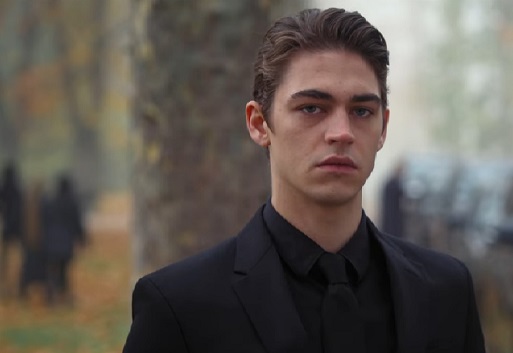
The world’s most boring couple, Tessa Young (Josephine Langford) and Hardin Scott (Hero Fiennes Tiffin), are in London to attend Hardin’s mother’s latest wedding.  Unfortunately, Christian Vance (Stephen Moyer) takes this opportunity to reveal that he is actually Hardin’s father which leads to Hardin storming off and grabbing a bottle of whiskey.  If you’ve seen the previous three After films, then you know that’s a big problem because Hardin is a recovering alcoholic who turns into an asshole when he’s drunk.  Of course, Hardin’s usually an asshole when he’s sober as well.

Because Tessa really doesn’t have any life beyond chasing after Harin and trying to keep him from being self-destructive, Tessa chases after him and tries to keep him from doing anything self-destructive.  Unfortunately, since Harden’s already drunk, he decides that he might as well burn down his mother’s house and that’s exactly what Hardin does.  In most movies, this would be treated as Hardin going off the deep end and as evidence that Tessa should get a thousand miles away from him.  In the After films, every stupid, impulsive, and destructive thing that Hardin does is just an excuse for Tessa to comfort him by having soft-focus sex in a car.  In the world of the After films, every toxic relationship is a Dior commercial.

Not now, Natalie!

Anyway, After Ever Happy pretty much follows the exact same pattern as the previous three films.  After Tessa’s father dies, she moves to New York in order to heal and Hardin loses it.  Hardin follows her to New York.  Tessa takes him back.  Hardin explodes over some trivial issue.  Tessa forgives him.  Tessa tries to do something for herself.  Hardin gets mad.  Tessa forgives him.  Hardin tries to be a better person, which in this case means that he gives his scarf to an old homeless man whom Tessa has been giving food.  (Tessa explains that giving the homeless man food makes her feel better about losing her dad, which is another way of saying that she’s only helping him to make herself feel good.  If her Dad was still alive, the homeless man would probably end up freezing to death while Tessa and Hardin debated whether Fitzgerland was a better writer than Hemingway.  Maybe one of those schmucks could try to help the old homeless man find shelter or something.  That scarf’s only going to do so much.)  Hardin turns his journals into a novel, which is somehow published.  Tessa is angered that Hardin wrote about her without asking her permission and she leaves him.  Hardin’s book is acclaimed, despite the fact that the excerpt we hear sound terrible.  Hardin becomes an amateur boxer or something.  I’m not really sure what was up with that scene.  “To be continued….,” the title card announces, so maybe the next movie will feature more action in the ring.

A few questions sprang to mind as I watched After Ever Happy:

Why, after four movies, does Hardin still only have one facial expression?

See?  Just one.

What was going on with Tessa’s hair during the second half of the movie?

Seriously, Tessa’s hair was one of the few things that she had going for her and this movie took that away from her.

Finally, how is it that, after four films, the lead performers still have next to zero romantic chemistry?  You would think that, after three years of playing these people, Hero Fiennes Tiffin and Josephine Langford would at least have a little bit of a spark to their interactions but instead, they still come across as being friendly acquaintances as opposed to lovers.  There’s nothing about their performances that suggest that they know each other in a way that only two people who are deeply in love could know each other.  There’s none of the little details that one immediately spots between people who have shared trauma and found love.  Instead, every emotion and thought is on the surface.  There’s no depth to the relationship.  Hardin is toxic and whiney.  Tessa is the doormat that other doormats walk over.

Typically, with a film like this, critics will say that the cast does their best with the material they’ve been given but, in this case, everyone’s just as lousy as the material.  Say what you will about the 50 Shades Films, at least Jamie Dornan and Dakota Johnson appeared to be having fun.  The cast of After Ever Happy, from the stars on down, just seem to be hoping that it will soon all be over with.