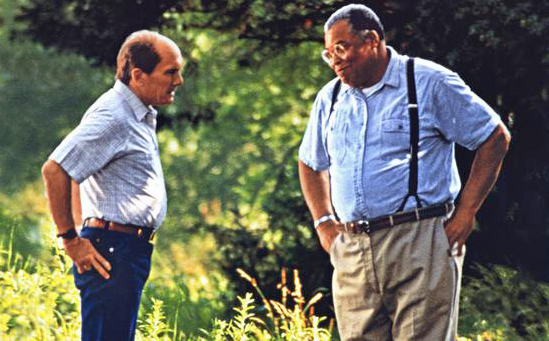
A FAMILY THING (1996) – Robert Duvall & James Earl Jones are brothers!


Just for the hell of it, I went on a little Robert Duvall marathon for his birthday on January 5th. I started the marathon off with his superior western with Kevin Costner, OPEN RANGE (2003). Next up was Duvall’s excellent crime film with Joe Don Baker and Robert Ryan, THE OUTFIT (1973). Duvall was in badass mode in this one. Based on one of Richard Stark’s “Parker” books, this was my first time to watch the film and damn, it was excellent. After that, I watched the bleak THE ROAD (2009), starring Viggo Mortensen, where Duvall just had a small part. It was a downer. I finished off the marathon late in the evening with A FAMILY THING (1996). I remember when this movie came out in the 1990’s because it was co-written by Billy Bob Thornton. Thornton was still a year away from his massive success with the movie SLING BLADE, but I knew him from his writing and co-starring in the superior crime film ONE FALSE MOVE (1991), as well as his small role in TOMBSTONE (1993). As an Arkansan, I knew Thornton was from Arkansas so I had taken a particular interest in him. But I was only 22 years old when A FAMILY THING was released, and a movie about a couple of old guys resolving family issues didn’t seem that appealing to me. As a guy into his 50’s, the entire concept seems more interesting to me now, so I gave it a spin for the first time to close out the marathon.

The story opens up in rural Arkansas with Earl Pilcher Jr. (Robert Duvall) getting the shock of his life when his beloved mother writes a final letter to him and instructs her local pastor to deliver it a few days after her death. The letter tells Earl that his biological mother was a black woman named Willa Mae who died in childbirth. It seems that Earl’s dad had gotten Willa Mae pregnant, and since he came out white, his “mother” was able to raise him as her own without having to tell him the truth. The letter also tells him that he has a half-brother named Ray Murdock (James Earl Jones) living in Chicago. It’s her dying wish that he meet Ray and get to know him as family. Pissed at his dad, and wanting to honor his mom, Earl heads to Chicago to meet Ray. Earl knows that Ray is a cop so he’s able to track him down. They immediately don’t like each other, but through a variety of circumstances, Earl ends up staying at Ray’s house for a couple of days. While there, he meets Ray’s wise, old Aunt T., Willa Mae’s sister (Irma P. Hall) and his sullen son Virgil (Michael Beach). Will the two men continue to push each other away, or will they eventually find the family connection that exists under all that messy past? 

I was surprised how deeply I was affected by A FAMILY THING. I’d be lying if I said I didn’t get teary-eyed a couple of times. The movie may use issues of adultery and racism to get the ball rolling, but more than anything else, it seems to understand that life is messy and that people are messy. We’ll disappoint ourselves, we’ll disappoint other people, and other people will disappoint us. There’s a reason that many people find their love in dogs and cats instead of people, because real relationships can be tough. The truth about my own life is that I could not have appreciated this film in 1996 at only 22 years of age. I was too naive. That’s no longer the case in 2025, and I can now truly relate to this story of two men who share a painful history, find common ground, and decide it’s worth moving forward together because family really does matter.

A movie like A FAMILY THING has no chance of working without a great cast, and this movie is a thespian jackpot. Robert Duvall is spot on perfect as the good ole guy from Arkansas, with a little bit of a racism engrained down deep into his soul, who now has to deal with the fact that he is half black. The scene where he confronts his dad about the lies that had been told to him all his life is as good as it gets. James Earl Jones matches Duvall in the even trickier role as the man who has always known about his “white” half brother Earl. This man has buried his hatred away for Earl’s father for decades, who he blames for the death of his own mother, and now has to deal with those feelings being dredged back up to the surface when Earl shows up in Chicago. Jones perfectly balances his character’s desire to keep the past in the past, with his decency as a man who doesn’t want to just throw Earl out on the street. He eventually softens towards him no matter how much bitterness he has for Earl’s dad. And neither Duvall or Jones even give the best performance in the film. That honor goes to Irma P. Hall as the blind, but extremely perceptive Aunt T. She sees through all of their bullshit, as she states to each of them on different occasions, and encourages them to get to know each other because they’re family. As they play games of racism and bitterness, she reminds them they are brothers no matter the color of their skin. It’s the performance of a lifetime and was at least worthy of an Oscar nomination in my opinion. 

Overall, A FAMILY THING may compress the amount of time and potential therapy it would take to resolve the type of family history presented here, but it does find a certain truth in the power of relationships. Earl and Ray don’t have to recognize the fact that they are brothers. As a matter of fact their lives are just fine without each other. But it’s their willingness to embrace the messy truth and find a way to connect with each other that makes the movie meaningful to me! 

Here’s the trailer for A FAMILY THING.
Lisa Reviews An Oscar Nominee: Arrowsmith (dir by John Ford)


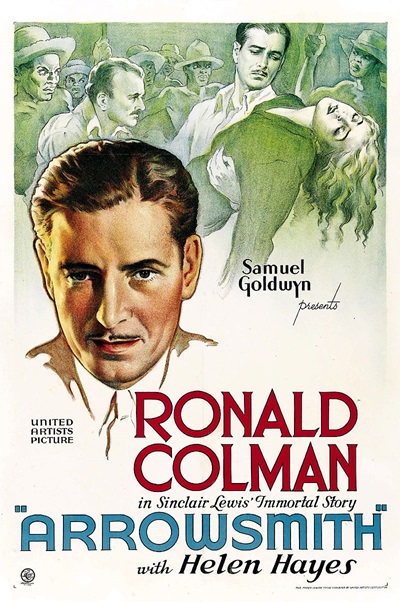
In the 1931 Best Picture nominee Arrowsmith, Ronald Colman stars as Martin Arrowsmith, a doctor who is trying to save lives without compromising his ethics.

Arrowsmith is mentored by the famed bacteriologist, Max Gottlieb (A.E. Anson) and married to a nurse named Leora (Helen Hayes).  At first, Arrowsmith makes his living as the local doctor in Leora’s small hometown in South Dakota.  However, Arrowsmith is ambitious and wants to do more with his life and career than just take care of a small town.  He wants to cure the world of disease.  When he’s offered a position at the prestigious McGurk Institute in New York, he enthusiastically accepts.  Having just suffered a miscarriage, Leora supports Arrowsmith’s decision and travels to New York with him.  No matter what happens, Leora is always there to support her husband, even when he doesn’t seem to appreciate it.

When Arrowsmith thinks that he’s discovered an antibiotic serum that appears to be capable of curing all sorts of diseases, he attempts to stay true to the methods taught to him by Dr. Gottlieb.  He takes his time.  He tests carefully.  He doesn’t rush out and give the serum to everyone.  However, Arrowsmith finds his methods continually sabotaged by his colleagues, who hope to raise money by telling the press about a miracle serum that can “cure all diseases!”  When Arrowsmith later finds himself combatting an outbreak of the Bubonic Plague in the West Indies, he again tries to employ the scientific method but finds himself being pressured by government officials to give his untested serum to every single person on the island.  Eventually, Arrowsmith’s ethics are pushed to their limits when even Leora falls ill.

Arrowsmith was based on a best-selling novel by Sinclair Lewis, though the plot was changed to make the story more palpable for film audiences.  In the novel, Arrowsmith is a bit of cad who regularly cheats on his wife.  In the film, Arrowsmith is passionate and driven but the exact nature of his relationship with wealthy Joyce Lanyon (Myrna Loy) is left so ambiguous that it actually leaves one wondering why the character is in the film at all.  What both the film and the novel have in common is an emphasis on the importance of science and the scientific method.  Arrowsmith’s idealism runs into the harsh reality of life during an epidemic.  Government officials are more concerned with saying that they’ve done something as opposed to considering whether their actions have ultimately done more harm than good.  In its way, Arrowsmith predicted the COVID era.

Arrowsmith was the first John Ford film to be nominated for Best Picture and its financial success allowed Ford the freedom to go on to become one of Hollywood’s most important directors.  Seen today, Arrowsmith feels a bit creaky and self-important, with little of the visual flair that Ford brought to his later films.  Ronald Colman’s performance as Arrowsmith seems a bit stiff, especially when compared to the much more lively (and sympathetic) performance of Helen Hayes.  Arrowsmith is a big and serious film and, if we’re going to be honest, it’s a little bit boring.  Still, it’s interesting to see the issues of today being debated 90 years in the past.

As for the Oscars, Arrowsmith was nominated for Best Picture, Adaptation, Cinematography, and Art Direction.  It lost in all four of the categories in which it was nominated.  That year, Best Picture was won by Grand Hotel, which curiously didn’t receive any other nominations at all.

Glass Jaw (2018, directed by Jeff Celentano)


When the daughter of his trainer dies of a drug overdose at his house, world light heavyweight champion Travis Austin (Lee Kholafai) takes the blame and goes to prison, even though the drugs were brought into his house by his sparring partner, Joe (Brandon Sklenar).

After four years of being incarcerated, Travis is released into a brand new world.  His wife (Korrina Rico), who waited for his release and only cheated on him once in a moment of weakness, now works as a waitress and lives in a small apartment.  Joe is now not only the light heavyweight champion but also refuses to help Travis get back on his feet.  Travis finally ends up working at a gym, owned by the cantankerous Frank Maloney (Mark Rolston).  It’s a tough life but an unexpected opportunity gives Travis a chance to win back his title.

Glass Jaw pretty much lost me as soon as Travis decided to take the rap and go to prison for something that Joe was responsible for.  Being loyal is one thing but being stupid is something else and, by taking the fall, Travis put his wife in a terrible position.  The film had all of the usual boxing cliches but the Big Fight at the end was strangely anti-climatic, even if both Kholafai and Sklenar looked credible while they were throwing punches at each other.

The best performance in the film was delivered by Jon Gries, who had a small role as Travis’s alcoholic father.  I would have liked for the entire movie to have been about his character.

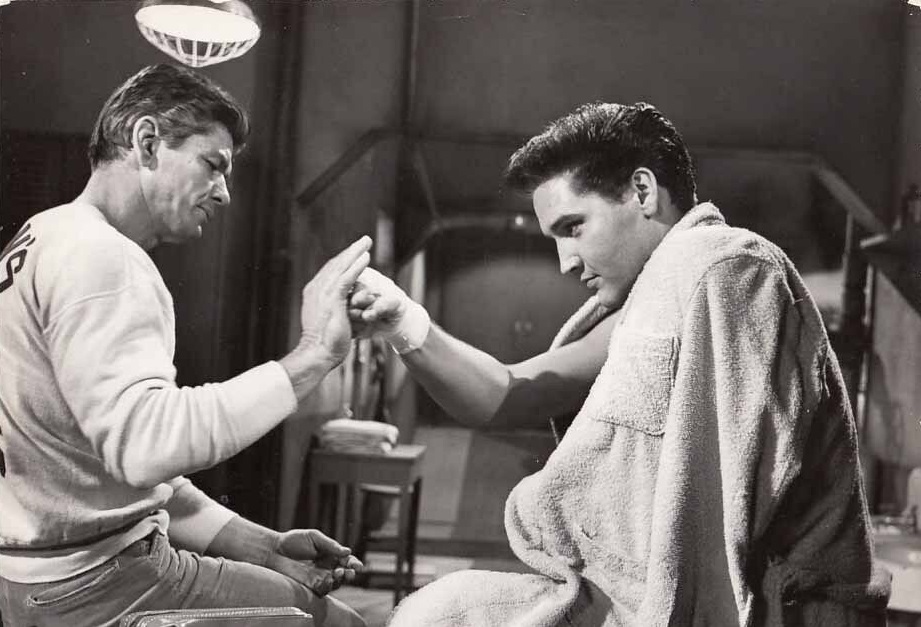
KID GALAHAD (1962) – Charles Bronson teaches Elvis how to box! Happy Birthday to the King!


In celebration of the January 8th birthday of the great Elvis Presley, I decided to watch his 1962 film KID GALAHAD, the only film where he co-stars with my movie hero Charles Bronson. I’ve always been a fan of Elvis Presley and seeing him on-screen with Bronson is a real treat for me.

KID GALAHAD opens with Walter Gulick (Elvis Presley) returning to his hometown in upstate New York. Recently discharged from the army, and in the need of money, the aspiring mechanic finds his way to Willy Grogan’s (Gig Young) boxing camp and agrees to spar with one of his up-and-coming young boxers. Walter doesn’t have much boxing skill, but he ends up having one hell of a right hook and knocks the young boxer flat on his ass. Seeing this, Willy Grogan, who has all sorts of personal and financial problems, thinks Walter might be the answer to getting out of debt to his bookie. Willy asks his trainer Lew (Charles Bronson) to work with the young, strong Walter, who’s now been dubbed “Galahad” by Willy’s girlfriend Dolly (Lola Albright) after he had protected her honor from a “man who doesn’t know how to behave around a lady.” Pretty soon, Willy has fights arranged for Walter under the name of “Kid Galahad.” The first fight begins with Galahad getting his faced being punched repeatedly until he gets one opening and then knocks the other fighter out with one punch. After that, with Lew’s help, Galahad’s skills start showing definite improvement. When he’s not working with Lew at the gym, Galahad finds time to romance and propose to Willy’s sister, Rose (Joan Blackman). This causes problems with the troubled Willy who doesn’t want his sister married to some “meatball” or “grease monkey.” Even worse, smelling money, gangster Otto Danzig (David Lewis) and his henchmen start putting pressure on the financially troubled Willy to force Galahad to take a dive in his big fight with “Sugar Boy” Romero so they can clean up on the fix, going so far as breaking Lew’s hands. Will Willy get the balls to say no to the gangsters? Will Galahad be able to beat Sugar Boy Romero and then retire to open his garage with Rose by his side? You probably already know, but you’ll just have to watch and see!

1962’s KID GALAHAD is a remake of a 1937 movie of the same name directed by Michael Curtiz, and starring cinematic legends Edward G. Robinson, Bette Davis, and Humphrey Bogart. I’ve never seen the earlier version, so I will not compare the two in any way. And to be completely honest, I haven’t watched very many Elvis Presley movies either. As I type this, I can’t think of a single moment I remember in his filmography not included in KID GALAHAD, and I wouldn’t have watched this one without the presence of Charles Bronson. With that said, I think Elvis gives a good performance in KID GALAHAD. He’s very likable, with his character having an old-fashioned chivalry towards women, a friendly, open way with men, and an appreciation for a strong work ethic. I think Elvis handles each of these parts of his character in a way to that makes me want to root for him. As good as Elvis is as Kid Galahad, Gig Young does most of the heavy lifting as the story really revolves around his character’s troubles even more than it does around Galahad. I think he does a pretty good job of taking a character who’s a pretty sorry guy, and by the end of the movie we actually find ourselves starting to like him. Even though he’s in a true supporting role, Charles Bronson is excellent as the trainer who teaches Galahad how to box. Every scene Bronson’s in is elevated by his enormous screen presence and authority. With Bronson in his corner, you feel Galahad is capable of anything. The most powerful scene in the entire film is when the gangsters try to buy his character off under the threat of violence, and he refuses, leading to his hands being broken. After becoming one of the biggest stars on the planet a number of years later, it’s easy to look back at these moments and wonder how in the hell was he not already a huge star in 1962.

Of course, this being an Elvis Presley movie, there are several musical numbers spread throughout the movie. While I don’t remember too much about the songs themselves, they didn’t really take me out of the drama of the movie either. I actually enjoyed seeing Elvis perform, with the people around him clapping along and enjoying themselves. I do remember a specific scene where Elvis is singing as he’s driving down the road, and Bronson’s sitting in the back seat with a big smile on his face like he’s having a great time. That’s my favorite moment of all the songs.  

Although I haven’t watched many of his movies, I’ve been an appreciative fan of Elvis Presley all my life. I can’t tell you how many times I heard his Christmas album in my younger years, as my mom would play it almost on repeat once we got to November. He was a talented, versatile singer whose charisma and stage presence have never been matched, and whose influence on music and entertainment is immeasurable. The fact that Elvis Presley and Charles Bronson made KID GALAHAD together means something to me, and I had a great time revisiting the film on his birthday!

See the Original Trailer for KID GALAHAD below.

Film Review: Wild 90 (dir by Norman Mailer)


Produced, directed, financed by, and starring writer Norman Mailer, 1968’s Wild 90 is incomprehensibly bad.  Words escape me when it comes to describing just how boring and pointless this film.

Over the course of four nights, Mailer and two of his friends were filmed in a shabby apartment.  Norman Mailer played The Prince, a gangster who talks tough and is constantly doing stuff like punching the room’s only hanging lightbulb.  Buzz Farber and Mickey Knox played Cameo and Twenty Years, the Prince’s partners in crime.  Acclaimed documentarian D.A. Pennebaker served as cinematographer, using a hand-held camera to capture the three men as they drank, laughed, fought, and pretended to be gangsters.

The plot of the film is not easy to describe, both because the entire film was improvised and also because the soundtrack is so muddy that it’s often impossible to understand what anyone’s saying.  As far as I can tell, the Prince’s latest criminal scheme has gone south and the Prince and his two cronies are hiding out in the apartment until the heat dies down.  They don’t have much to do, other than drink and exchange profane dialogue.  (The three men do their best to sound like real-life, poetically crude gangsters.  It’s hard to judge how well they do any of that because the dialogue is often incomprehensible.)  Some people drop by the apartment.  Normally, that would liven things up but in this one, everyone just seems like they want to leave before Norman Mailer accidentally punches them.  One man comes in a with a dog that start barking.  Mailer barks back until the dog falls silent.

Making all of this interesting is the fact that, in the 1960s, Norman Mailer was one of America’s leading public intellectuals.  Today, living in the age of influencers, it can be easy to forget that there were once public intellectuals, like Mailer, William F. Buckley, Gore Vidal, John Kenneth Galbraith, and Tom Wolfe, who disagreements were followed by the public and who made headlines when they showed up drunk on the daytime talk shows.  Mailer was an acclaimed and often controversial writer, one who was as famous for his arrogance and his public feuds as for his novels and essays. Mailer was a New York fixture and a Pulitzer Prize winner  He was one of the first writers to suggest that the Left and the Right could be united by a shared belief in individual freedom.  A year after the release of Wild 90, Mailer ran an ill-fated campaign for mayor of New York City.  His slogan was “No more bullshit!” and his campaign, which attracted some attention early on, was ultimately sabotaged by his habit of showing up drunk to his rallies and insulting his supporters.

What he was not was a very good filmmaker.  Wild 90 was Mailer’s first film and it’s a nearly unwatchable disaster.  (At least his later film, Maidstone, had Rip Torn around to liven things up.)  With its low-budget, black-and-white look and it’s DIY aesthetic, Wild 90 may remind some of the Andy Warhol’s Factory films but Warhol (or, if we’re to be absolutely honest, Paul Morrissey) was at least trying to be subversive.  Wild 90, on the other hand, is pure self-indulgence, a chance for Mailer to say, “Look how funny I am!”  Farbar and Knox at least manage to give semi-believable performances.  Mailer continually looks straight at the camera and seems to panic whenever either of his co-stars start to take the attention off of him.  The entire film seems to be Mailer’s attempt to convince everyone that he really was a tough guy.

There is one moment of the film that does work.  The film opens with some gorgeously shabby images of lower Manhattan. Norman Mailer was a proud New Yorker so it’s appropriate that the best part of the film is the part that highlights the city he loved.

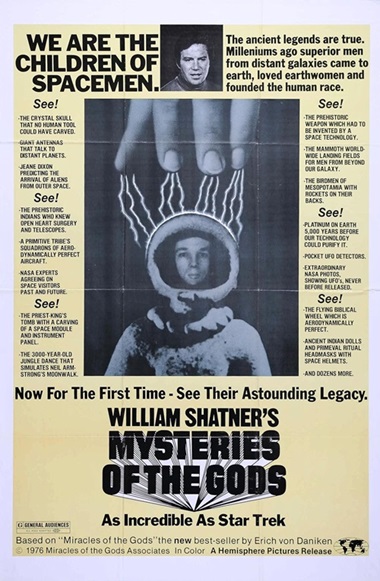
Documentary Review: William Shatner’s Mysteries of the Gods (dir by Harald Reinl and Charlie Romine)


First released in 1976, the German documentary Mysteries of the Gods raises the same questions that were asked by Chariots of the Gods and it offers up the same answers.  How did ancient man build the pyramids?  Aliens!  How were the giant statues of Easter Island moved to their final resting place?  Aliens!  Who created Stonehenge?  Aliens!  Who drew the South American ley lines?  Aliens!  Who took Elijah, Gilgamesh, and Enoch up into the sky?  Aliens!  Who is responsible for religion?  Aliens!

Mysteries of the Gods was made by the same people who did Chariots of the Gods but it’s less a continuation and more of a remake.  The only new thing that Mysteries of the Gods brought to the table was the suggestion that the governments of the world knew about the aliens and that they were, in some cases, working with the aliens.  I’ve already made my feelings about those theories clear.  I’m a skeptic and I’m proud of it.  Still, it’s interesting to wonder what type of advice the aliens would have given the world leaders.  I mean, considering everything that has happened over the past 66 years, it doesn’t appear to be very good advice!

Seriously, tell those dumbass aliens to go home and mess around with their own planet.

When Mysteries of the Gods came over to the United States, it was decided that the film needed a bit more of an American feel to it.  The original’s German narrator would have to go.  But who could replace him?  Who had the gravitas necessary to seriously discuss the theory of ancient astronauts?  Who would draw in the science fiction crowd while possibly still appealing to people who didn’t know much about the history of UFO sightings?  Who would have the proper enthusiasm for the project?  Who was reasonably famous but still enough in need of a paycheck that they would agree to be associated with something as shoddy as Mysteries of the Gods?

We all know the answer to that question.

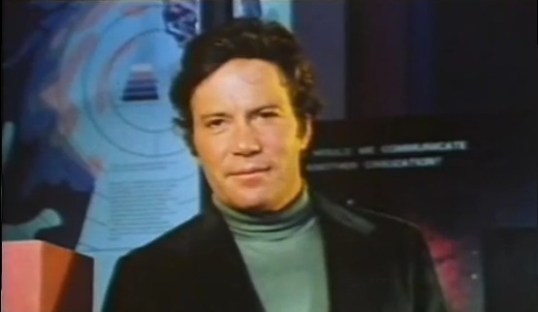
And if the American distributors were going to pay William Shatner to re-record the film’s narration, why not take full advantage of his presence and film some scenes of him interviewing various psychics and scientists?  Why not have him wax rhapsodic about a crystal skull while actually holding the artifact?  Why not have him actually visiting the locations described in the documentary?  Why not put him in a green turtleneck and a black jacket and present him as being the hip face of pseudo-science?  And why not change the title of the film to William Shatner’s Mysteries of the Gods, implying that Shatner himself had something substantial to do with the making of the film?

And let’s give credit where credit is due.  Mysteries of the Gods is a ludicrous documentary that provides even less evidence for its fantastical claim than Chariot of the Gods did.  But the American version of the film is worth watching, just to see William Shatner trying to repress his natural smirk while reciting the film’s overwrought narration.  Shatner appears to be amused by the whole thing and he definitely comes across as being a good sport as he gamely interview a series of crackpots who are all convinced they’ve cracked some sort of alien code.  The film ends on a triumphant note, with psychic Jeanne Dixon telling an excited Shatner that aliens will visit Earth in April of 1977.

Now, you may say that Dixon was incorrect.  There’s no record of aliens coming to Earth in 1977.  Maybe that’s just what they want you to believe!  To quote the Amazing Criswell, can you prove it didn’t happen?

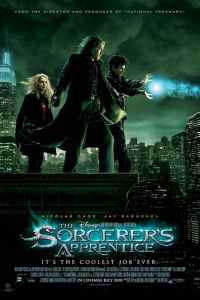
Quick Review: The Sorcerer’s Apprentice (dir. by Jon Turteltaub)


The Sorcerer’s Apprentice may be one of Disney’s better Live Action features. Borrowing from a small segment in Disney’s Fantasia, it builds a pretty cool story and still manages to pay homage to the original in it’s own way. Executive Produced by and starring Nicolas Cage, the film reunites him with his National Treasure director, Jon Turteltaub.

In the Dark Ages, the great wizard Merlin fought a major battle against the evil Morgana (Alice Krige, Star Trek: First Contact). At his side were his three apprentices, Veronica (Monica Bellucci, Beetlejuice Beetlejuice), Horvath (Alfred Molina, Prince of Persia) and Balthazar (Nicolas Cage). When Horvath betrays Merlin, both he and Morgana are defeated, contained in a layer of nesting dolls. Veronica is also part of the doll as she sacrifices herself to keep Morgana at bay. In order for Morgana to be destroyed, however, this can only be done by the Prime Merlinian, a Sorcerer of unimaginable power. To find the Prime Merlinian, Balthazar is given a ring for him to use.

When young Dave Stutler encounters Balthazar in his curio shop, we find that the ring does react to him and he may very well be the Prime Merlinian. Dave accidentally frees Horvath from the nesting doll and is saved by Balthazar before the pair of sorercers are trapped in an urn. 10 Years Pass (to the day), causing an event where both Horvath and Balthazar are freed. Can Balthazar train Dave (Jay Baruchel, Goon) in time to defeat Morgana, especially when Dave’s attentions are more focused on the girl of his dreams, Becky(Teresa Palmer, Netflix’s A Discovery of Witches)?

Thoughout his career, one of Cage’s magical traits is that he fully throws himself into a role. Not so much ‘method’ as maybe a Jeremy Strong (which may be more over the top), but he brings his own style to the mix. There isn’t a Cage character that isn’t enriched by the performances he brings to the table. For The Sorcerer’s Apprentice, he’s slightly subdued, but still carries the moxie he had in fllms like Face/Off, The Rock or even Mandy. He does make for a good father figure in this film.

Of course, the supporting cast is great. Molina makes for a nice villain in Horvath, with Toby Kebbell (Rock-n-Rolla) as an evil apprentice. Baruchel’s performance is pretty similar to what he did for How to Train Your Dragon, which made him perfect for this.

Building off of the National Treasure films, there’s as much humor in The Sorcerer’s Apprentice as there is adventure. After all, we are dealing with a tale of magic and wizards. There’s a cool car chase and a nice final confrontation. The connecting scene to Fantasia is a cute one, with magical brooms and mops trying to clean the workshop was a nice touch. The main theme of the story is just learning to believe in oneself and trust in what you’re capable of.

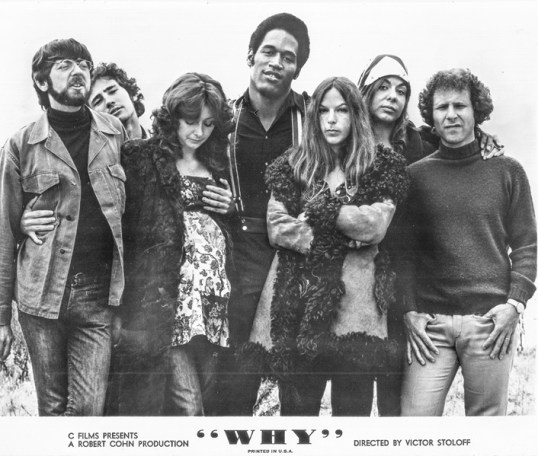
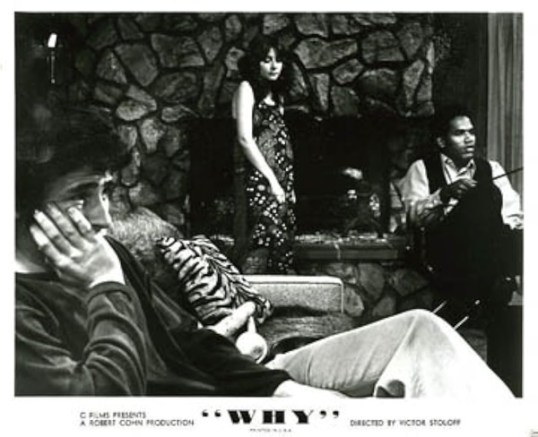
Insomnia Film #67: Why (dir by Victor Stoloff)


What’s an Insomnia File? You know how some times you just can’t get any sleep and, at about three in the morning, you’ll find yourself watching whatever you can find on cable or streaming? This feature is all about those insomnia-inspired discoveries!

If you’re having trouble getting to sleep tonight, you can always go over to either YouTube or Tubi and pull up Why, an obscure film from 1973 that has a semi-interesting cast.

The plot of Why is simple.  Six people gather at their psychiatrist’s mansion for group therapy.  Dr. Peter Carlson (played by Herb Goldberg, an actual psychiatrist) asks the members of the group questions and asks them to do things like try to imagine a moment that made them truly happy.  The members of the group discuss their problems and …. well, that’s pretty much it.

Who is in the group?  Jeannie Berlin plays Gail, a single mother who has been rejected by her family because she had an out-of-wedlock child with a black man.  Cathy Bleich plays Jennifer, who claims to be a teacher but who is also a pathological liar.  Linda Gillen is Christine, a rich teenager who is two-months pregnant and who is implied to be addicted to heroin.  Danny Goldman plays Bill, a suicidal gay man.  Musician Tim Buckley plays musician Glenn, who can’t get over his band breaking up.  And, playing a professional athlete named Bud, is O.J. Simpson.  “I smoke dope,” Bud says at one point before going on to explain why he thinks its important to be a good role model.

Why is an odd film.  It starts out with a lengthy animated sequence (complete with a hippie-style song) and then settles into being a stagey film that feels more like an extended acting exercise than an actual narrative.  It’s a talky film and some of the monologues work while others fall flat.  The best performances are given by Danny Goldman, Tim Buckley, and Linda Gillen but I imagine most people who watch this film will be giving most of their attention to O.J. Simpson, who talks about resenting the pressure to always be perfect.  In the end, there are no real break-throughs and one could argue that makes this the most realistic depiction of therapy ever filmed.

Reportedly, the film start out as a short film starring O.J. Simpson and Tim Buckley that was commissioned by Technicolor to see if video could be transferred to film.  The decision was made to expand the short into a feature.  The actors improvised during rehearsal and those improvs served as the basis for the script.  Again, this will probably be most interesting to people looking for hints into what it was like inside of O.J. Simpson’s head.  (O.J.’s character comes across as being friendly but guarded and quick to get angry about women in general.)

Again, it’s a talky film.  At times, it’s a rather boring film.  Many of the monologues start out strong but they tend to go on and on. Why might cure you of your insomnia.  That said, the film is interesting from a historical point of view.  It’s all very 70s, revealing a group of people trying to navigate a world that was still trying to figure out where they stood in the years immediately following the turmoil of 60s.  The characters have a brand new world ahead of them and none of them know if that’s a good thing or a bad thing.  Some things never change.

Previous Insomnia Files:

  1. Story of Mankind
  2. Stag
  3. Love Is A Gun
  4. Nina Takes A Lover
  5. Black Ice
  6. Frogs For Snakes
  7. Fair Game
  8. From The Hip
  9. Born Killers
  10. Eye For An Eye
  11. Summer Catch
  12. Beyond the Law
  13. Spring Broke
  14. Promise
  15. George Wallace
  16. Kill The Messenger
  17. The Suburbans
  18. Only The Strong
  19. Great Expectations
  20. Casual Sex?
  21. Truth
  22. Insomina
  23. Death Do Us Part
  24. A Star is Born
  25. The Winning Season
  26. Rabbit Run
  27. Remember My Name
  28. The Arrangement
  29. Day of the Animals
  30. Still of The Night
  31. Arsenal
  32. Smooth Talk
  33. The Comedian
  34. The Minus Man
  35. Donnie Brasco
  36. Punchline
  37. Evita
  38. Six: The Mark Unleashed
  39. Disclosure
  40. The Spanish Prisoner
  41. Elektra
  42. Revenge
  43. Legend
  44. Cat Run
  45. The Pyramid
  46. Enter the Ninja
  47. Downhill
  48. Malice
  49. Mystery Date
  50. Zola
  51. Ira & Abby
  52. The Next Karate Kid
  53. A Nightmare on Drug Street
  54. Jud
  55. FTA
  56. Exterminators of the Year 3000
  57. Boris Karloff: The Man Behind The Monster
  58. The Haunting of Helen Walker
  59. True Spirit
  60. Project Kill
  61. Replica
  62. Rollergator
  63. Hillbillys In A Haunted House
  64. Once Upon A Midnight Scary
  65. Girl Lost
  66. Ghosts Can’t Do It

Lisa Reviews An Oscar Nominee: Moonstruck (dir by Norman Jewison)


Nominated for Best Picture of 1987, Moonstruck is a film about love, romance, New York City, and being Italian.

Loretta Castorini (Cher) is a widow and a bookkeeper who lives with her parents, Cosmo (Vincent Gardenia) and Rose (Olympia Dukakis) in Brooklyn.  When her boyfriend, Johnny (Danny Aiello), asks Loretta to marry him, Loretta says yes even though she knows that, while she likes him, she’s not really in love with him.  After he proposes, Johnny reveals that he has to go to Sicily to see his “dying” mother.  He asks Loretta to pay a visit to his estranged brother, Ronny (Nicolas Cage), and invite him to the wedding.  Loretta, a strong believer in family and the importance of following tradition, agrees.

Loretta finds Ronny working in the bakery that he owns.  Ronny is not thrilled to learn that his brother has gotten engaged.  Ronny reveals that he has a wooden hand.  He lost his real hand when he accidentally placed it in a bread slicer while having a conversation with Johnny.  After he lost his hand, Ronny’s then-fiancée left him.  Ronny has never forgiven Johnny for the loss of his hand.  “I lost my hand!  I lost my bride!”  Ronny yells to the heavens.  Loretta, however, immediately understands that Johnny actually hurt his hand to get his fiancée to break up with him.  A conversation at Ronny’s apartment leads to the two of them impulsively sleeping with each other.  The next day, Ronny promises to never bother Loretta again if she agrees to go the opera with him.

What the guilt-stricken Loretta doesn’t know is that her father is having an affair himself and it turns out that Cosmo and Mona (Rose Gilette) enjoy the opera as well.  Meanwhile, Rose finds herself tempted by a lecherous college professor named Perry (John Mahoney).

There’s a lot of stereotypes to be found in Moonstruck.  Of course, passionate Ronny loves the opera.  Of course, the simple but well-intentioned Johnny abandons his fiancée so that he can rush to Sicily to be with his “dying” mother who, it turns out, isn’t dying at all.  Of course, Loretta slaps Ronny and tells him to snap out of it.  (I should note that I’m a fourth Italian myself so I could definitely relate to some of this film.  I’ve never liked opera, though.)  Fortunately, the film’s cast is so perfectly chosen and John Patrick Shanley’s script so adroitly maintains the balance between the broad comedy and the small dramatic moments that it doesn’t matter that all of the characters are a bit stereotypical.  The film comes to a wonderful life.  It’s impossible not love these characters, flaws and all.  Cher and Olympia Dukakis deserved the Oscars that they both won for this film.  Vincent Gardenia deserved the nomination that he received.  Nicolas Cage, Danny Aiello, and John Mahoney were not nominated but they should have been.  In particular, John Mahoney is heart-breaking in his small role, playing the type of lecherous character that most films would have just portrayed as being a cardboard buffoon.  As for Nicolas Cage, Moonstruck is a film that features both his trademark eccentricity and his ability to show the real and vulnerable human being underneath all of the bluster.  Moonstruck is a film about the search for love and the glory of finding it.  It’s a wonderfully romantic film, even if almost all of that love seems to involve infidelity.  As directed by Norman Jewison, Moonstruck not only celebrates falling in love but also celebrates being lucky enough to do so in New York City.  It’s a love letter not just to its characters but to the city as well.

Moonstruck was nominated for Best Picture but it lost to a far more epic production, The Last Emperor.


The Challenger (2015, directed by Kent Moran)


Jaden Miller (Kent Moran, who also directed) is a former honor student who threw away his scholarship to a private school when he got into a fight while defending another student.  Having dropped out of high school, Jaden now works as an auto mechanic in the Bronx.  When he and his mother (S. Epatha Merkerson) are evicted from their crummy townhouse, Jaden tries to make extra money by becoming a professional boxer.  As the “Bronx Boy,” he becomes a local hero and eventually, he wins the chance to challenge the light heavyweight champion of the world (Justin Hartley).

A by-the-numbers boxing movie, The Challenger was the final film of Michael Clarke Duncan and he’s the best thing about the movie.  Duncan plays Duane Taylor, the former boxing trainer who dropped out of the spotlight after one of his boxer threw a fight.  Duane agrees to train Jaden because he has a secret connection to both Jaden and his adoptive mother.  Clarke, with his powerful voice and his infectious laugh, is close-to-perfect in the role and he keeps things interesting, even when the movie sinks into an ocean of cliches.  The Challenger was released thee years after Duncan’s tragic death and the end credits feature behind-the-scenes footage of a friendly Duncan smiling and laughing with the film’s crew.  The movie may be imperfect but it serves as a tribute to a talented actor who passed away too young.