4 Or More Shots From 4 Or More Films is just what it says it is, 4 shots from 4 of our favorite films. As opposed to the reviews and recaps that we usually post, 4 Shots From 4 Films lets the visuals do the talking!
Today, the Shattered Lens wishes a happy birthday to Texas’s own Wes Anderson! It’s time for….
4 Shots From 4 Wes Anderson Films
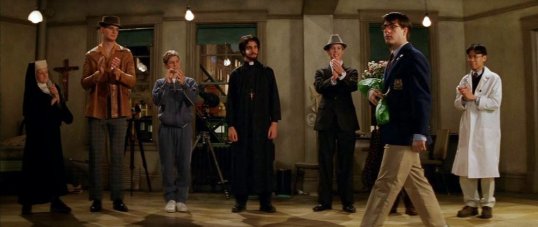
Rushmore (1998, dir by Wes Anderson, DP: Robert Yeoman)
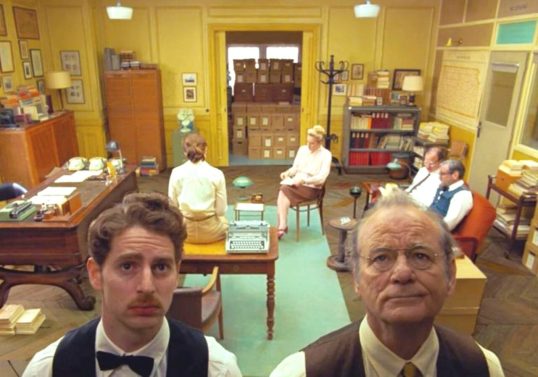
The Grand Budapest Hotel (2014, dir by Wes Anderson, DP: Robert Yeoman)
The French Dispatch (2021, dir by Wes Anderson, DP: Robert Yeoman)
Asteroid City (2023. dir by Wes Anderson, DP: Robert Yeoman)
2017’s The Death of Stalin opens in Moscow in 1953. Joseph Stalin (Adrian McLoughlin) calls into Radio Moscow and demands that he be sent a recording of the piano concerto that has just been performed live. The only problem is that no one bothered to record it while it was being performed. In a panic, the head of Radio Moscow announces that no one — not the musicians, not the exhausted conductor, and certainly not the audience — is allowed to leave until the orchestra has performed again.
Indeed, one of the recurring themes of The Death of Stalin is that everyone is terrified of their beloved dictator. The orchestra fears being executed for failing to recreate their performance. The members of the Central Committee fear being the next person to be purged from the ranks of Stalin’s government. The two guards that are posted outside of Stalin’s bedroom are so terrified of interrupting Stalin and getting on his bad side that they don’t investigate when they hear Stalin collapsing to the floor. When Stalin is found unconscious, the only doctors available are young and inexperienced because Stalin recently exiled all of the good doctors from Moscow. Even after Stalin dies from a cerebral hemorrhage, his reign of terror continues as all the members of his household staff are promptly executed to keep anyone from learning either the exact details of Stalin’s death or the way that the members of the Central Committee responded to his passing.
The Death of Stalin is a dark comedy that follows the members of the Central Committee as they scramble to protect their own positions after Stalin’s death. The humor comes from watching historical figures like Nikita Khrushchev, Vyacheslav Molotov, Lavrenti Beria, and Georgy Malenkov act like panicked junior executives who are desperately trying to save their own jobs during a corporate takeover. Of course, the stakes are a bit higher. Whoever succeeds Stalin will undoubtedly want to execute every other contender for the post. As with so many of Armando Iannucci’s works, the humor comes from watching very powerful people act in very immature and petty ways. While Malenkov (Jeffrey Tambor) tries to convince people that he actually is in charge, the brutal Beria (Simon Russell Beale) tries to bully his way into power and the wily Khrushchev (Steve Buscemi, giving one of his best performances) waits for his moment to strike. (Beria, it should be noted, is one of history’s greatest monsters and the film, while a comedy, does not shy away from his depravity.) Molotov (a hilarious Michael Palin) is so loyal to the Party that he says that Stalin was absolutely correct to have his wife executed just to then have Beria show up and reveal that Molotov’s wife is still alive. Meanwhile, Stalin’s idiot son (Rupert Friend) claims that it’s all an American plot while the rest of the Central Committee laughs at him behind his back. Only Georgy Zhukov (Jason Isaacs) seems to have full control of his emotions and his actions and it’s not a surprise to learn that, long after the events depicted in this film, purged from the Party. In The Death of Stalin, the leaders of Russia are obviously scared of anyone who is too competent at their job.
The Death of Stalin is not only a satiric portrayal of petty bureaucrats. It’s also a darkly humorous look of life in a dictatorship, where everyone is at the whim of whoever happens to be in charge at any given time. The film is full of power-hungry narcissists who use their ideology and their nationalism as a shield for their own ambitions. Everyone wants to control someone else. Even as mourners pass by Stalin’s coffin, they’re given orders on how to properly grieve and move. The film ends with a series of pictures of various people either having their faces scratched or, in some cases, just vanishing. In a free country, failure leads to humiliation. In a dictatorship, it leads to non-existence as the formerly prominent are suddenly erased from a history that no longer has a place for them. Ironically, of all the original leaders of communist Russia, it was Molotov who lived the longest. He was 96 when he died in 1986. If not for Stalin’s sudden death, he probably would have been purged and executed at the age of 63.
On this May Day, with so many people currently trying to rehabilitate the reputations of the 20th Century’s worst dictators, The Death of Stalin is must-watch.
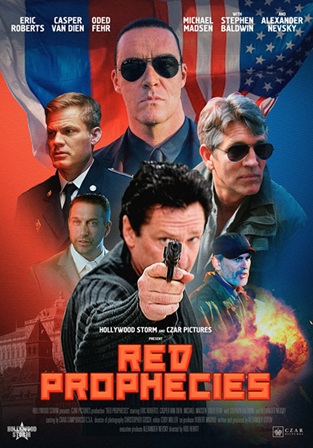
I was going to take a short break from reviewing the many films of Eric Roberts but then I came across 2021’s Red Prophecies on Tubi.
Actually, did I just say 2021? Coming up with a date for this film is actually a little bit more complicated than that. This film was apparently actually filmed in 2014 but it sat on the shelf for a while. The version that was released has a prologue and an epilogue that were obviously filmed in 2020. Russian actor Alexander Nevsky appears in both scenes, talking about his plans for manipulating the upcoming U.S. elections. It’s one of those scenes that is meant to be chilling but instead just reminds the viewer of how ludicrously melodramatic and performative most political discourse has been since 2017.
The majority of the film features Eric Roberts as John Payne, an American reporter who moves to Russia and becomes famous for his ability to predict what’s going to happen in Russian politics. For instance, Payne writes that an opposition leader is going to be arrested and he is! Payne gets his information from “The Oracle,” an anonymous source who sends him emails that John, who is supposed to be a veteran reporter, types up without question. Casper Van Dien, who is playing some sort of Russian intelligence agent, tries to figure out where Payne is getting his information from. Stephen Baldwin shows up as a shady Russian politician. Michael Madsen plays a UN official who Payne suspects is actually corrupt. (A corrupt UN official is probably the most plausible of the film’s plot points.) It’s all a part of a huge plot to destabilize both Russia and the United States. How it all links together is anyone’s guess. The story is not easy to follow, which is probably why the film sat on a shelf for seven years until someone realized that there was a market for international conspiracy films in the United States.
There’s a lot of familiar faces in this movie. We don’t actually hear their voices in the film because apparently, it would have cost too much money to have them come back to do ADR. So, instead, we get one person trying to sound like a dozen different people. Eric Roberts, Stephen Baldwin, and Michael Madsen all have very distinctive voices so when they all sound like a 20-something using autotune, you’re going to notice.
This was a messy film. I’m not really sure if it was mean to be pro-Russian or anti-Russian. The film takes place in Russia and it deals with people being oppressed and opposition leaders being murdered by the government but one name this is never mentioned is the name of Vladimer Putin. Is this movie supposed to be taking place in the real world or an alternate world? I was never quite sure. Several of the characters could have easily been cut from the film and again, buying the film’s story means accepting that a famously hard-boiled reporter would automatically trust an email sent to him by someone calling themselves The Oracle. It’s nice to see the cream of the B-movie, straight-to-video crop all in one film together but otherwise, Red Prophecies doesn’t add up to much.
Previous Eric Roberts Films That We Have Reviewed:
In 1959’s The FBI Story, veteran FBI agent Chip Hardesty (James Stewart) delivers a lecture to a group of new FBI recruits. He tells them the story of both the FBI and his time as a member of the agency. Somewhat implausibly, it turns out that Chip was involved with nearly every major FBI operation, as we discover while watching this flashback-filled, episodic film.
Battling the Ku Klux Klan in the Deep South? Chip was there.
Investigating the Oklahoma Indian murders? Chip was not only there but he was also the one who solved them through handwriting analysis! (Decades later, the crimes and the investigation would serve as the basis of Martin Scorsese’s Killers of the Flower Moon.)
During the public enemy era, Chip was there. He was there when Baby Face Nelson killed several unarmed FBI agents, including Chip’s best friend (Murray Hamilton). He was there when John Dillinger was gunned down in Chicago. He was there when my distant ancestor “Pretty Boy” Floyd was killed in Ohio. He wasn’t there when J. Edgar Hoover personally arrested Alvin Karpis or when “Machine Gun” Kelly said, “Don’t shoot, G-Man!” but Chip still makes sure to tell the recruits about it. He also talks about the gunfight that killed Ma Barker, presented her as being a machine gun-toting madwoman.
Chip investigates subversives during World War II and helped to round up Americans of German and Japanese descent during the internment era. (Chip insists that they weren’t rounded up because of their ancestry but because the FBI had gotten reports that they might be disloyal.) When the war wraps up, Chip turns his attention to fighting the international communist conspiracy and good for him. (Communism sucks!)
Strangely enough, it appears that Chip also tells the recruits a good deal about his personal life because we certainly do see a lot of it. Chip marries a librarian named Lucy (Vera Miles), who struggles with the demands of being an FBI agent’s wife but who ultimately accepts that Chip has to do his duty. Sometimes, Lucy wants Chip to quit and sometimes, Chip is tempted to get out. But they always remember that Chip and the FBI have a job to do. They raise a family. They lose a son at Iwo Jima. Their faith in God and country remains undiminished.
The FBI Story was made with the full cooperation of the FBI, with J. Edgar Hoover personally approving the script and making suggestions. Hoover even appeared as himself in the film, accepting a report about an airplane bombing with a grim look on his face. At one point, Chip is prepared to quit the FBI until he hears a speech from Hoover and he’s so inspired that he keeps his resignation letter tucked away in his suit pocket. Since this film came out in 1959, there’s no details of the FBI tapping the phones of Martin Luther King or Hoover collecting dirt on his political opponents. Instead, The FBI Story is pure propaganda, your reminder that law enforcement never makes mistakes and civil liberties can be always be sacrificed for the greater good.
It’s simplistic propaganda and it’s overlong and it promotes a few falsehoods as facts. (Despite what the film says, Pretty Boy Floyd had nothing to do with the Kansas City Massacre and most historians agree that Ma Barker was not the criminal mastermind that Hoover made her out to be after she was caught in the crossfire between her sons and law enforcement.) The film rather casually dismisses the concern over the World War II internments of American citizens. To me, something like that is a big deal but the film insists to us that it was all blown out of proportion. That’s the one moment when not even the film itself seems to be totally sold on what it’s selling.
Fortunately, the film stars the ever-reliable James Stewart, who brings his natural mix of charm and gravity to the role of Chip Hardesty. Stewart was a bit too old to play Chip as a bumbling young man in the early part of the film but, as the character grows up, so does Stewart’s performance. The scene where he and Vera Miles learn that his son has been killed in combat feels like it’s from a different and far better movie. I guess my point here is that James Stewart was one of those actors who could make even questionable material watchable and that’s certainly what he does with The FBI Story. The FBI, at a time when Hoover was aging and the excesses of the McCarthy era had left many Americans uneasy about the government, decides to borrow James Stewart’s credibility to boost their own. You may not like the FBI but how can you not love Jimmy Stewart?
The FBI Story came out the same year as one of Stewart’s best films, Anatomy of a Murder, a film that was a complicated as The FBI Story was simplistic. Stewart gives one of his best performances in Anatomy of a Murder, playing the type of character that Chip Hardesty probably wouldn’t want to have much to do with. With these two films, Stewart showed us both sides of the American justice system, the men who are tasked with enforcing the law and, even more importantly, the men who are tasked with making sure that law was enforced fairly. Whichever side your on, you have to be happy to have Jimmy Stewart there.
What’s an Insomnia File? You know how some times you just can’t get any sleep and, at about three in the morning, you’ll find yourself watching whatever you can find on cable or streaming? This feature is all about those insomnia-inspired discoveries!
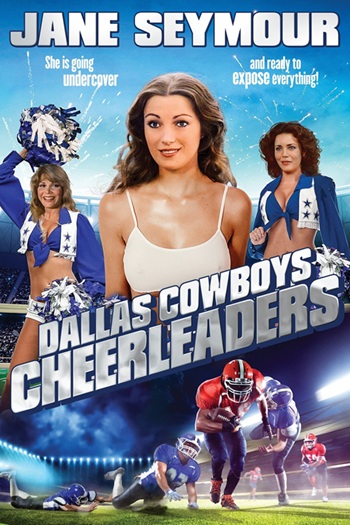
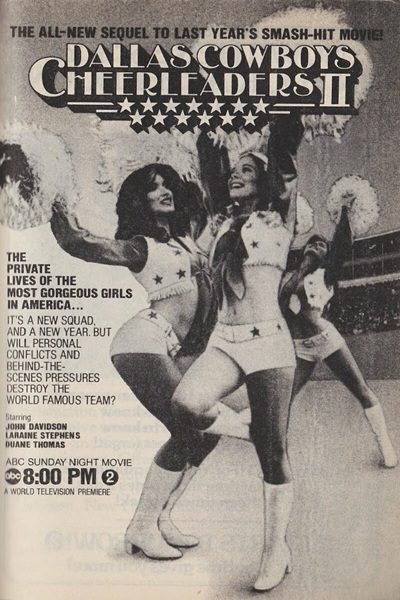
If you were having trouble getting to sleep last night, you could have gone over to YouTube and watched 1979’s DallasCowboysCheerleaders! And then, if you were still having trouble getting to sleep, you could have followed it up with 1980’s DallasCowboysCheerleaders II! And then if you were somehow still not able to get any rest …. well, sorry. There’s only two of them. I guess you could watch that MakingtheTeam show. I don’t know.
Anyway, back to the movies!
The first DallasCowboysCheerleaders stars Jane Seymour as a serious journalist who at first scoffs at the idea of going undercover as a Dallas Cowboys Cheerleader. But her ex-boyfriend and editor (Bert Convy) insists that she take the assignment. Jane goes undercover and even makes the squad! (It’s never mentioned whether she has any sort of dance or cheerleading experience so I find it a bit odd that she actually made it onto a professional cheerleading squad but whatever….) Seymour gets to know the other members of the Squad, including theLoveBoat’s Lauren Tewes. She comes to realize that she doesn’t want to write up a tabloid story about the cheerleaders. These are “good, down home girls,” she tells Convy. Convy doesn’t care. He wants scandal!
He’s not going to get it, though. The main message of this film is that the Dallas Cowboys Cheerleaders are basically saints with pom poms. Sure, one of them has a loser ex-boyfriend. And another one of them struggles a bit with the routines. It’s not an easy job but, in the end, everyone does their bit to support the team!
It’s all pretty silly but I’m from Dallas and I’m surrounded by Cowboy fans who have been complaining nonstop about the team for as long as I can remember so I enjoyed watching a movie that portrayed the Cowboys organization as being the greatest group of people on the planet. (No drug or gun problems here!) It’s very much a film of the 70s, made for television and straddling the line between being exploitive and being wholesome. Yes, the costumes are skimpy but no one smokes, drinks, or curses. The film features soapy drama, actual Dallas locations, 70s fashion, a great disco soundtrack, and dorky Bert Convy as a womanizer. Plus, like me, Jane Seymour has mismatched eyes. How can you not love this film!?
As for the sequel, it ditches almost everyone from the first film. Only Laraine Stephens, as the squad’s no-nonsense coach, returns. She’s got a whole new squad to deal with and only a limited amount of time to perfect the cheer that will win the Cowboys the Super….sorry, I mean to say the playoff game. Whenever anyone in the film says, “playoff game,” their lips read “Super Bowl,” so I guess there was some last-minute tinkering after shooting was completed. The squad also has to get ready to tour with the USO and to perform at a children’s hospital. (Ray Wise appears as a doctor at the children’s hospital.) The Cheerleaders are not only going to bring peace to the world but they’re also going to give those children the inspiration they need to get better. Yay!
This one isn’t as much fun, largely because Laraine Stephens’s character isn’t that much fun. The first film featured the very British Jane Seymour in Texas, somehow becoming a member of an all-American football team’s cheerleading squad and it was impossible not to enjoy the implausibility of it all. The second film is just Laraine Stephens getting mad at people for not having the routine down to perfection. No thanks, movie, I’m done with dealing with demanding choreographers. There’s a reason why I turned down all of those offers to join the cheer squad in high school. (For the record, my sister was the greatest cheerleader our high school ever had or ever will have! Erin watched the first movie with me a few weeks ago. She said it was okay but she didn’t think Jane Seymour was a convincing cheerleader.)
According to what I’ve read online, the first DallasCowboyCheerleaders film was a huge rating success. The second film was less so, which I guess is why there was never a third.
In 2022, sheriff’s deputies in Adams County, Ohio raided the home of rapper Afroman. According to the warrant, they were doing so on suspicion of drug trafficking and kidnapping. They found neither drugs nor kidnapping victims but they did find and seize over $5,000 worth of Afroman’s money. The money was later returned, with $400 of it missing. During the raid, they also damaged the front gate, blow up a door, and illegally turned off the house’s security cameras.
Afroman responded with three songs about the raid, all utilizing the footage that security cameras recorded before being shut down. The deputies attempted to sue, claiming that the videos were an invasion of their privacy. The judge eventually threw out their lawsuit though another lawsuit, claiming that the video and the songs “defamed” the deputies was allowed to proceed.
So, I guess you should enjoy the video for Will You Help Me Repair My Door? while you still can.



 Through the Shattered Lens