As some of our regular readers undoubtedly know, I am involved in hosting a few weekly live tweets on twitter. I host #FridayNightFlix every Friday, I co-host #ScarySocial on Saturday, and I am one of the five hosts of #MondayActionMovie! Every week, we get together. We watch a movie. We tweet our way through it.
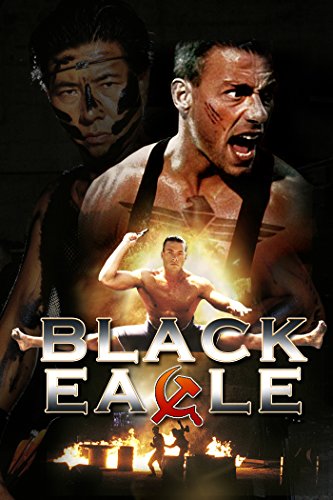
Tonight, for #MondayActionMovie, the film will be 1988’s Black Eagle! Selected and hosted by SweetEmmyCat, this movie stars Sho Kosugi, his sons, and Jean-Claude Van Damme! It’s also set in Malta, which I visited after graduating high school. The movie starts at 8 pm et and can be found on YouTube!
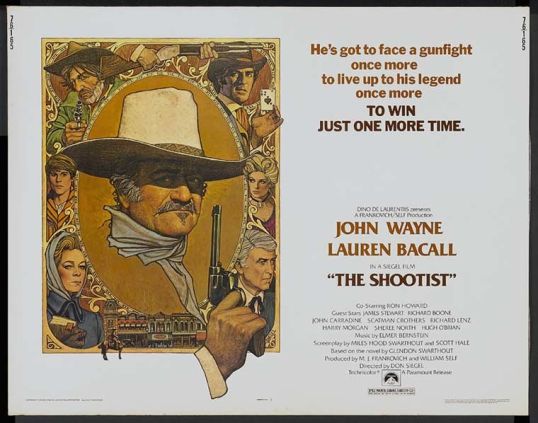
Following #MondayActionMovie, Brad and Sierra will be hosting the #MondayMuggers live tweet. We will be watching 1976’s The Shootist, the classic western that featured both John Wayne and Jimmy Stewart giving it their all. The Shootist is on Prime.
It should make for a night of fun viewing and I invite all of you to join in. If you want to join the live tweets, just hop onto twitter, start Black Eagle at 8 pm et, and use the #MondayActionMovie hashtag! Then, at 10 pm et, start The Shootist, and use the #MondayMuggers hashtag! The live tweet community is a friendly group and welcoming of newcomers so don’t be shy. And reviews of these films will probably end up on this site at some point over the next few weeks.
Today’s horror film is a true classic of its kind, the 1953 science fiction epic Robot Monster.
Now, I should admit that this is not the first time that I’ve shared Robot Monster in October. I share it every year and, every year, YouTube seems to pull the video down in November. That sucks because Robot Monster is one of those weird films that everyone should see. So, I’m going to share it again. And, hopefully, YouTube will let the video stay up for a while.
As for what Robot Monster is about…
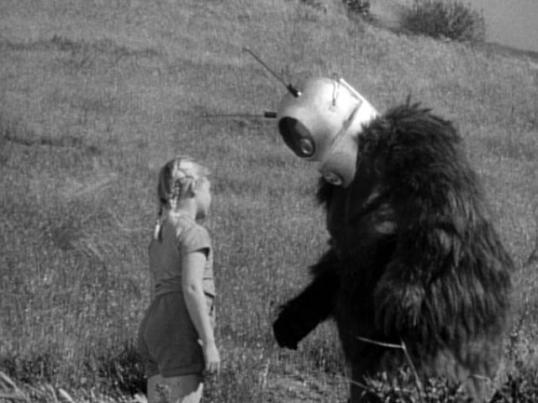
What happens with the Earth is attacked by aliens? Well, first off, dinosaurs come back to life. All of humanity is killed, except for one annoying family. Finally, the fearsome Ro-Man is sent down to the planet to make sure that it’s ready for colonization. (Or something like that. To be honest, Ro-Man’s exact goal remains a bit vague.)
Why is Ro-Man so fearsome? Well, he lives in a cave for one thing. He also owns a bubble machine. And finally, perhaps most horrifically, he’s a gorilla wearing a diver’s helmet. However, Ro-Man is not just a one-dimensional bad guy. No, he actually gets to have a monologue about halfway through the film in which he considers the existential issues inherent in being a gorilla wearing a diver’s helmet.
Can humanity defeat Ro-Man? Will Ro-Man ever get his intergalactic supervisor to appreciate him? And finally, why are the dinosaurs there?
Despite the film’s reputation for being borderline incoherent, most of those above questions actually are answered if you pay attention to the first few scenes of Robot Monster. In fact, one could even argue that Robot Monster is maybe a little bit more clever than it’s often given credit for. Of course, it’s still a zero-budget mess of a film but it’s also undeniably fun and, in some sections, unexpectedly dark. If you’ve never seen it before, you owe it to yourself to set aside an hour and two minutes in order to watch it. You’ve never see anything like it before.
Finally, I should note that Robot Monster’s hero was played by George Nader, who actually did go on to appear in several mainstream films. Despite his good looks and talent (which may not be obvious in this film but which he did have), George Nader struggled to get starring roles in Hollywood, where he was often dismissed as just being a member of Rock Hudson’s entourage. (It’s been theorized that Nader struggled because the studios feared that giving him too big of a role would lead to the gossip magazines writing about Nader’s relationship with Hudson, though the two were just friends. Nader was in a relationship with Hudson’s private secretary, Mark Miller, from 1947 until Nader’s death in 2001.) Nader finally left Hollywood and went on to have a pretty successful career in Europe. He was perhaps best known for playing secret agent Jerry Cotton in a series of films in the 60s.
Though he had retired from the band to pursue a solo career, Dee Dee Ramone wrote Poison Heart and gave it to Ramones. The story has always been that Dee Dee gave them the song as a way to thank the band for bailing him out of jail. I don’t know if that story is true or not but it does have a ring of truth to it. Print the legend, to quote The Man Who Shot Liberty Valance.
The song appeared on the soundtrack for Pet Semetary 2 and the video is clearly inspired by that song, with the child being forcefully dragged through the cemetery while the band performs in what appears to be an underground tunnel.
This video was directed by Samuel Bayer, who has done videos for just about everyone.
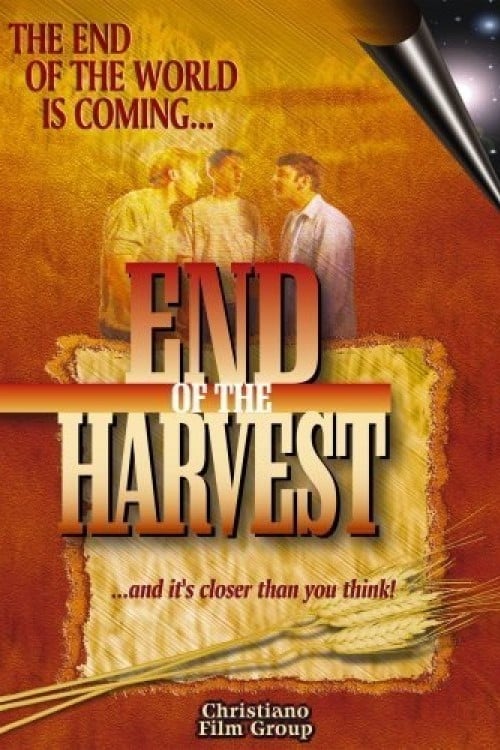
This 1995 film takes place on a college campus that is ruled over by the worst possible people …. THE PHILOSOPHY CLUB!
Okay, that might be an exaggeration. It’s a big campus and undoubtedly, most of the students are just doing their own thing and don’t particularly care about any of the clubs or any of the Greek organizations or any of that stuff. That said, it does seem like a surprisingly large amount of people are interested in the weekly Philosophy Club debates, despite the fact that the Philosophy Club itself seems to only have three members.
After seeing his religious friend get totally trampled while trying to debate the existence of God, Scott (Brad Heller) decides that it’s time to take a stand. Scott used to be a wild frat boy and he even lost his license due to a DUI. But now, he’s super Christian and he’s totally excited because he found a 50 year-old thesis about when the Bible says the world is going to end. Scott challenges the Philosophy Club to a debate and soon, flyers are being put up all over campus.
The only problem is that Scott isn’t ready for the debate. The Philosophy Club has uncovered the secrets of Scott’s dark past and, after they harass him on campus and start calling his ex-girlfriends, Scott starts to feel that he won’t be able to make his case. He begs Matt (David A.R. White) for help but Matt says that it’s pointless to try to debate anything in front of the Philosophy Club. The Philosophy Club doesn’t care about anything but Marx and Nietzsche. Matt not only thinks that the debate will be a waste of time but he also thinks that it will actually drive people away from religion.
Of course, Matt has another reasons for not wanting to talk about the end of the world. He’s been having odd dreams, in which he’s standing in a wheat field and watching an old farmer using a scythe to bring in the last harvest….
There have been several faith-base films that have been set on campus and they all have the same basic plot. A religious person goes to college and has their faith tested by people who were raised differently and who insist that science or philosophy can serve as a substitute for religion. It always seems to lead to a classroom debate and the religious student usually wins because all of the arguments have been slanted to their side. Of course, it’s not just Christian films that do this. If there’s one thing that Christians and atheists share in common, it’s an almost total ignorance about how the other side views the world and the questions of existence. Anti-Christian films always fall back on the stereotype of the fanatical parents who refuse to allow their children to leave the house. Christian films, on the other hand, always seem to feature an atheist who is angry at God. End of the Harvest doesn’t go quite as far into those stereotypes as some other Christian films do but it’s still hard not to notice that the bizarrely smug members of the Philosophy Club are left speechless by some pretty basic arguments. It’s the fantasy that both atheists and Christians tend to indulge in, the one where you come up with the pithy one-liner that no one can refute. Christians always want to know how you can be angry at a God you don’t believe in. Atheists always want to know, if God created everything, who created God. In the real world, both arguments can be easily refuted but, in the movies, they’re always game changers.
End of the Harvest is a fairly standard religion-on-campus film. It’s not going to convert anyone. That said, the scenes of Matt standing in that wheat field have a nicely surreal feel to them. In those scenes, it really does feel like the end is coming.
In the 2nd episode of Ghost Story, an important lesson is learned. If you’re going to bury a sea captain, do not bury him in concrete because his spirit belongs to the ocean. Upset his spirit and he’ll basically ruin whatever hopes you have of bringing tourists to the seashore!
This episode stars Gena Rowlands and Stuart Whitman and it was directed by none other than Richard Donner. Donner, of course, would go on to direct such films as The Omen, Superman, and Lethal Weapon.
Enjoy!
(Despite the weird thumbnail, this video should work if you click play.)
Usually, I only share Rangers stuff but today, Albert Pujols played his final regular season home game and he hit his 702nd career home run and the 23rd of what he says is going to be his final season. Pujols is now fourth on the career home run list, behind Babe Ruth (714), Hank Aaron (755) and Barry Bonds (762).
Moments like these are a huge reason why I love baseball.
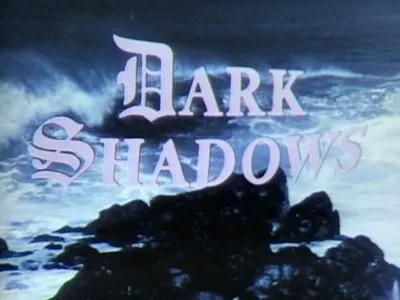
The year was 1967 and, in Collinsport, Maine, a petty criminal named Willie Loomis was about to make television history. Convinced that a fortune in jewelry was hidden in the Collins family’s mausoleum, Willie broke in and opened a coffin that, strangely, was covered in chains. Willie expected to find a fortune. Instead, he found Barnabas Collins, a 200 year-old vampire who transformed Willie into his servant and proceeded to spend the next five years masquerading as a cousin from Britain while searching for both a cure to his condition and for the reincarnation of the love of his life, Josette.
Played by stage actor Jonathan Frid, Barnabas Collins made his first appearance on the April 18th, 1967 episode of Dark Shadows. Though Barnabas was originally only meant to be a temporary addition to the show’s roster of characters, Frid proved to be popular with viewers, like my mother who not only watched the show when it first aired but also when reruns were broadcast in syndication many years later. The show soon came to center on the ruthless vampire.
In fact, Frid and Barnabas became some identified with the show that many are still shocked to learn that Dark Shadows had run for a full year before Barnabas was introduced as a character. When the show airs in syndication, it usually starts with Willie (played by John Karlen) opening Barnabas’s coffin and not with the earlier episodes in which the show’s nominal lead character, Victoria Winters, first arrived at Collinwood and met the members of the family.
Many future horror directors and writers have stated that their interest in the genre began with watching Jonathan Frid on Dark Shadows. And it all began with that one great moment when Willie Loomis opened the coffin and set Barnabas free.
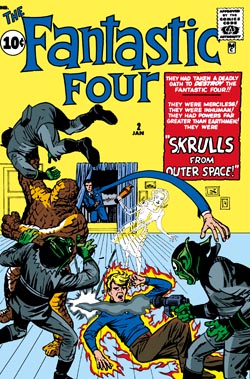
Just a few months after introducing themselves to the world, the Fantastic Four appear to be on a crime rampage! The Thing swims out to an oil rig and knocks it over with one punch. The Human Torch melts a memorial. The Invisible Girl steals jewelry. And when New York suffers a huge blackout, witnesses report seeing an arm stretching it’s way into a powerplant and flipping the off switch!
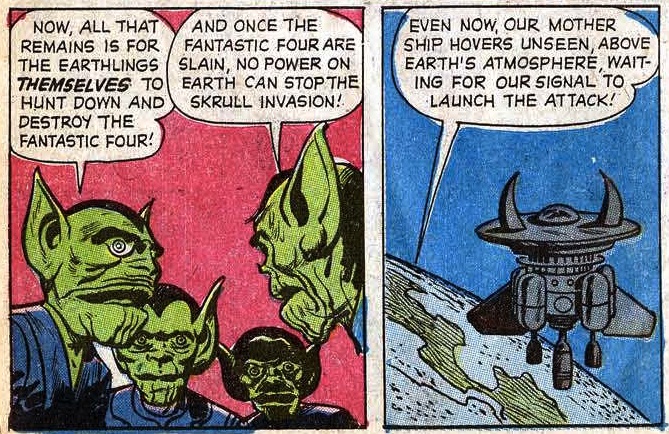
The Fantastic Four claim that they’re innocent and it turns out that they are. Four shape-shifting aliens, known as the Skrulls, have traveled to Earth and are pretending to be the Fantastic Four so that the government will turn on them and it will be easier for the Skrulls to take over the planet. Fortunately, Mr. Fantastic figures out what’s going on. Not only does he fool the Skrull commanders by showing them back issues of Journey Into Mystery and Strange Tales and saying that they’re actual newspapers about the monsters that exist on earth but he also hypnotizes three of the Skrulls on Earth and convinces them that they are cows.
I’ve always liked the Skrulls and it’s always bothered me that they seemed to lose almost every war that they got involved in. How could the Kree defeat the Skrulls? And was it necessary to add insult to injury by having Galactus eat their homeworld? The Skrulls just could not catch a break and I think that’s one reason why they’ve always been popular. With their ability to change their shape and adopt the powers of the heroes that they’re imitating, the Skrulls should have been unstoppable. They should have conquered this planet a long time ago. But the Skrulls, for all of their powers, could just never seem to get it together. To paraphrase Uncle Ben, with great power comes truly rotten luck.
Fantastic Four #2 was not only the first appearance of the Skrulls but it was also the first instance of a Marvel super hero team thwarting an invasion of Earth. (Eventually, Earth being invaded would become a monthly occurrence in the Marvel Universe.) The issue also introduced a major Marvel theme. The Fantastic Four may have saved the world from Mole Man just a few weeks before the Skrulls arrived but it didn’t take long for the general public to turn on them. It was a lesson that would later also be learned by Spider-Man and the X-Men. The general public is extremely fickle when it comes to its super heroes.
And it all started with four shape-shifters coming to Earth. The Skrulls may never win but Marvel still owes much to them.
Fantastic Four Vol. 1 No. 2
(September, 1962)
“The Fantastic Four Meets The Skrulls From Outer Space”
Script: Stan Lee Pencils: Jack Kirby Inks: George Klein Letters: John Duffy




 Through the Shattered Lens