An Offer You Can’t Refuse #20: The Untouchables (dir by Brian DePalma)


“Let’s do some good!” Eliot Ness shouts as he and a platoon of Chicago cops raid what they believe is a bootlegger’s warehouse.

That line right there tells you everything that you need to know about the 1987 film, The Untouchables.  In real life, Eliot Ness was known to be an honest member of law enforcement (which did make him a bit of a rarity in 1920s Chicago) but he was also considered to be something of a self-promoter, someone who tried to leverage his momentary fame into an unsuccessful political career.  In the 50s, after Ness had lost most of his money due to a series of bad investments and his own alcoholism, Ness wrote a book about his efforts to take down Al Capone in Chicago.  That book was called The Untouchables and though Ness died of a heart attack shortly before it was published, it still proved popular enough to not only rehabilitate Ness’s heroic image but also to inspire both a television series and the movie that I’m currently reviewing.

None of that is to say that Ness didn’t play a role in Al Capone’s downfall.  He did, though it’s since been argued that Ness had little to do with actual tax evasion case that led to Capone going to prison.  It’s just that, in real life, Eliot Ness was a complicated human being, one who had his flaws.  In The Untouchables, Kevin Costner plays him as a beacon of midwestern integrity, a Gary Cooper-type who has found himself in the very corrupt city of Chicago in the very corrupt decade of the 1920s.  The film version of Eliot Ness has no flaws, beyond his naive belief that everyone is as determined to “do some good” as he is.

So, The Untouchables may not be historically accurate but it’s still an entertaining film.  It’s less concerned with the reality of Eliot Ness’s life and more about the mythology that has risen up around the roaring 20s.  Everything about the film is big and operatic.  In the role of Al Capone, Robert De Niro sneers through every scene with the self-satisfaction of a tyrant looking over the kingdom that he’s just conquered.  While Costner’s Ness tells everyone to do some good, De Niro’s Capone uses a baseball bat to keep his underlings in line.  He goes to the opera and cries until he’s told that one of Ness’s men has been killed.  Then a big grin spreads out across his face.  It’s not exactly a subtle performance but then again, The Untouchables is not exactly a subtle movie.  It’s not designed to be a film that makes you think about whether or not prohibition was a good law.  Instead, everything is bigger-than-life.  It’s a film that takes place in a dream world that appears to have sprung from mix of old movies and American mythology.

In real life, Ness had ten agents working under him.  They were all selected because they were considered to be honest lawmen and they were nicknamed The Untouchables after it was announced to the press that Ness had refused a bribe from one of Capone’s men.  In the film, Ness only has three men working underneath him and they’re all recognizable types.  Sean Connery won an Oscar for playing Jmmy Malone, the crusty old beat cop who teaches Ness about the Chicago Way.  A young and incredibly hot Andy Garcia plays George Stone, the youngest of the Untouchables.  Best of all is Charles Martin Smith, cast as Oscar Wallace, a mild-mannered accountant who first suggests that Capone must be cheating on his taxes.  There’s a great scene in which the Untouchables intercept a liquor shipment on the Canadian border, all while riding horses.  Sitting on the back of his galloping horse and trying not to fall off, both Oscar Wallace and the actor playing him appear to be having the time of their lives.  For Oscar (and probably for much of the audience), it’s a fantasy come to life, a chance to “do some good.”

The Untouchables was directed by Brian DePalma and his stylish approach to the material is perfect for the film’s story.  DePalma fills the film with references to other movies, some from the gangster genre and some not.  (In one of the film’s most famous sequence, DePalma reimagines Battleship Potemkin‘s massacre on The Odessa Steps as a shoot-out between Eliot Ness and Capone’s men.)  DePalma’s kinetic style reminds us that The Untouchables is less about history and more about how we imagine history.  In reality, Capone was succeeded by Frank Nitti and The Chicago Outfit continued to thrive even in Capone’s absence.  In the film, Nitti (played by Billy Drago) brags about killing one of the Untouchables and, as a result, is tossed off the roof of a courthouse by Eliot Ness.  It’s not historically accurate but it makes for a crowd-pleasing scene.

Big, operatic, and always entertaining, The Untouchables is an offer that you can’t refuse.

Previous Offers You Can’t (or Can) Refuse:

  1. The Public Enemy
  2. Scarface (1932)
  3. The Purple Gang
  4. The Gang That Could’t Shoot Straight
  5. The Happening
  6. King of the Roaring Twenties: The Story of Arnold Rothstein 
  7. The Roaring Twenties
  8. Force of Evil
  9. Rob the Mob
  10. Gambling House
  11. Race Street
  12. Racket Girls
  13. Hoffa
  14. Contraband
  15. Bugsy Malone
  16. Love Me or Leave Me
  17. Murder, Inc.
  18. The St. Valentine’s Day Massacre
  19. Scarface (1983)

An Offer You Can’t Refuse #19: Scarface (dir by Brian DePalma)


“Hello to my little friend!”

Hi, little friend….

BOOM!

The 1983 film, Scarface, is a misunderstood film.  As we all know, it’s the story of Tony Montana (Al Pacino), who comes to Miami from Cuba along with his friend, Manny (Steven Bauer).  In return for murdering a former member of Castro’s government, Tony is given a job working for Frank Lopez (Robert Loggia).  When it becomes obvious that Tony is becoming too ambitious and might become a threat to him, Frank attempts to have Tony killed.  However, the assassination attempt fails, Tony murders Frank, and then Tony becomes Miami’s richest and most powerful crime lord.  Soon, Tony is burying his face in a mountain of cocaine while making deals with a sleazy Bolivian drug lord named Alejandro Sosa (Paul Shenar).  Tony also marries Frank’s mistress, Elvira Hancock (Michelle Pfieffer), though it’s obvious from the start the the only person that Tony truly loves is his sister, Gina (Mary Elizabeth Mastrantonio).  Anyway, it all eventually leads to a lot of violence and a lot of death.  Even F. Murray Abraham ends up getting tossed out of a helicopter, which is unfortunate since his character was a lot of fun.

Scarface is a famous film, largely because of Oliver Stone’s quotable dialogue and the no holds barred direction of Brian DePalma.  However, I think that people get so caught up on the fact that this is a classic gangster film that they miss the fact that Scarface is also an extremely dark comedy.  It satirizes the excess of the 80s.  Once Tony reaches the top of the underworld, he becomes a parody of the nouveau riche.  He moves into a gigantic house and proceeds to decorate it in the most tasteless way possible and there’s something oddly charming about this crude, not particularly bright man getting excited over the fact that he can finally afford to buy a tiger.  Towards the end of the film, there’s a scene where Tony rants while lounging in an indoor hot tub while Elvira languidly snorts cocaine and complains about the crudeness of his language and, at that moment, Scarface becomes a bit of a domestic comedy.  Tony’s reached the top of his profession, just to discover that it takes more than a live-in tiger and a wardrobe of wide lapeled suits to achieve true happiness.  So, he ends up sitting glumly in his office with a mountain of cocaine rising up in front of him.  “The world is yours” may be Tony’s motto but it turns out that the world is extremely tacky.  For all of his attempts to recreate himself as a wealthy and sophisticated man, Tony is still just a barely literate criminal with a nasty scar and a sour disposition.  The only thing he’s gotten for all of his ruthless ambition is an order of ennui with a cocaine appetizer.

I’ve always found Brian DePalma to be an uneven director.  He has a very distinct style and sometimes that style is perfectly suited to the story that he’s telling (i.e., Carrie) and sometimes, all of that style just seems to get in the way (i.e. The Fury).  Scarface, however, is the ideal story for DePalma’s over-the-top aesthetic.  DePalma’s style may be excessive but Scarface is a film about excess so it’s a perfect fit.  For that matter, you could say the same thing about Oliver Stone’s screenplay.  Stone has since stated that he was using almost as much cocaine as Tony Montana while he wrote the script.  The end result of the combination of Stone’s script, DePalma’s hyperactive direction, Pacino’s overpowering lead performance, and Giorgio Moroder’s propulsive score is a film that feels as if every minute is fueled by cocaine.  It’s not just a film that’s about drugs.  It’s also a film that feels like a drug.

Scarface is a big movie.  It runs nearly three hours, following Tony from his arrival in the United States to his final moments in his mansion, taking hundreds of bullets while grandly announcing that he’s still standing.  (Even after all of the bad things that Tony has done — poor Manny! — it’s impossible not to admire his refusal to go down.)  It’s also a difficult movie to review, largely because almost everyone’s seen it and already has an opinion.  Personally, I think the film gets off to a strong start.  I think the scenes of Tony ruthlessly taking control of Frank’s empire are perfectly handled and I love the scenes where Pacino and Steven Bauer just bounce dialogue off of each other.  They’re like a comedy team who commits murder on the side.  I also loved the “Take it to the limit” montage, which belongs in the 80s Cinema Hall of Fame.  At the same time, I think the final third of the movie drags a bit and that Tony’s sudden crisis of conscience when he sees that a man that he’s supposed to murder has a family feels a bit forced.  It also bothers me that Elvira just vanishes from the film.  At the very least, the audience deserved more of an explanation as to where she disappeared to.

But no matter!  Flaws and all, Scarface is a violent satire that holds up surprisingly well.  Al Pacino’s unhinged performance as Tony Montana is rightly considered to be iconic.  Pacino’s gives such a powerhouse performance that it’s easy to forget that the rest of the cast is pretty impressive as well.  I particularly liked the wonderfully sleazy work of F. Murray Abraham and Paul Shenar.  That said, my favorite character in the film remains Elvira, if just because her clothes were to die for and she just seemed so incredibly bored with all of the violent men in her life.  She goes from being bored with Frank to being bored with Tony and how can you not admire someone who, even when surrounded by all Scarface’s excess, just refuse to care?

Scarface is an offer that you can’t refuse.

Previous Offers You Can’t (or Can) Refuse:

  1. The Public Enemy
  2. Scarface (1932)
  3. The Purple Gang
  4. The Gang That Could’t Shoot Straight
  5. The Happening
  6. King of the Roaring Twenties: The Story of Arnold Rothstein 
  7. The Roaring Twenties
  8. Force of Evil
  9. Rob the Mob
  10. Gambling House
  11. Race Street
  12. Racket Girls
  13. Hoffa
  14. Contraband
  15. Bugsy Malone
  16. Love Me or Leave Me
  17. Murder, Inc.
  18. The St. Valentine’s Day Massacre

Song of the Day: Il Grande Silenzio by Ennio Morricone


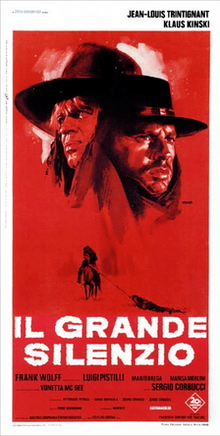
Today’s song of the day comes from Ennio Morricone’s score for the 1968 spaghetti western, The Great Silence.  Directed by Sergio Corbucci and featuring Jean-Louis Trintigant as a mute bounty hunter and Klaus Kinski as a savage outlaw, The Great Silence is one the darkest of the Italian westerns and Morricone’s elegiac score compliments the mood perfectly.

Previous Entries In Our Tribute To Morricone:

  1. Deborah’s Theme (Once Upon A Time In America)
  2. Violaznioe Violenza (Hitch-Hike)
  3. Come Un Madrigale (Four Flies on Grey Velvet)

Music Video of the Day: The Steps by HAIM (2020, dir by Paul Thomas Anderson)


I’m the youngest of four sisters and everyday, I’m thankful for that because I would seriously be so lost without them in my life.  I think that’s one reason why I like HAIM.  The Haim sisters remind me of my older sisters and that’s especially true in the video for The Steps.

The song, of course, is about a relationship that, if it hasn’t ended yet, is coming to an end.  The messiness of Haim’s morning routine perfectly mirrors the lyrics of the song, in which the narrator says that every time she tries to move forward, her lover gets mad at her for “making a mess.”  There’s something very liberating about HAIM’s messiness in this video.  It’s not just the fact that they’re throwing stuff all over the apartment and stumbling out of bed (which is the way I think most of us wake up but it’s something you rarely see in movies or music videos, where everyone wakes up refreshed and ready for a photo shoot) but it’s also the fact that there’s none of the fake glamour that you might expect to see in a music video like this.  It’s a song about freedom and being yourself and if that means making a mess then make a mess.  It’s a liberating song and a liberating video.  It’s not a video where HAIM tries to live up to some pop princess archetype.  This is a video that says, “This is who we are and fuck you if you can’t handle it.”

That said, I have to admit that I’m a compulsive cleaner and my natural instinct is to usually tidy up so my room has never looked as messy as my life.  I guess I should be happy about that because otherwise, I don’t think I’d ever be able to find anything.  And that’s okay.  It’s okay to be messy.  It’s okay to be neat.  What matters is that you’re being yourself and not allowing anyone to force you to try to be someone else.

This video, like most of HAIM’s recent videos, was directed by Paul Thomas Anderson.  The film critic Armond White has argued that Anderson’s work with HAIM is actually superior to most of his recent films and I think White might have a point.  (Before anyone starts yelling at me, I don’t care whether or not you like Armond White.  He’s a consistently interesting writer and someone has to be willing to be a contrarian.)  There’s a definitely naturalness to Anderson’s videos with HAIM, as if anything could happen at any moment.

Enjoy!

The TSL’s Grindhouse: The Murder of Nicole Brown Simpson (dir by Daniel Farrands)


Last year, I was one of the few people willing to defend The Haunting of Sharon Tate, which I felt was an effective film despite its rather icky premise.  I thought that the film managed to maintain a compelling atmosphere of dread and I also thought that, though somewhat miscast, Hilary Duff gave a good performance in the lead role.  Finally, I felt that, despite the exploitative nature of the film, the film was firmly on the side of Sharon Tate and the other victims of the Manson Family.  Though the title may have been offensive, the film itself was better than it had any right to be.

I really can’t say the same for The Murder of Nicole Brown Simpson, which is from the same production team as The Haunting of Sharon Tate and which imagines the final days in the life of another famous homicide victim.  Mena Suvari stars as Nicole Brown Simpson, the ex-wife of football player OJ Simpson (played, in a hyperactive manner, by Gene Freeman).  The film follows Nicole as she deals not only with her abusive ex-husband but also with shady friends like Faye Resnick (Taryn Manning) and slightly less-disreputable friends like Kris Jenner (Agnes Bruckner).

In the film, Nicole also has a short-lived affair with a handsome but unstable drifter named Glen Rogers (Nick Stahl).  In real life, Glen Rogers is currently incarcerated in Florida, where he awaits execution for a series of murders.  Rogers has confessed to killing people all across the country, though there’s some doubt as to whether or not Rogers was being honest when he did so.  (Rogers later recanted the confession.)  Rogers’s brother has claimed that Glen confessed to murdering Nicole Simpson and Adam Goldman, saying that he was actually hired to do so by OJ Simpson.  (Technically, Glen Rogers said that Simpson hired him to steal some jewelry but also gave him permission to kill Nicole if he felt that it was necessary.)  The film presents Rogers’s story as being fact, complete with a scene of OJ meeting with Glen shortly before the murders occur.

Other than making the case that Glen Rogers murdered Nicole and Ron, the majority of the film is just Mena Suvari walking around Los Angeles and talking to her friends about how she has a feeling that something terrible is going to happen.  Whereas The Haunting of Sharon Tate was willing to challenge the audience’s expectations by, at least briefly, changing history and presenting an alternate version of what could have happened that day in 1969, The Murder of Nicole Brown Simpson is pretty much a grim march towards death, with each scene bringing the audience closer and close to the night of the actual murderers.  If the film actually presented Nicole as being a fully-realized character as opposed to just a doomed victim, the story’s fatalistic atmosphere would work on an existential level but since the film doesn’t seem to care about who Nicole was before she died, it all just feels very sleazy.

Towards the end of the film, there’s an odd scene where an unseen force suddenly starts to violently throw Nicole across her bedroom, sending her against the walls and, at one point, pinning her to the ceiling.  It’s a weird scene because it comes out of nowhere and it’s never explained whether it really happened or if Nicole was imagining being attacked.  It doesn’t belong in this film and yet, it’s also the only moment when this film feels in any way unpredictable.  Is the film trying to suggest that death, as a paranormal entity, was stalking her even before the night of her murder or was the scene just tossed in to liven up what is otherwise a rather slowly paced movie?  Who knows?  Again, if the film had really explored the issue of whether or not fate is predetermined and inevitable, it would have made for a far more interesting story than the rush job that this film appears to have been.

Mena Suvari and Nick Stahl are two actors who probably deserve better than this.  Stahl is especially effective as the creepy but handsome Glen Rogers.  Visually, the film is full of Hollywood glamour and ominous shadows.  It’s not a bad-looking film, at all.  Technically, The Murder of Nicole Brown Simpson is well-made but, at the same time, it’s all just so astoundingly pointless.  The memory of Nicole Simpson deserved better.


An Offer You Can’t Refuse #18: The St. Valentine’s Day Massacre (dir by Roger Corman)


On February 14th, 1929, seven men were murdered in a garage in Chicago, Illinois.  Five of the seven men were known to be associates of gangster George “Bugs” Moran.  The other two men were considered to be innocent bystanders, a mechanic and a dry cleaner who just happened to enjoy hanging out with gangsters.  Though no one was ever convicted of the crime, it was well-known that the murders were carried out on the orders of Al Capone.

In many ways, the St. Valentine’s Day Massacre was a turning point in America’s relationship with organized crime.  Before the massacre, Capone had become a bit of a folk hero.  He knew how to talk to the press and he was viewed as merely breaking a law (in this case, prohibition) that most people opposed in the first place.  However, after the murders, public opinion soured on Capone.

Some of it was the brutality of the crime.  It’s been said that over five hundred bullets were fired in that garage, all to kill seven defenseless men who were lined up against a wall.  Grisly pictures of the victims were released to the press.  Perhaps if the seven men had been carrying weapons and had been involved in a shootout with their murderers, the public’s reaction would have been different.  But this was a cold-blooded execution.

Personally, I think the fact that the killers disguised themselves as cops also played a role in the public’s outrage.  It was a very calculated move on the part of the killers and it highlighted just how much planning went into the St. Valentine’s Day Massacre.  As well, it undoubtedly made people paranoid.  If a bunch of killer could dress up like cops, who knew who else they could dress up as?

Finally, I think that Capone’s biggest mistake was carrying out the crime on Valentine’s Day.  You don’t murder people on a holiday.  Anyone should know that.  If Capone had waited until February 20th, he probably could have gotten away with it.

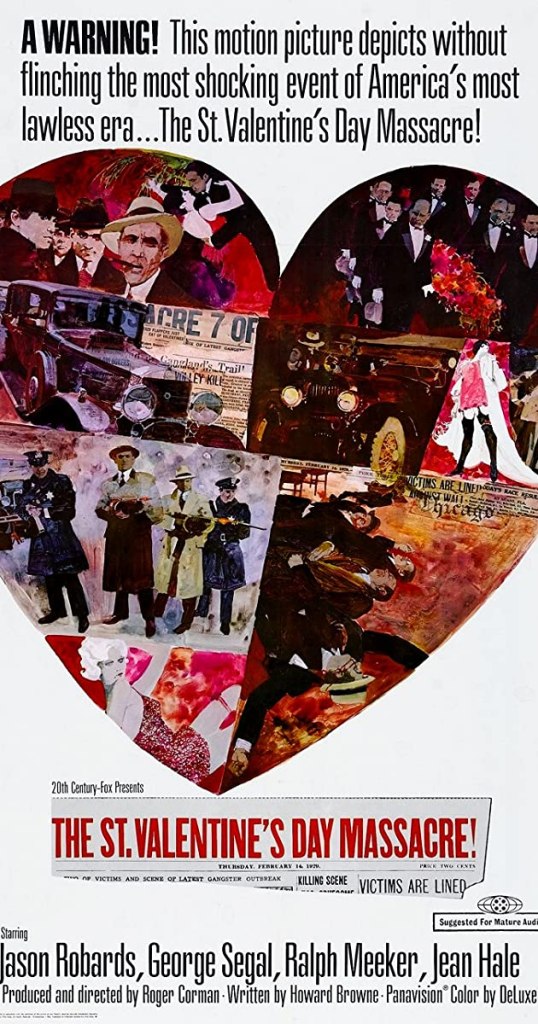
The 1967 film, The St. Valentine’s Day Massacre, details the rivalry between Capone and Moran, starting with them fighting for control over the Chicago rackets and ending with the title event.  Moran is played by Ralph Meeker while Jason Robards plays Capone.

Now I know what you’re probably thinking.  Perennial WASP Jason Robards as Al Capone?  That may sound like odd casting and, let’s just be honest here, it is.  However, it actually kind of works.  Robards may not be convincingly Italian but he is convincingly ruthless.  Add to that, one of the major subplots of the St. Valentine’s Day Massacre is that, even as the head of the Chicago Outfit, Capone still feels like an outsider in the world of organized crime because, while he is Italian, he isn’t Sicilian.  Capone feels as if Lucky Luciano and all of the major New York crime bosses look down on him and one reason why he’s so ruthless about taking over Chicago is that wants to show Luciano that he can be just as effective a crime lord as any Sicilian.  Capone feeling out of place in the Mafia is reflected by Robards initially seeming to be out of place in a gangster film.  By the end of the movie, of course, Capone has proven himself and so has Jason Robards.

Robards isn’t the only familiar face to be found in The St. Valentine’s Day Massacre.  Though this film was released by 20th Century Fox, it was directed by Roger Corman and Corman fills the production with members of his stock company.  Dick Miller, Jonathan Haze, and Jack Nicholson all have small roles as gunmen.  Bruce Dern plays the unlucky mechanic who enjoys hanging out with gangsters.  Buck Taylor, Leo Gordon, and Joe Turkel all have small roles.  John Agar plays Dion O’Bannon and is gunned down in his flower store.  Though not members of the Corman stock company, George Segal and David Canary plays brothers who work for Moran.  There’s a lot of characters wandering through this film but Corman makes sure that everyone gets a chance to make an impression.

It’s a good gangster film.  Though he was working with a larger budget than usual, Corman still brought his exploitation film aesthetic to the material and the end result is a violent, melodramatic gangster film that looks really impressive.  The film’s recreation of 1920s Chicago is a visual delight and looking at the well-dressed and stylish gangsters walking and driving down the vibrant city streets, you can understand why organized crime would have such a draw for some people.

The St. Valentine’s Day Massacre is a classic gangster film and a classic Corman film.  It’s an offer you can’t refuse.

Previous Offers You Can’t (or Can) Refuse:

  1. The Public Enemy
  2. Scarface
  3. The Purple Gang
  4. The Gang That Could’t Shoot Straight
  5. The Happening
  6. King of the Roaring Twenties: The Story of Arnold Rothstein 
  7. The Roaring Twenties
  8. Force of Evil
  9. Rob the Mob
  10. Gambling House
  11. Race Street
  12. Racket Girls
  13. Hoffa
  14. Contraband
  15. Bugsy Malone
  16. Love Me or Leave Me
  17. Murder, Inc.


The Late Shift (1996, directed by Betty Thomas)


Want to relive the public battle over whether David Letterman or Jay Leno would be Johnny Carson’s successor?

Then The Late Shift is the film for you!

Though it pales when compared to the subsequent battle between Leno and Conan O’Brien, the competition between Letterman and Leno to succeed Johnny Carson as host of The Tonight Show riveted America in the early 90s.  Most media critics (and, reportedly, Carson himself) felt that Letterman had not only earned the right to host The Tonight Show but that he represented the future of late night comedy.  The NBC network execs, however, preferred Leno, who had served for years as Carson’s permanent guest host and who was viewed as being more of a team player than Letterman.  The end result, of course, was that Leno got The Tonight Show, Letterman switched networks, and for years the country was separated into Leno people and Letterman people.  (Letterman got the critical acclaim but Leno got the ratings.)

The Late Shift opens with the unexpected retirement of Johnny Carson (played, as an enigma, by Rich Little) and then follows Letterman (John Michael Higgins) and Leno (Daniel Roebuck) as they maneuver their way to become his successor.  Unfortunately, neither Higgins nor Roebuck are particularly believable in their roles, though Roebuck does get to wear a truly impressive fake chin.  Far more impressive are Kathy Bates as Leno’s manager and Treat Williams as Mike Ovitz.  Bates rips through her scenes, destroying anyone standing in the way of Jay Leno while Williams is cool, calm, and menacing as the agent who was, at the time the film was made, the most powerful man in Hollywood.

The main problem with The Late Shift is that, when it went into production, Letterman was ahead in the ratings and the film is clearly sympathetic to him.  Leno comes across as a weasel while Letterman is portrayed as being neurotic but brilliant.  But, shortly before the film made its debut on HBO, Leno landed the first interview with Hugh Grant after the latter’s arrest with a prostitute.  Leno not only won that night in the ratings but he won every subsequent night and soon, Letterman was the one who was forever stuck in second place.  A title card was added to the end of  The Late Shift, admitting that Leno was now winning the war for the late night.  Since every minute of the film was designed to make Letterman appear to the winner, it’s hard not to be let down by the ending.

Despite the disappointing ending, The Late Shift is an entertaining look at network politics.  (Seinfeld fans will note that, after playing a version of Warren Littlefield during the show’s 4th season, Bob Balaban was cast as the real thing in The Late Shift.)  After watching the movie, be sure to read the Bill Carter book on which it’s based.

4 Shots From 4 Films: Special Kevin Bacon Edition


4 Shots From 4 Films is just what it says it is, 4 shots from 4 of our favorite films. As opposed to the reviews and recaps that we usually post, 4 Shots From 4 Films lets the visuals do the talking!

Today is the birthday of everyone’s favorite, hard-working character actor, Kevin Bacon!  And that means that it’s time for….

4 Shots From 4 Films

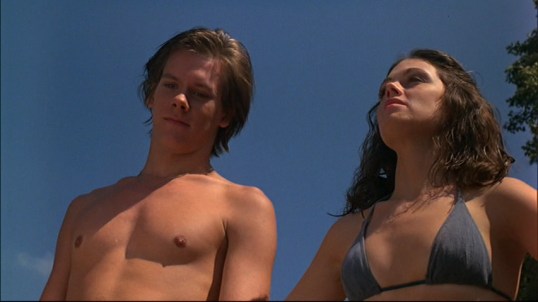
Friday the 13th (1980, dir by Sean S. Cunningham)

Quicksilver (1986, dir by Thomas Michael Donnelly)

JFK (1991, dir by Oliver Stone)

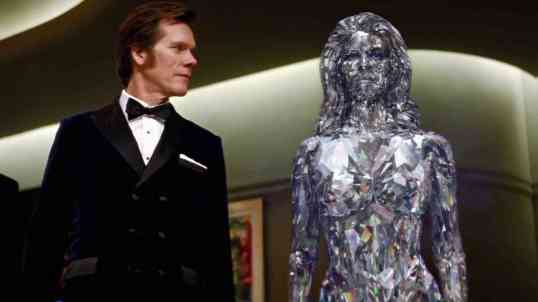
X-Men: First Class (2011, dir by Matthew Vaughn)


Song of the Day: Come Un Mardigale by Ennio Morricone


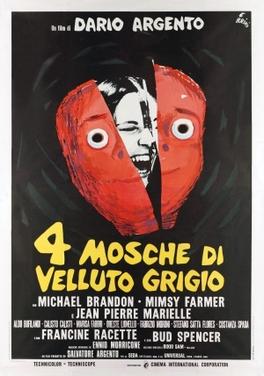
Today, we continue our tribute to Ennio Morricone with Come Un Madrigale, which he composed for Dario Arengto’s 1971 giallo, Four Flies on Grey Velvet!  Morricone scored Argento’s first three films and his atmospheric music was as important to their success as Goblin would be to the success of later Argento films like Suspiria and Deep Red.

Previous Entries In Our Tribute To Morricone:

  1. Deborah’s Theme (Once Upon A Time In America)
  2. Violaznioe Violenza (Hitch-Hike)