The Daily Grindhouse: My Brother’s Wife (dir by Doris Wishman)


My Brother's WifeReleased in 1966 and directed by Doris Wishman, one of the few women to make a living from directing grindhouse films, My Brother’s Wife is an odd one.  Filmed in stark black-and-white and featuring restless camerawork that suggests that the camera is as desperate as the characters in the film, My Brother’s Wife plays out like a wonderfully sordid dream.

My Brother’s Wife opens with two men getting into a fight at a pool hall.  As they fight, we hear (via the film’s oddly disconnected dialogue) that someone is dead and that one of the men is responsible.  In the best tradition of film noir, the rest of the movie is told in flashback.

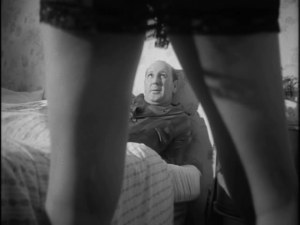
Frankie (Sam Stewart) is a loser, a drifter who wanders from town to town and who carries a gun in his suitcase.  On a whim, he pays a surprise visit to his older brother, Bob (Bob Oran).  Bob is everything that Frankie isn’t.  Bob is successful, kind, responsible, bald, and married to the much younger Mary (June Roberts).  Mary, who is frustrated with Bob’s lack of sexual passion, finds herself attracted to Frankie.  Soon, she and Frankie are having an affair.  Frankie starts to put pressure on Mary to steal all of Bob’s money and give it to him so that he can leave town.

Mary, of course, assumes that she’s going to be leaving town with Frankie but what she doesn’t know is that Frankie has got another girlfriend.  Zena (Darlene Bennett) is Mary’s opposite.  Whereas Mary is wracked with guilt over her affair with Frankie, Zena is a prototypical lingerie-clad grindhouse  bad girl.  However, Zena lives in fear of her lesbian cousin and is just as anxious as Frankie to get her hands on some money and to get out of town…

Zena!

Doris Wishman was one of the more eccentric grindhouse directors and her trademark surreal aesthetic is on display in My Brother’s Wife.  Very little actually happens in this 61-minute film but it remains watchable because Wishman brings so many odd touches to the material that the film could easily be mistaken for a film from David Lynch.

Visually, My Brother’s Wife is a film full of jarring camera angles and restless energy.  When Mary complains to Bob about their nonexistent sex life, the camera shows us their reflection in the bedroom mirror before panning over to show the two of them in the flesh before then panning back to their reflection in the mirror.  When the film’s characters leave a room, they do it by walking straight towards and occasionally looking directly at the camera.  Rarely does the camera ever film anyone straight on.  Instead, it always seems to be situated either above or directly below the film’s cast.

Of course, it can be argued that a lot of the film’s aesthetic touches were due less to artistic vision and more to the low-budget realities of grindhouse filmmaking.  For instance, Wishman shot the film without sound and the film’s sparse dialogue was dubbed during post-production.  As a result, there’s no background noise (which gives the entire film a sparse, ennui-drenched feel) and the tone of the voices delivering the dialogue often feels totally disconnected from the action on-screen.

Of course, the major issue with dubbed films is that the dialogue rarely matches the movement of the lips on-screen.  Wishman handles this issue by rarely allowing us to actually see anyone talk.  Instead, she shows us people reacting to someone else speaking.  Often times, she’ll cut to a shot of someone’s feet while they speak or else the camera will seem to randomly focus on whatever inanimate objects happens to be sharing the room with the people talking.  In perhaps the film’s strongest visual, we listen to Mary and Frank have a conversation while we look at their shadows projected on the bedroom wall.  It’s all rather dream-like and compulsively watchable.
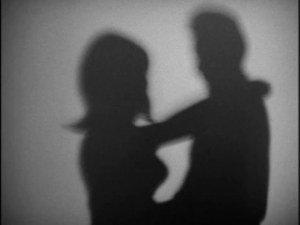
My Brother's Wife ShadowsMuch like David Lynch and the filmmakers of the French New Wave, Doris Wishman built the foundation of her own unique sensibility on B-movie material.  The cinematic world of Doris Wishman is one where weak men can’t resist duplicitous women and where everyone — regardless of innocence or guilt — is left punished at the end.  In Wishman world, all the men speak in hard-boiled dialogue and you can tell whether a woman is a good girl or a bad girl by what color lingerie she’s wearing.  Personally, if I had a time machine, I would love to go back to 1960s New York and audition to be a Doris Wishman bad girl.

Seriously, bad girls have all the fun.

While My Brother’s Wife may not be the best known film in Wishman’s eccentric filmography (that honor would probably go to either Nude on the Moon or Bad Girls Go To Hell), it’s still a valuable example of the Wishman aesthetic.
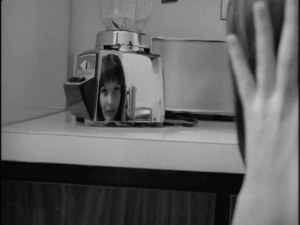
My Brother's Wife Mary In The Toaster

The Daily Grindhouse: Bunnyman (dir by Carl Lindbergh)


It seems like almost every holiday has inspired at least one horror film.  There’s been a host of films about killer Santas, there’s the Halloween films, and who could possibly forget Valentine?  Even Thanksgiving inspired Eli Roth to make a fake trailer for Grindhouse.

But what about Easter?

My BFF Evelyn and I were discussing this a while back.  Though both of us know our horror history, neither one of us could think of one horror film that takes place on Easter.  Finally, we both agree that the Easter Bunny just isn’t scary enough to inspire a horror film.  Santa Claus, after all, punishes boys and girls who haven’t been nice while the Tooth Fairy is just a paranormal dentist.  But the Easter Bunny…nobody could possibly be scared of the Easter Bunny, right?

Well, it would appear that director Carl Lindbergh disagreed with both me and Evelyn and he set out to prove it by making a movie.

Ladies and gentleman, it’s Bunnyman!

As Bunnyman begins, we meet six young morons who are driving through the countryside.  We never find out why they were all together or where exactly they were driving to but, before we can spend too much time worrying about that, they’re suddenly being chased by a mysterious truck which forces them off the road and causes them to crash and get stuck.  One of the six morons gets out of the car and starts trying to fix it.  (I’m using the term “moron” because — though the end credits claim that all of these characters have individual names — nobody uses them during the actual movie.  Instead, they communicate mostly by going, “Hey you!’ and “Let’s go!” and “Run!”)  While the mechanic moron is under the car, the truck comes driving up again and rams the car, killing mechanic moron.  The surviving morons get out of the car and spend the rest of the movie running through the woods.  Pursuing them is the driver of the truck who is carrying a chainsaw and dressed like the Easter bunny.

And that’s pretty much the entire film.  Oh sure, the morons run into a few random country folks, the majority of whom tell them to go away.  On this note, I do have to give the movie credit.  I may be a city girl now but I grew up in the country and I can tell you that, if there was anything that we weren’t going to mess with, it would have been a man carrying a chainsaw while dressed up like the Easter bunny.

Seriously, no way!

As always happens in these unfortunate situations, some of the morons die in the wilderness and then some more die when they stumble into Bunnyman’s cabin.  Bunnyman, by the way, lives with a hunchback and likes to perform experimental surgery while listening to classical music.

Bunnyman might not sound like much and, to be honest, it’s a pretty bad movie that only occasionally manages to be so bad that it’s good.   The writing is terrible and the acting is worst and director Lindbergh tells his story with absolutely no sense of pace or subtext.  (Seriously, there’s one scene where the morons talk to a redneck and that scene seems to go on for about 3 hours.  It’s a bit like some sort of odd MK-Ultra endurance test.)  The film also has a very strange sound mix.  Sometimes, the movie is way too loud and then other times, you can’t hear a thing.

However, with all that said, Bunnyman is also literally your only chance to see a man in an Easter bunny costume chasing a bunch of morons with a chainsaw.

That has to be worth something.

Supposedly, Bunnyman is based on an actual urban legend from Virginia and, according to the legend’s wikipedia page entry, the legend is actually pretty close to the film.  To which I have to say “Really?  A bunny costume?”  Then again, I’m from the southwest, the home of La Llorona, Goatman, and the Chupacabra so maybe I should just let sleeping bunnymen lie.

A Quickie With Lisa Marie: The Harrad Experiment (dir by Ted Post)


Earlier this week, when I reviewed the obscure Sissy Spacek film Katherine, I mentioned that I had seen Katherine as one of the three films included on the Classic Films of the 70s DVD.  The other two films included on the DVD were Born to Win and The Harrad Experiment.  Now, I have to admit that I’m having trouble recalling much about Born To Win but The Harrad Experiment … seriously, that’s a film that I’ll never forget.

First released in 1973 and reportedly based on a “daring” book about the sexual revolution, The Harrad Experiment opens with Sheila (Laurie Walters) hugging a tree and it’s all downhill from there.

Sheila Hugging A TreeSheila is excited because she’s just enrolled at Harrad College, an experimental school that’s run by Prof. Stuffy Q. Borington (James Whitmore) and his wife, Cougar Milf (Tippi Hedren).  Okay, I made up those two names.  Prof. Borington is actually named Philip Harrad and his wife is named Margaret but seriously, I like my names for them better.  Anyway, Philip and Margaret are obsessed with the need for society to throw off the shackles of sexual repression and Harrad College’s entire curriculum is devoted to students debating monogamy, taking yoga classes, and standing in a circle while holding hands and chanting, “Zoom.”  Everyone has a roommate of the opposite sex and they’re encouraged to have sex with every other student enrolled at the college.  (Interestingly enough, all of the students at the college appear to be heterosexual.)

Sheila, it turns out, is not only a virgin but is also so extremely prudish that you have to kind of wonder why she enrolled at Harrad College to begin with.  Her roommate Stanley (Don Johnson, who was so criminally hot here that it’s hard to believe that he would eventually end up playing the loathsome Big Danny Bennett in Django Unchained) has the opposite problem.  Stanley’s a long-haired rebel type and both Philip and Margaret are worried that he’s mostly attending their sex school because he just wants to get laid as opposed to getting laid and then discussing the social ramifications of getting laid.

Now, you’re probably thinking that The Harrad Experiment, being a film about sex, would feature a lot of sex.  Well, you would be wrong.  Instead, there’s a lot of scenes of Philip smoking a pipe and talking about sex and explaining why the concept of marriage is a dying one.  At one point, a students asks Philip to explain why, if he believes that, he’s still married to Margaret.

“We represent the past,” Philip explains, which is seriously such a cop-out.

(While I agreed with a lot of what Philip had to say about the prudish ways of our hypocritical society and I’m certainly not a believer in traditional marriage, I still found myself wondering what one would actually do with a degree from Harrad College.  This led to me imagining that annoying Everest College pitchman doing commercials for Harrad College — “You’re spendin’ all day on the couch, you ain’t getting none…” — and I started giggling for so long that I temporarily forgot that I was watching a movie.)

While there isn’t much sex, there is a lot of nudity and almost the entire cast (except for Whitmore, Hedren, and Fred Willard — yes, Fred Willard is in this movie) appears naked at some point.  That’s pretty good when it’s someone like Don Johnson but, unfortunately, the majority of the cast is made up of people like this guy:

Harrad Nudity

The Harrad Experiment is a slow, boring, and bad film but it’s one that everyone should see at least once, if just so they can say that they’ve seen it.  If nothing else, it’s a time capsule of the late 60s and the early 70s and we all know the only saying about those who forget the past.

Zoom indeed!

Hottie of the Day: Jessica Chastain


JESSICA CHASTAIN

Chastain11

Well, I might as well get on the Jessica Chastain bandwagon. She’s the latest pick for “Hottie of the Day” and also another addition to the redhead selections that’s growing (but still not the number 1 redhead on the site).

Jessica Chastain seemed to have come out of nowhere in the last two years. While she has been acting for many years before 2010 it wasn’t until 2011’s release of Terence Malick’s The Tree of Life which finally got her noticed. Since then she has been such films as Corialanus, Take Shelter, The Help, The Debt and Lawless. In each and every film she has been singled out as one of the highlight performances and from what I’ve seen she’s definitely deserving of the praise she’s been receiving.

Yet, it’s in 2012’s Zero Dark Thirty that Chastain may have finally gone from ingenue stage to full-blown star. She carries Kathryn Bigelow’s film from start to finish and all the accolades and acclaim she has been receiving for that performance may just snag her a Best Actress Oscar award next month. Even the box-office is not immune to the redhead’s growing star power as the top two films in North America for the weekend of Jan. 18-20 has her in the starring role with Zero Dark Thirty and the horror film Mama.

Born near my neck of the woods of Sonoma, California, Jessica Chastain is a graduate of the famed Julliard School in New York City and worked her way through the Hollywood system by getting supporting roles in tv series after tv series before her breakout role as the mother in The Tree of Life.

Chastain

Chastain01

Chastain03

Chastain04

Chastain06

Chastain07

Chastain08

Chastain10

PAST HOTTIES

The Daily Grindhouse: The Last Resort (dir by Brandon Nutt)


The Last Resort is a low-budget horror film from 2009 that tends to show up on Chiller a lot.  It’s a low-budget film about annoying people who, largely as the result of their own stupidity, get trapped in a really bad situation.  It’s a movie that many people dismiss but I’ve always found it to be a pretty effective little horror film.

In The Last Resort, Kathleen (played by Marissa Tait) is a bride-to-be who decides to go down to Mexico with her bridesmaids and have one last wild weekend for getting married.  They spend their first night in Mexico getting drunk and one of the bridesmaids, Sophia (America Olivio), leaves the group to spend the night with an American tourist named Rob (Nick Ballard).  The next morning, Kathleen and the three bridesmaids decide to take a tour of the countryside with two rather sleazy locals.  Sophia is left behind.

Not surprisingly, the two locals drive the group out to the middle of nowhere  and then rob them, seriously wounding one of the girls in the process.  Kathleen and her bridesmaids are abandoned to die in the desert but they manage to find a deserted resort where they take shelter for the night.  Unfortunately, it appears that the resort is also home to a murderous demon which proceeds to possess each of the girls, one after another.

The Last Resort has a really terrible reputation and if you happen to look it up on the imdb, you’ll come across a lot of negative comments about the film.  But you know what?  For what it is, The Last Resort is not that bad of a film.  The deserted resort is a genuinely menacing location and the director Brandon Nutt does a good job of maintaining an ominous atmosphere once the girls reach the location.  (Though it should also be admitted that it seems to take the film forever to reach that point.)

While the girls might not be memorable as individual characters, they are believable as a group.  You sincerely believe that they would not only all be friends but that they would also be the type of friends who, once they all get together, would end up spending a drunken weekend in Mexico and get stranded at a haunted resort.  In all honesty, one reason why this film resonated with me is because I’ve been on a few similar wild weekends myself.  Fortunately, neither me nor any of my friends were ever kidnapped at gunpoint but I do think that there were a few cases of demonic possession on some of those weekends.

Hey, it happens.

The Last Resort is one of those films that we tend to watch and go, “God, these people are so stupid,” but, to be honest, the stupider the characters act, the more strangely plausible a film like this feels.  The fact of the matter is that, at any given moment, 85% of the world is engaged in doing something stupid.  Smart people find themselves in stupid situations because, seriously, you don’t ever expect to find yourself being kidnapped or possessed until you already are.

That’s one reason why horror will always be a popular genre.  It’s one of the few genres that forces us to admit that, for the most part, we have no idea how vulnerable we are until it’s too late.  It’s easy to dismiss The Last Resort as being a film about stupid people making stupid decisions but, for me, it works precisely because it reminds us that we are capable of being just as stupid as the unfortunate bridesmaids in this film.

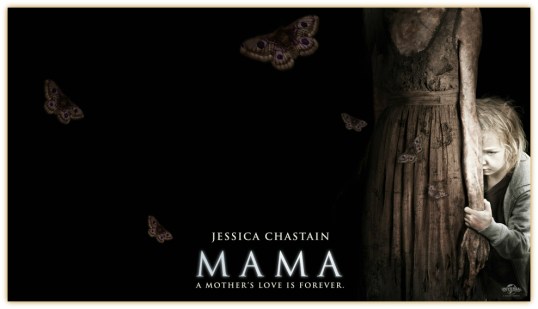
Review: Mama (dir. by Andres Muschietti)


Mama

In 2008 a young Argentine filmmaker made a 3-minute short film that caught the eye of one Guillermo Del Toro. The short film was titled Mama and it’s simple premise of ghostly mother chasing after two young girls in a darkened home was so well-received by Del Toro that he decided to produce a feature-length adaptation of the short film. He could’ve easily put himself in the director’s chair for the adaptation, but liking the work done by the short film’s original director the Mexican filmmaker gave the job to the original director, Andres Muschietti, and allowed him the freedom to make Mama the way it was meant to be made.

The feature-length version of the film works off of the screenplay written by the filmmaker Andres Muschietti and his sister Barbara Muschietti (with some help from Neil Cross) and expands on the brief sequence from the short film. We get a backstory as to the origins of the titular character and how she came to be throughout the film. We even get a much more detailed work up of the two young sisters who have become the obsession of the ghostly “Mama” and how they had gotten involved with her.

Mama opens up with a disturbing sequence where a father has murdered his partners in his company and his wife then taking his two young daughters out into the country where his grief at what he’s done leads him in an attempt to complete the cycle of becoming a family annihilator through the killing of his children then his own suicide. It’s only through the intervention of a shadowy figure in the abandoned cabin they’ve come across in the forest that this father’s plan fails. It’s a truly disturbing scene to see a father comforting his 3-year old daughter and at the same time hold a gun to her head. It’s almost a wonder that the audience feels both a sense of relief and horror at seeing “Mama” protect the young girls by killing the father.

We skip five years later as we find out that the father has a twin brother named Lucas (played by Game of Thrones‘ Nikolaj Coster-Waldau) who has spent the intervening years using whatever money the dead brother had left in an attempt to find the two young girls. Victoria and Lilly do get found by the scouts sent out by Lucas in the very same cabin where their father had taken them earlier in the film, but what the scouts find look more like feral animals than children.

One would think that the film would be about “Mama” wreaking havoc on Lucas to try and get her young girls back, but this film is not about mother versus father but mother versus mother. We’ve already met “Mama” briefly in the start of the film. The other mama in this fight for the girls’ love and soul is Lucas’ rocker girlfriend whose attitude in the beginning doesn’t shout maternal at all. Annabelle (played by Jessica Chastain) doesn’t think it’s her job to have to raise the two girls. It’s her love for Lucas that keeps her from bolting and trying to find a common ground with the two young girls. As the film moves forward Annabelle begins to feel protective of the two young girls and begins to believe that “Mama” is real and that she has followed Victoria and Lilly back from the cabin.

To say that this film is a horror film would be understating things. While it does have some jump scare moments and some creepy and disturbing images the story itself plays out more like a dark fairy tale set in a modern setting. just like another Del Toro produced horror film from the last couple years in The Orphanage, this film uses a fairy tale template to tell the story of the maternal love mothers have for their children. It’s interesting to note that the two mothers vying for Victoria and Lilly are not their biological mother, but surrogates who have come to love and care for the two girls in their own way.

Mama doesn’t break new grounds in the field of horror. It’s liberal use of gothic horror cliches and tropes by the Andres and Barbara Muschietti detracts from some darkly beautiful visuals and imagery that the filmmaker seemed very adept in creating to build that very sense of the fairy tale. What could’ve been a “been there and done that” and “paint-by-the-numbers” ghost story gets elevated by the performances by Jessica Chastain and the two young girls (Megan Charpentier as the elder sister Victoria and Isabelle Nélisse as the younger Lilly). Chastain in particular shines in the role of Annabelle as we believe her growth from reluctant caretaker to loving mother figure to protective mama bear by the time film ends on a very un-Hollywood ending.

Mama will definitely lose some fans of the horror genre who expect gore (which the film doesn’t have a drop of) and tons of scary moments (the film has jump scares but not much). This film will attract audiences looking for something familiar but at the same time with the added visual flair of a young filmmaker who looks to have a future in the genre, if not the industry, as a new creative eye who can work with something unoriginal and give it his own spin.

While the film is not on the same creative and storytelling level as Juan Antonio Bayona’s The Orphanage it is much better than Troy Nixey’s remake of the 1973 horror film Don’t Be Afraid of the Dark. The film does continue Guillermo Del Toro’s streak of finding new and upcoming young filmmakers in the horror genre and giving them a chance to break into the industry with him mentoring them through the process. Mama might not be a perfect film but Andres Muschietti’s work as a director shows that he has repaid Del Toro’s faith in him. I, for one, can’t wait to see what this filmmaker has up next.

An Obscure Film Review: Katherine (dir by Jeremy Kagan)


One of the great things about being an online film critic is that you occasionally come across a good but obscure film that you can then let the rest of the world know about as well.  Katherine is one such film.

I came across Katherine as part of a 3-film compilation DVD called Classic Films Of The 70s.  The other two films on the DVD were The Harrad Experiment and Born To Win and both of those films were so bad that I nearly tossed the DVD to the side without watching Katherine.  I’m glad I changed my mind because, while it may not have truly lived up to the promise of being a classic film of the 70s, Katherine was still a thousand times better than The Harrad Experiment.

Beginning with the idealism and hope of the early 60s and ending with a literal bang in the 70s, Katherine tells the story of how one woman is transformed from being a sheltered, upper class liberal to being a political revolutionary who is proud to embrace violence in order to bring about change.  Katherine ( Sissy Spacek, before she was Carrie) starts out as a teacher before falling in love with a civil rights activist (played, in a nicely smarmy performance, by Henry Winkler).  Against the backdrop of the Viet Nam War and the violence of the late 60s, Spacek and Winkler gradually become more and more radicalized until they eventually go underground and turn violent.  The film is made up of interviews with people who knew Katherine and Katherine herself even pops up and tells us her own version of her story.  Despite being forced to wear a horrid wig in the latter half of the film, Sissy Spacek gives a wonderfully empathetic and multi-layered performance as Katherine.  Even if you don’t always like the self-righteous stridency of the character, you never doubt her sincerity.

After I watched Katherine, I did a little research on the IMDb and I discovered that Katherine was a made-for-TV movie that was originally broadcast in 1975.  This did not surprise me because,  even as I was watching it, it was very easy to imagine a remake of Katherine (starring, I decided after much debate, Leighton Meester) being broadcast on the Lifetime Movie Network.  However, if Katherine felt like a Lifetime movie  with a political subtext, that’s only because I happen to love Lifetime movies.  Katherine is both an intelligent and interesting look at a very specific period of American history and a portrait of youthful idealism, disillusionment, and wanderlust.  We have all had to deal with that moment when our beliefs run into the wall of reality and Katherine captures that experience perfectly.

I found myself thinking about Katherine earlier today as I watched the presidential inauguration in Washington D.C.  Though the film might be close to 40 years old, its portrait of naive idealism, political stridency, and destructive activism still feels relevant.  Katherine is a film that most people have never heard of but it’s also one that is worth tracking down.

6 Trailers To Make You Go “Rah Rah RAH!”


It’s time for another edition of Lisa Marie’s Favorite Grindhouse and Exploitation Film trailers.  The trailer kitty is ready!  Are you?

1) Assassination (1988)

The trailer almost feels like a parody of a generic action movie trailer.  However, I’ve done the research and apparently, this is an actual film.

2) The President’s Analyst (1968)

I recently got this one on DVD but I haven’t watched it yet.  Any film from the 60s that features James Coburn and love beads is worth watching.

3) Detroit 9000 (1973)

This is another one that I’ve got on DVD but have yet to watch.

4) Billy Jack Goes To Washington (1977)

I think I’ve shared both this and the next trailer before but with it being National Rah Rah Rah Day and all, I figured why not share it again?

5) Werewolf of Washington (1973)

Rah rah…

6) The Delta Force 2 (1990)

…rah.

What do you think, Trailer Kitty?

Trailer Kitty

He’s thinking about it.

What Lisa and the Snarkalecs Watched Last Night #66: Tasmanian Devils (dir by Zach Lipovsky)


(Minor Spoilers)

Last night, the Snarkalecs and I watched the SyFy original movie Tasmanian Devils.  Who are the Snarkalecs?  You can find out here.

Why Was I Watching It?

Seriously, yesterday was a weird, weird day.  I don’t even know where to begin.  In between the pervy guys who have been working on the roof of the house across the alley, and the woman in Georgia who keeps accusing me of having an affair with her husband (another long story that you can read all about here), I was seriously ready to just change my name to Diabla, stop washing my hair, stop wearing makeup, and just move to Vermont.

But, through it all, I took the strength for the knowledge that, at 8:00, there would be an original movie on SyFy and that I would be watching it with my friends, the Snarkalecs…

What’s It About?

I’ll tell you what it’s not about.  It’s not about the spinning cartoon character who was always falling off cliffs and having safes dropped on his head.  No, these Tasmanian devils are vicious killers but, at the same time, they’re also kinda cute and adorable in a chupacabra kind of way.

Anyway, Apolo Ohno and a bunch of his friends go to Tasmania. Apolo jumps off of a cliff, has some trouble with his parachute, and ends up plunging into a hidden cave and getting impaled on the world’s biggest stalagmite.  Apolo hangs around for a bit, squirming like a bug and groaning despite the fact that he’s got a gigantic hole in chest.  Seriously, Apolo must be invincible.  Alas, his blood gets the attention of the Tasmanian devils and, in perhaps the defining scene of 2013, Apolo Ohno is literally ripped into little pieces on-screen.

There is a little bit more that happens in the film.  Apolo’s friends end up running into a park ranger played by Danica McKellar and they soon all find themselves being stalked through the wilderness by the Tasmanian devils.  However, for me, the film was pretty much about Apolo Ohno getting literally ripped into little pieces on-screen.

What Worked?

OH MY GOD!  Apolo Ohno was literally ripped into little pieces on-screen!  This led to me framing the term “Ohnotastic” as a way to refer to any spectacular death in a SyFy film.  This eventually led to the creation of the Ohno Scale, which from now on, will be used to judge the effectiveness of SyFy carnage.  Tasmanian Devils will now forever be one of the pivotal films in the history of the Snarkalecs.

(Hopefully, the next two-headed shark film from the Asylum will feature a Michael Phelps cameo.)

Beyond that, Tasmanian Devils was actually a pretty good film.  It was the epitome of a fun movie to watch with friends and director Zach Lipovsky actually managed to generate some genuine suspense.  Even better, both Lipovsky and Danica McKellar dropped by twitter and interacted with the people commenting on the film.  It’s always really nice whenever filmmakers do this.

On a personal note, I enjoyed Tasmanian Devils because it was filmed in Canada, a country that I am strangely obsessed with.  As for the male snarkalecs, they seemed to largely enjoy Tasmanian Devils because of the low-cut top that Danica McKellar’s park ranger was wearing.

What Did Not Work?

It all worked.  Life is too short to be critical of a film called Tasmanian Devils.

“OH MY GOD!  Just like me!” Moments

Insert your own low-cut top/heaving boobs comment here.

Lessons Learned

Apolo Ohno is not invincible.

The Daily Grindhouse: Alone With Her (dir by Eric Nicholas)


I recently watched the 2007 horror film Alone With Her and I have to say that I’m surprised that this film isn’t better known.  It’s probably one of the better horror films that I’ve seen recently.  I say this despite the fact that it’s a “found footage” horror film and, as such, the entire film is presented as being told through the lenses of various spy cameras.  I can count on two hands the number of “found footage” films that have actually worked for me.  As of right now, Alone With Her is sitting on the tip of my right pinkie finger.

Alone With Her opens with a disturbing montage in which Doug (Colin Hanks) wanders through the streets of the city, following every woman that he sees and secretly filming them with a hidden camera.  The fact that this montage plays out at such a naturalistic and unhurried  pace makes it all the more disturbing.  We watch as Doug does things like stand behind a woman so he can film up her skirt or pretend to shop solely so he can secretly get some leering footage of her cleavage.  By the end of this montage, I was already thoroughly creeped out and debating whether I would ever feel safe wearing a skirt in public again.

(Ultimately, I decided that I would continue to wear skirts but that, from now on, I’m going to pepper spray any man who stands less than a foot behind me.)

Eventually, Doug spots a woman named Amy (Ana Claudia Telancon) at a park and follows her back to her home.  Over the next few days, he obsessively films her as she unknowingly goes about her life until he finally breaks into her apartment and sets up numerous spy cameras.  Now free to observe every aspect of her life, Doug  arranges to meet the emotionally fragile Amy.  Using the knowledge that he’s gained from spying on her, he strikes up a friendship.  However, Amy’s best friend (played by Jordana Spiro) is suspicious of Doug and her suspicions lead to the film’s shockingly violent climax.

I didn’t have high expectations for Alone With Her and I have to admit that I’m still surprised at just how effective this film turned out to be.  For a film that doesn’t have much gore or any huge “shock” scenes, Alone With Her is an effectively creepy horror film that sticks with you long after the final frame.

A lot of the credit for the film’s success has to go to the cast.  Talancon is likable as Amy and Jordana Spiro brings unexpected nuance to the role of the stereotypically outspoken best friend.  Anyone who saw the sixth season of Dexter already knows that Colin Hanks can play a psycho but they still might not be prepared for just how downright creepy Hanks is in this film.  The film makes good use of Hanks’s neurotic persona and Hanks does a good job of gradually revealing the empty core that’s hiding behind Doug’s outward affability.  As played by Colin Hanks, Doug is the everyman-as-psycho.

However, the real star of the film is director Eric Nicholas.  I’m usually not a big fan of horror films that claim to have been assembled from  ”found footage.”  There are a few noticeable exceptions (like Ruggero Deodato’s Cannibal Holocaust, The Last Exorcism, Apollo 18, and Paranormal Activity 3) but, for the most part, these films never seem to be able to escape from the gimmicky feel of the concept.  (Add to that, they often fail to convince us that anyone would actually keep filming even while they’re being pursued by a masked murderer or whatever threat the narrative may supply.)  However, Nicholas manages to take the limitations of the found footage genre and transform them into strengths.  It helps that this film is about voyeurism and, by presenting what we’re seeing as being “found footage,” Nicholas creates a true sense of unease.  By the end of the film, I found myself nervously glancing around my bedroom and wondering if there was anyone secretly watching me.  Nicholas creates and sustains such an atmosphere of paranoia that the film’s familiar story takes on a surprising power.

As I stated previously, Alone With Her was a real surprise.  It’s a disturbing and all too plausible horror movie that stays with you.