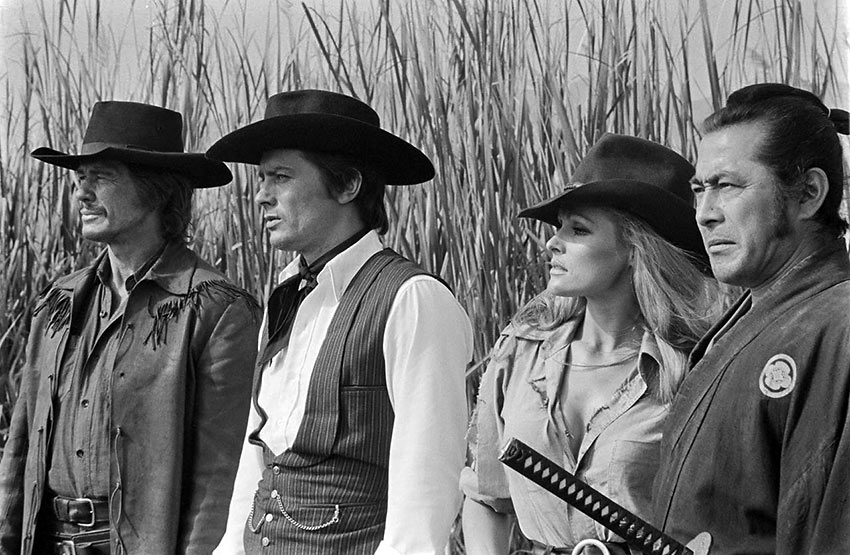
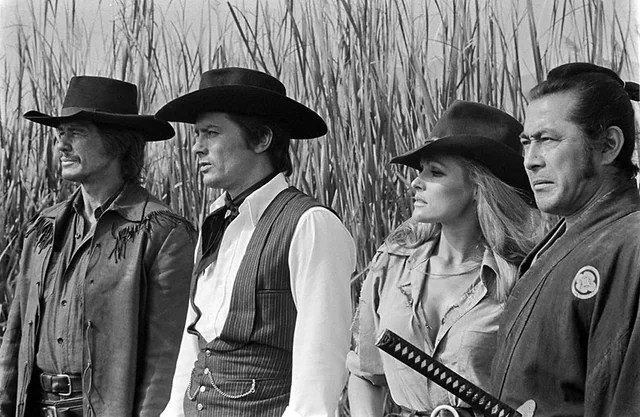
The underrated RED SUN (1971) – Charles Bronson & Toshiro Mifune in an East meets Western! 


Every so often I’m going to throw out a movie that I don’t think gets enough love, and that just doesn’t set right with me. Today’s movie is RED SUN. 

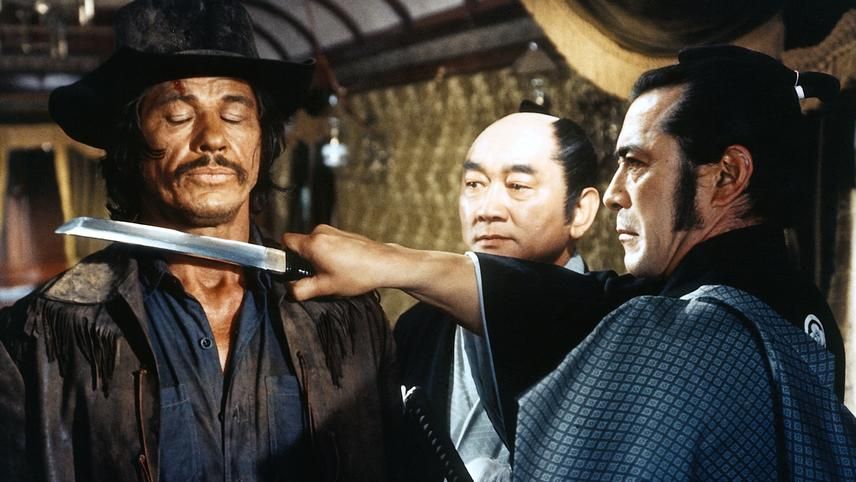
In RED SUN, two of the most macho actors in the history of world cinema team up in a western where train robber Link (Bronson) is forced to lead the honorable samurai Kuroda (Mifune) on a cross country trek to reclaim a stolen sword that was intended to be a gift from the Empire of Japan to the US President. If the two men can’t get the sword back in a week’s time, honor demands that the two men will lose their lives out of shame. Link isn’t really down with this plan, but he doesn’t have much of a choice in the matter due to the power and skill of Kuroda. Charles Bronson & Toshiro Mifune command the screen, with Charlie showing a likable sense of humor in his role as the bad / good cowboy. The two must find the evil Gauche (French superstar Alain Delon). Gauche is Bronson’s old train robbing partner who stole the sword and killed a samurai in the process, providing even more motivation for Kuroda. Add in Ursula Andress as a sexy woman who has a history with both Link and Gauche, and it doesn’t get much better than this!

RED SUN is not a perfect movie, but I couldn’t imagine anyone being disappointed by this enjoyable East meets Western that features true international superstars. In my book, it’s highly recommended!

Enjoy the trailer below:

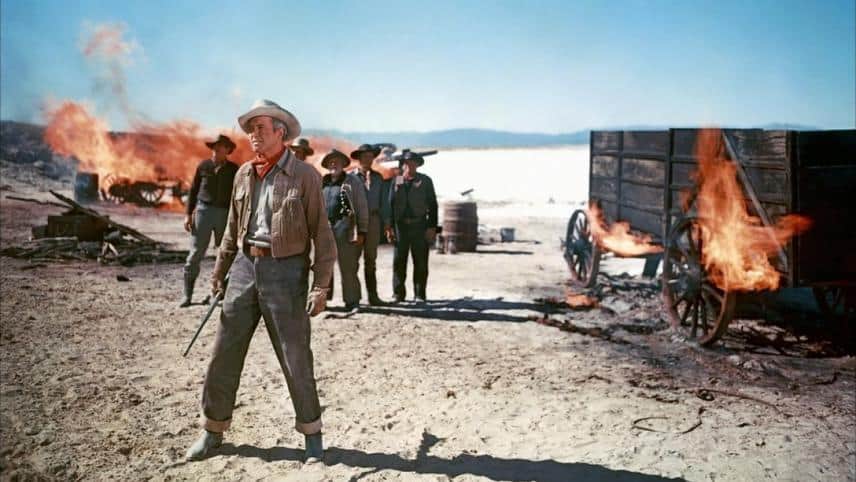
4 Shots From 4 Films – some of Brad’s “favorite westerns” edition!


4 Shots From 4 Films is just what it says it is, 4 shots from 4 of our favorite films. As opposed to the reviews and recaps that we usually post, 4 Shots From 4 Films lets the visuals do the talking!

I thought I’d try one of these “4 shots” posts. It’s really hard for me not to say anything, because each of these movies mean a lot to me, and the western remains my favorite genre even if I am a little stuck in the past. I’ll probably take a stab at a review of each of these films at some point. I hope you enjoy!

THE MAN FROM LARAMIE (1955)

RIDE LONESOME (1959)

RED SUN (1971)

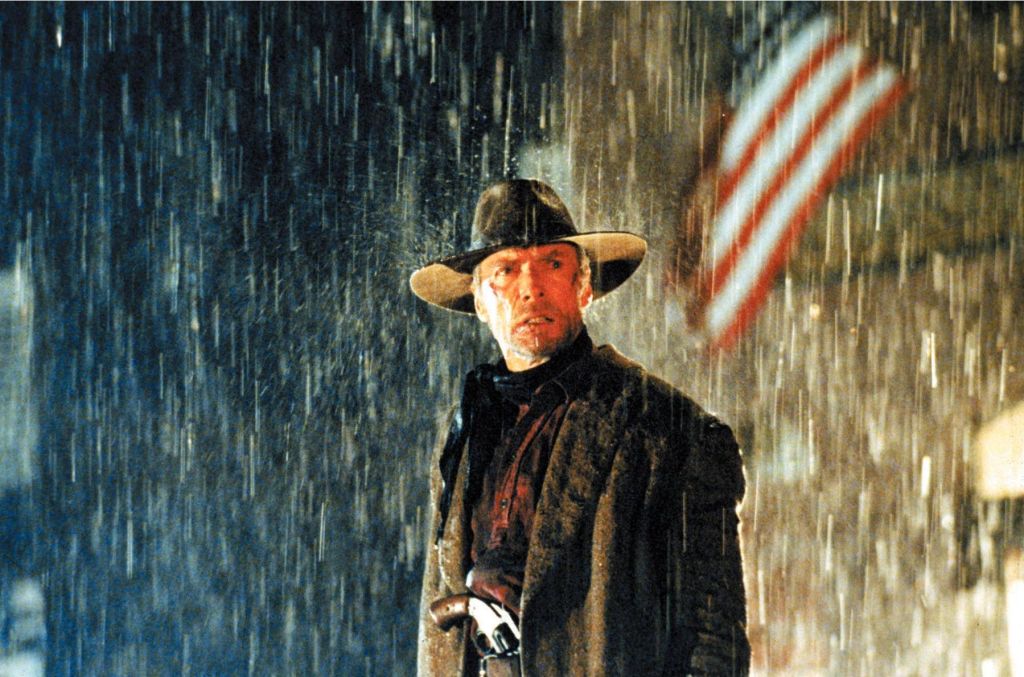
UNFORGIVEN (1992)

The Challenge (1982, directed by John Frankenheimer)


Rick Murphy (Scott Glenn) is a punch-drunk boxer who is hired to return an ancient sword to Japan so that it can be returned to its rightful owner, the honorable Toru (Toshiro Mifune).  Once in Japan, Rick becomes involved in a battle between Toru and his corrupt brother, Hideo (Atsuo Nakamura).  Hideo demands that Rick work as an undercover spy in Toru’s martial arts school or be beheaded.  Rick decides to keep his head and be a spy but he soon finds himself truly wanting to learn the ways of the Bushido.

A martial arts film is the last place most people would expect to find Scott Glenn and considering how miscast Glenn is, that’s understandable.  Scott Glenn feels very out-of-place as both a boxer and a modern-day samurai.  Scott Glenn is a very good actor but the role of Rick Murphy called for someone who could mix comedy with drama and be convincingly desperate.  That’s not Scott Glenn.  Who would have been better in the role?  Tom Berenger was already acting in 1982.  Or maybe even someone like Jan-Michael Vincent.  Vincent was a B-actor but, deep down, The Challenge is a B-movie.

The good thing is that the action often does make up for Glenn’s miscasting.  John Frankenheimer struggled with making the human drama compelling but he knew how to film a good fight.  John Sayles’s script is pulpy without ever being disrespectful to Japanese culture and, as always, Mifune looks like he could battle and defeat the entire world if he wanted to.

One final note: Steven Seagal worked behind-the-scenes on the film but we won’t hold that against it.

Film Review: Inchon (dir by Terence Young)


Inchon is an infamous film.

First released in 1982, this epic recreation of one key battles of the Korean War was an expensive film with a cast of well-known actors.  Jacqueline Bisset plays a wealthy army wife who tries to protect five South Korean children who have found themselves in the middle of the battle.  Ben Gazzara plays her husband, a major who is having an affair with the daughter of Toshiro Mifune.  David Janssen and real-life film critic Rex Reed wander through the film as journalist.  (Janssen growls like a man dealing with a serious hangover while Reed struggles to not look straight at the camera.)  Richard Roundtree plays a tough sergeant.  The great Italian actor Gabriele Ferzetti plays a Turkish officer.  And, finally, the role of legendary American general Douglas MacArthur — of “I will return” fame — is played by the very British Sir Laurence Olivier.  Olivier was apparently told that, in real life, MacArthur often sounded like the comedic actor W.C. Fields and Olivier often seems to be imitating Fields’s pinched style of speaking.  Olivier also wears almost as much makeup here as he did in his production of Othello.  MacArthur is portrayed as being almost a mystic warrior, a man who relies as much on his faith as his strategic genius to repel the communists.  (In victory, he recites The Lord’s Prayer.)  The film was directed by Terence Young, who previously brought James Bond to cinematic life.

Inchon is notorious for being a flop with both critics and audiences.  The film had a budget of $46,000,000 and reportedly made $5,000,000 at the box office before it was withdrawn.  The entirety of the budget was put up by the Unification Church, which is an organization that many people consider to be a cult.  (I like neither communists nor cultists so this film left me with no one to root for.)  The film proved to be such a flop at the box office that it has never been released on home video.  It did, however, air on television a few times and, in recent years, the television cut has been posted to YouTube.  That’s how I saw Inchon.

I watched Inchon because I’ve frequently seen it referred to as being one of the worst films ever made.  Watching the film, I have to say that I think the “worst film” label is a bit extreme.  For the most part, it’s just an extremely uneven and often rather boring film, one that mixed scenes of surprisingly brutal combat with dialogue-heavy scenes that just seem to drag on forever.  It’s a film that belongs as much in the disaster genre as the war genre as the film is full of rather shallowly-written characters who all have their own individual dramas to deal with.  Will Jacqueline Bisset save the children?  Who will sacrifice their lives to defeat the communists? Will Ben Gazzara, who often seems to be the sole member of the cast who is at least tying to give a credible performance, choose his wife or his mistress?  The film ultimately feels like a compressed miniseries.  Everyone has a story but hardly anyone makes an impression.

That said, Laurence Olivier’s performance as Douglas MacArthur …. agck!  Seriously, it’s hard to know where to even begin when it comes to talking about just how miscast Olivier is as the quintessential all-American general.  It’s been said that it takes a truly great actor to give a truly bad performance and Olivier certainly proves that to be true in this film.  Obviously frail and trying to sound like W.C. Fields, Olivier’s MacArthur is a general who would inspire zero confidence.  The film doesn’t help by portraying MacArthur as being an almost holy figure, one who is often framed to look like almost an angel descending from Heaven to lead the battle against America’s enemies.  The film is full of scenes of people discussing MacArthur’s genius just to be followed by a scene of Olivier looking old, tired, and rather grumpy.  There were a few times when I thought I could see Olivier’s hair dye running down the side of his face.  It may have been my imagination or just the graininess of the upload on YouTube but, given the quality of the film, I can’t really dismiss the possibility that it happened and no one felt like doing a second take.

As I said, Inchon can be found on YouTube.  It’s not the worst film ever made but that doesn’t mean it’s a good one.

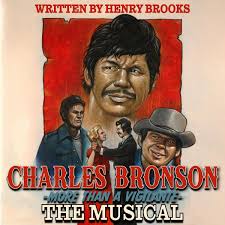
CHARLES BRONSON – More than a Vigilante – The Musical!


A young man named Henry Brooks has written a musical about the life of Charles Bronson. I’m sharing this post to make sure you are aware of it. It’s a memorable take on certain key moments and movies in Bronson’s life and career. The album is produced by Stephen Glickman (Big Time Rush), with Steven Weber (Wings) and Lisa Loeb (Stay: I Missed You) contributing their immense talent to this interesting project as Charles Bronson and Jill Ireland. As a lifelong fan of Bronson’s, I love seeing a younger generation embrace his unique talent. I think my personal favorite song on the album is called “Toshiro and I,” which is Henry’s amusing take on Bronson’s film with iconic Japanese actor Toshiro Mifune, RED SUN. There are many other good songs as well, with “You Oughta be an Actor,” “There’s Never Been So Few,” “Death Wish,” and “Couldn’t Beat the Cancer” all sticking out to me. There are a total of 16 songs on the album, and the songs take Bronson from a boy working in the coal mines all the way to a man mourning the loss of his beloved wife.

I’ve linked to YouTube versions of the songs below! Take a moment to subscribe if you get the chance. You can also find the album on Spotify and Apple Music. In the next couple of months, it should be available to purchase for your collection. I for one will be buying the album on vinyl as soon as I can!

I’m including a link to the episode of the “This Week in Charles Bronson” podcast where we discuss the project with Henry Brooks. We’re so happy to help spread the word on this exciting project!

4 Shots From 4 Films: Special Toshiro Mifune Edition


4 Shots From 4 Films is just what it says it is, 4 shots from 4 of our favorite films. As opposed to the reviews and recaps that we usually post, 4 Shots From 4 Films lets the visuals do the talking!

104 years ago today, the great Japanese actor Toshiro Mifune was born in Qingdao, Shandong, China, which was under Japanese occupation at the time.  After working as a photographer and as an assistant cameraman, Mifune made his acting debut in 1947, playing a bank robber in Snow Trail.

Mifune would go on to become an international superstar, appearing in hundreds of films before his death in 1997.  Sixteen of those films would be directed by Akira Kurosawa and Mifune’s performances in Kurosawa’s yakuza and samurai films would go on to inspire actors the world over.  When Sergio Leone adapted Yojimbo into A Fistful of Dollars, Clint Eastwood based his performance on Mifune’s performance in the original.  George Lucas would later create the character of Obi-Wan Kenobi with Mifune in mind.

In honor of the man and his career, here are

4 Shots From 4 Films

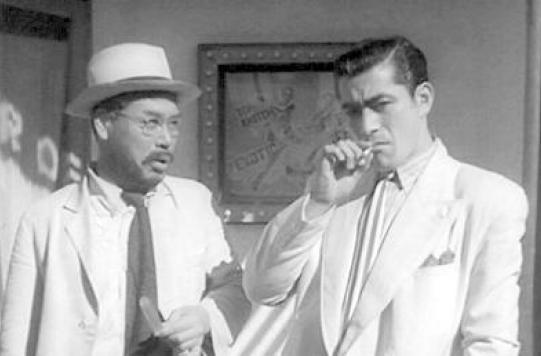
Drunken Angel (1948, directed by Akira Kurosawa)

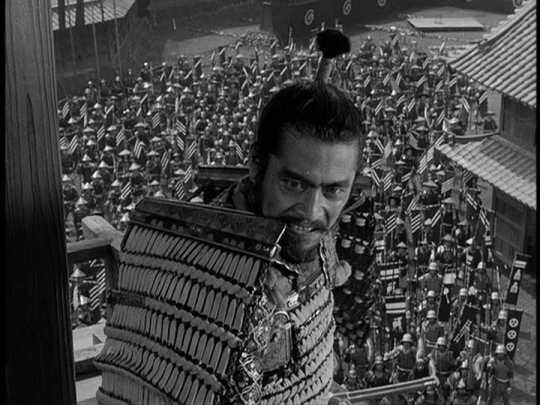
Throne of Blood (1957, directed by Akira Kurosawa)

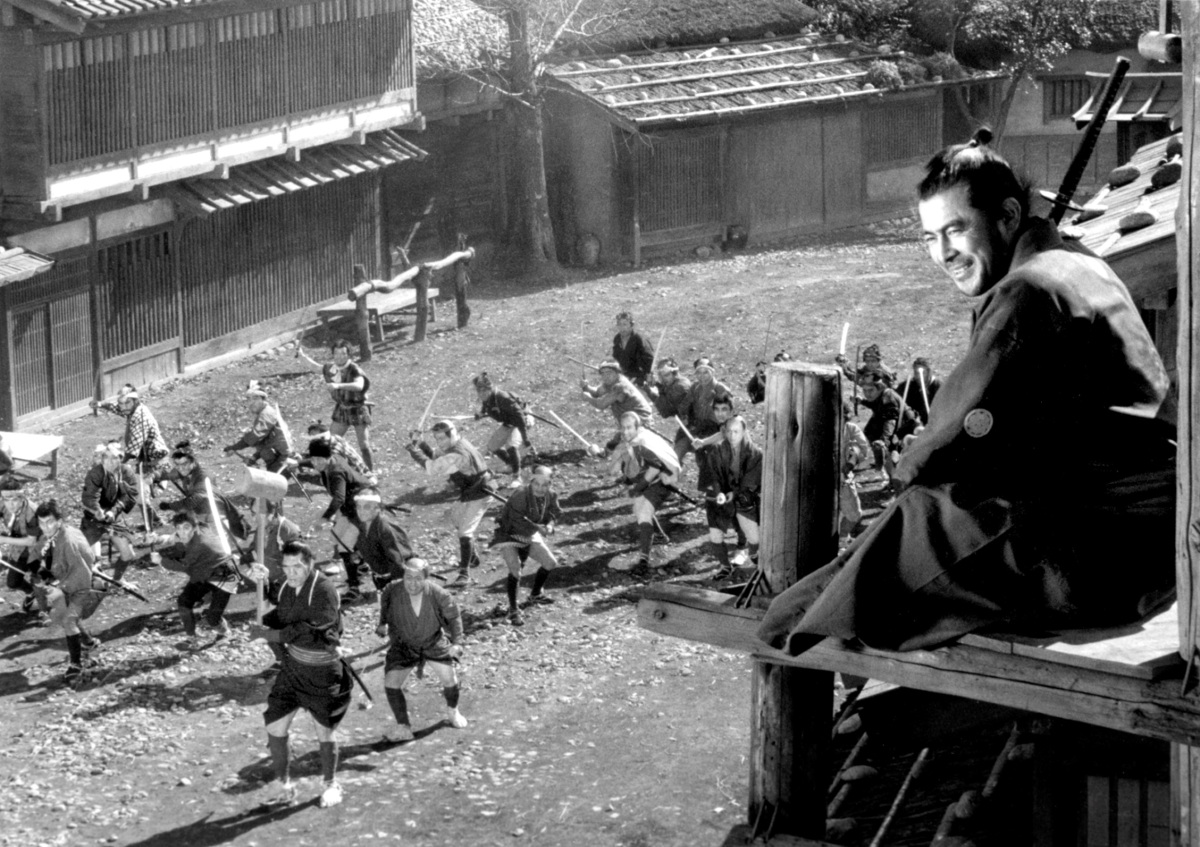
Yojimbo (1961, directed by Akira Kurosawa)

Shogun (1980, directed by Jerry London)

Scene that I Love: The Finale of Akira Kurosawa’s Yojimbo


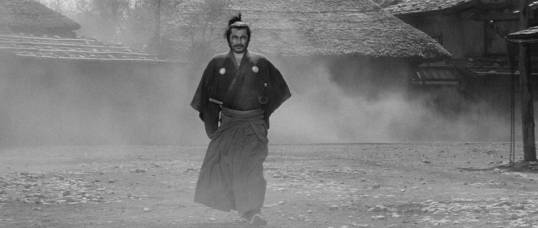
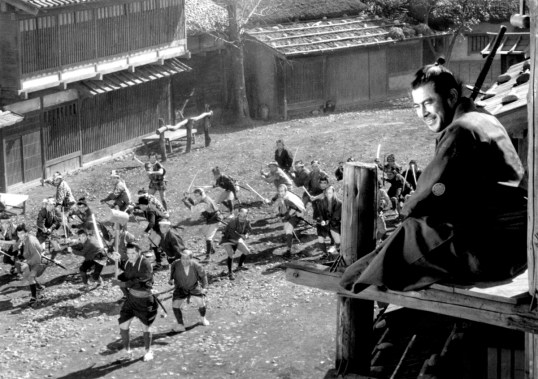
Yojimbo (1961, directed by Akira Kurosawa)

The great filmmaker, Akira Kurosawa, was born 111 years ago today, in Tokyo.  Kurosawa would go on to become one of the most influential directors of all time, making 30 films over a career that lasted 57 years.  Though Kurosawa is often cited as an influence on westerns (Seven Samurai became The Magnificent Seven, Yojimbo inspired Serigo Leone to create The Man With No Name), Kurosawa’s influence goes for beyond just one genre.  He directed action films.  He directed gangster films.  He directed social problem films.  He directed historical epics.  Kurosawa taught an entire generation of future film film directors the language of cinema.

In honor of the anniversary of Akira Kurosawa’s birth, here is a scene that we all love from his 1961 masterpiece, Yojimbo.  Playing the lead role of the lone swordsman is, of course, Kurosawa’s frequent star, Toshiro Mifune.


The International Lens: Throne of Blood (dir by Akira Kurosawa)


In feudal-era Japan, two great Samurai commanders, Miki (Akira Kubo) and Washizu (Toshiro Mifune) stumble upon a mysterious spirit (Chieko Naniwa) who tells them both their futures.  Though her prophecies are cryptic, it appears that she is predicting that, some day, Washizu will become the “Lord of the Spider Web’s Castle” and that he will eventually be succeeded by Miki’s son.  When Washizu later returns to his wife, Asaji (Isuzu Yamada), he tells her about the prophecy.  The ambitious Asaji encourages to make the prophecy come true by murdering the local lord, Lord Tsuzaki (Hiroshi Tachikawa)….

Does this sound familiar?  The 1957 Japanese film, Throne of Blood, is a version of Macbeth, with the action moved from Scotland to Japan and the three witches replaced by one spirit.  It’s an enthralling film, though it probably does help to already be familiar with the plot of Macbeth before watching the film.  Director Akira Kurosawa keeps the action moving at a quick pace and he doesn’t always stop to carefully explain everyone’s motivations.  That’s not a complaint, by the way.  Kurosawa emphasizes the confusion of living in a world of constant war and constant scheming.  As envisioned by both Shakespeare and Kurosawa, the worlds of Macbeth and Thrones of Blood are worlds where violence is a part of life and the only thing certain is that everyone is going to die eventually.  To try to deny fate is to be destroyed by it.

The world of Throne of Blood seems to be covered in a constant fog.  Perhaps it’s the fog of war or maybe it’s the fog of an uncertain future but, for me, the defining image of Throne of Blood is one of armored and bloody men emerging from a thick mist.  The viewer is never sure who might be hiding in the mist and, even more importantly for both those watching the movie and those existing inside of it, it’s impossible to see what might be waiting down the road.  The only person who can see through the mist is the Spirit but, just as in Shakespeare’s play, people tend to only hear what they want to hear when the Spirit speaks.  In the world of Throne of Blood, even those who have eyes have been rendered blind.

It’s a world where you can change the present but you can never escape the past.  Asaji finds herself vainly trying to wash the blood off of her hands.  Washizu finds himself haunted by the ghost of the man that he killed.  Even while Washizu shouts at a ghost that only he can see, it’s obvious that those around him are already plotting the best way to get him out of the way.  There is no real loyalty in Throne of Blood and it all leads to death and more death.  It’s hard to say that anyone really achieves any sort of victory in Throne of Blood.  That’s just not the way the world works.

Throne of Blood is basically a filmed nightmare, one that takes place in a world that’s drenched with blood and duplicity.  Toshiro Mifune gives another great performance in the role Washizu, though the film is ultimately stolen by Isuza Yamada as Washizu’s wife, who pushes her husband to murder and then finds herself driven to insanity by his actions.  Throne of Blood is both a superior Shakespeare adaptation and a great Kurosawa film.

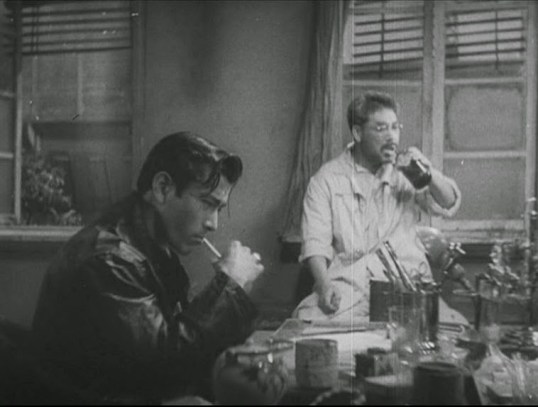
The International Lens: Drunken Angel (dir by Akira Kurosawa)


The 1948 Japanese film, Drunken Angel, tells the story of two seemingly different men living in a burned-out neighborhood in postwar Tokyo.

Sanada (Takashi Shimura) is an aging and world-weary doctor.  Though he may drink too much and he is occasionally too quick to snap at his patients, he truly cares about the people who live near his clinic.  He worries about the spread of tuberculosis, which was a very real concern in postwar Japan and which remains a concern to this day.  He continually tells his patients that they need to stop drinking and take better care of themselves, even though he does not seem to be capable of taking his own advice.

Matsunaga (Toshiro Mifune) is a young Japanese gangster, a member of the yakuza.  Matsunaga does everything with a swagger, one that he appears to have largely adapted from Hollywood gangster movies.  He not only dresses like an idealized version of an American gangster but he also smokes his cigarettes like one.  Everything about Matsunaga gives the impression that he’s desperate to prove that he’s something more than just a small-time hood living in a bombed-out neighborhood that’s centered around a poisonous bog.

One night, Matsunaga shows up at Sanada’s clinic.  He’s got a bloody hole in his hand.  Mastunaga claims that he walked into a door.  When Sanada responds with skepticism, Matsunaga adds that the door had a nail sticking out of it.  Sanada may not believe Matsunaga but he’s a doctor so he treats Matsunaga’s wound.  Sanada also diagnosis Matsunaga as suffering from tuberculosis and tells him that he has to stop drinking and womanizing.  Needless to say, Matsunaga is not pleased with this diagnosis.

Though they start out as antagonists, a weary friendship grows between the doctor and the gangster.  Matsunaga even starts to follow the doctor’s advice or, at least, he does until his boss, Okada (Reisaburo Yamamoto), is released from prison.  Under Okada’s influence, Matsunaga falls back into his own habits, drinking and going to nightclubs where the musicians perform Americanized music.  Okada is also the ex-boyfriend of Sanada’s nurse and, when he threatens to murder Sanada unless the doctor lead him to her, Matsunaga is finally forced to decide which of his two potential mentors will have his loyalty.

Taken on its own, Drunken Angel is an entertaining gangster film that features two memorable lead performances.  Takashi Shimura is likable as Sanada while Toshiro Mifune is dangerously charismatic as Matsunaga.  Director Akira Kurosawa originally planned for the film to focus solely on Sanada, with Matsunaga only playing a minor role.  Mifune, however, so impressed him that he ended up expanding Matsunaga’s role until Mifune was eventually the film’s co-lead.  (Following Drunken Angel, Kurosawa would go on to make 15 other films with Mifune.)  Kurosawa keeps the action moving at an exciting pace and he frames the story with haunting images of the dilapidated neighborhood that the two men call home.

However, Drunken Angel is even more fascinated with one consider that it was made at a time when Japan, having been defeated in World War II and still traumatized by the nuclear attacks on Nagasaki and Hiroshima, was still occupied by American forces.  The film was made at a time when it was still very much an open question as to what role Japan would play in a postwar world.  Would Japan become dominated by American culture (which, in this film, is represented by gangsters like Okada) or would it remain true to itself?  When Sanada warns Matsunaga that he is surrounded by toxic germs that are making him ill and threatening his future, he could very well have been talking about what Kurosawa perceived as being the threat of Americans transforming Japan into a westernized playground.

In the end, it’s a film that works on many levels, as a gangster film, as a portrait of a friendship, and as a metaphor for a people and a culture trying to find their place in a new and imperfect world.  If you haven’t seen it yet, now is the perfect time to do so.
4 Shots From 4 Films: Special Toshiro Mifune Edition


4 Shots From 4 Films is just what it says it is, 4 shots from 4 of our favorite films. As opposed to the reviews and recaps that we usually post, 4 Shots From 4 Films lets the visuals do the talking!

100 years ago today, the great Japanese actor Toshiro Mifune was born in Qingdao, Shandong, China, which was under Japanese occupation at the time.  After working as a photographer and as an assistant cameraman, Mifune made his acting debut in 1947, playing a bank robber in Snow Trail.

Mifune would go on to become an international superstar, appearing in hundreds of films before his death in 1997.  Sixteen of those films would be directed by Akira Kurosawa and Mifune’s performances in Kurosawa’s yakuza and samurai films would go on to inspire actors the world over.  When Sergio Leone adapted Yojimbo into A Fistful of Dollars, Clint Eastwood based his performance on Mifune’s performance in the original.  George Lucas would later create the character of Obi-Wan Kenobi with Mifune in mind.

In honor of the man and his career, here are

4 Shots From 4 Films

Drunken Angel (1948, directed by Akira Kurosawa)

Throne of Blood (1957, directed by Akira Kurosawa)

Yojimbo (1961, directed by Akira Kurosawa)

Red Sun (1971, directed by Terence Young)