44 Days of Paranoia #3: Winter Kills (dir by William Richert)


MPW-39279Yesterday, I took a look at Executive Action, a 1973 docudrama about the assassination of John F. Kennedy.  Today, I want to take a look at another film inspired by the Kennedys, the 1979 satire Winter Kills.

As the film opens, it’s been 16 years since a popular and dynamic President named Tim Kegan was assassinated in Philadelphia.  Despite constant rumors of conspiracy, the official story is that Kegan was killed by a lone gunman and that gunman was subsequently killed by another lone assassin.  The President’s half-brother, Nick (played by Jeff Bridges, who looks so impossibly young and handsome in this film), has disappointed his father (John Huston) by declining to follow his brother into politics.  Instead, he spends most of his time sailing on corporate oil tankers and dating fashion editor Yvette (Belinda Bauer).  This all changes when a dying man named Fletcher (and played, underneath a lot of bandages, by Joe Spinell) asks for a chance to speak to Nick.  Fletcher reveals that he was the 2nd gunman and that he was hired by to kill President Kegan.  Before dying, Fletcher tells Nick where he can find the rifle that was used to kill the President.

Following Fletcher’s directions, Nick finds both the rifle and proof that his brother’s death was the result of a conspiracy.  Determined to find out who was truly behind the conspiracy, Nick goes to see his father, the flamboyant tycoon Pa Kegan (John Huston) who, we discover, is only alive because he frequently gets blood transfusions from young women.  With Pa’s encouragement, Nick is sent on an increasingly bizarre odyssey into the darkest shadows of America, a world that is populated by militaristic businessmen, sinister gangsters, and an unemotional man named John Cerutti (Anthony Perkins) who very well may be the most powerful man in the world.

The martyred President might be named Tim Kegan, his accused assassin might be named Willie Abbott, and the man who shot Abbott might be named Joe Diamond (and might be played by Eli Wallach) but make no mistake about it — Winter Kills is a thinly disguised look at both the Kennedy assassination and the Kennedy family.  Based on a novel by Richard Condon (who also wrote the conspiracy classic, The Manchurian Candidate), Winter Kills takes all of the various Kennedy conspiracy theories and intentionally pushes them to their most ludicrous extremes.  The end result is a film that tries (and occasionally manages) to be both absurd and sincere, a portrait of a world where paranoia is the only logical reaction.

As I discovered from listening to director William Richert’s commentary on the Anchor Bay DVD, Winter Kills had a long and complicated production history.  The film was produced by two marijuana dealers, one of whom was murdered by the Mafia shortly after the film premiered while the other would later be sentenced to 40 years in prison on federal drug charges.  The production actually went bankrupt more than a few times, which led to Richert, Bridges, and Bauer making and releasing another film specifically so they could raise the money to finish Winter Kills.

When Winter Kills was finally released, it got a good deal of attention because of its spectacular cast.  Along with Bridges, Huston, Perkins, and Wallach, the film also features cameo appearances by Tomas Milian, Elizabeth Taylor, Ralph Meeker, Richard Boone, Sterling Hayden, Dorothy Malone, Toshiro Mifune, and a host of other actors who will be familiar to those of us who enjoy watching old movies on TCM.  And yet, according to Richert, the film itself was barely released in to theaters, the implication being that Winter Kills was a film about conspiracies that fell victim to a conspiracy itself.

Given the film’s history and the subject matter, I was really hoping that Winter Kills would turn out to be a great movie.  Unfortunately, it really doesn’t work.  The film struggles to maintain a balance between suspense and satire and, as a result, the suspense is never convincing and the satire is ultimately so obvious that it ends up being more annoying than thought-provoking.  The cast may be impressive but they’re used in such a way that film ultimately feels like it’s just a collection of showy celebrity cameos as opposed to being an actual story.

That said, Winter Kills remains an interesting misfire.  Jeff Bridges is a likable and compelling lead (and he gives the film much-needed focus) and, playing a role that has a lot in common with his better known work in Chinatown, John Huston is a always watchable if not necessaily likable.  Best of all is Anthony Perkins, who plays a role that, in light of what we now know about the NSA, seems oddly prophetic.

Finally, best of all, Winter Kills remains an interesting time capsule.  If nothing else, it reminds us that mistrust and paranoia are not unique to this century.

3260389_l1

6 Trailers For Spring Break


PCAS

Welcome to another edition of Lisa Marie’s Favorite Grindhouse and Exploitation Film trailers!

1) Terminal Island (1973)

This trailer (which contains some nudity and is NSFW) seems appropriate for Spring Break. 

2) The Big Gundown (1966)

How can you go wrong with Lee Van Cleef and Tomas Milian in the same film?

3) Slaughter (1972)

With a name like Slaughter, he’s got to be good.

4) Slaughter’s Big Rip-Off (1973)

Not surprisingly, Slaughter would return.

5) The Beatniks (1960)

However, before Van Cleef, Milian, and Slaughter, there were … BEATNIKS!

6) The Horror of Dracula (1958)

I’m including this trailer in honor of Christopher Lee who is now … Sir Christopher Lee!

What do you think, Trailer Kitties?

Film Review: Django Kill (dir. by Giulio Questi)


2228_spoiler_DjangoKill_t588

Released in 1967 and directed by Giulio Questi, Django Kill is one of the essential spaghetti westerns.

The film opens with a man literally clawing his way out of a shallow grave.  Played by Tomas Milian and known as the Stranger, the man is a Mexican outlaw who has been buried out in the middle of the desert.  Two sympathetic Indians discover the Stranger and, while they nurse him back to health, he has several flashbacks that explain how he came to be buried alive.

The Stranger was a member of a gang of thieves who stole a cargo of gold.  However, the Americans in the gang betrayed the Mexicans, gunning them down and fleeing with the gold.  The Indians agree to help the Stranger find the rest of his gang on the condition that the Stranger tell them what it was like to be dead.

The Stranger’s former gang, meanwhile, has arrived at a desolate town known as Unhappy Place.  From the minute that the gang first rides into town, we know that there’s something sinister about Unhappy Place.  A naked child stands in the middle of the street while another is used as a footrest by one of the adults.  A distraught woman watches them from behind a barred window.  A lame hedgehog drags itself across the dusty street.  As soon as the gang stops at the local saloon, the locals see the gold that they’re carrying and, in a shockingly brutal scene, the townspeople lynch the outlaws.

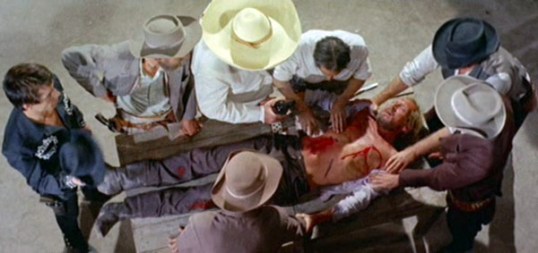
While this is going on, the Stranger rides into town.  Spotting the last living outlaw, the Stranger proceeds to gun him down.  In one of the film’s more infamous scenes, when the townspeople learn that the Stranger is using gold bullets, they proceed to literally rip the outlaw to pieces in an effort to retrieve the golden bullets.

With the outlaws dead, the townspeople claim the gold for themselves.  The Stranger, who was apparently more interested in revenge than getting the gold, stays in town and watches as things get increasingly weird.

How weird?

Well, how about the fact that the Stranger ends up having a romance with a crazy woman who spends her days trapped behind a locked door?

Or how about the fact that the Stranger finds himself in the middle of a power struggle between the townspeople and the flamboyantly homosexual Zorro (played, in grandly villainous fashion, by Roberto Camardiel) who rides into town with a gang of cowboys who are all dressed in black outfits with white embroidery?  In another one of the film’s infamous scenes, Zorro and his cowboys kidnap and gang rape the son of the town’s saloonkeeper.

(A young Ray Lovelock, who would go on to be one of the best actors to regularly work in Italian exploitation plays the son.)

Or how about the scene where Zorro plays with a bunch of Civil War figures while arguing with his pet parrot?  When Zorro offers the parrot a drink, the parrot replies, “I want more!”

Or, how about the fact that the Stranger, at one point, has to deal with several vampire bats while literally hanging from a cross?

Graphically violent and full of bizarre and disturbing imagery, Django Kill is one of the strangest westerns ever made and that strangeness keeps the film interesting even when the story doesn’t make much sense.  While Django Kill may not be the masterpiece that several claim it to (the film runs on a bit long and the dubbing of the English language version was absolutely terrible), it’s still one of the most compulsively watchable films that I’ve ever seen.  Just when you think the film can’t get any stranger, it does.

Django Kill was filmed under the title of If You Live, Shoot!  However, in a move typical of Italian cinema, the film was retitled to take advantage of the popularity of Sergio Corbucci’s Django.  The implication, of course, is that Tomas Milian is playing the same character here that Franco Nero played in Corbucci’s film.  Of course, nothing could be further from the truth.  Even in the crudely dubbed English version of the film, Milian is never referred to by name.  Instead, he’s simply known as the Stranger and, appropriately enough, the film feels more like a surreal take on Sergio Leone’s Dollar trilogy as opposed to being a part of the Django series.

That said, regardless of whether it’s a legitimate Django film or not, Django Kill …. If You Live, Shoot! is more than worth watching.  In fact, it’s essential for anyone who loves Italian exploitation films.

060312-DjangoKill-Post2

Django Unchained: We have a title!


So, here I am.  It’s May 1st, I’m suffering from a mighty terrible case of insomnia, my asthma is bothering me so much that I’d scream if I had the lung capacity, and let’s just say that whatever it is that I’m watching on LMN right now is not memorable enough to rate a What Lisa Watched Last Night post.

And yet, I’m excited.  Why?

Because we have a title!

In this case, we have the title to Quentin Tarantino’s upcoming Spaghetti Western (or “Spaghetti Southern” as Tarantino has suggested it should be called).  The title is Django Unchained.  When I first heard that title, along with the rumor the Franco Nero would have a cameo in the film, I was hopeful that maybe Tarantino was looking to restart the original Django series.  Back during the heyday of the Spaghetti Western, there were a countless number of Italian-made westerns that detailed the adventures of a ruthless bounty hunter named Django.  Franco Nero first played Django in a film entitled, not surprisingly, Django.  However, after the success of the first Django, Django was played by everyone from Tomas Milian to Ivan Rassimov to Jeff Cameron to George Eastman. 

However, it appears that the name of Tarantino’s Django is not evidence of a reboot but just of an homage.  Tarantino’s Django is a former slave who, along with an older German bounty hunter (presumably to be played by Christoph Waltz, who could use another good role), returns to the South to rescue his wife from an evil plantation owner. 

If you read the story over on Comingsoon.net, you can read a review of the script from someone who claims to have read a copy.  I’m not going to quote from that review because, quite frankly, it’s obvious just from the tone of it that the reviewer is busier trying to come across like a film geek badass than actually reviewing the script.  (Seriously, there’s nothing I hate more than people who think they’re more interesting than they actually are.)

Still, I will always look forward to anything Tarantino does.  Add Franco Nero into the mix and we have got a lot to look forward to.

6 Trailers For Your Oscar Hangover


Now that the Oscars are over with, it’s time for another installment of Lisa Marie’s Favorite Grindhouse and Exploitation Trailers.

1) The Sicilian Connections (1972)

Since we’re coming down off the Oscars, I’ll start this latest edition off with the trailer for The Sicilian Connection, an Italian rip-off of 1971 best picture winner, The French Connection.  I haven’t seen the actual movie but I love the music that plays in the background of this trailer.

2) Dirty Gang (1977)

This is another Italian crime flick.  This trailer is worth it to just see that wonderful credit “Tomas Milian as Trash.”

3) Trouble Man (1972)

Tomas Milian may have been Trash but Robert Hooks was Trouble.

4) Q: The Winged Serpent (1982)

I’m so happy to include this trailer because I think Arleigh will love it.  David Carradine and Richard Roundtree fight a prehistoric something-or-an0ther.  Michael Moriarty’s in this which can only mean that this is a Larry Cohen film.

5) Dawn of the Mummy (1980)

“Egypt…a nice place to visit but would you want to die there?”  Not surprisingly, this is an Italian film that was released in the wake of Dawn of the Dead and Zombi 2.

6) The Crippled Masters (1979)

I kinda feel that this trailer runs a little bit long but then again, I’m not big into Kung Fu films that don’t star Uma Thurman.  Still, this is one of those pure grindhouse trailers that has to be seen to be believed.