Nothing In Common (1986, directed by Garry Marshall)


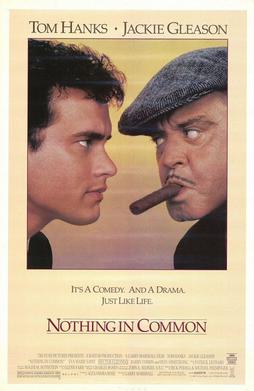
Tom Hanks plays David Basner (Tom Hanks), an advertising executive whose immature lifestyle gives him insight into what sells but has also left him totally unprepared to deal with the fallout when his mother (Eva Marie Saint) leaves his father, Max (Jackie Gleason).  David, who is struggling to come up with the perfect commercial for a demanding client (Hector Elizondo), has to come to terms with both his father’s bad health and his history of infidelity.

This isn’t my favorite Tom Hanks movie.  It comes from that awkward period when Hanks was trying to make the transition from comedy to drama and its attempt to mix the two genres is not always successful.  The scenes of Hanks at the ad agency are often so cartoonish that they don’t seem like they belong in a movie where Jackie Gleason loses a foot to diabetes and realizes that he spent his entire marriage emotionally abusing his wife.  The movie, though, is worth watching for the teaming of Hanks and Gleason, two comedic actors who eventually proved themselves to equally as skilled at playing it serious.  Gleason, especially, gives a strong performance.  This was his final film and Garry Marshall convinced him to take it by asking, “Do you really want to go out on Smokey and the Bandit 3?”  Gleason would die a little over a year after the release of Nothing In Common and this film, even if it wasn’t perfect, gave the world a chance to see what a good actor he really was.

This film is often cited as the the movie that started Hanks on the way to becoming a dramatic actor.  Like Punchline, Nothing In Common played a role in Hanks becoming more than just a comedian but  I think Big was ultimately the better showcase for Hanks’s ability to mix pathos with laughs.  Nothing In Common was directed by Garry Marshall and, as was usually the case with Marshall, he often doesn’t trust the audience to figure things out for themselves.  He goes overboard trying to force an emotional response instead of just trusting the material.  Tom Hanks still does a good enough job in Nothing In Common.  Hanks is as likable as always and you can see the dramatic actor emerging in Hanks’s performance even if Hanks still wasn’t totally comfortable with it.

Nothing In Common is flawed but it was definitely a better swan song for Jackie Gleason than Smokey and the Bandit 3.

That Thing You Do! (1996, directed by Tom Hanks)


That Thing You Do! is the story of a one-hit wonder.

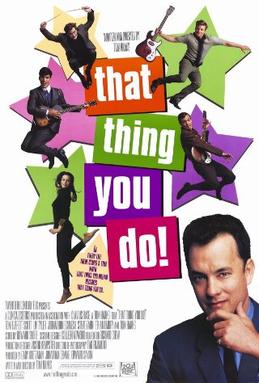
In 1964, an aspiring Jazz drummer named Guy (Tom Everett Scott) is a last minute addition to the a local band called the Oneders.  (It’s meant to sound like Wonders but almost everyone mispronounces it as O-Needers.)  The band’s egotistical leader, James (Jonathon Schaech) has written a slow ballad called That Thing You Do! but when Guy’s drumming causes the band to perform the song at a faster tempo, they end up with a local hit on their hands.  That local hit becomes a national hit when The Oneders are signed by Play-Tone Records.  First, Mr. White (Tom Hanks), their new manager, officially changes the name to The Wonders.  Secondly, he makes sure that every teen in America is dancing to That Thing You Do!  Third, he tells Guy to always wear sunglasses.  Fourth, he tells James that he will record and perform what Play-Tone tells him to.  Guitarist Lenny (Steven Zahn) and the unnamed Bass Player (Ethan Embry) are happy to be along for the ride but James chafes at his lack of artistic freedom.  Guy, meanwhile, falls for James’s girlfriend (Liv Tyler, at her loveliest) and dreams of meeting his idol, jazzman Del Paxton (Bill Cobbs).

That Thing You Do! was Tom Hanks’s directorial debut and, with its careful recreation of a bygone era and its collection of authentic sounding early 60s rock on the soundtrack, it was obviously a labor of love.  Considering the number of times that the song is played in the movie, it helps that it is a very good song.  That Thing You Do! is a catchy tune, one that you can’t help but tap your feet to.  At the same time, it also sounds like a one hit wonder.  It’s good but not so great as to make you expect much else from The Wonders.

Not surprisingly, Tom Hanks gets great performances from the entire ensemble cast.  Johnathon Schaech and Tom Everett Scott have never been better.  Liv Tyler is lovely and vulnerable as James’s unappreciated girlfriend.  Familiar faces like Peter Scolari, Kevin Pollak, Chris Isaak, and Clint Howard make welcome appearances.  Hanks himself is surprisingly intimidating as Mr. White.  When he says that the band will cover something the Play-Tone catalogue, it’s obvious that he’s not making a request.

The film is a tribute to being young and to loving music bit it’s also a study in the disillusionment of discovering that everything is ultimately a business.  James is frequently an arrogant jerk and he treats his girlfriend terribly but it’s hard not to sympathize with him when he says that he wants to do more than just cover songs from the Play-Tone catalogue.  To James and Guy, the Wonders are about self-expression and their love of music.  To Mr. White, the Wonders are just another band that came up with one catchy tune and who probably aren’t ever going to be heard from again.   That Thing You Do! pays tribute to all of the one-hit wonders out there, the bands who you forget about until you just happen to hear that one song on the radio or in a movie and suddenly, all the memories come flooding back.


Film Review: Cast Away (dir by Robert Zemeckis)


“WILSON!”

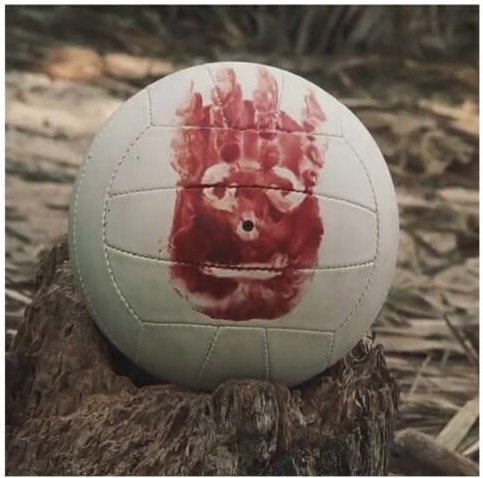
Seriously, I’m usually pretty well-behaved when I watch a movie but every time I see the 2000 film Cast Away, I find myself thinking, “Protect Wilson!  You must protect Wilson!”  And then, every time, I feel the sting of tears in my eyes as Wilson, with that red-face and that understanding attitude, goes floating away.

Wilson is a volleyball.  When a FedEx executive named Chuck Noland (played by Tom Hanks) finds himself stranded on a desert island, Wilson becomes his only companion.  A stain from Chuck’s bloody palm creates something that resembles a face on Wilson’s rubber surface and Chuck spends a lot of time talking to Wilson.  It’s how Chuck maintains his sanity, even as he loses weight, sheds most of his clothes, and grows a beard.

Chuck learns how to make fire.  He learns how to catch fish.  He is able to survive due to the supplies that he gathers from the FedEx packages that were being carried on the plane that crashed into the island.  But Chuck never stops dreaming of returning home to his girlfriend (Helen Hunt).  Eventually, Chuck finds the courage to try to make the journey back to civilization.  He brings Wilson with him but ultimately, this is something that Chuck is going to have to do on his own.  Of course, Chuck has failed to consider that he’s been gone for years.  He is presumed dead.  On the Island, time seemed like it was frozen.  For the rest of the world, life has continued.

Cast Away is a film that a lot of people, especially online film commentators, tend to criticize.  The complaint is usually that the film is essentially a commercial for FedEx, that it’s not believable that Tom Hanks could survive on that island for as long as he did, and that the film itself has a weak ending.  I’ll concede that the film does make FedEx look like the nicest corporation on Earth.  (FedEx’s CEO appears as himself, which should tell you something about how the company is presented.)  And I will admit that the film’s time-advancing jump cut, which abruptly takes Hanks from being clean-shaven and husky to being thin and bearded, does leave a lot of unanswered questions.  But I will always defend the film’s ending.  The film ends on a note of ambiguity but how else could it have ended?  Everyone thought Chuck Noland was dead.  His girlfriend had every right to get on with her life and, in fact, it would have been psychologically unhealthy for her if she hadn’t.  As for that final shot, it’s an acknowledgment that Chuck doesn’t know what lies ahead of him in the future.  All he knows is that he life isn’t over yet.  It’s a melancholy ending.  It’s a frustrating ending.  But it’s also the only way the film could have ended and therefore, it’s a perfect ending.

Cast Away is a film that I will always defend and it’s also a film that really only could have worked with Tom Hanks in the lead role.  He plays Chuck as being the ultimate everyman, an affable guy who was just trying to do his job and whose survival of the initial plane crash was largely due to luck.  Hanks is one of those actors who is instantly sympathetic and Cast Away uses his screen persona to good effect.  You want him to survive because he’s Tom Hanks.  He may be playing a character named Chuck Noland but ultimately, he’s Tom Hanks.  He survived being trapped in space.  Surely, he can survive being stranded on an island.  The majority of the film is just Hanks talking to himself.  This would have brought out the worst in so many actors but Tom Hanks makes it work.  And yes, he’ll bring tears to your eyes as he watches Wilson float away.  That’s the power of a good actor.

As for Wilson, I like to think that he washed up in Pensecola.  Recently, I played a little volleyball on a beautiful Florida beach.  Was that you, Wilson?


Live Tweet Alert: Join #FridayNightFlix For The Burbs!


As some of our regular readers undoubtedly know, I am involved in a few weekly live tweets on Twitter and Mastodon.  I host #FridayNightFlix every Friday, I co-host #ScarySocial on Saturday, and I am one of the five hosts of #MondayActionMovie!  Every week, we get together.  We watch a movie.  We tweet our way through it.

Tonight, at 10 pm et, #FridayNightFlix presents 1989’s The Burbs, starring Tom Hanks!

If you want to join us this Friday, just hop onto twitter, start the movie at 10 pm et, and use the #FridayNightFlix hashtag!  It’s a friendly group and welcoming of newcomers so don’t be shy.

The Burbs is available on Prime!  See you there!

Here’s The Trailer For …. Here!


The trailer for Robert Zemeckis’s latest technical experiment, Here, dropped today.  The film follows Tom Hanks and Robin Wright over the course of many decades and it uses de-aging technology to make them look younger.  The reaction online seems to be mixed, with some saying that Hanks and Wright look like wax figures of themselves.

Personally, I would have cast Hanks and Wright’s respective children as the younger versions of themselves but de-aging is the hot thing right now.

Here’s the trailer.  Judge for yourself.

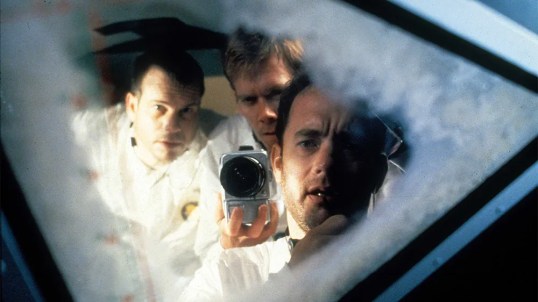
Scenes That I Love: The Crew of Apollo 13 Sees The Moon in Ron Howard’s Apollo 13


Today, the Shattered Lens wishes a happy birthday to director Ron Howard!

Ron Howard has been in the film business for his entire life, first as an actor and then as a director.  He is perhaps the epitome of the mainstream, Hollywood film director and, as such, he doesn’t always get the credit that he deserves.  He’ll never be considered an auteur but no matter!  Ron Howard makes efficient and often entertaining films and, in this age of bloated budgets and self-indulgence, there’s something to be said for his professional approach.

Plus, he gave us this absolutely beautiful scene from 1995’s Apollo 13.  In this scene, Jim Lovell (Tom Hanks) takes a look at the moon and, for a minute, thinks about what could have been.  Though Lovell may dream of walking on the moon, he knows it won’t happen and that his only concern now is getting both himself and his crew back home.  He’s a professional, much like Ron Howard himself.

Retro Television Review: The Love Boat 4.1 “Sergeant Bull/Friends and Lovers/Miss Mother”


Welcome to Retro Television Reviews, a feature where we review some of our favorite and least favorite shows of the past!  On Wednesdays, I will be reviewing the original Love Boat, which aired on ABC from 1977 to 1986!  The series can be streamed on Paramount Plus!

This week, come aboard for season 4!

Episode 4.1 “Sergeant Bull/Friends and Lovers/Miss Mother”

(Dir by Roger Duchowny, originally aired on October 25th, 1980)

Well, it’s time for the fourth season of The Love Boat and let’s see who is going to be taking a cruise this week….

Hey, we know that guy!

Yes, it’s a young Tom Hanks, making one of his first television appearances on The Love Boat.  Tom had a sitcom coming out so ABC decided to promote the then-unknown actor by giving him a guest role on one of their most popular series.

Who does Tom play?  He plays a complete a total douchebag named Rick Martin, a former fraternity brother of Gopher’s who enjoys giving Gopher a hard time about his reputation for being “Strike-Out Smith.”  Rick makes Gopher feel so uncomfortable that Gopher impulsively claims that Julie is his girlfriend.  Julie plays along with Gopher.  This not only leads to sleazy Rick trying to steal Julie away from Gopher but it also causes Julie and Gopher to have real feelings for each other.

Yes, it is interesting to watch Tom Hanks play a sleaze but what is even more interesting, for longtime watchers of the show, is that Julie and Gopher make a surprisingly credible couple.  They actually do have a very likable chemistry together and it never seems improbable that they might end up together.  Of course, in the end, they decide to just stay friends because anything else would have upset the balance of the show.

Tom’s presence overshadows the rest of the show but there are two other stories to deal with.  Vic Tayback plays a former dill sergeant who reunites with his former recruits (Nipsey Russell, Harvey Lembeck, and Jack Somack) and who turns out to still be such a hardass that they bribe their cabin stewardess (Doris Roberts) to pursue a romance with him.  Of course, the two of them fall in love for real.  This was all a bit silly and Tayback’s drill sergeant was a bit annoying but it was nice to see him drop his guard around Doris Roberts and admit that he was only acting like a drill sergeant because that was all he had ever been.

Finally, Gwen Hutchins (Shelley Smith) boards the boat and tells Doc Bricker that she is two-months pregnant.

“Your husband must be very proud!” Doc replies, without missing a beat.

No, Gwen explains, she’s not married.  Once again, we are reminded that Doc is a walking HR nightmare.

Anyway, Gwen falls for a guy named Dennis (Dennis Cole) but she worries how Dennis will react to learning that she’s pregnant.  At first, Dennis does not react well, even asking her if she considered getting an abortion.  (She explains that she doesn’t support abortion, which definitely would not fly if this episode were made today.)  It all works out in the end but, seriously, I think she deserves better than Dennis.  Dennis Cole is an actor who I have seen in quite a few of these shows and he always seem kind of lost.  That was certainly the vibe that he gave off here.

This was an entertaining-enough episode, though almost all of the credit for that goes to the presence of Tom Hanks and the likable chemistry between Fred Grandy and Lauren Tewes.  It was definitely a good way to start off the fourth season.

Icarus File No. 11: The Bonfire of the Vanities (dir by Brian De Palma)


In 2021, I finally saw the infamous film, The Bonfire of the Vanities.

I saw it when it premiered on TCM.  Now, I have to say that there were quite a few TCM fans who were not happy about The Bonfire of the Vanities showing up on TCM, feeling that the film had no place on a station that was supposed to be devoted to classic films.  While it’s true that TCM has shown “bad” films before, they were usually films that, at the very least, had a cult reputation.  And it is also true that TCM has frequently shown films that originally failed with audiences or critics or both.  However, those films had almost all been subsequently rediscovered by new audiences and often reevaluated by new critics.  The Bonfire of the Vanities is not a cult film.  It’s not a film about which one can claim that it’s “so bad that it’s good.”  As for the film being reevaluated, I’ll just say that there is no one more willing than me to embrace a film that was rejected by mainstream critics.  But, as I watched The Bonfire of the Vanities, I saw that everything negative that I had previously read about the film was true.

Released in 1990 and based on a novel by Tom Wolfe, Bonfire of the Vanities stars Tom Hanks as Sherman McCoy, a superficial Wall Street trader who has the perfect penthouse and a painfully thin, status-obsessed wife (Kim Cattrall).  Sherman also has a greedy mistress named Maria (Melanie Griffith).  It’s while driving with Maria that Sherman takes a wrong turn and ends up in the South Bronx.  When Sherman gets out of the car to move a tire that’s in the middle of the street, two black teenagers approach him.  Maria panics and, after Sherman jumps back in the car, she runs over one of the teens.  Maria talks Sherman into not calling the police.  The police, however, figure out that Sherman’s car was the one who ran over the teen.  Sherman is arrested and finds himself being prosecuted by a power-hungry district attorney (F. Murray Abraham).  The trial becomes the center of all of New York City’s racial and economic strife, with Sherman becoming “the great white defendant,” upon whom blame for all of New York’s problems can be placed.  Bruce Willis plays an alcoholic journalist who was British in the novel.  Morgan Freeman plays the judge, who was Jewish in the novel.  As well, in the novel, the judge was very much a New York character, profanely keeping order in the court and spitting at a criminal who spit at him first.  In the movie, the judge delivers a speech ordering everyone to “be decent to each other” like their mothers taught them to be.

Having read Wolfe’s very novel before watching the film, I knew that there was no way that the adaptation would be able to remain a 100% faithful to Wolfe’s lacerating satire.  Because the main character of Wolfe’s book was New York City, he was free to make almost all of the human characters as unlikable as possible.  In the book, Peter Fallow is a perpetually soused opportunist who doesn’t worry about who he hurts with his inflammatory articles.  Sherman McCoy is a haughty and out-of-touch WASP who never loses his elitist attitude.   In the film, Bruce Willis smirks in his wiseguy manner and mocks the other reporters for being so eager to destroy Sherman.  Hanks, meanwhile, attempts to play Sherman as an everyman who just happens to live in a luxury penthouse and spend his days on Wall Street.  Hanks is so miscast and so clueless as how to play a character like this that Sherman actually comes across as if he’s suffering from some sort of brain damage.  He feels less like a stockbroker and more like Forrest Gump without the Southern accent.  There’s a scene, written specifically for the film, in which Fallow and Sherman ride the subway together and it literally feels like a parody of one of those sentimental buddy films where a cynic ends up having to take a road trip with someone who has been left innocent and naïve as result of spending the first half of their life locked in basement or a bomb shelter.  It’s one thing to present Sherman as being wealthy and uncomfortable among those who are poor.  It’s another thing to leave us wondering how he’s ever been able to successfully cross a street in New York City without getting run over by an angry cab driver.

Because the film can’t duplicate Wolfe’s unique prose, it instead resorts to mixing cartoonish comedy and overwrought melodrama.  It doesn’t add up too much.  At one point, Sherman ends a dinner party by firing a rifle in his apartment but, after it happens, the incident is never mentioned again.  I mean, surely someone else in the apartment would have called the cops about someone firing a rifle in the building.  Someone in the press would undoubtedly want to write a story about Sherman McCoy, the center of the city’s trial of the century, firing a rifle in his own apartment.  If the novel ended with Sherman resigned to the fact that his legal problems are never going to end, the film ends with Sherman getting revenge on everyone who has persecuted him and he does so with a smirk that does not at all feel earned.  After two hours of being an idiot, Sherman suddenly outthinks everyone else.  Why?  Because the film needed the happy ending that the book refused to offer up.

Of course, the film’s biggest sin is that it’s just boring.  It’s a dull film, full of good actors who don’t really seem to care about the dialogue that they are reciting.  Director Brian De Palma tries to give the film a certain visual flair, resorting to his usual collection of odd camera angles and split screens, none of which feel at all necessary to the story.  In the end, De Palma is not at all the right director for the material.  Perhaps Sidney Lumet could have done something with it, though he would have still had to deal with the less than impressive script.  De Palma’s over-the-top, set piece-obsessed sensibilities just add to the film’s cartoonish feel.

The film flopped at the box office.  De Palma’s career never recovered.  Tom Hanks’s career as a leading man was momentarily derailed.  Bruce Willis would have to wait a few more years to establish himself as a serious actor.  Even the normally magnanimous Morgan Freeman has openly talked about how much he hated being involved with The Bonfire of the Vanities.  That said, the film lives on because  De Palma allowed journalist Julie Salomon to hang out on the set and the book she wrote about the production, The Devil’s Candy, is a classic of Hollywood non-fiction.  (TCM adapted the book into a podcast, which is how The Bonfire of the Vanities came to be featured on the station.)  Thanks to Salomon’s book, The Bonfire of the Vanities has gone to become the epitome of a certain type of flop, the literary adaptation that is fatally compromised by executives who don’t read.

Previous Icarus Files:

  1. Cloud Atlas
  2. Maximum Overdrive
  3. Glass
  4. Captive State
  5. Mother!
  6. The Man Who Killed Don Quixote
  7. Last Days
  8. Plan 9 From Outer Space
  9. The Last Movie
  10. 88