Insomnia File #69: Candy (dir by Christian Marquand)


What’s an Insomnia File? You know how some times you just can’t get any sleep and, at about three in the morning, you’ll find yourself watching whatever you can find on cable or streaming? This feature is all about those insomnia-inspired discoveries!

If you find yourself having trouble getting to sleep tonight, you can always pass the time by watching the 1968 film, Candy.  It’s currently on Tubi.

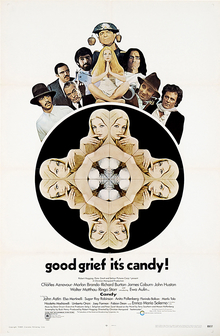
Based on a satirical novel by Terry Southern and Mason Hoffenberg, Candy follows Candy Christian (Ewa Aulin), a naive teenager from middle America as she has a number of increasingly surreal adventures, the majority of which end with her getting sexually assaulted by one of the film’s special guest stars.  It’s very much a film of the 60s, in that it’s anti-establishment without actually seeming to know who the establishment is.  It opens with a lengthy sequence that appears to be taking place in outer space.  It ends with an extended sequence of Candy walking amongst the film’s cast and a bunch of random hippies.  Director Christian Marquand appears as himself, directing the film.  Yep, this is one of those films where the director and the film crew show up and you’re supposed to be say, “Far out, I didn’t realize I was watching a movie, man.”

The whole thing is a bit of a misfire.  The novel was meant to be smut that satirized smut.  The film isn’t really clever enough to work on any sort of real satirical level.  As was the case with a lot of studio-made “psychedelic” films in the 60s, everything is a bit too obvious and overdone.  Casting the Swedish Ewa Aulin as a character who was meant to represent middle America was just one of the film’s missteps.  Based on The Graduate, Mike Nichols probably could have made a clever film out of Candy.  The French Christian Marquand, a protegee of Roger Vadim’s, can not because he refuses to get out of the film’s way.  It’s all jump cuts, flashy cinematography, and attempts to poke fun at American culture by someone who obviously knew nothing about America beyond the jokes told in Paris.

That said, the main reason that anyone would watch this film would be for the collection of guest stars who all show up and try to take advantage of Candy.  Richard Burton plays an alcoholic poet named MacPhisto and his appearance goes on for far too long.  (Burton, not surprisingly, appears to actually be drunk for the majority of his scenes.)  Ringo Star — yes, Ringo Starr — plays a Mexican gardener who assaults Candy after getting turned on by the sight of MacPhisto humping a mannequin.  When Emmanuel’s sisters try to attack Candy, she and her parents escape on a military plane that is commanded by Walter Matthau.  Landing in New York, Candy’s brain-damaged father (John Astin) is operated on by a brilliant doctor (James Coburn) who later seduces Candy after she faints at a cocktail party.  Candy’s uncle (John Astin, again) also tries to seduce Candy, leading to Candy getting lost in New York, meeting a hunchback (Charles Aznavour), and then eventually ending up with a guru (Marlon Brando).  Candy’s adventures climax with a particularly sick joke that requires a bit more skill to pull off than this film can afford.

If you’re wondering how all of these famous people ended up in this movie, you have Brando to thank (or blame).  Christian Marquand was Brando’s best friend and Marlon even named his son after him.  After Brando agreed to appear in the film, the rest of the actors followed.  Brando, Burton, and Coburn received a share of the film’s profits and Coburn later said that his entire post-1968 lifestyle was pretty much paid for by Candy.  That seems appropriate as, out of all the guest stars, Coburn i the only one who actually gives an interesting performance.  Burton is too drunk, Matthau is too embarrassed, Starr is too amateurish, and Brando is too self-amused to really be interesting in the film.  Coburn, however, seems to be having a blast, playing his doctor as being a medical cult leader.

Candy is very much a film of 1968.  It has some value as a cultural relic.  Ultimately, it’s main interest is as an example of how the studios tried (and failed) to latch onto the counterculture zeitgeist.
Previous Insomnia Files:

  1. Story of Mankind
  2. Stag
  3. Love Is A Gun
  4. Nina Takes A Lover
  5. Black Ice
  6. Frogs For Snakes
  7. Fair Game
  8. From The Hip
  9. Born Killers
  10. Eye For An Eye
  11. Summer Catch
  12. Beyond the Law
  13. Spring Broke
  14. Promise
  15. George Wallace
  16. Kill The Messenger
  17. The Suburbans
  18. Only The Strong
  19. Great Expectations
  20. Casual Sex?
  21. Truth
  22. Insomina
  23. Death Do Us Part
  24. A Star is Born
  25. The Winning Season
  26. Rabbit Run
  27. Remember My Name
  28. The Arrangement
  29. Day of the Animals
  30. Still of The Night
  31. Arsenal
  32. Smooth Talk
  33. The Comedian
  34. The Minus Man
  35. Donnie Brasco
  36. Punchline
  37. Evita
  38. Six: The Mark Unleashed
  39. Disclosure
  40. The Spanish Prisoner
  41. Elektra
  42. Revenge
  43. Legend
  44. Cat Run
  45. The Pyramid
  46. Enter the Ninja
  47. Downhill
  48. Malice
  49. Mystery Date
  50. Zola
  51. Ira & Abby
  52. The Next Karate Kid
  53. A Nightmare on Drug Street
  54. Jud
  55. FTA
  56. Exterminators of the Year 3000
  57. Boris Karloff: The Man Behind The Monster
  58. The Haunting of Helen Walker
  59. True Spirit
  60. Project Kill
  61. Replica
  62. Rollergator
  63. Hillbillys In A Haunted House
  64. Once Upon A Midnight Scary
  65. Girl Lost
  66. Ghosts Can’t Do It
  67. Heist
  68. Mind, Body & Soul

Paper Lion (1968, directed by Alex March)


Writer George Plimpton (Alan Alda) is a Park Avenue sophisticate who practices “participatory” journalism.  He has already written about pitching in an exhibition all-star game and getting knocked out by Sugar Ray Robinson.  He is having trouble coming up with his next stunt until he goes to Central Park and plays a touch football game with his girlfriend Kate (Lauren Hutton) and his editor, Oscar (David Doyle).  Oscar sees George throwing the ball and decides that George should write about going to a professional football team’s training camp as a player.

George, who fantasizes about throwing the game-winning touchdown, is enthusiastic.  Most of the teams that George approaches are less enthusiastic but finally, the Detroit Lions agree to sign him as a quarterback.  Once the other players realize that George is a writer and not a professional athlete, there’s a lot of resentment.  As Guard John Gordy (playing himself) puts it, he could easily get injured while protecting an inexperienced quarterback like George.  George can always go back to Park Avenue but, for the rest of the players, the game is their life and they don’t like the idea of some outsider coming in and treating it all like a joke.  At first, only the fearsome defender Alex Karras (also playing himself) is willing to support George but eventually, George’s refusal to give up wins over the rest of the team.  They even let him score a touchdown during practice.

When the preseason begins, George waits for his opportunity to take the field.  How many yards can he lose in three plays?

Paper Lion is based on a true story.  In 1963, George Plimpton did attending training camp and play a scrimmage for the Lions and he later wrote a book about the experience.  The movie changes the time period from ’63 to ’67 so that all of the then-members of the Lions could play themselves.  (Though Karras was a friend of Plimpton’s, he was actually suspended during the 1963 season and, unlike in the movie, never joined Plimpton on the practice field.)  The film plays Plimpton’s football career largely for laughs, celebrating every guy’s fantasy of being a sports star while also showing why it’s probably best to leave the actual game to the professionals.  Alan Alda doesn’t imitate Plimpton’s famous Mid-Atlantic accent but he does capture the excitement of a man getting to live out his fantasy.

Paper Lion was made with the full cooperation of the NFL and a good deal of the film’s final third is made up footage that was shot for an actual game.  Seen today, it’s interesting to see how positively Paper Lion portrays both the game and its players and to contrast it with how the game is usually portrayed today.  There’s no talk of steroids or fears of multiple concussions.  All of the players are clean-cut, friendly, witty, and helpful.  Even the training camp hazing is all done is good fun.  Paper Lion introduces us to the nicest people in the world and they’re all football players!

Retro Television Reviews: Fantasy Island 3.10 “Class of 69/The Pug”


Welcome to Retro Television Reviews, a feature where we review some of our favorite and least favorite shows of the past!  On Tuesdays, I will be reviewing the original Fantasy Island, which ran on ABC from 1977 to 1986.  Almost entire show is currently streaming is on Youtube!

This week, boxing comes to Fantasy Island!

Episode 3.10 “Class of 69/The Pug”

(Dir by Earl Bellamy, originally aired on November 24th, 1979)

Once again, this episode opens with no banter between Mr. Roarke and Tattoo.  Instead, Tattoo announces the arrival of the plane and rings the bell and then he and Mr. Roarke head down to the docks to meet their guests.  This is the third episode in a row without any pre-guest banter and I have to admit that I’m really missing it.

As for this week’s guests, they’re an improvement on last week’s rather forgettable offering.

Joey Lee (Gary Collins) is a former heavyweight boxer who comes to the Island with his son, Mitch (K.C. Martel).  Joey thinks that he’s just been hired to serve as a sparring partner for the world champion, Jackson Malone (Fred Williamson).  Jackson has a title defense coming up, right on the Island.  What Joey doesn’t know is that Mitch’s fantasy is for his father to have a shot at the championship.  When Malone’s opponent has to drop out of the fight, Joey is named as a substitute.  Mitch is excited, until he finds out that Joey is being pressured to take a dive in the third round.  Will Joey throw the fight?  And, even if Joey doesn’t, how will Mitch react to seeing his father getting pounded in the face by the world champion?  Will Mitch learn that his love for his father is more important than his father’s championship?

This fantasy was a typical Rocky rip-off, right down to Fred Williamson doing a credible Apollo Creed impersonation.  The problem, of course, is that the middle-aged and mild-mannered Gary Collins was in no way credible as a heavyweight boxer.  The fact that the world champion was played by an actual athlete didn’t help matters.  (It’s true that Carl Weathers, like Williamson, was also a football player before he played Apollo but Sylvester Stallone himself had been an amateur boxer before he played Rocky so it was easier to buy the idea of their match going the distance.)  In the end, I liked the fact that Mitch realized that his father’s health was more important than being champion.  The fantasy had a nice ending, even if it’s difficult to buy the set-up.

The other fantasy featured Adrienne Barbeau as Brenda Richards.  When she first arrives on Fantasy Island, Tattoo comments on how obese Brenda is, even though she’s only a few pounds overweight.  (Adrienne Barbeau wears a very unconvincing fat suit.)  Mr. Roarke explains that Brenda was humiliated at her high school prom when her date, arrogant jock Lance (Tim Thomerson), tricked her into undressing in the gym before then bringing in the entire senior class in to laugh at her.  (Yikes!)  The high school reunion is being held on Fantasy Island and Brenda’s fantasy is to get revenge.  Roarke gives her a potion which allows her to be thin for 48 hours.  (In reality, Barbeau just ditches the fat suit.)

At the reunion, Brenda tricks Lance into taking off his wig.  The entire senior class discovers that Lance is totally bald and they laugh and laugh.  Everyone is impressed with Brenda’s revenge except for Brenda’s old high school friend, Bernie Drexel (Fred Grandy, taking a break from The Love Boat).  Brenda sees that she was just as cruel to Lance as he was to her back in high school so she makes a public apology and encourages everyone to be kind to one another.  Barbeau then puts the fat suit back on.  Bernie says that Brenda will always be the most beautiful woman that he knows.  Awwwww!

I actually liked this fantasy, largely because of the chemistry between Barbeau and Grandy.  Plus, Tim Thomerson made a great arrogant jock.  I know that some people will say that this episode featured too many jokes about Brenda’s weight (especially considering the fact that, even before drinking the potion, Brenda was hardly obese) but I appreciated the fact that it had an anti-bullying message.  And if her romance with Bernie inspires Brenda to eat healthy and start getting regular exercise, all the better!

At the end of the episode, Mr. Roarke tells Tattoo that beauty is in the eye of the beholder.  “To me,” Mr. Roarke says, “you are six feet two inches tall.”

Uhmmm….yeah, I don’t know how I feel about that ending.  It seems like the show, whether intentionally or not, is saying that Tattoo will be forever unloved because of his height.  Even without the pre-guest banter, Roarke is finding ways to passive-aggressively taunt his assistant.  That’s life on Fantasy Island.

Hagler vs. Hearns “The War” Is A Real Fight


CCqwYshUUAA6qes.jpg large

So, it looks like the fight of the century between Floyd Mayweather, Jr and Manny Pacquiao turned out to be more of a whimper instead of a bang.

Now, this short, but sweet 3-round fight from April, 15, 1985 was (and is) what a great fight looks like. It’s the kind of fight Floyd will never put himself in and the sort of fighters he would duck and dodge until they’re on the downside of their careers then he would agree for the money fight.

Floyd is not, as he proclaimed a couple weeks ago, the greatest fighter ever. He’s no Muhammad Ali. He’s no Sugar Ray Robinson. He’s not even in the same league as Sugar Ray Leonard, Roberto Duran, Marvin Hagler and Thomas Hearns.