Brad reviews BREAKING IN (1989), starring Burt Reynolds!


BREAKING IN (1989) opens with veteran safecracker Ernie Mullins (Burt Reynolds) pulling a job at a rich guy’s house, only to be surprised when a young, amateurish thief named Mike (Casey Siemaszko) turns up at the same place to raid the fridge. Immediately taking a liking to the kid, Ernie decides to offer Mike a chance to learn his trade. Thus begins a partnership, and odd-couple friendship, where the two men pull a series of jobs together, with Ernie passing on his knowledge to his young protege who seems to be enjoying the sudden influx of cash into this life. Unfortunately, the generation gap causes some problems as Mike doesn’t necessarily take heed to Ernie’s advice to never being too greedy or flashy. Soon, Mike is renting high rise apartments and buying fancy cars with cash. When they pull a big job on the 4th of July, will Mike’s less than frugal ways drag them both down?!

Written by the excellent, independent writer and director John Sayles (MATEWAN, EIGHT MEN OUT) and directed by Scottish director Bill Forsyth (LOCAL HERO), BREAKING IN is a reminder of just how great Burt Reynolds is in the right role. In his 50’s at the time this was filmed, Reynolds gives a relaxed, lived-in, character performance that comes across as effortlessly cool, and he does it without having to rely on his trademark charm and big grin. The late 80’s were a time when Burt was no longer a box office superstar, and BREAKING IN seems to be an unjustly forgotten entry in his hugely successful career. After this, Burt would find TV success on EVENING SHADE, and he’d be nominated for an Oscar for his role in BOOGIE NIGHTS (1997), but his Ernie Mullins stands out to me as one of his last great film roles. Casey Siemaszko is good as Mike, but this is Reynolds’ show and he’s overshadowed even in a solid performance. As far as the other supporting performances, Sheila Kelley stood out to me as a sharp-tongued prostitute who Siemaszko falls in lust with. The poem she shares about a man’s “balls” is a highlight of the film as far as I’m concerned, and further illustrates the quality of Sayles’ screenplay!

I like the way that BREAKING IN feels low-key, even as the characters engage in their various criminal heists. This can be credited to director Bill Forsyth who turns what could have been a standard master / apprentice crime film into something that feels somewhat realistic. The pacing is slow as Reynolds passes on his knowledge, and for some people it may be too slow, but that’s one of the things I really liked about the movie. The two men really get to know each other. That way, when they have disagreements and blow ups a couple of times, they’re still able to respect each other and patch things up. That’s how things are in the real world, as opposed to most movies where a simple disagreement will almost certainly lead to ridiculous consequences. BREAKING IN respects its characters in a way that’s unique to most crime films. 

At the end of the day, BREAKING IN is a gem that is at its best as a lighthearted character study of a professional thief whose time is passing him by. Burt Reynolds rarely got to play roles this subtle, and I think he made the most of the opportunity. As a big fan of Reynolds, I highly recommend this one. 

Why I Love Toy Story of Terror!


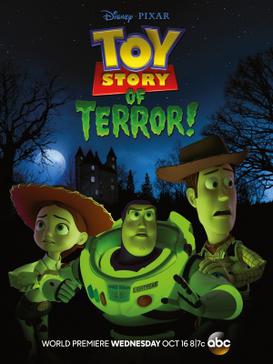
In Toy Story of Terror!, Bonnie (voice of Emily Hahn) is going on a Halloween road trip to visit her grandmother. When the car gets a flat, Bonnie and her mother have to spend the night in a creepy hotel. Bonnie has brought aome of her toys with her –Sheriff Woody (Tom Hanks), Buzz Lightyear (Tim Allen), Jessie (Joan Cusack), Mr. Potato Head (Don Rickles), Rex (Wallace Shawn), Trixie (Kristen Schaal), and Mr. Pricklepants (Timothy Dalton). Mr. Pricklepants says that the motel feels like the setting of a horror story and he’s right! Mr. Potato Head vanishes, leaving behind only his arm. While the toys search for him, they are captured one-by-one by an iguana. The owner of hotel (Stephen Tobolowsky) is stealing his guests’ toys and selling them online.

Toy Story of Terror! introduces some other toys, all of whom have been captured and imprisoned in a glass case. Combat Carl (Carl Weathers) was my favorite but I also have a soft spot for Old Timer (Christian Romano), the alarm clock who spoke like an old man. I like the iguana too. He didn’t know he was being bad.

What makes Toy Story of Terror! so special is that Jessie has to conquer her fear of being in a box to rescue Woody and the other toys. Everyone is scared of something, even brave and confident Jessie. Like Jessie, I get claustrophobic. I’m embarrassed to admit it but I do like to a keep a nightlight on when I’m sleeping. I don’t like the idea of waking up and not being able to see what’s in front of me. Toy Story of Terror! isn’t just about toys. It’s also about how it’s okay to scared because, deep down, we all have the strength to conquer our fears. Jessie proves it when she hides in a box so she can save Woody. Maybe I’ll even turn off the nightlight tonight. Nah, I don’t think so.

Lisa and I have watched Toy Story of Terror! every year since it first aired in 2013. Every time I see it, it makes me smile and it makes me feel like there’s nothing that I can’t do. I don’t know if they’re going to broadcast the special on TV this year. There really haven’t been any special Halloween shows yet, though there’s still another week to go. If they don’t air, it’ll be a shame. It is on Disney+, though. And It’s The Great Pumpkin, Charlie Brown is on Apple TV! Don’t forget to watch them this October!

Basic Instinct (1992, directed by Paul Verhoeven)


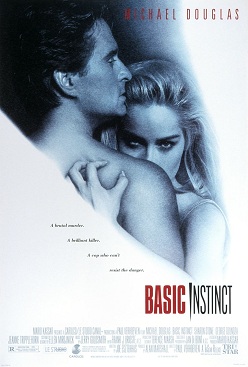
Nick Curran (Michael Douglas) is a San Francisco police detective who, along with his jolly partner Gus (George Dzundza), finds himself investigating the ice pick-stabbing of a rock star.  The main suspect is glamorous writer Catherine Trammel (Sharon Stone), who is obviously guilty but manages to outsmart all of the men investigating her by not wearing panties during her interrogation.  Nick finds himself drawn to Catherine, despite his own relationship with with psychologist Elizabeth Garner (Jeanne Tripplehorn).  The more Nick digs into Catherine’s past, the more he becomes obsessed with her but also the more he suspects that she may be a serial killer.  This is mostly because Catherine obviously is a serial killer and anyone should have been able to figure that out.  Instead, Nick, an experienced homicide detective, just gets turned on.

It’s strange to remember how seriously people took Basic Instinct when it was released in 1992.  People debated whether it was a throwback to Hitchcock or just a dirty movie.  Feminists debated whether it was empowering or exploitive.  For several years afterwards, every show from The Simpsons to Seinfeld parodied the interrogation scene.  (In Seinfeld’s case, it helped that Wayne Knight appeared in the film as the district attorney who kept shifting in his seat to get a better view.)  Sharon Stone was described as being the new Grace Kelly and, for a period of years, was the subject of fawning profiles in which she was asked about the future of sex in movies.  For a while, she was inescapable.

Sharon Stone, to be fair, did make the role of Catherine her own.  It’s impossible to imagine some of the other actresses considered — Michelle Pfeiffer, Geena Davis, Mariel Hemingway, or Meg Ryan — in the role.  After a decade of not getting anywhere with her film career, Stone was hungry to be a star and was also willing to do things on camera that other name actresses would have refused.  Sharon Stone was not the next Grace Kelly and Catherine Trammel was ultimately more of a sexual fantasy than an actual character but Stone still deserves a lot of credit for her uninhibited performance in the role.  Though Stone later said that she didn’t realize what was actually being filmed during the interrogation scene, it’s her confidence and her unapologetic sensuality that makes the scene compelling.  Her performance has the energy that the sleepwalking Michael Douglas lacks.

Today, Basic Instinct is best-viewed as a satire.  Director Paul Verhoeven sends up both the cop film and the erotic thriller with a movie that turned everything to eleven.  The film’s sensibility is established by the fact that Michael Douglas’s “hero” is nicknamed Shooter because he killed two innocent people while high on cocaine.  The film’s main joke is an obvious one.  Everyone is too busy staring at Sharon Stone to notice that she’s about to stab them in the back with an icepick.  Joe Eszterhas’s script was vulgar to the point of parody and, fortunately, director Paul Verhoeven understood that even more than Eszterhas did.

Basic Instinct has been imitated countless times but it’s never been equaled.  To that, the credit is owed to Sharon Stone and Paul Verhoeven.


Film Review: Groundhog Day (dir by Harold Ramis)


Happy Groundhog Day!  For the record, Punxsutawney Phil saw his shadow today so get ready for six more weeks of winter!

Oh, how I love Groundhog Day.  I really do.  It’s perhaps the silliest holiday that we have in America and I absolutely adore the whole thing.  I love the fact that people get dressed up for it.  I love that there are people who plan their entire weekend around seeing what the groundhog predicts.  I love that we all know there’s no way a groundhog can reasonably predict the weather but, for one day, we pretend like it can.  And while Groundhog Day itself had its beginning in Germany, the holiday really has become pure Americana.  It’s such an innocent holiday, or at least it is now that Bill de Blasio is no longer in a position to kill the magic groundhog.

(Boo de Blasio!  Boo!)

Of course, no Groundhog Day is complete without watching the 1993 comedy of the same name.  The film has become such a major part of American culture that even people who haven’t watched it know what it’s about.  (It’s a bit like It’s A Wonderful Life in that way.)  Bill Murray plays Phil Connors, a cynical weatherman who is sent to cover Groundhog Day in Punxsutawney and finds himself reliving the same day over and over again.  Every morning, it’s once again February 2nd.  Sonny and Cher’s I Got You Babe plays on the radio.  Phil is approached by Ned Ryerson (Stephen Tobolowsky), an annoying former classmate turned insurance salesman.  Phil steps in the same puddle.  He finds himself covering the same story and, again and again, he’s stranded by the same blizzard.  At first, Phil is angry.  Even multiple suicides can’t stop the cycle.  Kidnapping the groundhog can’t stop the cycle.  Then, he decides to take advantage of living the same day over and over again.  He gets to know the people in the town and realizes that they’re not so bad.  He saves the mayor (Brian Doyle-Murray) from choking at dinner but, in the film’s most poignant moment, realizes that an old homeless man is going to die regardless of how many times he tries to save him.  Phil learns how to learn the piano.  He learns how to speak French.  And, most importantly, he falls in love with Rita (Andie MacDowell).  Of course, when he tells Rita this, she assumes he’s just trying to take advantage of her.  Rita says that they barely know each other but what she doesn’t realize is that Phil has been spending day-after-day with her.

As you might have guessed I relate to Rita.  She loves the silliness of the holiday and so do I.  I also relate to Nancy Taylor (Marita Geraghty), just because of her determination to enjoy the day no matter what.  That said, this is totally Bill Murray’s film and this is one of his best performances, one in which he expertly mixes his trademark comedy with some very poignant drama.  One thing I like about this film is that Phil becomes a better man as a result of living the same day over and over again but it doesn’t totally change his personality.  At the end, he’s still the same sarcastic smartass that he was at the start of the film but he’s no longer a cynic.  He’s learned how to appreciate other people.  He’s fallen in love.  Much like George Bailey, he’s become the richest man in town.  This is a rare film where the main character is as interesting after he’s reformed as before.

It always breaks my heart a little to read that Bill Murray and director Harold Ramis had a difficult time working together while making this film.  It’s truly a perfect film and that’s due to both Murray’s performance and Ramis’s heartfelt direction.  I’m also glad that Ramis and Murray made up before Ramis passed away.  Life’s too short and sadly, unlike in the movies, we don’t always get a chance to go back and correct the past.

Groundhog Day is a holiday classic and may it continue to be watched for decades to come.

#SundayShorts with WEDLOCK (1991)!


Since Sunday is a day of rest for a lot of people, I present #SundayShorts, a weekly mini review of a movie I’ve recently watched.

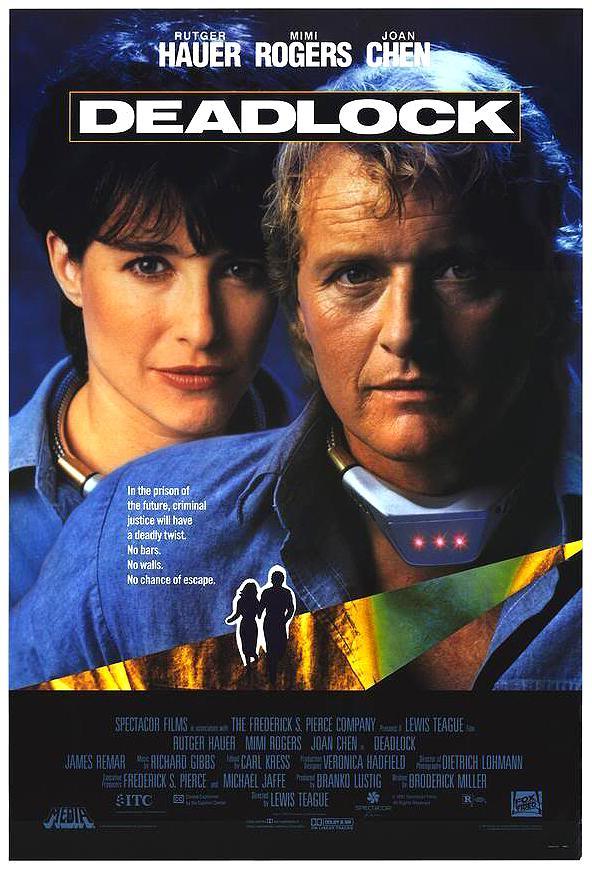
Master diamond thief Frank Warren (Rutger Hauer) pulls off a big job with the help of his fiancé Noelle (Joan Chen) and his best friend Sam (James Remar). Unfortunately, after the job is finished, Noelle unceremoniously ends her courtship with Frank when she shoots him multiple times because she’s now hooked up with Sam. The next time we see Frank, who somehow survived the close-range shootings, he’s on a bus to a prison called Camp Holliday, which is run by Warden Holliday (Stephen Tobolowsky). Camp Holliday is a high-tech prison where each inmate is gifted a collar containing an explosive device that also happens to be electronically connected to another inmate. As long as the two prisoners are within 100 yards from each other, it’s all good. If they are separated by more than 100 yards, their collars will explode leaving a bloody nub where their head used to be. And since nobody knows who their “wedlock partner” is, trying to escape is not a strong option. One day fellow prisoner Tracy Riggs (Mimi Rogers) comes to Frank and tells him that she’s his wedlock partner. Through a variety of circumstances, the two are able to escape, but they still must maintain their 100-yard proximity as the authorities try to track them down. Meanwhile, Sam and Noelle, and even Warden Holliday, have all teamed up to try to find where Frank stashed the diamonds prior to heading to prison. And what about Tracy, who’s side is she really on?

I didn’t have the Home Box Office channel when I was growing up, so I wasn’t aware of this film until it premiered on home video as “DEADLOCK.” Of course, being a huge fan of Rutger Hauer, I rented it as soon as possible. The key to lower budget, made-for TV movies working will always be tied to three things: an entertaining premise, a game cast, and a director who can put the movie together. I’m happy to report that WEDLOCK has each of these things. Even though we had seen exploding neck collars in prison before in THE RUNNING MAN (1987), I like the way this film ties one prisoner’s fate to another’s. That extra dimension makes for some exciting moments in the film. Rutger Hauer is especially good in WEDLOCK. If any other actor was in the lead, I honestly doubt I would have enjoyed it as much, but with him it becomes a fun movie. And the fact that he’s tied to the beautiful Mimi Rogers for most of the movie makes it that much more fun. The remainder of the cast goes pretty far over the top, but that’s okay because subtle character portrayals are not part of the equation in these types of movies. James Remar and Joan Chen are fun as the initial betrayers and current pursuers, Basil Wallace is effectively evil as a bully and fellow inmate, and Stephen Tobolowsky is his usual fun self as Warden Holliday.  Director Lewis Teague has a pretty nice resume of interesting films leading up to WEDLOCK, including ALLIGATOR (1980), FIGHTING BACK (1982), CUJO (1983), CAT’S EYE (1985), and NAVY SEALS (1990). He does a fine job here, as the movie has many well executed scenes that play out at a nice pace. Overall, I’ve always been a fan of low budget action movies that are done well. This one fits the bill for me.  

Five Fast Facts:

  1. Rutger Hauer and Joan Chen worked on 3 films together, including WEDLOCK. I have a soft spot in my heart for their film THE BLOOD OF HEROES (1989) and recommend it. I thought their other movie, PRECIOUS FIND (1996) was pretty bad. I watched it one time in the 90’s and haven’t watched it since.
  2. WEDLOCK received a Primetime Emmy nomination for “Outstanding Individual Achievement in Sound Editing for a Miniseries or a Special.”
  3. Even though WEDLOCK was set “in the future,” early in the film we see a movie theater marquee showing the Steven Seagal movie MARKED FOR DEATH (1990). I found that interesting considering that Basil Wallace is a bad guy in WEDLOCK, and he played twin brother bad guys in MARKED FOR DEATH. Danny Trejo also has small parts in both WEDLOCK and MARKED FOR DEATH.
  4. Mimi Rogers starred in another film in 1991 called THE RAPTURE. It’s a thought-provoking film that some people love, and some people hate. I personally found it intriguing, and it features a really strong performance from Rogers.
  5. In 1995, the film DEADLOCK 2 was released. It’s not a sequel as it doesn’t build on the events of the first film or bring back any of the characters, but it is set in a world of exploding prison collars. The film stars Esai Morales and Nia Peeples.  

When I rented the film in the early 90’s, it was called DEADLOCK. I’m sure I owned it on VHS at one point in my life.

Check out the trailer below:

Lisa Marie Reviews An Oscar Nominee: The Insider (dir by Michael Mann)


In the 1999 Best Picture Nominee, The Insider, the American media takes a beating.

Al Pacino plays Lowell Bergman.  Bergman is a veteran newsman who, for several years, has been employed as a producer at 60 Minutes.  He is a strong believer in the importance of the free press and he’s proud to be associated with both 60 Minutes and CBS News.  He’s one of the few people who can manage the famously prickly correspondent, Mike Wallace (Christopher Plummer).  When we first see Bergman, he and Wallace are in the Middle East and arranging a tense interview with the head of Hezbollah.  It’s easy to see that Bergman is someone who will go anywhere and take any risk to get a story.  It’s also apparent that Bergman thinks that the people that he works with feel the same way.

That all changes when Bergman meets Jeffery Wigand (Russell Crowe), a recently fired tobacco company executive who initially agrees to serve as a consultant for one of Bergman’s story but who leaves Bergman intrigued when he reveals that, due to a strict confidentiality agreement, he’s not allowed to discuss anything about his time as an executive.  As the tobacco companies are currently being sued by ambitious state attorney generals like Mississippi’s Mike Moore (who plays himself in the film), Bergman suspects that Wigand knows something that the companies don’t want revealed.

And, of course, Bergman is right.  Wigand was fired for specifically objecting to his company’s effort to make cigarettes more addictive, something that the tobacco industry had long claimed it wasn’t doing.  Wigand’s pride was hurt when he was fired but he knows that breaking the confidentiality agreement will mean losing his severance package and also possibly losing his marriage to Liane (Diane Venora) as well.  However, Wigand is angered by the heavy-handed techniques that his former employer uses to try to intimidate him.  He suspects that he’s being followed and he can’t even work out his frustrations by hitting a few golf balls without someone watching him.  When Wigand starts to get threats and even receives a bullet in the mail, he decides to both testify in court and give an interview to Wallace and 60 Minutes.

The only problem is that CBS, after being pressured by their lawyers and facing the risk of taking a financial loss in an upcoming sell, decides not to run the interview.  Bergman is outraged and assumes that both Mike Wallace and veteran 60 Minutes producer Don Hewitt (Philip Baker Hall) will support him.  Instead, both Wallace and Hewitt side with CBS.  Left out in the cold is Jeffrey Wigand, who has sacrificed almost everything and now finds himself being attacked as merely a disgruntled employee.

Directed by Michael Mann and based on a true story, The Insider is what is usually described as being “a movie for adults.”  Instead of dealing with car chases and super villains and huge action set pieces, The Insider is a film about ethics and what happens when a major media outlet like CBS News fails to live up to those ethics.  (No one is surprised when the tobacco company tries to intimidate and silence Wigand but the film makes clear that people — or at least people in the 90s — expected and hoped for more from the American press.)  Wigand puts his trust in Bergman and 60 Minutes largely because he believed Bergman’s promise that he would be allowed to tell his story.  It’s a promise that Bergman made in good faith but, in the end, everyone from the CBS executives to the tobacco companies is more interested in protecting their own financial future than actually telling the truth.  Wigand loses his family and his comfortable lifestyle and Bergman loses his faith in the network of Edward R. Murrow.  It’s not a particularly happy film but it is a well-made and thought-provoking one.

Pacino and Crowe both give excellent performances in the two lead roles.  Pacino, because he spends most of the film outraged, has the flashier role while Crowe plays Wigand as a rather mild-mannered man who suddenly finds himself in the middle of a national news story.  (Crowe’s performance here is one of his best, precisely because it really is the opposite of what most people expect from him.)  Crowe does not play Wigand as being a crusader but instead, as an ordinary guy who at times resents being put in the position of a whistleblower.  (Director Mann does not shy away from showing how Bergman manipulates, the reluctant Wigand into finally testifying, even if Bergman’s motives were ultimately not malicious.)  That said, the strongest performance comes from Christopher Plummer, who at first seems to be playing Mike Wallace as being the epitome of the pompous television newsman but who eventually reveals the truth underneath Wallace’s sometimes fearsome exterior.

The Insider was nominated for Best Picture.  Somehow, it lost to American Beauty.

Lisa Marie Reviews An Oscar Nominee: Mississippi Burning (dir by Alan Parker)


1988’s Mississippi Burning opens on a lonely Mississippi backroad in 1964.  A car is pulled over by the police.  Inside the car are three young men, one black and two white.  Judging from their nervous expressions and the sound of the people who stopped them and the fact that they’re in Mississippi during the 60s, we can guess what is about to happen to the people in the car.

With the three men, who were civil rights activists who were involved in voter registration efforts, officially considered to be missing, the FBI sends down two agents to find out what happened.  The two agents are Alan Ward (Willem DaFoe) and Rupert Anderson (Gene Hackman).  Ward is a Northerner who does things by the book and who resents having to deal with lax Southern law enforcement.  He is serious-minded and, just in case we need a reminder of how serious he is, he wears bar-rimmed glasses that make him look like the world’s most fearsome IRS agent.  Anderson is from Mississippi.  He’s a talkative good ol’ boy who was a sheriff before he joined the FBI.  “You know what has four eyes but can’t see?” Anderson asks, “Mississippi.”  It’s a tense partnership, as Ward sometimes disapproves of Anderson’s methods and Anderson thinks that Ward doesn’t understand how things work in Mississippi.

From the first minute we meet local law enforcement, we know that they’re the killers.  Just the fact that one of them are played by Brad Dourif is evidence enough.  However, no one in town is willing to say a word against the police or their cronies.  The white citizens are either too intimidated or they agree with what happened to the three civil rights workers.  (The three men are often referred to as being “outside agitators.”)  The black townspeople live in fear of the Klan and have no reason to trust the word of white FBI agents like Ward and Anderson.

Ward and Anderson investigate the case, hoping that they can find some bit of evidence that will prove the guilt of Sheriff Stuckey (Gailard Sartain), Deputy Pell (Brad Dourif), KKK leader Clayton Townley (Stephen Tobolowsky), and maybe even the town’s mayor (R. Lee Ermey).  One advantage that the FBI has is that the murderers are incredibly stupid.  Another is that Deputy Pell’s abused wife (Frances McDormand, giving the film’s best performance) might be persuaded to testify against her husband.

Mississippi Burning is an example of both powerful filmmaking and problematic history.  Like Ridley Scott, director Alan Parker got his start making commercials and he brought the same sensibility to his movies.  He knew what audiences wanted to see and he made sure to give it to them.  Mississippi Burning looks fantastic and is full of memorable performances.  (Both McDormand and Hackman received Oscar nominations).  The action moves quickly and the villains are so hateful that watching them end up getting humiliated really does bring about a sort of emotional release.

At the same time, this is a film about the Civil Rights era that presents the FBI as being the heroes.  And while it’s true that the FBI did investigate the real-life murders that inspired this film, Mississippi Burning leaves out the fact that the FBI was just a rigorous in harassing and wire tapping Martin Luther King as they were in keeping an eye on the leaders of the Klan.  It’s a film about racism in which the heroes are as white as the villains.  Gene Hackman gives a good performance as Rupert Anderson but the film never really delves all that deeply into Anderson’s feelings about racism in the South.  We’re told that he was a sheriff in Mississippi but we never learn much about what type of sheriff Anderson was.  He’s opposed to the Klan but, historically, the same can be said of many segregationists in the 60s, many of whom felt the Klan’s activities brought unwanted federal attention to what was happening in their home states.  By not delving into Anderson’s own history as a member of Mississippi law enforcement or the FBI’s own more problematic history when it comes to the civil rights movement, the film provides viewers with the escape of viewing the bad guys as being aberrations as opposed to being the norm in 1964.  In the end, Mississippi Burning is an effective thriller with strong heroes and hateful villains.  Just don’t watch it for historical accuracy.

Mississippi Burning was nominated for Best Picture but it lost to Rain Man.

Spaceballs (1987, directed by Mel Brooks)


°ëØ

A long time ago, in a galaxy far far away…

President Skroob (Mel Brooks), the evil and incompetent leader of Planet Spaceball, has squandered all of the air on his planet and is planning on stealing the atmosphere of the planet Druida.  To pull this off, he arranges for the idiotic Prince Valium (Jim J. Bullock) to marry Vespa (Daphne Zuniga), the princess of Druida.  (All together now: “She doesn’t look Druish.”)  Vespa and her droid, Dot Matrix (voice by Joan Rivers), flee Druida with Lord Dark Helmet (Rick Moranis) and Colonel Sandurz (George Wyner) in pursuit.

In debt to the intergalactic gangster, Pizza the Hut (voiced by Dom DeLuise), a mercenary named Lone Star (Bill Pullman) and his associate, the man-dog hypbrid Barf (John Candy), accept a contract from Vespa’s father (Dick Van Patten) to track down his daughter.  They take off in their space Winnebago to bring Vespa home.  Though they start only interested in money, Lone Star and Barf come to learn about love, freedom, and a mystical power known as the Schwartz.  (“No, the Schwartz!”)

Back when I was growing up and just being able to have HBO made you the coolest guy on the block, Spaceballs was one of my favorite movies.  I watched it every time that it came on cable.  As usual with Mel Brooks, there were a lot of double entendres that went over my young head but there was also enough goofy humor that I could laugh at what was going on.  I could quote all the lines.  I laughed whenever Rick Moranis showed up in his Darth Vader-costume.  I laughed at John Candy’s facial expressions.  I laughed when Mel Brooks showed up as Yogurt, the Spaceballs version of Yoda.  Pizza the Hut?  That’s hilarious when you’re a kid!

I recently rewatched the film.  Revisiting it was a lesson in how your memory can trick you.  I could still quote most of the lines with reasonable accuracy but nothing was quite the way I remembered it.  Rick Moranis and John Candy were still hilarious and, being older, I could better appreciated the frustration felt by George Wyner’s Colonel Sandurz.  I also realized what a good performance Bill Pullman gave as Lone Star.  While everyone else mugged for the camera, Pullman played his role straight.

I also discovered that a lot of the scenes that I remembered as being hilarious were actually just mildly amusing.  Mel Brooks was always hit-and-miss as a director, the type who would toss everything and the kitchen sink into his films.  Spaceballs has a lot of hilarious scenes but it’s obvious that Brooks didn’t have the same affection for the source material as he did with Young Frankenstein or Blazing Saddles or even High Anxiety.  Brooks is poking fun at Star Wars because it’s popular but he doesn’t seem to have any strong feelings, one way or the other, about George Lucas’s space epic.

I still laughed, though.  Even if Spaceballs wasn’t the masterpiece that I remembered it being, I still enjoyed rewatching it.  The jokes that hit were funny enough to make up for the ones that missed.  Even with his weaker films, Mel Brooks is a national treasure.

Film Review: Atlas Shrugged Part Three (dir by J. James Manera)


In 2014, the Atlas Shrugged trilogy came to a close with Atlas Shrugged Part III: Who Is John Galt?  As you can probably guess from the title, this is the movie that finally revealed the elusive character of John Galt.

Unfortunately, after all the time spent discussing the character over the past two movies, there’s really no way that the actual John Galt could possibly live up to all the hype.  John Galt, the man who stopped the motor of the world and who is the world’s greatest living engineer, turns out to be a sensitive lumberjack type who has founded his own scenic village in Galt’s Gulch.  He’s manly and handsome and chivalrous and he’s a bit dull.  Kristoffer Polaha, who plays the character, is a perfectly pleasant and likable actor but there’s nothing about his screen presence or his performance that suggests that he’s the man who has figured out how to save civilization from the regulatory state.  As a character, Galt works best as a literary creation, someone who the reader can imagine for themselves.  When seen on screen, he’s a bit of a letdown.

Taking over the role from Taylor Schilling and Samantha Mathis, Laura Regan plays Dagny Taggart as an overworked businesswoman who really needs a vacation.  (Of the three actresses who played the character, only Mathis was credible as the dynamic Dagny of Ayn Rand’s original novel.)  Having crashed her plane in the mountains at the end of the second film, Dagny is nursed back to health by John Galt and the inhabitants of Galt’s Gulch.  Dagny is shocked to discover that most of her old friends are now living in Galt’s Gulch.  As they explain, they’re on strike and they’re no longer going to serve a government that is looking to control and ultimately destroy them.  Unfortunately, the film presents Galt’s Gulch as being a bit of a dull place, one that is not even livened up the presence of pirate Ragnar Danneskold (Eric Allan Kramer).  It’s the type of place where Dagny can visit the local farmer’s market and recuperate in a taste-fully decorated bed and breakfast, all while falling in love with her hunky host.  If the first two Atlas Shrugged films now feel somewhat prophetic, the third one feels like a Libertarian-themed Hallmark movie.

Atlas Shrugged: Part III feels a bit rushed.  Apparently, no one from the cast and crew of either the first or the second film returned to work on Atlas Shrugged: Part III and it feels quite a bit different from the previous two films.  Whatever one may think of the way the first two films presented the effects of government regulation, they were effective because they specifically showed the consequences.  The audience actually saw two trains collide due to incompetent management.  The audience saw the government showing up and forcefully taking over Rearden Metal.  The third film relies on a narrator, one who tells us what happened instead of letting us see it with our own eyes.  We hear about a bridge collapsing but we don’t see it.  We hear about union thugs forcefully taking over a factory but we don’t see them.  We hear about out-of-control government bureaucrats but, as opposed to the first two films, we don’t really get to spend much time with them and, when we do, they’re far more cartoonish in their villainy than they were in the first two films.  John Galt does get to deliver his speech to the world but it’s in a truncated form and the film’s decision to then cut to Sean Hannity, Glenn Beck, and Ron Paul all praising the speech on television not only goes against the film’s depiction of a country where public dissent is suppressed but it also reminds the audience that the film’s outlook has more in common with Fox News than Ayn Rand.

As previously mentioned, the third film has a totally different cast from the first two films.  Greg Germann is enjoyably over-the-top as the unhinged James Taggart but, otherwise, the new cast fails to make much of an impression, with some of them only showing up for a few brief seconds before disappearing from the story.  Rob Morrow plays Hank Rearden but is only seen for less than a minute.  By sidelining one of the book’s most important characters, Atlas Shrugged: Part III also drops the whole storyline about Hank’s affair with Dagny.  While I guess that makes it easier for the film to then have Dagny and John Galt hook up, it still feels a bit unfair to the people who actually watched the entire trilogy.

Considering that both Parts I and II have improved with the passage of time, Part III is a rather disappointing ending for the trilogy.  Upon watching, John Galt would probably be disappointed but not surprised.

Wedlock (1991, directed by Lewis Teague)


This HBO film opens with a shot of an urban skyline and a title card that reads “somewhere in the future.”  However, the city looks like a present-day city and the cars don’t fly and all of the clothing is 90s fashionable and the people in the movie use pay phones.  Since Wedlock was made in 1991, I guess the movie takes place in … 1992?  Maybe 1993.

Frank (Rutger Hauer), Noelle (John Chen), and Sam (James Remar) are professional thieves who have just managed to make a big score.  They’ve stolen several million dollars worth of diamonds.  Unfortunately, Sam tripped an alarm during the theft so Frank had to make off with the diamonds.  After he hides them, Frank goes to the rendezvous point to meet up with Sam and Noelle.  His partners betray him, shooting Frank and, after discovering that he doesn’t have the diamonds him, leaving him for dead.

However, Frank survives.  He ends up getting sent to Camp Holliday, a prison run by Warden Holliday (Stephen Tobolowsky, who you’ll recognize as Ned Ryerson from Groundhog Day). The Warden explains that his prison is more progressive than most.  Not only is the prison co-ed but prisoners are allowed more freedom to move around.  The only catch is that all the prisoners wear an explosive dog collar.  Each prisoner has a randomly selected mate, someone to whom they are wedlocked, if you will.  Move more than 100 yards away from your partner and boom!  Both collars go off and two prisoners end up losing their heads.

The Warden wants to know where the diamonds are hidden so he sets about torturing Frank (who has been given the prison name of Magneta) but he soon discovers that it won’t be easy to break Frank Warren.  Even after Frank gets locked in a sensory deprivation tank, he just laughs and says the diamonds are with Santa at the North Pole.  Another prisoner, Ivory (Mimi Rogers) approaches Frank and says that she’s figured out that she’s his partner.  She wants to escape and she needs Frank to come with her.  But can Frank trust her and, if she’s wrong, won’t both of their heads explode?  Then again, who in the near future of the 1990s would turn down a chance to run off with Mimi Rogers?  Meanwhile, Frank’s partners are waiting for him to escape from the prison so that they can follow him to wherever the diamonds are located.

Though the plot may be ludicrous, Wedlock works because it has a good cast (even Danny Trejo has a small role) and it was directed by Lewis Teague, who started his directorial career under Roger Corman and who has always understood how to put together a good B-movie.  The prison scenes are more interesting than the scenes that take place in the outside world but the exploding head effects are cool and Rutger Hauer, James Remar, and Mimi Rogers are always enjoyable to watch no matter what they’re doing.