Godzilla Film Review: Shin Godzilla (dir by Hideaki Anno and Shinji Higuchi)


In 2004, Godzilla: Final Wars was released by Toho and promoted as Godzilla’s final film.

And indeed, for ten years, there was no sign of Godzilla. There were rumors that he would return but, for the most part, he was a fondly remembered relic of a different era. That changed in 2014, when Legendary Pictures produced and Warner Bros. distributed a new Americanized version of Godzilla. Though the new version was not particularly well received by critics, it did well enough at the box office to convince Toho that it was time to make a new Godzilla film of their own.

2016’s Shin Godzilla is not a sequel to any of the previous Godzilla films. Instead, Shin Godzilla imagines a continually evolving Godzilla attacking Japan, for the first time, in 2016. When Godzilla first appears, he definitely doesn’t look like himself. He doesn’t have his famous scaly skin. Instead of proudly striding through the cities and stepping onto buildings, he slithers through the streets. To be honest, he actually looks a little… well, goofy. At first, I wasn’t really sure that I would be able to accept this Godzilla. However, the film apparently predicted my reaction. Throughout the film, Godzilla slowly transforms (or “evolves,” as the film puts it) into the majestic monster that we all know and love. And when that Godzilla finally made his appearance, I wanted to cheer. I also wanted to hide behind the couch, because this is one of those films where Godzilla has no interest in being a nice guy. He lives to destroy, and Shin Godzilla, made in the aftermath of the earthquake, tsunami, and nuclear crisis that rocked Japan in March 2011, doesn’t shy away from showing the amount of damage and death that would result from an actual monster attack.

The film uses Godzilla sparingly. Instead, most of the running time is taken up with meetings. The Japanese government meets and tries to figure out what to do about the monster that’s attacking their country. The military is unprepared. The citizens have no memory of being put under a national emergency. The prime ministers (yes, the film goes through more than one) all look like they’re about to have a panic attack when they’re expected to make a decision. The Americans send over an envoy (Satomi Ishihara) who views dealing with Godzilla as a way to further her own political ambitions. Running throughout the film is the idea that the Japanese government has been left powerless to deal with real emergencies. The film’s ineffective bureaucrats become stand-ins for the same bureaucrats who failed in 2011. This is the most openly political Godzilla film since the first one.

Indeed, Shin Godzilla is far more concerned with how the government reacts to Godzilla than with Godzilla himself. I imagine that was, and probably still is, an issue for some viewers of the film. Myself, I appreciated the film’s portrait of a useless and largely impotent bureaucracy full of entrenched people who were more concerned with their own advancement than with protecting the citizens they were supposed to be serving. There’s a satirical edge to Shin Godzilla that I absolutely loved. Be glad Godzilla isn’t real, the film seems to be saying, because these idiots certainly aren’t going to protect you. Instead, all they can do is issue meaningless statements and pointless regulations designed to maintain the illusion of their own power. In its way, Shin Godzilla predicted the entire COVID era. It’s a Godzilla film with a lesson for us all.

Previous Godzilla Reviews:

  1. Godzilla, King of the Monsters (1958)
  2. Godzilla Raids Again (1958)
  3. King Kong vs Godzilla (1962)
  4. Mothra vs. Godzilla (1964)
  5. Ghidorah: The Three-Headed Monster (1964)
  6. Invasion of the Astro-Monster (1965)
  7. Godzilla vs. The Sea Monster (1966)
  8. Son of Godzilla (1967)
  9. Destroy All Monsters (1968)
  10. All Monsters Attack (1969)
  11. Godzilla vs Hedorah (1971)
  12. Godzilla vs Gigan (1972)
  13. Godzilla vs Megalon (1973)
  14. Godzilla vs Mechagodzilla (1974)
  15. The Terror of Mechagodzilla (1975)
  16. Cozilla (1977)
  17. Godzilla 1985 (1985)
  18. Godzilla vs. Biollante (1989)
  19. Godzilla vs King Ghidorah (1992)
  20. Godzilla vs. Mothra (1992)
  21. Godzilla vs Mechagodzilla 2 (1994)
  22. Godzilla vs SpaceGodzilla (1994)
  23. Godzilla vs. Destoroyah (1995)
  24. Godzilla (1998)
  25. Godzilla 2000 (1999)
  26. Godzilla vs Megaguirus (2000)
  27. Godzilla, Mothra, and King Ghidorah: Giant Monsters All-Out Attack (2001)
  28. Godzilla Against Mechagodzilla (2002)
  29. Godzilla: Tokyo S.O.S. (2003)‘
  30. Godzilla: Final Wars (2004)
  31. Godzilla (2014)
  32. Godzilla: Planet of the Monsters (2017)
  33. Godzilla, King of the Monsters (2019)
  34. Godzilla vs Kong (2021)
  35. Godzilla Minus One (2023)

Horror Review: Ichi the Killer (dir. by Miike Takashi)


Filmmaking in Japan has always thrived on extremes—but not in one uniform direction. On one end lies the haunting, gothic atmosphere of horror steeped in shadows, ritual, and psychological dread; on the other lies the explosion of ultra-violence, pushed to grotesque and sometimes cartoonish heights. This duality mirrors the country’s broader cultural and artistic history, from the impressionistic ritualism of Noh theater and kabuki to the stark contrasts found in ukiyo-e prints. It was inevitable that such traditions would shape Japanese cinema, inspiring films that swing between meditative stillness and overwhelming sensory assault. Few modern filmmakers embody this radical spectrum more vividly than Miike Takashi, the ever-provocative and unapologetically eclectic mad genius of Japanese film.

Trying to find a Western counterpart to Miike often feels impossible. He refuses to be pinned down, leaping from genre to genre with the same restless energy as a filmmaker like Steven Soderbergh, but with far darker, more transgressive tendencies. Yet even in his eclecticism, Miike tends to operate at the polar extremes of Japanese genre filmmaking. One year he delivers chillingly restrained, gothic atmosphere—as seen in Audition or One Missed Call, both sustained by mood, dread, and psychological unease. The next, he unleashes pure ultra-violence, as in Dead or Alive or Ichi the Killer, films that seem designed to push cinematic violence far beyond socially tolerable thresholds. He’s made yakuza dramas, samurai fantasies, children’s stories, westerns, thrillers, and even musicals. To watch Miike is to surrender to unpredictability—but always to expect extremity.

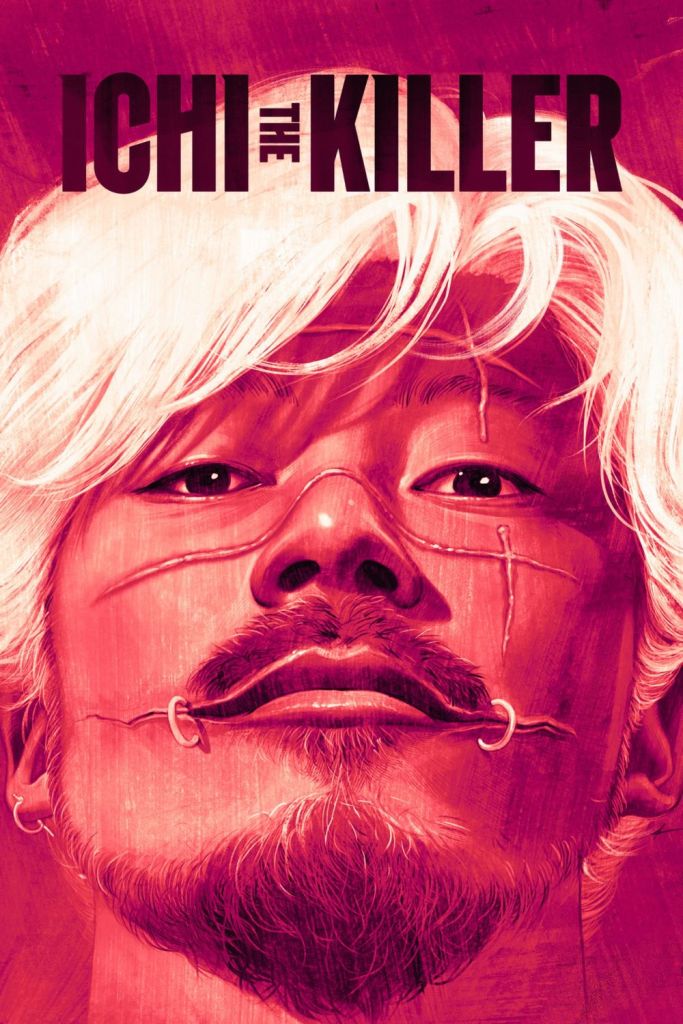
And nowhere is Miike’s fascination with the violent pole more vividly captured than in his infamous 2001 adaptation of Hideo Yamamoto’s manga Ichi the Killer (Koroshiya 1 in Japan). The film remains one of his boldest and most grotesque provocations: hallucinatory, hyper-violent, and defiantly sadomasochistic. If Audition showed Miike at his gothic and restrained, building terror through silence and stillness, then Ichi the Killer does the opposite—it blasts the viewer with sensory chaos, arterial spray, and sadomasochistic spectacle. The result pushes beyond gore into nightmare surrealism, so extreme it resembles Peckinpah’s The Wild Bunch refracted through a carnival mirror.

On its surface, the narrative is deceptively straightforward: at its core lies the hunt between two men. Ichi, an emotionally fragile vigilante manipulated into becoming a weapon of destruction, and Kakihara, a flamboyant, sadistic yakuza enforcer who thrives on pain both given and received. While Miike alters aspects of the manga, he retains the dual narrative thread of these two figures spiraling toward an inevitable rooftop showdown high above Tokyo’s neon chaos. Yet to describe the plot too literally is pointless. Miike warps Yamamoto’s crime saga into something closer to a fever dream, a delirious collage of violence and grotesquerie where linear logic is slowly dissolved, leaving behind only sensation.

Where Ichi the Killer separates itself is in its layered subtext of body horror and sadomasochism. Miike is not content with gore alone; he explores the intimate psychology of pain and pleasure, showing their fusion in ways that unsettle. This is established from the film’s beginning, in one of its most infamous moments, when Ichi—lonely, voyeuristic, and lost in disturbing fantasies—masturbates while watching a prostitute being assaulted, climaxing onto a balcony railing. The explicitness shocks, but more importantly, it plants the film’s thematic flag: eroticism polluted by brutality, desire inseparable from cruelty. Miike ensures the audience feels implicated, not just as witnesses but as voyeurs who cannot look away.

Kakihara embodies the other side of this sadomasochistic spectrum. He lives for violence, both inflicting and enduring it. His Glasgow smile—cut into his cheeks years before Ledger’s Joker canonized the image—is carved symbol of his philosophy: rebellion scarred into flesh, grotesque yet strangely glamorous. Much of this impact rests on Tadanobu Asano’s performance. Watching him in this role today, it’s startling to compare Kakihara to his later mainstream work in the Marvel Cinematic Universe (Thor films) or the prestige Shōgun remake. The actor who once played measured dignity and stoicism there is here unchained, flamboyant, and feral. His Kakihara is rockstar-like, charismatic, terrifying, and magnetic; the performance feels like a primal howl that stands in stark contrast to his more restrained global roles. By the finale, one could argue Kakihara comes closer to the film’s “hero” than Ichi himself, embodying violence not merely as cruelty but as pure identity.

The film unfolds as a series of violent tableaux, each more outrageous than the last, somewhere between grotesque cartoon and waking nightmare. Bodies are mangled, organs splatter, arterial spray bursts like abstract expressionist brushstrokes. Miike pushes the imagery so far it sometimes tips into slapstick, calling to mind Peter Jackson’s Dead Alive. It’s violence past the point of horror, collapsing into absurdist comedy: as if Tom and Jerry were redrawn with box cutters and razor wire. Tarantino’s famous “House of Blue Leaves” sequence in Kill Bill clearly draws inspiration from Miike’s operatic bloodletting.

And yet Ichi the Killer is not mere shock and gore. Beyond its chaotic excess, the film probes violence as spectacle—something audiences recoil from but also consume with fascination. Miike refuses to let the audience off the hook. He doesn’t desensitize; he implicates. Watching Ichi means simultaneously condemning its cruelty and acknowledging our own morbid curiosity. That tension—between gothic atmospheres of dread and gaudy ultra-violence—is where Miike thrives.

This duality makes Ichi the Killer one of the most notorious entries in modern cult cinema. It isn’t for everyone, and was never intended to be. Some audiences will find it unwatchable, others mesmerizing. But what is undeniable is its extremity, one end of the spectrum of Japanese genre filmmaking stretched to breaking point. If Audition embodies Miike’s gothic restraint, Ichi represents his carnival of brutality. Together, they capture the twin poles of his artistry and of Japanese extremity itself. Violence here is more than gore—it is body horror, sadomasochism, and spectacle fused together, a dark carnival Miike dares us to enter and dares us not to look away.