Shattered Politics: Harry’s War (dir by Kieth Merrill)


It’s Tax Day, which means that it’s a good day to remember that the IRS is not your friend.

That can sometimes be hard to forget, with all the talk of making people “pay their fair share” and all the drama that seems to accompany any suggestion that federal bureaucracy should be reduced.  Back in 2003, there was a big story about how the IRS was going to hire 3,000 new employees and it amazed me how the media tried to frame this as being a good thing to which no one could possibly object.  Whenever I turned on the news, I would see government official bragging about how they were going to bring in even more IRS agents to make “the billionaires” pay their fair share.  (They may say “billionaires” but one can be sure that those 3,000 IRS agents weren’t going to anyone near anyone who donated to the right people.)  In the recent election, I was always amused by analysts who were shocked to discover that many voters, especially those were struggling to pay their bills, weren’t enthusiastic about the idea of a supercharged IRS.

The fact of the matter is that people hate the IRS.  The IRS exists to make people’s live difficult.  The IRS exists to take our money away from us, money that we earned but which we are apparently not worthy of keeping.  The IRS is an agency that demands that you do you own taxes but then threatens to throw you in jail if you make a mistake.  When people hear 3,000 new IRS agents, they imagine 3,000 more people looking to take their money and toss them in prison for forgetting to carry the one.  I often think that if the IRS simply sent people a bill every year, people would actually get a lot less upset about having to pay taxes.  I get a property tax bill from the country and I have no problem paying it because it gives me an exact amount.  Instead, the IRS says, “We know how much you owe but we’re not going to tell you.  If you pay too much, you won’t get a refund and if you pay too little, we’ll destroy your life.”

On days like this, watching a film like 1981’s Harry’s War can be a cathartic experience.  The film stars Edward Herrmann (yes, the History channel guy) as Harry, a postman who was raised by Beverly Payne (Geraldine Page), an eccentric woman who collects military memorabilia and whose property is listed as being a church and is therefore tax exempt.  In her will, Beverly has named Harry as her heir.  Arrogant IRS district director Ernie Scelera (David Ogden Stiers) is convinced that Beverly is hiding a fortune from the IRS and he proceeds to harass both her and Harry in court until Beverly drops dead of a heart attack.  Harry inherits Beverly’s property and also her tax bill.  However, Harry has also inherited all of her military stuff and soon, he’s crashing Ernie’s press conference with a tank and then engaging in a lengthy stand-off with the government.  The film is a dramedy and you never really doubt that Harry will somehow triumph (even if his victory is ultimately a symbolic one) but the film still reminds us of how quickly the government will turn on its citizens when it’s being defied and the final few moments bring to mind some of the worst ATF and FBI excesses of the past 30 years.  That said, Harry is quick to point out that he’s not waging war on the government.  He’s waging war on the unelected bureaucrats who have forgotten that civil servants are supposed to work for the people and not against them.  “All that power in one place,” Harry says scornfully about the IRS and it’s hard to deny that he has a point.  It’s hardly a perfect film but, in this day and age, it’s a film that will leave you cheering.


Shattered Politics: The Front Runner (dir by Jason Reitman)


Based (loosely, I assume) on a true story, 2018’s The Front Runner tells the story of a politician named Gary Hart (played by Hugh Jackman).

The year is 1987 and former U.S. Sen. Gary Hart is preparing to announce that he will be seeking the Democratic nomination for the Presidency of the greatest nation of all time, the United States!  (YAY!)  Hart is widely seen as the front runner, for both the nomination and the general election.  He’s got the youth vote sewn up.  He’s energetic.  He’s supposed to be intelligent.  We are told that he is handsome and charismatic.  (I say “told” because, in this film, they seem to be informed attributes as Hugh Jackman is given a truly terrible haircut and his performance here is a bit on the dull side.)  Hart announced his candidacy while standing in the Rocky Mountains.  His wife (Vera Farmiga) is behind him, even if she chooses not to join him on the campaign trail.  His campaign manager (J.K. Simmons) is welcoming new and idealistic volunteers to the campaign headquarters and encouraging them to remember that all of the difficulties of the campaign will be worth it after Gary Hart is elected president.  As for the press, they’re investigating long-standing rumors that Hart is a womanizer.  “Follow me around, you’ll get bored,” Hart says.  So, two reporters from the Miami Herald (Bill Burr and Steve Zissis) do just that they catch a young woman named Donna Rice (Sara Paxton) apparently staying over at Gary Hart’s Florida townhouse.

“It’s nobody’s business!” Hart snaps, when asked about his private life and it’s obvious that the film expects us to take Hart’s side.  The problem, as Hart’s campaign manager points out, is that a lot of people are volunteering for Hart’s campaign and have sacrificed a lot to help him out and now, if Hart doesn’t figure out some way to deal with the story, it looks like it was all for nothing.  Even if Hart didn’t cheat with Rice, he still showed remarkably poor judgment in spending time alone with her in Florida while his wife was back in Colorado.  The film argues that the press went overboard pursuing the story and perhaps they did.  The press tends to do that and really, no politician has any excuse not to realize that.  But, even if we accept the argument that the press acted unethically, that doesn’t exactly exonerate Gary Hart, though this film certainly seems to think that it does.  To a certain extent, this film reminded me a bit of James Vanderbilt’s Truth, in which it was assumed we would be so outraged that Cate Blanchett’s Mary Mapes was fired for producing a story about George W. Bush’s time in the National Guard that we would overlook that Mapes and CBS news tried to build a major story around a bunch of obviously forged documents.

(Of course, if Hart had been running today, I doubt the scandal would have ended his campaign.  If anything, Donald Trump’s personal scandals seemed to play to his advantage when he ran in 2016 and 2024.  To a find a 21st Century equivalent to Hart’s scandal, you’d probably have to go all the way back to John Edwards in 2008.  Of course, Edwards was cheating on his wife while she was dying of breast cancer, which makes Edwards a special type of sleaze.)

As for the film itself, director Jason Reitman tries to take a Altmanesque approach, full of overlapping dialogue and deceptively casual camera moments.  There are a few moments when Reitman’s approach work.  The start of the film, in which the camera glided over hundreds of journalists reporting from outside the 1984 Democratic Convention, was so well-handled that I briefly had hope for the rest of the film.  Reitman gets good performances from dependable veterans like J.K. Simmons and Alfred Molina.  But, at the heart of the film, there’s a massive blank as Hugh Jackman gives an oddly listless performance as Hart.  The film expects us to take it for granted that Gary Hart would have been a good President but there’s nothing about Jackman’s performance to back that up.  It’s odd because, typically, Hugh Jackman is one of the most charismatic actors around.  But, as Gary Hart, he comes across as being petulant and a bit whiny.

It’s an interesting story but ultimately, The Front Runner doesn’t do it justice.


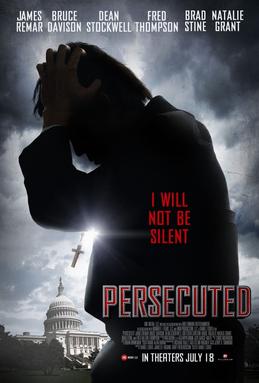
Shattered Politics #94: Persecuted (dir by Daniel Lusko)


Persecuted-2014-poster

It may seem strange that I would choose to end my series of reviews of films that feature politics and politicians by reviewing Persecuted, an obscure film from 2014.  After all, Shattered Politics started out with D.W. Griffith’s Abraham Lincoln.  Over the past three weeks, I’ve reviewed everything from Mr. Smith Goes To Washington to The Phenix City Story to Dr. Strangelove to The Godfather to Nashville to Once Upon A Time In America to The Aviator.  I have been lucky enough to review some of the greatest films ever made.  And now, at the end of this series, I find myself reviewing Persecuted, a film that has a score of 0% over on Rotten Tomatoes.

Consider that for a moment.

As I sit here typing out this sentence, not a single critic has given Persecuted a good review.  And I will admit right now that I’m not going to be the first.  Persecuted is cheap-looking, heavy-handed, melodramatic, histrionic, foolish, silly, preachy, predictable, strident, and just about every other possible criticism that comes to mind.  If the film is redeemed by anything, it’s that it is full of good actors who do the best that they can with characters that are either seriously underwritten or ludicrously overwritten.

Persecuted takes place in the near future.  Sen. Donald Harrison (Bruce Davison) has written something called the Faith and Fairness Act, which would basically require churches to provide equal time to other religions and would make it illegal to suggest that only one religion has all the answers.  How exactly that would work, I’m not sure.  However, a big part of Harrison’s bill is that, in exchange for giving up any claim to having all the answers, churches will now get money from the federal government.  As a result, a lot of church leaders have sold out and announced their support for the bill.

However, evangelist John Luther (James Remar) refuses to support the bill.  As we’re told when Luther first appears, he’s a recovering alcoholic and drug addict who used to be a professional gambler.  But then he found faith and he’s now the most popular man in the country.  Or, at least, he is until he’s drugged by the government and framed for murdering a prostitute.

So now, Luther is on the run.  He has to evade capture, prove his innocence, and reveal the truth about Harrison and his shadowy backers.  Helping Luther out is his father, an Episcopalian priest who is played by former real-life Presidential candidate Fred Thompson.  (Thompson, incidentally, is a very good actor and brings a lot of conviction and authority to his role.)  Not helping Luther are the former leaders of his church, one of whom is played by character actor Dean Stockwell.

I’ll admit right now that, as familiar and talented as all four of them may be, James Remar, Bruce Davison, Fred Thompson, and Dean Stockwell are hardly big stars and you really can’t blame any of them for presumably taking a job strictly for the money.  That said, it’s still odd to see such good actors appearing in a film like Persecuted and they all deserve at least a little bit of credit for doing their best with the material that they had to work with.  However, my favorite performance came from Brad Stine, who plays glib preacher who betrays Luther.  Stine is just so sleazy and hyperactive that he’s a lot of fun to watch.

Now, while Persecuted is obviously a faith-based film, it’s plot actually has more in common with the paranoia movies of the 70s than it does with Left Behind.  John Luther is a guy who knows the truth and has been framed as a result and he spends nearly the entire film on the run.  If anything, this is a film that will probably appeal more to conspiracy theorists than to Christians.  But, judging from the film, the conspiracy that’s trying to destroy John Luther doesn’t appear to be very competent.  How else do you explain that John Luther — the most famous man in the world — manages to easily evade capture despite the fact that he spends most of the film wandering around in broad daylight with dried blood on his face.  At one point, he even calls his wife and has a conversation with her.  “Ah!” I thought, “this is where we’ll discover that the conspiracy is listening in on the conversation!”  But no, that didn’t happen.  In fact, his wife talked to him while, in the background, two cops searched their house.  “The police are looking for you,” the wife says but neither one of the police officers seems to hear her.  Apparently, it didn’t seem to occur to any of them that John Luther might call his wife.  For a paranoia film to work, you have to feel like the film’s hero is in constant danger and Persecuted never succeeded in doing that.  How can anyone be scared of a conspiracy that can’t even handle the basics?

Persecuted is not a good film but, in its own unfortunate way, it is a relevant one.  Much as how the first film I reviewed for Shattered Politics, D.W. Griffith’s Abraham Lincoln, told us a lot about America in the 1930s, Persecuted tells us a lot about how America is viewed by its citizens in the 21st Century.  Persecuted is a film that insists that our leaders can’t be trusted, that your friends will betray you if ordered to do so by those in authority, and that everything bad will come disguised as something good.  It’s not exactly an optimistic view of politics or America but then again, these are the times that we live in.  It’s been a long time since Billy Jack went to Washington.  It’s been even longer since Mr. Smith first showed up.

Now, instead, all we have is Bruce Davison telling us, “You thought you were bigger than the system and you’re not!”

And, on that note, Shattered Politics comes to an end!  I’ve had a lot of fun writing this series of 94 reviews and I hope that you’ve enjoyed reading them!  If there’s any conclusion that I think can be drawn from these 94 films, it’s that politicians will always betray you and politics will always depress you but movies will always be there to lift you back up.

If I had to choose between voting and watching a movie, I would pick a movie every time.  Fortunately enough, I live in a country where I am allowed to do both.

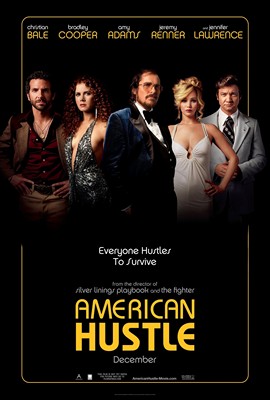
Shattered Politics #93: American Hustle (dir by David O. Russell)


American_Hustle_2013_poster

“Some of this actually happened.”

— Opening Title of American Hustle (2013)

I have always been surprised by how much some people hate the 2013 best picture nominee, American Hustle.  Even two years after the film was first released, you’ll still find people whining that the film felt like David O. Russell’s attempt to remake Goodfellas (yes, I have actually seen more than a few people online making this idiotic claim) or claiming that the movie was overrated or that there wasn’t anyone in the film that they could root for.  While every film has its detractors, I’m always a little bit taken aback by just how passionately some people dislike this film.

Some of it, of course, is because the film that beat American Hustle for best picture was the universally acclaimed 12 Years A Slave.  As hard as it may seem to believe now, there were a lot of people who thought that American Hustle might actually beat 12 Years A Slave.  Strangely enough, a lot of online film bloggers tend to take a Manichaen approach to the Oscars, viewing each year’s race in terms of good and evil. The film that they want to win represents good and, therefore, every competing film must represent evil.  It’s a pretty stupid and immature way of looking at things but, then again, the stupid and immature approach has worked pretty well for Sasha Stone and Ryan Adams over at AwardsDaily.com so who am I to criticize?

Of course, I don’t think it’s a coincidence that the majority of American Hustle‘s most strident online critics have been male.  I imagine that they watched the film and, in Amy Adams and Jennifer Lawrence, they saw every unresolved crush of their adolescence.  When Amy Adams successfully fooled Christian Bale and Bradley Cooper, these critics saw themselves being fooled.  When Jennifer Lawrence called Bale a “sick son of a bitch,” these critics felt that they were being called a sick son of a bitch.  American Hustle is a film about men who don’t know how to talk to women and that probably struck a little too close to home for a lot of those online critics.

(I imagine that the majority of online American Hustle haters probably preferred Rooney Mara’s version of the Girl with the Dragon Tattoo to Noomi Rapace’s.)

Of course, the truth of the matter is that American Hustle was one of the best films of a very good year.  Of all the films nominated for best picture of 2013, American Hustle was my personal favorite.

Based, very loosely, on true story, American Hustle is a period piece.  It takes place in the late 70s, which of course means that we get a lot of great music, a scene in a disco, and clothes that are both somehow ludicrous and to die for at the same time.  It’s a glamorous film about glamorous people doing glamorous and not-so-glamorous things and how can you not love that?

Irving (Christian Bale, giving a brave performance) is a generally nice guy who also happens to be a con artist.  His unlikely partner is Sydney (Amy Adams), a former stripper turned Cosmo intern.  When Sydney is working with Irving, she takes on a totally different identity and tells people that she’s Lady Edith Greensly, a British aristocrat who has international banking connections.  When Sydney plays Edith, she speaks in a posh British accent and what’s interesting is that her accent is often (deliberately) inconsistent.  However, as Irving points out, it doesn’t matter whether her accent is a 100% convincing or not.  What’s important is that people want her to be Lady Edith Greensly and people will make excuses for almost anything as long as it confirms what they want to believe.

Eventually, Irving and Sydney are arrested by ambitious and highly strung FBI Agent Richie DiMaso (Bradley Cooper).  Richie, who spends a good deal of the film with curlers in his hair, lives with his mother and has a boring fiancée who he doesn’t seem to like very much.  (Richie is also briefly seen sniffing coke, which might explain a lot of his more extreme behavior.)  Richie wants to make a name for himself and he views Irving and Sydney as his way to do so.  He blackmails them into helping him set up and arrest crooked politicians and businessmen.  Richie also finds himself growing obsessed with Sydney, who he believes to be English even after she tells him that she isn’t.

All of this eventually leads to Irving and Richie setting up the Mayor of Camden, New Jersey, Carmine Polito (Jeremy Renner).  Polito, who may be corrupt but who also seems to sincerely care about helping the citizens of his town, wants to revitalize gambling in Atlantic City.  Irving and Richie introduce him to FBI agent Paco Hernandez (Michael Pena), who is disguised as Sheik Abdullah and who they claim is interested in investing in Carmine’s plans.  This, of course, leads to a meeting both with a local Mafia don (Robert De Niro) and with several politicians who agree to help out the Sheik out in exchange for money.

(And no, the film did not lie.  This is based on a true story, believe it or not.)

Complicating things is the fact that Irving himself comes to truly like the generous and big-hearted Carmine and how can you not?  When the film was first released, Jeremy Renner was a bit overshadowed by Bale, Cooper, Adams, and Jennifer Lawrence.  However, Renner gives the best performance in the film, playing Carmine with a disarming mix of innocence and shrewdness.  He’s the type of guy who is smart enough to walk out on the first meeting with the fake sheik’s associates but who is still naive enough that he can be charmed by Irving.  When the fake sheik gives Carmine an equally fake knife as a gift, the look of genuine honor on Carmine’s face is heart-breaking.

The other big complication is Irving’s wife, Rosalyn (Jennifer Lawrence).  Rosalyn is jealous, unstable, unpredictable, and, in her own way, one of the smarter people in the film.  She’s also a bit of pyromaniac and, when she accidentally blows up a new microwave, you’re really not surprised.  (And, when Rosalyn starts to obsessively clean the house while singing Live and Let Die at the top of her lungs, I felt like I was watching a blonde version of myself.)  When Rosalyn starts to have an affair of her own, it leads to American Hustle‘s satisfying and twisty conclusion.

(Again, a lot of the same online toadsuckers who irrationally hate American Hustle seem to hold a particular contempt to Jennifer Lawrence’s performance in this film, as if to acknowledge that Lawrence — as always — kicks ass would somehow be a betrayal of Lupita Nyong’o’s award-winning performance in 12 Years A Slave.)

Don’t listen to the haters.  American Hustle is a great film, a stylish and frequently funny look at politics, corruption, and the ways that people con themselves into believing what they want and need to be true.

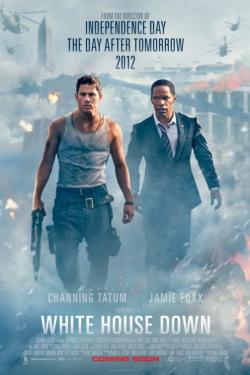
Shattered Politics #92: White House Down (dir by Roland Emmerich)


White_House_Down_poster_with_billing_block

To say that the 2012 film White House Down is stupid is probably unnecessary.  After all, the film was directed by Roland Emmerich and Emmerich specializes in making stupid films.

And, in many ways, White House Down is prototypical Emmerich film, a long and self-important collection of mayhem and heavy-handed pontification.  In the case of this film, liberal President Sawyer (Jamie Foxx) is pushing for a treaty that will magically bring about world police.  Naturally, a bunch of evil right-wingers (including characters played, somewhat inevitably, by James Woods and Richard Jenkins) don’t want world peace so they hire a bunch of mercenaries who attack the White House.  It’s all a part of a plot to force Sawyer to launch a nuclear attack on Iran because … well, why not?  Fortunately, aspiring secret service agent (and kick-ass combat veteran) John Cale (Channing Tatum) is there to work with the President and save the country.

And, since Emmerich is from the bigger is always better school of filmmaking, many familiar landmarks are blown up and it takes the film well over two hours to tell its simplistic story.  To be honest, if your action movie can’t get the job done in under two hours, then you’re going to have problems.  Once a viewer has spent two hours watching one movie, it’s inevitable that he or she will start to question the film’s logic.  If the film’s clever enough, all lapses and inconsistencies can be forgiving.  If the film is White House Down, it’s a lot less easy to be forgiving.

Of course, from a political point of view, Emmerich tries to have it both ways.  For anti-government types like me, it’s always fun to watch Washington D.C. blow up.  For those on the right, White House Down presents a situation that can only be solved by heroes with guns.  And, of course, Democrats can view White House Down as wish fulfillment, an alternative timeline where Barack Obama actually is as sincere and effective as they wish him to be.

In fact, if anything saves White House Down, it’s the chemistry between Foxx and Tatum.  Wisely, neither one of them appears to be taking the film that seriously and both of them seem to be having a lot of fun blowing things up.  Channing Tatum, in particular, deserves some sort of award.  How many bad films have been made tolerable by Tatum’s willingness to laugh at himself?  I’ve lost count but White House Down definitely benefits from his presence.  He and Foxx make Emmerich’s style of filmmaking as tolerable as it will ever be.

http://www.youtube.com/watch?v=4AXbiCdmXgw

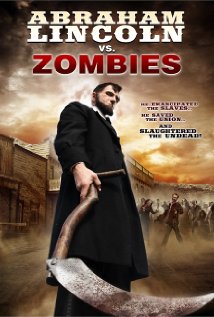
Shattered Politics #91: Abraham Lincoln vs. Zombies (dir by Richard Schenkman)


Abraham_Lincoln_vs._Zombies_(movie_poster)

Well, here we are!  Last month, I started the process of watching and reviewing 94 movies about politics and politicians.  I started Shattered Politics with D.W. Griffith’s 1930 film Abraham Lincoln and now, three weeks later, we’ve reached the final day of Shattered Politics.  We have four more films to review and what better way to start things off than by taking a look at yet another films about Abraham Lincoln.

Now, I’ve previously reviewed three films about Abraham Lincoln.  I’ve reviewed D.W. Griffith’s creaky 1930 version.  I’ve reviewed Henry Fonda as Young Mr. Lincoln.  And, of course, I’ve reviewed Daniel Day-Lewis in Steven Spielberg’s Lincoln.  And, on the very site, reviews of Abraham Lincoln: Vampire Hunter have been posted by both Arleigh and Ryan The Trash Film Guru.  (For the record, I’ve also reviewed The Lincoln Lawyer and The Conspirator. So there.)  That’s a lot of films about Abraham Lincoln and why not?  He’s our greatest President.  He freed the slaves, he won the Civil War, and, ultimately, he was the first President to be martyred by assassination.

However, when one considers all of those films about Abraham Lincoln, it’s hard not to notice that none of them featured zombies.  And, considering how much we love zombies here at the Shattered Lens, that has always struck me as being a major oversight.

So, thank God that, in 2012, the Asylum released a film called Abraham Lincoln vs. Zombies.

For that matter, thank God for the Asylum.  Mainstream critics and snarky blogger types love to criticize Asylum-produced films but you know what?  Nobody makes films quite like the Asylum.  Quite frankly, people who attack an Asylum film for having a low-budget or for being over the top are missing the point.  Asylum films are supposed to be fun.  They’re the type of films that are meant to be watched with a group of your closest and funniest friends.  At their best, Asylum films are movies that you laugh with as opposed to laughing at.

As far Abraham Lincoln vs. Zombies is concerned, everything you need to know about the film is right there in the title.  The film opens with young Abe Lincoln decapitating his zombified mother and then jumps forward several decades.  Abe Lincoln (played, with a lot of gravity and melancholy by the excellent Bill Oberst, Jr.) is now President.  When he discovers that a zombie outbreak has occurred at Fort Pulaski, Lincoln takes a break from writing the Gettysburg Address and leads a group of secret service men down to the fort.  With the help of Gen. Stonewall Jackson (Don McGraw), young Teddy Roosevelt (Canon Kuipers), future lawman Pat Garrett (Christopher Marrone), and a handsome, alcoholic Southern actor who is using the name John Wilkinson (Jason Vail), Lincoln kills a lot of zombies and even reunites with a former lover (Rhianna Van Helton).

And, seriously, you have to love a film that features Abraham Lincoln using a scythe to chop off the heads of the undead.  If you’re watching a film like this and you’re worrying about narrative logic or historical accuracy, then you may be taking life a little bit too seriously.  The title promises Abraham Lincoln and zombies.  And the film totally delivers.

And how can you not appreciate that?

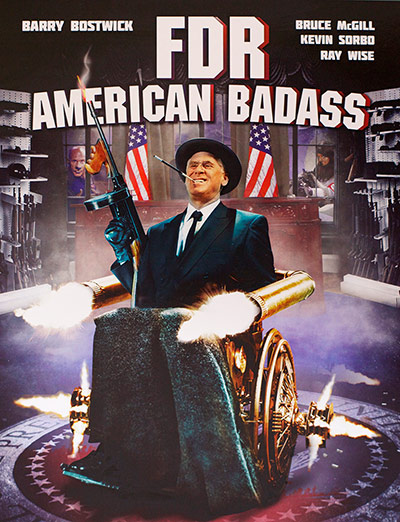
Shattered Politics #90: FDR: American Badass! (dir by Garrett Brawith)


FDR-American-Badass-movie-poster

So, as I was thinking about Hyde Park On Hudson, I started to ask myself: what would have made that movie better?  Obviously, the script could have been improved.  Bill Murray could have had some better lines.  Laura Linney could have been a bit less bland.  The direction could have been a bit more dynamic…

And of course, the film could have used a few more werewolves.  Maybe not a huge amount of werewolves because, after all, you do want to keep things plausible.  But, at the same time, a werewolf or two would have livened things up.

And then I thought about Sunrise at Campobello and I realized that film was also missing something.  Once again, the film could have used some werewolves.

“My God,” I thought, “aren’t there any filmmakers out there willing to combine Franklin Roosevelt with werewolves!?”

And then, I realized that there was!

The 2012 film FDR: American Badass! features Barry Bostwick in the role of Franklin D. Roosevelt.  At the start of the film, Roosevelt is the dynamic and athletic governor of New York.  However, while out jogging one day, Frank is attacked by a werewolf and ends up contracting polio as a result.  Recovering in the hospital, Roosevelt decides to run for President and kill werewolves.

Over the course of the film, he does just that.  And, when it turns out that the leaders of the Axis Powers are all werewolves as well, FDR single-handedly wins World War II.  Fortunately, with the help of Albert Einstein, FDR gets his wheelchair equipped with all the latest weaponry.

And did I mention that, as President, FDR smokes weed with Abraham Lincoln (Kevin Sorbo)?  Because he so totally does…

So, at this point, you’re probably already getting the feeling that FDR: American Badass! is kind of a weird film.  And it is.  But what makes the film better than you might think is the fact that it totally commits itself to making no sense.  FDR: American Badass! is full of scenes that are alternatively hilarious, disgusting, and offensive but it works because, unlike something like A Million Ways To Die In The West, FDR: American Badass! is at least creative in its stupidity.  Say what you will about the idea of FDR killing werewolves, the fact of the matter is that there’s only one film where you can actually see that happen.

So, should you see FDR: American Badass?

Go back and read the film’s title.

Did it make you roll your eyes and say, “Oh my God, that is so stupid?”  If so, you’ll probably have a similar reaction to the film itself.

On the other hand, did the title make you smile?  If so, you’ll probably find something to enjoy in this movie.

At the very least, FDR: American Badass! is better than Hyde Park on Hudson.

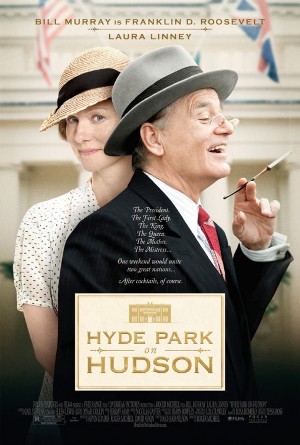
Shattered Politics #89: Hyde Park on Hudson (dir by Roger Michell)


Hyde_park_on_hudson_poster

Is there anything more frustrating than a film that should have been good but yet somehow turned out to be … well, to be rather awful?

Case in point: 2012’s Hyde Park On Hudson.  In this slow-moving and almost painfully old-fashioned film, Bill Murray plays President Franklin D. Roosevelt.  When the film opens in 1939, Roosevelt is being visited by his sixth cousin, Margaret (Laura Linney).  It’s been several years since Roosevelt and Margaret last saw each other.  Franklin’s mother (Elizabeth Wilson) thinks that Margaret’s company could cheer up her melancholy son.  So, FDR and Margaret go out for a drive and, sitting atop a nice green hill, Margaret gives him a hand job.

And it is the most stately and respectable hand job to ever be quaintly portrayed in an American film.

Anyway, the rest of the film deals with FDR’s affair with Margaret.  Eventually, Margaret discovers that FDR has many mistresses but, before she does that, she helps FDR to charm England’s King George VI (Samuel West).  In the days leading up to World War II, George and his wife (Olivia Colman) visit Roosevelt out at his Hyde Park estate.  As we all know from watching The King’s Speech, George is insecure about his stutter.  But, fortunately, FDR points out that, despite the fact that he’s in a wheelchair, people still view him as being a strong leader and therefore, people will view George in the same way, regardless of his stutter.

And, speaking as a former stutterer, I have to say that it’s amazing to witness how poorly Hyde Park On Hudson deals with subject matter that was so brilliantly handled in The King’s Speech.

When I first heard about Hyde Park On Hudson, I had high hopes for it.  After all, I love history.  I love royalty.  I love gossip and I love scandal.  And, really. FDR was one of our more gossip-worthy Presidents, a spoiled rich kid who could not reach his full potential until after he was struck down by polio and who regularly cheated on his wife while battling both the Great Depression and the Nazis.  FDR was a dynamic and controversial figure and none of that comes through in Hyde Park on Hudson.

(Seriously, Bill Murray is totally wasted in this film.  If you’re going to cast an iconic actor in an iconic role, at least give him some good dialogue.)

In the end, Hyde Park on Hudson fails because it’s just too respectful.  It’s a slow, visually unimaginative film that manages to make an exciting time feel dull.  FDR deserves better and so does Bill Murray.

http://www.youtube.com/watch?v=RqQzNyxSShM

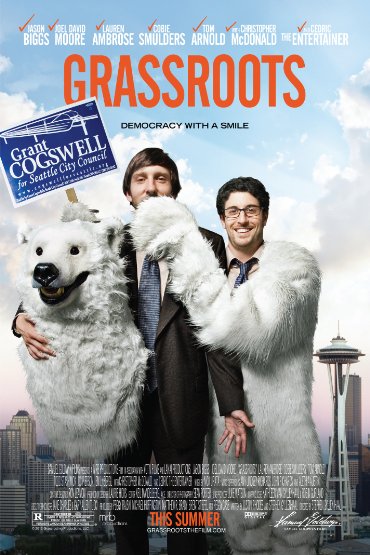
Shattered Politics #88: Grassroots (dir by Stephen Gyllenhaal)


Grassroots_2012Well, it’s nearly over.

For the past three weeks, I’ve been watching and reviewing 94 films about politics and politicians.  We started Shattered Politics by reviewing the 1930 film Abraham Lincoln and, 86 reviews later, we have finally reached 2012!  It’s hard to believe that, over just three weeks, I have reviewed that many films.  Some of those films have been good.  Some of them have been bad.  And, quite a few of them, have been somewhere in between.

The 2012 film Grassroots in one of those in between sort of films.  It’s based on a true story.  Phil Campbell (Jason Biggs) is a Seattle-based journalist who has just lost his job.  Unsure what to do with himself, Phil finds himself reluctantly dragged into the city council campaign of his friend, a music critic named Grant Cogswell (Joel David Moore).

Grant is running because he feels that the city council is not making proper use of the Seattle monorail.  Grant also appears to be a bit crazy, the type of guy who will spontaneously start to shout about everything that he views as being wrong with the world.  However, Grant is also very sincere in his desire to do the best for the people of Seattle and Phil agrees to manage his campaign.

And, as Grant continues to campaign and as the city’s political establishment goes out of its way to make it difficult for Grant or any other insurgent to run a legitimate campaign, he starts to pick up support and suddenly, it starts to look like he very well could win.

And then, the World Trade Center is attacked on September 11th and suddenly, the voters are a little bit less enthusiastic about handing the keys to the asylum over to one of the inmates…

Grassroots is a minor film but it’s definitely likable.  It took me a while to adjust to the film, largely because almost all of the characters are the type of stereotypical Seattle hipsters who would probably be used for violent comic relief in most other films.  (Don’t misunderstand, though — some of my best friends are hipsters … though they’ll never admit it.)  As well, the film trots out the familiar trope of having the campaign cause friction in Phil’s marriage and seriously, is there a more tired plot point than sudden marital friction?

But, ultimately, the film won me over because, much like Grant, it’s just so sincere in its love for Seattle and in its belief in grassroots politics.  It won’t challenge Milk for the title of being the most inspiring recent film about a city council election.  But, taken on its own terms, Grassroots is a likable movie that should inspire even more hipsters to run for public office.

http://www.youtube.com/watch?v=0mRKnHaaieQ

Shattered Politics #87: The Ghost Writer (dir by Roman Polanski)


GhostwriterlargeIn the 2010 film The Ghost Writer, Ewan McGregor plays a character known as the Ghost. We never actually learn the name of his character and that’s perhaps appropriate.  The Ghost has made his living by being anonymous.  He’s a ghost writer.  He’s the guy who is hired to help inarticulate and occasionally illiterate celebrities write best-selling biographies.

The Ghost has been given a new assignment.  He is to ghost write the memoirs of former British Prime Minister Adam Lang (Pierce Brosnan).  Despite the fact that Adam is one of the most famous men in the world, the Ghost is not initially enthusiastic about working with him.

First off, there’s the fact that Adam and his wife, Ruth (Olivia Williams), are currently hiding out in America because America is one of the few countries that will not extradite him to be prosecuted for war crimes at the International Criminal Court.  It seems that Adam (much like Tony Blair) is a controversial figure because of some of the actions he may have authorized as a part of the war on terror.  Not only does the Ghost have political objections to working with Adam but he has to leave his London home and go to Massachusetts in order to do so.

Secondly, there’s the fact that, once the Ghost arrives in America, he discovers that — for such a controversial figure — Adam is actually rather boring and seems to have very little knowledge about anything that he did while he was prime minister.  Instead, he seems to be more interested in spending time with his mistress (Kim Cattrall, giving the film’s one bad performance).  Ruth seems to be the political (and smart) one in the marriage.

And finally, there’s the fact that the Ghost is actually the second writer to have worked with Adam.  The previous writer mysteriously drowned.  While that death was ruled to be an accident, the Ghost comes to suspect that it was murder and that the motive is hidden in the first writer’s manuscript…

The Ghost Writer is a favorite of mine, a smart and witty political thriller that features great performances from Ewan McGregor, Olivia Williams, and Pierce Brosnan.  Brosnan especially seems to be having a lot of fun sending up his dashing, James Bond image.  Roman Polanski directs at a fast pace and maintains a perfect atmosphere of growing paranoia throughout the entire film. In the end, The Ghost Writer proudly continues the tradition of such superior paranoia films as The Conversation, Three Days of the Condor, and the Parallax View.

Incidentally, I have a theory that Adam Lang was also the unseen Prime Minister who was featured in Into the Loop.  Watching The Ghost Writer, it’s hard not to feel that Adam really feel apart without Malcolm around to help him out.