…it’d probably look a lot like HARDWARE WARS, the 1978 short spoof by Ernie Fosselius. Set to Wagner’s “Ride of the Valkyrie”, this trailer-styled parody features Mad Magazine type character names like Princess Anne Droid, Augie Ben Dogie, Ham Salad, and 4Q2. Narrated by none other than Paul Frees, even George Lucas is said to like it! “You’ll laugh, you’ll cry, you’ll kiss three bucks goodbye” but mostly you’ll laugh at the hilarious HARDWARE WARS:
Tag Archives: science fiction
The Savior of the Universe: Flash Gordon (1980, directed by Mike Hodges)
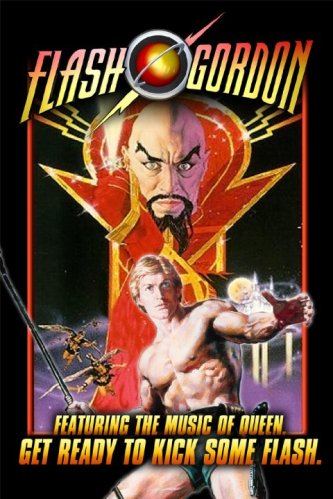 Life on the planet Mongo is not easy. Aided by Darth Vader wannabe Klytus (Peter Wyngarde) and the sadistic General Kala (Mariangela Melato), the evil Emperor Ming (Max Von Sydow) rules with an iron fist. All of the citizens are heavily taxed and kept in a state of perpetual war in order to keep them from joining together and rebelling. Those who attempt to defy Ming are executed.
There are many different races living on both Mongo and its moons. The Arborians, also known as the tree people, live in a jungle and are ruled by Prince Barin (Timothy Dalton). Until Ming overthrew his father, Barin was the rightful heir to the throne of Mongo. Barin is also one of the many lovers of Aura (Ornella Muti), Ming’s rebellious daughter.
Barin distrusts the Hawkmen, a group of winged barbarians. Led by the boisterous Prince Vultan (the one and only Brian Blessed), the Hawkmen live in a palace that floats above Mongo. Both Vultan and Barin share a desire to overthrow Ming but neither one of them can set aside their own dislike and distrust of each other.
Ming grows bored easily but Klytus has found him a new play thing, an obscure planet in the S-K system. “The inhabitants,” Klytus says, “refer to it as the planet Earth.”
It all leads to this:
You may have been too busy listening to Queen’s theme song to notice (and I don’t blame you if you were) but I have always found it strange that, even though Ming had never heard of Earth before Klytus brought it to his attention, he still had a button labeled “Earthquake.” Whenever I watch Flash Gordon, I wonder if I am the only one who has noticed this.
With Ming plaguing Earth with tornadoes, hurriances, and “hot hail,” it is up to three Earthlings to travel to Mongo and defeat him. Dr. Zarkov (Topol) is an eccentric scientist who was forced out of NASA because of his belief in Mongo. Dale Arden (Melody Anderson) is a reporter. And, finally, Flash Gordon (Sam J. Jones) is a professional athlete. Because this movie is a fantasy, Flash Gordon is a superstar quarterback for the New York Jets.
The character of Flash Gordon was first introduced in a 1934 comic strip and was played by Buster Crabbe in several classic serials. Among Flash’s many young fans was a future filmmaker named George Lucas, who would later cite Flash’s adventures as being a major inspiration for the Star Wars saga. After the unprecedented success of Star Wars: A New Hope, it only made sense that someone would try to make a Flash Gordon film.
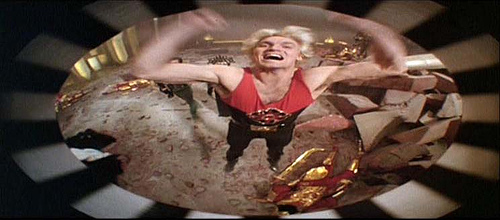
That someone was producer Dino De Laurentiis. (Before writing the script for Star Wars, Lucas attempted to buy the rights for Flash Gordon from De Laurentiis.) To write the script that would bring Flash into the 80s, De Laurentiis hired Lorenzo Semple, Jr. Semple was best known for helping to create the 1960s version of Batman and he brought a similarly campy perspective to the character and story of Flash Gordon. As a result, the film ended up with scenes like this one, where Flash interrupts one of Ming’s ceremonies with an impromptu football scrimmage:
It also led to Brian Blessed’s entire performance as Prince Vultan, which is especially famous for the way that Blessed delivered one line:
(That also makes for a great ringtone.)
Sam J. Jones and Melody Anderson often seem to be stranded by Semple’s script but Max Von Sydow, Topol, Brian Blessed, Peter Wyngarde, and Ornella Muti all get into the swing of things. Seen today, Flash Gordon is entertaining but too intentionally campy for its own good. On the positive side, the images still pop off the screen and the soundtrack sounds as great as ever. When you listen to Queen’s theme song, you have no doubt that “he’ll save every one of us.”
As Flash Gordon himself put it after he saved the universe: “YEAAAAH!”
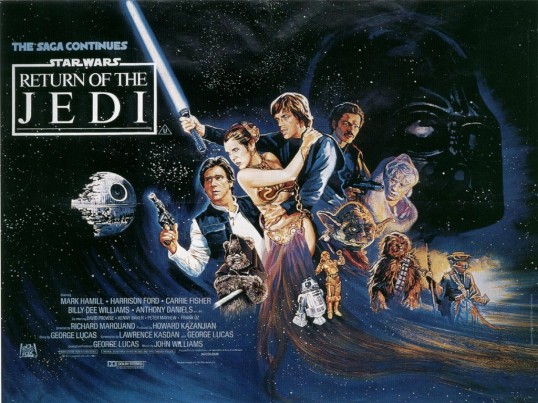
Sci-Fi Film Review: Return of the Jedi (dir by Richard Marquand)
As you’ve probably noticed, we’ve devoted this month to science fiction here at the Shattered Lens. Gary Loggins reviewed THX-1138. Valerie took a look at everything from The Star Wars Holiday Special to Turkish Star Wars to Return of the Ewok. Ryan the Trashfilm Guru reviewed such Italian classics as Cosmos: War of Planets and War of the Robots. Patrick Smith reviewed a terrifying Christmas movie about Santa. Myself, I’ve taken a look at such films as Contamination and 2019: After the Fall of New York.
We’ve reviewed a lot of science fiction and we’ve got a lot more left to go. (Keep an eye out for my reviews of Starcrash and The Humanoid over the upcoming few days.) However, from the beginning, this month has always been centered around Star Wars. You may have heard that there’s a little movie called Star Wars: The Force Awakens and it’s opening this week. Apparently, a few people are excited about it. Since we love reviewing little known art films here at the Shattered Lens, we decided why not review all of the previous Star Wars films during the week leading up to the release of The Force Awakens? Jeff (a.k.a. the blogger known as Jedadiah Leland) started us off by reviewing The Phantom Menace. Then Alexandre Rothier took a look at Attack of the Clones, followed by Jeff’s look at Revenge of the Sith. Leonard Wilson was the next to step up to the plate, reviewing both A New Hope and The Empire Strike Back.
And now, it’s my turn to add my thoughts to this project. It’s time to review the 1983 film, Return of the Jedi. And I have to admit that, when I first thought about what I wanted to say in this review, I was totally intimidated. Unlike my fellow writers here at the Shattered Lens, I’m hardly an expert when it comes to Star Wars. Don’t get me wrong — I know the basics. I know that Darth Vader is Luke’s father. I know that Han Solo flies the Millennium Falcon and that Princess Leia is in love with him. I know there’s an evil Empire and I know that there are rebels. I’m not a virgin when it comes to Star Wars but, at the same time, I’m definitely not as experienced (with Star Wars) as most of my friends and fellow movie bloggers.
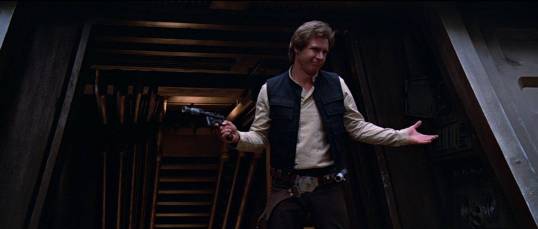
“Dang, Lisa, get over it!”
So, late this afternoon, when I sat down to watch Return of the Jedi, it was with more than a little trepidation. My obvious panic and welling tears convinced Jeff to watch the movie with me and I was happy for that. He loves Star Wars so I knew he could explain to me what was going on.
Finally, we watched Return of the Jedi and I discovered that I was panicking over nothing. Return of the Jedi may be the third part of trilogy and I may not be an expert on the films that came before it. But, even with all that in mind, Return of the Jedi is not a difficult film to figure out. As opposed to the finales of Harry Potter, The Hobbit, and The Hunger Games, Return of the Jedi keeps things simple. A good guy has been kidnapped by a bad guy. The other good guys come to the rescue and then go to another planet so that they can fight an even bigger bad guy. It’s not complicated.
As I watched Return of the Jedi and realized that I was having absolutely no problem following the film’s plot, I also realized that the Star Wars films are such a huge part of our culture that, regardless of how many of them we’ve actually sat through, everyone has absorbed them by osmosis. Bits and pieces of it are everywhere, showing up in everything from TV sitcoms to political commentary. (Remember how everyone used to compare Dick Cheney to Darth Vader?) The Star Wars franchise is almost biblical in that respect. At the same time, the fact that everyone knows about these movies makes them a little difficult to review. You don’t so much watch a Star Wars film as you join in a universal experience. As a reviewer, you definitely find yourself wondering what you can add to a conversation that everyone else has already had.
As a stand alone movie, Return of the Jedi is actually three separate films mixed together. The first film deals with Luke Skywalker (Mark Hamill) showing up at Jabba the Hutt’s palace and rescuing Han Solo (Harrison Ford), Princess Leia (Carrie Fisher), Chewbacca (Peter Mayhew), and two robots from being tossed into a creature called the Sarlacc, which is basically a giant vagina out in the middle of the desert. The second film deals with the rebels teaming up with a bunch of teddy bears and fighting the Empire on a jungle planet. And the third film features Luke and Darth Vader (body of David Prowse, voice of James Earl Jones, face of either Sebastian Shaw and Hayden Christensen, depending on which version of the film you’re watching) dealing with their family issues while the Emperor (Ian McDiarmid) cackles in the background. Some parts of the film work better than others. The end result is entertaining but definitely uneven.

Jedi‘s heart belongs to that third film, the one dealing with Luke and Darth Vader. I’ve read some pretty negative online comments about Mark Hamill’s performance in New Hope and Empire Strikes Back but, in Return of the Jedi, he brings an almost haunted intensity to the role of Luke. In theory, it’s easy to be snarky about all the talk about the “Dark Side of the Force,” but, when you look in Hamill’s eyes, you totally understand what everyone’s going on about. You see the fire and the anger but, even more importantly, you see the struggle between good and evil. There’s a very poignant sadness to the scenes where he and his father prepare to meet the Emperor.
And speaking of the Emperor, he is pure nightmare fuel! AGCK!

As for the other two films to found within Return of the Jedi, the jungles of Endor didn’t do much for me. Don’t get me wrong. I thought the action scenes were handled well and, unlike apparently everyone else in the world, I was not annoyed by the inclusion of the Ewoks, the killer teddy bears who helped to the Rebels to take down the Empire. I thought the Ewoks were cute and I actually got pretty upset when one of them was killed in battle. If I had been alive when Return of the Jedi had been released, I probably would have wanted a stuffed Ewok and, I imagine, that was the main reason they were included in the film. (I also imagine that’s the main reason why a lot of people can’t stand them.)
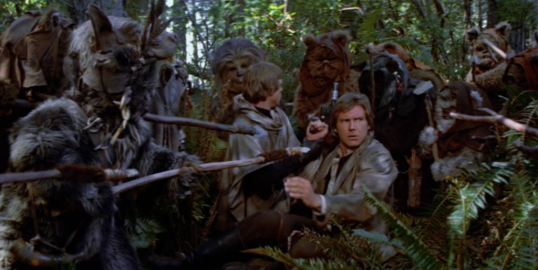
So, no, the Ewoks did not bother me. What did bother me was that under-construction Death Star floating out in the middle of space. It bothered me because I really couldn’t imagine any reason why — after the first Death Star was apparently such a colossal failure — the Empire would insist on trying to do the exact same thing all over again. This, along with the fact that they were rather easily defeated by a bunch of teddy bears, leads me to wonder whether the effectiveness of the Empire was just a little overrated. I mean, the Emperor was scary but otherwise, everyone involved with the Empire was pretty incompetent.
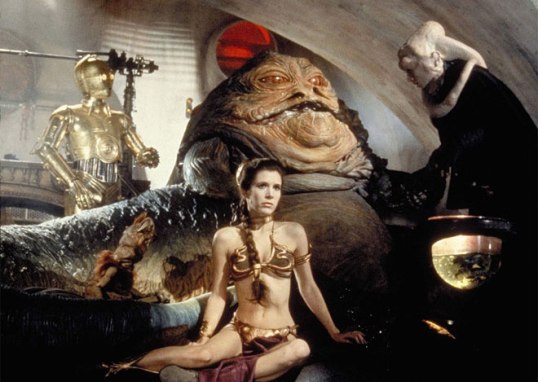
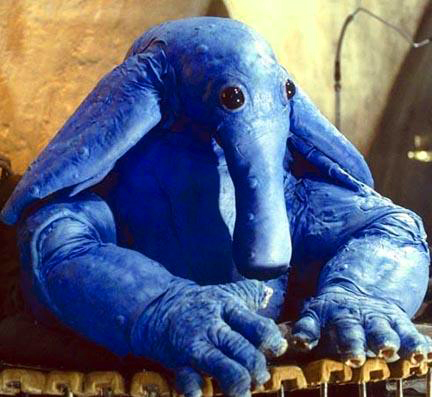
Far more impressive, as far as villains go, was Jabba the Hut. In fact, Jabba and his decadent entourage were so memorable and colorful and evil and icky that they pretty much overshadowed almost everything else in the film. I mean, Jabba even had a blue elephant playing music for him! And I know that I’m supposed to be critical of the film for putting Leia in that gold bikini but you know what? Leia may have been forced to wear a gold bikini but she never gave up her dignity or her defiance. And when it came time to take out Jabba, Leia used the tools of her oppression to do so, strangling him with his own chains. In that one scene, Leia proved herself to be a true rebel.
There’s a lot that’s good about Return of the Jedi but, as I said earlier, it’s definitely an uneven film. Richard Marquand’s direction is perhaps the epitome of workmanlike. It’s efficient and it’s dependable and there’s absolutely nothing surprising or particularly challenging about it.
It’s interesting to note that, before Richard Marquand was selected as director, the job was offered to both David Lynch and David Cronenberg, two directors who are all about surprising and challenging the audience. What would David Lynch’s Return of the Jedi been like? Well, here’s one possibility:
As for David Cronenberg’s Return of the Jedi, it might have looked something like this:
For better or worse, the world got Richard Marquand’s Return of the Jedi, which I imagine was pretty close to what George Lucas wanted the film to be.
As I sit here finishing up this review and wondering just why exactly I was so intimidated earlier (seriously, this turned out to be one the easiest reviews that I’ve ever written), I estimate that 75% of the people that I know are currently sitting in a theater and watching The Force Awakens. Keep an eye out for Arleigh’s review in the next few days!
And in closing, here’s that blue elephant that I mentioned earlier. Dance!
Boobs, Music, and Sci-Fi: Heavy Metal (1981, directed by Gerald Potterton)
 I think I was twelve when I first saw Heavy Metal. It came on HBO one night and I loved it. So did all of my friends. Can you blame us? It had everything that a twelve year-old boy (especially a 12 year-old boy who was more than a little on the nerdy side) could want out of a movie: boobs, loud music, and sci-fi violence. It was a tour of our secret fantasies. The fact that it was animated made it all the better. Animated films were not supposed to feature stuff like this. When my friends and I watched Heavy Metal, we felt like we were getting away with something.
Based on stories from the adults-only Heavy Metal Magazine, Heavy Metal was divided into 8 separate segments:
Soft Landing (directed by Jimmy T. Murakami and John Bruno, written by Dan O’Bannon)
Heavy Metal opens brilliantly with a Corvette being released from a space shuttle and then flying down to Earth, surviving reentry without a scratch. Who, after watching this, has not wanted a Space Corvette of his very own?
Grimaldi (directed by Harold Whitaker)
On Earth, a terrified young girl listens a glowing green meteorite called the Loc-Nar tells her that it is the source of all evil in the universe. This sets up the rest of the film, which is made up of stories that the Loc-Nar tells about its influence. The Loc-Nar is the film’s MacGuffin and, seen today, one of Heavy Metal’s biggest problems is that it has to find a way to force the Loc-Nar into every story, even if it meant sacrificing any sort of consistency about what the Loc-Nar was capable of doing. Even when I was twelve, I realized that the Loc-Nar was not really that important.
Harry Canyon (directed by Pino Van Lamsweerde, written by Daniel Goldberg)
In this neo-noir tale, futuristic cabby Harry Canyon (voiced by Richard Romanus) is enlisted to help an unnamed girl (voiced by Susan Roman) to find the Loc-Nar. Slow and predictable, Harry Canyon does feature the voice of John Candy as a police sergeant who attempts to charge Harry for police work.
 Den (directed by Jack Stokes, written by Richard Corben)
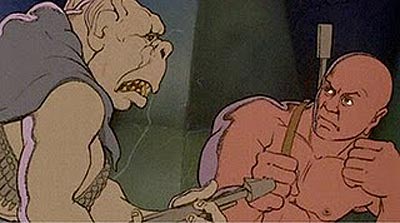
Nerdy teenager David (voiced by John Candy) finds a piece of the Loc-Nar and is transported to the world of Neverwhere, where he is transformed into Den, a muscular, bald warrior. As Den, David gets to live out the fantasies of Heavy Metal‘s target audience. On his new planet, Den rescues an Earth woman from being sacrificed, overthrows an evil queen and a sorcerer, and gets laid. A lot. Den is the best segment in Heavy Metal, largely because of the endearing contrast between the action onscreen and John Candy’s enthusiastic narration.
Captain Sternn (directed by Paul Sebella and Julian Harris, written by Bernie Wrightson)
 On a space station orbiting the Earth, Captain Lincoln F. Sternn is on trail for a countless number of offenses. Though guilty, Captain Sternn expects to be acquitted because he has bribed the prosecution’s star witness, Hanover Fiste. However, Hanover is holding the Loc-Nar in his hand and it causes him to tell the truth about Captain Sternn and eventually turn into a bloodthirsty giant. Captain Sternn saves the day by tricking Hanover into getting sucked out of an air lock.
Captain Sternn was a reoccurring character in Heavy Metal Magazine and his segment is one of the best. Eugene Levy voices Captain Sternn while Joe Flaherty voices his lawyer and Dean Wormer himself, John Vernon, is the prosecutor. Even National Lampoon co-founder Douglas Kenney provided a voice.
B-17 (directed by Barrie Nelson, written by Dan O’Bannon)
After the Loc-Nar enters Earth’s atmosphere, it crashes into a bullet-riddled World War II bomber, causing the dead crewmen within to reanimate as zombies. Scored to Don Felder’s Heavy Metal (Takin’ a Ride), B-17 is one of the shorter segments and its dark and moody animation holds up extremely well.
So Beautiful and So Dangerous (directed by John Halas, written by Angus McKie)
Nubile Pentagon secretary Gloria is beamed aboard a spaceship that looks like a giant smiley face. While she has sex with the ship’s robot captain, the two crew members (voiced by Harold Ramis and Eugene Levy) pour out a long line of cocaine and shout “Nosedive!” before snorting up every flake. So Beautiful and So Dangerous is so juvenile and so ridiculous that it is actually all kinds of awesome.
Taarna
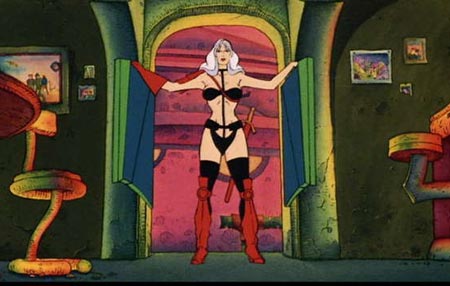
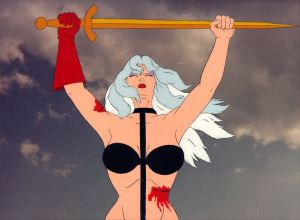 In the film’s final and most famous segment, Taarna, the blond warrior was featured on Heavy Metal‘s poster, rides a pterodactyl across a volcanic planet, killing barbarians, and finally confronting the Loc-Nar. She sacrifices herself to defeat the Loc-Nar but no worries! We return to Earth where, for some reason, the Loc-Nar explodes and the girl from the beginning of the film is revealed to be Taarna reborn. She even gets to fly away on her pterodactyl. Taarna was really great when I was twelve but today, it is impossible to watch it without flashing back to the Major Boobage episode of South Park.
Much like Taarna, Heavy Metal seems pretty silly when I watch it today. But when I was twelve, it was the greatest thing ever.
Sci-Fi Film Review: 2019: After The Fall of New York (dir by Sergio Martino)
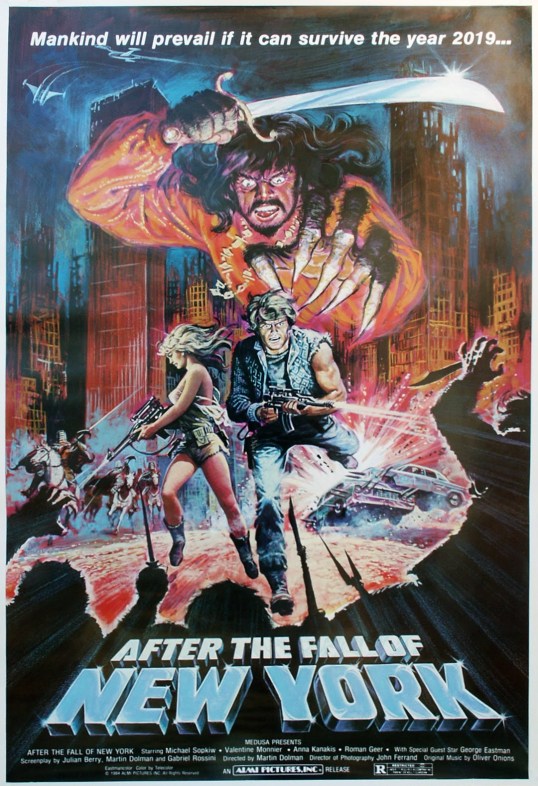
“Where is this woman can make babies!?”
— Big Ape (George Eastman), asking the question that everyone’s wondering in
2019: After The Fall Of New York (1983)
“Giara, if love had any meaning in the world, you would be the one I love.”
— Parsifal (Michael Sopkiw) in 2019: After The Fall of New York (1983)
New York City was a frequent location for Italian exploitation films and why not? Seeing as how most of the Italian exploitation films of the 70s and 80s were specifically designed to pass for an American product (with the actors and directors often credited under Americanized pseudonyms), it would only make sense to use America’s best-known city. Interestingly enough, these films rarely portrayed New York as being a very pleasant place. There was always either a mob war or a zombie invasion or police corruption or a madman with a knife to deal with. This portrayal of New York as Hell-on-Earth reached its logical conclusion with Lucio Fulci’s The New York Ripper but even films less extreme than Fulci’s still presented New York as representing every negative thing that has ever been thought about Americans.
After the international success of the first two Mad Max films and John Carpenter’s Escape From New York, there was a handful of Italian films that were meant to portray what life would be like in New York after a nuclear apocalypse. (In most cases, life would not be pleasant.) Of the films that made up this odd, yet undeniably energetic genre, 1983’s 2019: After The Fall of New York is one of the best.
Every post-apocalyptic film opened with the task of explaining who went to war with who. In this case, the war was started 19 years earlier by the European-Asian Alliance. After reducing America to atomic rubble, the Euracs (as they’re called) set up their headquarters in New York. When 2019: After the Fall of New York opens, the few radiation-scarred survivors have been reduced to living in the sewers and eating rats. The Eurac army rides through the streets atop white horses, capturing survivors and subjecting them to terrible medical experiments. Consider this: 2019: After The Fall of New York was an Italian-made film about evil Europeans (including, presumably, soldiers recruited from Italy) invading America. If you ever had any doubt about how determined the Italian film industry was to appeal to American audiences, 2019: After The Fall of New York should erase them.

Despite losing the war, there is still an American government. The President of the Pan-American Confederacy (played by Edmund Purdom, who regularly showed in strange movies like this one and Don’t Open Til Christmas) is determined to savage what he can of American society before relocating to either Alaska or the moon. Just in case you had any doubt that this movie was made a long time ago, the supporters of the Pan-American Confederacy are called the Confederates. And they’re the heroes of the film…
It turns out that there is only one fertile woman left on Earth. And the Confederate President is determined to take her to the moon to harvest her eggs and use in vitro fertilization to restart the human race. However, she is currently in a state of hibernation in New York (which, we are told, protects her from the radiation. That doesn’t really sound quite right but we’ll just go with it). President Purdom wants her rescued before the Euracs track her down!

Meanwhile, Parsifal (Michael Sopkiw) is in Nevada, where he makes his living by winning violent car races. After his latest race, he is rewarded with a sex slave but, because he’s a good guy, he lets the slave go free. (Before leaving, the slave does tell Parsifal about the existence of cyborgs, which is information that comes in useful later on.) No sooner has Parsifal done his good dead then he’s grabbed by some Confederate soldiers and taken to see President Purdom. Purdom doesn’t quite say, “I heard you were dead,” but he might as well.
Working with the one-eyed Ratchet (Roman Geer) and a bitter former academic named Bronx (Vincent Scalondro), Parsifal enters New York and tries to find the woman while staying on step ahead of the Eurac commander (Serge Feuillard). Along the way, Parsifal gains allies like a little person named Shorty (Louis Ecclesia), a kickass warrior named Giara (Valentine Monnier), and former circus performer turned gang leader, Big Ape (George Eastman).

That’s right, George Eastman is in this movie. If you know the least bit about Italian exploitation cinema, you will not be surprised when George Eastman shows up. You also won’t be disappointed. Eastman (whose real name is Luigi Montefiori) was a regular presence in everything from Spaghetti Westerns to grisly thrillers like Anthropophagus to flamboyant gialli like Delirium to post-apocalyptic thrillers like Raiders of Atlantis and this one. As always, Eastman is a lot of fun to watch in the role of Big Ape. Nobody played hulking menace with quite the flair of George Eastman at his best.
Along with Eastman, 2019: After the Fall of New York also some cult appeal because it starred Michael Sopkiw. The handsome Sopkiw had a short film career, starring in four Italian films and working with directors like Lamberto Bava and Sergio Martino, before retiring from acting. The briefness of his career and his backstory as a former sailor-turned-marijuana smuggler-turned-model have given Sopkiw a certain enigmatic mystique among fans of Italian exploitation. 2019: After the Fall of New York was Sopkiw’s first role and he brings a lot of enthusiasm to the role.
As directed by Sergio Martino, 2019: After The Fall of New York is full of interesting oddities that set it apart from your typical Italian post-apocalyptic thriller. For instance, a radiation-scarred man is occasionally seen wandering through the rubble, playing a trumpet and, at one point, serving as a chorus to the action. Another character, in a scene reminiscent of a Fulci film, has his eyes graphically ripped from their sockets and spends the rest of the film preparing for an eye transplant. Two of Big Ape’s followers are dressed up as gorillas and Big Apes even gets a chance to show off his skills with a scimitar. Perhaps my favorite random detail is that the Euracs do their evil plotting in front of a reproduction of Picasso’s Guernica. It’s just so wonderfully weird.

In fact, the whole movie is wonderfully weird. 2019: After The Fall of New York is Italian exploitation at its best!
Sci-Fi Review – Star Wars: Episode II – Attack of the Clones (dir. by George Lucas)
Attack of the Clones is, at least in my opinion, the worst Star Wars film ever made. Hands down. That is not to say it’s not mildly entertaining, but it demands a great deal of good will from its viewer to keep him from sneering at the movie constantly, especially if said viewer is a fan.
Christ, where do I even begin.
It’s important to note that Episode II is a transition movie. If that’s not clear enough, what I mean is that it’s a movie that exists to connect both the childish, yet potentially endearing Episode I, and the much darker and edgier Episode III. Episode II is somewhere inbetween these two moods, trying to make the transition smoother, disastrously so. It’s catastrophic in many levels, but mostly because of Hayden Christensen’s Anakin Skywalker. We’ll get there soon.
Episode II starts as a movie about politics. Now, I like fictional world politics as much as the next person. I honestly do. Especially in a space opera setting. But in Star Wars the politics are dull and barely explained. Padmé Amidala’s two terms as democratically elected Queen of Naboo (wait, what?) are now over, and she continues her career as a politician by becoming a senator. The story begins by trying to make it interesting that people are trying to kill Amidala, on what appears to be politically motivated crimes. We don’t get much context, except that she opposes some other senators. Palpatine, being the super trustworthy guy everyone always knew he was, assigns the Jedi Order to protect her, and finds that Obi-Wan is a suitable bodyguard for Padmé, considering their friendship way back in Episode I. Of course, Obi-Wan must take his apprentice, Anakin Skywalker, with him. And hilarity ensues.
Now, you’re probably familiar with whom Anakin is to become, and you probably know whose father he is, so this movie must establish one very important thing; an origin to the affection between future Lord Vader and an unwitting woman, so that we can learn whose womb was it that those guys from the original trilogy came from. Therefore, in addition to being about lackluster politics, this is a movie about love.
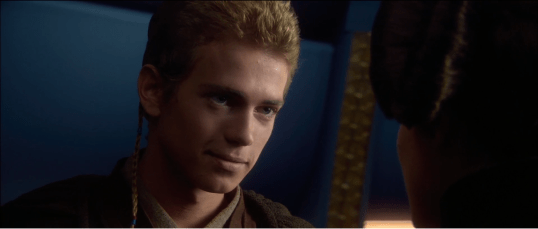
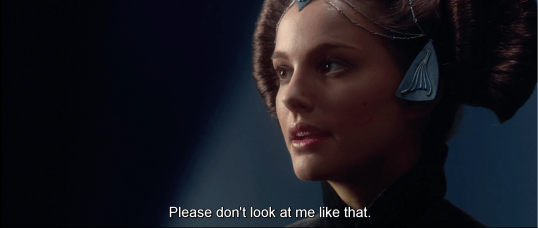
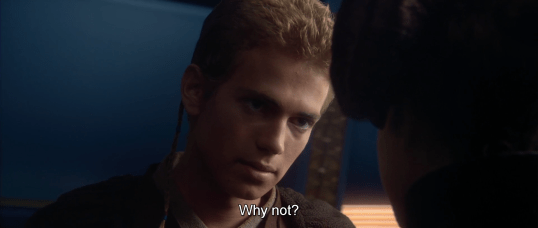
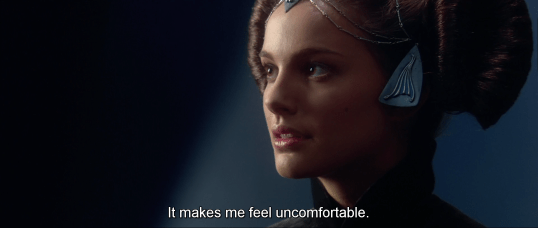
DAMN SON.
Now, I have to agree with Padmé. You can preach all you want about how you have a massive crush on Hayden Christensen’s mini braid, but that piercing sex offender gaze made me uncomfortable. Throughout the first act, Anakin goes from flirting with the poor woman to actively doing stuff very similar to sexual harassment. I mean, seriously, look at this lecherous, leering asshole.
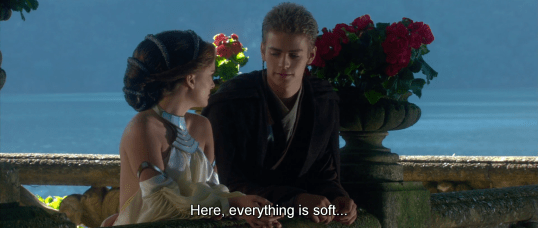
Darth Vader has always been regarded as one of the greatest villains of cinema, but I never figured that he was also one of the sleaziest.
I wish this was the only problem with Anakin. Maybe it’s not Mr. Christensen’s acting, but the poor writing (though I suspect that, considering his absence in major movies this decade, his acting was definitely a factor). Young Skywalker is a very gifted Jedi, being immaculately conceived by midi-chlorians and all (I can’t stop laughing), and he is painfully aware of his skills, which he shows through an overpowering arrogance. Now, arrogance when done right can be charming, and perhaps that was the intention; to make Darth Vader a badass even as a teenager, a daredevil, someone who just barely succeeds, but does it with style. Anakin, however, comes across as impudent, annoying, and exceedingly stupid. It seems Anakin can’t go two scenes without doing something that would displease the Jedi council, and entirely aware of it too. ‘Cause that’s just how he rolls. James Dean from a galaxy far far away.
Second act comes. Anakin grows more and more adolescent and fascist. More politics happen. Then there are some cool action scenes that seem to save the film. Obi-Wan is written as barely having a personality, aside from comments that try to make it evident that he is growing older and grumpier, even though he can’t be much more than 30. Regardless, he is arguably the saving grace in the main cast, at the very least as far as really cool fights go. He pilots fighter ships, he fights with a lightsaber; the man sees some action. It’s almost depressing to see an actor of Ewan McGregor’s caliber being reduced to action hero and grumpy mentor to an angsty teenager.
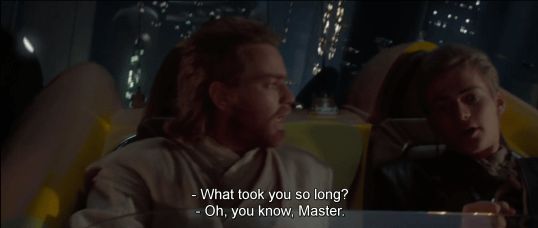
Their dynamic is oddly reminiscent of Gran Torino
Jar Jar also appears. Fan favourite Jar Jar. I feel this is worth mentioning because in an extremely important scene he proposes (as stand-in senator for Amidala) to convey supreme power to Chancellor Palpatine. Yes, that Chancellor Palpatine, and I have to wonder why they couldn’t task this burden to an unnamed senator. Don’t people hate the poor gungan enough? It’s as if George Lucas is just fucking with his public to see how far they can go, at this point.
And then, in the third act, we are introduced to the big bad: Count Dooku, played by the late Sir Christopher Lee. You’d think that bringing this legend of acting might infer that this character is the highlight of the cast. Might have been. Dooku is a character full of potential. He’s obviously evil, but with just the right amount of idealism to seem more shades of grey than the cruel, pure black villains the series are accostumed to. But apparently all he does is some exposition, then pave the way for the epic arena fight scene that kind of defines this movie as a Star Wars film (perhaps one of the only things that defines this as a Star Wars film), some more exposition, a lightsaber duel (a really cool one, wrapping up the whole two things that make this a Star Wars film), and then he’s gone, apparently having started a war. The movie is over, without fully explaining why things escalated, and who exactly Count Dooku represents that the Republic is at war with.
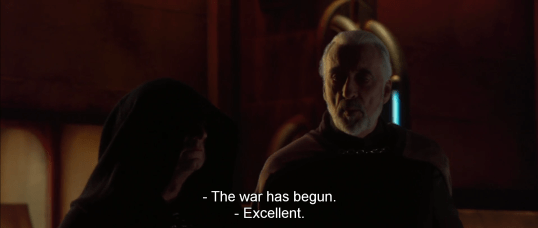
WAR AGAINST WHOM???
I’m serious when I say this can be an entertaining movie. The fight scenes can be fun and you can laugh at what ridiculous situations the actors are subjected to. But it’s mostly incredibly dull. It’s a film that throws you into an extended torrent of politics you need to understand beforehand to appreciate, and that lead to Clone Wars, a pretty cool spin-off that most people never got to see and that might as well have been properly included as crucial to the continuity since it’s much better than this. As a standalone film, the story is a confusing, rushed mess even at two hours long. As a Star Wars film, Attack of the Clones makes it obvious that the series is not infallible. Horribly, gapingly, obviously not infallible.
The TSL Daily Sci-Fi Grindhouse: Contamination (dir by Luigi Cozzi)
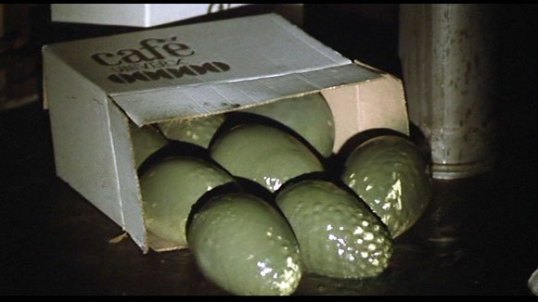
See those green things in the picture above? You’re probably looking at them and you’re thinking to yourself, “Those are the biggest avocados that I’ve ever seen!”
Well, they’re not avocados.
No, instead they are green eggs from Mars. They may look harmless but if they start glowing, pulsating, and making an eerie womping noise, you might want to get away from them. When those eggs explodes, they spray out a green goo. Any living creatures that is so much as even splashed by this goo will then explode in a mass of blood and guts. It’s messy. I would not want to clean up after anyone is sprayed with green goo.
Those eggs are at the center of this week’s daily sci-fi grindhouse, the 1980 Italian film, Contamination. How much you enjoy Contamination will largely depend on how much you like old school Italian exploitation films in general. If you’re the type who rolls your eyes at bad dubbing and who demands that a film follow some sort of narrative logic, you are not the ideal audience for this movie. However, if you’re like me and you enjoy the pure shamelessness of Italian exploitation, you’ll probably have an easier time enjoying Contamination.
It won’t come as a surprise to any student of Italian or grindhouse cinema to learn that Contamination was ripped off from several films that were popular in the late 70s. The eggs are largely lifted from Alien and, whenever the goo-sprayed bodies explode, it’s reminiscent of that ugly little thing bursting out of John Hurt’s chest. The second half of the film feels like a secondhand James Bond film, complete with a sinister conspiracy, a mysterious mastermind who earlier faked his own death, and a femme fatale. The conspiracy is headquartered on a coffee plantation in South America. It’s not difficult to imagine Baron Samedi or some other villain from Live and Let Die showing up and laughing before throwing an exploding egg at someone.
Contamination opens with a seemingly deserted ship floating into New York harbor. Fans of Italian cinema will immediately think about the opening of Lucio Fulci’s Zombi 2. Just as Zombi 2 opened with the New York City police investigating an abandoned boat and getting attacked by a zombie, Contamination features the New York City police investigating an abandoned boat and getting sprayed with green goo. The only cop who doesn’t explode, a tough New Yawker named Tony (Marino Mase), works with Col. Stella Holmes (Louise Marleau) to figure out why those eggs were on that boat.
Helping them out is an alcoholic former astronaut named Commander Ian Hubbard (Ian McCulloch). Somewhat appropriately, McCulloch was also in Zombi 2. (And let’s not forget about his role in Zomie Holocaust…) I once read an interview with McCulloch (in Jay Slater’s overview of Italian zombie cinema, Eaten Alive) in which he said that he didn’t feel he did a very good job in Contamination but I think he’s being too hard on himself. Is the very British and slightly uptight Ian McCulloch miscast as a cynical, alcoholic, American astronaut who can’t even walk to his front door without stumbling over discarded beer cans? Sure, he is. But he’s so miscast that it actually becomes rather fascinating to watch him in the role. He may be miscast but you can tell he’s really trying and he’s just so damn likable that you almost feel like it would be a disservice to him not to watch the film.
Anyway, Stella, Tony, and Hubbard have to discover out why the green eggs are on Earth and they eventually do figure out what’s going on. I’ve watched the film multiple times and I have to admit that I’m still not sure what they figured out. It’s a confusing movie and I doubt that there’s really any way that it could have ever made any sort of coherent sense but then again, that’s part of the film’s charm.
So, here’s what does work about Contamination. The exploding green eggs are both scary and wonderfully ludicrous. Ian McCulloch is a lot of fun as drunk Commander Hubbard. Goblin provides an excellent and propulsive score. And finally, there’s an alien monster who simply has to be seen to be believed. To his credit, director Luigi Cozzi realized that the monster looked cheap and he uses all sorts of creative editing and employed an arsenal of jump cuts to try to keep you from noticing. Much as with McCulloch’s performance, you can’t help but appreciate Cozzi’s effort.
As I said before, you’re enjoyment of Contamination will probably be determined by how much you enjoy Italian exploitation films in general. If you’re not familiar with the Italian grindhouse, Contamination is not the film to use for an introduction. However, if you are already a fan, you might appreciate Contamination.
Contamination is in the public domain and, as such, very easy to track down.
Sci-Fi Film Review: Warriors of The Year 2072 (dir by Lucio Fulci)
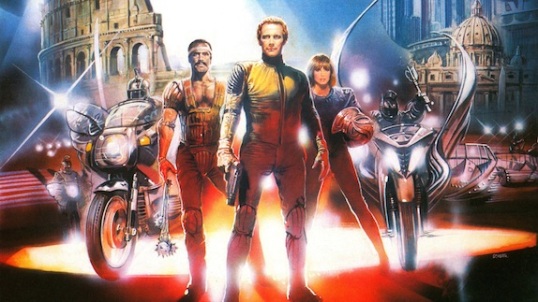
Before The Hunger Games…
Before The Purge…
There was…oh wait, does this sound familiar? Did you just read those two lines and get hit by a sudden feeling of déjà vu? Well, that might be because I used those exact same lines to start my review of the 1965 Italian sci-fi film, The Tenth Victim.
They’re still applicable for this review though. In many ways, the 1984 film Warriors of the Year 2072 (a.k.a. The New Gladiators) is a loose remake of The Tenth Victim. (I imagine some critics would say it’s more of a rip-off than a remake. What you label it will probably depend on how much tolerance you have for Italian exploitation films in general.) Of course, Warriors of the Year 2072 draws inspiration from more than just The Tenth Victim. A Clockwork Orange, Escape From New York, the Mad Max films, Blade Runner; bits and pieces from all of them show up here.
Even if you didn’t already know it, you might be able to guess that this film was directed by Lucio Fulci. The film features Fulci regulars Al Cliver (of Zombi 2 fame) and Howard Ross (of New York Ripper fame) in supporting roles. Cinzia Monreale, who had her throat ripped apart in Fulci’s The Beyond, appears in a cameo in which she again has her throat ripped apart. (Actually, she just hallucinates having her throat ripped apart and is seen alive afterward, as if Fulci himself is saying, “See, it’s all just film trickery. Nobody really gets hurt in my movies.”) Finally, and most obviously, a character graphically loses an eye. It’s simply not a Fulci film without some sort of graphic ocular trauma.
The film also features a theme that would show up in a lot of Fulci’s post-New York Ripper works. Warriors of the Year 2072 is about the role of violent entertainment in both maintaining and destroying society. Which is not to say that the film really has that much to say about it. Thematically, Warriors of the Year 2072 is all surface level but those themes are still present.
As for the film itself, it takes place in the year 2072, so at least the title is being honest with us. The world is now run by competing television networks. The American television network has the highest rated show: Kill Bike, in which men on motorcycles battle to the death. Cortez (Claudio Cassinelli), the program director for Rome-based WBS-TV, is ordered by the station’s owner, the mysterious Sam, to come up with a program that will be more popular than Kill Bike. At first, Cortez tries to put on a show called The Danger Game, where people are forced to hallucinate dying in violent ways. When that show fails to beat Kill Bike, Cortez decided to just rip-off Kill Bike…
And let’s just stop a moment to point out the obvious. Neither The Danger Game nor Kill Bike would feel at all out-of-place on television today. Remember Fear Factor? How different is The Danger Game from that old show?
Anyway, Cortez’s new show is basically Kill Bike with a twist. The motorcycle combat will now take place in the Roman coliseum and the contestants will all be convicted murderers awaiting execution. Fortunately, the very popular star of Kill Bike — Drake (Jared Martin) — has recently been convicted of murder! It’s convenient how that worked out…
As we discover through the magic of slow motion flashbacks, Drake was returning home one night when he discovered that his wife had been murdered by three young men who all appeared to be doing a bad impersonation of Malcolm McDowell in A Clockwork Orange. The three men were then murdered and Drake was convicted. However, Drake insists that he’s innocent and, even when confronted by laughing hallucinations of the three men, he refuses to attack them.
Could it be that someone is framing Drake? Of course! But why…
Well, before we find out the answer to that, we watch as Drake is brought to the coliseum and is trained in gladiatorial battle. He immediately makes an enemy out of the head guard, the sadistic Raven (Howard Ross, who is hilariously over-the-top). He also bonds with the other gladiators, one of whom is named Abdul. Abdul is played by Fred Williamson, largely because it’s not a mid-80s Italian sci-fi dystopia without Fred Williamson.
Warriors of The Year 2072 cannot compare to Fulci at his best. This is no Zombi 2 or The House By The Cemetery. At the same time, it’s definitely better than most of the films that Fulci made after The New York Ripper. Fulci was a supreme stylist and, as a result, Warriors of the Year 2072 is always watchable. Even when you don’t have the slightest idea what’s going on, you still can’t quite bring yourself to look away. Yes, the special effects are nothing special. And yes, it’s obvious that futuristic Rome was just a miniature set. But the cheapness of the film gives it an odd charm. It’s the cheapest future imaginable and somehow, it actually feels appropriate. Why do we always assume the future will be sleek and shiny? Maybe it’ll look like cardboard, like in Warriors Of The Year 2072!
Warriors of the Year 2072 is a campy, frequently silly, and oddly entertaining look at the future of the human race. If you’re a Fulci fan or a lover of Italian exploitation cinema, track it down.
Sci-Fi Film Review: The 10th Victim (dir by Elio Petri)
Before The Hunger Games…
Before The Purge…
There was The 10th Victim!
This Italian film from 1965 takes place in a future that is a lot like our present. After years of war and senseless violence, the world is finally at “peace.” Wars are avoided by allowing people to take part in the Big Hunt. When you join the Hunt, you’re agreeing to take part in 10 rounds of competition. For five rounds, you’re the hunter. For the other five rounds, you’re the hunted. Survive all 10 rounds and your reward will be money and retirement. So far, only 15 contestants have managed to survive.
If you’re being hunted, you get a letter informing you that you are now being hunted. The only way to win is to kill the person who has been assigned to hunt you. Unfortunately, you’re not told who is hunting you and, if you accidentally kill someone who is not hunting you, you’ll be sent to prison for 30 years. And, of course, the whole time you’re trying to avoid getting killed, others are being hunted around you. World peace means that there are constant gun battles in the streets, all of which are calmly observed by a rather apathetic populace. It’s a violent world but it’s legal violence so it doesn’t really concern anyone beyond the people that are getting killed.
(At one point, an announcement is heard while a hunter guns down his target: “Live dangerously but obey the law…live dangerously but obey the law…”)
Coverage of the Big Hunt is the world’s most popular television show and, as a result, legalized murder has become big business. Companies regularly sponsor hunters and turn their kills into elaborate commercials for their products.
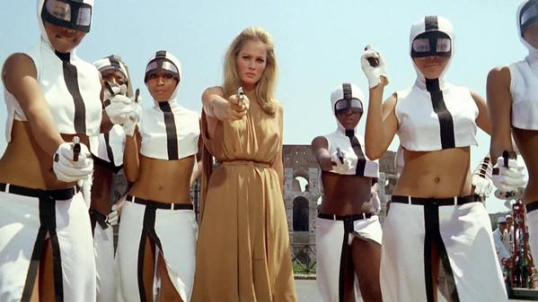
When we first meet Caroline Meredith (Ursula Andress), she is using a literal bullet bra to shoot a man dead. Caroline is sponsored by Ming Tea and, when she is assigned to hunt Marcello Pollitti (Marcello Mastroianni), the company flies her out to Italy. In order to make Marcello’s death as cinematic and commercial as possible, Ming Tea and Caroline decide to lure him to Rome’s Temple of Venus. The Ming Tea dancers are flown in, a choreographer starts working on their routine, and Caroline tracks down Marcello.
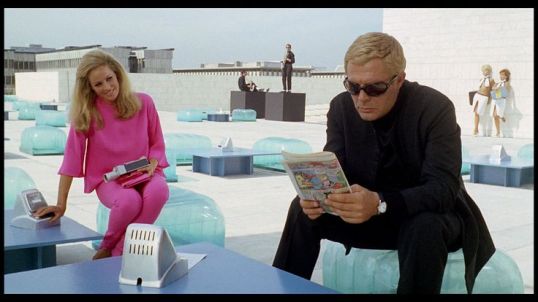
Marcello has just found out that he’s being hunted and he’s more than a little depressed. He’s also paranoid and when Caroline first approaches him, Marcello suspects that she’s his hunter and not, as she claims, a journalist. However, because of the legal penalty for killing a non-hunter, Marcello cannot kill Caroline until he’s sure that she wants to kill him. Meanwhile, Caroline cannot kill Marcello until they’re at the Temple of Venus, in front of the cameras and the dancers.
And, of course, there’s also the fact that, as they get to know each other, Caroline and Marcello start to fall in love. When Caroline observes Marcello conducting a bizarre religious ceremony (he’s the head of a cult of sun worshippers), she is so touched that she starts to cry. Or does she? Are her tears just a ploy to keep Marcello from suspecting that she wants to kill him? We’re never quite sure.
If you didn’t already know that The 10th Victim was made in 1965, you would guess it after just a few minutes. This is one of those hyperstylized works of pop art that, for many people, define 60s cinema. How you react to the film will depend on how much tolerance you have for its nonstop style. Speaking as someone who happens to love over-the-top pop art, I enjoyed it but I could imagine other viewers ripping out their hair at the sound of the film’s peppy theme song.
But, if you’re patient, you will eventually discover that, underneath the film’s excesses, it’s actually a rather clever satire of media, politics, culture, religion, and just about everything else that deserves to be satirized. Marcello Mastroianni and Ursula Andress are both a lot of fun and, in the end, the whole thing works as both a surprisingly accurate prophecy of today’s world and as a time capsule of the 1960s.
Plus, I loved the bullet bra. I need to get one of those.
It’s a dangerous world, after all.
Sci-Fi Film Review: The Hunger Games: Mockingjay — Part 2 (dir by Francis Lawrence)
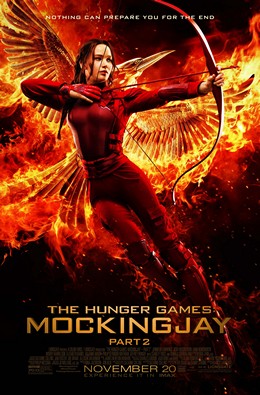
It’s finally over!
It probably sounds like I’m really excited that the final Hunger Games adaptation has been released. It may sound like I’m happy that the saga of Katniss Everdeen and her life in Panem has finally come to an end. And, to a certain extent, I am. After everything that Katniss has been through, she deserves some peace and, fortunately, the series has ended before Jennifer Lawrence got bored with playing the role. (To see what happens when actor gets bored with an iconic role, check out Daniel Craig in Spectre.) Even though I think it can be argued that Mockingjay Part Two is the weakest of all the Hunger Games films, it still allows both Katniss and the actress who brought her to life to go out on a high note.
There’s a part of me that cringes a little when I think about all of the films that were released as a direct result of the success of The Hunger Games. The Giver, The Maze Runner, Divergent, Tomorrowland, the list goes on and on. I’ve reached the point where I can now say that I am officially sick of sitting through adaptations of Young Adult dystopian fiction. And yet, I was still excited to see The Hunger Games: Mockingjay Part Two (even if that title is way too long and unwieldy). Regardless of the number of mediocre films that it may have inspired, The Hunger Games franchise has always remained compelling.
So, how was Mockingjay Part Two? Obviously, it doesn’t work as a stand-alone film. The pacing is totally off, characters appear and disappear almost at random, and it’s all rather confusing. If you haven’t seen the film that came before Mockingjay Part Two, I imagine that you would be totally confused by this film. But, when viewed as the fourth part of one gigantic epic story, the whole thing is rather brilliant.
When the film opens, Katniss is still being used a prop in Alma Coin’s (Julianne Moore) revolution. The majority of the film deals with her journey into and through the capital. She wants to track down and assassinate President Snow (the wonderfully evil Donald Sutherland) whereas Coin just wants to use her as a symbol to solidify her authority. As Katniss quickly realizes, there’s not much difference between Snow and Coin. However, it takes one great tragedy for Katniss to truly understand the truth about the Alma Coin and her revolution. If you’ve read the book, you’ll already know about and be prepared for that tragedy but it’s still a heart-breaking moment.
It’s also the most important moment in the franchise, one that reminds us that The Hunger Games has always been far more politically sophisticated (and thematically darker) than all of the films, books, and fan fic that has been inspired by it. This is a seriously dark and, some would say, cynical movie and, as a student of history, I appreciated that. I appreciated that Mockingjay didn’t try to force a happy ending on us and I also appreciated the fact that Mockingjay didn’t buy into the simplistic Manichaen worldview that is currently ruining worlds both real and cinematic. The film’s final scene may be hopeful but it’s never naive.
It’s a bit unfortunate that Mockingjay had to be split into two separate films. Mockingjay Part Two is full of exciting moments but there’s also a lot of scenes that feel like filler. You get the feeling they were included to make sure that Mockingjay Part Two’s running team was equal to the other films in the franchise. This is a film that features a lot of genuinely exciting action and some truly emotional moments. It’s also a film that features a lot of speeches. If only both parts of Mockingjay could have been released as one six hour film. I would have watched it!
The film also features the final performance of Philip Seymour Hoffman, playing the rule of Plutarch. Hoffman is not in many scenes and reportedly, he died before filming two of his biggest scenes. Those scenes were rewritten and his dialogue given to other actors. At one point, Woody Harrelson starts to read a letter that was written by Plutarch and it’s a sad scene because you’re aware that, originally, Hoffman was meant to deliver those lines in his trademark style. As it is, Hoffman only appears in a few minutes of Mockingjay Part Two and he doesn’t do much. But, when the film briefly features his bemused smile, you’re reminded of what a great actor the world lost when Philip Seymour Hoffman died.
Of course, the entire Hunger Games franchise has been full of great actors. Jennifer Lawrence brought Katniss to wonderful and empowering life and one of the joys of Mockingjay Part Two is getting to see her bring the character’s story to a close. But even beyond Jennifer Lawrence’s rightly acclaimed work, the entire cast of the franchise deserves a lot of credit. I’ve always loved Donald Sutherland’s interpretation of President Snow and he’s at his best here.
For that matter, if there ever is another Hunger Games film or a Hunger Games spin-off, why not make it about Jena Malone’s Johanna Mason? The way that Malone delivered her angry and frequently sarcastic dialogue was definitely one of the film’s highlights.
Regardless of whether there are any future films, The Hunger Games: Mockingjay Part Two is a worthy conclusion to a great story.
(By the way, as you may have guessed from the title of this post, December is science fiction month here at the Shattered Lens! We hope you enjoy it!)
Previous Hunger Games Reviews:
 Through the Shattered Lens