Today is a special day here at the Shattered Lens as we celebrate the birthday of Dario Argento!
Now, we’ve got a lot of Argento-related stuff scheduled for October so, for today, I’m just going to share one of the best scenes from one of my favorite Argento films, 1975’s Deep Red. This scene features what is seriously the creepiest puppet that I’ve ever seen.
In honor of Werner Herzog’s birthday, today’s scene that I love comes from one of his best films. 1972’s Aguirre, The Wrath of God not only established Herzog as a major filmmaker but it also showed that he was the director who could get the best out of the notoriously difficult Klaus Kinski.
In this scene, Kinski plays the mad conquistador, Aguirre. Lost with his men in the Amazon, Aguirre establishes control over the dwindling expedition.
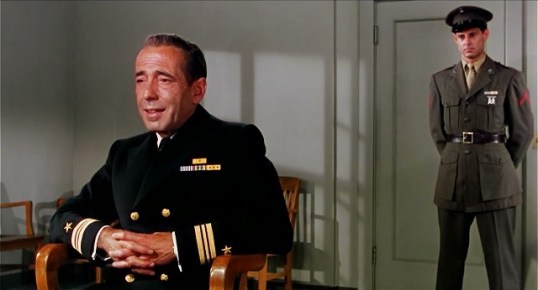
In this scene, Captain Queeg (Humphrey Bogart) is cross-examined by Barney Greenwald (Jose Ferrer). The court martial concerns whether or not an officer under Queeg’s command was justified in taking over the ship from Queeg. Greenwald, tasked with defending the head mutineer, knows that the only way to win the case is to expose Queeg himself as a paranoid and unstable officer. Greenwald does his job but he’s not happy about it.
This scene, directed by Edward Dmytryk, features both Bogart and Ferrer at their absolute best.
Today’s scene that I love comes from Christopher Nolan’s Oppenheimer. In this scene, the very first nuclear bomb is detonated and history is changed forever. Nolan captures the mix of pride and outright horror as the most deadly weapon of all is tested for the very first time. In much the same way that some of us cannot resist the chance to stare directly at a solar eclipse, Cillian Murphy’s Oppenheimer cannot help but stare directly at what he has helped to create.
Today, the Shattered Lens wishes a happy birthday to director James Nguyen! Today’s scene that I love comes from Nguyen’s masterpiece, 2010’s Birdemic: Shock and Terror!
Those who claim that Brian De Palma stole too much from Hitchcock obviously never met James Nguyen.
On the one hand, it’s a historically inaccurate portrayal of the events leading to the transformation of the Roman Republic to the Roman Empire. The pace is often slow. Some of the performances are regretful. It’s a film that was first envisioned as being a cheap B-picture but ended up nearly bankrupting 20th Century Fox. Of all of the movies released in 1963, it sold the most tickets and yet, because of the films huge production costs, it still lost money.
On the other hand, it’s a truly gigantic film, one that recreates the perhaps imagined splendor of the ancient world and which does it without the use of CGI. The film may not exactly embrace historical accuracy but it does embrace the melodrama. And, finally, you have scenes like the one below, in which it was obvious that Elizabeth Taylor and Richard Burton couldn’t wait for the cameras to stop rolling so they could toss off the costumes and make some history of their own.
The writer Mary Shelley was born on this date in 1797. Shelley, of course, is best-known for writing Frankenstein, a book that some claim is the first science fiction novel. (That’s debatable but it was still a major literary achievement.)
In this scene from 1936’s BrideofFrankenstein, Elsa Lanchester appears as Mary Shelley, continuing her story. (Of course, Lanchester also played the Bride herself.)
Today, the Shattered Lens observes what would have been the birthday of the great William Friedkin. As a director, William Friedkin revolutionized both the horror genre and the crime genre. The car chase from 1971’s The FrenchConnection has been much imitated but rarely equaled.
A few years ago, I attended a showing of The French Connection at the Alamo Drafthouse. As exciting as this chase is, it’s even more amazing when viewed on a big screen.