Is it ever too early to start trying to predict what films will be nominated for Oscars next year?
In a word … yes.
After all, it’s only March. Grand Budapest Hotel has just now been released in New York and Los Angeles. Whiplash and Boyhood were acclaimed at Sundance. But otherwise, this is the time of year when the studios release films like The Legend of Hercules and Jack Ryan: Shadow Recruit.
Yes, it’s way too early and, quite frankly, a bit silly to try to predict anything right now.
But, a lot of us are still going to try.
Below you can find my way too early predictions for the 2015 Oscar nominations. Needless to say, these are blind guesses and should not be taken too seriously.
Some may notice that three films that are very popular with other award watchers are not listed on my list of best picture predictions. I have not listed Grand Budapest Hotel because the Academy, in the past, has not exactly been receptive to the films of Wes Anderson. As for David Fincher’s Gone Girl, I’m predicting it will have more in common with his rehash of The Girl With The Dragon Tattoo than The Social Network. Finally, I’m looking forward to seeing Paul Thomas Anderson’s Inherent Vice but I think the material will be too quirky for the Academy.
Best Picture
Birdman
Boyhood
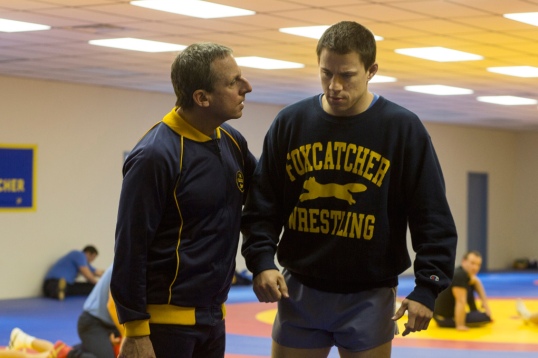
Foxcatcher
Get On Up
The Imitation Game
Interstellar
Unbroken
Whiplash
Wild
Best Director
Alejandro Gonzalez Inarritu for Birdman
Angelina Jolie for Unbroken
Richard Linklater for Boyhood
Morten Tyldum for The Imitation Game
Jean-Marc Vallee for Wild
Best Actor
Chadwick Boseman in Get On Up
Steve Carell in Foxcatcher
Benedict Cumberbatch in The Imitation Game
Brendan Gleeson in Calvary
Timothy Spall in Mr. Turner
Best Actress
Amy Adams in Big Eyes
Jessica Chastain in A Most Violent Year
Rosamund Pike in Gone Girl
Emma Stone in Magic in the Moonlight
Reese Whitherspoon in Wild
Best Supporting Actor
Robert Duvall in The Judge
Idris Elba in Beasts of No Nation
Mark Ruffalo in Foxcatcher
J.K. Simmons in Whiplash
Christopher Walken in Jersey Boys
Best Supporting Actress
Viola Davis in Get On Up
Amy Ryan in Birdman
Kristen Scott-Thomas in Suite Francaise
Meryl Streep in Suffragette
Jacki Weaver in Magic in the Moonlight
Those are my predictions for now. Come April, I’ll sit down and make (and post) another collection of blind guesses. If nothing else, these way too early predictions will give everyone something to laugh about when, next year, the actual Oscar nominations are announced.
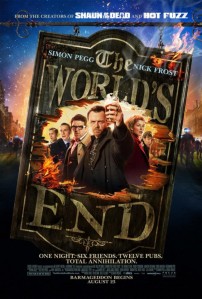
A strange thing happened on the way to seeing The World’s End. With the audience seated for the film, we all watched as the credits began. When I saw that Constantin Film was involved, I thought to myself, “Wait, wasn’t Edgar Wright’s films mostly Working Title Productions? This is different.” Turns out the movie that started playing was The Mortal Instruments, the result of which had a few moviegoers groaning and actively talking about the film. Someone actually cried out “It’s the King of the North!” after seeing Lena Headey and her co-star who barely resembled Robb Stark. After about 5 minutes of this, the film was shut down, the reel replaced and The World’s End was ready to begin.
The World’s End marks the final film in Edgar Wright’s Cornetto Flavors Trilogy. The Cornetto (which look like King Cones here in the states) was something of a joke in Shawn of the Dead with the color red, and then had a return appearance in Hot Fuzz with the color blue. The World’s End has a connection with green when it comes to Cornettos.
The film reunites Wright with Simon Pegg and Nick Frost, and in a twist from the previous films together, it’s Pegg whose character is the over the top one with Frost as the straight man. I’ll admit that I walked in this actually expecting the opposite, and found myself chuckling when it didn’t turn out that way. Surrounded by a cast made up of Wright regulars like Paddy Considine (Hot Fuzz, The Bourne Ultimatum) and Martin Freeman (Love Actually, The Hobbit), along with some new faces in Pierce Brosnan and Rosamund Pike, there isn’t a cast member that feels out of place here. Even when the story feels like it’s about to lull, there’s some weird quip or moment that invoked a laugh or chuckle in the audience.
The World’s End is the story of Gary King (Pegg), who as a teen growing up in small town, dared to do the impossible with his friends. The plan was to make a run to 12 different pubs in the town, have a pint of beer in each one, leading up to the final pub called The World’s End. In the initial attempt, they managed to get about 3/4ths of the way through before getting so smashed that they had to bail out. Time passes, as it always does and the old gang has grown up, moved on to different lifestyles and in some cases, built families. King, on the other hand, is very much stuck in his own time period spending the bulk of his time reliving his glory days. He’s that guy that talks about his High School Football days as if they were yesterday, some 20 odd years later. This is a running theme through the film – the notion that being caught up in nostalgia is not as great as it ever appears, and that being too nostalgic – living too much in the past – could possibly suggest that one isn’t appreciating what they have right now, nor are they looking forward to anything. Sometimes, you just can’t go home…or can you?
King decides to get his friends together for one last run on The Golden Mile. As they go from pub to pub, they go over various events in their lives and start to notice (in true Wright fashion) that something really weird seems to be going on in the town. As things begin to unravel, they come to find that actually are in real danger and need to get past all of their issues if they’ll get through it. Just like Shaun of the Dead and Hot Fuzz, the second half of film becomes something of a horror thriller with comedy throughout. Elements of The Thing and Invasion of the Body Snatchers become noticeable as the team tries to survive. That’s pretty much it. Take the recent This is the End, add a few beers and a tighter script and you have The World’s End. The first half of the movie may seem slow, but it does pick up, and pick up well.
Pegg and Frost are the grounding forces to The World’s End. Their performances (particularly Pegg’s) are what keeps it all afloat when it seems like the story might unravel. If the film suffers from any problems, is that it’s something of a downshift for Wright compared to Scott Pilgrim vs. The World. There are a number of action moments in The World’s End, but at the same time, they don’t quite have the umph factor of Wright’s other films. By the time you reach the end, you may actually find yourself scratching your head over what you’ve seen, but then again, the ending of Shaun of the Dead didn’t quite make sense to me either. Not saying that it could have all been better (as I may see it again before the weekend is out), it’s just different.
Overall, The World’s End is a fun ride into the past of a series of characters that will remind you to focus on the present, and laugh while doing so. It’s a fitting close to these films, even if it isn’t the sharpest film in the set (for me that remains Hot Fuzz). If only they served beers at the movie theatres, that would be perfect.
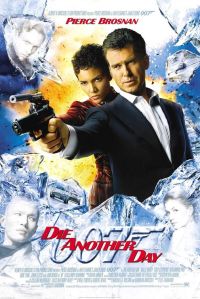
Leading up to the North American release of the latest James Bond feature film, Skyfall, The Shattered Lens is reviewing each and every James Bond film in the history of the franchise. Today’s film is the controversial Die Another Day, the twentieth film in the James Bond franchise, and the final such film to feature Pierce Brosnan in the titular role as 00-agent James Bond. Despite launching to mixed reviews – particularly overseas, where it generated significantly negative reaction in North and South Korea – it was at the time the highest grossing Bond film of all time.
Our cold open for this film has us in North Korea. There, 007 is assuming the identity of a diamond smuggler who is assisting a North Korean Colonel, Tan-Sun Moon, in laundering blood diamonds as part of an ongoing search for advanced military hardware. In order to bypass the landmines of the Korean Demilitarized Zone, the good Colonel has constructed an entire army of hover vehicles which can cross the region without triggering the mines, allowing for a land invasion of South Korea. Bond proceeds with the exchange, but is identified by Zao (Rick Yune), Colonel Moon’s right hand man. Bond triggers an explosion which badly disfigures Zao’s face, which becomes embedded with dozens of diamonds. Colonel Moon attempts to escape on a hovercraft, and Bond pursues him, eventually chasing the Colonel off the edge of a waterfall, apparently killing him. Afterward, Bond is captured by General Moon, the Colonel’s father, and is imprisoned.
After over a year of imprisonment and torture, Bond is traded during a prisoner exchange for Zao. Upon returning to MI6, M (Dame Judi Dench) tells Bond that his 00-status has been suspended. Both she and the Americans believe that Bond cracked under torture and revealed classified information, necessitating the prisoner exchange that brought him back. However, the release of Zao leaves both M and Bond extremely bitter. Determined to recapture Zao, Bond evades MI6’s security and disappears. He travels to Hong Kong, seeking a way back into North Korea, but his contact there informs him that Zao has attempted to disappear in Cuba and provides him with the necessaries to travel there instead.
After he arrives in Havana, Cuba, Bond investigates a clinic there which specializes in gene therapy that is virtually unknown in the first world. Bond’s local contact describes it as prolonging the lives of their leading citizens, and the richest folks in the West, but Bond also learns that the gene therapy would allow a person to totally restructure their appearance and assume a whole new identity. During his investigation, he meets a woman who introduces herself as Jinx (Halle Berry) who, initially unknown to Bond, is an NSA agent on a similar investigation, albeit one with presumably very different goals. Bond locates Zao inside the clinic, and a chase ensues. Although Zao ultimately manages to escape by helicopter (and Jinx in dramatic fashion by diving off the sea wall and boarding a waiting boat which drives her off), Bond recovers a pendant left behind by Zao. Upon unscrewing it, Bond discovers a cache of diamonds. Upon inspection, the diamonds are chemically identical to diamonds found in Sierra Leone, but they bear the identifying mark of a diamond mine owned by a British billionaire and thrill seeker, Gustav Graves (Toby Stephens). Bond is determined to investigate.
This forms the basis of the remaining plot. Our set pieces this time aren’t quite so varied, as much of the remaining story plays out in Iceland, where Graves’ diamond mine is situated, and where he has constructed a special ice hotel for the purpose of a technology convention. Eventually, we return to Korea, for a final showdown that seems somehow empty, despite the increasingly high stakes in terms of both explosions and technology.
The truth, ultimately, is that Die Another Day is a bit of a mess. It has a seemingly incessant procession of action sequences, but they raise the stakes primarily through CGI and improbable wizardry, in a way that threatens our suspend disbelief. I know that this is Bond, and that in 80s-early 00s Bond very much fell into the trap (who didn’t?) of ‘bigger and better’. However, this film takes things a bit too far in my estimation. Its villains aren’t quite as fun as the ones in the past two films (well, Mr. Stamper is kind of a drag I suppose), and don’t really fit the Bond mold. The story is pretty straightforward, but probably doesn’t receive quite the treatment that it deserves to get us established in it. The interactions between Bond and M are a bit too stiff, and I say that even keeping in mind tomorrow’s review piece, Casino Royale. There’s something about Die Another Day that made me think everyone involved was just going through the motions, like a sense of fatigue just hung over the proceedings. It was a bit of a bummer.
As for the women of Bond, Die Another Day actually has a lot to recommend. Breaking convention, this section is heavy with spoilers, but I’m going to risk it just this once. Don’t read on if you’re new to this film and planning to watch it!
Die Another Day continues to feature Dame Judi Dench as a pleasantly strong and uncompromising intelligence chief (I probably haven’t made enough of how much I enjoy her in the role of M in my reviews up to this point). In addition, we’re treated to Halle Berry as Jinx, an ass-kicking NSA agent who seems to do a lot of getting outmaneuvered and captured for being so adept. I didn’t care for Berry’s performance in this film, and I’d be lying if I said she stacked up well against Tomorrow Never Dies’ Michelle Yeoh as a Chinese intelligence agent. Still, compared to some of the other Bond girls, Berry is definitely a warrior. The other major female character, however, is Miranda Frost (Rosamund Pike), a frigid and beautiful MI6 agent… actually, a double agent, who betrayed Bond in the cold open. Pike’s character definitely gives off the edge of competence and deadliness that I, for one, am rooting for in female characters in any Bond movie, and she sells it well. Unfortunately, she’s not nearly as fun as Elektra King, as her motivations are completely unexplored and she just feels like an add-on to the existing plot surrounding some dangerous North Koreans.
Overall, this is probably not one of the better Bond films, though I’d argue that it doesn’t deserve the bad rap that some have given it either. It’s not a terrible film, just overwrought in a kind of Michael Bay way that undermines the characters and concepts. This is a common complaint of all four Pierce Brosnan films, especially, as well as some of the Roger Moore and Timothy Dalton efforts. However, this is the one that I most agree with that assessment of. This film really gets out of control with effects and gadgetry.
That’s it for today’s review. I leave you with the theme from Die Another Day, performed by Madonna. Tomorrow’s review will be of 2006’s Casino Royale.
Well, here’s your chance to, once again, tell me what to do. I’ve randomly selected 12 films from my film collection. Whichever film gets the most votes will be watched and reviewed by me next Tuesday, March 20th.
Here are the films up for consideration:
1) Black Jesus (1968) — This Italian film stars Woody Strode as an African rebel leader who is captured by his country’s right-wing, American-backed dictatorship.
2) Capote (2005) — Philip Seymour Hoffman was an Oscar for best actor for playing writer Truman Capote in this film that details how Capote came to write his true crime classic, In Cold Blood. This film was also nominated for best picture.
3) Chappaqua (1966) — In this underground cult classic, drug addict Conrad Rooks seeks treatment in Switzerland while being haunted by a scornful William S. Burroughs. This film features cameo from Allen Ginsberg, The Fugs, and just about every other cult figure from 1966.
4) Crazy/Beautiful (2001) — Jay Fernandez and Kirsten Dunst have lots and lots of sex. This was like one of my favorite movies to catch on cable back when I was in high school. 🙂
5) An Education (2008) — In my favorite movie from 2008, Carey Mulligan is a schoolgirl in 1960s England who has a secret affair with an older man (played by Peter Sarsgaard), who has plenty of secrets of his own. Co-starring Rosamund Pike, Emma Thompson, Alfred Molina, and Dominic Cooper (who is to die for, seriously).
6) Female Vampire (1973) — In this atmospheric and ennui-filled film from the infamous Jesus Franco, a female vampire spends the whole movie wandering around naked and dealing with the lost souls who want to join the ranks of the undead.
7) Nightmare City (1980) — In this gory and fast-paced film from Umberto Lenzi, an accident at a nuclear plant leads to a bunch of blood-thirsty zombies rampaging through both the city and the countryside. Hugo Stiglitz plays Dean Miller, zombie exterminator! Nightmare City is probably most remembered for introducing the concept of the fast zombie and for serving as an obvious inspiration for Danny Boyle’s 28 Days Later.
8) The Other Side of Midnight (1977) — Based on a best-selling novel, The Other Side of Midnight tells the story of a poor French girl who becomes a world-famous actress and who ends up sleeping with apparently every wealthy man in the world. Meanwhile, the man she loves ends up marrying Susan Sarandon. Eventually, it all ends with both a hurricane and a murder. Apparently, this film cost a lot of money to make and it was a notorious box office bomb. It looks kinda fun to me.
9) Peyton Place (1957) — Also based on a best-selling novel, Peyton Place is about love, sex, and scandal in a small town. Lana Turner is a repressed woman with a past who struggles to keep her daughter from making the same mistakes. At the time it was made, it was considered to be quite racy and it was even nominated for best picture. This film is a personal favorite of mine and it’s pretty much set the template for every single film ever shown on Lifetime.
10) Rosebud (1975) — From director Otto Preminger comes this film about what happens when a bunch of rich girls on a yacht are taken hostage by Islamic extremists. The film’s diverse cast includes Peter O’Toole, Richard Attenborough, Cliff Gorman, former New York Mayor John Lindsay, former Kennedy in-law Peter Lawford, Raf Vallone, Adrienne Corri, Lalla Ward, Isabelle Huppert, and Kim Cattrall.
11) Valley of the Dolls (1967) — Oh my God, I love this movie so much! Three aspiring actresses move to the big city and soon become hooked on pills and bad relationship decisions. Every time I watch this movie, I spend hours yelling, “I’m Neely O’Hara, bitch!” at the top of my lungs.
12) Zombie Lake (1981) — From my favorite French director, Jean Rollin, comes this extremely low budget film about a bunch of Nazi zombies who keep coming out of the lake and attacking the nearby village. Some people claim that this is the worst zombie films ever made. I disagree.
Please vote below for as many or as few of these films as you want to. The poll will remain open until March 20th and whichever film gets the most votes will be watched and reviewed by me.
2010’s Clash of the Titans remake wasn’t what fantasy fans were expecting. Yes, it had spectacle and taking advantage of 3D (rage of the time due to the success of Avatar), but how the film ended up quality-wise left much to be desired. For an epic summer blockbuster film (as hyped by it’s ads and marketing push) the film felt very underwhelming. It showed in the box-office as it failed to generate Olympian-level cash though it still generated a little under $500million worldwide. I’m guessing it’s this number which greenlit a sequel to a remake of a film that never had one.
Wrath of the Titans forgoes having just two titans battle it out with Perseus (Sam Worthington) stuck in the middle. This time around the sequel will deal with the weakening of the Olympian Gods as human worship wanes while at the same time the powers of the imprisoned Titans rise. So, from the trailer alone this looks to have action that’s even more amped up than it’s predecessor. Previous director Louis Leterrier has stepped aside as director and in his place for the sequel is Jonathan Liebesman (Battle: Los Angeles…which I thought was actually quite good despite what my partner-in-writing Lisa Marie says about the film).
Sam Worthington, Liam Neeson and Ralph Fiennes return to their roles from the previous film. Replacing Alexa Davalos in the role of Princess Andromeda from the first film is Rosamund Pike who now takes the role as Queen Andromeda. Bill Nighy and Danny Huston join the cast as Hephaestus and Poseidon respectively.
Wrath of the Titans is set for a March 30, 2012 release which just reinforces my point that the summer blockbuster season seem to be encroaching into Spring with each passing year.
Made in Dagenham, an immensely likable and even inspiring film from England, is based on a true story. It dramatizes the 1968 strike of sewing machinists at the Ford assembly plant in Dagenham, England. The all-female workforce walked off the job in protest to the fact that they were not being paid an equal rate with their male co-workers. Going from being treated as a sexist punchline to eventually shutting down production at the Dagenham plant, these women brought the issue of equal pay for equal work to the world’s attention and, ultimately, played a large part in the passage of legislation designed to guarantee equal pay regardless of sex. And, while it might sound like the material for standard, overly sentimental move-of-the-week, Made in Dagenham is both a warm-hearted tribute and an immensely entertaining film.
Usually, I’m wary of films that claims to “pay tribute to strong women,” largely because they always 1) seem to be rather condescending towards the women they’re claiming to pay tribute and 2) always seem to be intent on providing a very narrow definition of what it means to be “strong.” Far too often, either stridency or an idealized noble savagery is presented in the place of “strength.” What makes Made in Dagenham a true tribute to strong women is that it portrays women as individuals and as human beings (as opposed to idealized figures of either reverence or loathing). What a novel idea! All of the strikers — from Sally Hawkins as the strike’s leader to Geraldine James as the oldest striker to Jaime Winestone as the youngest — are treated with a definite (and refreshing) respect yet at the same time they’re never so idealized as to become plastic saints. They’re not presented as being models of perfection. Instead, they’re just working mothers and wives who are simply standing up for their rights and you would have to be heartless not to end up rooting for them.
On my list of my 25 favorite films of 2010, Made in Dagenham was number #22 and that’s largely because of Sally Hawkins’ performance as the strike leader. Hawkins is hardly a household name but if you’ve seen her in films like Happy-Go-Lucky, An Education, and Never Let Me Go, then you know that Hawkins is one of those rare performers who is capable of both being ordinary and a star at the same time. She brings an authentic feel to her working class characters even when she’s acting for a condescending and elitist director like Mike Leigh. To understand just how important Hawkins is to the success of this movie, just try to imagine the exact same film but starring either Sandra Bullock or Julia Roberts. One can imagine that either Bullock or Roberts would be given a lot more inspiring speeches (complete with triumphant music in the background) and a few scenes where they would get to say something sassy (and ultimately pointless) to all the one-dimensional male chauvinists standing in their way. They also probably would have contracts to keep from having to act underneath the hideous (but historically authentic) beehive hairdoes that Hawkins and the other women in the film have. Hawkins, however, gives her performance without any of the usual Hollywood safety nets and she is completely and totally winning playing a strong-willed but inherently nice woman who struggles to be a wife, a mother, a worker, and an activist all at the same time. As I watched her performance, I couldn’t help but be reminded of my mom who raised four daughters on her own and who was the strongest woman I know. I ultimately felt as if Hawkins performance was a tribute to not only my mom but every other woman throughout history whose strength is, far too often, ignored by those who do the recording.
Made in Dagenham is not a perfect film. For all the authentic moments in the film, there’s a few that are a bit too obvious and, when they show up, they fit in so awkwardly with everything else on-screen that they temporarily throw the whole film out of whack. This is the type of film where, as Sally Hawkins gives the most important speech of her life at a labor conference, she looks up just in time to see that her husband (Daniel Mays) has shown up in just the nick of time and is now standing in the back of the room, watching her with an apologetic smile on his face. It’s a sweet scene and, for all I know, it actually did happen that way but it still temporarily makes the movie feel like a self-consciously inspirational Lifetime movie.
And then there’s the issue of Miranda Richardson, who essentially has an extended cameo role as Barbara Castle. Though Castle is known not at all in the States (most of the people in the theater with me seemed to think Richardson was supposed to be playing Margaret Thatcher and I might have thought the same if I hadn’t looked the movie up on Wikipedia before seeing it), she was quite prominent in the UK. A left-wing member of Parliament and a pioneer for women in politics, Castle was Secretary of State for Employment at the time of the strike and, as shown in the film, she eventually intervened in the strike and helped to bring about legislation designed to guarantee women equal pay with their male co-workers. As such, Castle is as much of a part of this story as the actual strikers and you can’t fault the movie for including several briefs scenes featuring her watching the situation from afar. What you can fault director Nigel Cole for is allowing Richardson to overact to such an extent that her scenes come across as so heavy-handed that they epitomize every negative cliché of a feminist film. Richardson plays her role with an attitude that seems to shout, “The real star is here,” and I found myself resenting her because she seemed to be determined to ruin a truly inspiring film.
But the thing is, despite these flaws, Made in Dagenham is an inspiring film. It’s inspiring because of Hawkins and it’s inspiring because of an ensemble of actresses (including Hawkins’ Education co-star Rosamund Pike who does a great job in a role that could have felt artificial if performed by a lesser actress) who come together perfectly. I saw Made in Dagenham on January 1st and it was the perfect film to start 2011 off with.

 Through the Shattered Lens