For the past few days, like all good people, I have been totally obsessed with the Winter Olympics! Last week, I asked my friends to suggest some Winter Olympic-themed movies that I could watch and review. More than a few of them immediately recommended that I check out a film called Downhill Racer.
First released in 1969, Downhill Racer tells the story of David Chappellet (a very young and very handsome Robert Redford). When we first meet David, he’s just arrived in Switzerland. An alternate to the U.S. ski team, David has been summoned by Coach Eugene Claire (Gene Hackman) to replace an injured skier. From the minute that David arrives, it’s obvious that he’s not interested in being anyone’s friend. He’s upset that he was an alternate. He’s upset that he’s going to be skiing so late in the competition. He’s upset about … well, almost everything. Unlike the rest of his teammates, he’s a loner and he rarely has much to say. He cares about one thing: winning championships and being recognized as the best. David is not a particularly likable character. However, the fact that he doesn’t seem to care what anyone thinks about him is one of the things that makes him compelling. Add to that, David quickly proves himself to be one of the best. He may be arrogant but, more often than not, he can back up his pride.
Why is David so driven? We get some clues when David returns to his hometown in Idaho. Even though everyone in the town knows him and he doesn’t have any trouble convincing a former girlfriend to go off with him, David still seems out-of-place. When he visits his father, the taciturn man is not impressed by David’s success. As his father puts it, the world is full of champions. Why should David deserve any more praise than anyone else?
Standing in contrast to the reservered David is Coach Claire. Whereas David is reserved, Claire is passionate. Whereas David is an unapologetic loner, Claire is willing to fight for every member of his team. Whereas David reacts to a crash by refusing to accept that he made a mistake, Coach Claire is always brutally honest. David couldn’t be a champion without Claire’s help but, in the end, the Coach is destined to remain in the background while David signs lucrative sponsorship deals and becomes a hero to television viewers everywhere.
It’s a familiar story, though perhaps it wasn’t as familiar in 1969 as it is today. Today, we’ve grown accustomed to the idea that celebrities can be jerks and that “heroes” are often just manufactured idols. (Downhill Racer has a good deal of fun with the shallowness of the media’s coverage of David Chappellett’s career.) That said, familiar or not, there’s a good deal of authenticity to be found in the performances of both Redford and Hackman. It takes a bit of courage to play a character who is as narcissistic and arrogant as David Chappellett but, even more so, it takes talent to make that character compelling. As for Hackman, he’s the ideal coach. He knows both how to get the best out of Chappellett but also when to call him out on his crap. From the minute we meet the Coach, we knows that he cares but we also know that he’s seen a lot of David Chappelletts come and go over the years.
Of course, the main reason to watch Downhill Racer is because of the racing scenes, many of which were filmed as a point-of-view shot, putting you in the skis as the frozen landscape flies past you. They are amazing to watch. I’ve never been skiing, which is probably a good thing when you consider that I’m a bit accident-prone. But the skiing sequences in Downhill Racer left me breathless, shaken, and exhilarated.
Downhill Racer is definitely one to watch, during the Olympics or any other time.
What’s an Insomnia File? You know how some times you just can’t get any sleep and, at about three in the morning, you’ll find yourself watching whatever you can find on cable? This feature is all about those insomnia-inspired discoveries!
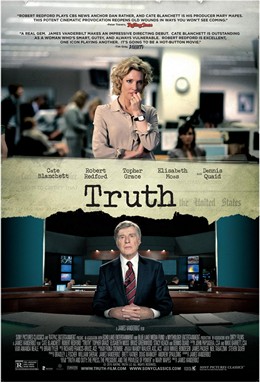
If, last night, you found yourself awake at three in the morning, you could have turned over to Starz and watched the 2015 film, Truth.
I can’t say for sure whether or not Truth would have put you to sleep. It kept me awake, largely because I was in a state of shock that any movie could be as bad as what I was watching. Without running the risk of hyperbole, I can say that Truth is one of the worst fucking movies that I’ve ever seen in my entire life. It’s not just that the film is poorly scripted, inconsistently acted, and directed in the most heavy-handed way possible. No, the problems with Truth went far beyond mere execution. Truth is a film with an agenda, one that I kind of agree with, but it’s such a total misfire that it ends up doing more damage to its cause than good. Truth is meant to be a defense of the much maligned mainstream media but it’s so poorly put together that it’s easy to imagine it being one of Donald Trump’s guilty pleasures. Remember how all of us musical theater nerds used to hatewatch Smash? I imagine that the White House staff does the same thing with Truth.
Truth is ostensibly based on a true story. In 2004, veteran anchorman Dan Rather (played by Robert Redford) reported a story that then-President George W. Bush got preferential treatment while he was serving in the Air National Guard. This story was considered to be especially big because 1) the Iraq War was deeply unpopular, 2) Bush was in a tight race for reelection, 3) his opponent, John F. Kerry, didn’t have much to offer beyond having served in Vietnam, and 4) questions were being raised about what Kerry actually did in Vietnam.
One of the most important pieces of evidence in Rather’s story were four memos that had been provided by a retired Lieutenant Colonel from the Air National Guard, a veteran Bush-hater named Bill Burkett (played, in the film, by Stacy Keach). Shortly after the story aired, conservative bloggers claimed that the memos were obvious forgeries. After spending weeks defending the story and haughtily dismissing anyone who didn’t collect an eight-figure paycheck from CBS, Rather admitted on air that the authenticity of the memos could not be verified. In the wake of the scandal, Rather’s longtime producer, Mary Mapes (Cate Blanchett), was fired. Rather retired a year earlier than expected and went on to become one of those reliably dull commentators who occasionally emerges to complain about how the world hasn’t been the same since Adlai Stevenson died. Mapes later wrote a book, which argued that 1) the memos were authentic and 2) it didn’t actually matter whether they were authentic, even though they like so totally were.
With all the current talk about fake news and whether both the media and Hollywood exist in a bubble, Truth is a film that should be especially relevant but, as previously stated, it’s so clumsy and heavy-handed that it actually does more harm than good. About halfway through the film, there’s a hilarious scene in which literally the entire country is shown watching 60 Minutes with awe-struck expression on their face. Children are watching. Customers in a bar are watching. The cooking staff in the kitchen pauses in their work to watch the report. Heroic music rises on the soundtrack. This scene, with all of its self-important grandeur, pretty much sums up everything that’s wrong with Truth. It’s one thing to argue that the news media does, should, and must play an important role in American life. It’s another thing to make your argument by constructing a fantasy world where the entire country plots their lives around watching 60 Minutes. But that’s the way Vanderbilt directs the entire film. He’s so high on the fumes of his good intentions that he doesn’t realize his film basically comes across like a parody of those intentions.
Especially in the second half of the film, there’s a lot of speeches about why journalism is important. And those speeches may actually make a great point but the problem is that none of them convince us that Mary Mapes and Dan Rather didn’t get fooled by some painfully obvious forgeries. In its laudable effort to defend journalism, Truth makes the mistake of excusing shoddy journalism. When, towards the end of the film, Mapes exclaims that the memos were only a minor part of the overall story and not necessary to prove that Bush got preferential treatment, you want someone to ask her, “If you could prove the story without them, then why did you include these unverifiable documents in the first place, especially considering that they were received from a questionable source?” But nobody does because none of the film’s saintly characters have been written or portrayed with the nuance necessary to be able to survive a question like that. Truth‘s problem is that it wants to have it both ways. “It doesn’t matter that this story was based on obviously fake documents,” Truth says, “And, because Mary Mapes and Dan Rather were sent by God to tell the truth, the obviously fake documents were completely real.”
And then there’s the film’s performers. Stacy Keach is great as Burkitt and his eccentric performance suggests the film that Truth could have been if it wasn’t so concerned with trying to portray its lead characters as saints. But then there’s Robert Redford, whose portrayal of Dan Rather has all the nuance and personality of a wax figure. (Redford wears suspenders. That’s the extent of his performance.) As Mary Mapes, Cate Blanchett is totally wasted. She doesn’t really have a character to play, beyond her male director’s conception of what a professional woman is supposed to be like. (She also has a traumatic back story of abuse, which the film trots out in such a klutzy manner that it’s actually incredibly insulting to real-life abuse victims.) Dennis Quaid, Topher Grace, and Elisabeth Moss all show up as members of Mapes’s team. Quaid is playing a military man so he gets to salute in slow motion. Grace is playing a hipster with a beard so he gets this embarrassing scene where he rants about how he’s being targeted not because of sloppy reporting but because of a corporate conspiracy. (This was obviously meant to be a huge applause moment but, like a lot of the movie, it doesn’t explain how the progressive cause is helped by shoddy journalism.) Moss doesn’t get to do anything, other than sit in the background. To waste a cast of this quality is a crime.
So why did this mostly terrible film get respectful reviews? Why did Sasha Stone and Jeff Wells insist that Truth was destined to be an Oscar contender? Call it confirmation bias. Truth plays to mainstream liberals (which includes the majority of film reviewers) in much the same way that God’s Not Dead 2 plays to Christians. But just because you agree with a film’s ideology, that doesn’t make it an example of good filmmaking. While artistic films are often political, it’s rare that political films are ever art. If every anti-Bush film was an artistic masterpiece, we would be living in a cinematic golden age.
Here’s the thing. We live in a time when the media is under attack and being used a convenient scapegoat for every bad thing in America. Donald Trump largely won in 2016 by portraying the media as being biased and that’s a charge that will undoubtedly be repeated many times over the next four years. A heavy-handed mess like Truth doesn’t help anything.
Earlier tonight, as a part of their 31 Days of Oscar, TCM aired The Sting, the film that the Academy selected as being the best of 1973. I just finished watching it and what can I say? Based on what I’ve seen of the competition (and there were a lot of great films released in 1973), I would not necessarily have picked The Sting for best picture. However, the movie is still fantastic fun.
The Sting reunited the director (George Roy Hill) and the stars (Robert Redford and Paul Newman) of Butch Cassidy and the Sundance Kidand told yet another story of likable criminals living in the past. However, whereas Butch Cassidy largely satirized the conventions of the traditional Hollywood western, The Sting is feels like a loving homage to the films of 1930s, a combination of a gritty, low-budget gangster film and a big budget musical extravaganza. The musical comparison may sound strange at first, especially considering that nobody in The Sting randomly breaks out into song. However, the musical score (which is famously dominated by Scott Joplin’s The Entertainer) is ultimately as much of a character as the roles played by Redford, Newman, and Robert Shaw. And, for that matter, the film’s “let-pull-off-a-con” plot feels like an illegal version of “let’s-put-on-a-show.”
The film takes place in the 1936 of the cultural imagination, a world dominated by flashy criminals and snappy dialogue. When con artists Johnny Hooker (Robert Redford) and Luther Coleman (Robert Earl Jones) inadvertently steal money from a gangster named Lonnegan (Robert Shaw), Lonnegan has Luther murdered. Fleeing for his life, Hooker goes to Chicago where he teams up with Luther’s former partner, veteran con man Henry Gondorff (Paul Newman). Gondorff used to be one of the great con artists but he is now living in self-imposed obscurity, spending most of his time drinking and trying to avoid the FBI. Hooker wants to get revenge on Lonnegan by pulling an elaborate con on him. When Gondorff asks Hooker why, Hooker explains that he can either con Lonnegan or he can kill him and he doesn’t know enough about killing.
The rest of the film deals with Hooker and Gondorff’s plan to con Lonnegan out of a half million dollars. It’s all very elaborate and complicated and a bit confusing if you don’t pay close enough attention and if you’re ADHD like me. But it’s also a lot of fun and terrifically entertaining and that’s the important thing. The Sting is one of those films that shows just how much you can accomplish through the smart use of movie star charisma. Redford and Newman have such great chemistry and are so much fun to watch that it really doesn’t matter whether or not you always understand what they’re actually doing.
It also helps that, in the great 70s tradition, they’re taking down stuffy establishment types. Lonnegan may be a gangster but he’s also a highly respected and very wealthy gangster. When Newman interrupts a poker game, Lonnegan glares at him and tells him that he’ll have to put on a tie before he’s allowed to play. Lonnegan may operate outside the law but, in many ways, he is the establishment and who doesn’t enjoy seeing the establishment taken down a notch?
As entertaining as The Sting may be and as influential as it undoubtedly is (Steven Soderbergh’s Ocean films may be a lot more pretentious — which makes sense considering that Soderbergh is one of the most pretentious directors in film history — but they all owe a clear debt to The Sting), it still feels like an unlikely best picture winner. Consider, for instance, that The Sting not only defeated American Graffiti and The Exorcistbut Ingmar Bergman’s Cries and Whispers as well. On top of that, when you consider some of the films that were released in 1973 and not nominated — Mean Streets, Badlands,The Candy Snatchers, Day of the Jackal, Don’t Look Now, Jesus Christ Superstar, and The Long Goodbye — it’s debatable whether The Sting should have been nominated at all. That’s not a criticism of The Sting as much as it’s an acknowledgement that 1973 was a very good year in film.
So, maybe The Sting didn’t deserve its Oscar. But it’s still a wonderfully entertaining film. And just try to get that music out of your head!
In this episode of The Twilight Zone, Gladys Cooper plays an elderly woman who lives in such fear of death that she refuses to even open the door of her apartment. Then, one day, a young policeman (Robert Redford) is shot outside of her apartment and Cooper is forced to finally confront the world.
This episode was directed by Lamont Johnson and written by George Clayton Johnson. It originally aired on January 5th, 1962.
Here’s the trailer for Truth, a film about Dan Rather, Mary Mapes, and a bunch of forged documents. Judging from the trailer, it looks super tedious but I’m sure it’ll get an A from the reviewer at the A.V. Club. This looks like the type of boring political film that I would normally pay money to avoid seeing but since it’s being talked up as a potential Oscar nominee, I guess I’ll have to see it and a lot of other movies that I don’t really care that much about.
Today we celebrate the 4th of July, the United States’ Independence Day, and I mean the one from British rule and not from invading aliens.
This day has always been about the balance of one’s level of patriotism (or lackof), gathering with friends and family for barbecues and fireworks. I would also like to add that the 4th of July has also meant watching or listening to one’s favorite baseball team. Baseball, for me at least, will always remain America’s national past time.
So, here are four films that one should check out this day, or any day to understand why baseball remains such a major part for some people’s lives.
When I made out my schedule of reviews for Embracing the Melodrama, I did not realize that I was setting myself up for a mini-marathon of Kiefer Sutherland movies but somehow, that’s exactly what happened! No sooner had I watched and jotted down my impressions of Bright Lights, Big Cityand 1969, then I started watching a 1988 film called Promised Land (which should not be confused with the recent Matt Damon/Jon Krasinski fracking film).
And guess who stars in this particular film?
That’s right — Kiefer Sutherland!
Now, if Bright Lights, Big City featured Kiefer as a sociopath and 1969 featured Kiefer as a blonde-haired golden boy, Promised Land features Kiefer as a prototypical outsider.
Promised Land opens at a high school basketball game. Hancock (Jason Gedrick) is the handsome and popular jock who is a star on the court and who is dating a cheerleader named Mary (Tracy Pollan). Danny (Kiefer Sutherland) is the nerdy kid who gets good grades and who is nicknamed Senator because he wants to enter politics. He has an obvious crush on Mary but also appears to have one on Hancock as well. As Hancock runs up and down the court, nobody cheers louder than Danny. Meanwhile, Hancock barely knows who Danny is.
Three years later and things have changed. Hancock, having gone to college on an athletic scholarship just to drop out and return home, is now a vaguely fascistic police officer. Mary has remained in college. When she returns home for Christmas break, Hancock tries to rekindle their relationship but Mary has moved on.
Meanwhile, Danny has dropped out of school as well. After spending a few years drifting around, he meets the lively, vivacious, and totally insane Bev (Meg Ryan). He and Bev get married in Las Vegas and decide to head back to Danny’s hometown for Christmas…
Drama, violence, and tragedy follow!
But you already guessed that, didn’t you? That’s one of the problems with Promised Land. From the minute that Bev says that she wants to meet Danny’s family, you can tell exactly how this story is going to end. And while a predictable plot can sometimes be redeemed by memorable performances, that’s not the case with Promised Land. Kiefer Sutherland and Meg Ryan both give good and dangerous performances but Jason Gedrick and Tracy Pollan make for a boring couple.
(Interestingly enough, Tracy Pollan was also in Bright Lights, Big City.)
Promised Land does have some historical significance, in that it was the first film to ever be partially funded by the Sundance Institute. Robert Redford is listed as an executive producer. But, historical significance aside, there’s really not much about Promised Land to really recommend going to the effort to try to track it down. It’s not so much bad as just very forgettable.
Should I start this post by ticking everyone off or should I start out by reviewing the 1969 best picture nominee Butch Cassidy and The Sundance Kid?
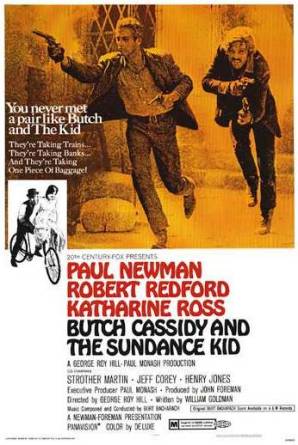
Let’s do the review first. I recently watched Butch Cassidy and the Sundance Kid when it aired as a part of TCM’s 31 Days of Oscar. This was actually my third time to see the film on TCM. And, as I watched Butch Cassidy and the Sundance Kid for the third time, I was shocked to discover how much I had forgotten about the film.
Don’t get me wrong. I remembered that it was a western and that it starred Paul Newman and Robert Redford as real-life outlaws Butch Cassidy and the Sundance Kid. I remembered that it opened and ended with sepia-toned sequences that suggested that Butch and Sundance represented the last gasp of the old west. I remembered that Butch won a fight by kicking a man in the balls. I also remembered that they robbed the same train twice and, the second time, they accidentally used too much dynamite. I remembered that, for some reason, Butch spent a lot of time riding around on a bicycle. I remembered that Butch and Sundance ended up getting chased by a mysterious posse. I remembered that Sundance could not swim. And I remembered that the film eventually ended on a tragic note in South America…
And I know what you’re saying. You’re saying, “It sounds like you remembered the whole movie, Lisa!”
No, actually I did not. The thing with Butch Cassidy and the Sundance Kid is that the scenes that work are so memorable that it’s easy to forget that there’s also a lot of scenes that aren’t as memorable. These are the scenes where the film drags and you’re thankful that Paul Newman and Robert Redford were cast as Butch and Sundance, because their charisma helps you overlook a lot of scenes that are either too heavy-handed or which drag on for too long. You’re especially thankful for Newman, who plays every scene with a twinkle in his wonderful blue eyes and who is such a lively presence that it makes up for the fact that Redford’s performance occasionally crosses over from being stoic to wooden. It can be argued that there’s no logical reason for a western to feature an outlaw riding around on a bicycle while Raindrops Keep Fallin’ On My Head plays on the soundtrack but Paul Newman’s so much fun to watch that you can forgive the film.
Newman and Redford both have so much chemistry that they’re always a joy to watch. And really, that’s the whole appeal of Butch Cassidy and the Sundance Kid, the chance to watch two iconic actors have fun playing opposite each other. Even though Katharine Ross appears as their shared romantic interest, the film’s love story is ultimately between Butch and Sundance (and, by extension, Newman and Redford). You can find countless reviews that will give all the credit for the film’s appeal to William Goldman’s screenplay. (You can also find countless self-satisfied essays by William Goldman where he does the exact same thing.) But, honestly, the film’s screenplay is nothing special. This film works because of good, old-fashioned star power.
Now, for the part that’ll probably tick everyone off (heh heh), I think that Butch Cassidy and the Sundance Kid is actually a pretty good pick for a future remake. All you have to do is pick the right actors for Butch and Sundance. I’m thinking Chris Pratt as Butch and Chris Evans as Sundance…
“What do we do now?” — Democratic senate candidate Bill McKay (Robert Redford) in The Candidate (1972)
When I reviewed Advise & Consent, I mentioned that if anyone could prevent billionaire Tom Steyer from winning the Democratic nomination to run in the 2016 California U.S. Senate election, it would be Betty White. Well, earlier today, Tom Steyer announced that he would NOT be a candidate. You can guess what that means. Betty White has obviously already started to set up her campaign organization in California and, realizing that there was no way that he could possibly beat her, Tom Steyer obviously decided to step aside.
So, congratulations to Betty White! (I would probably never vote for her but I don’t live in California so it doesn’t matter.) As future U.S. Senator Betty White prepares for the next phase of her career, it would probably be a good idea for her to watch a few movies about what it takes to win political office in the United States.
For example: 1972’s The Candidate.
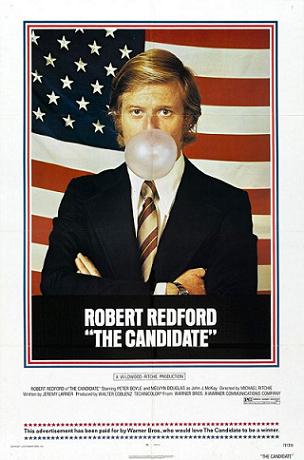
The Candidate would especially be a good pick for the nascent Betty White senate campaign because the film is actually about a senate election in California! California’s U.S. Sen. Crocker Jarmon (Don Porter) is a Republican who everyone assumes cannot be defeated for reelection. Democratic strategist Marvin Lucas (a heavily bearded Peter Boyle) is tasked with finding a sacrificial candidate.
The one that Marvin comes up with is Bill McKay (Robert Redford, before his face got all leathery), a 34 year-old lawyer who also happens to be the estranged son of former Governor John J. McKay (Melvyn Douglas, whose wife Helen ran for one of California’s senate seats in 1950). As opposed to his pragmatic and ruthless father, Bill is idealistic and the only reason that he agrees to run for the Senate is because Marvin promises him that he’ll be able to say whatever he wants. Marvin assures Bill that Jarmon cannot be beaten but if Bill runs a credible campaign, he’ll be able to run for another office in the future.
However, Jarmon turns out to be a weaker candidate than everyone assumed. As the charismatic Bill starts to close the gap between himself and Jarmon, he also starts to lose control of his campaign. He soon finds himself moderating his positions and worrying more about alienating potential voters than stating his true opinions. (In one of the film’s best scenes, Bill scornfully mutters his standard and generic campaign speech to himself, obviously disgusted with the vapid words that he has to utter in order to be elected.) The film ends on a properly downbeat note, one that reminds you that the film was made in the 70s but also remains just as relevant and thought-provoking in 2015.
Written by a former political speech writer and directed, in a semi-documentary style, by Michael Ritchie, The Candidate is an excellent film that answer the question as to why all political campaigns and politicians seem to be the same. The Candidate is full of small details that give the film an air of authenticity even when a familiar face like Robert Redford is on screen.
Whenever I watch The Candidate, I find myself wondering what happened to Bill McKay after the film’s iconic final scene. Did he ever regain his idealism or did he continue on the path to just becoming another politician. As much as we’d all like to think that the former is true, it’s actually probably the latter.
That just seems to be the way that things go.
Hopefully, Betty White will learn from Bill McKay’s example.
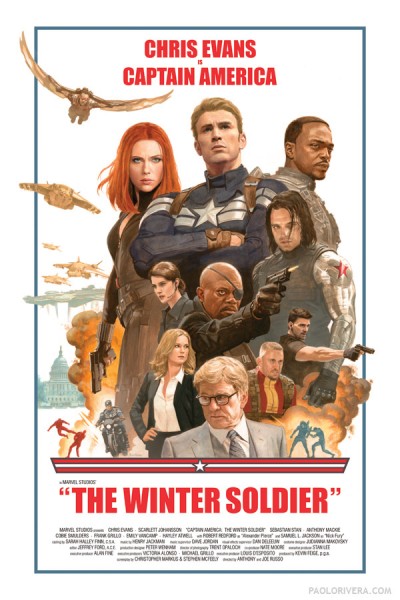
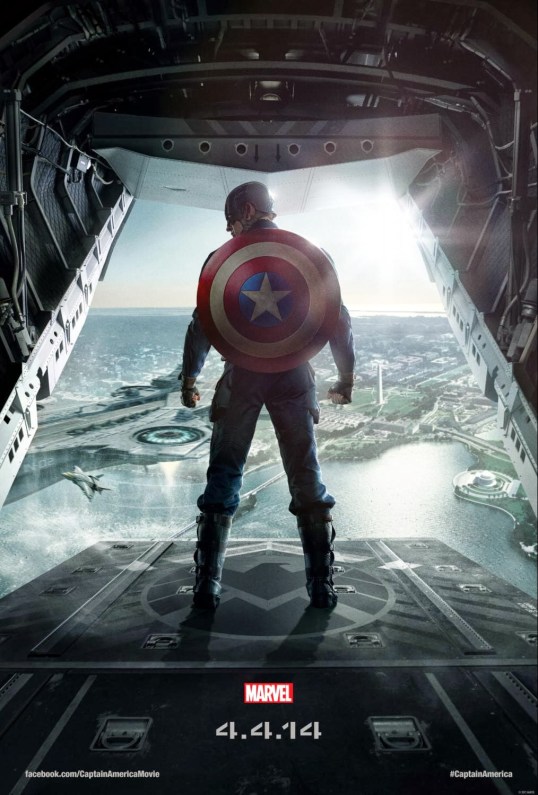
I would estimate that, when it comes to the movies, Ryan the Trash Film Guru and I agree with each other perhaps 95% of the time. What’s interesting is that the 5% of the time that we have disagreed, it’s always been the result of an entry in the Marvel Cinematic Universe. As Ryan has documented many times on this site, he’s not a fan of the MCU. (The title of his review of the second Thor film is probably one of the best that’s ever appeared on this site.) As for me, I’m the exact opposite. In fact, I am such a fan of the MCU that I am about to suggest that Captain America: The Winter Soldier — along with being one of the best action films of the year — deserves serious Oscar consideration.
Now, unlike some of the films that I’ve suggested deserve your consideration, Captain America: The Winter Soldier, along with receiving critical acclaim, was also a major commercial success. What made The Winter Soldier unique was that it deserved both the acclaim and the money. There was a lot that I liked about The Winter Soldier. In the role of Captain America, Chris Evans was both likable and, most importantly, believable as a hero out of time. And while I would have never guessed that her character was supposed to be Russian, Scarlett Johansson continued her streak of kicking serious ass in the role of the Black Widow. Samuel L. Jackson brought his customary style to the role of Nick Fury and Sebastian Stan was properly intimidating as the Winter Soldier. The action scenes were exciting, the dialogue was sharp and witty, and the film worked both as a stand alone film and as a part of the overall Marvel universe.
But, for me, what truly elevated Captain America: The Winter Soldier was the film’s subtext. (In that way, I would compare it to another surprisingly intelligent genre film, The Purge: Anarchy.) For those who may have forgotten, the villains of the Winter Soldier are all members and pawns of Hydra, a secret organization that has so infiltrated the American establishment that it has literally become something of a shadow government. Hydra has also infiltrated SHIELD and plans to use their intelligence capabilities to not only preemptively identify possible threats but to eliminate them as well. In fact, by taking control of the SHIELD helicarriers, Hydra can anonymously deliver death and destruction from above.
Does that sound familiar to anyone?
What truly makes this subtext come alive is that fact that the main villain — Hydra’s double agent in SHIELD — is played by none other than Robert Redford. Any student of American film knows what Robert Redford represents. Early in his career, Redford was the idealistic, ambitious, and frequently laconic protagonist, the perfect symbol of American exceptionalism. In the 1970s, Redford was the audience surrogate in classic paranoia films like Three Days of the Condor and All The President’s Men.Lately, as the man behind the Sundance Film Festival and a frequent director, Robert Redford has been the epitome of bourgeois, establishment liberalism.
Hence, when we hear Redford say, “Hail Hydra,” it’s more than just a catch phrase. It’s also the film’s way of saying that we’re all fucked. If even Robert Redford can be a villain, the film seems to be saying, then how foolish do we have to be to fully trust anyone or anything? If Robert Redford can order people killed and then justify it by claiming that he was acting for a greater good then why are we so shocked when governments do the exact same thing?
We live in paranoid times. In the future, historians will recognize that few films captured that paranoia as perfectly as Captain America: The Winter Soldier.



 Through the Shattered Lens