The Unnominated #12: Tombstone (dir by George Pan Cosmatos)


Though the Academy of Motion Picture Arts and Sciences claim that the Oscars honor the best of the year, we all know that there are always worthy films and performances that end up getting overlooked.  Sometimes, it’s because the competition too fierce.  Sometimes, it’s because the film itself was too controversial.  Often, it’s just a case of a film’s quality not being fully recognized until years after its initial released.  This series of reviews takes a look at the films and performances that should have been nominated but were, for whatever reason, overlooked.  These are the Unnominated.

I have come around on Tombstone.

The first time I watched this 1993 film, I was a bit confused as to why so many of my friends (especially my male friends) worshipped the film.  To me, it was a bit too messy for its own good, an overlong film that told a familiar story and which featured so many characters that it was difficult for me to keep track of them all.  Perhaps because everyone I knew loved the film so much, I felt the need to play contrarian and pick out every flaw I could find.

And I still think those flaws are there.  The film had a troubled production, with original director Kevin Jarre falling behind in shooting and getting replaced by George Pan Cosmatos, a director who didn’t have any real interest in the material and whose all-business approach rubbed many members of the cast the wrong way.  Kurt Russell took over production of the film, directing the actors and reportedly paring down the sprawling script to emphasize the relationship between Russell’s Wyatt Earp and Val Kilmer’s Doc Holliday.  On the one hand, this led to a lot of characters who really didn’t seem to have much to do in the finished film.  Jason Priestley’s bookish deputy comes to mind.  On the other hand, Russell was right.

The film’s heart really is found in the friendship between Wyatt and Doc.  It doesn’t matter that, in real life, Wyatt Earp was hardly as upstanding as portrayed by Kurt Russell.  It also doesn’t matter that the real-life Doc Holliday was perhaps not as poetic as portrayed by Val Kilmer.  Today, if you ask someone to picture Wyatt Earp, they’re probably going to picture Kurt Russell with a mustache, a cowboy hat, and a rifle.  And if you ask them to picture Doc Holliday, they’re going to picture Val Kilmer, sweating due to tuberculosis but still managing to enjoy life.  Did Doc Holliday every say, “I’ll be your huckleberry,” before gunning someone down?  He might as well have.  That’s how he’s remembered in the popular imagination.  And it’s due to the performances of Russell and Kilmer that I’ve come around to eventually liking this big and flawed western. With each subsequent viewing, I’ve come to appreciate how Russell and Kilmer managed to create fully realized characters while still remaining true to the Western genre.  If Wyatt Earp initially fought for the law, Doc Holliday fought for friendship.  Kilmer is not only believable as a confident gunslinger who has no fear of walking into a dangerous situation.  He’s also believable as someone who puts his personal loyalty above all else.  He’s the type of friend that everyone would want to have.

That said, I do have to mention that there are a lot of talented people in the cast, many of whom are no longer with us but who will live forever as a result their appearance here.  When Powers Boothe delivered the line, “Well …. bye,” he had no way of knowing that he would eventually become a meme.  Boothe is no longer with us, I’m sad to say.  But he’ll live forever as long as people need a pithy way to respond to someone announcing that they’re leaving social media forever.  Charlton Heston appears briefly as a rancher and he links this 90s western with the westerns of the past.  Robert Mitchum provides the narration and it just feels right.  The large ensemble cast can be difficult to keep track of and even a little distracting but there’s no way I can’t appreciate a film that manages to bring together not just Russell, Kilmer, Boothe, Heston, and Mitchum but also Sam Elliott, Bill Paxton, Michael Biehn, Michael Rooker, Billy Bob Thornton, Frank Stallone, Terry O’Quinn, and even Billy Zane!  The female roles are a bit underwritten.  Dana Delaney is miscast but Joanna Pacula feels exactly right as Doc Holliday’s lover.

But ultimately, this film really does belong to Val Kilmer.  When I heard the sad news that he had passed away last night, I thought of two films.  I thought of Top Gun and then I thought of Tombstone.  Iceman probably wouldn’t have had much use for Doc Holliday.  And Doc Holliday would have resented Iceman’s attitude.  But Val Kilmer — that brilliant actor who was so underappreciated until he fell ill — brought both of them to brilliant life.  In the documentary Val, Kilmer attends a showing of Tombstone and you can say he much he loves the sound of audience cheering whenever Doc Holliday showed up onscreen.

Tombstone was a flawed film and 1993 was a strong year.  But it’s a shame that Val Kilmer was never once nominated for an Oscar.  Tombstone may not have been a Best Picture contender but, in a year when Tommy Lee Jones won the Oscar for Best Supporting Actor for his role in the similarly flawed The Fugitive, it seems a shame that Kilmer’s Doc Holliday was overlooked.
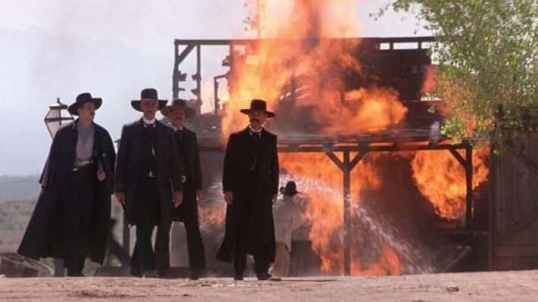
Tombstone (1993, dir by George Pan Cosmatos (and Kurt Russell), DP: William Fraker)

Previous entries in The Unnominated:
  1. Auto Focus 
  2. Star 80
  3. Monty Python and The Holy Grail
  4. Johnny Got His Gun
  5. Saint Jack
  6. Office Space
  7. Play Misty For Me
  8. The Long Riders
  9. Mean Streets
  10. The Long Goodbye
  11. The General

Film Review: Precious Cargo (dir by Max Adams)


2016’s Precious Cargo tells the story of Jack (Mark-Paul Gosselaar) and his ex-wife Karen (Claire Forlani).

Karen is a professional thief who has botched a robbery for her former lover, crime boss Eddie Filosa (Bruce Willis).  Eddie wants Karen dead so, of course, Karen flees down to the Florida everglades, where she finds Jack living in a swamp shack and making love to his latest girlfriend, Jenna (Lydia Hull).  Karen tells them to go ahead and finish up and she’ll just wait out in the kitchen.  Jack in not particularly happy to see Karen again but then he notices that she has a baby bump.  “Always use a condom,” Karen tells Jenna.  Eddie’s men, led by Simon (Daniel Berhardt), attack and it all leads to a boat chase that is surprisingly exciting when you consider that Precious Cargo is a low-budget, direct-to-video offering.

It turns out that Jack can save Karen from Eddie’s wrath by planning and executing a heist for the crime boss.  Jack assembles his crew, Jack gets ready for the heist …. uh-oh, it’s time for a double cross!  The plot is nothing special.  It’s identical to a hundred other low-budget crime films that you’ve seen recently.  It’s the type of thing that Michael Mann could have turned into a metaphor for American ennui but, in this film, it’s just a typical heist.  The viewer enjoys it while it’s happening and then forgets about it two minutes afterwards.

That said, Precious Cargo is not quite as bad as the typical direct-to-video film.  Mark-Paul Gosselaar — yes, Zack Morris himself — gives a reasonably compelling performance as Jack.  To a certain group of people, he’s always be Zack and I imagine he’s sick of people asking him about whether or not he still has his giant phone but, as he’s gone from teen idol to adult actor, Gosselaar has shown himself to be a talented actor.  (For the record, Zack lost his phone in the drunk driving episode.  I know some people say that episode doesn’t count because it was a Tori episode but I say that it does.  So there.)  Claire Forlani is actually more compelling in these direct-to-video films than she ever was in any of the big budget studio films that she used to appear in.

Of course, I imagine that the main selling point for this film was meant to be Bruce Willis.  This is one of the direct-to-video films that dominated the last fourth of Willis’s career.  When Willis retired due to aphasia, there was a general assumption that all of Willis’s direct-to-video films were made as a result of his condition.  I don’t know if that’s quite true.  (It’s entirely possible that he just wanted a quick payday.)  But it is true that Willis only has a few minutes of screentime in Precious Cargo and that several shots involving Eddie were accomplished with a stand-in.  That said, in this film, Willis still brings some energy to the part.  He’s an effective villain, even if I think everyone prefers to see Willis saving the day.  Even in the direct-to-video era, Bruce Willis still had a definite presence.

Precious Cargo is predictable and ultimately forgettable but it’s still entertaining enough for 90 minutes.

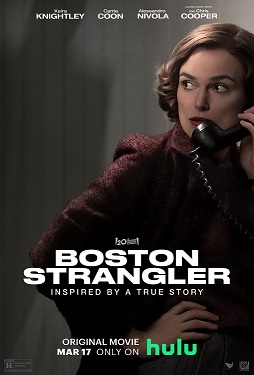
Film Review: Boston Strangler (dir by Matt Ruskin)


In the Boston of the early 1960s, Loretta McLaughlin (Keira Knightley) is a reporter for the Boston Record American.  Loretta is frustrated with a newsroom that is dominated by a boys club of aging, overweight, sexist old timers.  When she thinks that she’s discovered that there is a murderer targeting and strangling elderly women in Boston, she goes to her editor, Jack Maclaine (Chris Cooper), and asks to be allowed to write up a story about her suspicions.  Jack would prefer that Loretta write a story about the new toaster that’s been released by Sunbeam.

So, Loretta does some investigating on her own and she discovers that the police suspect that all of the recent murders are being committed by one man.  The story that she writes ends up on the front page and it even leads to her sharing a sip of whatever alcohol Jack has in his flask.  The Boston police initially deny Loretta’s story and it looks like Loretta is going to spend the rest of her career reviewing kitchen appliances.  But then the police just as suddenly confirm Loretta’s story and Loretta is back on the Strangler beat.  She’s partnered with a veteran reporter named Jean Cole (Carrie Coon).

Together, Loretta and Jean battle sexism while investigating not just the Strangler but also the police department’s incompetence.  Their reporting makes them local celebrities, with many people coming to them with the leads that the police couldn’t be bothered to follow up on.  Despite Jean’s warnings about getting too involved with the case, Loretta obsesses over the Strangler’s crimes.  Could the murderer be Daniel Marsh (Ryan Winkles), the boyfriend of one of the victim’s?  Could it be George Nassar (Greg Vrostros), a criminal who reportedly has a genius IQ?  Or could it be Albert DeSalvo (David Dastmalchian), the man who confesses to the crimes under the condition that his confession cannot be used in court and the belief that his family will be sent the reward money that would otherwise go to someone who helped the police to catch the Boston Strangler?  DeSalvo, who was given a life sentence for a series of rapes that he committed before and after the murders began, is never convicted of any of the murders but, with his confession, the murders are declared to be solved.  But are they?  Loretta is not so sure.

Boston Strangler is not the first film to be made about the murders but I think that it might be the first to seriously explore the theory that DeSalvo was lying when he confessed to the majority of the murders.  (As the film points out, DeSalvo’s cellmate just happened to be the same George Nassar who was also a suspect in the murders.)  1968’s The Boston Strangler, for instance, explained away the inconsistencies in DeSalvo’s confessions by suggesting the DeSalvo suffered from dissociative identity disorder and that DeSalvo himself didn’t understand what he was doing.  This latest version of the story, however, presents DeSalvo as being a streetwise, lifelong criminal who confessed because his lawyer, F. Lee Bailey, convinced him that he would get a book deal and that he would be sent to a mental hospital as opposed to a prison.  A title card at the end of the film informs us that DNA testing has confirmed that DeSalvo committed one of the 13 murders to which he confessed but that the other 12 murders remain unsolved.  While one might wonder why anyone would confess to a murder that they didn’t actually commit, it’s actually something that has happened on more than a few occasions.  Typically, the false confession will come from someone who, like DeSalvo, is already looking at a life sentence and who has nothing to lose by helping the police close the book on some unsolved crimes.  The confessor gets a little extra notoriety and maybe some special treatment and the cops get to increase their clearance rate.  In Boston Strangler, it’s suggested that DeSalvo’s confession was accepted because everyone wanted the crimes and the fear that went with them to just magically go away.

It’s an intriguing theory and one that has more evidence to back it up than the majority of conspiracy theories that one comes across online.  Unfortunately, Boston Strangler really doesn’t do the story much justice because it focuses on the least interesting part of it.  We don’t learn much about the investigation, DeSalvo, or the lives of the Strangler’s victims.  Instead, the film gets bogged down with newsroom politics, as Loretta demands to be taken seriously and Jean offers advice on how to play the political game.  Every journalism cliché is present, from the crotchety old editor to the afterwork bar to the publisher who doesn’t want to upset the city’s power brokers.  Admittedly, when it comes to journalists, there’s probably a good deal of truth to be found in all of those clichés but the film still leans a bit too heavily into them.  Every time we see Chris Cooper looking at the front page and taking a sip from his flask, we’re reminded that we’ve seen the exact same scene in a hundred other movies about newspapers.

As directed by Matt Ruskin, Boston Strangler has the washed-out, shadowy look that David Fincher used to good effect in Zodiac. The difference is that, in Zodiac, the shadows created a feeling of an all-enveloping evil slowly consuming the world.  Zodiac’s visual style felt as if it was showing the viewer a true picture of the heart of darkness.  In Boston Strangler, the visual style just leads the viewer to suspect that the director watched Zodiac before filming.  The film’s visuals are so washed-out that it actually becomes a bit boring to look at.  This is the rare film that makes Boston seem bland.  Interestingly, when the action briefly moves to Michigan, the visuals suddenly become much more colorful and interesting.  Perhaps by design, there’s a vibrancy to the Michigan scenes that is missing from the rest of the film.  Unfortunately, those Michigan scenes are very brief.

The cast is full of talent but the majority of the performers are let down by a script that doesn’t allow anyone to have more than one or two personality traits.  Keira Knightley speaks with a convincing Boston accent and has a few good scenes in which she shows that Loretta is coming to understand the true horror of the story she’s covering but the script itself doesn’t allow Loretta to have much of a personality beyond being outraged.  Carrie Coon, cast as potentially the most interesting character in the film, also feels underused.  As for Chris Cooper, he glowers with the best of them but the film can’t figure out much to do with him beyond having him drink from his flask.

There’s an interesting moment in the film in which it is suggested that DeSalvo built a false confession out of the details that he came across in Loretta and Jean’s stories about the crimes.  It’s a moment that suggests that the media itself has some culpability when it comes to the crimes of men like Albert DeSalvo and whoever else may or may not have been strangling women in 1960s Boston.  It’s perhaps the most honest moment of the film but it’s also a moment that’s not followed up on.  That’s a shame because it suggests the movie that Boston Strangler could have been if it hadn’t gotten so bogged down with all the journalism film clichés.  (Again, I would mention Zodiac as the prime example of how to do this type of film effectively.)  Boston Strangler hints at the bigger story but it never really goes far beneath the surface.

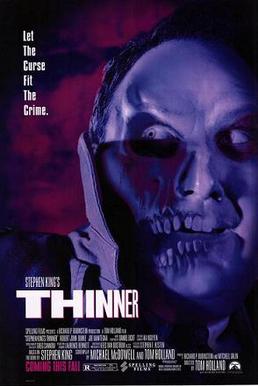
Thinner (1996, directed by Tom Holland)


Billy Halleck (Robert John Burke, in a fat suit) is a morbidly obese attorney who might be destined to die of a heart attack but who definitely will not be serving jail time despite running over an old gypsy woman. After a corrupt judge and crooked cop, both of whom are friends of Billy’s, conspire to get Halleck acquitted, all three of them are cursed by the woman’s husband (Michael Constnatine). The judge turns into a lizard while the cop is covered in sores. Halleck, however, finally starts to lose weight! At first, he’s happy. He’s finally getting thin and all he had to do was run over an old woman! But then, he realizes that he’s never going to stop getting thinner and he’s going to just waste away.

Thinner is based on a novel by Richard Bachman, who was actually Stephen King. Like most of the Bachman books, Thinner is nastier than most of the King books. Billy is a terrible character and he deserves exactly what’s coming to him. The book is not usually listed as being one of King’s better efforts and the movie doesn’t get much love either. I’ve always liked Thinner, though. It’s like a really good episode of Tales From The Crypt, with Billy paying the price for his sins. Billy actually gets several chances to redeem himself but, because he’s such a terrible character, he keeps messing them up. Instead of begging for forgiveness, Billy hires a gangster (Joe Mantegna) to try to take out the gypsies. Even when the dead woman’s husband gives Billy a chance to escape his fate with some shred of dignity, Billy would rather go after his perceived enemies. Many bad things happen to Billy but he brings them all on himself. Even when it becomes obvious that he’s under a curse, he still thinks he can plea bargain his way out of it.  He’s a lawyer, through and through.

Thinner is frequently cartoonish and broad but that works for the story that it’s telling. Robert John Burke’s performance may not have many shadings to it but again, it’s right for the story that’s being told.  My favorite performance in the film was Joe Mantegna’s turn as the gangster and fans of Late Night Cinemax will feel a rush of nostalgia when Kari Wuhrer makes an appearance as the beautiful daughter of the woman that Billy ran over.  Thinner is a middle-tier King adaptation, neither as bad nor as good as some others. I dug it.

Film Review: Robocop 3 (dir by Fred Dekker)


“Oh wow, Robocop can fly!”

An odd film, Robocop 3. Released in 1993, this was the third and final film in the original Robocop franchise. While the action is still set in Detroit and Robocop is back (albeit now played by Robert John Burke) and Nancy Allen shows up long enough to get killed off, Robocop 3 feels strangely separate from the previous two Robocop films. If the first two Robocop films were dark, satirical, and over-the-top in their violence, the third film is a family friendly adventure film that reimagines Robocop as being some sort of fair housing activist.

And, on top of all that, Robocop can fly now. Admittedly, that’s because Robocop gets fitted for a jetpack that he didn’t have in the previous films but he still looks incredibly ludicrous flying through the streets of Detroit. Since the Robocop armor has always looked very bulky and very heavy, it’s hard to believe that he could fly as quickly and as smoothly as he does in this film.

There’s a new set of villains too. Rip Torn has replaced Dan O’Herilhy as the CEO. And listen, I like Rip Torn. He will always be a hero to me because he bit Norman Mailer’s ear off. But Torn is far too obviously evil in the role of the CEO. O’Herlihy smartly played the Old Man as being avuncular and amoral. You could look at him and understand how he rose to his position of prominence. Torn’s performance is a bit more cartoonish but then again, Robocop 3 is the most cartoonish of the series.

The CEO wants to tear down Old Detroit so the residents of Old Detroit are fighting back. Leading the CEO’s forces — called the Rehabbers — is Paul McDagget (John Castle), who is a complete and total madman but who, at the same time, is never quite as memorable as Kurtwood Smith or Tom Noonan. He’s really just another generic militaristic bad guy. Normally, you would expect Robocop to be on the side of the company and the police but he’s been reprogrammed by an 8 year-old hacker named Nikko (Remy Ryan). Robocop is now working with the rebels. One of the rebels is played by Stephen Root, proving once again that you never know where Stephen Root might pop up.

Robocop 3 has none of the satiric bite of the first two movies. Instead of being a symbol of authoritarianism gone beserk, Robocop becomes a generic do-gooder. The violence is toned down and, with the addition of a kid sidekick, it’s obvious that this Robocop was meant to be a safer version of the character. Unfortunately, a safe Robocop equals a boring Robocop. You watch this movie and you wonder what happened to the Robocop who shot Ronny Cox out of a window.

“My friend’s call me Murphy,” he says towards the end of the film, “You can call me Robocop.” That seemed to indicate that Robocop had quite a future ahead of him of doing the right thing and standing up to big evil corporations but Robocop 3 was such a bomb at the box office that Robocop’s further adventures would only be seen on TV. The franchise was rebooted back in 2014, in a film that my friend Mark called “Rubber Cop.” After Rubber Cop fell flat, it was announced that Robocop would be rebooted for a second time, this time with a movie that would serve as a direct sequel to the first Robocop and which would ignore the sequels and the first reboot. Personally, I think it might be time to let Robocop retire. He had a good run.

Stallone Acts: Cop Land (1997, directed by James Mangold)


Garrison, New Jersey is a middle class suburb that is known as Cop Land.  Under the direction of Lt. Ray Donlan (Harvey Keitel), several NYPD cops have made their home in Garrison, financing their homes with bribes that they received from mob boss Tony Torillo (Tony Sirico).  The corrupt cops of Garrison, New Jersey live, work, and play together, secure in the knowledge that they can do whatever they want because Donlan has handpicked the sheriff.

Sheriff Freddy Heflin (Sylvester Stallone) always dreamed of being a New York cop but, as the result of diving into icy waters to save a drowning girl, Freddy is now deaf in one ear.  Even though he knows that they are all corrupt, Freddy still idolizes cops like Donlan, especially when Donlan dangles the possibility of pulling a few strings and getting Freddy an NYPD job in front of him.  The overweight and quiet Freddy spends most of his time at the local bar, where he’s the subject of constant ribbing from the “real” cops.  Among the cops, Freddy’s only real friend appears to be disgraced narcotics detective, Gary Figgis (Ray Liotta).

After Donlan’s nephew, Murray Babitch (Michael Rapaport), kills two African-American teenagers and then fakes his own death to escape prosecution, Internal Affairs Lt. Moe Tilden (Robert De Niro) approaches Freddy and asks for his help in investigating the corrupt cops of Garrison.  At first, Freddy refuses but he is soon forced to reconsider.

After he became a star, the idea that Sylvester Stallone was a bad actor because so universally accepted that people forgot that, before he played Rocky and Rambo, Stallone was a busy and respectable character actor.  Though his range may have been limited and Stallone went through a period where he seemed to always pick the worst scripts available, Stallone was never as terrible as the critics often claimed.  In the 90s, when it became clear that both the Rocky and the Rambo films had temporarily run their course, Stallone attempted to reinvent his image.  Demolition Man showed that Stallone could laugh at himself and Cop Land was meant to show that Stallone could act.

For the most part, Stallone succeeded.  Though there are a few scenes where the movie does seem to be trying too hard to remind us that Freddy is not a typical action hero, this is still one of Sylvester Stallone’s best performances.  Stallone plays Freddy as a tired and beaten-down man who knows that he’s getting one final chance to prove himself.  It helps that Stallone’s surrounded by some of the best tough guy actors of the 90s.  Freddy’s awkwardness around the “real” cops is mirrored by how strange it initially is to see Stallone acting opposite actors like Harvey Keitel, Robert De Niro, and Ray Liotta.  Cop Land becomes not only about Freddy proving himself as a cop but Stallone proving himself as an actor.

The film itself is sometimes overstuffed.  Along with the corruption investigation and the search for Murray Babitch, there’s also a subplot about Freddy’s unrequited love for Liz Randone (Annabella Sciorra) and her husband’s (Peter Berg) affair with Donlan’s wife (Cathy Moriarty).  There’s enough plot here for a Scorsese epic and it’s more than Cop Land‘s 108-minute run time can handle.  Cop Land is at its best when it concentrates on Freddy and his attempt to prove to himself that he’s something more than everyone else believes.  The most effective scenes are the ones where Freddy quietly drinks at the local tavern, listening to Gary shoot his mouth off and stoically dealing with the taunts of the people that he’s supposed to police.  By the time that Freddy finally stands up for himself, both you and he have had enough of everyone talking down to him.  The film’s climax, in which a deafened Freddy battles the corrupt cops of Garrison, is an action classic.

Though the story centers on Stallone, Cop Land has got a huge ensemble cast.  While it’s hard to buy Janeane Garofalo as a rookie deputy, Ray Liotta and Robert Patrick almost steal the film as two very different cops.  Interestingly, many members of the cast would go on to appear on The Sopranos.  Along with Sirico, Sciorra, Patrick, and Garofalo, keep an eye out for Frank Vincent, Arthur Nascarella, Frank Pelligrino, John Ventimiglia, Garry Pastore,  and Edie Falco in small roles.

Cop Land was considered to be a box office disappointment when it was released and Stallone has said that the film’s failure convinced people that he was just an over-the-hill action star and that, for eight years after it was released, he couldn’t get anyone to take his phone calls.  At the time, Cop Land‘s mixed critical and box office reception was due to the high expectations for both the film and Stallone’s performance.  In hindsight, it’s clear that Cop Land was a flawed but worthy film and that Stallone’s performance remains one of his best.