For today’s horror on the lens, we present the 1957 film, The Amazing Colossal Man!
Directed by Bert I. Gordon, The Amazing Colossal Man tells the story of what happens when Lt. Col. Glenn Manning (Glen Langan) is exposed to an atomic blast, the force of which not only burns off his clothes but leaves him bald as well! At first, everyone is convinced that there’s no way Glenn Manning will survive but, to everyone’s surprise, he does survive.
And he starts to get bigger!
That’s right — radiation does the craziest things!
Soon, Glenn’s a giant and he’s not very happy about it. As the government tries to keep both the accident and the mutation a secret, Glenn grows more and more bitter and angry. And it certainly doesn’t help matters when the scientists decide they want to inject him with a giant syringe.
Seriously, you’ve got to see this syringe!
Anyway, The Amazing Colossal Man is one of those fun sci-fi films that elitist critics love to criticize. But you know what? If you’re watching a movie like this because you want to nitpick every little detail, you’re missing the point. The Amazing Colossal Man is a 1950s B-movie and, when taken on those terms, it’s a lot of fun.
Add to that, Glen Langan really throws himself into the title role!
This episode of Buffy the Vampire Slayer made me cry the first time I saw it. And it’s made me cry every time that I’ve watched it since.
(Along with She’s All That, It also left me with a totally unrealistic expectation of what my senior prom would be like but that’s okay.)
The Prom originally aired on May 11th, 1999.
(10/13/2015 update: Oh my God, y’all! I am so pissed off at Hulu right now! This entire show was available when I first created this post. And now, that I’ve actually published it, Hulu suddenly just wants to provide a 90-second preview. Please accept my apologies.)
— Monique (Beverly Lynne) in Hell’s Highway (2002)
It certainly is, Monique! It certainly is.
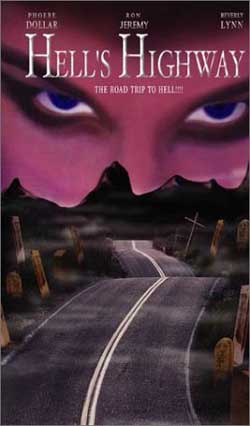
Hell’s Highway is a stretch of road that runs through the desolate California desert. The side of the road is decorated with crosses, each signifying another person who lost her or his life on the road. There are only a few cars on this lonely stretch of highway. One car belongs to a serial killer who dresses as a priest. Another car is being driven by veteran porn actor Ron Jeremy, who ends up getting castrated in close-up.
And then there’s a group of college friends on a road trip. They drink beer. They smoke pot. They occasionally stop to camp out on the side of the road. And they also pick up a hitchhiker named Lucinda (Phoebe Dollar).
Picking up Lucinda was probably a mistake because, as soon as she gets in the car, she starts talking about how much she enjoys killing people. She then pulls out a gun and tells them, “My name’s not really Lucinda but it’s close enough.” The road trippers manage to kick her out of the car and drive away.
But it’s not that easy to get rid of Lucinda!
The next day, they once again come across her hitchhiking. They run her over and then drive off with her large intestine still wrapped around the back bumper.
And yet, Lucinda continues to reappear! No matter how many times they destroy her, Lucinda always returns…
Like so many of the films that I’ve reviewed for this October, Hell’s Highway is included in the Decrepit Crypt of Nightmares box set. Like every other film included in that set, Hell’s Highway is a low-budget, direct-to-video gorefest that doesn’t really waste much time with anything as mundane as plausibility. And yet, for what it is, Hell’s Highway is actually pretty effective. Lucinda makes for an effectively creepy villain and all of her victims are so unlikable that you won’t feel too bad when they get killed.
Perhaps best of all, Hell’s Highway ends with one of those out-of-nowhere twists that makes so little sense that it becomes oddly brilliant. Just when you think the film can’t get any stranger or any more implausible, it goes there. And it goes there with such conviction that you can’t help but slightly admire it.
Perhaps despite itself, Hell’s Highway works surprisingly well.
When I say “George Romero,” you probably immediately think of zombies. And why not? Night of the Living Dead is perhaps the best known zombie film ever made and Dawn of the Dead is perhaps the second best known. Day of the Dead and Land of the Dead both have their fervent admirers. Without the work of George Romero, there would be no Walking Dead. Without the zombie films of George Romero, countless children would have never grown up to become horror filmmakers. Without George Romero, there would have been no Italian zombie films, which means that I would never have fallen in love with Italian horror and I wouldn’t have been tweeting about it that day in 2010 when Arleigh asked me if I wanted to be a contributor to this website.
Seriously, we all owe a lot to the zombie films of George Romero.
And yet, interestingly enough, Romero’s best film was one that did not feature a single zombie. In fact, it’s a film that, despite the delusions of some of its characters, does not feature a single supernatural element. It’s definitely a horror film but the horrors of the 1978 film Martin are the horrors of the human mind.
Martin (John Amplas) is young, nervous, socially awkward, and enjoys drinking blood. The sun makes him slightly uncomfortable, though it does not make him burst into flames. He has frequent black-and-white flashbacks, in which he sees himself pursued by villagers carrying torches and pitchforks. Occasionally, Martin calls up a radio talk show and has actually gained an audience of listeners, who only know him as “the Count.” Martin believes himself to be a vampire. Of course, he’s not. Instead, he’s just a creepy and mentally unbalanced necrophiliac.
Unfortunately, for Martin, his extremely religious uncle Tateh Cuda (Lincoln Maazel) is also convinced that Martin is a vampire. Martin’s parents have died and Cuda has agreed to allow Martin to live with him in the dying industrial town of Braddock, Pennsylvania. As soon as Martin arrives, Cuda greets him as “Nosferatu” and tells him that if he kills anyone in Braddock, Cuda will pound a stake into his heart.
(Of course, what Cuda doesn’t know, is that Martin already murdered a woman during the train ride from Indiana to Pennsylvania.)
Upon arriving at his new home, Martin works at Cuda’s butcher shop and, defying his uncle’s orders, gets to know his cousin Christine (Christina Forrest). Martin finds himself torn between his fantasy life as a vampire and the chance to lead a normal existence in Braddock. He meets a bored housewife, Mrs. Santini (Elyane Nadeau), and soon is having an affair with her but he still finds himself driven to search for blood.
Meanwhile, Cuda watches and continues to sharpen his stake…
Martin is a dark and grim (and yet, at times, darkly humorous) portrait of two people living under a shared delusion. Just as Martin gains satisfaction by imagining himself as being a supernatural vampire known as the Count, Cuda feels that his purpose in life is to protect the community from bloodsuckers like his nephew. Both of them need the other to function but they’re equally destined to destroy each other. Amplas and Maazel both give excellent performances and Romero captures a tragic sort of beauty to Braddock’s decay.
Martin may be one of Romero’s less known films but it’s also one of his best.
For today’s Horror on The Lens, we present 1980’s He Knows You’re Alone!
He Knows You’re Alone is an old school slasher film, which means that it’s basically about one stalking killer and a bunch of people who have absolutely no common sense. The gimmick here is that the slasher is stalks young brides-to-be. Admittedly, this is all pretty standard stuff, though the film does have a clever opening and features some good cinematography and —
OH MY GOD, IS THAT TOM HANKS!?
Yes, He Knows You’re Alone is the debut film of Tom Hanks and he’s so young in this film that he still has a chin. He plays a college student named Eliot. Nowadays, He Knows You’re Alone is usually described as “starring Tom Hanks” but actually, Tom’s role is pretty small. But he’s still probably the most likable person in the film.
Anyway, He Knows You’re Alone is an above average slasher flick and it’s definitely not safe for work so stop watching movies while on the clock! Wait until you get home to enjoy He Knows You’re Alone!
In this episode of The Twilight Zone, Ollie Pope (Edward Andrews) kills a boy in a hit-and-run accident. Ollie tries to cover up the crime and frame an innocent man. His car, however, has a different idea.
This episode originally aired on January 3rd, 1964.
Like many of the films that I’ve reviewed so far this month, Demon Slaughter was included in the Decrepit Crypt of Nightmares box set. I have to admit that the main reason I ended up watching Demon Slaughter was because it was only 62 minutes long. Sometimes, you’re in the mood to watch an epic and sometimes, you’re in the mood to watch something that’s barely an hour long.
Anyway, Demon Slaughter was originally released in 2004 and it tells the story of Jimmy (Adam Berasi), who is some sort of criminal who apparently owes money to a bunch of other criminals. So, naturally, Jimmy goes on a shooting rampage and kills a lot of people. This, of course, leads to Jimmy’s girlfriend being brutally murdered. Jimmy then flees to a cabin where he meets a red-faced demon, deals with a horde of zombies (many of who appear to be smiling as Jimmy shoots at them), and has a vision involving several naked women. After a fairly impressive scene that features someone melting, Jimmy ends up getting into a theological discussion and the film’s final twist is revealed!
The first half of Demon Slaughter didn’t do too much for me. There was nothing supernatural. Instead, it was just people running around with guns, talking tough, and shooting at each other. I imagine everyone had fun filming those scenes (boys always like to do the whole bang! bang! You’re dead! thing) but it was kind of tedious to watch. As well, the sound kept going in and out. I’m not sure if that was a production issue or if it was just a problem with my DVD.
But then, once, Jimmy was in the cabin and shooting at all the zombies, the film got a bit more entertaining. While the special effects weren’t exactly convincing, they did have a definite DIY charm to them. Plus, that melting face was pretty cool!
— Captain Wade Parent (James Brolin) in The Car (1977)
Yes, that’s right! The car is in the garage and it’s hunting for blood!
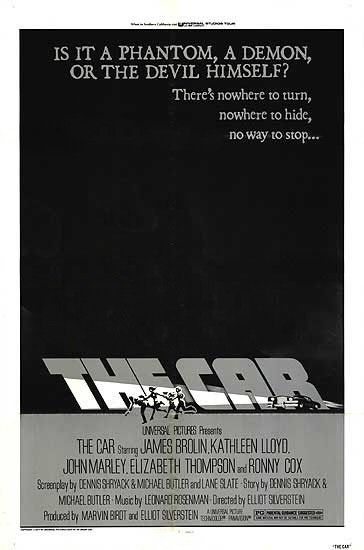
The Car is a pretty stupid movie that doesn’t really work but at least it’s enjoyably stupid. From the minute I started watching this movie, I knew that the only way I could recommend it would be if James Brolin shouted, “The car is in the garage!” at some point. When he did, I had to cheer a little. I love being able to recommend a movie.
The Car takes place in the small desert town of Santa Ynez. Nothing much ever seems to happen in Santa Ynez, which perhaps explains why the police force is so large. (Why wouldn’t you want to be a police officer in a town with no crime? It wouldn’t be a very demanding job.) Sheriff Everett Peck (John Marley) keeps the peace and sends his time talking about how much he hates bullies. Wade Parent (James Brolin) is his second-in-command and has a 70s pornstache. Wade’s best friend is Deputy Luke Johnson (Ronny Cox), a recovering alcoholic with impressive sideburns. And then there’s a few dozen other cops. Seriously, this tiny town has a HUGE police force.
One day, however, the police finally get something to do. A black Lincoln Continental has suddenly appeared, stalking the roads around the town. It doesn’t have a licence plate and the windows are tinted a dark red so it’s impossible to see who — if anyone — is driving. Stranger still, the car’s doors have no handles. When the car does show up, it seems to appear out of nowhere and once it’s run someone over, it seems to vanish just as quickly.
When the car first appears, it runs down two cyclists. A few hours later, it kills an obnoxious hippie hitchhiker (John Rubinstein). The only witness was alcoholic wife beater Amos Clements (R.G. Armstrong). When Amos goes to the police, the car tries to run him over as well but instead, it ends up killing Sheriff Peck.
Now, Wade is in charge and he has to do something about the car. Unfortunately, Wade’s girlfriend, Lauren (Kathleen Lloyd), made the mistake of screaming insults at the car when the car attempted to run down the school marching band. Now, the car is stalking her. Meanwhile, Luke is convinced that the car is being driven by none other than devil. Wade says that’s impossible. Luke points out that the car refuses to drive through consecrated ground.
And eventually, the car does show up in the garage…
The Car is one of the stupider of the many Jaws ripoffs that I’ve seen. You’ll be rooting for the car through the entire film, which is good since the car kills nearly everyone in Santa Ynez. (If any of them were likable, The Car wouldn’t as much fun to watch.) It’s dumb but the film does have an appropriately silly ending and James Brolin does get to yell, “The car is in the garage!”
Today’s Horror on the Lens comes to use from 1958. It’s entitled I Bury The Living and say whatever you want about the actual film, that’s a great title.
In I Bury The Living, Richard Boone plays Robert Kraft, the newly appointed chairman of a committee that oversees the local cemetery. Through a series of unlikely events, Kraft becomes convinced that, through the use of black and white push-pins, he can control who will live and who will die.
Does Robert really have God-like powers or is something else happening?
Watch below to find out! I Bury The Living is no Dellamorte Dellamore but it’s still an enjoyably over the top piece of cemetery mayhem.
In this episode of The Twilight Zone (which was originally aired on May 4th, 1962), a neurotic ventriloquist named Jerry (Cliff Robertson) has a bizarre relationship with his dummy. Not only does Jerry seem to hate his inanimate partner but the dummy doesn’t seem to be too fond of Jerry either.
You’ll probably already figured out The Dummy‘s twist but it’s still extremely well-done, featuring a great performance from Cliff Robertson and expressionistic direction from Abner Biberman.