International Horror Film: The Shiver of the Vampires (dir by Jean Rollin)


This is the one with the vampire in the clock.

Now, admittedly, a female vampire emerging from a grandfather clock is an image to which filmmaker Jean Rollin would frequently return.  It was one of his most iconic images and, in many ways, a perfect visual for his uniquely dream-like aesthetic.  Seeing as how Rollin’s films always seemed to be, at least somewhat, concerned with how the past bleeds over into the present, it only makes sense that every grandfather clock — that ultimate symbol of the past — would have a vampire lurking somewhere within it.

As far as I know, though, 1971’s The Shiver of the Vampires was the first time that Rollin ever featured a vampire emerging from a clock.  Rollin often cited The Shiver of the Vampires are being one of his personal favorites from his filmography so it makes sense that he would continually return to that film’s best-known moment.

Though I prefer later films like Living Dead Girl, Two Orphan Vampires, and Night of the Hunted, The Shiver of the Vampires is definitely one of Rollin’s best films.  It’s certainly the first of his films in which Rollin feels like a truly mature filmmaker.  This was his third film and, like both Le Viol du Vampire and The Nude Vampire, it plays out like a cinematic dream.  At the same time, it’s more coherent than either of those earlier films, without the occasional moments of pretension that sometimes threatened to make those two films feel like elaborate student exercises.

The Shiver of the Vampires takes place in all of the usual Rollin locations.  There’s an isolated castle and decrepit castle, a symbol of the past which still features very modern graffiti on some of the walls.  There’s the chapel, which seems to be specifically designed to accommodate human sacrifice.  And, of course, there’s the beach.  As with so many Rollin films, all paths lead to the beach, a location that Rollin presents as being both comforting and menacing.

The Shiver of the Vampires tells the story of a honeymooning newlywed couple, Isle (Sandra Julien) and Antoine (Jean-Marie Durand).  Isle is looking forward to visiting her two cousins at their castle but, upon arriving, Isle and Antoine discover that the castle is now the home to two young women and that Isle’s cousins died just the day before.  Upset at both the news and a strange meeting with another woman named Isabelle (Nicole Nancel), Isle decides to spend the night sleeping alone.  However, while Isle is getting ready for bed, Isolde (played by the singularly-named Dominique) emerges from the grandfather clock.

Isolde is the vampire who not only killed the cousin but who, along with her two servants, has taken over the castle.  While Isolde leads Isle to the cemetery, Antoine wanders around the castle and just happens to run into the two dead cousins…

At its heart, The Shiver of the Vampires is an old Universal haunted castle movie with a bit more nudity and the sexuality move to the forefront as opposed to just being subtext.  It’s a horror film with plenty of blood and one rather nasty death via piercing by pointed nipple covers.  At the same time, it’s also a rather sentimental film.  Ultimately, Isle is vulnerable not because she has any secret desire to be a vampire but instead because her cousins, regardless of what they’ve become, are the only family that she has left.  Married or not, Antoine is just an interloper.

As with all of Rollin’s films, The Shiver of the Vampires plays out at its own dream-like pace, with the camera loving examining every inch of the old castle.  On the one hand, the film may be a dream of dark and disturbing things but, at the same time, it’s also a sad-eyed look at family and the impossibility of escaping the past.

And, of course, you’ll never forget that grandfather clock.

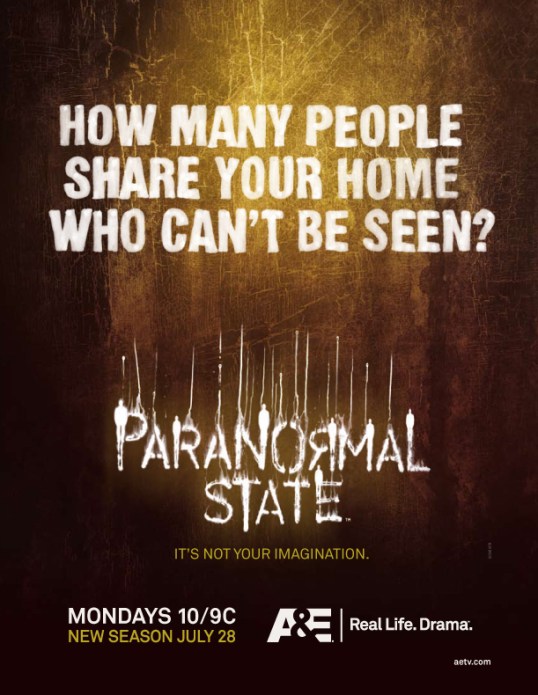
Guilty Pleasure No. 44: Paranormal State


“We are students…..we are seekers…..and sometimes we are warriors. And each time we help someone, I feel like I’m one step closer to finding the truth…”

The words opened up all 86 episodes of Paranormal State, a “reality” show that ran on A&E from 2007 to 2011.  They were delivered by Ryan Buell, who was the head of the Pennsylvania State University Paranormal Research Society.  Buell also narrated every episode of Paranormal State and perhaps the most memorable thing about the show was the strangely robotic sound of his narration.  Buell delivered his lines in a memorably flat monotone, one that rarely betrayed a hint of emotion while talking about the spirits that the Team supposedly dealt with in each and every episode.  Even when Buell talked about the demon that had supposedly been stalking him since childhood, he did so with all the emotion of Alexa confirming a grocery list.

Paranormal State was one of those shows where people would around in a dark house with an infrared camera while randomly saying stuff like, “Did you feel that?  I felt a suddenly cold wind in this room.  You’ll just have to take my word for it.”  Occasionally, a light would get knocked over or a door would close on its own.  Along with asking each other if they had felt anything, the members of the Paranormal Research Society were also fond of asking, “Did you hear that?” and “Oh my God, did you just see that?”  I always liked it when they would review the film in slow-motion and point at a barely visible smudge on the image and say, “There it is.  There’s the spirit.”  Ultimately, it would usually lead to a medium being called in and wandering around the house and going, “It’s time for you to move on, spirit.  Whisper something if you’re here.  Oh my God, did you hear that?”

It was all pretty obviously staged and kind of dumb but I still enjoyed the show because I liked the idea of a bunch of college students skipping class so that they could spend the night in a deserted barn while waiting for the ghost of a angry farmer to push over a pitchfork or something.  I mean, if my college had given credit for ghost hunting, I totally would have done it!  The show may have been fake but it was fun to pretend that it was real.

After the show ended, Ryan Buell had his personal difficulties, which I’m not going to dwell on.  As for the show, it actually lives on.  I recently came across reruns on the FYI network and I’ve lost track of the number of people I’ve met who, like me, can recite that opening narration by heart.  Seriously, it just gets in your head.

Previous Guilty Pleasures

  1. Half-Baked
  2. Save The Last Dance
  3. Every Rose Has Its Thorns
  4. The Jeremy Kyle Show
  5. Invasion USA
  6. The Golden Child
  7. Final Destination 2
  8. Paparazzi
  9. The Principal
  10. The Substitute
  11. Terror In The Family
  12. Pandorum
  13. Lambada
  14. Fear
  15. Cocktail
  16. Keep Off The Grass
  17. Girls, Girls, Girls
  18. Class
  19. Tart
  20. King Kong vs. Godzilla
  21. Hawk the Slayer
  22. Battle Beyond the Stars
  23. Meridian
  24. Walk of Shame
  25. From Justin To Kelly
  26. Project Greenlight
  27. Sex Decoy: Love Stings
  28. Swimfan
  29. On the Line
  30. Wolfen
  31. Hail Caesar!
  32. It’s So Cold In The D
  33. In the Mix
  34. Healed By Grace
  35. Valley of the Dolls
  36. The Legend of Billie Jean
  37. Death Wish
  38. Shipping Wars
  39. Ghost Whisperer
  40. Parking Wars
  41. The Dead Are After Me
  42. Harper’s Island
  43. The Resurrection of Gavin Stone

Horror Film Review: The Guardian (dir by William Friedkin)


OH MY GOD!  THAT TREE IS EATING PEOPLE!

“You mean the tree played by Kevin Costner?”

No, no.  You’re thinking of the wrong Guardian, my imaginary friend.  This Guardian is from 1990 and it’s the killer tree film that was directed by William Friedkin.

“William Friedkin directed a killer tree film?”

Apparently so.

“What’s it about?”

It’s kind of hard to say.  Camilla (Jenny Seagrove) is hired as a nanny and proceeds to not only claim the baby as her own but also tries to seduce the baby’s father away from his wife.

“I think it’s cute the way that you always mention the actor’s name is parenthesis….”

Well, that’s what we’re taught to do.  But back to The Guardian.  The Guardian could also be a movie about a druid who steals babies so that she can sacrifice them to a tree God.

“You mean like that big talking tree from the from Lord of the Rings?”

I guess.  Or maybe Camilla is a reincarnation of Lillith, the demon who kidnaps babies in the night.

“Poor Lillith, so misunderstood.”

Or maybe Camilla is a witch who can make wolves and tress do her bidding!

“Like Sabrina?”

I don’t want to talk about fcking Sabrina.

“Did you mean to spell the f-word that way?”

I try to keep my actual cursing to minimum.  That way, it means something.

“That’s sweet.”

Whatever.  Back to The Guardian!  It’s also possible that Camilla actually is a tree that’s come to life and is now doing evil tree stuff!

“So, what you’re saying is that the film is unclear about just what exactly Camilla’s deal is?”

That’s it, exactly!  The Guardian is a notorious mess and it’s probably significant that this is one of two films that William Friedkin doesn’t even acknowledge in his otherwise tell-all autobiography, Friedkin Confidential.  Reportedly, there were problems on the set. From what little I’ve found online, it would appear that Friedkin originally wanted the movie to be about a mentally deranged woman who thought she was a druid. But the producers wanted a horror film about a woman who actually was a druid. Somehow, this eventually led to The Guardian becoming a movie about a woman who is actually a tree. What’s funny is that the film itself feels like a typical crazy nanny Lifetime film, up until the moment that one of Camilla’s employers attempts to take a chainsaw to that tree.

“Trees don’t like chainsaws.”

Yeah, no joke.  Anyway, before all that happens, Camilla is killing people left and right but yet no one seems to notice.  She doesn’t make any secret of the fact that she’s trying to seduce Phil (Dwier Brown) but Phil’s wife, Kate (Carey Lowell), doesn’t seem to care.  Instead, Phil and Kate attempt to set Camilla up with their friend, goofy Ned (Brad Hall).  It doesn’t take long for Ned to get devoured by a bunch of wolves.  That’s what happens when you walk in on a druid nanny turning into a tree, I guess.

“Isn’t Brad Hall married to Julia Louis-Dreyfus?”

Indeed, he is!  And you don’t see him in any movies nowadays so I guess getting eaten by wolves was kind of the last straw.  But the movie gets even weirder!  There’s also an odd scene in which three gang members just happen to be walking through the woods when they come across Camilla and the baby. They kind of pop up out of nowhere and they immediately turn out to be some pretty bad guys. Luckily, a tree pops up and kills the all. Is the tree Camilla or is the tree someone else? Who knows?

“Gang members in the woods?  You mean like in Friday the 13th Part 3?”

Strangely enough, yes.  Even stranger is the fact that no one notices anything strange about Camilla. To be honest, there are times that Camilla might as well be wearing a sign that reads, “Druid” but no one seems to notice. Then again, it’s debatable whether or not she was actually a druid. She might actually be a tree and I guess it’s understandable that something like that wouldn’t naturally occur to anyone. I mean, I think we’ve all probably met a druid or two but someone who is actually a tree? Well, that’s unusual.

“Very unusual!”

Anyway, The Guardian is a messy film and I’m afraid that I’m probably making it sound more fun than it actually is.  If you do watch it, please be sure to chime in with your thoughts on whether or not Camilla is actually a tree.  I look forward to hearing your opinion!

“Don’t you want to hear my opinion?”

No.

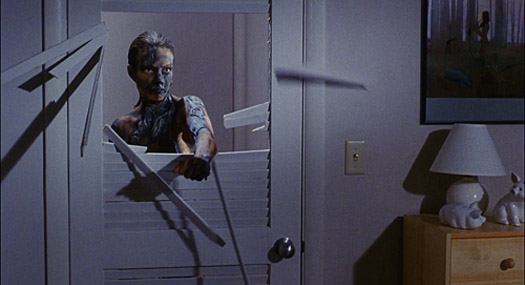
Yes, this an actual scene from The Guardian.

Horror on the Lens: Hands of a Stranger (dir by Newt Arnold)


After concert pianist Vernon Paris (James Stapleton) loses his hands in an auto accident, he is the recipient of a double hand transplant.  Unfortunately, Vernon isn’t happy with having a stranger’s hands and he fears that he’ll never be able to play the piano again.  Even worse, he soon becomes convinced that the hands are evil and are trying to force him to commit murders.

But is it the hands or Vernon’s own unstable mind that’s responsible his actions?

This 1962 horror film was the fourth adaptation of the Maurice Renard’s The Hands of Orlac.  As opposed to other film adaptations of Renard’s novel, Hands of Stranger plays up the ambiguity of whether the recipient of the hands is truly possessed or if he’s just using the hands as an excuse to indulge in his dark side.

Enjoy!


Music Video of the Day: Black River Killer by Blitzen Trapper (2009, dir by Daniel Elkayam)


If Cormac McCarthy was writing and directing music videos, the end result would probably be a lot like this brilliant video for Blitzen Trapper’s Black River Killer.

The song may be about a man who is thrown in jail on a whim and charged with the murder of a woman that was found on the Sunset Strip but, as soon becomes obvious, sometimes whims turn out to be correct.  The song’s narrator is a murderer, one who kills randomly and without giving it much of a second thought.  According to an interview Eric Earley gave to Rainn Wilson, the killer is actually a supernatural force that possesses one individual after another.  So, even if the current Black River Killer ceases his activities, a new one will take his place.

Enjoy!

Horror on TV: Suspense 1.7 “A Night At The Inn” (dir by Robert Stevens)


Suspense was an anthology series that aired from 1949 to 1953.  As you can probably guess from the show’s title, each episode was a thriller of some sort.  Occasionally, the episodes were also horror-themed.  Suspense was also a live production, with each episode essentially functioning as a 30-minute play.

Tonight’s episode of Suspense originally aired on April 26th, 1949 and it features Boris Karloff.  It deals with four thieves hiding out in a British Inn, after having stolen a ruby eye from a holy statue in India.  Needless to say, that was not a particularly wise decision.

Enjoy!

Horror on the Lens: Curse of the Swamp Creature (dir by Larry Buchanan)


Today’s horror on the lens is 1966’s Curse of the Swamp Creature!

Probably the best thing about Curse of the Swamp Creature is that it was filmed in the town of Uncertain, Texas, which is right near the Texas/Louisiana border.  Uncertain, which sits on the shores of Caddo Lake, was incorporated in 1961.  Reportedly, when filling out the paperwork, the town’s founders wrote “Uncertain” in the blank for the name because they genuinely hadn’t come up with a name.  And …. well, you know what happens when you try to make a joke on an official document.

Anyway, this film was directed by Larry Buchanan and that’s really all you need to know about it.  Buchanan specialized in making low-budget remakes of other films, though he always claimed that Curse of the Swamp Creature was a totally original idea on his part.  The film is about a mad scientist who lives in the swamp and is trying to reverse evolution.  Things don’t always work out the way that they should and occasionally, the mad scientist has to feed his alligators.  John Agar’s in the movie, of course.

Enjoy!

Music Video of the Day: American Horror by Speedy Ortiz (2014, dir by Peter Binswanger)


Needless to say, the part with the dancer being controlled and then transformed into something else totally freaked me out, mostly because I’ve had nightmares like that.

And then, of course, you have the tentacles and the graffiti, which feels like something that H.P. Lovecraft would have come up with if he had lived in New York City in the 1970s and had to travel on the subway everyday.  It’s easy to imagine old Howard Lovecraft, heading to an accounting job while staring at the graffiti all around him and wondering what type of monster was responsible for it.  Cthulhu tags his territory.

As for the wizard with the eyes — well, glowing eyes are always freaky.

Enjoy!

The TSL’s Horror Grindhouse: The Flesh and Blood Show (dir by Pete Walker)


I had a few reasons for watching the 1972 slasher film, The Flesh and Blood Show.

First off, the film was directed by Pete Walker.  Though Pete Walker may not be as well-known as some of his contemporaries and his overall cinematic output is dreadfully uneven, he was still responsible for enough memorable films that I will always give him a chance.

Secondly, it’s a British film and the British were responsible for some of the best horror films of the late 60s and early 70s.

Third, speaking as a horror fan, that title is just irresistible.  The Flesh and Blood Show?  Well, there’s nothing subtle about that!  Looking at that title, you find yourself wondering, “How much flesh and how much blood is actually in this film?”

Well, having watched the film, I can tell you that there’s very little blood and a good deal of flesh.  The Flesh and Blood Show was Walker’s first horror film.  Before moving into the horror genre, Walker specialized in making sexploitation movies and it’s kind of obvious that, when he directed this film, he was still more comfortable asking people to undress than asking them to play dead.  As opposed to other slasher films, the majority of the young cast survives and the almost all of the murders occur off-screen.  Every couple of minutes or so, someone else is getting undressed.  The constant nudity actually starts to get pretty funny after a while.  One could very easily use The Flesh and Blood Show to construct a drinking game.

As for the film’s plot, it deals with a group of actors who receive invitations to an abandoned theater.  An unseen producer apparently wants them all to perform an infamous play, perhaps the same play that is rumored to have led to tragedy back in 1945.  If it seems rather odd that the film’s characters would willingly go to an abandoned theater in the middle of nowhere and perform a possibly cursed play, no one is ever going to accuse anyone in this film of being smart.  Why ask why when there’s so much dancing and undressing to do?

There’s also an elderly major (Patrick Barr) hanging out around the theater.  He was actually one of my favorite characters in the movie because he approached everything with this very British, very stiff upper lip attitude.  Of course, the major himself has a secret.  That said, the secret isn’t that surprising.  I figured it out as soon as he showed up.

Naturally, all the murders at the theater are linked back to a tragedy in the past.  The final 15 minutes of the movie are made up of an extensive flashback to that tragedy and I will say this: it’s the best part of the film.  The flashback was originally filmed in 3-D and Walker uses this as an excuse to indulge in some surreal flourishes.

There are a few positive things to be said about The Flesh and Blood Show.  Pete Walker was a talented director and that talent comes through in even his weaker films.  There are a few scenes where Walker manages to maintain a properly ominous atmosphere and the movie’s score is so melodramatic and over the top that it’s kind of hard not to love it.

But, for the most part, The Flesh and Blood Show is a rather forgettable film.  If you want to see a good Pete Walker film, track down Frightmare.

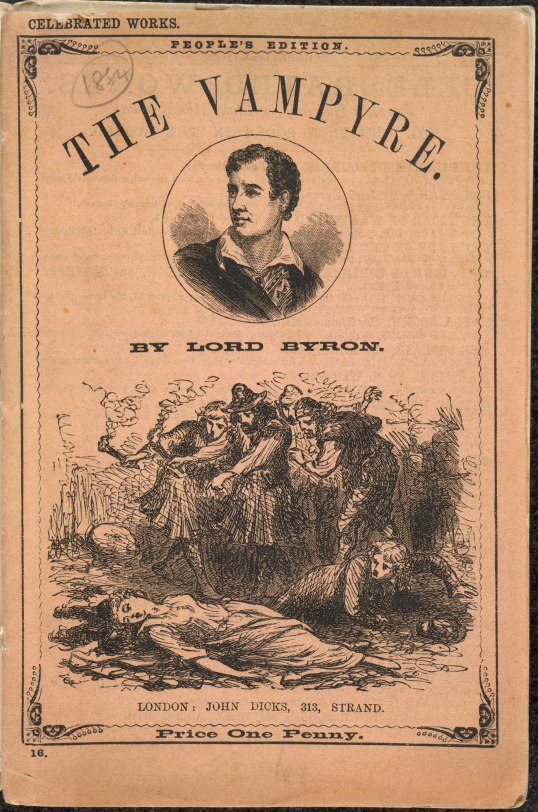
Book Review: The Vampyre by John William Polidori


Though The Vampyre was often erroneously attributed to Lord Byron, it was written by John William Polidori

First written way back in 1816, The Vampyre is a story about an amazingly naive young gentleman named Aubrey who becomes friends with the mysterious Lord Ruthven.

Everything about the enigmatic Lord Ruthven would seem to suggest that he’s a vampire but Aubrey never figures that out while he and the nobleman travel across Europe.  Even after an inkeeper’s daughter dies of a vampire attack shortly after telling Aubrey about vampires (and, also, immediately after the sudden arrival of Ruthven), it still doesn’t occur to Aubrey that there might be something strange about Lord Ruthven.  When Lord Ruthven is mortally wounded by bandits, he makes Aubrey swear an oath that he will not tell anyone about Ruthven’s death for a year and a day.  Aubrey promises to keep the oath.

Now, apparently, back in the 19th century, people took those oaths very seriously because, even after Lord Ruthven shows up alive once again and now claiming to be the Earl of Marsden, Aubrey can’t tell anyone that he saw Ruthven die.  Even after Ruthven starts to court Aubrey’s sister with the obvious intention of draining her blood, Aubrey still cannot bring himself to break his oath.  Is it because oaths were really that important or is it that Aubrey himself is as in thrall of Ruthven as his sister?

John William Polidori was a physician and a writer, as well as a contemporary and friend to Mary Shelley, Lord Byron, and Percy Shelley.  The Vampyre was conceived and written as a part of the same contest that saw Mary Shelley write Frankenstein.  Though Polidori’s story is understandably overshadowed by Mary Shelley’s (and, it must be said, Polidori was nowhere near as good a writer as his famous friends), it’s still historically significant as the first “romantic” vampire tale.  It’s the story from which so many others have sprung.

Many have also speculated that the story was based on Polidori’s friendship with Lord Byron, with Polidori represented by the unstable Aubrey while the self-centered but charismatic Lord Ruthven was perhaps meant to be a stand-in for Byron himself.  This may be true or it may not.  (When it comes to Byron, the Shelleys, and Polidori, it’s always perhaps a bit too tempting to read too much between the lines.)

The Vampyre is a historically important piece of work so, if you’re a fan of vampires, you have to read it.  Flaws and all, we owe much to Lord Ruthven and John William Polidori.