Film Review: Django Kill (dir. by Giulio Questi)


2228_spoiler_DjangoKill_t588

Released in 1967 and directed by Giulio Questi, Django Kill is one of the essential spaghetti westerns.

The film opens with a man literally clawing his way out of a shallow grave.  Played by Tomas Milian and known as the Stranger, the man is a Mexican outlaw who has been buried out in the middle of the desert.  Two sympathetic Indians discover the Stranger and, while they nurse him back to health, he has several flashbacks that explain how he came to be buried alive.

The Stranger was a member of a gang of thieves who stole a cargo of gold.  However, the Americans in the gang betrayed the Mexicans, gunning them down and fleeing with the gold.  The Indians agree to help the Stranger find the rest of his gang on the condition that the Stranger tell them what it was like to be dead.

The Stranger’s former gang, meanwhile, has arrived at a desolate town known as Unhappy Place.  From the minute that the gang first rides into town, we know that there’s something sinister about Unhappy Place.  A naked child stands in the middle of the street while another is used as a footrest by one of the adults.  A distraught woman watches them from behind a barred window.  A lame hedgehog drags itself across the dusty street.  As soon as the gang stops at the local saloon, the locals see the gold that they’re carrying and, in a shockingly brutal scene, the townspeople lynch the outlaws.

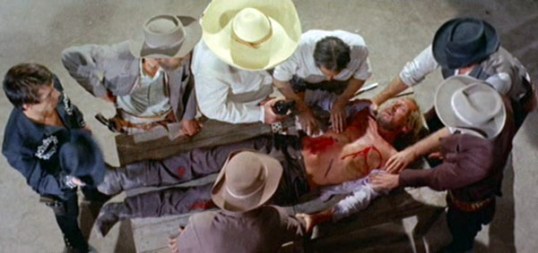
While this is going on, the Stranger rides into town.  Spotting the last living outlaw, the Stranger proceeds to gun him down.  In one of the film’s more infamous scenes, when the townspeople learn that the Stranger is using gold bullets, they proceed to literally rip the outlaw to pieces in an effort to retrieve the golden bullets.

With the outlaws dead, the townspeople claim the gold for themselves.  The Stranger, who was apparently more interested in revenge than getting the gold, stays in town and watches as things get increasingly weird.

How weird?

Well, how about the fact that the Stranger ends up having a romance with a crazy woman who spends her days trapped behind a locked door?

Or how about the fact that the Stranger finds himself in the middle of a power struggle between the townspeople and the flamboyantly homosexual Zorro (played, in grandly villainous fashion, by Roberto Camardiel) who rides into town with a gang of cowboys who are all dressed in black outfits with white embroidery?  In another one of the film’s infamous scenes, Zorro and his cowboys kidnap and gang rape the son of the town’s saloonkeeper.

(A young Ray Lovelock, who would go on to be one of the best actors to regularly work in Italian exploitation plays the son.)

Or how about the scene where Zorro plays with a bunch of Civil War figures while arguing with his pet parrot?  When Zorro offers the parrot a drink, the parrot replies, “I want more!”

Or, how about the fact that the Stranger, at one point, has to deal with several vampire bats while literally hanging from a cross?

Graphically violent and full of bizarre and disturbing imagery, Django Kill is one of the strangest westerns ever made and that strangeness keeps the film interesting even when the story doesn’t make much sense.  While Django Kill may not be the masterpiece that several claim it to (the film runs on a bit long and the dubbing of the English language version was absolutely terrible), it’s still one of the most compulsively watchable films that I’ve ever seen.  Just when you think the film can’t get any stranger, it does.

Django Kill was filmed under the title of If You Live, Shoot!  However, in a move typical of Italian cinema, the film was retitled to take advantage of the popularity of Sergio Corbucci’s Django.  The implication, of course, is that Tomas Milian is playing the same character here that Franco Nero played in Corbucci’s film.  Of course, nothing could be further from the truth.  Even in the crudely dubbed English version of the film, Milian is never referred to by name.  Instead, he’s simply known as the Stranger and, appropriately enough, the film feels more like a surreal take on Sergio Leone’s Dollar trilogy as opposed to being a part of the Django series.

That said, regardless of whether it’s a legitimate Django film or not, Django Kill …. If You Live, Shoot! is more than worth watching.  In fact, it’s essential for anyone who loves Italian exploitation films.
060312-DjangoKill-Post2

What Lisa And Evelyn Watched Last Night #70: California Dreams S3E5 “Yoko Oh No!” (dir by Kevin Sullivan)


Last night, my BFF Evelyn and I watched yet another episode of the old 90s sitcom California Dreams.

Why Were We Watching It?

Believe me, I would have much rather have been watching an old episode of Saved By The Bell: The New Class but. unfortunately, YouTube has yanked down nearly every episode of SBTB:TNC that’s ever been uploaded.  However, every episode of California Dreams is available on YouTube.  Why exactly it’s okay to violate California Dreams‘ copyright but not Saved By The Bell’s is a question for which there is no easy answer.

That said, ever since my sister Megan first introduced me to the show last December, I’ve grown to appreciate California Dreams.  For a terrible sitcom, it wasn’t that bad.

What Was It About?

So, in this episode, there’s yet another battle of the bands taking place at Sharky’s.  (I have to admit that there’s still a lot of episodes of California Dreams that I haven’t seen but, seriously, it seems that Sharky’s had a vattle of the bands every other week or so.)  Anyway, the Dreams are looking to win the Battle of the Bands for the 2nd time in a row but they’re going to have to beat Total Defiance, a rap group that’s edgy in a mid-90s, Saturday morning sitcom sort of way.

When Total Defiance’s manager, Rosie, calls Lorena “a groupie,” Lorena (played by Diana Uribe) asks to be allowed to sing with the Dreams.  At this point in the series, Lorena was dating Jake (Jay Anthony Franke), the leader of the Dreams.  So, of course, Lorena is allowed to join the group despite being totally tone deaf.

What Worked?

Though it probably wasn’t meant to be, Rosie’s dismissive description of the California Dreams and their music is actually pretty spot on.

This is a pretty good episode for both the character of Lorena and for the actress who played her.  Though everyone on YouTube seems to disagree with me, I actually think the Jake and Lorena were a good couple and I prefer the episode where she and Jake are together to the ones where Jake is dating Tiffani (Kelly Packard) and Lorena is going out with Sly (Michael Cade).

So, I’ve made my sisters, my boyfriend, my best friend, and my Australian friend watch an episode or two of California Dreams and they’ve all said the same thing: Lorena reminds them of me.  Despite the fact that I doubt that Lorena would ever be a fan of Italian horror, I can see their point.

What Did Not Work?

“Suuuuuuurf dudes with attitude … kinda groovy …. feeling mellow….”  Again, Rosie was right.

“OH MY GOD! Just like me!” Moments

Like Lorena, I’m a good dancer but I can’t sing to save my life.  In fact, my sisters claim that I’m tone deaf but I prefer the term “musically challenged.”

Unlike Lorena, I would never have faked laryngitis to get out of singing.  I would have gotten up on stage and screeched my little heart out.

Lessons Learned

If you want to sing despite having no talent, date a guy in a band.

Lisa Marie Reviews The Oscar Nominees: The Oscar (dir by Russel Rouse)


the-oscar-stephen-boyd-db54

I stayed up way too late last night but it was totally worth it because I was watching a film from 1966, The Oscar.

Among those of us who love bad and campy movies from the 50s and 60s, The Oscar is a legendary film.  It has a reputation for being one of best so bad-its-good-films ever made.  The Oscar is a film that I’ve read about in several books but, until last night, I had never gotten a chance to actually see it.  When I saw that the film was going to be on last night, I said “Sleep be damned!” and I stayed up and watched.  What other choice did I have?

The Oscar takes place in a world where women are “dames” and men are “fellas” and everyone acts as if they’re a character in a Rat Pack-themed fanfic.  One look at Frankie Fane (played by Stephen Boyd) and you know he’s the type of guy who snaps his fingers when he walks and probably uses pig Latin when he flirts.  He’s one cool cat and as the film begins, he’s been nominated for an Academy Award for Best Actor.

The film begins at the Oscars.  Frankie sits out in the audience, surrounded by Hollywood royalty and nervously waiting for the envelope to be opened.  The camera pans over to Frankie’s personal manager, Hymie Kelley.  Hymie stares bitterly at his former friend and suddenly, we hear his thoughts and do they ever let us know what type of movie we’re about to see.

As Hymie himself puts it:

“You finally made it, Frankie! Oscar night! And here you sit, on top of a glass mountain called “success.” You’re one of the chosen five, and the whole town’s holding its breath to see who won it. It’s been quite a climb, hasn’t it, Frankie? Down at the bottom, scuffling for dimes in those smokers, all the way to the top. Magic Hollywood! Ever think about it? I do, friend Frankie, I do…”

Hymie, incidentally, is played by the singer Tony Bennett.  This was Bennett’s first dramatic film role and it was also his last.  Whatever talent or magnetism Bennett may have had as a singer, it didn’t translate into screen presence.  Bennett goes through the entire film looking embarrassed but who can blame him when the script calls for him to constantly tell Frankie that, “You lie down with pigs, you stand up smelling like garbage…”

As we discover through the use of flashback, Frankie has had to lay down with a lot of pigs to get his chance at winning an Oscar.  After starting out his career working at sleazy clubs, Frankie, Hymie, and Frankie’s stripper girlfriend (Jill St. John) find themselves in New York.  Frankie dumps his girlfriend (unaware that she’s pregnant with his child) after he meets artist Elke Sommer at a “swinging party.”

“Are you a tourist or a native?” Frankie asks her.

“Take one from column A and one from column B.  You get an egg roll either way,” Sommer replies.

No wonder Frankie tells her, “You make my head hurt with all that poetry.”

Eventually, Frankie is discovered by a talent agent who takes him to see studio mogul Joseph Cotten (who went from Citizen Kane, The Magnificent Ambersons, and Third Man to this).  Cotten is so impressed with Frankie that he says, “Once in a while, you bring me meat like this.  It all has different names: prime rib of Gloria, shoulder cut of Johnny.  MEAT!”

With the help of savvy talent agent Milton Berle, Frankie becomes a film star but he’s still a total heel who cheats on Sommer and takes advantage of Hymie’s loyalty.  When Frankie gets nominated for an Oscar, he hires a sleazy private investigator (Ernest Borgnine, of course) to leak a story about Frankie’s criminal past.  Frankie assumes that one of his fellow nominees will be blamed for the leak and that he’ll be able to ride a wave of sympathy to victory.

And who are Frankie’s fellow nominees?  We only learn the identity of three of them – Frank Sinatra, Richard Burton, and Burt Lancaster.  We never find out what movie Sinatra was nominated for but we’re told that Burton was nominated for The Grapes of Winter (which, I’m going to assume, was a film version of a Shakespeare play about Tom Joad) while Lancaster was nominated for his amazing performance in The Spanish Armada.  Doesn’t that sound like an amazing film?

Oh, how to describe the delirious experience of watching The Oscar?  In many ways, it is a truly terrible movie but it’s fun in the way that only a “racy” film from the mid-60s can be.  Nobody plays his or her role with anything resembling subtleness.  Instead, everyone spends the entire film yelling, screaming, and gritting their teeth while flaring their nostrils.  Everyone, that is, except for Tony Bennett who gives a performance that has a definite community theater feel to it.  Even better is the dialogue.  People in this film don’t just say their lines – they exclaim them.  If you’ve ever wanted to spend two hours in a world where every sentence ends with an exclamation point, watch The Oscar.

For a film that was apparently meant to be something of a love letter to the Academy, The Oscar was only nominated for two Oscars.  It received nominations for Best Art Design and Best Costume Design.  While I had a hard time seeing what was so impressive about the film’s art design (in the world of The Oscar, Hollywood has a definite Ikea feel to it), the costumes were fairly impressive in a tacky, 1966 type of way.

Finally, I think it’s time that somebody remake The Oscar.  David Fincher can direct it, Aaron Sorkin can write the script, Jessie Eisenberg can play Frankie Fane, and Justin Timberlake would make for an adorable Hymie Kelley.  For the supporting roles, I think Billy Crystal would be a natural for Milton Berle’s role and perhaps Philip Baker Hall could step into the shoes of Joseph Cotten.  Perhaps veteran film blogger and self-described very important person Sasha Stone could make her film debut in Ernest Borgnine’s role.

Seriously, I think it would be a winner.

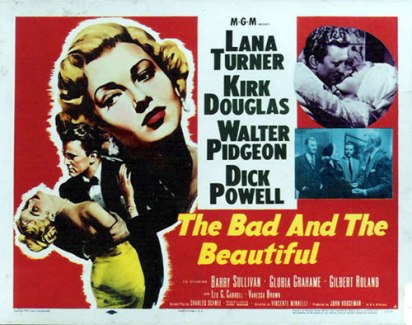
Lisa Marie Reviews The Oscar Winners: The Bad and the Beautiful (dir by Vincente Minnelli)


BadAndTheBeautiful1952hs800

What can I say about The Bad and the Beautiful?

Released in 1952 and directed by Vincente Minnelli, The Bad and the Beautiful is arguably one of the greatest films ever made.  It’s certainly one of my favorite films.

Perhaps appropriately, The Bad and the Beautiful is a film about the movies.

Jonathan Shields (played in a truly amazing performance by Kirk Douglas) is a legendary film producer.  He’s won Oscars, he’s got a reputation for being a genius, and, as the film begins, he is one of the most hated men in Hollywood.  It’s been years since Shields made a succesful film but he thinks that he’s finally come up with a movie that can put him back on top.  His assistant, Harry Pebbel (played with a weary dignity by Walter Pidgeon), invites Hollywood’s best director, actress, and screenwriter to a meeting and he proceeds to spend the rest of the film trying to convince them to help Jonathan make his comeback.

The only problem is that all three of them hate Jonathan Shields and have sworn that they’ll never work with him again.  Through the use of flashbacks, we see how each of them first met Jonathan and how each eventually came to despise him.

Director Fred Amiel (Barry Sullivan) first met Jonathan when Jonathan hired him to pretend to be a mourner at his father’s funeral.  With Jonathan’s help, Fred moves up from directing B-movies to finally getting a chance to make his dream movie, an adaptation of a believably pretentious novel called The Far Off Mountain.  With Jonathan’s help, Fred even gets womanizing film star Gaucho Ribera (a hilariously vain Gilbert Roland) to agree to star in Fred’s movie.  Jonathan also introduces Fred to Georgia (Lana Turner), the alcoholic daughter of Jonathan’s mentor.

Jonathan eventually makes Georgia into a film star and Georgia falls in love with him.  Of all the major actresses of the 1950s, Lana Turner seems to get the least amount of respect from film historians.  She’s more remembered today as the epitome of glamour and scandal but, in The Bad and the Beautiful, Turner gives one of the best performances of her career.  In her best scene, Georgia has a nervous breakdown while driving in the rain and, for those few minutes, you forget that you’re watching an iconic film star.  Instead, you’re just amazed by the performance.

Finally, the screenwriter is James Lee Bartlow (Dick Powell), an intellectual novelist who is brought to Hollywood by Jonathan.  While the reluctant Bartlow finds himself being seduced by J0nathan, his flighty wife (Gloria Grahame) is seduced by Gaucho.

The Bad and the Beautiful is perhaps one of the few perfect movies ever made, a film that qualifies as both art and entertainment.  There are so many reasons why I love this film that its hard for me to describe them all.  The film snob in me loves the fact that Minnelli directed The Bad and the Beautiful as if it were a classic black-and-white film noir.  The entire film is lit and shot to emphasize shadows and moral ambiguity.  As played by Kirk Douglas, Jonathan Shields is as seductive and dangerous a figure as Barbara Stanwyck in Double Indemnity.  My inner film historian loves the fact that the film is full of barely disguised portraits of real life Hollywood figures like David O. Selznick, Val Lewton, Alfred Hitchcock, and Diane Barrymore.  Finally, and perhaps most importantly, my girly girl side loves that this film is basically a big melodramatic soap opera.  Lana Turner’s outfits are to die for and Jonathan Shields is the ultimate bad boy that we can’t help but love.

The Bad and the Beautiful received 6 Oscar nominations but it wasn’t nominated for best picture.  (This snub is all the more surprising when you consider what the Academy did name as the best picture of 1952 — Cecil B. DeMille’s The Greatest Show on Earth.)  Out of those six nominations, the Bad and the Beautiful won five Oscars.  (Of all the film’s nominees, only Kirk Douglas failed to win.)  As of this writing, The Bad and the Beautiful still holds the record for most Oscars won by a film that failed to be nominated for best picture.

Lisa Marie Reviews The Oscar-Nominated Films: Mutiny on the Bounty (dir. by Lewis Milestone)


Mutiny_On_The_Bounty_1962_1

Previously, I reviewed the 1935 Best Picture winner Mutiny on the Bounty, a film that still stands as one of the best adventure films ever made.  However, this was not the only film made about the Bounty to be honored with several Oscar nominations.  In 1962, another version of Mutiny on The Bounty was released and, like its predecessor, received a nomination for Best Picture of the year.  However, while the 1935 Mutiny on the Bounty remains one of the most entertaining films ever made, the 1962 Mutiny on the Bounty is a mess.

As in the 1935 version of the story, we once again follow the HMS Bounty as it sails from England to Tahiti.  Again, the ship’s captain is the tyrannical Capt. Bligh (Trevor Howard) and again, the eventual mutiny is led by Fletcher Christian (Marlon Brando).  While the 1935 version presented Christian as the unquestioned leader of the mutiny, this version features an indecisive Christian who is goaded into leading the mutiny by a seaman named John Mills (Richard Harris).  Whereas the 1935 Fletcher Christian never regretted his decision, the 1962 version seems to regret the mutiny from the moment it occurs and literally spends the rest of the film trying to get the mutineers to agree to return to England with him.

Perhaps the biggest difference between the two versions of Mutiny on the Bounty is that the 1935 version was a 2-hour film that felt shorter while the 1962 remake lasts 3 hours and 15 minutes (including intermission) and feels even longer.  The 1962 version was made at a time when Hollywood was attempting to counteract the influences of European art films and American television by making films that were a thousand times bigger then they needed to be.  Whereas the 1935 Mutiny on The Bounty was all about telling the story as efficiently as possible, the 1962 Mutiny on the Bounty was about telling audiences, at every possible moment, that they couldn’t see anything like this on television or in some French art film.  Audiences in 1962 may very well have been amazed by the endless shots of Tahitians dancing and the Bounty rocking on the ocean but, for modern audiences, the entire film just feels incredibly slow and padded.

Another major difference between the two versions of Mutiny on the Bounty is that Marlon Brando, to be charitable, was no Clark Gable.  Much as Clark Gable could never have been a credible Stanley Kowalski or Vito Corleone, Brando could never have been a convincing Fletcher Christian.  Whereas Gable played Christian as the epitome of masculinity, Brando’s internalized, method approach serves to turn the character into something of a wimp.  It doesn’t help that Brando’s twangy attempt at an English accent sounds like every bad Monty Python impersonation that’s ever been heard in a college dorm room.

The 1962 Mutiny on the Bounty was a notoriously troubled production.  Marlon Brando was reportedly bored with the role of Fletcher Christian (which might explain why he gave such an eccentric performance) and he reportedly used his star status to demand and make constant changes in the script.  The film’s original director, Carol Reed, reportedly quit over frustration with Brando and was replaced by Lewis Milestone.  Milestone, a veteran director who had started his career during the silent era, proved just as ineffectual when it came to controlling Brando.  By the end of the film, Richard Harris was literally refusing to film any scenes opposite Brando.  The end result was that the film went wildly over schedule and over budget.

Despite being reviled by even contemporary critics, Mutiny on the Bounty received seven Oscar nominations, including Best Picture.  The nomination was a triumph for the studio system as MGM reportedly directed all of its employees to vote for the film. That may have been enough to win Mutiny a nomination for best picture but the actual Oscar went to Lawrence of Arabia.

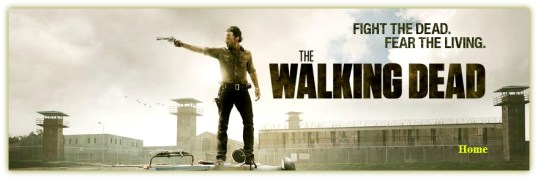
Review: The Walking Dead S3E10 “Home”


TheWalkingDeadS3E10

“Running is not an option.” — Glenn Rhee

[some spoilers within]

The series returned from it’s two month hiatus with even bigger numbers that still continues to surprise many tv pundits. The Walking Dead seems to be the show that no behind-the-scenes problems or storytelling and characterization problems can kill like other shows that has similar problems. The show is not on the same level as HBO’s Boardwalk Empire and Game of Thrones, FX’s Justified and Sons of Anarchy or even AMC stablemates Breaking Bad and Mad Men, but it’s a show that looks to have become must-see tv because of the very things tv pundits and critics have been complaining about.

Tonight’s episode, “Home”, was a microcosm of why the show has been such a frustration to hardcore fans of the comic book and the zombie genre, but also why the show still continues to bring in huge viewing numbers. Numbers that has begun to rival shows on the major networks and not just shows on cable. It was an episode that made me wonder if the season’s trip to redemption from season 2’s wildly uneven tone was suddenly being wasted. Then the second half of the episode arrived like a bullet to the head and we’re reminded why the show has gained such a huge following.

“Home” opens up with Rick still in the grips of the psychotic break we saw and experienced to end the previous episode. This part of tonight’s narrative is beginning to look like one of this season’s weaker ones. While I thought it was good to show the source of Rick’s growing mental instability the way the writers have gone about it makes Rick such a wildly uneven character when the “crazies” hit him. We understand that the burden of leadership has cost the poor man since he rejoined his family but whenever he begins to hallucinate it’s quite a glaring change. The same could be said about Glenn’s sudden rage-fueled need to avenge himself on the Governor for what he thinks was done to Maggie. We’ve seen leadership qualities in Glenn throughout the series’ run, but this need for vengeance for something that didn’t happen to him looks so out of character for Glenn. He’s almost channeling his inner-Shane and, despite what fans of TV Shane’s character might think, that’s never a good thing.

Tonight’s episode was all about the concept of the word “home” what it means to people surviving in a world where no place is safe. The prison and Woodbury are homes for two different survivors. On the one hand, we have Rick and his band of survivors who have survived some of the worst this zombie apocalypse has thrown their way and learned the hard way to survive. On the other side we have Woodbury where most of it’s population never learned to survive but relied on those in power to keep them safe. People in power who really do not have their well-being in mind, but just a resource to dominate and use when it suits them. One home has been invaded and it’s illusion of safety shattered by Rick and his people. Tonight we see the Governor repay that action in his own way.

Home is now a concept that doesn’t seem like a logical thing in this new world order and tonight’s episode went too talky about whether it was safe to remain in the prison or whether it was their best chance of survival. It didn’t help that Rick was on his crazytown jaunt through the woods outside the prison, Glenn was going all Shane on everyone and Hershel was starting to sound very Dale-like. Not very good combinations considering the writers on this show could never handle the quieter and philosophical moments on the show.

Where the episode was saved was when the bolts, bullets and blood flew in abundance in the second half. This first begun with Daryl doing something that Merle would never see himself doing on his own and that’s helping a band of strangers cornered by a large group of zombies. We see how much Daryl’s time with Rick away from the influence of his more volatile big brother Merle has made Daryl a better man without taking away his inherent badassness (yes that is a made up word that should be used more often).

The Governor’s payback against Rick and his people becomes a bookend to the midseason finale where Rick attacked Woodbury. The prison’s illusion of safety has been destroyed and with it one of their own who seemed to be finding his role. Axel was beginning to become a character of note then the Governor and his bullet happened and we’re once more left with the the core group which entered the prison.

If there’s one thing this show has done well since it first began two years ago it’s action and gore. I think it’s what this show does well that keeps people from tuning in for new episodes. There’s a chaotic feel to the action that makes them such a fun thing to watch. These people are not action heroes and not trained professionals in killing but it doesn’t keep them from trying to be both which goes to one of the core tenets of the zombie apocalypse genre. These people should be working together but the inherent mistrusts people have when put into extreme situations keeps that from happening. It’s why things got out of hand and things fell apart for everyone. It looks like it’s happening again but in a much more smaller scale with this war between Rick and the Governor.

With the season now putting the showdown between the two groups front and center it should keep things basic and that’s a good for this show. Basic and simple narratives keep the show moving at a fast-pace. It’s when everyone has some downtime to reflect on the nature of things that the show falters. Here’s to hoping that the first half of this episode was something that had to be done to set things up for the rest of the second half of this season. If it’s not then maybe there was reason why Glen Mazzara will not be returning as showrunner for season 4.

Notes

  • Tonight’s episode of was directed by series newcomer Seith Mann and written by series regular Nichole Beattie.
  • We have ourselves another cameo of a series regular killed off with Sarah Wayne Callies appearing as a figment of Rick’s fractured mind during the episode’s cold opening.
  • Interesting how this sequence is musically scored by the same music theme from way back in the series’ pilot. At first, I thought the return to this motif in the cold opening was announcing the announced return of Lennie James’ Morgan Jones character from the pilot.
  • Glenn trying to make up for Rick’s latest bout of craziness as leader of the group is both refreshing and, at the same time, funny as he’s clearly trying to overcompensate for what happened to him and Maggie during their time in Woodbury.
  • We may be starting to see one of the reasons why Glen Mazzara was replaced as showrunner for the upcoming season. Only two episodes into the second half of season 3 and we’re starting to see the bad habit of the show spinning it’s wheels as it rehashes some philosophical questions about survival and leadership.
  • Andrea being put in charge of Woodbury while the Governor “pulls himself together” would be a much more interesting turn of events if Andrea wasn’t such a broken character played by a performer who can’t seem to find that fine line between cocky and annoying that her character seems to be written as.
  • The best performance of this second half of the season seems to consistently be from Lauran Cohan as Maggie Greene. She has another fine performance tonight as Maggie as she pretty much puts Glenn in his place.
  • Good to see the writers resisted the temptation to revert Carol back to being an emotional mess once she found out about Daryl choosing to leave the group.
  • Speaking of the Dixon Brothers: it looks like Daryl really regrets choosing blood over his new family as Merle continues to be Merle. His attitude towards the Latino family besieged by walkers on the creek bridge is so hilariously racist yet something that continues to stay in character. It definitely helps in making the question of whether Daryl stays with Merle or goes back to the group not become a protracted affair as we see at the end of the sequence.
  • The first half of the episode was quite a bore that highlighted the very flaws this show has had throughout it’s current broadcast life, but the second half saved it by showing just why people continue to return to watch each new episode every Sunday.
  • Axel, we hardly knew you but at least you lasted longer than Oscar. I must say that his death mirrored very well the way he died in the comics.
  • It would seem that it’s easier to headshot zombies when they’re stumbling towards Rick and his people than to actually hit the Governor and his shooters when they’re standing still.
  • Zombie Kill Count of tonight’s episode: 35 (at least 15 more off-screen).

Past Season 3 Episode Review

  1. Episode 1: “Seed”
  2. Episode 2: “Sick”
  3. Episode 3: “Walk With Me”
  4. Episode 4: “Killer Within”
  5. Episode 5: “Say the Word”
  6. Episode 6: “Hounded”
  7. Episode 7: “When the Dead Come Knocking”
  8. Episode 8: Made to Suffer
  9. Episode 9: The Suicide King

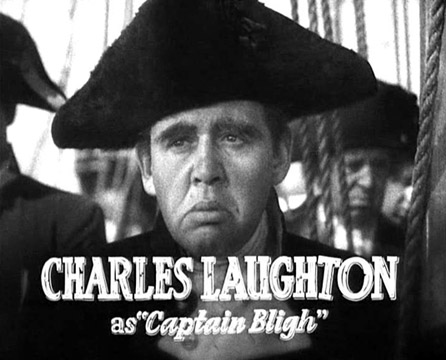
Lisa Marie Reviews The Oscar Winners: Mutiny on the Bounty (dir by Frank Lloyd)


Charles Laughton

It’s been a strange Oscar season and it could get even stranger.  Several critics and industry insiders are speculating that, on February 24th, Argo might win the Oscar for best picture without winning in any other category.  As strange as that may sound, Argo would not be alone in achieving this distinction.  In the past, 3 films have won best picture without winning anything else.

Mutiny on the Bounty, the best picture of 1935, is one of those films.

Based (rather loosely, according to many historians) on a true story, Mutiny on the Bounty tells the story of one of the most controversial events in maritime history.  The HMS Bounty leaves England in 1787 on a two-year voyage to Tahiti.  The Bounty is manned by a disgruntled crew (many of whom have been forced into Naval service) and is captained by a tyrant named William Bligh (Charles Laughton).  Bligh has little use for the majority of his crew and thinks nothing of having a man whipped until he is dead for even the pettiest of infractions.

Blight’s lieutenant is Fletcher Christian (Clark Gable), a compassionate man who disapproves of Bligh’s methods.  As the voyage continues, Christian grows more and more vocal with his disgust towards Bligh.  When the ship finally reaches Tahiti, Christian falls in love with a local Tahitian girl and defies Bligh’s direct orders so that he can spend time with her.

It’s only after the ship leaves Tahiti and Bligh’s tyranny leads to the death of an alcoholic crew member that Christian finally leads the mutiny of the film’s title. The rest of the film is divided between Bligh’s surprisingly heroic efforts to survive after being set adrift in a lifeboat and Christian’s attempts to avoid being captured by British authorities.  Caught up in the middle of all of this is Christian’s friend (and audience surrogate), Roger Byam (Franchot Tone).

Mutiny on the Bounty was one of the biggest box office hits of 1935 and it received 8 Academy Award nominations, including Best Picture, Best Director, and a record-setting 3 nods for Best Actor with Clark Gable, Charles Laughton, and Franchot Tone all receiving nominations.  However, out of those 8 nominations, Mutiny only won the award for Best Picture while John Ford’s The Informer took home the Oscars for Best Director and Actor.  Mutiny on the Bounty was the third (and, as of this writing, the last) best picture winner to fail to win any other categories.

For a film that lost dramatically more awards than it won, Mutiny on the Bounty still holds up pretty well.  Director Frank Lloyd keeps the film moving at a quick pace and perfectly captures not only the misery of the Bounty but the joyful paradise of Tahiti as well.  Lloyd is at his best during the short sequence of scenes that depict Bligh’s efforts to reach safety after being forced off of the Bounty.  During this sequence, the audience is forced to reconsider both Captain Bligh and everything that we’ve seen before.  It introduces an intriguing hint of ambiguity that is not often associated with films released in either the 1930s or today.

Of the three nominated actors, Clark Gable and Charles Laughton both give  performances that remain impressive today.  In the role of Fletcher Christian, Gable is the literal personification of masculinity and virility.  Meanwhile, in the role of Bligh, Laughton is hardly subtle but he is perfectly cast.  If Gable’s performance is epitomized by his charming smile than Laughton’s is epitomized by his constant glower.  Wisely, neither the film nor Laughton ever make Bligh out to be an incompetent captain.  As is shown after the mutiny, the film’s Bligh truly is as capable a navigator and leader as everyone initially believes him to be.  Unlike many cinematic tyrants, Blight’s tyranny is not the result of insecurity.  Instead, Bligh is simply a tyrant because he can be.  Laughton and Gable are both so charismatic and memorable that Franchot Tone suffers by comparison.  However, even Tone’s bland performance works to the film’s advantage.  By being so normal and boring, Roger Byam is established as truly being the sensible middle between Gable’s revolutionary and Laughton’s tyrant.

Mutiny on the Bounty remains an exciting adventure film and it certainly holds up better than some of the other films that were named best picture during the Academy’s early years.  If Argo only wins one Academy Award next Sunday, it’ll be in good company.

Guilty Pleasure No. 4: The Jeremy Kyle Show


Jeremy Kyle Wanker

I’ll just be honest about this.

I do not like Jeremy Kyle.

Jeremy Kyle is an English talk show host.  He hosts shows in both the United Kingdom and, since 2011, in the USA.  On both shows, he deals with the usual daytime television topics: infidelity, out-of-control teenagers, interventions, DNA tests, and lie detectors.  He is also perhaps the most unpleasant person that I have ever seen on television.

As opposed to other talk show hosts who pretend to be impartial, Jeremy Kyle is always quick to let us know that he hates his guests even more than we do.  When someone confesses to cheating on his or her spouse, Jeremy reacts as if he was the one being cheated on. With a permanent scowl on his face and speaking in a tone of voice that reeks of manufactured contempt, Jeremy Kyle repeatedly tells us that his main concern is the children and that he has no respect for anyone who he feels has put their own selfish desires first.

“In the UK,” he’ll find an excuse to shout during every episode, “we have a saying — keep it in your trousers, mate!”

In many cases, Kyle’s guests deserve to be yelled at but that doesn’t make Jeremy Kyle any less annoying.  For all of his shouting and his moral outrage, Jeremy Kyle is far too obvious a showman to be taken seriously as a sincere crusader for family values.  He’s made a career out of exploiting that which he claims to condemn and the fact that he seems so totally humorless about that fact makes him just as bad as the people he has on his show.  He’s a bully but he’s also a surprisingly ineffective one.  The main image that one retains from the Jeremy Kyle Show is the sight of a husband and wife screaming at each other while Jeremy impotently demands that they both be quiet.  The only time that Jeremy really has any control over his stage is when he has his ever present security team standing a few feet in front of him.

When I told my British friends that Jeremy Kyle now had a show in the States, they all had the same reaction.  They apologized.  As for me, I refused to sign that petition to deport Piers Morgan but if anyone starts a petition to deport Jeremy Kyle, I’ll be more than happy to put down my signature.

So, you may be asking, where does the pleasure from this guilty pleasure come from?

It comes from knowing that there’s always a possibility that one of Jeremy Kyle’s guests might lose it and punch Jeremy out.  Every time I’ve seen the Jeremy Kyle Show, I’ve always been struck by just how much everyone on the stage appears to hate Jeremy.  When I do watch this show, it’s because I’m waiting for those priceless moments when somebody will tell Jeremy to shut up and his face will briefly turn red.  I doubt that I’m alone in laughing whenever a guest unexpectedly jumps to his feet and Jeremy reacts by scurrying behind a security guard.  In those moments, Jeremy Kyle’s superior mask falls away and he’s revealed for the pathetic little martinet that he is.

On those rare occasions that I waste my time watching the Jeremy Kyle Show, I’m watching because something like this could happen:

That’s the real pleasure of The Jeremy Kyle Show.

Previous Guilty Pleasures:

  1. Half-Baked
  2. Save The Last Dance
  3. Every Rose Has Its Thorns

What Lisa Marie and the Snarkalecs Watched Last Night #69: Heebie Jeebies (dir by Thomas L. Callaway)


Last night, the Snarkalecs and I watched the world premiere SyFy movie Heebie Jeebies!  And wow — was it ever bad!

Seriously, how bad was Heebie Jeebies?  It’s so bad that I couldn’t even find a trailer for it on YouTube.  It’s as if the universe is trying to convince us that this film does not actually exist.  However, we know what we saw last night.

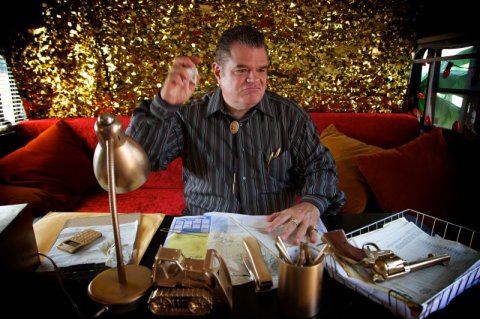
(As proof, here’s a picture of Michael Badalucco, whose over-the-top  performance as the gold-obsessed Billy Butler was one of the more commented upon aspects of the film.)

Why Were We Watching It?

That’s a question that many of us asked last night.

What Was It About?

Usually, low-budget monster movies on SyFy are a lot of fun but that’s because most low-budget monster movies on SyFy are made by the Asylum.  Unfortunately, Heebie Jeebies was not an Asylum film.

Instead, it’s a film about this monster that comes out of a mine and wanders around attacking people and eating gold.  You read that correctly.  This monster kills people and then eats their gold.   Will the town of Golderton survive?

What Worked?

Nothing.

What Did Not Work?

Everything.

“Oh my God!  Just like me!” Moments

I found myself relating to poor Veronica (Evie Thompson), the younger sister of a character that I named Deputy Dumbass (Robert Belushi).  All Veronica wanted to do was go out and have sex with her boyfriend but instead, she had to spend her entire night listening to her brother talk about how it wasn’t safe to go out just because of a little old monster that happened to be killing people.  Even worse, once she finally did what I would have done and sneaked out of the house, she and her boyfriend (who was kinda fugly, to be honest) ended up getting held hostage by two ex-convicts.

Lessons Learned

Only the Asylum should be allowed to make low-budget monster movies.

What Lisa and Evelyn Watched Last Night #68: California Dreams S3E17 “Tiffani’s Gold” (dir by Patrick Maloney)


On Wednesday night, my BFF Evelyn and I watched (via YouTube) an episode of the 90s sitcom California Dreams.  The name of this episode was Tiffani’s Gold and, needless to say, it’s a very special episode.

Why Were We Watching It?

As I wrote back in December, I was introduced to this show over Christmas by my sister Megan.  Ever since then, I’ll be regularly watching old episodes of California Dreams on YouTube.  I’ve seen the members of the Dreams deal with racism, eating disorders, gang violence, body issues, and environmental panic.  When I discovered that the episode Tiffani’s Gold dealt with drug abuse — well, how couldn’t I watch?

As for Evelyn, she insists that I make clear that the only reason she was watching it was because I insisted.

What Was It About?

Tiffani is stressed about making the national volleyball team so she starts taking steroids.  Tiffani makes the team but she also starts to snap at people, beat up her friends, and smash plates at the local hang-out.

Meanwhile, in a totally unrelated subplot, Mark, Sly, and Tony compete for the title of Mr. Stud and Jake continues to insist on wearing a heavy leather jacket to the beach.

What Worked?

As well-intentioned as it most certainly was, this episode had a definite Reefer Madness type of appeal to it.  California Dreams, much like my beloved Degrassi, presents us with a world where not only can the worst happen but the worst will end up happening within the next 10 minutes.  Seriously, how can you not be impressed by the fact that, after a week of taking steroids, Tiffani is literally picking Sly up and throwing him against a locker?

That said, I could relate to Tiffani’s anger in several scenes.  Seriously, sometimes, a girl just needs to be left alone!

Evelyn says the main thing that worked about this episode is that the California Dreams never actually performed.

What Did Not Work?

Evelyn and I totally disagreed with the results of the Mr. Stud contest.  Seriously, Mark looked good in that tuxedo and I didn’t believe Jake for a second when he claimed to have gotten choked up at the movies.  (Oh, and by the way, it’s okay for a guy to cry but he should never sob.  That’s the important thing.)

“OH MY GOD!  Just like me!” Moments

I have now been told, by five different people, that the character of Lorena reminds them of me and since two of these people were my sister and BFF, I’ll take their word for it.  Still, I have a hard time imagining that Lorena would ever have been a fan of Italian horror.

Lessons Learned

Well, duh!  Don’t do steroids!  Though, actually, it seems like the steroids accomplished their purpose.  I mean, Tiffani did make the national team and all.  In fact, it seems like Tiffani’s main problem is that people put too much pressure on her so I guess the real lesson here is that you shouldn’t put too much pressure on your friends when they’re using steroids.