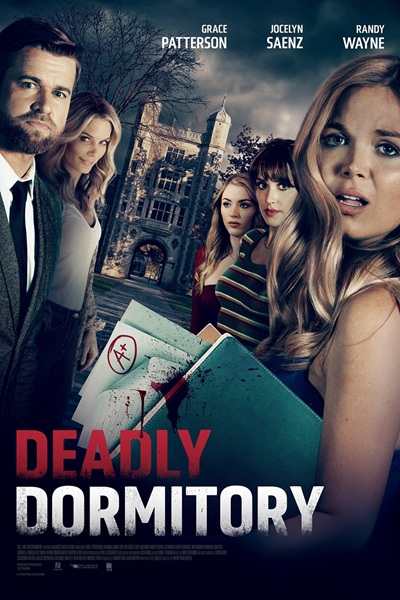
Lifetime For October: Deadly Dorm (dir by Brent Ryan Green)


This is one of those Lifetime films that has several different titles. The poster says Deadly Dormitory. Letterboxd claims that the title is Deadly Dorm. If you want to watch this film on Prime, you’ll have to look up College Professor Obsession. Me, I’m going to go with Deadly Dorm because that’s the easiest to say and the quickest title to type.

First aired in 2021, Deadly Dorm tells the story of Jenny Willis (Grace Patterson), a high school track star who is recovering from a knee injury. She’s finally well enough to accept a partial scholarship to an exclusive college. She tells her parents that she’s willing to go to a state school, but her parents insist that they will be able to pay for college. The whole opening of the movie reminded me of that old commercial they would show where recent high school graduates would record themselves saying, “I am going to college,” as if that was some sort of rare thing. I remember one guy who said, “It’s oh-fish-ee-al,” and I was just like, “Maybe don’t say it like that once you’re on campus.”

Anyway, Jenny enrolls in the college and moves into the dorm. Everyone she meets acts shocked when they hear which dorm room she’ll be moving into. It turns out that the room was previously occupied by a girl who died under mysterious circumstances. She was on the roof of the dorm, and she either fell, was pushed, or jumped. Jenny freaks out when she realizes that she’s going to be sleeping in the dead girl’s bed. Seriously, Jenny, just buy some new sheets and calm down.

Jenny is scandalized when her psychology professor (Randy Wayne) tells her that, if she wants to get better grades, she should try dressing a little better and showing off her legs and cleavage when she comes to class. Jenny is upset, and she has every right to be, even though I do agree that Jenny’s wardrobe is a bit on the frumpy side. Jenny’s roommate and new best friend, Beth (Johanna Liauw), says that the professor is a jerk but he also has tenure, so maybe it would be a good idea for Jenny to just give him what he wants.

Jenny starts to investigate on her own, and she soon comes to believe that the dead girl was also harassed by the professor. What if the professor killed the girl who used to live in Jenny’s dorm room? What if the professor has killed several people on campus? Does tenure cover that? It probably does at a private institution like this one. Jenny really should have gone to a state school.

On the one hand, I appreciated that this film had a lot of twists and turns in the plot. It embraced the melodrama, and I support that. I have to admit, though, that Jenny and her overprotective mother (Jocelyn Saenz) both kind of got on my nerves. Jenny was such a generic character that I actually felt sorry for her roommates. One character ends up seriously injured as a result of helping out Jenny, and it was hard not to notice that Jenny didn’t really seem to feel much guilt about that. When it came to college friendships, my firm rule was that I didn’t want to be dragged into anyone else’s drama, and Jenny doesn’t seem like she would have respected that.

The best scene in the film was when Jenny tried to stand up to her professor in the middle of class and the professor responded by announcing that she had borderline personality disorder and all of the other students just nodded in agreement. That felt like the most realistic scene in the film, as it captured how people will believe anything as long as it’s said by someone in authority.

I Watched Heart Of The Country (2013, Dir. by John Ward)


After her husband is arrested for financial fraud, country singer Faith (Jana Kramer) returns home to North Carolina and reconnects with her estranged family.  Her father (Gerald McRaney) is there to offer support and small-town, no-nonense wisdom and she’s going to need all of it when she has to choose between the hot local doctor and her repentant husband.

Because Faith’s father was dying of a brain tumor, I assumed this was a Nicholas Sparks movie but it wasn’t.  It was just a close copy.  Heart of the Country was a movie about the importance of keeping your marriage together, even if your husband was involved in a Ponzi scheme!  Faith’s husband (Randy Wayne) didn’t have anything to do with the scheme but he knew it was going on at his firm and he didn’t say anything.  When he thinks about rejecting a plea deal that would keep him out of prison because it would mean admitting his guilt and embarrassing his old money family, Faith’s father tells him to be a man and admit that he knew what was going going on at his firm.

Other than some mild language, Heart of the Country could have easily passed for a Hallmark movie.  I didn’t agree with Faith’s decision at the end but I did like the way the movie portrayed the relationship between her and her father.  Gerald McRaney was really good in the role.  It was the last movie that I watched yesterday and I’ll give it a mild recommendation just because of McRaney and some of the music on the soundtrack.  If you’re into Hallmark-style movies, this one was okay.

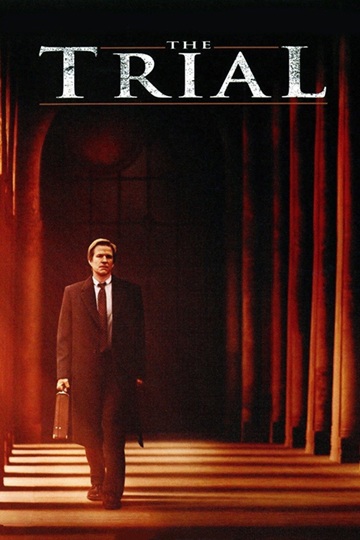
October Positivity: The Trial (dir by Gary Wheeler)


In 2010’s The Trial, Matthew Modine stars as Mac.

Mac is a Southern lawyer, even though it’s been a while since he practiced.  After his wife and children were killed in a car accident, Mac decided to retire from practicing law but he never surrendered his license.  A judge (Rance Howard) reaches out to him, asking him to serve as a public defender for Pete Thomason (Randy Wayne), a young man who has been accused of murdering his girlfriend.  The evidence is stacked against Pete and there are plenty of wealthy people who, for various reasons, want Pete to quickly be convicted.  Mac takes the case because he can tell that Pete is being railroaded.  When he discovers that Pete will possibly be facing the death penalty if he’s convicted, the case becomes very personal for Mac.

The prosecuting attorney (Bob Gunton) has managed to find a doctor (Brett Rice) who is willing to testify that Pete is a sociopath.  (The doctor has a reputation for finding just about anyone on trial to be a sociopath.)  Mac finds a doctor of his own, Dr. Anne Wilkes (Clare Carey), his testifies that Pete is nowhere near being a sociopath.  The problem is that Pete has no memory of what happened the night of the murder.  Mac may believe that Pete is innocent but can he convince the jury when the evidence all seems to suggest otherwise?

Like The List, The Trial was based on a novel by Robert Whitlow and it was directed by Gary Wheeler.  I was pretty hard on The List in last night’s review but I actually rather enjoyed The Trial, which was a solid and well-made legal thriller.  (The film’s status as a faith-based film largely comes from a scene in which Mac quotes the Book of Provers in regards to how, during a trial, it’s easy to believe the first person who speaks but it’s equally important to listen to how the accused replies.)  I enjoyed the twists and turns of the plot and the film’s ending worked well.  Though the film had a a made-for-television feel to it (despite having been a theatrical release), it still held and rewarded my interest.

It helped that the cast was well-selected and everyone gave good performances.  Matthew Modine, in particular, gave a strong performance as Mac, playing him not as being a saint but instead as being someone who was just determined to give his client the defense he deserved and to ultimately do the right thing.  Robert Forster played Mac’s brother-in-law and lead investigator and he brought his own brand of world-weary determination to the part.  Nobody plays a smug prosecutor as well as Bob Gunton, though it should be noted that the character himself never became a caricature.  Rance Howard was the ideal judge, tough but fair.  Randy Wayne was sympathetic as the confused Pete.  The cast really brought the film’s world to life.

I always enjoy a good legal thriller and The Trial was certainly that.

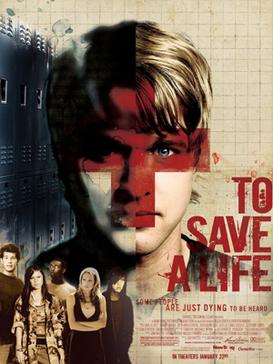
October Positivity: To Save A Life (dir by Brian Baugh)


The 2009 film, To Save A Life, tells the story of two friends.

When they were children, Roger saved Jake’s life by pushing him out of the way of a car.  Roger ended up with a permanent limp while Jake was able to continue playing basketball.  By the time they start high school, Jake (now played by Randy Wayne) is a basketball star while Roger (Robert Bailey, Jr.) is an outcast.  Jake and Roger start to drift apart, with Jake even abandoning Roger so that he can go to a party with his popular new girlfriend, Amy (Deja Kreutzberg).  By the time that they’re seniors, Jake and Roger barely acknowledge each other’s existence.  When Roger brings a gun to school and kills himself in front of his classmates, Jake is wracked with guilt.  When Jake goes to Roger’s funeral, he discovers that he’s the only one of Roger’s classmates who bothered to show up.

Jake tries to go back to his normal life.  He plays basketball.  He dates Amy.  He continues to be the school’s beer pong champion.  He desperately seeks approval from his mother and his father, both of whom are too busy dealing with their own failing marriage to pay much attention to Jake.  However, Jake cannot shake the feeling that he not only betrayed Roger but that his current life is empty.

To the shock of everyone, Jake starts to attend the meetings of a church youth group.  Jake gets to know the other members of the group and discovers that quite a few of them are not particularly sincere in their faith.  The local preacher’s kid, Danny (Bubba Lewis), tells Jake that the church’s youth pastor, Chris (Joshua Weigel), is only using him because he knows that Jake is a popular student and Chris believes that Jake will bring more members into the group.  When Jake convinces Amy to attend church with him, she finds the whole experience to be weird and off-putting.  When she tells Jake that he’s pushing her too hard to be a part of his new group, it’s hard not to feel that she has a point and, fortunately, Jake realizes that she has a point.  Later, she reveals a secret that could change both her life and Jake’s life forever.

With the help of his friend Andrea (Kim Hidalgo), Jake starts to try to reach out to all the other students who, like Roger, believe themselves to be outcasts.  For his efforts, he is shunned not only be his former friends but also by several members of the youth group.  When Jake befriends troubled Johnny Garcia (Sean Michael Afable), Johnny is framed for a crime he didn’t commit….

I’ve reviewed several faith-based films this month, mostly because I felt it would serve as an interesting and occasionally humorous counterpoint to all of the horror reviews.  For the most part, I’ve been fairly snarky in my reviews and I think that snark is justified.  Faith-based films, no matter how sincere they may be, are often rather cringey to sit through.  That said, I actually really liked To Save A Life, which is a generally well-acted, well-directed, and not particularly preachy film.  Unlike a lot of other faith films, To Save A Life doesn’t idealize Jake’s experience.  His problems don’t disappear once he starts going to church and the film makes clear that his guilt over Roger’s death is something that he will always carry with him.  Instead, the film’s emphasis is less on preaching at people and more on just treating them decently and with respect.  The film is willing to concede that Amy has a point when she says that the relentless positivity of the church youth group is all a bit much and that the members themselves can be just as judgmental and hypocritical as anyone else in the world.  Indeed, the film stands out from other faith-based films by featuring a villain who largely hides his activities behind the fact that his father is a preacher.  The film benefits from a cast who, for the most part, all give naturalistic performances.  Randy Wayne and Kim Hidalgo especially do a good job of making their characters seem like actual human beings as opposed to idealized symbols.

To Save a Life is actually pretty good.  And that’s a good note on which to end this October Positivity series.