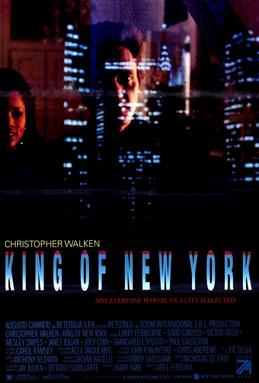
Drug kingpin Frank White (Christopher Walken) has been released from prison and is again on the streets of New York City. Frank might say that he’s gone straight but, as soon as he’s free, he’s partying with his old crew (including Laurene Fishburne, Steve Buscemi, Giancarlo Esposito, and others). While Frank’s agent (Paul Calderon) goes to all of the other city’s gangsters and explains that they can either get out of Frank’s way or die, three detectives (Victor Argo, David Caruso, and Wesley Snipes) make plans to take Frank out by any means necessary. Meanwhile, Frank is donating money to politicians, building hospitals, and presenting himself as New York’s savior.
KingofNewYork is the epitome of a cult film. Directed by Abel Ferrara, the dark and violent King of New York was originally dismissed by critics and struggled to find an audience during its initial theatrical run. (It was lumped in with and overshadowed by other 1990 gangster films like Goodfellas and Godfather Part III.) But it was later rediscovered on both cable and home video and now it’s rightly considered to be a stone cold crime classic. Walken gives one of his best performances as Frank White and that’s not a surprise. The film was clearly made to give Walken a chance to show off what he could do with a lead role and Walken captures Frank’s charisma and humor without forgetting that he’s essentially a sociopath. Walken gives a performance that feels like James Cagney updated for the end of the 80s. What’s even more impressive is that all of the supporting characters are just as memorable as Walken’s Frank White. From Laurence Fishburne’s flamboyant killer to David Caruso’s hotheaded cop to Paul Calderon’s slippery agent to Janet Julian’s morally compromised attorney, everyone gives a strong performance. (I’m usually not a Caruso fan but he’s legitimately great here.) They come together to bring the film’s world to life. Everyone has their own reason for obsessing on Frank White and his return to power. I’ve always especially appreciated Victor Argo as the weary, veteran detective who finds himself trapped by Caruso and Wesley Snipes’s impulsive plan to take down Frank White. Frank White and the cops go to war and it’s sometimes hard to know whose side to be on.
Director Abel Ferrara has had a long and storied career, directing films about morally ambiguous people who are often pushed to extremes. Personally, I think KingofNewYork is his best film, a portrait of not just a criminal but also of a city that combines the best and the worst of human nature. The action is exciting, the cast is superb, and Frank’s justifications for his behavior sometimes make a surprising amount of sense. Thought there’s occasionally been speculation that it could happen, there’s never been a sequel to King of New York and it doesn’t need one. KingofNewYork is a film that tell you all that you need to know about Frank White and the city that he calls home.
In honor of Tom Cruise’s 63rd birthday, I decided to watch THE FIRM, which is based on the 1991 novel from author John Grisham. Cruise stars as the brilliant Harvard law graduate Mitch McBride, who convinces his wife Abby (Jeanne Tripplehorn) to move to Memphis, TN, so he can join the prestigious Memphis law firm of Bendini, Lambert & Locke. With the help of his veteran mentor Avery Tolar (Gene Hackman), Mitch seems to be excelling at his job, and everything is just so perfect. Unfortunately, the good times don’t last as Mitch starts to notice some suspicious stuff going on with the firm, beginning with the mysterious deaths of two of his fellow attorneys. He’s soon approached by FBI agents, led by Wayne Tarrance (Ed Harris), who tell him that there are nefarious deeds taking place at the firm, including the laundering of money for the Chicago mob. When Mitch starts questioning the activities of the firm, he finds himself the subject of blackmail and intimidation from the firm’s security officer William Devasher (Wilford Brimley) because the firm will do anything to protect its secrets. Mitch is soon caught between betraying his corrupt employers, who are threatening to kill him, and the FBI, who is pressuring him to expose the firm’s criminal activities. Not wanting to lose his life, go to jail, or get disbarred, Mitch devises an extremely risky plan to outsmart the firm and the FBI, but is even he brilliant enough to pull this one off?!
Back in the early 90’s, it seemed that every other movie being released was adapted from a John Grisham novel, and the very first of those adaptations was THE FIRM in 1993. Extremely successful at the box office, THE FIRM grossed over $270 million worldwide, setting the stage for five new movies based on Grisham novels over the next five years. THE FIRM was not only financially successful, it’s also an extremely effective movie that showcases a 30-year-old Tom Cruise at his very best. Director Sydney Pollack crafted a creepy and paranoid thriller, using a slow-burn buildup that relies on Cruise’s ability to believably go from naïve and starstruck at the beginning, to scared and desperate during the middle portion of the film, and ultimately to resourceful and intelligent at the end, as he navigates the dangerous situations he finds himself in. It’s a dynamic, intense performance, and even with a huge supporting cast of excellent actors around him, Cruise dominates every frame of this film. Other performances that stand out to me are Jeanne Tripplehorn as Mitch’s wife Abby, Wilford Brimley as the firm’s enforcer, Gary Busey and Holly Hunter as a private investigator and his administrative assistant from Little Rock, and David Strathairn as Mitch’s jailbird brother in Arkansas. Gene Hackman is good in his role as Mitch’s corrupted mentor Avery Tolar, but his character is not one of my favorites from the legendary actor. His character has accepted his corruption and learned to cope with it over the years through alcohol and womanizing, just so he can keep making the money. He knows better and that’s the part that ultimately makes him the most pathetic. Ed Harris is also good in the film as the FBI Agent, but his character is kind of an asshole, and it’s fun to see Mitch outsmart him.
I also like the Memphis, Tennessee locations showcased in THE FIRM, locations that I’ve been to many times, such as Beale Street, Mud Island, and The Peabody Hotel. Early in the movie, Cruise’s character flips right along with the “Beale Street flippers,” popular Beale Street entertainers who perform nightly for tips. I’ve given them some of my cash over the years! And the chase sequence that starts at Mud Island and spills over into downtown Memphis is one of the most exciting parts of the movie. My home state of Arkansas even gets in on the action when Mitch meets FBI agent Wayne Tarrance at the Southland Greyhound Park located in West Memphis, Arkansas. The greyhound race track no longer exists at that location, as the final dog race was held on December 31, 2022. The site has now become the Southland Casino, one of three operating casinos in Arkansas, with the other two being the Oaklawn Casino in Hot Springs and The Saracen Casino in Pine Bluff. I also like the fact that the sleazy private investigator, played by Gary Busey, is from Little Rock, Arkansas. I commute to Little Rock daily to work at my accounting and tax firm, and it’s fun imagining that there could be an “Eddie Lomax” somewhere around here.
THE FIRM may not be a perfect film… some fat could have been trimmed out as it runs for over two and a half hours, a lot of time for a “thriller;” and while effective on paper, I also can’t help but wonder if the resolution would have worked quite as well in real life as it’s portrayed in the film. I still love the movie and consider it to be one of Tom Cruise’s best. I revisit it quite often, and I’m glad his birthday gave me another excuse to watch it again today!
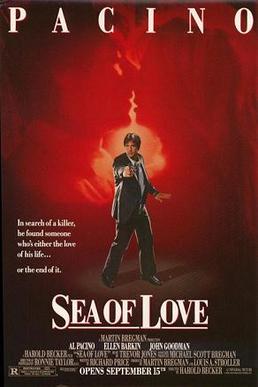
In New York City, someone is ritualistically murdering the men who are placing rhyming personal ads in a tabloid newspaper. Assigned to the case is Frank Keller (Al Pacino), an alcoholic burn-out whose wife just left him for another cop. Keller and his partner (John Goodman) decide to go undercover. Frank places a rhyming personal ad of his own and then goes to a restaurant to see who shows up. When Helen Cruger (Ellen Barkin) answers the ad, it leads to a relationship between Frank and Helen. Frank is falling for Helen but what if she’s the murderer?
Sea of Love is a superior thriller, even though it doesn’t really work as a mystery. As soon as you see a certain person’s name in the cast list, you’re going to guess who the killer is because that person is always the killer. Sea of Love isn’t really about the mystery, though. It’s about people looking something that’s missing from their lives and realizing that the world is passing them by. The movie works because of the performances of Al Pacino and Ellen Barkin, cast as two lonely middle-aged people who are desperately looking for some sort of connection. Helen and Frank are both in their 40s and wondering if their current situation is really as good as it’s going to get. The film uses Frank’s fear that Helen could be the killer as a metaphor for the fear that anyone feels when they are first starting to open up to someone. Both Pacino and Barkin give emotionally raw and poignant performances. I don’t think I’ve ever seen Al Pacino look as miserable as he did for the majority of Sea of Love. This was Pacino’s first film role after the disaster of Revolution and the movie’s box office success was revived Pacino’s career and convinced him to give movies a try again.
Director Harold Becker captures the feel of New York at its grittiest and least welcoming and Richard Price’s script is full of priceless dialogue. This is one of the rare films in which everyone has something intelligent or meaningful to say. Featuring a strong supporting cast and career-best performances from Ellen Barkin and Al Pacino, Sea of Love is much more than just another cop film.
Welcome to Retro Television Reviews, a feature where we review some of our favorite and least favorite shows of the past! On Mondays, I will be reviewing Miami Vice, which ran on NBC from 1984 to 1989. The entire show can be purchased on Prime!
This week, Crockett and Tubbs get involved in a theft and a theatrical troupe.
Episode 3.23 “Everybody’s In Show Business”
(Dir by Richard Compton, originally aired on May 1st, 1987)
The theft of a valuable briefcase that belonged to drug lord Don Gallego (Paul Calderon) leads the Vice Squad to Mikey (Michael Carmine), an ex-con who is now a published poet and runs his own theater group specifically for people who have just gotten out of prison. Unfortunately, Mikey has once again started using drugs (“Once a junkie, always a junkie,” Tubbs scornfully says) and he desperately needs the money that he can make by selling the briefcase back to Gallego. Gallego, for his part, will do anything to get that briefcase back.
This episode had a few good things going for it. Paul Calderon gave a strong performance as Don Gallego, a ruthless drug lord who dispenses threats and violence with style. (Calderon was also in King of New York as the untrustworthy Joey D. and he played the bartender, English Bob, in Pulp Fiction. Reportedly, Calderon was the second choice for the role of Jules Winnfield.) Mikey’s young brother is played by Benicio Del Toro and, while Del Toro doesn’t really get to do much in this episode, his appearance continues Miami Vice‘s tradition of featuring future stars amongst its supporting cast.
That said, Michael Carmine’s performance as Mikey didn’t really work for me. Mikey was meant to be wild, charismatic, and touched with a hint of genius but Carmine overacts to such an extent that it becomes impossible to take Mikey seriously as any of those three things. A scene where he portrays his version of Elvis is meant to be a showstopper but it just left me cringing. Sonny, somewhat uncharacteristically, is portrayed as being an admirer of Mikey’s poetry. (I thought Tubbs was supposed to be the sensitive one.) Unfortunately, the poetry that we hear doesn’t sound that impressive. Sonny has been portrayed as being such a cynic in the past that it’s hard to buy the idea that he would be so moved by Mikey. If anything, it almost feels as if Sonny and Tubbs have switched roles in this episode. Usually, Tubbs is the one who isn’t cynical enough.
The episode ends on something of an off-note, with Mikey apparently being near death but somehow managing to escape the hospital after he’s visited by Crockett and Tubbs. This is the sort of thing that would perhaps have worked if Mikey was a recurring character. If they had brought back Noogie and had him as the poetry-writing junkie in over his head, this episode probably would have worked. But we don’t really know Mikey and, from what we see of him, he comes across as being a bit of a jerk. So, what do we care if he gets in trouble?
Welcome to Retro Television Reviews, a feature where we review some of our favorite and least favorite shows of the past! On Mondays, I will be reviewing Miami Vice, which ran on NBC from 1984 to 1989. The entire show is currently streaming on Tubi!
This week, the second season with a two-hour long premiere! Crockett and Tubbs are going to New York!
Episode 2.1 and 2.2 “The Prodigal Son”
(Dir by Paul Michael Glaser, originally aired on September 27th, 1985)
The second season premiere of Miami Vice opens with a series of set pieces.
In Panama, Crockett and Tubbs visit a secret military base in the jungle and are disgusted to learn how the Panamanian military gets information about drug smugglers. Tubbs and Crockett find one horribly tortured man in a tent. Tubbs gives him a drink of water and gets what information he can from the man. Crockett and Tubbs leave the tent. A gunshot rings out as the involuntary informant is executed. When the shot rings out, both Crockett and Tubbs turn back to the tent in slow motion, stunned by the brutality of their allies in the Drug War. Indeed, it’s hard not to compare the scene to the famous photograph of a South Vietnamese general executing a communist during the Vietnam War.
The Vietnam analogy continues with the next scene. In the Everglades, Crockett, Tubbs, and the entire Vice Squad work with the DEA to ambush the Revilla cousins as they bring drugs into the U.S. Sitting in the swamp, Crockett compares the experience to Vietnam, suggesting that the war on the drugs is just as futile and as costly. And indeed, it’s hard not to notice that every drug dealer that Crockett and Tubbs has taken down over the course of this show has immediately been replaced by another. The Revillas are just another in a long line of people getting rich off of other people’s addictions.
After the bust goes down, Crockett and Tubbs arrives at a celebratory party, just to discover that almost of all of the undercover DEA agents have been murdered and Gina has been seriously wounded. There is something very haunting about this scene, with Crockett and Tubbs rushing through a penthouse and seeing a dead body in almost every room.
At a meeting in a stark office, the head DEA agent explains that his agency has been compromised and all of his undercover agents have been unmasked. Someone has to go to New York and work undercover to take down the Revillas but it can’t be any of his people. Since the Revillas are smuggling their stuff in through Miami, Miami Vice has jurisdiction. Paging Crockett and Tubbs!
Working undercover as Burnett and Cooper, Crockett and Tubbs visit a low-level drug dealer (played by Gene Simmons) who lives on a yacht and who gives them the name of a connection in New York City.
From there, Miami Vice moves to New York City, where Crockett and Tubbs meet a low-level criminal named Jimmy Borges (played by an almost impossibly young Penn Jillette) and they try to infiltrate the Revilla organization. Along the way, Tubbs meets up with Valerie (Pam Grier) and discovers that she has apparently lost herself working undercover. Meanwhile, Crockett has a brief — and kind of weird — romance with a photographer named Margaret (Susan Hess).
(“I like guns,” she says when Crockett demands to know why she stole his.)
With Crockett and Tubbs leaving Miami for New York in order to get revenge for a colleague who was wounded during an operation, The Prodigal Son almost feels like the pilot in reverse. Also, much like the pilot, the exact details of The Prodigal Son‘s story are often less important than how the story is told. This episode is full of moody shots of our heroes walking through New York while songs like You Belong To The City play on the soundtrack. (There’s also a song from Phil Collins, undoubtedly included to bring back memories of the In The Air Tonight scene from the pilot.) It’s all very entertaining to watch, even if the story itself doesn’t always make total sense. Indeed, you really do have to wonder how all of these criminals keep falling for Sonny’s undercover identity as Sonny Burnett. You would think that someone would eventually notice that anyone who buys from Sonny Burnett seems to get busted the very next day.
Stylish as the storytelling may be, this episode actually does have something on its mind. Those lines comparing the War on Drugs to the Vietnam Conflict was not just throwaways. Towards the end of the episode, Crockett and Tubbs follow a lead to the offices of J.J. Johnston (Julian Beck, the ghost preacher from Poltergeist II). The skeletal Johnston is an investor of some sort. He has no problem admitting that he’s involved in the drug trade, presumably because he knows that there’s nothing Crockett and Tubbs can do to touch him. Upon meeting the two cops, he immediately tells them exactly how much money they have in their checking accounts. He points out that they’re poor and they’re fighting a losing war whereas he’s rich and he’s making money off of a losing war. Beck gives a wonderfully smug performance as Johnston and it should be noted that, of all of the episode’s villains, he’s the only one who is not brought to any sort of justice. Val almost loses herself. Tubbs and Crockett don’t even get a thank you for their hard work. The somewhat sympathetic Jimmy Borges ends up dead while the Revillas were undoubtedly been replaced by even more viscous dealers. Meanwhile, J.J. Johnston relaxes in his office and counts his money. This is the No Country For Old Men of Miami Vice episodes.
This episode is also full of familiar faces. Charles S. Dutton, Kevin Anderson, Anthony Heald, Miguel Pinero, James Russo, Bill Smtirovich, Zoe Tamerlis, Paul Calderon, and Louis Guzman, they all show up in small roles and add to show’s rather surreal atmosphere. This is Miami Vice at its most dream-like, full of people you think you might know despite the fact that they’re doing things of which you don’t want to be a part.
As for the title, The Prodigal Son is Tubbs and he is tempted to stay in New York City. But, in the end, he joins Crockett on that flight back to Miami. It’s his home.
Welcome to Retro Television Reviews, a feature where we review some of our favorite and least favorite shows of the past! On Mondays, I will be reviewing Miami Vice, which ran on NBC from 1984 to 1989. The entire show is currently streaming on Tubi!
This week, Crockett and Castillo take down some home invaders. Yes, Crockett and Castillo. Not Crockett and Tubbs. Read on to find out why.
Episode 1.19 “The Home Invaders”
(Dir by Abel Ferrara, originally produced by March 15th, 1985)
Always do your research.
Philip Michael Thomas does not appear in this episode of Miami Vice. At the start of the episode, it’s mentioned that he’s in New York, visiting Valerie Gordon. It’s a line that sounds like it was written at the spur of the moment and, when I heard it, I assumed that there had been some sort of behind-the-scenes drama between Thomas and the producers. Fortunately, before I went with that and said something snarky, I actually looked up the reason for Thomas’s absence and I discovered that he was injured performing a stunt in the previous episode. Thomas missed this episode because he was recovering. As well, this was the only episode that he missed during the entire run of Miami Vice.
Thomas may be absent but that doesn’t mean that crime is going to take a break in Miami. A series of violent home invasions lead to Crockett and Castillo getting temporarily assigned to the robbery division. Crockett is excited to be working under his former boss and mentor, Lt. John Malone (Jack Kehoe). Castillo quickly realizes that Malone has gotten rusty and that his investigation into the robberies has been sloppy.
This is a moody episode, with the emphasis as much on Crockett’s disillusionment with his old boss as with the efforts to catch the home invaders. That said, the home invaders are a scary bunch. Led by Esai Morales and David Patrick Kelly, they are totally ruthless and willing to kill anyone who fails to move quickly enough. The scenes in which they break into various mansions and threaten the inhabitants are difficult to watch and it definitely captures the trauma of having your personal space invaded and your sense of safety destroyed.
(When I was 17, our house was broken into and, for months, I couldn’t sleep through the night. Almost every night, I was woken up by what I thought was the sound of someone breaking into my house and I would end up walking through the house in my nightclothes, carrying a golf club for protection. One night, I nearly hit my sister when she came out of the kitchen with a midnight snack. It may sound funny now but, at the time, it was terrifying.)
It ends with a shootout that’s violent even by the standards of Miami Vice. Castillo and Crockett gun down the bad guys and it’s hard not to notice that, while Crockett seems to be clearly upset by the fact that he had to kill a few men, Castillo barely shows any emotion at all. Castillo is effective because he holds back his feelings about everything. That’s also why Castillo, and not Crockett, is capable of seeing that Lt. Malone is past his prime. With the home invaders neutralized, Malone tells Crockett that he’s quitting the force. His days of being an effective detective are over. The job and all of the terrible stuff that he deals with on a daily basis has left him burned out and it’s hard not to notice that he and Crockett are the same age. Fighting crime in Miami takes a toll.
This episode was directed by Abel Ferrara, who keeps the action moving quickly and who fills the screen with ennui-drenched images of people who are not sure whether they’re making any difference at all. This is an effective episode, even without the presence of Ricardo Tubbs.
I was going to pick another heavy metal video for today but then Lisa told me that today is Martin Scorsese’s birthday and I realized which video I had to pick. I was actually surprised to see that no one had ever picked Bad for music video of the day in the past. This is one of those videos that epitomized an era and it was directed by Martin Scorsese.
Here’s the long version, which was rarely played on MTV.
Here’s the shorter version for the Too Long, Didn’t Watch crowd.
You can’t fault Scorsese’s gritty direction, especially in the early black-and-white half of the video. Michael Jackson is not really convincing as someone who was ever considered to be “bad,” especially when he’s going up against Wesley Snipes, but there’s not much Scorsese could have done about that. Snipes is not the only familiar actor to appear in this video. The drug dealer is played by Paul Calderon, who played the bartender in Pulp Fiction. The voice of Michael Jackson’s mother is supplied by Roberta Flack. Cinematographer Michael Chapman and editor Thelma Schoonmaker, two regular Scorsese collaborators, also worked on this video. The script was written by novelist Richard Price.
I can’t hear this song without thinking about Weird Al Yankovic.
Garrison, New Jersey is a middle class suburb that is known as Cop Land. Under the direction of Lt. Ray Donlan (Harvey Keitel), several NYPD cops have made their home in Garrison, financing their homes with bribes that they received from mob boss Tony Torillo (Tony Sirico). The corrupt cops of Garrison, New Jersey live, work, and play together, secure in the knowledge that they can do whatever they want because Donlan has handpicked the sheriff.
Sheriff Freddy Heflin (Sylvester Stallone) always dreamed of being a New York cop but, as the result of diving into icy waters to save a drowning girl, Freddy is now deaf in one ear. Even though he knows that they are all corrupt, Freddy still idolizes cops like Donlan, especially when Donlan dangles the possibility of pulling a few strings and getting Freddy an NYPD job in front of him. The overweight and quiet Freddy spends most of his time at the local bar, where he’s the subject of constant ribbing from the “real” cops. Among the cops, Freddy’s only real friend appears to be disgraced narcotics detective, Gary Figgis (Ray Liotta).
After Donlan’s nephew, Murray Babitch (Michael Rapaport), kills two African-American teenagers and then fakes his own death to escape prosecution, Internal Affairs Lt. Moe Tilden (Robert De Niro) approaches Freddy and asks for his help in investigating the corrupt cops of Garrison. At first, Freddy refuses but he is soon forced to reconsider.
After he became a star, the idea that Sylvester Stallone was a bad actor because so universally accepted that people forgot that, before he played Rocky and Rambo, Stallone was a busy and respectable character actor. Though his range may have been limited and Stallone went through a period where he seemed to always pick the worst scripts available, Stallone was never as terrible as the critics often claimed. In the 90s, when it became clear that both the Rocky and the Rambo films had temporarily run their course, Stallone attempted to reinvent his image. Demolition Man showed that Stallone could laugh at himself and Cop Land was meant to show that Stallone could act.
For the most part, Stallone succeeded. Though there are a few scenes where the movie does seem to be trying too hard to remind us that Freddy is not a typical action hero, this is still one of Sylvester Stallone’s best performances. Stallone plays Freddy as a tired and beaten-down man who knows that he’s getting one final chance to prove himself. It helps that Stallone’s surrounded by some of the best tough guy actors of the 90s. Freddy’s awkwardness around the “real” cops is mirrored by how strange it initially is to see Stallone acting opposite actors like Harvey Keitel, Robert De Niro, and Ray Liotta. Cop Land becomes not only about Freddy proving himself as a cop but Stallone proving himself as an actor.
The film itself is sometimes overstuffed. Along with the corruption investigation and the search for Murray Babitch, there’s also a subplot about Freddy’s unrequited love for Liz Randone (Annabella Sciorra) and her husband’s (Peter Berg) affair with Donlan’s wife (Cathy Moriarty). There’s enough plot here for a Scorsese epic and it’s more than Cop Land‘s 108-minute run time can handle. Cop Land is at its best when it concentrates on Freddy and his attempt to prove to himself that he’s something more than everyone else believes. The most effective scenes are the ones where Freddy quietly drinks at the local tavern, listening to Gary shoot his mouth off and stoically dealing with the taunts of the people that he’s supposed to police. By the time that Freddy finally stands up for himself, both you and he have had enough of everyone talking down to him. The film’s climax, in which a deafened Freddy battles the corrupt cops of Garrison, is an action classic.
Though the story centers on Stallone, Cop Land has got a huge ensemble cast. While it’s hard to buy Janeane Garofalo as a rookie deputy, Ray Liotta and Robert Patrick almost steal the film as two very different cops. Interestingly, many members of the cast would go on to appear on The Sopranos. Along with Sirico, Sciorra, Patrick, and Garofalo, keep an eye out for Frank Vincent, Arthur Nascarella, Frank Pelligrino, John Ventimiglia, Garry Pastore, and Edie Falco in small roles.
Cop Land was considered to be a box office disappointment when it was released and Stallone has said that the film’s failure convinced people that he was just an over-the-hill action star and that, for eight years after it was released, he couldn’t get anyone to take his phone calls. At the time, Cop Land‘s mixed critical and box office reception was due to the high expectations for both the film and Stallone’s performance. In hindsight, it’s clear that Cop Land was a flawed but worthy film and that Stallone’s performance remains one of his best.
Gerard Depardieu is naked a lot in Welcome to New York and I know you’re probably being snarky and sarcastically thinking, “Well, then I’m definitely going to track down this film…” but actually, the frequent display of Depardieu’s body gets to the heart of what makes his performance so memorable. Playing an extremely unsympathetic role, Depardieu doesn’t hide the character’s depravity from the audience. He reveals every inch of the character, from his flabby body to his empty soul. It takes courage to bring such an unsympathetic character to life and talent to keep the audience watching and fortunately, Depardieu has both of those.
Welcome to New York opens with Depardieu (as himself) talking to a group of reporters and explaining why he’s decided to play a character based on Dominique Strauss-Kahn in Abel Ferrara’s upcoming movie. It’s an interesting way to start, both because it features Depardieu’s scornful opinion of politicians and because it leaves no doubt that, even if Depardieu’s character has been renamed Devereaux, Welcome to New York is directly based on the Dominique Strauss-Kahn case.
(Dominique Strauss-Kahn, of course, was the wealthy French socialist who many thought was going to be the next President of France until he was arrested after raping a hotel maid in New York City. As a wealthy and well-connected white man, he was acquitted of raping the maid, who neither wealthy, well-connected, or white. Throughout the trial, the usual collection of elitists complained about how Americans just didn’t understand French culture but, ultimately, Strauss-Kahn’s political career was ended by the scandal.)
Welcome to New York closely follows the facts of the Strauss-Kahn case. Wealthy banker and politician Devereaux is in New York on business. When he meets his daughter and her boyfriend, he spends the entire lunch asking them about their sex life. When he returns to his hotel, he and his business associates hire a group of prostitutes and have one of the most depressing orgies ever captured on film.
I have to admit that during these first part of the film, I was often tempted to turn off Welcome To New York. No, it wasn’t that the film was too explicit. Instead, my problem was that Devereaux was such a dull character. Devereaux has a lot of sex during the first third of the film but, at no point, does he seem to enjoy it. Instead, he is detached from everything happening around him and it doesn’t exactly make for compelling viewing.
But, as the film played out, I realized that we weren’t supposed to find Devereaux in any way compelling. Instead, Devereaux is portrayed as a hollow and empty shell. For him, sex is all about entitlement and power. After his is arrested for raping the hotel maid, Devereaux appears to be more surprised than anything else. Rather than feeling regret at being caught or even fear that he might be convicted, Devereaux seems to be shocked that a man of his wealth would be held responsible for his actions.
After Devereaux is arrested, the film’s pace picks up a bit. Devereaux’s wife, Simone (Jacqueline Bisset), flies to New York and takes over her husband’s defense. It’s not that Simone feels that Devereaux has been wrongly accused. In fact, Simone really doesn’t seem to care much for her husband in general. However, Simone is determined that Devereaux is going to be the next president of France and she certainly has no intention of allowing some American criminal case to stand in his way. Bisset gives a chilling performance as the almost fanatically driven Simone.
Soon, Devereaux is under house arrest and staying at a rented house. (For these scenes, Welcome to New York filmed in the same house that Strauss-Kahn stayed at during his trial.) It’s while locked away in the house that Devereaux finally starts to realize that he has gone too far. It’s in the house that Devereaux remembers the man he was once was and is forced to confront the man that he has become.
Welcome to New York is not always an easy film to watch but, thanks to Depardieu and Bisset’s ferocious performances, it’s a film that will reward patient viewers.
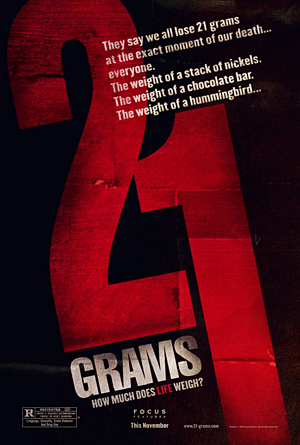
Remember how shocked a lot of us were when we first saw Birdman? Well, it wasn’t just because Birdman featured an underwear-clad Michael Keaton levitating in his dressing room. And it also wasn’t just because Birdman was edited to make it appear as if it had been filmed in one continuous take (though, to be honest, I would argue that the whole “one continuous shot” thing added little to the film’s narrative and was more distracting than anything else.) No, the main reason we were shocked was that Birdman was directed by Alejandro Gonzalez Inarritu and, when we thought of an Inarritu film, we thought of something like 2003’s 21 Grams.
It’s not easy to explain the plot of 21 Grams, despite the fact that 21 Grams does not tell a particularly complicated story. In fact, if anything, the plot of 21 Grams feels like something that either Douglas Sirk or Nicholas Ray could have come up with in the 50s. Indeed, the plot of 21 Grams is far less important than the way the Inarritu tells the story. (In that, the dark and grim 21 Grams does have something in common with the arguably comedic Birdman.)
Inarritu tells his story out of chronological order. That, in itself, is nothing spectacular. Many directors use the same technique. What distinguishes 21 Grams is the extreme to which Inarritu takes his non-chronological approach. Scenes play out with deceptive randomness and it is left to the viewer to try to figure out how each individual scene fits into the film’s big picture. As you watch 21 Grams, you find yourself thankful for little details like Sean Penn’s beard, the varying lengths of Naomi Watts’s hair, and the amount of sadness in Benicio Del Toro’s eyes because it’s only by paying attention to those little details can we piece together how once scene relates to another.
The film tells the story of three people whose lives are disrupted by the type of tragedies that the pre-Birdman Innaritu was best known for.
Sean Penn plays Paul Rivers, who is a sickly mathematician who desperately needs a new heart. He’s married to a Mary (Charlotte Gainsbourg), who devotes all of her time to taking care of him and is frustrated by Paul’s fatalistic attitude towards his condition. When Paul does finally get a new heart, he gets a new existence but is haunted by the fact that it has come at the expense of another man’s life.
Christina Peck (played by Naomi Watts) is a former drug addict who is now married with kids and who appears to have the perfect life. That is until her husband and children are tragically killed and, in her grief, Christina falls back into her old lifestyle. The formerly stable and happy Christina becomes obsessed with the idea of getting revenge for all that she has lost. Naomi Watts was deservedly nominated for an Oscar for her work here. Her vulnerable and emotionally raw performance holds your interest, even when you’re struggling to follow the film’s jumbled chronology.
And finally, there’s Jack Jordan (Benicio Del Toro). Like Christina, Jack is a former drug addict. Whereas Christina used the stability of family life to help her escape from her demons, Jack uses his new-found Christianity. And just as Christina struggles after she loses her family, Jack struggles after tragedy causes him to lose his faith. Like Paul, he struggles with why he’s been allowed to live while other have not. Del Toro was nominated for an Oscar here and, like Watts, he more than deserved the nomination.
(While Sean Penn was not nominated for his performance in 21 Grams, he still won the Oscar for his role in Mystic River.)
21 Grams is a powerful and deeply sad film, one that will probably shock anyone who only knows Inarritu for his work on Birdman. 21 Grams is not always an easy film to watch. Both emotionally and narratively, it’s challenging. But everyone should accept the challenge.
 Drug kingpin Frank White (Christopher Walken) has been released from prison and is again on the streets of New York City. Frank might say that he’s gone straight but, as soon as he’s free, he’s partying with his old crew (including Laurene Fishburne, Steve Buscemi, Giancarlo Esposito, and others). While Frank’s agent (Paul Calderon) goes to all of the other city’s gangsters and explains that they can either get out of Frank’s way or die, three detectives (Victor Argo, David Caruso, and Wesley Snipes) make plans to take Frank out by any means necessary. Meanwhile, Frank is donating money to politicians, building hospitals, and presenting himself as New York’s savior.


 Through the Shattered Lens