Cleaning Out The DVR Yet Again #16: Zoolander 2 (dir by Ben Stiller)


(Lisa recently discovered that she only has about 8 hours of space left on her DVR!  It turns out that she’s been recording movies from July and she just hasn’t gotten around to watching and reviewing them yet.  So, once again, Lisa is cleaning out her DVR!  She is going to try to watch and review 52 movies by Wednesday, November 30th!  Will she make it?  Keep checking the site to find out!)

zoolander_2_poster

On October 14th, I recorded Zoolander 2 off of Epix.

A sequel to the 2001 cult hit, Zoolander 2 came out earlier this year and got absolutely terrible reviews and quickly vanished from theaters.  Watching the film last night, I could understand why it got such terrible reviews.  Zoolander 2 is not only a terrible movie but it’s also a rather bland one.  Somehow, the blandness is even more offensive than the badness.

Zoolander 2 opens with Justin Bieber getting assassinated and Derek Zoolander (Ben Stiller) being forced to come out of retirement and discover why pop stars are being targeted.  And, of course, Zoolander can’t do it without the help of Hansel (Owen Wilson)!  Penelope Cruz is in the film as well, playing  Zoolander’s handler and essentially being wasted in a role that could have been played by anyone.

Oh!  And Will Ferrell returns as well.  Ferrell gives a performance that essentially shouts out to the world, “Fuck you, I’m Will Ferrell and no one is going to tell Will Ferrell to tone his shit down!”

Actually, I think everyone in the world is in Zoolander 2.  This is one of those films that is full of cameos from people who probably thought a silly comedy would be good for their image.  For instance, there’s a huge number of journalists who show up playing themselves.  Matt Lauer shows up and I get the feeling that we’re supposed to be happy about that.  There was a reason why people cheered when the sharks ate him in Sharknado 3.

You know who else shows up as himself?  Billy Zane!  And Billy Zane has exactly the right type of attitude for a film like this.  He shows up and he mocks the whole enterprise by giving the Billy Zaniest performance of Billy Zane’s career.  For that matter, Kiefer Sutherland also shows up as himself.  I’m not really sure what Kiefer was doing in the film but he makes sure to deliver all of his lines in that sexy growl of his.  Kiefer knows what we want to hear.

You may notice that I’m not talking about the plot of Zoolander 2.  That’s largely because I couldn’t follow the plot.  This is an incredibly complicated film but it’s not complicated in a funny way.  Instead, it’s complicated in a way that suggests that the film was made up on the spot.  It’s as if the cast said, “We’re all funny!  Just turn on the camera and we’ll make it work!”

The problem with Zoolander 2 is obvious.  The first film pretty much exhausted the comic possibilities of making a spy film about shallow and stupid models.  Don’t get me wrong — the first film did a good job but it’s not like it left any material untapped.  But I would ask you to indulge me as I imagine an alternate reality.

Consider this: Terrence Malick was reportedly a huge fun of Zoolander.

Let’s take just a minute to imagine a world in which Ben Stiller asked Terrence Malick to write and direct Zoolander 2.  And let’s say, just for the sake of argument, that Malick agreed!

Just think about it — 4 hours of Zoolander and Hansel staring up at the sky and thinking about nature.  “What is this thing that causes the heart of man to beat?” Zoolander asks.  “Are we nature or has nature become us?” Hansel replies.

That would have been a fun film!
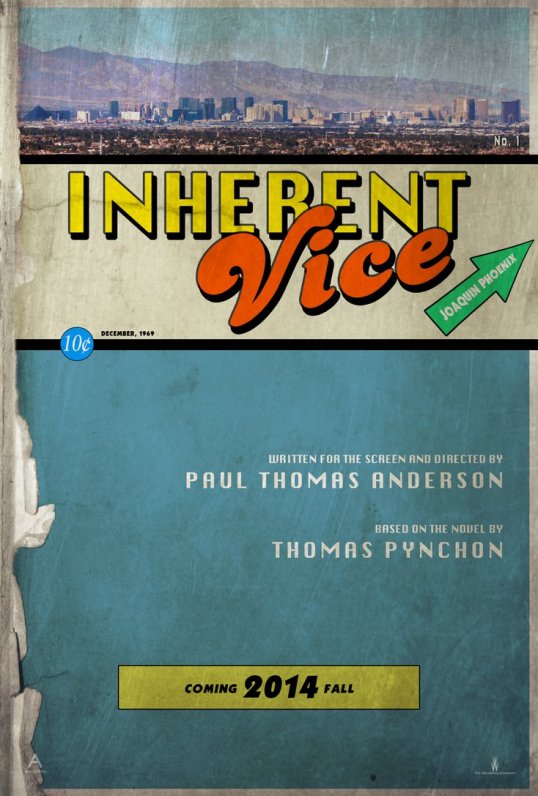
Film Review: Inherent Vice (dir by Paul Thomas Anderson)


Inherent-Vice-poster

One of the best things about Paul Thomas Anderson’s latest film, Inherent Vice, is that Doc Sportello, the private detective played by Joaquin Phoenix, is a real stoner.  He’s not one of those weekend smokers, who gets high on Saturday, brags about it on Sunday, and then spends the rest of the week interning at Vox.  For the entire 2 hour and 20 minute running time of Inherent Vice, Doc is stoned.  From the minute we first meet him to the end of the film, there is never one moment where Doc is not stoned.  Most stoner comedies feature a scene where the main character shocks everyone by turning down a hit because he’s dealing with something so important that he has to “keep his mind straight.”

Not so with Doc!

And, in Doc’s case, it definitely helps him out.  Inherent Vice tells a story that is so full of paranoia, conspiracy, and random connections that only a true stoner could follow it.  Much like Doc, the film often seems to be moving in a haze but occasionally, out of nowhere, it will come up with a scene or a line of dialogue or a detail that is so sharp and precise that it will force you to reconsider everything that you had previously assumed.

To be honest, if you are one of the people who watched Inherent Vice this weekend and could actually follow the film’s plot, then you’ve got a leg up on me.  (That said, I’ve still got pretty good legs so it all evens out.)  But, that’s not necessarily a complaint.  As befits a film based on a novel by Thomas Pynchon and directed by one of the most idiosyncratic filmmakers around, the twists and turns of Inherent Vice are deliberately meant to be obscure and confusing.  Characters appear and then vanish.  Clues are discovered and then forgotten.  Connections are hinted at but then never confirmed.  Inherent Vice ultimately serves a tribute to stoner’s paranoia and, as a result, the plot’s incoherence leads to a certain contact high.

The film takes place in California in the 1970s.  Doc is both a hippie and a private detective. His current girlfriend (Reese Witherspoon) works for the district attorney’s office and doesn’t seem to like him much.  His ex-girlfriend, Shasta (Katherine Waterston), reenters his life and asks him to help protect her new boyfriend, real estate developer Mickey Wolfman (Eric Roberts).  Mickey has disappeared.  Shasta disappears.  As Doc investigates, he wanders through a psychedelic Los Angeles and deals with an ever growing collection of eccentrics.

For instance, there’s Hope Harlingen (Jena Malone), a former heroin addict who now runs a group that aims to promote “responsible drug use” among children.  She believes that her husband, Coy (Owen Wilson), is dead but actually Coy is a government informant who keeps popping up in the strangest places.

There’s Rudy Blatnoyd (Martin Short), a decadent dentist who may or may not be responsible for all of the heroin entering California.

There’s Sauncho Smilax (Benicio Del Toro), Doc’s lawyer who specializes in maritime law.

There are Nazi bikers, new age doctors, a formerly blacklisted actor turned right-wing spokesman, a black revolutionary whose best friend was a member of the Aryan brotherhood, three FBI agents who keep picking their noses, the decadent rich, and, of course, the endlessly clean-cut and bullying officers of the LAPD.

And then there’s Detective “Big Foot” Bjornsen (Josh Brolin), a celebrity cop and occasional television extra who seems to admire Doc, except for when he’s trying to frame Doc for everything from murder to drug smuggling.  Bjornsen is probably the most interesting character in the entire film and Brolin plays the character perfectly.  His scenes with Phoenix crackle with a comedic energy that bring the film to life.

As for the movie itself, it’s not for everyone.  A lot of very smart people are going to dislike it, much as many of them did with The Master.  In some ways, Inherent Vice truly is an endurance test.  Speaking as someone who enjoyed the film, even I occasionally found myself saying, “Okay, does everyone have to have a silly name?”  Inherent Vice is a long, rambling, and occasionally frustrating film but, for me, it still worked because of the strong cast and Anderson’s attention to detail.

Unbroken is a film that seems to take place in an entirely different world from Inherent Vice but these two films do have one big thing in common.  Both of them have been victims of the expectation game.  Many of the same people who thought Unbroken would be a surefire Oscar nominee also assumed, sight unseen, that Inherent Vice would be right there with it.  Much as how Unbroken has suffered for merely being good as opposed to great, Inherent Vice is also suffering for failing to live up to the expectations that were thrust upon it.  Inherent Vice is not an awards movie.  Instead, it’s a fascinatingly idiosyncratic film that was made by a director who has never shown much concern with playing up to the audience.  While Unbroken is enough of a crowd pleaser to still have a shot at some Oscar glory, Inherent Vice is the type of film that will probably never get nominated.  (I do have some hope that Brolin will get a supporting actor nomination but, even there, it appears likely that Brolin’s spot will be given to The Judge‘s Robert Duvall.)

Well, no matter!  Flaws and all, Inherent Vice will be a film that people will still be debating and watching years from now.

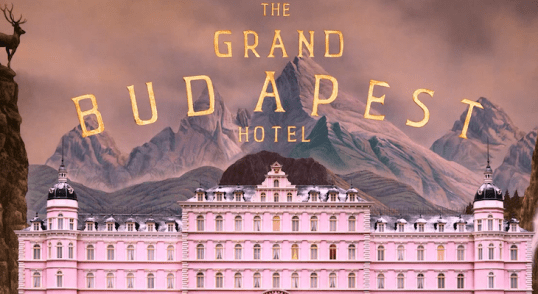
A Few Very Late Thoughts On Wes Anderson’s The Grand Budapest Hotel


grand-budapest-hotel

It took me a while to come around to appreciating The Grand Budapest Hotel.

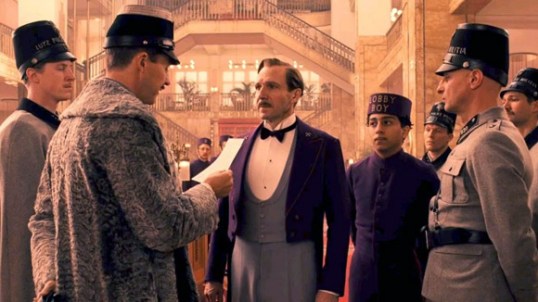
When I first saw Wes Anderson’s latest film, way back in March, I have to admit that I was somehow both impressed and disappointed.  The film’s virtues were obvious.  Ralph Fiennes gave a brilliant lead performance as Gustave, the courtly and womanizing concierge of the Grand Budapest Hotel.  As played by Fiennes, Gustave came to represent a certain type of old world elegance that, I’m assuming, died out long before I was born.  As is typical of Anderson’s film, The Grand Budapest Hotel was visual delight.  Even when the film’s convoluted storyline occasionally grew self-indulgent, The Grand Budapest Hotel was always interesting and fun to watch.

At the same time, I had some issues with The Grand Budapest Hotel.

One of the major ones — and I will admit right now that this will seem minor to some of you — is that halfway through the film, a cat is killed.  The evil Dimitri Desgoffe von Taxis (Adrien Brody) is attempting to intimidate a nervous lawyer, Kovacs (Jeff Goldblum).  Kovacs’s owns a cat and, at one point, Dimitri’s henchman, Jopling (Willem DaFoe), tosses the cat out of a window.  Kovacs runs to window and sees his dead cat splattered on the sidewalk below…

And this is when the audience in the theater laughed and I got very angry.

To me, there was nothing funny about killing that man’s cat.  But the more I’ve thought about it, the more that I’ve come to realize that my reaction had more to do with the audience than the film.  The film was not saying that the cat’s death was funny.  The film was saying that Dimitri and Jopling were evil and dangerous, as their actions throughout the film would demonstrate.  It was the audience that decided, since Grand Budapest Hotel is full of funny moments and has the off-center style that one has come to expect from Wes Anderson, that meant every scene in the film was meant to be played strictly for laughs.  The fact of the matter is that a typical Wes Anderson film will always attract a certain type of hipster douchebag.  They were the ones who loudly laughed, mostly because they had spent the entire movie laughing loudly in order to make sure that everyone around them understood that they were in on the joke.

But that’s not the fault of the film.  Despite what you may have heard and what the Golden Globes would have you believe, The Grand Budapest Hotel is not a comedy.  For all the deliberately funny and quirky moments, The Grand Budapest Hotel is actually a very serious film.  For all of the slapstick and for all of Ralph Fiennes’s snarky line readings, The Grand Budapest Hotel ultimately ends on a note of deep melancholy.

When I first saw The Grand Budapest Hotel, it seemed like it was almost too quirky for its own good.  And, to be honest, I could still have done without some of Anderson’s more self-indulgent touches.  The sequence at the end, where Gustave, who has been framed for murder, gets help from a series of his fellow hotel concierges started out funny but, as everyone from Bill Murray to Owen Wilson put in an appearance, it started to feel less like the story of Gustave and more like the story of all of Wes Anderson’s famous friends.

However, the more I’ve thought about it (and The Grand Budapest Hotel is a film that I’ve thought about a lot over the past year), the more I’ve realized that the quirkiness is only a problem if you made the mistake of thinking that the film is meant to be taken literally.

The more I thought about it, the more obvious it became that the most important scenes in The Grand Budapest Hotel were to be found at the beginning and the end of the film.

The film opens with a teenage girl sitting in front of the grave of a great author.  She opens a book and starts to read.

As soon as the girl starts to read, we flashback 29 years to 1985 where the author (Tom Wilkinson) sits behind his office desk and starts to talk about the time that he visited the Grand Budapest Hotel.  

We flashback again to 1969, where we see how the author (now played by Jude Law) met the owner of the Grand Budapest Hotel, a man named Zero (played by F. Murray Abraham).  Over dinner, Zero tells the author the story of how he first came to the Grand Budapest and how he eventually came to own the hotel.

And again, we go back in time, this time to 1932.  We see how the young Zero (Tony Revolori) first met and came to be the protegé of Gustave (Ralph Fiennes).  We see how Gustave taught Zero how to be the perfect concierge.  Eventually, Gustave would be framed for murdering a guest, Zero would meet and fall in love with Agatha (Saoirse Ronan), and then Zubrowska (the fictional Eastern European country in which this all takes place) would be taken over by fascists who would eventually claim the hotel as their own.

After the story of Gustave, Zero, and Agatha has been told, we suddenly flash forward to the author talking to Zero and then to the old author telling the story to his grandson and then finally back to the teenage reader sitting in the cemetery.

In other words, the Grand Budapest Hotel may be the story of Zero but we’re experiencing it through the memories of the author as visualized by the reader.  Gustave, Zero, and the entire Grand Budapest Hotel are not just parts of a story.  Instead, they become symbols of an old way of life that, though it may have been lost, still exists in the memories of old travelers like the author and the imaginations of young readers like the girl in the cemetery.

As I said at the start of this, I was vaguely disappointed with The Grand Budapest Hotel when I first saw it but, perhaps more than any other movie that I saw last year, this has been a film that I haven’t been able to get out of my mind.  Having recently rewatched the film on HBO, I can also attest that both The Grand Budapest Hotel and Ralph Fiennes’s performance not only hold up on a second viewing but improve as well.

I still stand by some of my original criticisms of The Grand Budapest Hotel.  I still wish that cat had not been thrown out the window, even though I now understand that Anderson’s main intent was to show the evil of Dimitri and Jopling.  And I still find some of the cameos to be jarring, precisely because they take us out of the world of the film.

But you know what?

Despite those flaws, The Grand Budapest Hotel is still a unique and intriguing film.  When I sat down tonight and made out my list of my top 26 films of 2014, I was not surprised that Grand Budapest Hotel made the list.  But I was a little bit surprised at how high I ended up ranking it.

But then I thought about it and it all made sense.

The-Grand-Budapest-Hotel-580


Trailer: Inherent Vice (Official)


Inherent-Vice-poster

The arrival of a new Paul Thomas Anderson film seems to always be a time for excitement. P.T. Anderson’ films can never be called boring. They’re all entertaining on some level for even those who don’t quite get Anderson’s quirky-style of storytelling.

I’ve admired all of Anderson’s films. Have I liked all of them? Not really, but I can understand why many anticipate each and every new film he releases like it was the second coming.

I have no idea what’s going in just going by the trailer, but it does have a noir vibe going for it. Plus, it has Joaquin Phoenix and Josh Brolin.

Inherent Vice is set to premiere on October 4, 2014 during the New York Film Festival before going wide release on December 12, 2014.

Back to School #54: Rushmore (dir by Wes Anderson)


rushmore-play

It’s an understatement to say that Wes Anderson’s films tend to divide viewers.  It seems like critics either love his excessively stylized and quirky vision or else they dismiss him as being a pretentious, overrated, and overly concerned with the problems of the rich and the suburban.  Even among the writers here at the Shattered Lens, there are conflicting opinions.  Leon the Duke gave Moonrise Kingdom a rave review.  On the other hand, I know that Ryan The Trashfilm Guru is not particularly a fan of Anderson’s films.

Myself, I always find it usually takes me a while to warm up to an Anderson film.  With the exception of The Fantastic Mr. Fox, I always seem to find myself somehow both impressed and slightly disappointed after seeing an Anderson film for the first time.  Perhaps it’s because Anderson is such a highly praised director with such a recognizable style that I always tend to go into his film with my expectations set way too high.  And so, I often times end up watching the latest Anderson film and thinking about how much I loved the film’s production design and some of the performances but often times feeling that, narratively, there was something missing.  On first viewing, Anderson’s trademark quirkiness can be overwhelming.  Usually it’s not until a second or third viewing that I really start to appreciate an Anderson film for something more than just the way it looks.  Eventually, I came to love Moonrise Kingdom and The Grand Budapest Hotel but it took me a while.

However, there is an exception to every rule.  And, as far as my reaction to Wes Anderson’s films are concerned, 1998’s Rushmore is that exception.  Rushmore is a film that I have unquestionably loved since the very first time I saw it.  Maybe it’s because, while Rushmore is undeniably quirky, that quirkiness doesn’t overwhelm the human aspect of the film’s story.  Maybe it’s because Rushmore — along with Bottle Rocket — is the most identifiably Texan of all of Anderson’s films.  Or maybe it’s just because Bill Murray gives such a great performance.

Seriously, Bill Murray makes any movie better.

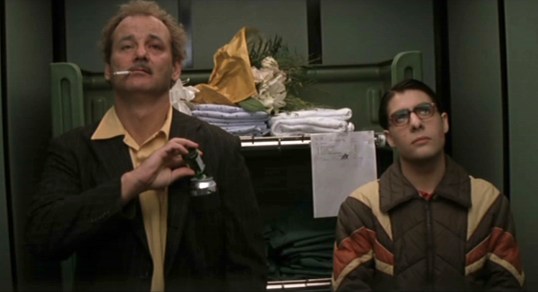
02-rushmore-max-and-mr-blume

Rushmore is named after Rushmore Academy, a private school in Houston.  (Rushmore is quite obviously based on St. Mark’s, which is perhaps the most exclusive private school down here in Dallas.  Owen Wilson, who collaborated on Rushmore‘s script with Anderson, was expelled from St. Mark’s in the 10th Grade.)  15 year-old Max Fischer (Jason Schwartzman, who gives a sympathetic performance as a potentially off-putting character) loves attending Rushmore.  He’s involved in a countless number of extracurricular activities and has written and directed several plays, the majority of which are based on films from the 70s.  (We see his stage version of Serpico and it’s hilarious.)

tumblr_mcasy9Qj4S1r5l2jyo1_400

Unfortunately, Max has a few problems.  For one thing, unlike most of his peers, he’s not rich.  He tells everyone that his father (Seymour Cassel) is a neurosurgeon but actually, he’s a barber.  Even more seriously, Max spends so much of his time starting clubs and writing plays that he doesn’t ever bother to study.  Max is on the verge of flunking out and, despite numerous warnings from Dr. Guggenheim (Brian Cox), he refuses to do anything to improve his grades.

Instead, Max is more interested in pursuing a crush he has on an older teacher, the widowed Rosemary Cross (Olivia Williams).  What Max doesn’t realize is that his mentor, industrialist Herman Blume (Bill Murray), also has a crush on Ms. Cross.

rushmore02

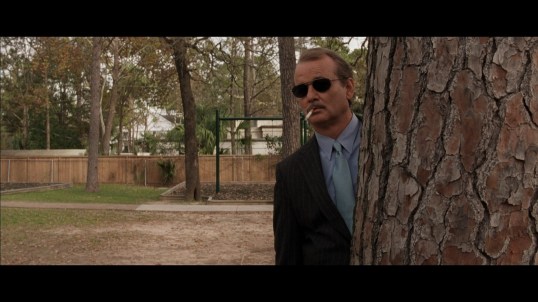
While Max may be the film’s main character, Herman Blume is, without a doubt, the film’s heart.  Blume is a Viet Nam vet (“You were in the shit?” Max asks.  “Yes, I was in the shit,” Blume replies) who has literally gone from rags to riches.  And now that he is rich, he finds himself living an empty life with a wife who doesn’t respect him and two sons who are total idiots.  When Blume starts to mentor Max and pursue Ms. Cross, he starts to care about living once again.

rm61

Meanwhile, Max attempts to impress Ms. Cross by building an aquarium on the school’s baseball field.  This leads to Max getting expelled and having to enroll in a public school.  (Max continues to wear a suit and tie, even after being expelled.)  However, Max then discovers that Blume has been seeing Ms. Cross and soon, the mentor and the student become rivals…

And a lot of other stuff happens but you know what?  I’m not going to tell you what because if you haven’t seen Rushmore, you need to see it and discover all of this for yourself.  You won’t be sorry!

It may be named after the school but Rushmore is ultimately about how love and our dreams make life worth living.  For Max, Rushmore is his fantasy ideal, a world that he loves because it provides him a sanctuary from the harshness of the real world.  When Mr. Blume says, about Ms. Cross, “She’s my Rushmore,” we understand exactly what he means.  But, and this is what distinguishes Rushmore from so many other films about quirky love triangles, is that Ms. Cross is just as independent and important a character as Max and Mr. Blume.  Blessed with excellent performances from Seymour Cassel, Brian Cox, Jason Schwartzman, Olivia Williams, and especially Bill Murray, Rushmore is one of Wes Anderson’s best films.

rushmore-1999-movie-poster1

6 More Quickies With Lisa Marie: Beginners, Hall Pass, Horrible Bosses, Paul, Prom, and Terri


When I swore to myself that I would write a review of every new film I saw in 2011, I failed to take into consideration that 1) I see a lot of films, 2) I have a day job, and 3) I’m like Ms. ADHD.  So, as part of my effort to catch up, here’s 6 quickie reviews. 

Beginners (directed by Mike Mills)

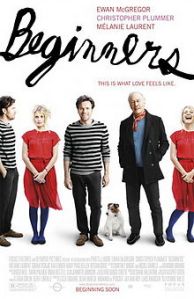
Beginners opened with a lot of critical hype earlier this year and, though it’s not quite as great as it’s being made out to be, it still deserved the majority of that praise.  At the very least, I retain better memories of Beginners than I do this summer’s other similarly hyped film, A Better Life.  Ewan McGregor is an artist who struggles to come terms with the death of his gay father (Christopher Plummer) while falling in love with a French actress (Melanie Laurent).  The autobiographical film effortlessly shifts from flashbacks to Plummer’s life in-and-out of the closet to McGregor’s relationship with Laurent and the end result is a meditation on love, secrets, and life.  Most of the pre-release buzz dealt with Plummer’s performance but, honestly, Plummer is good but you never forget you’re watching Christopher Plummer and Goran Visnjic, who plays Plummer’s boyfriend, overacts.  The film really belongs to Ewan McGregor who gives one of his best performances in this film.  Seriously, does any actor fall in love as wonderfully as Ewan McGregor?

Hall Pass (directed by Peter and Bobby Farrelly)

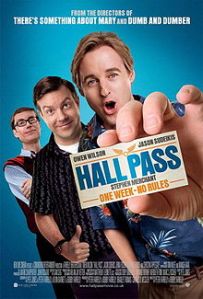
Best friends Owen Wilson and Jason Sudekis are given a “hall pass” (i.e., permission to cheat) by their spouses (Jenna Fischer and Cristina Applegate).  The film’s forgettable but seriously, guys, don’t go asking us for a hall pass, okay?  One interesting point is that this film was co-written by the guy who won the first season of Project Greenlight.  Remember that show? 

Horrible Bosses (directed by Set Gordon)

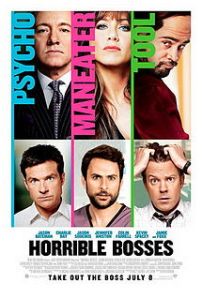
Jason Sudekis also appeared in another comedy this year and if Hall Pass is one of the year’s most forgettable comedies, than Horrible Bosses is one of the best.  Basically Jason Bateman, Charlie Day, and Sudekis are stuck working for horrible bosses (played by Kevin Spacey, Colin Farrell, and Jennifer Aniston) and they decide that the only way to handle the situation is to commit mass murder.  There’s a lot I could say about this film but chances are, you’ve already seen it.  Therefore, you already know that this is a rare dark comedy that actually has the guts to be truly dark.  You also know that the entire cast brings an almost heroic sincerity to their often bizarre roles with Charlie Day’s misunderstood sex offender as an obvious stand-out.  Probably the best advice that I can give in this review is to enjoy and appreciate this film while you can before the inevitable sequel comes out and screws up all these good memories.

Paul (directed by Greg Mottola)

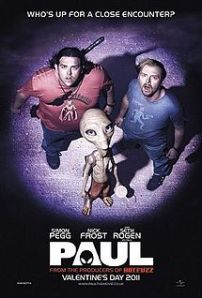
I didn’t see Paul when it was first released in theaters because the trailer really made it look kinda awful.  However, I did eventually give it a shot OnDemand and I was pleasantly surprised.  Two English sci-fi fanboys (played by Simon Pegg and Nick Frost) are taking a road trip to visit all of the major UFO sites in the U.S.  This leads to them meeting an alien named Paul (voiced by Seth Rogen) who is being pursued by the typical guys in black suits.  Anyway, this is a predictable film and the balance between the serious and comedic is often a bit awkward.  However, it’s still a likable film and how can’t you enjoy watching Pegg and Frost?  They can make even the lamest of jokes hilarious.  Kristen Wiig steals the film as a fundamentalist who, upon being enlightened about the nature of the universe by Paul, embraces blasphemy with endearing enthusiasm.

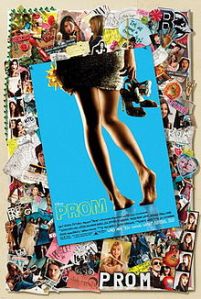
Prom (directed by Joe Nussbaum)

No, I did not force Jeff to take me to see this when it was first released in theaters back in April.  I tried, mostly be saying things like, “Wow, Prom looks like it would be a funny movie to see and spend the whole time making mean jokes about and making all the little tweens in the audience cry…” but he saw through my ruse and, if memory serves me correct, I ended up seeing the second worst film of 2011 (a.k.a. The Conspirator) instead.  Anyway, I ended up seeing Prom OnDemand last month and it’s not really that bad.  It’s not good either.  It’s just kinda there.  In other words, Prom is incredibly meh and that’s one thing prom night should never be.  (I loved my proms, by the way, and, whenever things seem overwhelming, I often think to myself, “If only every night could be Prom Night…”)  Prom is forgettable and inoffensive but come on, tweens deserve better films.  They are the future, after all.

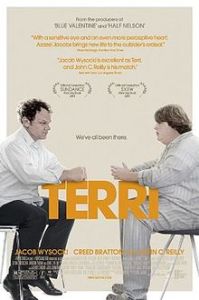
Terri (directed by Azazel Jacobs)

Terri made me cry and cry and was one of my favorite movies of the summer.  It’s a surprisingly poignant film that worked wonders with material that, at first glance, seemed awfully conventional.  Terri (played by Jacob Wysocki) is a sensitive, obese teenager who is taken under the wing of an unconventional assistant principal (John C. Reilly).  It’s a familiar story but director Azazel Jacobs tells this story with care and sensitivity and Wysocki and Reilly bring their characters to life with such skill that you can’t help but get caught up in their story.  Terri’s loving but senile uncle is played by Creed Bratton, who proves here that he’s capable of doing a lot more than just parodying himself on The Office.  When I went to this movie, two old women sitting behind me went, “Awwww!” at a scene where Wysocki spontaneously hugs Reilly.  The film earns the sentiment.

Most of these films are available via OnDemand or are currently available on DVD.  Horrible Bosses and Terri are scheduled to be released in October while Beginners will come out in November.

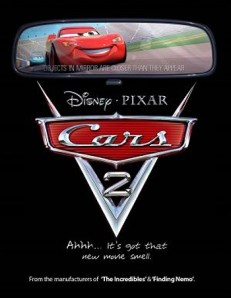
Film Review: Cars 2 (dir. by John Lasseter & Brad Lewis)


There was once a rumor that the major heads of Pixar – John Lasseter, Pete Docter, Andrew Stanton, and Lee Unkrich (I don’t count Brad Bird because he came later) were afraid to let any of their staff take on directing any of their films. With such an illustrious track record, it’s understandable. Pixar has picked up quite a reputation as being one of the few production companies one can count on to have Supposedly, they felt that the quality wouldn’t be as great.

So, I’m certain that the Pixar Heads are eating their own pie when they realize how Cars 2 turned out. It’s a fun film that the kids will adore, but it really lacks the heart that many of the other Pixar films are known for. Mind you, I’m not blasting the movie and saying it should be avoided. Not at all. It’s just that this is more of a movie for the kids and less of one for the adults. I feel that’s the problem everyone’s having with it. This is a good thing. It reminds Pixar of what they need to do to keep winning Oscars, while still being entertaining for the kids. Hopefully, because one of the head honchos made a mistake, maybe the company may consider letting some of the new kids try a hand at it.

In short, the Kid in me loved Cars 2. The Adult in me felt “Well, at least the Kid enjoyed it.” It suffers from two problems – a great story that would have been better set in the world of The Incredibles and a forced moral to the story. This may be the first Pixar film since A Bug’s Life where I haven’t teared up, this coming from someone who couldn’t make it out of the first 15 minutes of Up without tissues.

Previously on Cars, Lightning McQueen (Owen Wilson) won his very first Piston Cup after a pit stop in the small town of Radiator Springs, where he learned to slow down and relax. He also met up with Tow Mater (Larry the Cable Guy), who may not be the brightest spark plug in the engine, but means well and manages to help when he can. Now, we find that McQueen has earned a number of Piston Cups and is one of the best racers in the world. After returning to Radiator Springs, he finds himself greeted by Mater – who’s been anxiously waiting for his best friend. Mater, being who he is, can’t help but be a little overboard in his fun, which ends up getting McQueen involved in a brand new race that’s sponsored by a clean fuel magnate.

Finn McMissile (Michael Caine) and Holly Shiftwell (Emily Mortimer) are also investigating what could be a dangerous situation. While meeting with one of their American contacts (a great cameo by Bruce Campbell), the contact passes on some special information to Mater. Mater, not realizing what he’s been tagged with, is mistaken for a spy by the duo and brought into the investigation. That’s basically what Cars 2 is. It’s “Mater becomes a Spy”, and for the most part it works, but only if you really like the character. Mater is finally given his time to shine and he pulls it off well. I myself don’t mind Larry the Cable Guy, so it’s okay for me. For the grown ups, it could be a Mater overload. The kids will eat it up. The parents may actually get a little annoyed at how clueless Mater can be at times.

I have to admit that both Michael Caine and John Tuturro (Francesco Bernoulli) were two of the strongest character voices in the film. Owen Wilson’s okay, but the story really is only about him in terms of his relationship to Mater. I really didn’t care too much about Lightning this time around. We know his story, he’s grown about as much as he can in my eyes. More or less, he’s playing second or third fiddle. Seeing Caine in this made me want to watch Harry Brown again, or The Fourth Protocol. The fact that he’s also playing an Aston Martin DB5 type Vehicle is a sweet touch for me. He ’s smooth with his lines and pulls off the British Agent role pretty well. Mortimer is also relaxed in her role. Tuturro’s Bernoulli is as over the top as he was in The Big Lebowski, and he was a treat here as McQueen’s main rival. He may have had more fun than the others working on this, from the way he sounds.

Visually, Cars 2 is as beautiful as the other Pixar films, but doesn’t really seem to break that much new ground. Toyko looks nice, Paris is perfect (right down to the Ratatouille reference, if you catch it) and Italy looks sweet, but we know Pixar can do that. The 3D, however is downright magical, and I’m one who honestly believes the medium is best served with Animated films rather than filmed ones. It’s not exactly How to Train Your Dragon, but it’s still good in it’s own right.

I mentioned earlier that the story could have been better set in the world of The Incredibles. It’s an interesting spy story (the reasoning behind why what’s happening was funny in the sense of cars and the like), but the idea that cars are actually doing all of this action kind of pulls away from the story. At least, the adult in me comes off with this thought. For kids, it’s cars doing cool stuff, and I doubt it’ll come across as boring. The other problem is that the moral of the story – accepting your friends for who they are, despite their quirks (because we all have them) – feels a little forced. It’s like someone concentrated so hard on trying to do it that when it does occur, you go..”Okay, I get it.”, But I didn’t walk away feeling anything. Ratatouille’s Remy had a passion for cooking, one so great that he even made the most wicked food critic believe that “Anyone Can Cook”. In Up, Carl Fredricksen learned to let go of what he was holding on to and found new adventures. Mater undergoes a change, but it isn’t quite a big or a substantial. Actually it doesn’t even last long. It’s just clean fun.

Overall, looking at Cars 2, it’s not the greatest Pixar film they’ve done – far, far from it, but it’s a kid’s film. It’s quite enjoyable, but it sacrifices heart for action, something that Kung Fu Panda 2 managed to hold onto this year. Your kids will love it and you’ll enjoy that they’ll love it, but just don’t bring any tissues. They’re not necessary. You really wont find your heartstrings pulled here too much.

Film Review: Midnight in Paris (dir. by Woody Allen)


Woody Allen’s latest film, Midnight in Paris, has an appealing premise behind it. 

Gil (Owen Wilson) is a Hollywood screenwriter who has come to Paris with his shallow fiancée Inez (Rachel McAdams) and her stuffy Republican parents (played by Kurt Fuller and Mimi Kennedy).  Disillusioned with American culture, Gil idealizes the Paris of the 1920s, the Paris that was home to Ernest Hemingway, F. Scott Fitzgerald, and James Joyce.  However, Inez and her parents are far less impressed with Paris and, as quickly become clear, with Gil himself.  While Inez spends her time with self-important “intellectual” Paul (a bearded Michael Sheen), Gil takes to wandering the streets of Paris at night.

One night, as Gil wanders around Paris, a vintage car approaches out of the shadows and the two well-dressed passengers in the back seat invite Gil to join them.  Gil does so and discovers that he’s been transported back to 1920s Paris.  He meets everyone from Hemingway (Corey Stoll) to Salvador Dali (Adrien Brody) to F. Scott and Zelda Fitzgerald (Tom Hiddleston and Alison Pill).  At the end of the night, Gil finds himself transported back to modern-day Paris.  Soon, Gil finds himself sneaking out at midnight every night so he can escape to the past, where he eventually meets and starts to romance an idealistic model named Adrianna (Marion Cotillard).  While Gil finds himself torn between his modern life and the past that he loves, he also begins to discover that the inhabitants of the 20s feel the same way about their present as he does about his.

The premise of the film itself is likable and one that I think anyone can relate to.  Who doesn’t wish that they could go back in the past and live with all the amazing people who they’ve only read about?  Myself, there are many eras that I often fantasize about finding myself in.  1920s Paris is definitely one of them but I’ve also occasionally dreamed of being in 1950s New York, having a threesome with Kerouac and Cassady or maybe being in Paris during the early days of the French new wave, appearing in movies directed by Rollin, Truffaut and Godard.  Ever since I read Peter Biskind’s Easy Riders and Raging Bulls, there’s been a part of me that wishes so much I could have been out in Hollywood or New York in the 1970s, hanging out on the beach with directors like Martin Scorsese, William Freidkin, Jon Milius, and even Peter Bogdonavich.  (But especially Freidkin, his terrible charisma just radiates from the page.) 

Still, Allen is smart enough as a screenwriter to know that everyone tends to idealizes the past, even those who we now idealize in the present.  Perhaps my favorite part of the film came when Wilson, while in the 1920s, sees a character getting into a horse-drawn carriage so that she can go back to the time that she idealizes as fiercely as he idealizes the 20s.

Midnight in Paris has a lot to recommend it.  Cotillard, despite the fact that she’s played the same idealized French mystery woman about a thousand times, gives a likeable performance and Rachel McAdams is hilariously shallow.  Michael Sheen, as well, makes a perfect stand-in for every pompous, self-important jerk who has ever talked down to you.  On the basis of his cameo appearance here as Dali, Adrien Brody really needs to consider doing more comedy.  He’s a lot more appealing when he’s being funny than when he’s trying to be a leading man.

At the same time, I have to admit that I wanted to like Midnight in Paris more than I actually did.  I like Owen Wilson as both an actor and a writer but he’s a little bit miscast here and the end result is that he occasionally seems like he’s trying too hard.  You just never buy him and McAdams as a couple and, as such, there’s really not much at stake as far as his romance with Cotillard is concerned. 

As well, I found it hard not to be a little bit disappointed with the way Allen presented 1920s Paris.  Though they were all well-cast and acted, Hemingway, the Fitzgeralds, Gertrude Stein (Kathy Bates), and all the rest just fell flat as actual characters.  Gil gets a chance to go into the past and essentially, he discovers that Hemingway was macho, the Fitzgeralds were neurotic and self-destructive, and that Dali didn’t make much sense.  Personally, I would be a bit let down if I got a chance to meet these icons and I discovered that essentially they just acted the exact same way that they acted in various PBS educational programs.

Despite this, Midnight in Paris is still a likable, frequently engaging comedy that works best as a tribute to a legendary and beautiful city that Allen (not to mention myself) obviously loves.  Flaws and all, this movie made me want to visit Paris once again (though Florence and Venice remains my favorite cities of all time) and, for that reason alone, it makes Midnight in Paris a film worth seeing.