If Michael Caine is playing the main character’s mentor, then it must be a Christopher Nolan film.
Tag Archives: movie
Teaser: Cinderella
After watching the teaser for Disney’s live action version of Cinderella, all I can say is that shoe looks really uncomfortable! I can’t imagine dancing in that! That said, I still like this trailer because it has a nice fairy tale feel to it, with the butterfly turning into gold and all. Maybe Cinderella will go against the current trend of reinterpreting every childhood tale as darkly as possible.
We’ll find out in 2015.
Here’s some news from Cannes and the trailer for Mr. Turner!
As much as I wish I was in Cannes right now, I’m not. I’m stuck here in the States while everyone else gets to pose for the photographers, walk around topless on the beach, and see movies. Oh well, there’s always next year. Until then, I’m keeping up with Cannes via social media.
The festival opened last night with Grace of Monaco and guess what? The reaction would appear to confirm that the film is just as much of a misfire as I think everyone assumed it would be. It’s not so much that the film sounds terrible as much as it just sounds like it’s remarkably bland.
However, no sooner had everyone dismissed Grace than everyone started to rave about Mike Leigh’s latest film, Mr. Turner. I’ve been intrigued by Mr. Turner ever since I first heard about it, largely because it’s a biopic of the great landscape painter J.M.W. Turner and I’ve got a degree in art history. The enthusiastic reaction that both the film and star Timothy Spall have gotten at Cannes have only served to make me even more excited about seeing this film once it’s released here in December. (My friends in the UK will get to see it in October.)
(Not to brag or anything — because you know I would never do that! — but quite a few of the reviews from Cannes are speculating that both the film and Spall could be Oscar contenders. That’s something that I predicted way back in March.)
As the film premiered at Cannes, the official trailer was also released.
And here it is!
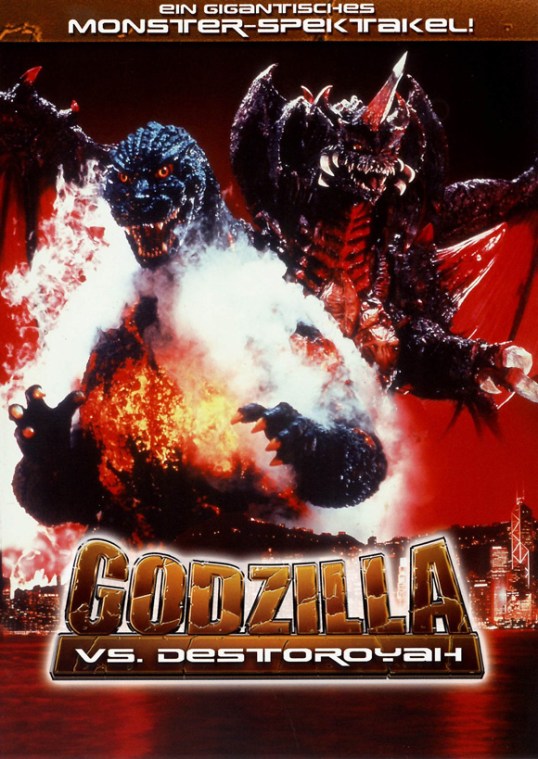
Film Review: Godzilla vs. Destoroyah (dir by Takao Okawara)
With the new Godzilla film scheduled to be released in just two more days, we’ve been taking a look back at some of Godzilla’s previous adventures. We’ve looked at everything from Godzilla vs. King Kong to Ghidorah, The Three-Headed Monster. We’ve even taken a look at Godzilla’s adventures in the Marvel Universe. Today, we consider the 22nd Godzilla film, 1995’s Godzilla vs. Destoroyah.
As Godzilla vs. Destoroyah opens, the task of monitoring and managing Godzilla has been entrusted to a military organization known as G-Force. To be honest, my first impulse was to mock G-Force because their headquarters is known as G-Center and I kept expecting to see a tour group walking through the building while their cheerful guide explained, “This is the spot — the G-Spot.” However, I have to admit that if I ever somehow found myself as a member of the military, I would want to be a member of G-Force, just because some of the female G-forcers get to wear a really nice uniform with a cute black skirt and a beret. Seriously, I’d enlist just to get the beret.
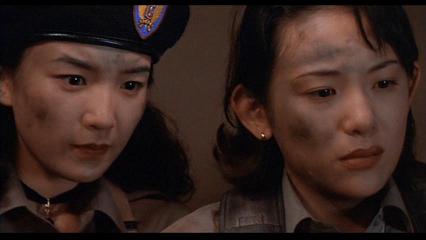
It’s all about the beret.
Anyway, G-Force may have cute uniforms but they’re apparently not very good at doing their job because they’ve lost track of Godzilla. When last seen, Godzilla and his son — Godzilla, Jr. (yes, that’s what they actually call him) — were living on the charmingly named Birth Island. However, Birth Island has been destroyed and when Godzilla, Sr. finally resurfaces, he’s glowing red and destroying Hong Kong.
Yes, Godzilla, Sr. has some issues. As the G-Force scientists eventually deduce, Godzilla’s heart — which also acts as a nuclear reactor — is on the verge of a meltdown. Not only is Godzilla dying but his death will probably cause a nuclear chain reaction that will lead to the end of the world. As silly as this particular plot twist might sound, it actually works pretty well. It’s a much-needed return to Godzilla’s roots, a reminder that, before he became a film star, Godzilla was meant to be the living embodiment of the atomic nightmare. As well, the fact that Godzilla is slowly being destroyed by the same thing that brought him to life gives him a certain tragic dignity. You may not believe that you could feel sorry for a big rubber lizard but you would be wrong. Once it becomes clear that Godzilla is using his last remaining strength to search for and protect his son, you’d have to have a heart of stone not to be moved by his plight.

Unfortunately, G-Force is apparently full of men with hearts of stone and, instead of trying to make that father-son reunion happen, they instead decide to trot out the old Oxygen Destroyer that was used to defeat the original Godzilla back in the 1954. (In the 90s, the series was retconned to explain that the first Godzilla was destroyed in 1954 and that all the subsequent Godzilla movies featured the original’s successor.) However, what G-Force has failed to take into account is that experimenting with the Oxygen Destroyer will also create a giant mutant crab known as Destoroyah.
Destoroyah, despite having a bit of a name problem, is actually pretty scary and, at times, feels like something that could have sprung from the imagination of H.R. Giger. An extended scene, in which Destoroyah menaces a woman trapped in a car, is particularly well done.
Since this is a Godzilla film, all of this inetivably leads to a gigantic fight between Godzilla, Junior, and Destoroyah that manages to destroy Tokyo for the hundredth time. Of course, even as Godzilla steps up to save the world from Destoroyah, he still remains a ticking atomic bomb…
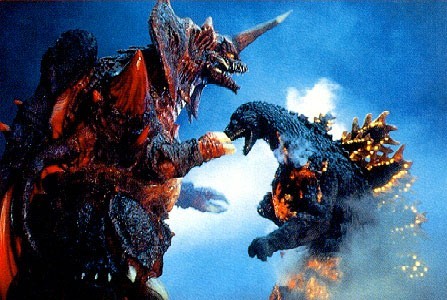
Godzilla vs. Destoroyah was meant to be the final Japanese Godzilla film, a final hurrah for the series before the American version (directed by noted Shakespearean scholar Roland Emmerich) was released. As such, Godzilla vs. Destoroyah is very much a tribute to Godzilla’s long history (clips from the first film abound) and an attempt to give Godzilla a proper and heroic send-off before he would be reinterpreted by the Americans. There’s an elegiac feel to much of Godzilla vs. Destoroyah and it works a lot better than you would have any reason to expect. If this had been the final Japanese Godzilla film, it would have been a perfect chapter to end on.
However, as we all know, Godzilla vs. Destoroyah was not the final Japanese Godzilla film. Roland Emmerich’s Godzilla was a notorious flop and continues to be reviled by good people everywhere. Toho bought back the rights to the character and went on to produce 6 more films starring Godzilla. And now, in just a few more days, a second attempt at an American Godzilla film will be released.
Will it be as good as Roland Emmerich’s film?
Yes. Of course, it will. How couldn’t it be? Roland Emmerich is basically just Uwe Boll with a bigger budget, after all.
Will the new Godzilla be as good as Godzilla vs. Destoroyah?
That’s a question that remains to be answered.
Trash Film Guru Vs. The Summer Blockbusters : “The Amazing Spider-Man 2”

Seriously, folks, this whole contrarian role I seem to have either stumbled or , if you want to be grandiose about things, been thrust into? Its actually getting pretty old. Sure, I can’t do much about how my brain works, but once in awhile, maybe just for a day or so to see what it would be like, I’d love to at least like the same stuff everybody else does, and dislike all the same stuff that the rest of you do, too, just to relieve the tedium of seeing things in a fundamentally different way than everyone else. Mind you, I’n only talking about changing things up as far as my taste in films and other ostensibly “entertaining” media go here, these other perfectly mainstream ideas like “corporations are our friends and we shouldn’t tax them too high,” and “problems like racism, sexism, and other forms of discrimination are all in this past” — you can keep those, I’m happy to still keep tilting at windmills and telling Mr. and Ms. Middle America that they’re hopelessly deluded if they really believe the Hallmark Card pseudo-reality being sold to them while their pockets are being picked clean by the same rich assholes who then have the nerve to tell them that the real “moochers” are poor folks, or people of color, or single mothers, or any other group still that’s still easy to scapegoat and demonize.
At this point you’re probably wondering what any of this has to do with reviewing the just-released (“just,” in this case, meaning last week) The Amazing Spider-Man 2, and I can’t say I blame you, so here’s what I’m getting at : received “wisdom” has it that this is just some bog-standard, average-at-best super-hero flick. And the same received “wisdom” has it that the reason this is no great shakes (and you can bet the exact same argument will be trotted out in a couple of weeks in regards to the new X-Men movie) is because it’s not a Marvel Studios product but is, in fact, a Sony/Columbia release under license from Marvel. And I’m sorry, but I smell a serious rat with that fallacious line of “reasoning.”
Let me tell you why : Marvel, and their bosses at Disney, desperately want the Spider-Man property back “in house” (same goes for X-Men) and have a vested interest in promoting the myth that only they can do it “right.” To that end, I’ll bet my bottom dollar that they’re the ultimate source of this goofy idea that somehow Sony’s Spider-Man lacks the “magic” that they’d bring to the property (and that’s really what Spidey is at this point — a “property” — as opposed to an actual character) and I’d even go so far as to speculate that they’ve contacted their bought-and-paid for media mouthpieces and had off-the-record conversations with them designed to subtly kick up an orchestrated “whisper campaign” against this film.
Shit, as science has proven, always runs downhill, and soon the folks who make their living telling other people what to think have affected the opinions of the legions of unpaid armchair critics (like myself) who in turn affect the opinions of fans and more casual movie-goers, and before you know it, the meme that The Amazing Spider-Man 2 just ain’t all that great has taken firm hold in the public consciousness. Sure, it all looks spontaneous enough, and most of the people playing along with the scheme have no idea that they’re doing, essentially, pro bono work for one monolithic studio conglomerate in their covert “war” against another monolithic studio conglomerate, but there you have it.

What’s especially despicable about this, though, is how rancid and idiotic “homer”-ism in the “fan” community is so easily manipulated to shady ends, yet seldom if ever turned in a genuinely positive direction. The same “fans” who are actively and openly rooting for Marvel to “get back their baby,” for instance, don’t seem to care too much about the situation of Spidey’s actual creator, Steve Ditko, who is 86 years old and has never seen a dime from any of the flicks his legendary creation appears in — hell, when Sam Raimi’s first Spider-Man movie came out, Ditko was living under, to put it politely, reduced circumstances in a rented apartment above a New York City thrift store. If even a tiny fraction of the amount of energy fans put into campaigning for Marvel Studios were put into campaigning for the dozens, if not hundreds, of creators that Marvel has screwed over, who knows? Maybe the cause of creators’ rights would finally be getting somewhere. Let me be as blunt as possible here : if you care more about Marvel getting back the cinematic rights to Spider-Man, the X-Men, and the Fantastic Four than you do about folks like Steve Ditko, Gary Friedrich, Bill Mantlo, or the heirs of Jack Kirby, then you’re either a complete asshole, being played for a sucker, or both. These actual people deserve your support — not the corporate suits who continue to profit off the fruits of others’ imaginations.
To that end, I don’t have any real personal stake in whether or not The Amazing Spider-Man 2 is “not as good as it could/would be with Marvel Studios in charge,” because I could care less about the bottom-line corporate balance sheets of either DisMar or Sony/Columbia. They’re all faceless, greedy bastards in my book. But after watching the film, the rat I smelled grew even more pungent, so I decided to put my little “homer” theory to the test via the modern “miracle” of social networking.
Don’t worry, I didn’t waste too much time on this off-the-cuff experiment, only about 30 minutes or so, but the results were telling. I went onto twitter, looked for the first dozen comments of the “this would be so much better if Marvel did it” variety (they weren’t had to find), and asked the folks making such statements why they thought that. Of the 12 folks I asked, seven never responded, three said variations of the exact same thing (“because it’s theirs and they’d know how to do it right”) and two said they flat-out didn’t know why, “it just would be.”
Not done making a nuisance of myself, I then asked all 12 people again “What’s so ‘wrong’ with this movie in the first place in comparison with Marvel Studios product?” and received only two answers, one of which was “it just is,” and the other being “you can tell just by watching that they don’t get it.”
Excuse me, but — what’s not to get? It’s not like I’m going to try to convince you here that The Amazing Spider-Man 2 is necessarily all that great, but for what it is, frankly, it’s just fine, and in fact it’s a damn sight better than the last two Marvel Studios releases, the thoroughly uninspired Captain America : The Winter Soldier and the downright risible Thor : The Dark World, both of which were essentially big-budget TV movies-of-the-week (and overseen by television directors, no less). I’d even go so far as to say it’s quite a bit more enjoyable than Marvel’s most-ballyhooed cinematic endeavors, the incredibly over-rated The Avengers and the obviously-constructed-by-the-numbers Iron Man films.
It’s far from a terrific super-hero movie, mind you, like Christopher Nolan’s Batman Begins or Richard Donner’s original Superman, but it definitely fits comfortably into the “above average, at any rate” group populated by flicks like The Dark Knight (which is nowhere near as good as many seem to think, but is still fairly solid) and Raimi’s Spider-Man 2. So I guess my main argument isn’t even necessarily that this is all that much better than at least the top-tier Marvel Studios flicks, like the first Thor and Captain America : The First Avenger, but that it’s in no way appreciably worse. Given that, then, and taking into consideration how positively homogenized and formulaic Marvel’s “in-house” product has become in the absence of genuinely talented directors like Kenneth Branagh and Joe Johnston, there’s absolutely no reason to believe they’d “do a better job of things” if the web-slinger’s rights suddenly fell back into their lap.

Frankly, some of the criticism being leveled at this flick is just plain absurd on its face, and amazingly hypocritical. I’ve seen folks who gushed over The Avengers claim, with a straight face, that the problem with The Amazing Spider-Man 2 is that it “relies too heavily on CGI battle scenes.” And Whedon’s movie didn’t? I’ve seen many self-styled “opinion makers” who gushed over the the “human” characterization in Nolan’s Bat-films say that this movie “has too much Peter Parker, not enough Spider-Man.” I’ve seen people who applauded the revisionist origin story given Superman in Zack Snyder’s Man Of Steel grouse about how director Marc Webb and his committee of screenwriters are “playing too fast and loose” with Spidey’s backstory here. And, while I’ll grant you that Jamie Foxx’s Max Dillon/Electro character is flat-out absurd in both its human and super-human iterations, and that getting shocked by a big cable and falling into a vat of electric eels is a pretty lame way for a villain to get his powers, it’s worth noting that many of the people poking fun at this have no problem with the idea of a chemically-enhanced “super soldier” being frozen in a block of ice and waking up, without having aged a day, in the Captain America movies, or of the Norse Gods being a real race of inter-dimensional super-beings in the Thor films, and are even willing to swallow the single-most laughable notion in all comic-book flicks, that of a spoiled billionaire rich kid who inherits his daddy’s company and still actually works for a living, as Tony Stark does in the Iron Man series.
There are plenty of folks out there telling you what Webb and company get wrong in The Amazing Spider-Man 2 — from the aforementioned Electro stuff to Andrew Garfield’s take on Peter Parker being “unlikable” (news flash — he’s been a self-pitying, self-aborbed, flat-out selfish little prick in the comics from day one) to Sally Field’s Aunt May being “too young” (whatever , she does a really nice job) to Paul Giamatti’s wasted and pointless cameo as the villainous Rhino at the end —let me take just a few minutes to tell you what this movie gets right.

Dane DeHann is positively creepy as Harry Osborn/The Green Goblin and his origin/descent into villainy is portrayed in a way that actually makes sense. Likewise, even though his screen time is limited, Chris Cooper knocks it out of the park as his vicious, megalomaniacal father, Norman. There’s real chemistry between Garfield’s Parker and Emma Stone’s Gwen Stacy, and the film does a nice job of updating/translating the legendary penultimate Spidey/Gwen story for the silver screen. The CGI effects work is solid and a represents a big step up from the lackluster graphics of Webb’s first Spider-film. The characters are allowed to age at least semi-normally, as evidenced by the fact that Peter, Gwen, and their classmates are shown graduating high school at the start of the film (and a good thing too, since both actors are, what? Pushing 30?). Webb directs the action sequences that he’s being maligned for with far more aplomb than his more-praised counterparts like Jon Favreau or Joss Whedon, who just show one building after another being smashed to rubble in between those fucking interminable shots of Robert Downey Jr.’s face inside of his Iron Man helmet. And at least this movie gives us warts-and-all human beings at its core with plausible psychological motivations for doing what they do rather than mythological gods, science-whiz playboys, sexy Russian super-spies with no accents, or one-dimensional do-gooders fresh out of suspended animation.
It’s not enough to make The Amazing Spider-Man 2 a truly great super-hero movie, and a forced and tacked-on ending epilogue-ish ending doesn’t help (even if there’s plenty of reason for fans to “ooh”and “aah” when we get a sneak peek at the character designs for the members of the sure-to-pop-up-in-the-next-flick Sinister Six, and hey, isn’t that the Black Cat we get to meet — briefly and in her civilian identity — earlier on, too? Where’s the fan-gasming for that?), but it makes it a heck of a lot more involving than much-more-highly-praised (even if it’s dull and repetitious) fare that just so happens to carry the Marvel Studios logo above its title. And you know what? That’s all it would take for fans to love this one, and is the single, solitary reason why many of them don’t. You might call that loyalty, but I call it bullshit.
Film Review: Ghidorah, The Three-Headed Monster (dir by Ishiro Honda)
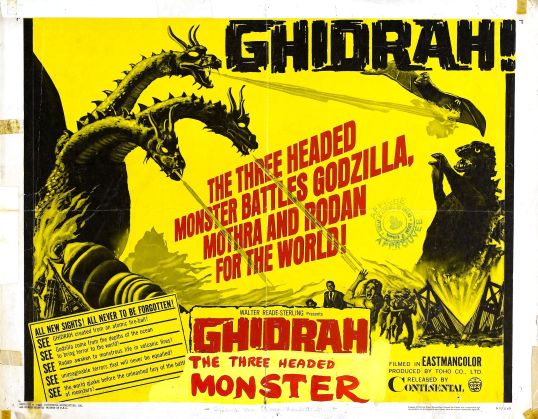
“These monsters are as stupid as human beings!” — Detective Shindo in Ghidorah, The Three-Headed Monster.
With that above line, Ghidorah, The Three-Headed Monster stakes it claim to being one the best of the old Godzilla movies.
First released in 1964, Ghidorah was the fifth film to feature Godzilla. Historically, it’s important because it was the first film to feature Godzilla as a hero. Though he doesn’t quite assume the role of Earth’s protector that would define his later films, Godzilla is definitely presented as being the lesser of two evils. Godzilla’s previously threatening role was taken by the film’s title character. Ghidorah, a flying, three-headed dragon, would go one to become one of Godzilla’s most frequent foes and you can tell why from watching this film. Seriously, if anyone could be considered a worthy opponent to Godzilla, its Ghidorah.
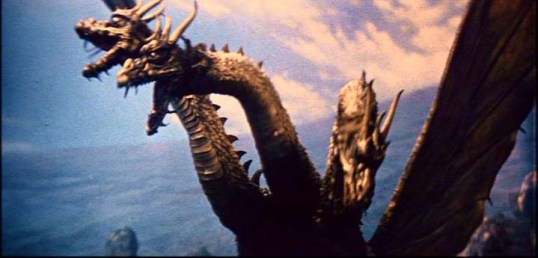
Ghidorah!
As is often the case with the best of the Japanese monster films, Ghidorah’s plot doesn’t make a lot of sense but it’s still fun to watch. As the film begins, Detective Shindo has been assigned to protect Princess Selina of the fictional country of Selgina. And Selina needs the protection because Selgina is full of sinister men wearing elaborate, court jester-style costumes. They want Selina dead and they go so far as to plant a bomb on her airplane. However, right before the bomb goes off, an apparently possessed Selina jumps out of the plane.
Meanwhile, Prof. Murai leads a group of scientists through the wilderness, searching for a meteor that has crashed to Earth. Is the meteor somehow connected to the bomb on Selina’s plane? As a matter of fact it is. Now, to be honest, you’ll probably figure out what’s going on with the meteor long before Prof. Murai or any of his colleagues but director Ishiro Honda still does a good job of building up the suspense. You know what’s going to happen but that doesn’t make it any less entertaining when it actually does.
While Murai investigates that meteorite, a woman who looks exactly like Selina suddenly shows up in Japan, telling people that she is a Martian and predicting the end of the world. First, she predicts that Rodan, a prehistoric pterosaur who was believed destroyed in a previous film, will come back to life. As you can probably guess, that’s exactly what happens.
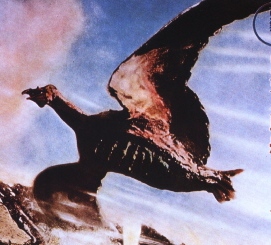
Rodan
Next, she predicts that Godzilla will rise from the sea and destroy a boat. Soon, Godzilla is destroying a boat and getting into a fight with Rodan. Finally, Selina predicts that Ghidorah will destroy the world. Soon, Ghidorah is flying over Tokyo and shooting bolts of lightning from his three heads.
Fortunately, Mothra the giant Moth happens to be in town and it falls to her to try to talk Rodan and Godzilla into teaming up with her to defeat Ghidorah. Unfortunately, Godzilla and Rodan really don’t see why they should waste their time trying to save humans. This leads to the film’s highlight — an extended argument between three monsters, conducted in angry roars and translated by the two miniature twins who live on Mothra’s island. (At one point, they reprimand Godzilla for cursing.) Watching these negotiations, a frustrated Shindo realizes that Godzilla and Rodan are just as stupid as human beings.
That scene (and Shindo’s realization) pretty much sum up everything that I love about Ghidorah. It’s a thoroughly over-the-top, occasionally rather silly film that also happens to be a lot of fun. The action moves quickly, the monsters are all truly monstrous, and the plot is so twisty that its impossible not to enjoy. Best of all, this film features Godzilla fighting his most worthy opponent. Ghidorah is both a classic monster and a classic film.
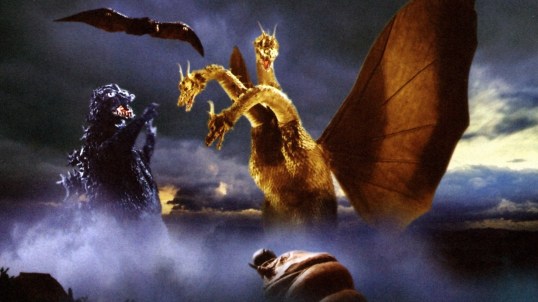
Godzilla, Rodan, Ghidorah, and Mothra
Film Review: Godzilla vs. The Sea Monster (dir by Jun Fukuda)
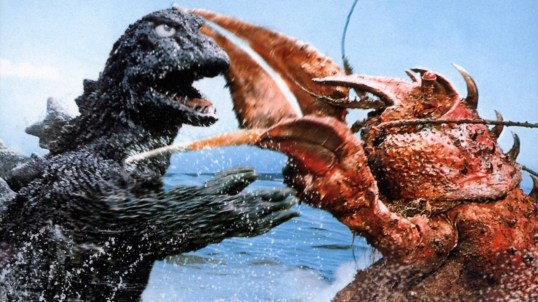
With the latest version of Godzilla set to be released in a little over a week’s time, we’ve been taking a look back at some of previous adventures of the king of all monsters. Today’s movie is the 7th Godzilla film, Godzilla vs. The Sea Monster.
First released in 1966 (and also known as Ebirah, Horror of the Deep), Godzilla vs. The Sea Monster opens with a young man named Ryoto who is desperately looking for brother, Yata. Yata is a fisherman who has gone missing at sea. Everyone else assumes that Yata is dead but Ryoto knows that if he can just find a boat, he can set sail and rescue his brother.
But where and how can Ryoto get a boat?
Well, Ryoto happens to spot a dance marathon being broadcast on television. First prize is a yacht! Ryoto runs down to the dancehall, just to discover that the contest has already been going on for three days and that it’s too late for him to enter.
(Incidentally, if you know how much I love to dance than you also know how much I loved the fact that this Godzilla film featured a random and somewhat senseless dance scene. Seriously, it was just so 1966.)
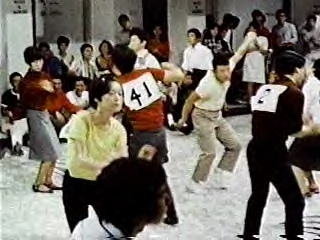
DANCE!
While at the dance, Ryoto meets Ichino and Nita, both of whom have already lost their chance to win the yacht. However, Ichino and Nita take sympathy on Ryoto and decide to take him to the docks so that he can see the yacht that he could have won if only he had been able to enter the contest. (If you’re thinking to yourself that this doesn’t make any sense and seems like an awfully complicated set up for a Godzilla movie — well, you’re right. Get used to it because this is about as logical as any of the characters in this film get.)
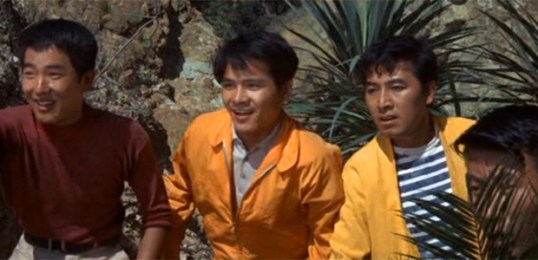
Our heroes.
Once they board the yacht, they’re confronted by a man named Yoshimura, who is carrying both a rifle and a briefcase full of money. As they stare at each other, a news report comes over the radio. It appears that there’s been a bank robbery. Yoshimura assures them that he’s not the bank robber and then, for some reason, invites them to spend the night on the yacht.
(I imagine that a lot of kids in 1966 were going, “Where’s Godzilla!?” at this point. Well, don’t worry. Godzilla will show up … eventually.)
When everyone wakes up the next morning, they discover that the yacht is now floating out in the middle of the ocean. That’s right — Ryoto has set sail and apparently, he just assumed that his three new friends would want to come along with him.
Anyway, long story short — the boat gets destroyed by a combination of a storm and a giant lobster (that would be Edirah) and our four “heroes” end up washed up on Devil’s Island. As they investigate their surroundings, they discover that the island is controlled by a terrorist organization known as Red Bamboo. (We know that Red Bamboo is evil because one of its leaders wears an eye patch.)
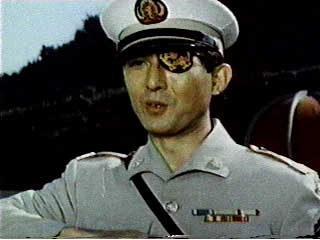
He’s bad.
Red Bamboo, it turns out, has been kidnapping the natives of Infant Island and putting them to work on Devil’s Island. Now, if you’ve seen any previous Japanese monster movies, you might know that Infant Island is also the home of Mothra, a giant moth who is occasionally Godzilla’s ally. The natives — both those who have been enslaved and those left on Infant Island — are busy praying for Mothra to come rescue them.
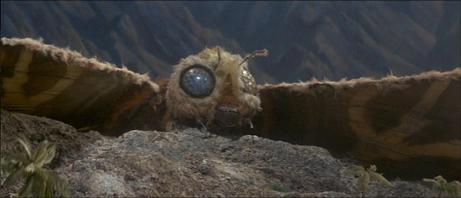
Mothra
At this point, you may be tempted to repeat, “But where’s Godzilla!?”
Don’t worry, Godzilla does eventually show up. It turns out that he’s on Devil’s Island, as well. However, he’s asleep. Our four “heroes” decide that the best way to defeat Red Bamboo and save the slaves would be to wake up Godzilla…
Okay, so this is a weird one. The film takes a while to get going, plot threads are raised and abandoned almost at random, and, once he does wake up, Godzilla doesn’t really act much like himself. (That could be because Godzilla vs. The Sea Monster was originally written to be a King Kong movie. That would certainly explain why Godzilla becomes infatuated with an escaped slave named Dayo.)
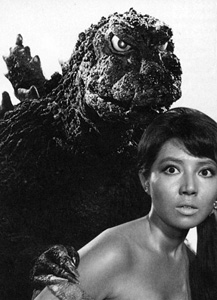
Godzilla and Dayo
But, with all that in mind, Godzilla vs. The Sea Monster has its charms. In many ways, I would compare it to Godzilla vs. Hedorah, in that the film is hardly Godzilla at his best but, at the same time, it has enough odd moments to keep things interesting. Ebirah may not qualify as one of Godzilla’s best opponents but he still has his moments. His first appearance — in which a giant claw reaches out of the ocean to grab that stolen yacht — is undeniably effective. Meanwhile, Red Bamboo makes for an enjoyably silly organization of evil doers. They’re like an amazingly inefficient version of Hydra. Their island headquarters is the epitome of 1966 evil chic and you have to appreciate the fact that not even they seem to be sure just what exactly their master plan entails.
And finally, there’s that big dance number at the beginning!
Seriously, you can’t go wrong with a random dance number…
Film Review: Godzilla vs. Gigan (dir by Jun Fukuda)
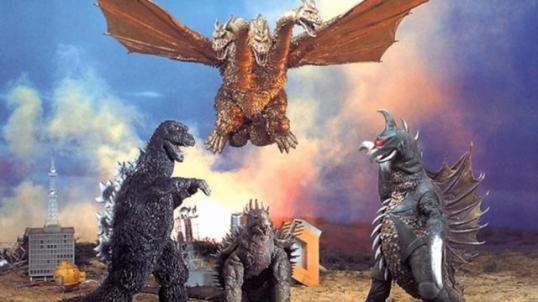
Godzilla and Friends
With the newest version of Godzilla scheduled to be released in another week and a half, we’ve been taking a look back at the some of the Big G’s previous adventures. On Monday, Arleigh paid tribute to King Kong vs. Godzilla. Yesterday, I reviewed the exquisitely odd Godzilla vs. Hedorah. And today, we take a look at the 12th film in the series, 1972’s Godzilla vs. Gigan.
Gengo is a cartoonist who has a lot of talent and a really kickass girlfriend who happens to have a black belt in karate. The one thing that Gengo does not have is a job because he can’t seem to convince any publishers to take a chance on characters like Shakura, a monster created from children’s discarded homework. (Personally, I would have loved to have seen a movie called Godzilla vs. Shakura.) However, things start to look up for Gengo when he is hired to help design an amusement park called World Children’s Land.
However, as Gengo quickly discovers, something is not right at World Children’s Land. For one thing, the park manager says that, as soon as the park opens and everyone sees Godzilla Tower, there won’t be any more need for the real Godzilla or any of his friends on Monster Island. Then, a young woman and her hippie friend approach Gengo and explain that the woman’s brother is being held prisoner somewhere in the park. Finally — and perhaps most seriously — it turns out that park is actually being managed by a bunch of cockroaches from outer space.
The roaches have taken human form (though they still cast cockroach shadows) and spend a lot of time talking about how much they want peace but make no doubt about it, they’re planning on conquering Earth and doing away with all of humanity. See, the roaches polluted their own planet and now, they’re looking for a new home. But, before they can conquer the world, they have to destroy Godzilla.
And so, the roaches summon two monsters from outer space. One of them is Ghidorah, a three-headed dragon who fought Godzilla in several films. And I do have to say that Ghidorah is a fearsome creature:
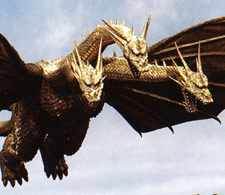
Ghidorah!
However, as impressive as Ghidorah is, his friend Gigan is even more impressive. Gigan is apparently a cyborg of some sort, complete with metal hooks for hands and a buzzsaw in his tummy. Check him out:
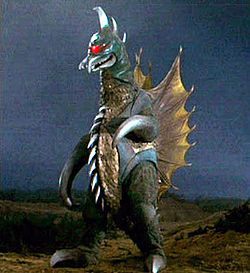
Gigan
Fortunately, Godzilla has an ally in his fight against Gigan and Ghidorah. Anguirus appears to be a giant armadillo and, judging from a scene where he and Godzilla have a conversation (!), he appears to be somewhat surly. However, Anguirus is simply too cute to be believed!
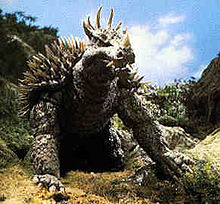
Awwwww! He’s not your typical armadillo!
Perhaps in response to the mixed reception earned by the frequently surreal Godzilla vs. Hedorah, Godzilla vs. Gigan is a much more traditional Godzilla adventure. I would venture that if you asked most people to describe a typical Godzilla film, they’d probably describe Godzilla vs. Gigan. Aliens invade Earth, evil monsters destroy Tokyo, and eventually Godzilla swims over from Monster Island to save the day.
But traditional as the film may have been, I still enjoyed it. The monsters are memorable, the battle scenes are entertaining, and the cheap special effects (as well as the unapologetic use of stock footage) are far more charming than they have any right to be. Listen, if you’re watching a movie like Godzilla vs. Gigan and expecting a coherent script or Avatar-style special effects then you probably need to lighten up a little.
On a final note, Godzilla vs. Gigan was released in the States as Godzilla on Monster Island and I have to say that I really like the idea of Monster Island. Not only do all the monsters appear to get along as long as there’s no humans around but you have to appreciate the fact that Monster Island is exactly what it says it is (unlike, say, Greenland or Vermont). I mean, if you go to a place called Monster Island and get eaten by a monster, you really have no one to blame but yourself. Perhaps we need to set up a Shitty, Alcoholic Father Island or an Internet Troll Island so that we can keep all of the world’s real-life monsters separated from the rest of us.
Just an idea.
But until that happens, why not enjoy Godzilla vs. Gigan?
Film Review: Godzilla Vs. Hedorah (dir Yoshimitsu Banno)
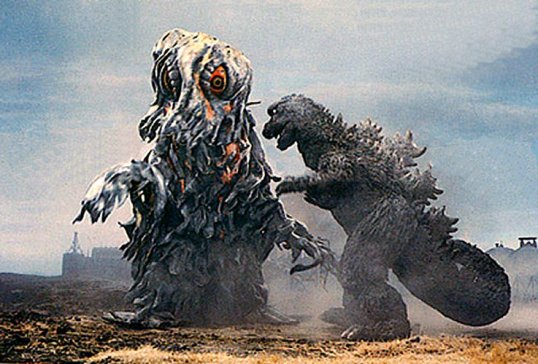
With the new Godzilla film due to be released in two more weeks, we’re taking a look back at the Godzilla franchise here on the Shattered Lens. Yesterday, Arleigh reviewed King Kong Vs. Godzilla. Today, I’m taking a look at Godzilla vs. Hedorah.
First released in 1971, Godzilla vs. Hedorah is, to put it lightly, a weird freaking movie. Judging from the reviews and the comments that I’ve read online, it’s also widely considered to be one of the worst of the Godzilla films. I watched it earlier today and — well, yes, it’s not exactly Godzilla’s finest moment. However, I’d be lying if I said that I didn’t enjoy Godzilla vs. Hedorah. It’s just such an odd movie.
When Godzilla vs. Hedorah was originally released here in the states, it was retitled Godzilla vs. The Smog Monster. That’s right! This is a Godzilla film with a message! And that message is “Stop polluting the planet or else a meteorite will crash into the ocean and cause all of the waste to take on sentient form.” And, just in case you can’t pick up on that message despite the fact that the film is about an actual smog monster, the movie’s theme song makes the message even more explicit. Both the theme song and the James Bondesque opening credits also serve to remind us that this isn’t your typical Godzilla movie.
(In the film’s defense, the song sounds a lot better when heard in the original Japanese.)
Godzilla vs. Hedorah starts out with a child named Ken who idolizes Godzilla and is worried about all of the muck that he sees floating in the water. “If Godzilla saw this,” Ken tells us, “he wouldn’t be very happy.” Ken also has dreams in which Godzilla arises from the ocean and uses his radioactive breath to set all of the world’s pollution on fire.
No sooner has Ken read an essay that he’s written about pollution then Hedorah comes to life and starts destroying Japan. Oddly enough, nobody in the film seems to be that upset about the imminent end of the world. However, according to Wikipedia, this was the 11th Godzilla film and I suppose that, after the 5th or 6th giant monster attack, it’s reasonable that people would adopt a somewhat blasé attitude towards them.
Anyway, Hedorah is destroying Japan by flinging around acidic sludge, a bunch of hippies decide that, seeing as how the world is doomed anyway, they might as well party on Mt. Fuji, and Ken’s father tries to figure out a way to defeat Hedorah. Meanwhile, Godzilla comes to the aide of humanity and you have to wonder why. The film implies that he’s been moved by Ken’s faith in him but, to be honest, Godzilla goes through this entire film looking somewhat annoyed by everything, including Ken. He’s willing to fight Hedorah but he doesn’t seem all that emotionally invested in it.
(If anything, Godzilla reminded me of how our cat Doc acts if he’s see a cat in the alley right before dinnertime. Doc might hiss once or twice but it’s pretty clear that his main concern is getting back inside so he can eat and then take a nap. The hissing is just to make sure the rest of us know that Doc’s not losing his touch.)
As I said before, Godzilla vs. Hedorah is not necessarily a good movie but it sure is strange! How strange is it? Well, let’s just take a look at Hedorah:
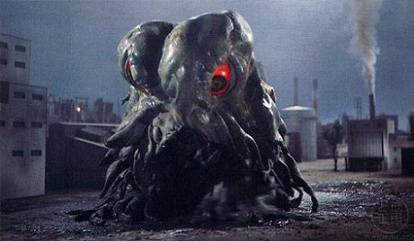 Personally, I think Hedorah looks more like Cthulhu than a smog monster but regardless, he’s certainly memorable.
However, there’s more to the strangeness of this film than just Hedorah. Godzilla vs. Hedorah was the first Godzilla film to be made in the 1970s and its obvious that director Yoshimitsu Banno wanted to make sure that his Godzilla film stayed up with the times. Hence, along with a heavy-handed political message, Godzilla vs. Hedorah features every single technique that was considered to be cutting edge in 1971.
Freeze frames?
This film’s got them.
Split-screens?
Hmmm…kinda. There’s a few scenes where — for no particular reason — we see a dozen or so tv screens, all featuring a dozen or so talking heads talking at once.
Hippies?
Hippies everywhere.
A random dance scene with groovy camera angles and gratuitous use of the zoom lens?
Yes. In fact, that was my favorite scene in the movie.
And, of course, there are the cartoons. Whereas modern movies would probably waste a lot of money on a lot of CGI to show us how Hedorah was created and grew, this movie shows us with random cartoons. And you know what? The cartoons are actually a lot more fun than any CGI ever could be.
In many ways, those cartoons perfectly sum up the appeal of Godzilla vs. Hedorah. They’re silly and a little stupid but how can you not enjoy them? Godzilla Vs. Hedorah isn’t exactly good but it’s definitely a lot of fun.
Scenes That I Love: Godzilla vs. Zilla from Godzilla: Final Wars
This latest scene that I love is for all of you Godzilla fans out there! In this scene from 2004’s Godzilla: Final Wars, the original Japanese Godzilla takes on his American counterpart, Zilla. Needless to say, it’s not an evenly matched battle.
Zilla, of course, starred in Roland Emmerich’s Godzilla, a film that is often cited as being one of the worst of the 90s. Will the upcoming Godzilla film help to erase memories of Zilla? We’ll find out on May 16th!
For now, enjoy the original kicking the imposter’s ass!

