Rudy Baylor (Matt Damon) is an idealistic young law school graduate who discovers that having a degree and passing the bar doesn’t automatically make you a success. He gets a job working a bar that just happens to be owned by an ambulance chasing attorney named Bruiser Stone (Mickey Rourke). Bruiser takes Rudy on as an associate and assigns his associate, Deck Shifflet (Danny DeVito), to teach Rudy how to find cases. When Bruiser flees the country to escape an FBI investigation, Rudy and Deck start their own law firm. Rudy soon finds himself with the case of his young career, representing a family in a law suit against Great Benefit Insurance. Rudy also falls for Kelly (Claire Danes), a young woman who is being abused by her husband (Andrew Shue).
It can be hard to believe today but, in the 90s, every John Grisham novel was adapted for the screen. Most of the adaptations weren’t very good but audiences ate them up. In many ways, The Rainmaker is the ultimate John Grisham adaptation because it contains every single trope that John Grisham made popular with his legal thrillers. This time, Matt Damon is the charismatic attorney. Roy Scheider is the soulless corporate CEO who needs to be brought down. Jon Voight is the intimidating opposing counsel. Danny DeVito is the eccentric comic relief and Mickey Rourke is the dues ex machina who returns to the movie to give Rudy a piece of information at the exact right moment. The appeal of Grisham is that he made readers (and eventually moviegoers) feel like insiders while presenting them with stories that were essentially very simple good vs evil morality tales. The insurance company is so cartoonishly evil that there’s no doubt Rudy is going to defeat them. There’s also no doubt that Rudy is going to find a better calling than ambulance chasing because the only thing that people hate more than insurance companies is lawyers.
The Rainmaker is never as complex as it pretends to be but it’s an entertaining legal movie. It was also director Francis Ford Coppola’s last big hit. It’s really more of a Grisham film than a Coppola film but Coppola’s influence is still felt in the almost uniformly excellent cast. (Ignore Andrew Shue if you can. Melrose Place was very popular in the 90s.) Damon, Danes, Rourke, Voight, Dean Stockwell, Danny Glover, Teresa Wright, Virginia Madsen, and Mary Kay Place all give memorable performances. Roy Scheider is loathsome as the sweater-wearing CEO. Best of all is Danny DeVito, who gets all of the best lines.
The Rainmaker was the best of the 1990s Grisham adaptations. While it’s not quite a masterpiece, it’s still emotionally very satisfying.
In the year 1979, a young Steven Spielberg attempted to conquer comedy in the same way that he previously conquered horror with Jaws and science fiction with Close Encounters of The Third Kind. Working from a script written by Robert Zemeckis and Bob Gale, Spielberg made a film about the days immediately following Japan’s attack on Pearl Harbor. The name of the film was 1941 and it remains Steven Spielberg’s only attempt to direct a full-out comedy. There’s a reason for that.
The film follows a large group of characters over the course of one day and night in 1941. It’s been six days since Pearl Harbor was attacked and the streets of Los Angeles are full of young men who are preparing to ship out and older man who are paranoid about when the next attack is going to come. However, Major General Joseph Stilwell (Robert Stack) just wants to see Dumbo at the local theater. Meanwhile, his womanizing aide (Tim Matheson, giving the same performance here that he did in National Lampoon’s Animal House) just wants to get Stillwell’s aviation-lusting secretary (Nancy Allen) into an airplane.
Elsewhere, Ward Douglas (Ned Beatty) is happy to allow Sgt. Tree (Dan Aykroyd) and his men (including John Candy) to set up on an anti-aircraft gun in his front yard. Ward’s daughter, Betty (Dianne Kay), is only concerned about entering a dance contest with her friend, Maxine (Wendie Jo Sperber). Cpl. Sitarski (Treat Williams) and dishwasher Wally Stephens (Bobby D iCicco) both hope to be Betty’s partner and their rivalry leads to a massive (and seemingly never-ending) brawl.
While Ward deals with the gun in his front yard, another concerned citizen — Claude Crumm (Murray Hamilton) — keeps watch from atop of Ferris wheel, along with amateur ventriloquist Herbie Kazlminsky (Eddie Deezen).
But that’s not all! Susan Backilinie recreates her role from a previous Spielberg film, skinny dipping while the Jaws theme plays in the background and running straight into a submarine that is commanded by Commander Akiro Mitamura (Toshiro Mifune, trying to maintain his dignity). Mifune decides to attack Hollywood but no one on the submarine is sure where that is. Christopher Lee appears as an arrogant German who is along for the ride. Slim Pickens shows up as a lumberjack who is temporarily captured by the Japanese. John Belushi plays Wild Bill Kelso, who flies his airplane through Los Angeles. Warren Oates yells and laughs. Dick Miller, Elijah Cook Jr. and Lionel Stander show up in small roles.
“Since when is Steven funny?” According to Peter Biskind’s Easy Riders, Raging Bulls, this was the reaction that most of Spielberg’s friends had when he announced that his next film would be a screwball comedy set during World War II. Watching the film, one gets their point. The majority of the film’s humor comes from people looking at the camera and screaming. There’s a lot physical comedy, which would undoubtedly work in small amounts but which grows rather tiring when it’s dragged out to the extent that Spielberg’s drags it out. (A brawl at a USO show seems like it should be funny but Spielberg allows it to go on for too long and the careful choreography takes away any element of spontaneity.) The film attempts to duplicate the style of Animal House (and it’s probably not a coincidence that Matheson, Belushi, and director John Landis all have roles in the film) but Spielberg often seems as if he’s trying too hard. There’s nothing subversive about the humor. It’s more antic than funny.
A huge problem is that there really isn’t much of a story here. Spielberg, who is normally one of Hollywood’s best storytellers, attempts to do a loose, Altman-style ensemble film and the result is that none of the characters feel alive and there’s never any sense of narrative momentum. There are a few performers who manage to make an impression amongst all the explosions and the yelling. John Belushi has the advantage of not having to share the majority of his scenes with anyone else. Warren Oates’s manic energy is more than welcome. Wendie Jo Sperber deserved more screentime. Murray Hamilton and Eddie Deezen frequently made me laugh. There’s a wonderful moment where Robert Stack’s intense general cries while watching Dumbo. But, for the most part, the film never comes together.
That said, 1941 is definitely a Steven Spielberg film. It received three Academy Award nominations, for Cinematography, Sound, and Visual Effects. (All three of those categories, not surprisingly, are more associated with spectacle than with comedy.) The film looks great! Spielberg’s attention to detail is there in the production design and the costumes. Watching 1941, you can see Spielberg’s talent while also seeing why he never directed another comedy.
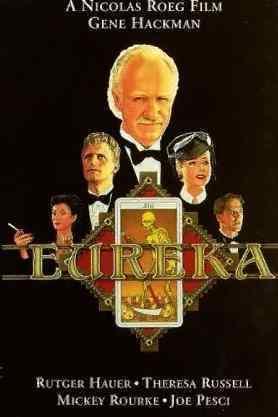
I’ve been thinking a lot about Gene Hackman as he recently celebrated his 95th birthday. He’s an incredible actor who has been a part of my life since I first really discovered my love of movies beginning in the mid-80’s. I’ve also been writing about Rutger Hauer every Sunday here on the Shattered Lens. Hackman and Hauer made a movie together back in 1983 called EUREKA, and to be honest, I almost forgot about it. It’s a movie I watched a long time ago and hadn’t watched again until today. It seemed like the perfect time for a revisit.
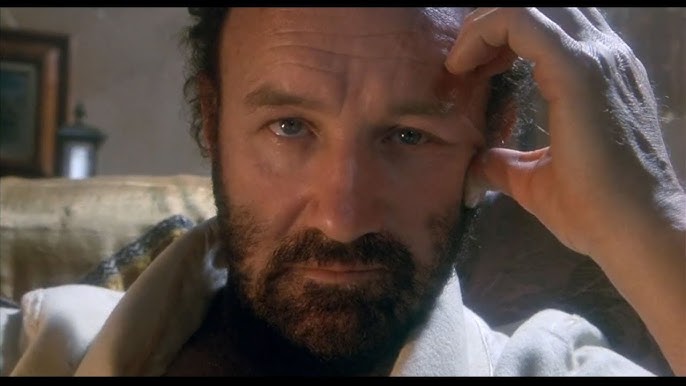
EUREKA opens with a stunning aerial shot that descends upon obsessed gold prospector Jack McCann (Gene Hackman) who’s fighting with a man on a snow-covered mountain in the Yukon territory. The man has asked Jack to partner with him in their search for gold, and Jack makes it clear that he will never “make a nickel on another man’s sweat.” Next, we see Jack as he’s walking through a nearly deserted town. In another unforgettable shot, Jack watches a man, who’s clearly gone mad, commit suicide just outside of the local “Claims office.” Before watching again today, that was the only scene that I could remember from my initial viewings of the film so many years ago. Next, we see Jack lying down below a tree at night, in windy, frigid temperatures, just about to freeze to death. Three hungry wolves have even approached ready for dinner. And this is where things get strange. Out of the blue, this clairvoyant madam (Helena Kallianiotes) from a local brothel sees him in her crystal ball, as a mysterious stone falls right next to him, starting a fire that warms him and drives away the wolves. He goes to see the madam at the brothel where she tells him that he will strike gold, but he “will be alone now.” Jack leaves the next morning and finds gold, rivers of gold. It’s another stunning sequence showing the obsessed man, who’s been searching for gold for 15 long and hard years, finally finding the object of his obsession.
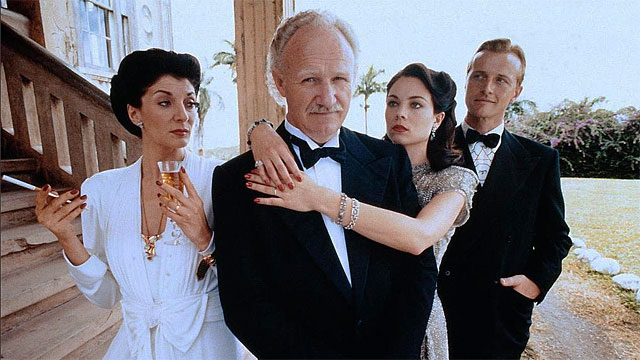
Cut to 20 years in the future, where Jack is now the richest man on earth, living on his own Caribbean island. It also appears he may also be the unhappiest man on earth. He has all the money in the world, but there is no peace in his heart or soul. His wife Helen (Jane Lapotaire), who he was once deeply in love with, is now detached and addicted to alcohol. His daughter Tracy (Theresa Russell) has fallen in love and married Claude Maillot Van Horn (Rutger Hauer). Jack cannot stand Claude as he suspects that he seduced and married Tracy so he could get to his money. His best friend Charles (Ed Lauter) has somehow gotten mixed in with Miami mobsters, led by a guy named Mayakofsky (Joe Pesci) and his lawyer Aurelio D’Amato (Mickey Rourke), who want to force Jack to sell them land on his island so they can build a casino. Jack feels like everybody just wants a piece of him and his money. He has lost the joy in his life. The rest of the film plays out against this backdrop as Jack tries to separate Tracy from Claude, and as the mobsters try to force Jack to sell to them by any means necessary.
EUREKA is not a film that everyone will love, but I enjoyed watching it again after so many years. Director Nicolas Roeg, who also directed PERFORMANCE (1970), DON’T LOOK NOW (1973) and FULL BODY MASSAGE (1995), creates some truly amazing and brutal images that once seen are not easily forgotten. The scene where Jack McCann finds his huge vein of gold is so beautiful, but there are alternatively horrific scenes of brutal violence that play out almost to the point of overkill. The movie also takes some surprising twists and turns in the third act that you may not see coming. I always like it when a movie surprises me. It’s a melodramatic film that doesn’t have a lot of likable characters, but with a cast this good, I’m willing to go along with the filmmakers. In addition to the excellent work of Gene Hackman and Rutger Hauer, Theresa Russell has the important role as the daughter stuck between the man she loves and the dad who adores her. Her acting style exemplifies the melodrama of Roeg’s vision, so it works well in the context of this film. Jane Lapotaire has a couple of strong moments as Hackman’s alcoholic wife who yearns for days long gone when they were so in love. We were quite spoiled in the early 80’s when a movie could round out its already impressive cast with actors like Joe Pesci, Mickey Rourke, Ed Lauter, Corin Redgrave and Joe Spinell.
Nicolas Roeg appears to be trying to make deep statements about the meaning of life in EUREKA. I’m not a person who generally consumes films for deep meaning, but I thought it might be fun to at least take a surface-level view of some of the items I noticed while watching the movie. Jack spouts a lot of profound things throughout the movie, things that he feels describe him as a person. I mentioned one earlier when Jack tells the competing prospector prior to finding gold that, “I’ll never make a nickel off of another man’s sweat.” He will continue to use this saying throughout the film, even after he’s a rich, jaded, older man. The truth is that he would not have found the gold without the help of the clairvoyant madam, with her even passing away right after he hits the jackpot. In another scene at an extremely awkward dinner party, Jack tells his guests that the only rule that matters is the Golden Rule, “Do unto others as you would have them do unto you.” While I agree with the importance of this rule, Jack does not seem to follow the Golden Rule in any way that helps others or gives him any sense of peace or connection. Jack does not seem to understand the contradictions in his use of these phrases as played out in his own life, but I also think that his lack of understanding helps to illustrate a truth that plays out at times in many of our own lives. So often we’ll claim certain beliefs and values, but our lives as lived will be much more complex and often hypocritical. We can see them in Jack, but can we always see them in ourselves?
EUREKA also seems to be a movie that’s open to different interpretations based on who’s viewing the movie and where they are in life at that specific time. In a moment of clarity with his wife, Jack seems to recognize the hypocrisy in his life when he tells her “I once had it all… now I just have everything.” Jack is finally reflecting on the important things in his life, rather than dwelling on his current distrust of everyone around him. This final quote got me to thinking about my own life and just how different I am as a man in my early 50’s compared that naïve 20-year-old who first watched this film. I didn’t know what it was like to chase my dreams, catch them, and then try to figure out how to keep striving with a purpose. I didn’t know what it was like to be married with the responsibility of loving my wife and genuinely caring about her needs, through both the good times and the bad times. I didn’t know what it was like to be a dad who wanted nothing but true happiness for his children. Jack has lived through these specific opportunities in life, and we can see how he’s dealt with them. Each of these things have now played out in my own life. There have been times that I’ve failed, and there have been times that I’ve succeeded. I just keep reminding myself to try to focus on the things that matter and not get distracted by the things that don’t. Even now, it’s not always easy to do.
First released in 1981 and then re-released in several different versions since then, Heaven’s Gate begins at Harvard University.
The year is 1870 and the graduates of Harvard have got their entire future ahead of them. At the graduation ceremony, Joseph Cotten gives a speech about how, as men of cultivation, they have an obligation to help the uncultivated. Student orator Billy Irvine (John Hurt) then gives a speech in which he jokingly says the exact opposite. Amongst the graduates, Billy’s friend, Jim Averill (Kris Kristofferson), laughs at Billy’s speech. It’s a bit of a strange scene, if just because all of the graduates appear to be teenagers except for Hurt and Kristofferson, who are both clearly in their 30s. The graduates of Harvard sing to their girlfriends and dance under a tree and, for a fleeting moment, all seems to be right with the world.
Twenty years later, all seems to be wrong with the world. Averill is now the rugged and world-weary marshal of Johnson Country, Wyoming. Cattle barons are trying to force immigrant settlers to give up their land. Gunmen, like Nate Champion (Christopher Walken) and Nick Ray (Mickey Rourke), are accepting contracts to execute immigrants who are suspected of stealing cattle. When Averill stands up for the people of Johnson Country, the head of the Wyoming Stock Grower Association, Frank Canton (Sam Waterston), hires a group of mercenaries to ride into Johnson County and execute 125 settlers. Billy Irvine, who now is dissolute alcoholic who works with Canton, warns his old friend Averill. Averill, who has fallen in love with Ella (Isabelle Huppert), the local madam, announces that he will defend the immigrants. Nate, who is also in love with Ella, considers changing sides.
Heaven’s Gate is loosely based on an actual event. I actually have three distant ancestors who traveled to Wyoming to take part in the Johnson County War. All three of them survived, though one of them was shot and killed in an unrelated manner shortly after returning to Ft. Smith, Arkansas. That said, director Michael Cimino is clearly not that interested in the historical reality of the Johnson County War or the issues that it raised. Just as he did with Vietnam in The Deer Hunter, Cimino uses the Johnson County War as a way to signify a loss of national innocence. Averill and Irvine start the film as hopeful “young” men with the future ahead of them. By the end of the film, one is dead and the other is living on a yacht and dealing with what appears to be crippling ennui.
Heaven’s Gate is a bit of an infamous film. Though the film was pretty much a standard western, Cimino still went far over-budget and turned in a first cut that was over six hours long. A four hour version was briefly released in 1980 but withdrawn after a week, due to terrible reviews and audience indifference. A studio-edited version that ran for two hours and 35 minutes got the widest release in 1981. Since then, there have been several other versions released. Cimino’s director’s cut, which was released as a part of the Criterion Collection in 2012, runs for 212-minutes and is considered to now be the “official” version of Heaven’s Gate.
For years, Heaven’s Gate had a terrible reputation. It’s failure at the box office was blamed for bankrupting United Artists. After the excesses of the Heaven’s Gate production, studios were far more reluctant to just give a director a bunch of money and let him run off to make his movie. (They should have learned their lesson with Dennis Hopper and The Last Movie.) Described by studio execs as being self-indulgent and even mentally unstable, Michael Cimino’s career never recovered and the director of The Deer Hunter went from being an Oscar-winner to being an industry pariah. (Some who disliked The Deer Hunter’s perceived jingoistic subtext claimed that Heaven’s Gate proved The Deer Hunter was just an overrated fluke.) However, the reputation of Heaven’s Gate has improved, especially with the release of Cimino’s director’s cut. Many critics have praised Heaven’s Gate for its epic portrayal of the west and, ironically given the controversy over The Deer Hunter, its political subtext. It’s anti-immigrant villains made the film popular amongst the Resistance-leaning film historians during the first Trump term.
So, is Heaven’s Gate a masterpiece or a disaster? To be honest, it’s somewhere in between. Whereas it was once over-criticized, it’s now over-praised. Visually, it’s a beautiful film but those who complained that the film was too slow had a point. As with The Deer Hunter, Cimino takes the time to introduce us to and immerse us in a tight-knit immigrant community. Personally, I like the much-criticized scenes of the fiddler on skates and Averill and Ella dancing in the roller rink. Overall though, as opposed to The Deer Hunter, the members of the film’s victimized community still feel less like individual characters and more like symbols. As for the political subtext, I think that any subtext of that sort is accidental. (I feel the same way about The Deer Hunter, which I like quite a bit more than Heaven’s Gate.) Cimino is more interested in the loss of innocence than whether or not the Johnson County War can be fit into some sort of nonsense Marxist framework.
The main problem with the film is that there is no center to keep everything grounded. Kris Kristofferson had a definite screen presence but, as an actor who was incapable of showing a great deal of emotion, he lacks the gravitas necessary to keep from being swallowed up by Cimino’s epic pretensions. Isabelle Huppert, an otherwise great actress, also feels lost in the role of Ella and Sam Waterston is not necessarily the most-intimidating villain to ever show up in a western. Christopher Walken, as the enigmatic and intriguing Nate Champion, gives the best performance in the film but his character still feels largely wasted.
There are some brilliant visual moments to be found in Heaven’s Gate. I even like the Harvard prologue and the ending on the boat, both of which are not technically necessary to the narrative but still add an extra-dimension to both Averill and Irvine. But, in the end, Heaven’s Gate is big when it should have been small and epic when its should have been intimate. It’s a misfire but not a disaster. Even great directors occasionally have a film that just doesn’t work. Speilberg had his 1941. Scorsese has had a handful. Coppola’s career has been a mess but no one can take his successes away from him. Michael Cimino, who passed away in 2016, deserved another chance.
I think that is the question that everyone, or at least every guy, asks themselves after watching Barry Levinson’s debut film. Most would probably want to say that they’re Boogie (Mickey Rourke), because he’s cool, all the ladies love him, and he makes creative use of a popcorn box at the movies. Some would probably say that they want to be Fenwick (Kevin Bacon) because he’s smart and sarcastic. No one wants to be Billy (Tim Daly) or Eddie (Steve Guttenberg), even though we would all want to be their friend.
The truth is that most of us would probably be Shrevie (Daniel Stern), the just-married one who is discovering that being an adult means working an unglamorous job and discovering the rest of the world doesn’t care about your taste in music. The luckiest of us might be Modell (Paul Reiser), the funny one who doesn’t get a story but who makes a lot of jokes.
Diner was one of the first great hang-out movies. There is no plot, at least not in the traditional sense. Instead, it’s about a group of long-time friends who live in Baltimore in 1959. They grew up together. They went to high school together. They’ve been hanging out at the same diner for as long as they can all remember. And now, they’re at the point in their lives where the world expects them to act like adults and accept all the responsibility that goes along with that. It’s a film that celebrates their friendship while also acknowledging that some of them are using that friendship as an excuse to not grow up. They escape into trivia and movies, with one minor character reciting Sweet Smell of Success by memory. Fenwick drinks. Boogie gambles. Even Billy, who doesn’t even live in Baltimore anymore, reverts to his old ways as soon as he returns for Eddie’s wedding and ends up sucker punching someone because of an old high school incident.
The preparations for Eddie’s wedding gives the film what structure it has. Eddie is marrying the unseen Elyse, assuming she can pass his demanding quiz about the Baltimore Colts. (That may sound unfair but if you’re from Baltimore, you’ll understand.) While Eddie gets ready for his wedding, Shrevie’s marriage to Beth (Ellen Barkin) seems to be falling apart and she finds herself tempted to cheat with Boogie, who has his own problems with a local bookie. Meanwhile, Billy learns that his girlfriend (Kathryn Dowling) is pregnant.
The film is about friendship and the friendships between the men feel real. Levinson held off on shooting the largely improvised diner scenes until the end of the film, by which time all of the actors had developed their own idiosyncratic relationships with each other. The heart of Diner is to be found in scenes like the one where Modell tries to ask for someone else’s sandwich without actually coming out and asking for it. The dialogue in that scene and so many others has the ring of age-old friendship. Though the film makes it easy to see why Mickey Rourke and Kevin Bacon become movie stars while Tim Daly has spent most of his career on television, the entire cast is still perfect in their roles. It’s about as strong as an ensemble as you could ever hope to see. They become the characters and watching the movie, it’s impossible not to see yourself and your friends in their performances.
Barry Levinson has gone on to direct many more films but for me, Diner will always be the best.
As some of our regular readers undoubtedly know, I am involved in a few weekly live tweets on Twitter and Mastodon. I host #FridayNightFlix every Friday, I co-host #ScarySocial on Saturday, and I am one of the five hosts of #MondayActionMovie! Every week, we get together. We watch a movie. We tweet our way through it.
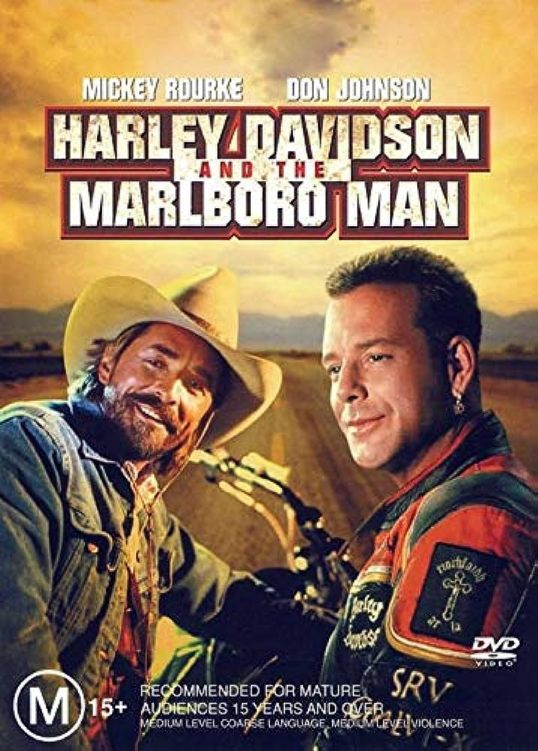
Tonight, at 10 pm et, #FridayNightFlix has got 1991’s Harley Davidson and the Marlboro Man, starring Mickey Rourke and Don Johnson!
If you want to join us this Friday, just hop onto twitter, start the movie at 10 pm et, and use the #FridayNightFlix hashtag! It’s a friendly group and welcoming of newcomers so don’t be shy.
Harley Davidson and the Marlboro Man is available on Prime! See you there!
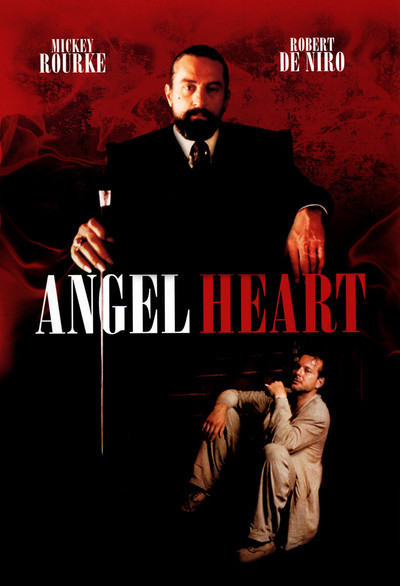
First released in 1987 and set in 1955, Angel Heart tells the story of Harry Angel (Mickey Rourke).
With a name like Harry Angel, it’s perhaps not surprising that Harry is a private investigator. Harry operates out of New York. He’s got a shabby apartment. He wears wrinkled clothes. He rarely shaves. He smokes almost constantly. (In a rare moment of comedy, the camera catches Harry blithely emptying a full ashtray in the middle of the street.) Harry looks like he reeks of tobacco, beer, sweat, and lost dreams. And yet, it’s difficult not to like Harry. He’s got a charming smile, even if his face is often bruised from his latest beating. He speaks in a low whisper and it’s hard not to get the feeling that Harry is actually kind of shy. He’s incredibly sleazy but there’s something about him that just makes the viewer want to take care of him.
Harry is hired by a mysterious man named Louis Cyphere (Robert De Niro, cheerfully overacting). Louis wants Harry to track down a singer named Johnny Favor. As Cyphere explains it, he did a favor for Johnny and Johnny has yet to pay Cyphere what he owes. Johnny has been suffering from PTSD ever since he served in World War II. When last seen, Johnny was receiving electroshock treatment in an upstate hospital.
Harry’s search for Johnny leads him into an increasingly complex and disturbing conspiracy. He meets a doctor who is addicted to morphine and, when the doctor turns up dead, Harry coolly uses the dead man’s shoe to light his match. Eventually, Harry’s investigation leads him to New Orleans, where he meets both Johnny’s wife (Charlotte Rampling) and Johnny’s unacknowledged daughter, Epiphany (Lisa Bonet). As Harry searches for Johnny, he deals with strange visions of his own mysterious past. He sees himself wandering around Times Square shortly after the attack on Pearl Harbor. Harry also finds himself having to deal with the fact that almost everyone that he talks to ends up being brutally murdered. Every time that Harry tries to quit the case, Cyphere offers him more money. (Cyphere tends to show up whenever Harry finds himself on the verge of abandoning his search.)
Angel Heart moves at its own deliberate pace. In fact, the first hour can feel a bit slow but that first hour definitely pays off during the second half of the film. By the time that Harry starts to truly uncover what has happened to Johnny, the audience actually cares about Harry and is actually worried about what’s going to happen to him when he reaches the end of the case. Mickey Rourke was (and is) an eccentric actor but he’s at his most effective in Angel Heart. A lesser actor would have just played Harry as being a typical hardboiled detective. Rourke plays Harry as being a lost soul, a vulnerable man who is often as confused and scared as the people that he’s looking for. By the end of the film, Harry realizes that the answer to the mystery was right in front of them and his look of despair is surprisingly powerful. If De Niro gives a good performance that is almost totally on the surface, Rourke gives the type of performance that allows the audience to explore what’s going on beneath the surface of a character who many would initially view as being a cliché. Mickey Rourke’s Harry Angel is right up there with Bogart’s Sam Spade and Jack Nicholson’s Jake Gittes. He’s a familiar character who also seems to be a human being.
Full of sex, violence, and increasingly disturbing imagery, Angel Heart is not for everyone. Alan Parker’s direction emphasizes the darkness of Harry’s world and the bleakness of his situation. The film ends with a twist that may not be totally unexpected but which is still undeniably disturbing. The more you think about it, the most disturbing it gets. Angel Heart is an atmospheric and intelligent chiller. It’s existential horror at its most nightmarish.
In the 2013 film, Dead in Tombstone, Danny Trejo plays Guerrero De La Cruz, an old west outlaw who is loyal to his family, who has no problem robbing banks, but who also is not a fan of unnecessary bloodshed. Even though the film opens with Guerrero and his gang gunning down a posse of men, that’s just because they were saving the life of Red (Anthony Michael Hall), who just happens to be Guerrero’s half-brother. No sooner than you can say, “In what world could Danny Trejo and Anthony Michael Hall possibly be related?,” Red is asking Guerrero to help him pull off a daring robbery.
Guerrero helps Red because Guerrero is all about family. Unfortunately, Red is all about money and, not wanting to share the loot after the robbery, he promptly guns Guerrero down. Not only does Red shoot Guerrero but he insists that each member of the gang shoot him as well, implicating all of them in the crime.
Guerrero dies and promptly goes to Hell, where he’s met by Lucifer (Mickey Rourke). Guerrero doesn’t want to go to to Hell. He wants to get revenge. He offers to send a lot more souls down to Hell if Lucifer gives him a chance to return to the world of the living so that he can kill Red and the former members of his gang. Amused, Lucifer agrees but with a condition: Guerrero only has 24 hours to kill all six of his killers and Guerrero has to do all of the killing himself. He can’t hire someone else to do it or ask anyone for help. Guerrero agrees.
Unfortunately, as Guerrero soon discovers, he’s not the only one who wants Red dead. He’s going to have to move quickly if he’s going to kill all the members of the gang before Calathea (Dina Meyer), the wife of a sheriff killed by Red, gets a chance to do it herself!
Dead In Tombstone is one of those films that sounds a lot more interesting than it is. The concept behind the film is actually a pretty neat one and I like the idea of Guerrero actually having competition. This isn’t one of those westerns where everyone patiently waits their turn to go after the bad guys. The entire world wants these guys dead! Plus, who wouldn’t be excited about the idea of watching Danny Trejo and Mickey Rouke act opposite each other? With his weathered features and stoic demeanor, Danny Trejo is the perfect choice to play an outlaw and, for that matter, Rourke’s gravelly whisper and permanent smirk are put to good use in the role of the Devil. And while Anthony Michael Hall might seem like an odd choice to play Danny Trejo’s half-brother, he’s still properly villainous and loathsome in the role of Red.
And yet, the overall film itself is a bit uneven. The film looks good (especially for a straight-to-video project) but it never really seems to develop any sort of narrative momentum and there’s more than a few slow spots. At times, the film seems to be unsure of just how seiously it wants to take itself and, as a result, the story exists in a kind of limbo between being a straight western with supernatural elements and send-up of the whole genre. The end result is pretty uneven but the dream combination of Rourke and Trejo still makes it worth watching.
In this 1983 film, Gene Hackman plays Jack McCann, a prospector who is determined to either get rich or freeze to death as he wanders around Alaska in the 1920s. When he’s not having sex and philosophical discussions with the local witch, Freida (Helena Kallianiotes), Jack desperately searches for gold. Jack is convinced that gold is all that he needs to be happy, though Freida counsels him that it’s also important to pursue more Earthly delights. Everywhere Jack looks, he sees people dying in the snow. In fact, Jack nearly dies himself until he stumbles across a mountain full of gold. As gold dust pours down on him, he celebrates while having flashbacks to Freida writhing in ecstasy. It’s just that type of film. When Jack tells Freida about his claim, he asks what’s going to happen next. Freida tells him that it’s both the end and the beginning. Once again, it’s just that type of film.
At this point, Eureka jumps ahead 20 years. The year is 1945. World War II is coming to an end. Jack is no longer freezing and starving to death in Alaska. Now, he is one of the world’s richest men. He even owns his own island in the Caribbean. Jack has a huge house, a beautiful view of the ocean, and all the money in the world. One could even say that his life has become an exclusive beach vacation, an eternal Spring Break, if you will. And yet, even with all of his money, Jack has fallen victim to ennui. He was happier when he was poor and starving and seeking warmth from Freida. Now, he’s got an alcoholic wife (Jane LaPotaire) and his daughter, Tracy (Theresa Russell), is in love with a dissolute aristocrat named Claude (Rutger Hauer), to whom Jack takes an instant dislike. Claude claims that Jack has stolen his wealth from the Earth. Claude is the type who eats gold and then promises to return it to Jack as soon as he can. That’s something that actually happens. It’s kind of silly but Rutger Hauer is such a charmer that he nearly pulls it off.
Claude and Tracy aren’t the only thing that Jack has to worry about. An American gangster named Mayakofsky (Joe Pesci) wants to take over Jack’s island so that he can build a casino on it. However, despite the best efforts of Mayakofsky’s attorney (Mickey Rourke), Jack is still not willing to sell. When hitman Joe Spinell shows up outside the estate, are Jack’s days of ennui numbered?
Of course, they are! That’s not really a spoiler. Eureka is (loosely) based on the real-life murder of Sir Harry Oakes, an American-born prospector who was thought to be one of the world’s richest men when he was brutally murdered in the 40s. Jack is, of course, a stand-in for Oakes while Mayakofsky is based on Meyer Lansky, the mobster who many people suspect ordered Oakes’s murder. Lansky was never charged with the crime. Instead, Oakes’s son-in-law, Count Alfred de Marigny, was arrested and charged with the crime. After a trial that made international news and was described as being “the trial of the century,” de Marigny was acquitted and the murder of Harry Oakes remains officially unsolved.
It’s an interesting story and it seems like one that should perfectly translate to film. Surprisingly though, Eureka doesn’t really do it justice. The film was directed by one of the masters of cinematic surrealism, Nicolas Roeg. Roeg, of course, is probably best remembered for films like Performance, Don’t Look Now, Walkabout, and The Man Who Fell To Earth. As one might expect from a Roeg film, Eureka is visually stunning but, as a director, Roeg can’t seem to decide whether he’s more interested in Jack’s ennui or in all the soapy melodrama surrounding Jack’s murder. As such, neither element of the film gets explored with any particular depth and the resulting film, while always watchable, still feels rather shallow and disjointed. (After taking forever to reach the end of Jack’s story, Eureka then turns into a rather conventional courtroom drama. Theresa Russell does get to utter the immortal line, “Did you cut off my father’s head?” but otherwise, it’s kind of dry.) The film is at its strongest when Jack is just a prospector in Alaska. The harsh landscape and the crazed dialogue is perfect for Roeg’s dream-like style. Once the film moves to the Caribbean, it suffers the same fate that befell Jack when he become rich. It loses its spark.
That said, Eureka has its moments. Any film that features Gene Hackman, Mickey Rourke, Joe Pesci, Rutger Hauer, and Joe Spinell all acting opposite of each other is going to have at least a few scenes worth watching. I particularly liked Pesci’s surprisingly subdued performance as Mayakofsky. With everyone else in the film chewing every piece of scenery on the island, Pesci wisely underplays and is all the more menacing for it. While Eureka ultimately doesn’t add up too much, it’s worth watching at least once for the cast.
Finally, my personal theory is that Harry Oakes’s murder had more to do with the Duke and Duchess of Windsor (formerly King Edward VIII and Wallis Simpson) than it did with Meyer Lansky. (The Duke was the governor of the Bahamas at the time of Oakes’s murder.) But that’s just my opinion.
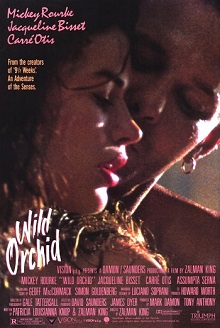
Emily (played by blank-faced model Carrie Otis) is a lawyer who can speak French, Spanish, Portuguese, Chinese, and Italian but who has never spoken the language of love. A high-powered New York firm hires her away from her former employer in Chicago on the requirement that she immediately head down to Rio de Janeiro. Claudia Dennis (Jacqueline Bisset) is trying to close the deal on buying a luxury hotel and she needs a lawyer now!
Claudia, however, has plans for Emily that go beyond real estate. As soon as Emily arrives, Claudia arranges for her to go on a date with the wealthy and mysterious James Wheeler (Mikey Rourke). Wheeler is single but he’s so far refused all of Claudia’s advances. She wants to know if he’s adverse to all women or just her. Wheeler is very taken with Emily but he’s been hurt so many times in the past that he can’t stand to be touched. Instead, he gets his thrills by being a voyeur.
It leads to a trip through Rio, where everyone but Emily is comfortable with their sexuality. When Wheeler isn’t encouraging her to watch a married couple have sex in the back seat of a limo, Claudia is encouraging Emily to disguise herself as a man and enjoy the nonstop carnival of life in Rio. There’s a lot of business double-dealing, many shots of Mickey Rourke riding on his motorcycle, and a final sex scene between Rourke and Otis that is one of the most rumored about in history. For all of the scenes of Wheeler explaining his philosophy of life, Wild Orchid doesn’t add up too much, though it certainly tries to.
Wild Orchid was a mainstay on late night Cinemax through most of the 90s. This was Carrie Otis’s first film and to say that she gives a bad performance does a disservice to hard-working bad actors everywhere. There’s bad and then there’s Carrie Otis in Wild Orchid bad. She walks through the film with the same blank expression her face, playing a genius who can speak several languages but often seeming as if she’s struggling to handle speaking in just one language. She looks good, though, and all the movie really requires her to do is to look awkward while Rourke and Bisset chew up the scenery.
On the one hand, Wild Orchid is the type of bad movie that squanders the talents of actors like Mickey Rourke, Jacqueline Bisset, and Bruce Greenwod (who has a small role as a sleazy lawyer) but, on the other hand, it’s a Zalman King film so it may be insanely pretentious but it’s also rarely boring. Visually, King goes all out to portray Rio as being the world’s ultimate erotic city and the dialogue tries so hard to be profound that you’ll have to listen twice just to make sure you heard it correctly. My favorite line? “We all have to lose ourselves sometimes to find ourselves, don’t you think?” Mickey Rourke says that and he delivers it as only he could.
Wild Orchid may have been a box office bust but it was popular on cable and on the rental market, largely because of that final scene between Rourke and Otis. Mikey Rourke later married Carrie Otis. Neither returned for Wild Orchid II: Two Shades of Blue.
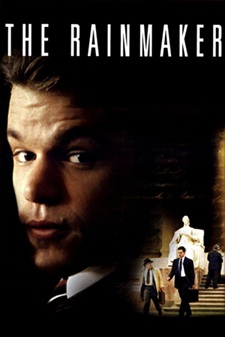 Rudy Baylor (Matt Damon) is an idealistic young law school graduate who discovers that having a degree and passing the bar doesn’t automatically make you a success. He gets a job working a bar that just happens to be owned by an ambulance chasing attorney named Bruiser Stone (Mickey Rourke). Bruiser takes Rudy on as an associate and assigns his associate, Deck Shifflet (Danny DeVito), to teach Rudy how to find cases. When Bruiser flees the country to escape an FBI investigation, Rudy and Deck start their own law firm. Rudy soon finds himself with the case of his young career, representing a family in a law suit against Great Benefit Insurance. Rudy also falls for Kelly (Claire Danes), a young woman who is being abused by her husband (Andrew Shue).


 Through the Shattered Lens