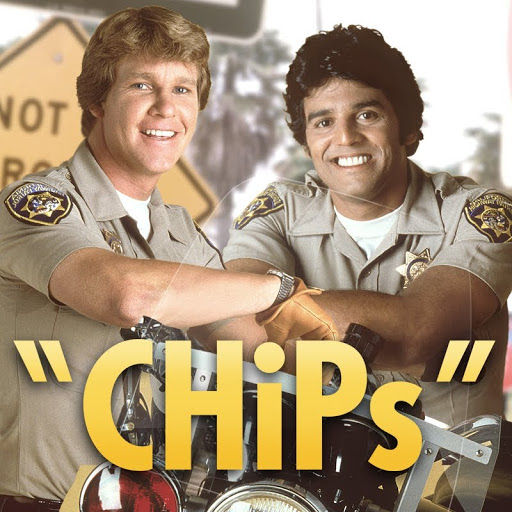
Late Night Retro Television Review: CHiPs 4.7 “Satan’s Angels”


Welcome to Late Night Retro Television Reviews, a feature where we review some of our favorite and least favorite shows of the past!  On Mondays, I will be reviewing CHiPs, which ran on NBC from 1977 to 1983.  The entire show is currently streaming on Prime!

This week, Bonnie is taken hostage!  It’s good thing Ponch exists because you know no one else on this show is going to able to rescue her.

Episode 4.7 “Satan’s Angels”

(Dir by Phil Bondelli, originally aired on December 14th, 1980)

When confronting a group of outlaw bikers who are harrassing a teenager (Heather Locklear, in her screen debut), Bonnie is kidnapped!  Reno (John Quade) manages to snap her own handcuffs on her wrists and then drags her to a cabin owned by Stan (William Smith) and his wife (Candice Azzara).

Can the Highway Patrol find the cabin?  The cabin is in the mountains it might not be easy to locate.  It’s a good thing that Ponch and Jon just happen have those motorized hang gliders!   It’s California living to the rescue!  Needless to say, Ponch and Jon (but mostly Ponch) are able to swoop in for the rescue.

This episode didn’t do much for me but then again, episodes about hostage situations rarely do.  Once a character is taken hostage, it pretty much causes the action to slow down to a crawl.  There’s only so many times you can listen to someone being told not to even think about escaping before it gets kind of boring.  This episode did feature the great villainous character actor, William Smith.  It had that going for it.  But, otherwise, the episode itself moved very slowly and it didn’t help that Bonnie herself was required to make a lot of very stupid mistakes so that she could be kidnapped in the first place.  When a show’s storyline depends on a previous competent person suddenly being amazing incompetent, it’s an issue.

This episode’s b-plot featured Getraer’s very pregnant wife continually going the hospital, just to discover it was a false alarm.  Getraer’s wife was played Gwynne Gilford who was (and is) married to Robert Pine.  Their son, Chris Pine, was born a few months before this episode aired.

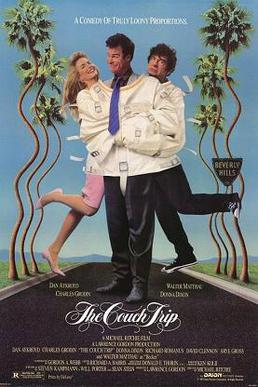
The Couch Trip (1988, directed by Michael Ritchie)


When renowned radio psychiatrist George Matlin (Charles Grodin) has a nervous breakdown, he takes a trip to Europe with his wife (Mary Gross) to both recover and also work on his marriage.  (Matlin’s breakdown was the result of an extramarital affair.)  Needing someone to host Dr. Matlin’s radio show, his producers call Dr. Lawrence Baird (David Clennon), who oversees a mental facility in Chicago.  They assume that Dr. Baird is just dumb enough that they won’t have to worry about him overshadowing Dr. Matlin while he’s guest-hosting.  However, when they call, Dr. Baird is out of his office and the phone is answered by John Burns (Dan Aykroyd), a con artist who has been pretending to be insane so that he can avoid serving time in prison.  Pretending to be Baird, Burns accepts their offer and then escapes from the asylum and heads to Beverly Hills.  The real Dr. Baird, not knowing about the offer, goes on vacation in Europe.  Though Burns had originally only been planning on doing the radio job long enough to get paid enough money to head to Mexico, he soon becomes a celebrity with his non-nonsense, blunt advice.

There’s a lot of talented people in The Couch Trip, including Walter Matthau as a former priest-turned-kleptomaniac and Aykryod’s wife, Donna Dixon, as Matlin’s colleague and Burns’s eventual love interest.  Director Michael Ritchie was responsible for some of the best films of the 70s and radio psychiatry is certainly a ripe subject for satire.  Why, then does, The Couch Trip fall flat?  Some of it is because the movie never seems to know if it wants to be wacky farce or a dramedy about a criminal who finds a new life helping people.  The other big problem is that the talented Dan Aykroyd is miscast as the type of unapologetic smartass that Bill Murray could play in his sleep.  (In a version where Murray played John Burns, Aykroyd would have been perfect casting as George Matlin.)

Aykroyd was one of the most talented members of the original Not Ready For Prime Time Players.  (His impersonations of Nixon and Jimmy Carter were second-to-none.)  Sadly, Hollywood has never figured out what to do with his off-center talent.  The Couch Trip is a prime example of that.


Film Review: Starman (dir by John Carpenter)


John Carpenter has directed 18 features film, from 1974’s Dark Star to 2010’s The Ward.  Some of his films have been huge box office successes.  Some of his films, like The Thing, were box office flops that were later retroactive recognized as being classics.  Carpenter has made mainstream films and he’s made cult favorites and, as he’s always the first to admit, he’s made a few films that just didn’t work.  When it comes to evaluating his own work, Carpenter has always been one of the most honest directors around.

Amazingly, Carpenter has only directed one film that received an Oscar nomination.

That film was 1984’s Starman and the nomination was for Jeff Bridges, who was one of the five contenders for Best Actor.  (The Oscar went to F. Murray Abraham for Amadeus.)  Bridges played the title character, an alien who is sent to Earth to investigate the population and who takes on the form of the late husband of Jenny Hayden (Karen Allen).  The Starman takes Jenny hostage, though its debatable whether or not he really understands what it means when he picks up her husband’s gun and points it at her.  He and Jenny drive across the country, heading to Arizona so that he can return to his ship.  Pursued by the government (represented by the sympathetic Charles Martin Smith and the far less sympathetic Richard Jaeckel), the Starman learns about emotions, eating, love, and more from Jenny.  Jenny goes from being fearful of the Starman to loving him.  Carpenter described the film as being It Happened One Night with an alien and it’s not a bad description.

After Jenny and the alien visitor make love in a boxcar, the Starman says, “I gave you a baby tonight,” and that would be an incredibly creepy line coming from a human but it’s oddly charming when uttered by an alien who looks like a youngish Jeff Bridges.  Bridges definitely deserved his Oscar nomination for his role here.  Speaking with an odd accent and moving like a bird who is searching for food, Bridges convincingly plays a being who is quickly learning how to be human.  The Starman is constantly asking Jenny why she says, does, and feels certain things and it’s the sort of thing that would be annoying if not for the way that Bridges captures the Starman’s total innocence.  He doesn’t mean to be a pest.  He’s simply curious about everything.

Bridges deserved his nomination and I would say that Karen Allen deserved a nomination as well.  In fact, it could be argued that Allen deserved a nomination even more than Bridges.  It’s through Allen’s eyes that we see and eventually come to trust and then to love the Starman.  Almost her entire performance is reactive but she makes those reactions compelling.  I would say that Bridges and Allen deserved an Oscar for the “Yellow light …. go much faster” scene alone.

Carpenter agreed to make Starman because, believe it or not, The Thing had been such a critical and commercial flop that it had actually damaged his career.  (If ever you need proof that its best to revisit even the films that don’t seem to work on first viewing, just consider Carpenter’s history of making films that were initially dismissed but later positively reevaluated.  Today, The Thing, They Live, Prince of Darkness, and In The Mouth of Madness are all recognized as being brilliant films.  When they were first released, they all got mixed reviews.)  Carpenter did Starman because he wanted to show that he could do something other than grisly horror.  Starman is one of Carpenter’s most heartfelt and heartwarming films.  That said, it also features Carpenter’s trademark independent streak.  Starman not only learns how to be human but, as a result of the government’s heavy-handed response to his arrival, one can only assume that he learns to be an anti-authoritarian as well.

Starman is one of Carpenter’s best films and also a wonderful showcase for both Karen Allen and Jeff Bridges.

SLING BLADE (1996) – #ArkansasMovies, my celebration of movies filmed in the Natural State!


I love watching movies that are filmed in my home state of Arkansas. We’ve had our share of big stars show up in the Natural State. Burt Reynolds, Billy Bob Thornton, Bill Paxton, Robert De Niro, Dennis Quaid, Matthew McConaughey, Tom Cruise and Andy Griffith have all filmed really good movies here. Martin Scorsese directed one of his very first movies in southern Arkansas. It’s going to be fun revisiting some of my favorite Arkansas movies and sharing them with you!

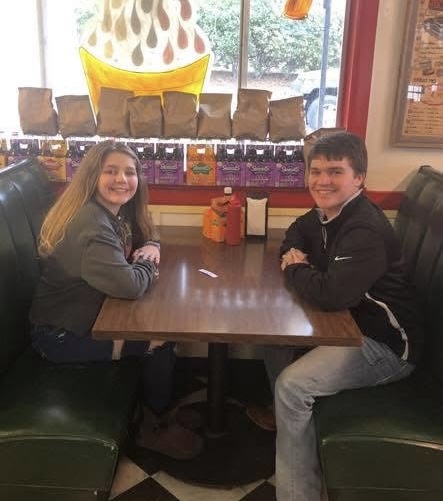
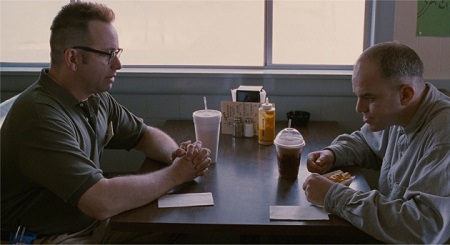
I live out in the country in Saline County, Arkansas. Back in 1996, Billy Bob Thornton wrote, directed and starred in a little film made right here called SLING BLADE (1996). It’s one of my favorite movies. Here’s a picture of our son and daughter sitting at the same table at Garry’s Drive-In Diner where Billy Bob Thornton and John Ritter sat in the movie. 

Thornton stars as Karl Childers, a developmentally disabled man who was abused as a child by his parents and the other children in the community. At the age of 12, he murdered his mom and her teenage lover Jessie Dixon with a sling blade. After 30 years in the mental hospital, the state decides he’s no longer dangerous, so they give him his stack of books and send him on his way. Karl has no clue of how to get on with his life, but the administrator of the hospital (James Hampton) helps him get a job as a small engine mechanic in his hometown. Hanging out at the laundromat one day, Karl meets a boy named Frank (Lucas Black) and helps him carry his bags of clothes back to his house. The two become friends and start hanging out a lot together. Frank introduces Karl to his mom, Linda (Natalie Canerday), and her gay best friend and boss, Vaughan (John Ritter). Karl also meets Linda’s abusive and alcoholic boyfriend, Doyle (Dwight Yoakam). Karl grows to love Frank and Linda. When he witnesses a drunk Doyle’s abusive and threatening behavior towards Frank and Linda one night, Karl starts thinking that Doyle may really hurt his friends someday. He decides he’s going to make sure that can never happen. 

First and foremost, I love SLING BLADE because of Billy Bob Thornton’s performance as Karl Childers. He had been developing the character of Karl for many years before the movie was made. He loved pulling “Karl” out when he was just hanging out and goofing around with his friends. He based his character on bits and pieces of so many different people in his life. As a native Arkansan, many of the words he says and the way he says them reminds me of different people I’ve known over the years. His opening monologue where he describes the murders of his mother and the young Jessie Dixon is a masterpiece in and of itself. Thornton created a truly unique character, and that’s extremely rare these days. It’s a performance for the ages and continues to inspire terrible imitations to this day!

The remainder of the cast in SLING BLADE is so good and natural. Lucas Black is phenomenal as Frank. Billy Bob Thornton has been asked how he got such a great performance from the then 12-year-old boy from Alabama. He says he didn’t get that performance; that’s just the kind of actor Lucas Black is. The relationship between Karl and Frank is the key to the film working, and Black is perfect. Natalie Canerday is excellent as Frank’s mom, Linda. She’s from Russellville, Arkansas, so her accent is authentic, and she just blends perfectly into the film. John Ritter provides a very solid supporting performance as Linda’s gay friend who cares deeply for her and Frank. Thornton was part of the cast of Ritter’s early 90’s sitcom with Markie Post called HEARTS AFIRE. He actually wrote this screenplay while working on the show. The two were great friends off camera and Ritter actually worried that he wouldn’t be able to give a serious performance opposite Thornton’s portrayal of Karl. And then there’s country music superstar Dwight Yoakam as the abusive bully Doyle Hargraves. He’s simply great in the film. He doesn’t just portray Doyle as a monster either. There are many people in this world like Doyle Hargraves, and Yoakam is able to capture that. Director Jim Jarmusch has a memorable cameo in the film. He sells Karl his “french fried potaters.” And the great Robert Duvall even makes a short appearance in the film as Karl’s dad. Duvall was over in the Memphis area filming his own movie A FAMILY THING, which was written by Thornton. He just made the 2 hour drive over for the day and filmed his scene.

Every scene filmed in SLING BLADE is filmed here in Benton and Saline County. The opening and closing scenes between Thornton and actor J.T. Walsh at the “nervous hospital” were filmed at the old Benton Services Center, which is now a psychiatric nursing home just outside of Benton. I’ve driven by the location of the home where Linda and Frank lived. I drive by the laundromat where Karl meets Frank every time I go eat at Garry’s Sling Blade Drive-in. I’ve driven out to the bridge over the Saline River that is prominently featured in the film (see picture below). Heck, I even went to college at the University of Central Arkansas with one of the young ladies who interview Karl at the beginning of the film. I love this movie, and I’m so proud that it was filmed in my backyard. 

SLING BLADE is an incredible film with a truly unique character at its center. The film is at times funny, heartbreaking, violent, slow, awkward, dramatic, and thrilling. It’s a resounding success for Billy Bob Thornton as a director, actor, and writer, even winning him an Oscar for his screenplay. I give this film my highest recommendation. 

I’ve included the trailer for SLING BLADE below:

Past reviews in the #ArkansasMovies series include:

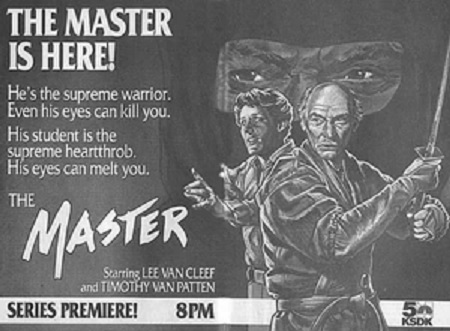
Retro Television Reviews: The Master 1.3 “State of the Union”


Welcome to Retro Television Reviews, a new feature where we review some of our favorite and least favorite shows of the past! On Fridays, I will be reviewing The Master, which ran on NBC from January to August of 1984. The show can be found on Tubi!

This week, The Master stands up for the working man!

Episode 1.3 “State of the Union”

(Dir by Alan Myerson, originally aired on February 3rd, 1984)

“Hi, I’m Max Keller and this is how I start my morning.”

So begins yet another episode of The Master!  This time, McAllister (Lee Van Cleef) is forcing Max (Timothy Van Patten) to start his day by running.  McAllister says that it’s a part of Max’s ninja training but I think it’s more a case of McAllister just seeing how many stupid things he can force Max to do before Max says, “Enough!”

This week finds Max and McAllister in Clearwater, California.  In order to make a little money, Max enters a dirt bike race.  It turns out that Max is very well-known on the dirt bike circuit and he even runs into an old friend named Hog (Mickey Jones) at the race.  Hog only shows up for a few minutes.  He shakes Max’s hand, jokes about the fact that Max is traveling with a hamster and a weird old man, and then he pretty much disappears from the episode.

McAllister watches the race while stroking Max’s pet hamster.

Try to get that image out of your head.

Anyway, Max does not win the race.  Instead, the race is won by Carrie Brown (Crystal Bernard).  At the finish line, Carrie is nearly run over by one her competitors, Chad Webster (Cotter Smith).  Chad is the son of the owner of the local cannery.  It turns out that Carrie also works at the cannery. Max takes an immediate liking to Carrie and decides that he should also get a job at the cannery.

McAllister points out that Carrie is attractive.  Max replies, “Does your ninja training make you immune to such things?”  McAllister shrugs.  It’s kind of an odd scene.

Anyway, at the cannery, Max quickly learns that there’s more to Carrie than just 80s hair and dirt bike racing.  Carrie is also a union organizer!  She’s carrying on her late brother’s dream of unionizing the cannery.  This largely means handing out flyers and encouraging people to go to a meeting. 

How bad are things at the cannery?  They’re so bad that an older worker gets crushed by a palette.  Fortunately, McAllister and Max show up just in time to help out.  Through the use of one of his magic throwing ticks, McAllister is able to send the palette crashing into the ocean.  While Max proceeds to flirt with Carrie, attentive viewers will see the worker — who is now probably crippled for life — being carried away in the background.  Despite having saved the guy’s life, neither Max nor McAllister ever ask about him again.

Anyway, you know where all this is heading.  Carrie wants to unionize the workers.  Chad and his buddies try to intimidate the workers into not joining the union.  At a meeting at the local church, Max gives a speech about how the workers have to get organized.  There are plenty of fights and car chases and yet another bar brawl.  That Max just can’t say out of trouble!

McAllister also joins Max on the dirt bike so that he can throw ninja stars at the bad guys.  This leads to some pretty bad rear projection shots.

In the end, Chad is revealed to have murdered Carrie’s brother.  The cannery votes to unionize and Max and McAllister promptly leave town because even they know better than to work at a union shop.  Though it’s not specifically stated, I imagine that the cannery probably closed two months and Carrie ended up following in the lead footsteps of Jimmy Hoffa.

This episode was a bit silly, largely because neither perky Crystal Bernard nor perpetually mush-mouth Tim Van Patten were believable as firebrand labor activists.  Lee Van Cleef seemed to be largely bored with the whole thing.  Fortunately, next week’s episode features a guest appearance from George Lazenby so maybe that will liven things up on The Master.

We’ll find out soon!

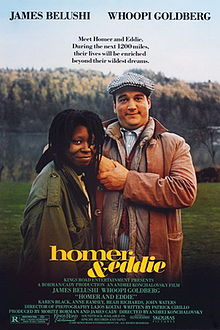
Lisa Cleans Out Her DVR: Homer and Eddie (dir by Andrei Konchalovsky)


(Lisa is currently in the process of cleaning out her DVR.  It’s taking her such a long time that she’s running out of cutesy ways to talk about how long it’s taking.  She recorded this 1989 comedy off of Starz on May 10th.)

This is another strange one.

Homer and Eddie opens with Homer (James Belushi) standing on the corner of an isolated stretch of desert road.  He is hitchhiking.  When a car finally stops to pick him up, Homer is so excited!  He gets in the back seat, gives the two men in the front seat a really wide smile, and innocently asks them how they’re doing.

One of the men (played by director John Waters) holds up a gun and demands all of Homer’s money.  After Homer hands the money over, he is kicked out of the car.  As the car drives away, Homer pulls a few dollars out of his sock and loudly yells that he fooled them and that they didn’t get all of his money.

The car abruptly stops and, going in reverse, pulls back up to Homer.  Homer gives up his money and the car speeds off.

In short, Homer probably shouldn’t be hitchhiking on his own.  Homer, you see, was hit in the head by a baseball when he was younger.  He has the mind and the innocent outlook of a child.  He is cheerful, he is religious, and he is totally unprepared to deal with real world.

Fortunately, Homer won’t be alone for too long.  Homer comes across an apparently deserted car and, without money or a place to stay, he decides to use the car as shelter.  However, it turns out that the car isn’t as abandoned as it looks!  No, the car is being used by Eddie (Whoopi Goldberg).  Eddie stole the car when she escaped from a mental institution.  Why was Eddie in the mental institution?  She’s a paranoid schizophrenic and she occasionally kills people.  Eddie and Homer are soon taking a very strange road trip, heading up north so that Homer can see his dying father.

It’s a very disjointed film, one that switches tone from scene to scene.  The two stars seem to be acting in totally different movies.  Belushi gives a very broad performance, one that often crosses the line into pure goofiness.  Eddie, meanwhile, is continually and constantly full of rage.  You never know when she’s going to snap and kill someone.  I spent a good deal of the movie waiting for her to kill Homer.  Maybe that was the point but it’s still hard to laugh at scenes of Homer and Eddie waving at a school bus full of cheerleaders when you’re also waiting for Whoopi Goldberg to beat and dismember Jim Belushi.

Homer and Eddie can  summed up by one lengthy sequence.  Eddie takes Homer to a brothel so that he can lose his virginity.  While Homer is dancing around in his underwear, Eddie is at a convenience store, shooting the clerk (played by Pruitt Taylor Vince).  The clerk, who was perfectly nice to Eddie before getting shot, looks at his wound and feebly says, “Why did you do that?” before dying.

It’s a weird little movie.  Usually, I love weird moves but this one is too much of a mess for even me.  As I watched it, I couldn’t help but think of how much more interesting the movie would be if it was the child-like Homer killing people and schizophrenic Eddie trying to keep him calm.  On a positive note, this was decades before Whoopi Goldberg gave up her edginess to co-host The View and she gives shockingly good performance.  When Eddie loses control, she’s actually frightening.  But, unfortunately, the film itself just doesn’t work.