Welcome to Retro Television Reviews, a feature where we review some of our favorite and least favorite shows of the past! On Mondays, I will be reviewing Miami Vice, which ran on NBC from 1984 to 1989. The entire show is currently streaming on Tubi!
This week, the squad loses a member!
Episode 1.5 “Calderone’s Return: The Hit List”
(Dir by Richard A. Colla, originally aired on October 19th, 1984)
This episode opens with Sonny Crockett …. shaving!
That’s right. After four episodes featuring Sonny with stubble, he finally shaves in this one. Tubbs is shocked to see it. However, Sonny has a good reason for shaving because he is due in divorce court, where he hopes that he can keep his soon to be ex-wife from taking his son to Georgia.
At the courthouse, Sonny and Caroline (Belinda Montgomery) take one look at each other and realize that they don’t want to give up on their marriage. They cancel the hearing and fire their attorneys. Caroline says that she’ll find a job in Miami and the Crockett family will stay together.
Yay! It’s a good thing Sonny shaved.
Unfortunately, the pilot’s main bad guy, Calderone, wants to return to Miami and he’s sent an assassin (Jim Zubiena) to not only take out his potential rivals but also to kill the cops who he blames for his downfall. When Tubbs and Rodriguez discover that Crockett is the 8th name on the assassin’s hit list and that six of the previous names are already dead, Rodriguez orders Crockett to go into productive custody. Knowing that Crockett has trouble with following orders, Lt. Rodriguez personally escorts Sonny to his boat so that Sonny can pack. When Rodriguez spots the reflection of a muzzle on a nearby building, Rodriguez pushes Sonny out of the way just as the Assassin pulls the trigger. Rodriguez takes the bullet that was meant for Sonny.
And I have to admit that I was a bit upset by Rodriguez getting shot, despite the fact that Rodriguez wasn’t a particularly well-developed character. He was the typical tough chief with a secret heart of gold and, for the most part, his brief role on the show consisted of barking at Sonny to do things by the book. But still, Gregory Sierra was a likable actor and, as a result, Rodriguez always came across as being nice even when he was angry at Crockett. Technically, the reason Rodriguez sacrificed his life was because Sierra requested to be written off the show. In the world of Miami Vice, though, Rodriguez’s death gave both Crockett and Tubbs even more motivation to seek revenge on Calderone.
But, before Crockett and Tubbs can head down to the Bahamas to get Calderone, they have to take care of the Assassin. After an hour of chases, misdirections, and one wonderfully over-the-top nightclub brawl, Crockett and the Assassin face each other in Crockett’s house, firing bullets at each other while Crockett’s wife and son cower in another room. It’s an exciting fight, containing one particularly memorable moment when the Assassin appears to be firing his machine gun directly at the camera. The Assassin was played by Jim Zubiena, who is a professional marksman and was a gun advisor on the set. The Assassin doesn’t say one word but he’s still terrifying precisely because he obviously knows how to handle a gun. In the end, it takes the entire Vice Squad to gun him down and it’s nice to see Crockett and Tubbs finally being helped out in a gunfight by Gina, Trudy, Switek, and Zito.
The Assassin may be dead but Calderone still lives. After Crockett tells his shaken wife that he’ll reschedule their divorce hearing, he and Tubbs head for the Bahamas as part one of Calderone’s Revenge comes to a close.
Welcome to Retro Television Reviews, a feature where we review some of our favorite and least favorite shows of the past! On Mondays, I will be reviewing Miami Vice, which ran on NBC from 1984 to 1989. The entire show is currently streaming on Tubi!
This week, Crockett and Tubbs gain an informant!
Episode 1.4 “Cool Runnin'”
(Dir by Lee H. Katzin, originally aired on October 5th, 1984)
One of the main themes of Miami Vice was that, no matter how many drug lords that Crockett and Tubbs got off the streets, there was always someone in the wings waiting to replace them. The drug trade was (and is) big business and there was always someone willing to step into the vacuum that was left by the downfall of any of the major players. For all of their efforts, Crockett and Tubbs were essentially fighting a war on drugs that could not be won.
Cool Runnin’ features an early example of this. With Calderone having fled Miami for Colombia, he’s been replaced by Desmond Maxwell (Afemo Omilami), a Jamaican who is willing to murder just about anyone who gets in his way. When he’s first seen, he and the members of his gang are gunning down a group of rival drug dealers in a mall parking lot. Later, Desmond kills one undercover cop and seriously wounds another.
Another major theme in Miami Vice is that Crockett (and, to a lesser extent, Tubbs) are willing to put others at risk to take down their targets. The majority of this episode deals with Nugart Neville ‘Noogie’ Lamont (Charlie Barnett), a talkative thief and speed freak who is recruited, somewhat against his will, to be an informant. When Crockett and Tubbs discover that Noogie served time with Desmond, they use Noogie to set up a meeting with Desmond. When Crockett tells Desmond that he wants to buy from him and that he’ll be waiting for him at Noogie’s apartment, Tubbs points out that Crockett is putting Noogie’s life in danger without even bothering to tell Noogie beforehand.
(Crockett, it should be noted, isn’t thinking straight for most of this episode because his wife has filed for divorce and wants to take his son to Georgia.)
At first, it appears that Noogie is going to get a reprieve when a calls comes in that the man who killed the undercover cops has been arrested. It doesn’t take long for Crockett (and the audience) to figure out that the man who has been arrested is not Jamaican (instead, he’s Haitian) and that he’s been beaten by the racist cop who arrested him.
Instead, the killers are now at Noogie’s apartment, where they are waiting for Crockett and Tubbs to show up so that they can kill both the cops and their informant. It all leads to final shoot-out, one that is shown almost entirely in slow motion and which is surprisingly effective.
This was a good episode about the human cost of getting involved as law enforcement, whether as a cop or a criminal. While Desmond Maxwell was not a particularly nuanced character, he was appropriately intimidating and the audience never had any doubt that he would coldly kill anyone who he viewed as being a threat. (One of the more haunting moments of the episode features the Vice Squad listening to the tape of shooting in which Desmond gunned down two detectives.)
The episode was largely dominated by Charlie Barnett’s performance as Noogie. Barnett was a stand-up comedian who first came to prominence performing in Central Park. He was nearly cast on SaturdayNight Live until it was discovered that he struggled with reading. Barnett was replaced, at the last minute, by another New York comedian, Eddie Murphy. As Noogie. Barnett never stops moving, talking, and performing. It’s actually exhausting just watching him. But, as the episode proceeds, Barnett starts to calm down and, by the end of it, the audience is actually happy that he wasn’t killed in the shoot-out.
Unfortunately, next week, a major character will be killed in a shootout. Who? Find out next Monday!
Welcome to Retro Television Reviews, a feature where we review some of our favorite and least favorite shows of the past! On Mondays, I will be reviewing Miami Vice, which ran on NBC from 1984 to 1989. The entire show is currently streaming on Tubi!
This week, Crockett and Tubbs drive into the abyss and discover what happens when you lose yourself in vice.
Episode 1.3 “Heart of Darkness”
(Dir by John Llewellyn Moxey, originally aired on September 28th, 1984)
The third episode of Miami Vice appears to be take place at least a month or two after the end of the pilot. Tubbs is not only now a member of the Miami Vice Squad but he and Crockett are now best friends. Gone is all the animosity and mistrust that characterized their initial relationship. Now, Crockett is willing to open up to Tubbs and Tubbs is willing to defend Crockett’s pet alligator, Elvis, when Sonny briefly flies into rage mode and threatens to throw away its favorite blanket.
(Sonny is upset because Elvis, who doesn’t like being left on the boat alone, ate one of Sonny’s records.)
Though Tubbs has been accepted by the Vice Squad, he’s still struggling to adjust to Miami, which is a bit more laid back than New York. Early on, he complains to Lt. Rodriguez about his apartment. Rodriguez just rolls his eyes. Sorry, Tubbs. Only one Miami cop gets to live with an alligator on a houseboat. Everyone else is stuck with a one-bedroom.
Crockett and Tubbs’s current assignment is to penetrate the world of Southern Florida porn kingpin, Walter Kovics (Paul Hecht). Kovics is involved with the Mafia and is suspected of having ordered several murders. When one of his actresses (played by Suzy Amis, making her television debut) is not only murdered but also turns out to be an underage runaway from Kansas, the case becomes personal. Crockett and Tubbs want to take down Kovics but the only way to get to Kovics is through his second-in-command, Artie Rollins. At first glance, Artie seems to be a typical coked up criminal but, upon further investigation, Crockett and Tubbs learn that Artie Rollins is actually Arthur Lawson, an FBI agent who has spent the last few years of his life working undercover. Now, no one is sure if Artie is still working undercover or if he’s truly gone over to the other side. Artie claims that he’s still working to bring down Kovics but when Kovics discovers that Crockett and Tubbs are undercover cops, Artie is the one who is ordered to shoot them. Which side is Artie on? Not even he seems to know for sure.
Artie is played by Ed O’Neill. The future star of Married With Children and Modern Family star was in his mid-thirties when he appeared in Miami Vice and this was one of his earliest television roles. O’Neill gives an unpredictable performance, one that is often frightening and sometimes even a bit poignant. As played by O’Neill, Arthur is a man who has truly lost himself and the character is compelling because Arthur himself doesn’t seem to know what he’s going to do from minute-to-minute. He may want to take down Kovics but he’s also spent so many years in Kovics’s world that he knows he won’t ever be able to adjust to anything else. In the end, Arthur does the right thing but he sacrifices his soul as he does it and his joy at gunning down Kovics is almost as disturbing as the look he had in his eyes when he was previously considering whether to execute Crockett and Tubbs. The show’s final moments find Crockett and Tubbs sitting in a cop bar. Crockett confesses that he saw a lot of himself in Arthur Lawson. Rodriguez approaches them and informs them that, while being debriefed at FBI headquarters, Arthur committed suicide.
This was an interesting episode. The plot was a bit conventional but it was elevated by Ed O’Neill’s performance as the unstable Arthur. (O’Neill kept the viewer guessing, along with Crockett and Tubbs, as to who Arthur really was.) And, of course, just when it seems like everyone’s gotten their happy ending, Rodriguez reminded us that happy endings are never guaranteed. Everything comes with a price. Indeed, that’s one of the major themes of Miami Vice. Arthur sacrificed his identity, his soul, and ultimately his life to see that justice was done but, in the end, someone will quickly replace Kovics and the business of vice will continue with little interruption. Arthur will be largely forgotten and only mentioned as a cautionary tale. Can anyone blame Sonny for wanting to spend all of his time on a boat with an alligator?
Welcome to Retro Television Reviews, a feature where we review some of our favorite and least favorite shows of the past! On Mondays, I will be reviewing Miami Vice, which ran on NBC from 1984 to 1989. The entire show is currently streaming on Tubi!
This week, we learn who Tubbs really is and one scene changes television forever.
Episode 1.2 “Brother Keeper: Part Two”
(Directed by Thomas Carter, originally aired on September 16th, 1984)
The pilot for Miami Vice originally aired as a two-hour made-for-TV movie but, when it was released in syndication, it was split into two separate episodes. That’s the way it’s usually aired on the retro stations and that’s also the way that it’s featured on Tubi. And, as you can tell, that’s the way that I’ve decided to review it for this site.
Picking up where the first half ended, Brother’s Keeper: Part Two finds Sonny and Tubbs searching through the deceased Leon’s apartment. Calderone’s men obviously visited the place and ransacked it before Sonny and Tubbs arrived but Sonny still manages to find Leon’s collection of important phone numbers. Tubbs is surprised to discover that Leon lived in a very nice apartment but that’s the way things work in Miami. Cocaine means big money and any one willing to take the risk can live like a king. While the cops and the regular people go home to small apartments and houses that they can barely afford, the successful criminal lives a life of relative luxury. The question is less why so many people are dealing drugs as why so many people aren’t.
While searching the apartment, Tubbs suddenly realizes that Sonny Crockett used to be a football star with the University of Florida. (“You were a funky honky!” Tubbs exclaims.) Apparently, Sonny was one of the best but a series of injuries ended his NFL dreams and, instead of going pro, Sonny did two tours of duty in Vietnam. (The South Asian conference, Sonny calls it.) Myself, I’m wondering how a semi-famous former football player can also be an undercover detective, working under a false name. Wouldn’t he always be worried that a drug dealer would recognize him from the college days and figure out that Sonny Burnett was actually Sonny Crockett?
Sonny’s co-worker and girlfriend, Gina (Saundra Santiago), takes a break from working the undercover prostitution detail and lets Sonny know that she did a background check on Raphael Tubbs and he’s dead! Raphael was a New York cop who was killed in shootout weeks before the other Tubbs landed in Miami. When Sonny confronts him about this, Tubbs admits that he’s actually Ricardo, Raphael’s younger brother. Raphael was a decorated Brooklyn detective. Rico Tubbs, on the other hand, was a Bronx beat cop who forged a lot of documents in order to come down to Florida and convince Vice to allow him to work the Calderone case. Sonny isn’t happy about being lied to but he has a lot more to worry about because, the night before, he apparently rolled over to Gina and whispered his ex-wife’s name in her ear! Needless to say, things are a bit awkward between just about everyone.
Actually, awkward doesn’t even begin to describe what happens when Tubbs suggests that Lt. Rodriguez could be Calderone’s mole. Sonny refuses to consider it until he overhears Rodriguez talking about enrolling his son in a pricey private school. Fortunately, Rodriguez is innocent and the real mole’s number is found in Leon’s apartment. Unfortunately, that number belongs to Sonny’s former partner, Scott Wheeler (Bill Smitrovich)!
After getting Wheeler to confess and turning him over to Rodriguez, Sonny and Tubbs drive down the dark streets of Miami at night, heading towards a rendezvous with Calderone. They don’t say much. Tubbs loads his shotgun. Sonny stops and makes a call to his ex-wife, something that his former partner Eddie didn’t get to do before he was killed. The neon of Miami glows menacingly in the darkness. Meanwhile, in the background, Phil Collins sings In the Air Tonight….
And it’s an absolutely beautiful sequence. Between the surreal menace of Miami at night, the atmosphere of impending doom, and the moody song playing in the background, this sequence plays out like a surreal dream. Both Tubbs and Crockett know that they are quite possibly driving to their death but, at this point, they have no other choice. Too many people have died to turn back. Neither Sonny nor Tubbs has anything in their life at that moment, beyond arresting Calderone.
And they do manage to arrest Calderone, along with killing quite a few of his associates. However, Calderone is released by a crooked judge and flies away in a private airplane while Sonny and Tubbs can only stand on the runway and watch. Sonny says that Calderone will return eventually. Tubbs replies that he probably doesn’t have a job anymore. Sonny asks Tubbs if he’s interested in a “career in Southern law enforcement.”
The second part of the pilot was dominated by that one scene of Tubbs and Sonny driving down the street. And that scene was so strong and it made such an impression that it’s easy to ignore that the rest of Brother’s Keeper Part Two was not quite as exciting as Part One. If the first part of the pilot set up Miami as a hedonistic playground of the rich and corrupt, the second part felt a bit more conventional in its approach. Or, at least, it did until Phil Collins started to sing and play the drums. One cannot understate the importance of that one scene. That one scene, done with next to no dialogue, pretty much told the viewer everything that they needed to know about the show, about Miami, and about Crockett and Tubbs as partners. In that scene, the show reminded us that no one is guaranteed to get out alive.
Next week: Crockett and Tubbs infiltrate an undercover pornography ring and Ed O’Neill appears as an FBI agent who may have gone over to the dark side.
Welcome to Retro Television Reviews, a feature where we review some of our favorite and least favorite shows of the past! On Mondays, I will be reviewing Miami Vice, which ran on NBC from 1984 to 1989. The entire show is currently streaming on Tubi!
Legend has it that Miami Vice was originally pitched as being “MTV Cops.” That may or may not be true but what is known is that it was a show that, for many people, continues to epitomize the 80s. Its cynical and frequently surrealistic portrait of life in Miami continues to be influential to this day. With Florida currently being at the center of so many discussions, it just seemed like a natural pick for Retro Television Reviews.
(Up until a few days ago, the mayor of Miami was running for President and two other Florida residents are currently the front runners for one party’s presidential nomination. As I sit here writing this, national politics are often described as Florida vs California. Even more than in the past, America revolves around Florida.)
Though Miami Vice is often describe as being a Michael Mann production, the show itself was actually created by Anthony Yerkovich, who felt that Miami in the 80s had become the American equivalent of Casablanca during World War II. Mann served as executive producer and he played a big role in creating the show’s trademark visual style. And, of course, the theme song was provided by Jan Hammer:
Episode 1.1 “Brother’s Keeper, Part One”
(Dir by Thomas Carter, originally aired on September 16th, 1984)
Though the show is considered, to this day, to be the epitome of the Southern Florida aesthetic, Miami Vice actually begins in New York City.
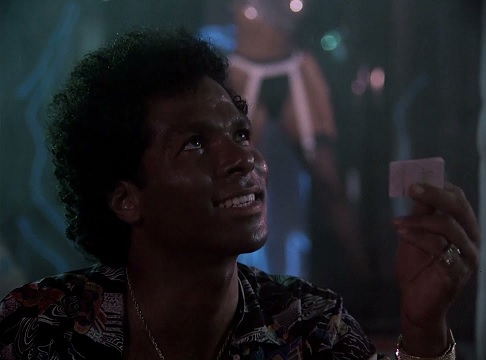
On a dark and wet New York Street, a detective named Tubbs (Philip Michael Thomas) sits in his car. When a group of young men approach the car and demand that Tubbs give them some money, Tubb responds by coolly pointing a shotgun at them. The men take the message and leave.
Tubbs is staking out a Colombian drug dealer named Calderone (Miguel Pinero). Tubbs follows Calderone and his associates to a club, the type of place where even the neon lighting seem to be shadowy. When Tubbs gets into a fight with some of Calderone’s bodyguards, Calderone flees into the dark night.
The action moves to Miami, which is as bright and sunny as New York was cold and dark. Undercover vice cop Sonny Crockett (Don Johnson), wearing a white suit and a green t-shirt, gives advice to his partner, Eddie Rivera (a young and charismatic Jimmy Smits, making his television debut). Eddie talks about how his wife is nervous about him being a cop. Sonny tells Eddie to call her after they get finished dealing with a local drug dealer named Corky.
Corky knows Crockett as “Sonny Burnett” and he believes Eddie is a buyer from California. When Corky arrives, they drive out to an underpass. Corky and Eddie walk over to another car to check out Corky’s product. Sonny spots the bomb that’s been taped under car’s hood but he’s too late to keep it from blowing up both Corky and Eddie.
When Lt. Rodriguez (Gregory Sierra) arrives on the scene, he’s not amused to discover two of his detectives — Stan Switek (Michael Talbott) and Larry Zito (John Diehl) — joking about how the police dogs are going to get hooked on all of the cocaine residue. However, he’s even more annoyed with Sonny, who is quickly established as being the type of cop who does not “do it by the book!” Rodriguez also says that Sonny hasn’t changed since his “football days.” Sonny says that Eddie was killed by a mysterious dealer known as The Colombian. Rodriguez replies that Sonny can’t even prove that the Colombian exists. Rodriguez is particularly angered when Sonny says that there must be a mole working in the department.
While Sonny tells Eddie’s wife the bad news and then heads over to his son’s birthday party (it’s established that Sonny is divorced), Tubbs lands in Miami. Hanging out at a strip club and doing an elaborate dance to Rockwell’s Somebody’s Watching Me, Tubbs is approached by a man named Scott Wheeler (Bill Smitrovich). Pretending to be a Jamaican named Teddy Prentiss, Tubbs arranges to meet a drug dealer that Wheeler claims to know.
What Tubbs doesn’t know is that Wheeler is an undercover DEA agent and that he’s also Sonny Crockett’s former partner. Sonny is the “dealer.” That night, Sonny and a real-life drug dealer, Leon (Mykelti Williamson) show up at the meeting with Wheeler and “Teddy.” Unfortunately, Zito and Switek show up earlier than expected and they end up arresting everyone before Leon can lead Sonny to the Colombian. Tubbs makes a run for it, jumps into the boat that Sonny drove to the meeting, and speeds away. Sonny jumps into his own car and chases the boat while the Miami Vice theme song plays in the background. (Trust me, it’s a supercool scene.)
Finally confronting Tubbs on a bridge, Sonny reveals that he’s a detective. Tubbs produces his own badge and introduces himself as Raphael Tubbs of the NYPD. He explains that he’s in Miami because he’s after a Colombian drug dealer named Calderone. Sonny explains that he’s too busy searching for the Colombian to worry about Tubbs’s search. Finally, Lt. Rodriguez shows up and helps them to understand that they’re both looking for the same guy. Rodriguez suggests that they work together but Sonny refuses.
The next morning, Tubbs tracks Sonny down on the houseboat on which he lives. It’s a tense meeting, with Sonny punching Tubbs for suggesting that he wasn’t a good enough cop to save Eddie’s life. Sonny apologizes afterwards and Tubbs accepts the apology and then punches Sonny so that they’ll be even. Sonny then introduces Tubbs to his pet alligator, Elvis. It’s male-bonding, 80s style!
Sonny and Scott head over to the courthouse so that they can be “arraigned,” along with Leon. I really liked the performance of Howard Bergman, who played the eccentric judge, Clarence Rupp. At one point, the lights went out in the courtroom and when they came back, everyone from the judge to the bailiffs to the court reporter had drawn a gun. After mentioning his appreciation of the second amendment, Judge Rupp announces that Leon is free to go without bail because he’s cooperating with the police. A panicked Leon yells that he’s not cooperating.
Later, a fearful Leon calls Rodriguez and offers to cooperate in return for protective custody. Leon is hiding out at the beach, where Tubbs is keeping an eye on him. When Sonny arrives, he’s not amused to see Tubbs there. Meanwhile, a hitman who has disguised himself as a woman shoots and kills Leon while Girls Just Want To Have Fun plays on the soundtrack.
And so ends part one of Brother’s Keeper. And you know what? Even after all this time, it’s still easy to see why Miami Vice took off and why it continue to inspire a slew of imitators. The pilot was genuinely exciting, with the perfect mix of music, visuals, and charismatic performances. Jimmy Smits broke my heart in his tiny role. Mykelti Williamson made Leon into an almost sympathetic character as he realized that the cops were willing to sacrifice him to get at his boss. From the start, Don Johnson’s gruff performance as Sonny feels like a perfect match for Philip Michael Thomas’s more earnest portrayal of Tubbs. If Sonny is a cynic, Tubbs seems to feel that he can make a difference by taking down men like Calderone. We’ll have to see how long that lasts.
Next week, we’ll finish up the pilot with part two of Brother’s Keeper!
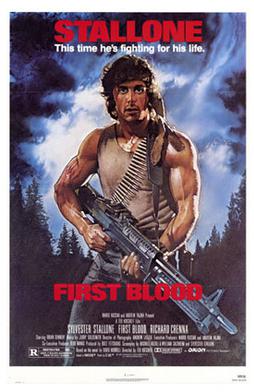
From everything that I had heard and seen over the past few years, I was under the impression that this 1982 film was the ultimate in mindless action. I figured that the film was basically just two hours of Sylvester Stallone hiding in the woods, firing a machine gun, riding a motorcycle, and eventually blowing up a small, bigoted town. It wasn’t a film that I was in any particular hurry to experience but I knew it was one that I would have to watch eventually, if just because of how many filmmakers have cited the film as an influence. On Sunday night, First Blood aired on the Sundance Channel and, for the first time, I watched it all the way through. What I discovered is that there’s a lot more to First Blood than I had been led to believe.
Now, don’t get me wrong. It’s definitely an action film. Stallone spends a lot of time hiding in the woods, firing a machine gun, riding a motorcycle, and blowing up a town. Somewhat improbably, only one character actually dies over the course of the film, though quite a few end up getting maimed and wounded. There’s even a close-up of Stallone stitching up a nasty gash on his arm, which totally made me cringe. But, even with all the gunfire and explosions, First Blood has more on its mind than just carnage. It’s a brooding film, one that angrily takes America to task for its treatment of its veterans and outsiders. In its way, it’s an action film with a heart.
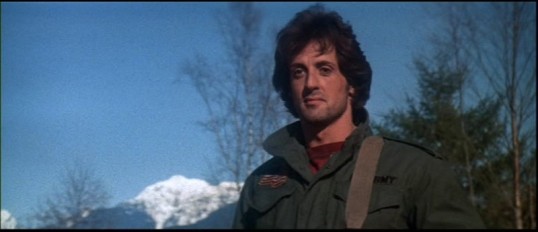
Sylvester Stallone plays John Rambo, a troubled drifter who is still haunted by not only his experiences in Vietnam but also by the feeling that his own country doesn’t want him around. When Rambo, with his unkempt hair and wearing a jacket with an American flag patch prominently displayed, shows up in the town of Hope, Washington, it’s not to cause trouble. He just wants to see an old friend, a man with whom he served. Unfortunately, his friend has died. The man’s bitter mother says that he got cancer from “that orange stuff they were spraying around.” Even though the war is over, it’s still killing the only people who can possibly understand how Rambo feels about both his service and his uncertain place in American society.
As Rambo walks through the town, he’s spotted by Sheriff Will Teasle (Brian Dennehy). Rambo just wants to get a cup of coffee and relax. Teasle, however, views Rambo as being a stranger and, therefore, a possible threat to his town. Teasle wants Rambo to leave. Rambo wants to know why, after everything that he’s sacrificed for his country, he’s being told that he needs to get a haircut. From this simple conflict — a misunderstanding really, as Teasle doesn’t know that Rambo is mourning the death of his friend and instead interprets Rambo’s sullen silence as being a threat — an undeclared and unwinnable war soon breaks out.
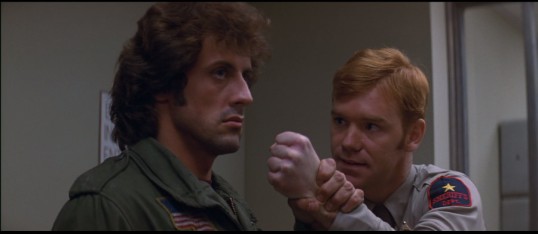
Technically, Teasle is the film’s villain. He’s the one who arrests Rambo for vagrancy. It’s his abusive deputies who cause Rambo to have the flashbacks that lead to him breaking out of jail. It’s Teasle’s arrogance that leads to him ignore the warnings of Rambo’s former commanding office, Sam Trautman (Richard Crenna). And yet, Teasle himself is never portrayed as being an evil man. Instead, Dennehy plays Teasle as being well-meaning but stubborn. It’s been written that the most compelling villains are the ones who don’t realize that they’re the villain and that’s certainly true in Teasle’s case. Teasle’s job is to protect the town and its citizens and that’s what he’s determined to do. If his actions become extreme, it has less to do with any deliberate cruelty on his part and everything to do with the fact that, towards the end of the film, he finally figures out that he’s in way over his head.
Once Rambo has disappeared into the woods and maimed (but not killed) all of Teasle’s deputies, he only has one request and that’s to be left alone. He simply wants to stay in the woods, hunting for food and free from a society that has nothing to offer him during peacetime. What’s interesting is that, at the start of the film, everyone wants Rambo to just disappear. He’s a reminder of not just the turmoil of the Vietnam era but also the fact that Vietnam was the first war that America lost. Rambo’s presence is viewed as being like an ugly scar that you wish would just fade away. However, once Rambo does actually vanish, people won’t stop looking for him. As opposed to the later films in the franchise, the Rambo of First Blood doesn’t want to fight anyone. Rambo just wants to be left alone in solitude and considering the way that he’s treated by the town of Hope, it’s hard to blame him.
And so, you end up sympathizing with this John Rambo. Even thought he’s blowing up a town during the Christmas season and there’s a few scenes where he’s kind of scary, it’s impossible not to feel that he has a right to his anger. You find yourself wishing that the Sheriff had just left him alone or that maybe Rambo had just taken Teasle’s earlier advice and left town. Because, as you watch the film, you know that 1) there was no good reason why any of this had to happen and 2) things probably aren’t going to end well for either John Rambo or Will Teasle.
First Blood was based on a novel that was first published in 1972. The film spent nearly a decade in development, as various directors, screenwriters, and actors circled around the project. At one point, First Blood was envisioned as an anti-war film that would have been directed by Sidney Lumet and which would have featured a bearded Al Pacino lurking through the wilderness and killing not only Teasle but also several deputies and national guardsmen. When Stallone agreed to star in the film, he also rewrote the script, transforming Rambo into a sympathetic outsider who goes out of his way not to kill anyone. The end result was an underdog story that audiences could embrace.
Seen today, it’s interesting to see how many familiar faces pop up in First Blood. For instance, a young and really goofy-looking David Caruso pops up and totally overacts in the role of the only sympathetic deputy. A less sympathetic deputy is played by Chris Mulkey, who would go on to play other unsympathetic characters in a huge number of movies and TV shows. Interestingly enough, the most sadistic of the deputies was played by Jack Starrett, who directed a several classic B-moves in the 70s. (One of Starrett’s films was The Losers, in which a bunch of bikers were sent to Vietnam to rescue an American diplomat.)
As opposed to many of the films that it subsequently inspired, First Blood holds up surprisingly well. It may be violent but it’s violence with a heart.
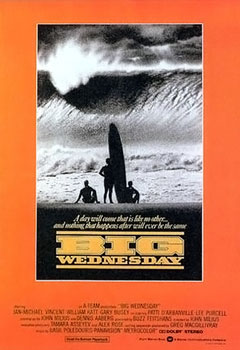
If there is a male bonding hall of fame, Big Wednesday has to be front and center.
This episodic movie follows three legendary surfers over twelve years of change and turmoil. Jack Barlowe (William Katt) is the straight arrow who keeps the peace. Leroy “The Masochist” Smith (Gary Busey) is the wild man. Matt Johnson (Jan-Michael Vincent) is the best surfer of them all but he resents both his fame and the expectation that he should be some sort of role model for the younger kids on the beach. From 1962 until 1974, the three of them learn about love and responsibility while dealing with cultural turmoil (including, of course, the Vietnam War) and waiting for that one legendary wave.
After writing the screenplays for Dirty Harry and Apocalypse Now and directing The Wind and The Lion and Dillinger, John Milius finally got to make his dream project. Big Wednesday was based on Milius’s own youth as a California surfer and he has said that all three of the main characters were based on different aspects of his own personality. Expectations for Big Wednesday were so high that Milius’s friends, George Lucas and Steven Spielberg, exchanged percentages points for Star Wars and Close Encounters of The Third Kind for a point of Big Wednesday. The deal turned out to be worth millions to Milius but nothing to Lucas and Spielberg because Big Wednesday was a notorious box office flop. Warner Bros. sold the film as a raunchy comedy, leaving audiences surprised to discover that Big Wednesday was actually, in Milius’s words, a “coming-of-age story with Arthurian overtones.”
I can understand why Big Wednesday may not be for everyone but it is one of my favorite movies. It is one of the ultimate guy films. Some of the dialogue and the narration may be overwrought but so are most guys, especially when they’re the same age as the surfers in Big Wednesday. We all like to imagine that we are heroes in some sort of epic adventure. The surfing footage is amazing but it is not necessary to be a surfer to relate to the film’s coming-of-age story or its celebration of the enduring bonds of friendship. Katt, Vincent, and Busey all give great performances. Considering their later careers, it is good that Big Wednesday is around to remind us of what Gary Busey and Jan-Michael Vincent were capable of at their best, before their promising careers were derailed by drugs and mental illness. Be sure to also keep an eye out for infamous 70s character actor Joe Spinell as an army psychiatrist, a pre-Nightmare on Elm Street Robert Englund, playing a fellow surfer and providing the film’s narration, and Barbara Hale, playing the patient mother of her real-life son, William Katt.
One final note: At a time when the shameful stereotype of the psycho Vietnam vet was becoming popular and unfairly tarnishing the reputation of real-life vets, Big Wednesday was unique for featuring a character who not only joins the Army but who appears to return as a better person as a result.
“Do you think we like being associated with the President of the United States? I mean, we run an honest business here!” —
Jeff (Gerrit Graham) in Used Cars (1980)
As a film lover, I’ve sat through so many disappointing commentary tracks that, when I come across one that’s actually fun and informative, it causes me to like the film even more. One of the best commentary tracks that I’ve ever heard was the one that Robert Zemeckis, Bob Gale, and Kurt Russell recorded for the DVD release of the 1980 comedy Used Cars.
The film — which was an early credit for both director Zemeckis and screenwriter Gale — tells the story of two rival used car lots. The bad guy car lot is owned by Roy L. Fuchs (Jack Warden). The good guy car lot is owned by Roy’s brother, Luke Fuchs (also played by Jack Warden). The top salesman at the good guy car lot is Rudy Russo (Kurt Russell). The film shows what happens when Luke dies and Rudy tries to prevent Roy from taking over the lot.
The commentary track is distinguished by just how much Zemeckis, Gale, and Russell seem to truly enjoy watching and talking about the film. Kurt Russell, in particular, has an incredibly engaging laugh and his sense of fun is contagious. However, for me, the most interesting part of the commentary track came when Bob Gale explicitly compared Rudy Russo and Luke’s daughter (played by Deborah Harmon) to Bill and Hillary Clinton and then even starts to do a surprisingly good imitation of Bill’s hoarse Arkansas accent.
What made it interesting was that the comparison was absolutely correct.
Politicians are salesmen. Much as politicians will say anything to get your vote, the salesmen in Used Cars will say and do anything to get your money. Politicians sell promises that are too good to be true. Rudy Russo and Roy L. Fuchs do the same thing, claiming that their used cars are just as good and safe as a car that’s never been owned before.
In fact, one of the major plotlines in Used Cars is that Rudy is plotting to make the move from selling cars to buying votes. There’s a vacancy in the state senate and Rudy is planning on running for the seat. All he has to do is come up with the $10,000 necessary to buy the nomination from the local political machine. (I imagine it would be more expensive to buy a nomination today.) Luke agrees to loan Rudy the money but, before he can, Luke goes on a test drive with a former race car driver.
The driver works for Luke’s evil brother, Roy. Roy knows that Luke has a heart condition and he specifically sends over that driver to give Luke a fatal heart attack. Just as Rudy is trying to sell a car to a costumer who is skeptical about whether or not he should pay an extra fifty dollar for something he doesn’t want (“$50.00 never killed anyone!” the customer insists), Luke staggers into the office and dies.
(The shocked customer agrees to pay the extra fifty dollars. Ever the salesman, Luke grabs the fifty before he dies.)
With Luke dead and his estranged daughter nowhere to be seen, Roy is next-in-line to take over Luke’s car lot. So, Rudy hides the body and tells everyone that Luke is down in Florida. Both he and his fellow salesman, the hilariously superstitious Jeff (Gerrit Graham), conspire to make as much money as possible before anyone discovers the truth.
How do they do it? Illegally, of course!
First off, they break into the broadcast of a football game and do an ad. Then, they use strippers to attract customers. And finally, Rudy comes up with his master plan, interrupting a televised address from the President of the United States.
“You can’t fuck with the President!” Jeff says.
“Hey, he fucks with us…” Rudy responds.
Seriously, I love Rudy.
In fact, I really liked Used Cars. It’s a good combination of broad humor and clever satire and both Kurt Russell and Gerrit Graham give such likable performances that you can ignore the fact that they’re both playing total jerks. (In fact, I would argue that one reason that we love Rudy is because he’s so honest about being so crooked.) Not every scene worked perfectly. The scene where Rudy and Jeff interrupt that football game goes on forever and, after a spokesmodel’s dress is ripped off, becomes so uncomfortable to watch that it actually takes the film a while to recover. But then, after that, you get the interruption of the President’s speech. You get Jeff freaking out over whether or not red cars or unlucky. You get some fun driving school humor. And, of course, you get a cute dog that can do tricks and helps to sell cars. The film recovers and, ultimately, Used Cars is a celebration of small businesses everywhere.
And you know what?
I really hope Rudy did make it into the state senate.
We need more Rudy Russos in government.
And we really need more commentary tracks featuring Kurt Russell!





 If there is a male bonding hall of fame,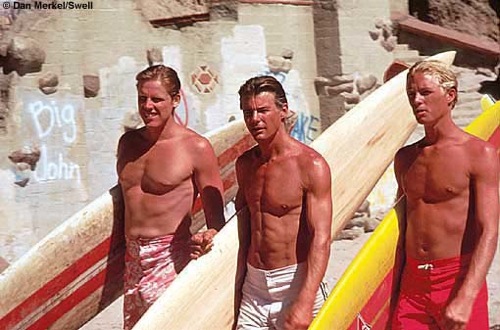

 Through the Shattered Lens