The TSL Horror Grindhouse: Fear City (dir by Abel Ferrara)


Welcome to Manhattan in the mid-80s!

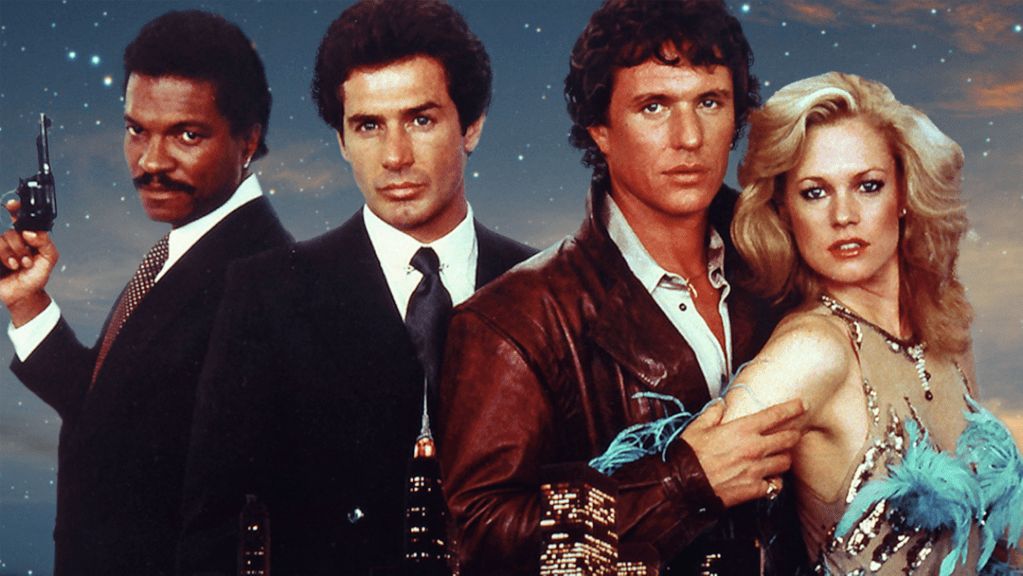
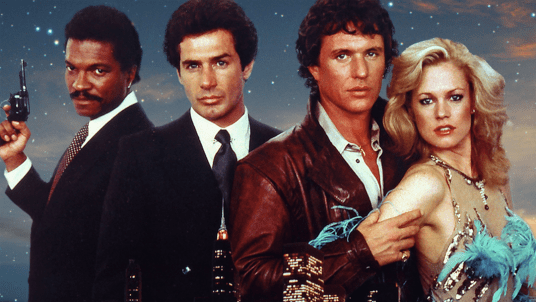
While self-righteous vice cop Al Wheeler (Billy Dee Williams) patrols the streets with the fury of an Old Testament prophet, men flock to seedy bars to watch women like Loretta (Melanie Griffith) dance and strip.  Mobsters like Carmine (Rossano Brazzi) control the streets while club owners like Mike (Michael V. Gazzo) and Frank (Joe Santos) try to do business and make enough money to keep things open.  Bookers like Nicky Parzeno (Jack Scalia) and Lou Goldstein (Jan Murray) compete to see who can place their girls in the most clubs.  Nicky’s best friend and business partner, Matt Rossi (Tom Berenger), is haunted by his violent past as a boxer and his failed relationship with the drug-addicted Loretta.

Meanwhile, a nameless man (John Foster) practices nude tai chai in his warehouse apartment and writes feverishly in his journals.  At night, he stalks the streets with a blade in his hand.  He targets strippers, attacking them as they try to get home from the club.  Honey (Ola Ray) is attacked on a subway platform.  Loretta’s girlfriend, Leila (Rae Dawn Chong), is attacked on the streets.  Obsessed with Loretta’s safety, Matt struggles with his own inner demons as he prepares for a final confrontation with the killer….

1985’s Fear City is another one of director Abel Ferrara’s heavily stylized fever dreams.  In typical Ferrara fashion, the plot is so sordid that one might be tempted to think that the film is meant to be a self-parody and the dialogue mixes profane insults with bizarrely philosophical asides.  As played by Billy Dee Williams, Al Wheeler is not just a cop who wants to clean up New York and Times Square.  Instead, he’s a seething soldier to traditional morality and one who is so intense that it’s something of a shock that he doesn’t just walk around New York shooting people for jaywalking.  Meanwhile, Tom Berenger’s Matt is a hulking brute who is haunted by the time he killed a man in the ring.  He knows what he’s capable of and it scares him but, in order to save Loretta and his business, he’s going to have to become that deadly boxer once again.  “I hate Matt Rossi because he’s arrogant,” Al Wheeler says through gritted teeth.  Meanwhile, Matt deals with his own issues by trashing his office and then leaving the mess for someone else to clean up.  I’m not sure what that was supposed to accomplish but it’s apparently something that Matt just has to do.

Abel Ferrara directed this film five years before King of New York and, in some ways, Fear City feels like a dry run for King of New York.  Both films are highly stylized and both present New York as being a neon-lit Hell where the rich and the poor come together in mutual self-loathing and where the criminals often have more of a code of honor than the cops who are trying to stop them.  Of course, King of New York had Christopher Walken’s magnetic performance as Frank White holding the film and its many storylines together.  Fear City doesn’t really have that.  Billy Dee Williams, Tom Berenger, Jack Scalia, and Melanie Griffith all give strong performance but none of their characters are really quite compelling or grounded enough to keep the film from spinning off into delirious excess.

In other words, Fear City is a mess but it’s one of those over-the-top, shamelessly sordid messes that you really can’t look away from.  There’s enough philosophical dialogue to confirm that, as with King of New York, Ferrara was shooting at something more than just a typical exploitation film.  Unlike King of New York, Ferrara doesn’t quite succeed in saying anything particularly deep about the human condition in Fear City.  But that’s okay.  It’s an entertainingly sordid film.
Love on the Shattered Lens: Something Wild (dir by Jonathan Demme)


1986’s Something Wild opens with Charlie Driggs (Jeff Daniels) eating lunch in a New York diner.

Charlie is a stockbroker.  He wears a suit.  He’s quiet and mild-mannered.  He just got a promotion at work.  He carries a picture of his kids in his wallet.  Everything about Charlie shouts that he’s a nice guy who is extremely conventional in his outlook and behavior.  But then, Charlie sneaks out of the diner without paying and is spotted by a woman (Melanie Griffith) who says that her name is Lulu.

Dressed in black and with a brunette bob that makes her look like Louis Brooks (and which is later revealed to be a wig), Lulu chases after Charlie.  She offers him a ride back to his job, downtown.  However, when Charlie gets in the car, Lulu instead speeds off towards New Jersey.  Lulu grabs Charlie beeper and throws it away.  (I guess that was the 80s equivalent of stealing someone’s phone.)  She stops off at a liquor store and robs the place while Charlie unknowingly waits out in the car.  She takes him to a motel and, after handcuffing to the bed, has sex with him and calls his office….

And then the film takes an unexpected turn.  What started out as one of those NSFW stories that occasionally cropped up on Internet message boards suddenly turns into a quirky slice of Americana.  Lulu and Charlie head to Pennsylvania for Lulu’s high school reunion.  Lulu reveals that her real name is Audrey and she’s actually blonde.  Audrey introduces Charlie to her family as being her husband and Charlie plays along with her.  At the reunion, Charlie turns out to be just as skillful a liar as Audrey.  But there’s nothing particularly mean-spirited about their lies.  Audrey wanted to be able to brag about having a wonderful husband at her reunion and Charlie, whose wife left him for a dentist, wanted to pretend that he was still married and still a regular part of his children’s lives.  The reunion itself is a masterful set piece, one in which director Jonathan Demme balances his trademark quirky humor with a genuine love for small town American.  With the old school bands playing in front of an American flag, Demme transforms the reunion into a metaphor for everything good about this country.  It’s a place where two lonely people can find each other.  The weekend may have started out like a middle-aged man’s fantasy but Charlie finds himself falling in love with the real Audrey.  It’s very sweet and humorous and it makes you feel good about life in general….

And then Ray shows up and the film takes another unexpected turn.  Played by Ray Liotta, Ray is Audrey’s ex-husband.  He’s a charmer, as one might expect from a character played by a young Ray Liotta.  Ray is friendly with Charlie, telling him stories about how wild Audrey was in high school.  It’s only as the night progresses that it becomes obvious that Ray is a sadistic sociopath and he wants Audrey back.

The violence in the film’s second half is a bit jarring.  After the good-natured, screwball comedy of the film’s first 50 minutes, it’s shocking to suddenly see Ray pistol-whipping a clerk and then breaking Charlie’s nose.  At the same time, meeting Ray allows us to know what it was that attracted Audrey to Charlie.  Charlie is the opposite of Ray, a good man who truly cares about other people.  Ray is the type of bad boy who is very attractive when you don’t know any better.  Charlie is the guy who seems conventional but, underneath it all, turns out to be something wild as well.

Directed by Jonathan Demme, Something Wild has a good eye for the quirkiness of America.  It portrays the world out of New York with love and none of the condescension that tends to show up in so many other road trip movies.  Daniels, Griffith, and the much-missed Ray Liotta all gives performance that take the viewer by surprise.  None of them are who we originally assume them to be and Griffith’s deconstruction of the type of character who would later be termed a “manic pixie dream girl” is probably her best and most honest performance.  Even Ray, for all his violent tendencies, has moments of humanity.  Something Wild is a celebration of life, rebellion, and love.  Like Charlie and Audrey, it’s more than worth taking a chance on.

Retro Television Review: Miami Vice 3.20 “By Hooker by Crook”


Welcome to Retro Television Reviews, a feature where we review some of our favorite and least favorite shows of the past!  On Mondays, I will be reviewing Miami Vice, which ran on NBC from 1984 to 1989.  The entire show can be purchased on Prime!

This week, Sonny falls for a madame.

Episode 3.20 “By Hooker by Crook”

(Dir by Don Johnson, originally aired on March 20th, 1987)

Here I am, halfway through the third season of Miami Vice and it still amuses the Heck out of me how shocked Crockett and Tubbs are whenever their cover gets blown.

As far as  I can tell, neither Crockett nor Tubbs make much of an effort at maintaining their cover, beyond using the names Burnett and Cooper.  (Tubbs occasionally uses a fake Jamaican accent.)  They dress exactly the same as cops as they do when they’re criminals.  They hang out, in public, with the other members of the Vice Squad.  They occasionally respond to “all unit” calls, which means that anyone in the area at the time will recognize them as being cops.  Add to that, Crockett is supposedly a minor Florida celebrity, a former football star who went to Vietnam.  In short, these two have the worst covers ever but they’re still stunned when the criminals see through their “Burnett and Cooper” identities …. even though it happens in every episode!

This time, it’s George Takei, playing a viscous crime lord, who sees through their cover and orders his men to attack.  It leads to a shoot-out, much of which is filmed in slow motion.  It would be pretty exciting and dramatic, except for the fact that one of Takei’s henchmen is played Captain Lou Albano, the rubber band-wearing wrestler.  It also doesn’t help that Takei is …. well, he’s Takei.  He camps up his villain role to such an extent that it’s impossible to take him seriously as any sort of threat.  Even though he orders his men to kill an escort played by Vanity, he still comes across as being flamboyant, eccentric old George.

This episode was directed by Don Johnson and, as often happens when a cast member first tries his hand at directing, it’s filled with shots that are supposed to make you go, “Hey, this guy’s got a vision!”  The slow motion gunfight is an example of this.  An extended scene that is filmed with a fish-eyed lens (the better to represent Izzy’s point of view as he looks through a peephole) is another example.  A sex scene between Crockett and a madame who is played by Melanie Griffith is filmed in soft focus and lit in such a way that it looks like the entire set is about to burst into flame from the heat.  Johnson the director seems to be saying, “Dang, Don Johnson’s hot!”

At the time of this episode, Melanie Griffith was divorced from Don Johnson and married to Steve Bauer.  Later, she would divorce Bauer and remarry Johnson.  Johnson and Griffith do have amazing chemistry in this episode so kudos to Johnson the Director for making a good casting choice.  Johnson the actor owes him one.

#MondayMuggers – Why FEAR CITY (1984)?


Every Monday night at 9:00 Central Time, my wife Sierra and I host a “Live Movie Tweet” event on X using the hashtag #MondayMuggers. We rotate movie picks each week, and our tastes are quite different. Tonight, Monday January 27th, we’re watching FEAR CITY starring Tom Berenger, Billy Dee Williams, Jack Scalia and Melanie Griffith.

So why did I pick FEAR CITY, you might ask?

  1. I’m a huge fan of Tom Berenger. SOMEONE TO WATCH OVER ME (1987 with Mimi Rogers), SHOOT TO KILL (1988 with Sidney Poitier), MAJOR LEAGUE (1989 with Charlie Sheen), and LAST OF THE DOGMEN (1995 with Barbara Hershey) are some of my very favorite films. He’s an outstanding actor and screen presence. Tom Berenger is one of those actors who I always enjoy seeing on screen.
  2. FEAR CITY is directed by Abel Ferrara. Abel Ferrara is one of those directors who makes movies about the very worst in society. His films MS. 45 (1981), KING OF NEW YORK (1990), and BAD LIEUTENANT (1992) are all movies that intrigued me greatly as I was trying to discover who I was growing up in the 80’s and early 90’s. 
  3. The sleaze is off the charts in FEAR CITY, with so many big-time stars, and set in New York City of the 1980’s. From everything I’ve read, this a time capsule of a place that no longer exists. If I ever make it to New York City, I’ll be greeted with a place that’s designed more like Disney World. I think it’s interesting to see the city as presented here!
  4. I also think it will be interesting to see what it’s like to experience a movie like FEAR CITY as part of a group. I discovered this film as a teenager in the 80’s. I remember being a little embarrassed as I watched the film, especially with its large serving of nudity (from big stars) and graphic violence. I’ve watched films in groups with the most extreme graphic violence imaginable and no one batted an eye. I’m looking forward to seeing how this plays out.

So join us tonight to for #MondayMuggers and watch FEAR CITY! It’s on Amazon Prime.

Icarus File No. 11: The Bonfire of the Vanities (dir by Brian De Palma)


In 2021, I finally saw the infamous film, The Bonfire of the Vanities.

I saw it when it premiered on TCM.  Now, I have to say that there were quite a few TCM fans who were not happy about The Bonfire of the Vanities showing up on TCM, feeling that the film had no place on a station that was supposed to be devoted to classic films.  While it’s true that TCM has shown “bad” films before, they were usually films that, at the very least, had a cult reputation.  And it is also true that TCM has frequently shown films that originally failed with audiences or critics or both.  However, those films had almost all been subsequently rediscovered by new audiences and often reevaluated by new critics.  The Bonfire of the Vanities is not a cult film.  It’s not a film about which one can claim that it’s “so bad that it’s good.”  As for the film being reevaluated, I’ll just say that there is no one more willing than me to embrace a film that was rejected by mainstream critics.  But, as I watched The Bonfire of the Vanities, I saw that everything negative that I had previously read about the film was true.

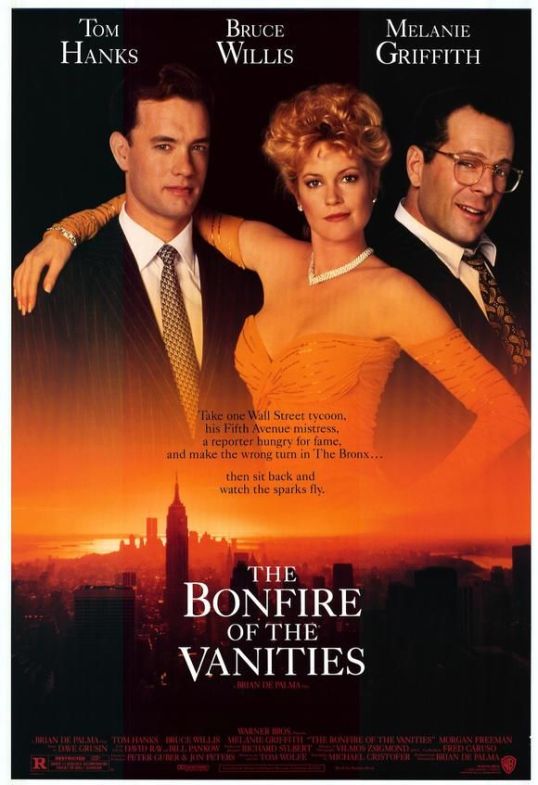
Released in 1990 and based on a novel by Tom Wolfe, Bonfire of the Vanities stars Tom Hanks as Sherman McCoy, a superficial Wall Street trader who has the perfect penthouse and a painfully thin, status-obsessed wife (Kim Cattrall).  Sherman also has a greedy mistress named Maria (Melanie Griffith).  It’s while driving with Maria that Sherman takes a wrong turn and ends up in the South Bronx.  When Sherman gets out of the car to move a tire that’s in the middle of the street, two black teenagers approach him.  Maria panics and, after Sherman jumps back in the car, she runs over one of the teens.  Maria talks Sherman into not calling the police.  The police, however, figure out that Sherman’s car was the one who ran over the teen.  Sherman is arrested and finds himself being prosecuted by a power-hungry district attorney (F. Murray Abraham).  The trial becomes the center of all of New York City’s racial and economic strife, with Sherman becoming “the great white defendant,” upon whom blame for all of New York’s problems can be placed.  Bruce Willis plays an alcoholic journalist who was British in the novel.  Morgan Freeman plays the judge, who was Jewish in the novel.  As well, in the novel, the judge was very much a New York character, profanely keeping order in the court and spitting at a criminal who spit at him first.  In the movie, the judge delivers a speech ordering everyone to “be decent to each other” like their mothers taught them to be.

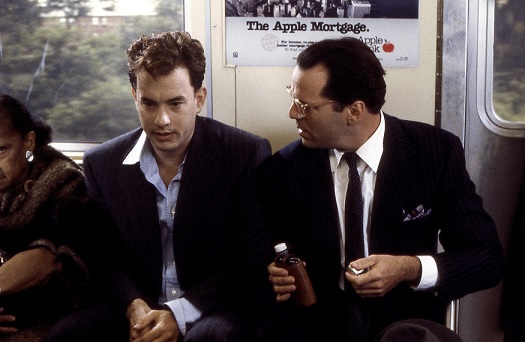
Having read Wolfe’s very novel before watching the film, I knew that there was no way that the adaptation would be able to remain a 100% faithful to Wolfe’s lacerating satire.  Because the main character of Wolfe’s book was New York City, he was free to make almost all of the human characters as unlikable as possible.  In the book, Peter Fallow is a perpetually soused opportunist who doesn’t worry about who he hurts with his inflammatory articles.  Sherman McCoy is a haughty and out-of-touch WASP who never loses his elitist attitude.   In the film, Bruce Willis smirks in his wiseguy manner and mocks the other reporters for being so eager to destroy Sherman.  Hanks, meanwhile, attempts to play Sherman as an everyman who just happens to live in a luxury penthouse and spend his days on Wall Street.  Hanks is so miscast and so clueless as how to play a character like this that Sherman actually comes across as if he’s suffering from some sort of brain damage.  He feels less like a stockbroker and more like Forrest Gump without the Southern accent.  There’s a scene, written specifically for the film, in which Fallow and Sherman ride the subway together and it literally feels like a parody of one of those sentimental buddy films where a cynic ends up having to take a road trip with someone who has been left innocent and naïve as result of spending the first half of their life locked in basement or a bomb shelter.  It’s one thing to present Sherman as being wealthy and uncomfortable among those who are poor.  It’s another thing to leave us wondering how he’s ever been able to successfully cross a street in New York City without getting run over by an angry cab driver.

Because the film can’t duplicate Wolfe’s unique prose, it instead resorts to mixing cartoonish comedy and overwrought melodrama.  It doesn’t add up too much.  At one point, Sherman ends a dinner party by firing a rifle in his apartment but, after it happens, the incident is never mentioned again.  I mean, surely someone else in the apartment would have called the cops about someone firing a rifle in the building.  Someone in the press would undoubtedly want to write a story about Sherman McCoy, the center of the city’s trial of the century, firing a rifle in his own apartment.  If the novel ended with Sherman resigned to the fact that his legal problems are never going to end, the film ends with Sherman getting revenge on everyone who has persecuted him and he does so with a smirk that does not at all feel earned.  After two hours of being an idiot, Sherman suddenly outthinks everyone else.  Why?  Because the film needed the happy ending that the book refused to offer up.

Of course, the film’s biggest sin is that it’s just boring.  It’s a dull film, full of good actors who don’t really seem to care about the dialogue that they are reciting.  Director Brian De Palma tries to give the film a certain visual flair, resorting to his usual collection of odd camera angles and split screens, none of which feel at all necessary to the story.  In the end, De Palma is not at all the right director for the material.  Perhaps Sidney Lumet could have done something with it, though he would have still had to deal with the less than impressive script.  De Palma’s over-the-top, set piece-obsessed sensibilities just add to the film’s cartoonish feel.

The film flopped at the box office.  De Palma’s career never recovered.  Tom Hanks’s career as a leading man was momentarily derailed.  Bruce Willis would have to wait a few more years to establish himself as a serious actor.  Even the normally magnanimous Morgan Freeman has openly talked about how much he hated being involved with The Bonfire of the Vanities.  That said, the film lives on because  De Palma allowed journalist Julie Salomon to hang out on the set and the book she wrote about the production, The Devil’s Candy, is a classic of Hollywood non-fiction.  (TCM adapted the book into a podcast, which is how The Bonfire of the Vanities came to be featured on the station.)  Thanks to Salomon’s book, The Bonfire of the Vanities has gone to become the epitome of a certain type of flop, the literary adaptation that is fatally compromised by executives who don’t read.

Previous Icarus Files:

  1. Cloud Atlas
  2. Maximum Overdrive
  3. Glass
  4. Captive State
  5. Mother!
  6. The Man Who Killed Don Quixote
  7. Last Days
  8. Plan 9 From Outer Space
  9. The Last Movie
  10. 88

Cleaning Out The DVR: One On One (dir by Lamont Johnson)


Sometimes, I come across things on my DVR that I not only have no memory of recording but which I also cannot, for the life of me, figure out why I decided to record it in the first place.  I recorded the 1977 film One On One off of TCM on January 17th and I’m not really sure why.

It’s not that One On One is a terrible movie or anything like that.  It’s an extremely predictable film and it’s got one of those soundtracks that is extremely 70s but not cool disco-style 70s.  No, instead this film is full of the type of soft rock music that your grandmother listens to while driving to the local CVS Pharmacy.  (The majority of the songs are performed by a group called Seals and Croft and are painfully undanceable.)  But, even with that in mind, it’s not really a bad movie.  If I’m confused about why I recorded it, it’s because One on One is a movie about basketball, which is a sport that holds absolutely zero interest for me.

(My main issue with basketball has to do with the sound of all of those squeaky shoes on the court.)

But, before going any further, let’s watch a commercial:

One on One tells the story of Henry Steele (Robby Benson), a high school basketball star.  Henry is from Colorado, which this film seems to suggest is the equivalent of coming from Siberia.  When Moreland Smith (G.D. Spradlin). the renowned coach of Western University’s basketball team, offers Henry a full athletic scholarship, Henry negotiates a pretty good deal for himself.  Not only is his education going to be paid for but he also wins a guarantee that he’ll never be cut from the team and that his father will get a car.  All Henry has to do is keep his grades up but that shouldn’t be a problem.  Sure, Henry appears to be an idiot but the athletic department will set him up with a tutor and, as long as the coach is happy with him, it’s not like Henry’s actually going to have to go to class.

Upon arriving in Los Angeles, Henry picks up a hitchhiker (a very young Melanie Griffith) who promptly robs him of all of his money.  Once he arrives at the university, he discovers that Coach Smith is not going to be the surrogate father figure that he was expecting.  Instead, Coach Smith is a rather cold and ruthless taskmaster, whose main concern is winning.  When Henry, who is by far the shortest player on the team, struggles, Smith tells Henry that he needs to renounce his scholarship and return home.  When Henry refuses to do so, Smith becomes obsessed with trying to break him.

As Henry’s roommate, Tom (Cory Faucher), points out, Henry’s head is not in the game.  Instead, Henry can’t stop thinking about his tutor, Janet (Annette O’Toole).  At first, Janet assumes that Henry is just a dumb jock, largely because Henry’s a jock and he spends the first half of the movie acting really, really dumb.  Then, out of nowhere, Henry reveals that he’s not only read Moby Dick but he can quote passages from memory.  In fact, Henry even understands that Ahab was — wait for it — obsessed!  Oh my God, Janet realizes, Henry’s literate!  In fact, Janet exclaims that Henry is the first person she’s met who has actually read Moby Dick!  (Really?)  Janet and Henry fall in love but, unfortunately, Janet is already dating her psychology professor.

(The professor has got a beard that looks like it reeks of stale weed and he says stuff like, “Have you seen my sandals?,” so we know better than to take him seriously when he compares the popularity of college athletics to the rise of fascism.  When Henry accuses him of being a hippie, the professor just smirks and says something condescending.  Stupid hippie.)

Will Janet and Henry fall in love?  Will Janet dump her unattractive and unappealing boyfriend so she can date Henry?  Will Henry manage to pass his classes?  Will Henry ever get a chance to prove himself on the court?  Will … oh, why even ask these questions?  You already know what’s going to happen in this movie.  There’s really not a single unexpected moment to be found in One on One.  Everything about the film, from the coach’s ruthlessness to Henry’s transformation from idiot to savvy player, feels pre-ordained.  It’s a predictable movie but, at the same time, it’s a likable movie.  At the start of the film, Benson overplays Henry’s stupidity and O’Toole overplays Janet’s brittleness but, at the film progresses, both performers seem to relax and, by the time the end credits role, they’re actually a fairly likable couple.  Benson even gets a killer final line, one that I imagine made audiences in 1977 applaud.

That said, the film is pretty much stolen by G.D. Spradlin.  Spradlin was a former Oklahoma oilman who reinvented himself as a politician and then as a character actor.  Best known for playing Senator Pat Geary in The Godfather, Part II, Spradlin had a flair for bringing casually corrupt authority figures to life.  In One on One, Spradlin turns Coach Smith into a Mephistophelean figure, offering Henry success at the cost of his soul.  Coach Smith is arrogant, oily, casually racist, and an all-around jerk but, at the same time, it is also obvious that he knows how to lead a team to victory.  The great thing about Spradlin’s performance is to be found in not just how menacing he is but in how charismatic he is.  You never doubt that Coach Smith is both a lousy human being and an absolutely brilliant coach.  If nothing else, he’s good at his job.

As I said at the start of this review, I am not really sure why I recorded One on One but it turned out to be better than I was expecting.  It is a flawed and uneven film but worth watching for Spradlin’s intriguingly villainous turn.


Lisa Reviews An Oscar Nominee: Working Girl (dir by Mike Nichols)


(With the Oscars scheduled to be awarded on March 4th, I have decided to review at least one Oscar-nominated film a day.  These films could be nominees or they could be winners.  They could be from this year’s Oscars or they could be a previous year’s nominee!  We’ll see how things play out.  Today, I take a look at the 1988 best picture nominee, Working Girl!)

Welcome to the 80s!

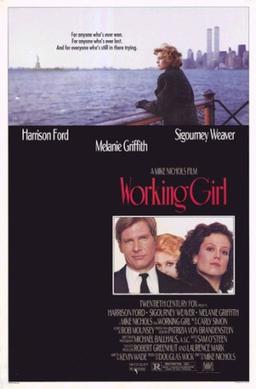
Yes, Working Girl is definitely a film of its time.  It’s a film that’s obsessed with big things: big dreams, big offices, big money, and big hair.  It’s a movie where the heroes talk about hostile takeovers and where everyone’s dream is to eventually to be an executive on Wall Street.  You know all of those people who claim that The Big Short is the greatest movie ever made?  I can guarantee that the majority of them would totally hate every character in Working Girl.  Working Girl is such a film of the past that it even features Alec Baldwin doing something other than bellowing at people.  In fact, Baldwin’s actually sexy in Working Girl.  It was strange to see him in this film and realize that he was the same actor who currently spends all of his time picking fights on twitter and defending James Toback.

Of course, Alec Baldwin has a relatively small role in Working Girl.  He plays Mick Dugan, the type of blue-collar guy who gives his girlfriend lingerie for her birthday (“I just wish you would get me something that I could wear outside,” she says as she tries it on) and who then proceeds to cheat on her while she’s off at work.  From the minute we first meet Tess McGill (Melanie Griffith), we know that she deserves better than Mick.

Tess is a professional administrative assistant.  She’s just turned 30 but she’s not ready to give up her dreams and settle for a life of fighting off coke-snorting executives and coming home to some guy like Mick.  (Speaking of early performances from infamous actors, one of the coke-snorting executives is played by Kevin Spacey.)  Tess has got a bachelor’s degree in Business.  As she puts it, she has a “mind for business and a bod for sin.”

She’s also got a new boss, an up-and-coming executive named Katharine Parker (Sigourney Weaver).  It turns out that Katherine is 29 years old.  (“I’ve never worked for someone younger than me before,” Tess says as Katherine gives her a condescending smile.)  Katharine encourages Tess to think of her as being a mentor.  If Tess has any ideas for investments, she should feel free to bring them to Katharine.  Of course, when Tess does so, Katharine claims that her bosses shot the idea down.  It’s only after Katharine breaks her leg in a skiing accident and is laid up in Europe that Tess discovers that Katharine has actually been stealing her ideas and not giving her any credit for them.

What is Tess to do?  Well, she does what any of us would do.  She passes herself off as an executive and presents her idea to Jack Trainer (Harrison Ford) herself.  Jack is impressed with the idea but he’s even more impressed with Tess.  Of course, complicating things is that Jack was once in a relationship with Katharine and Katharine still thinks that she’s going to eventually marry Jack.  And, of course, there’s the fact that Tess is lying about actually being an executive…

Working Girl is a frequently amusing film, elevated by performances of Melanie Griffith and, in the role of Tess’s best friend, Joan Cusack.  Add to that, Harrison Ford is remarkable non-grouchy as Jack Trainer and Sigourney Weaver appears to be having the time of her life playing a villain.  Even as I laughed at some of the lines, here was a part of me that wished that the film had a bit more bite.  At times, Working Girl tries too hard to have it both ways, both satirizing and celebrating Wall Street culture.  In the end, the film works best as a piece of wish-fulfillment.  It’s a film that says that not only can you win success and Harrison Ford but you can get your bitchy boss fired too.

Despite being a rather slight (if likable) film, Working Girl was nominated for Best Picture of 1988.  However, it lost to Rain Man.

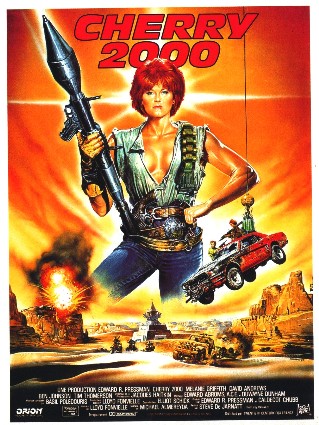
Film Review: Cherry 2000 (dir by Steve De Jarnatt)


Okay, so this one is kind of weird.

Remember how, a few nights ago, I watched and reviewed something called Prison Planet?  No?  Well, I don’t blame you.  I wish I could forget about it too.  Anyway, the movie that aired right before Prison Planet was yet another futuristic tale that was largely set in a desert wasteland.  This movie was originally released in 1988 and the title was Cherry 2000.

Cherry 2000 takes place in 2017, or perhaps I should say that it takes place in 2017 as imagined by someone in 1988.  In this film’s version of 2017, both the economy and the environment are a mess, America is divided into warring urban and rural zones, and all human emotion and creativity is being stifled by government bureaucracy.  In short, Cherry 2000‘s version of 2017 is a lot like the real world’s version of 2017…

In the future, everyone’s still obsessed with getting laid but all of the bureaucratic red tape has made things difficult.  Having sex now means first getting a lawyer to draw up a contract.  In order to avoid all of the legal complications, men are now marrying specially designed sex robots.  Again, this probably seemed way out there in 1988 but, in the current world, it just looks like my twitter timeline.

(Do they have sex robots for women in the world of Cherry 2000?  As far as I could tell, all of the sex robots in the film were designed for men’s pleasure, which doesn’t seem quite fair.)

Anyway, Sam Treadwell (David Andrews) is a business executive who thinks that he is deeply in love with his robot wife, Cherry 2000 (Pamela Gidley).  However, a mix of sex and a broken washing machine causes Cherry to short-circuit.  When Sam tries to get her repaired, he’s told that it’s a lost cause.  Cherry is beyond repair.  Add to that, apparently the Cherry 2000 model is no longer being manufactured.  If Sam wants a new Cherry, he’s going to have to go into Zone 7 and get one out of an abandoned factory.

So, of course, that’s what Sam does.  The only problem is that Sam is a business guy and Zone 7 is the most dangerous place in the world.  Why is it so dangerous?  Because it’s ruled by a warlord named …. Lester.  (No offense meant to anyone named Lester but that’s not exactly the most intimidating name in the world.)  Lester is played by B-movie mainstay Tim Thomerson, who appears to be having fun whenever he appears on-screen.

To help guide him through Zone 7, Sam hires E (Melanie Griffith).  E is the film’s saving grace, largely because she kicks everyone’s ass.  The great thing about E is that, from the minute she first appears, she makes no secret of the fact that she finds Sam and his sex robot to be just as pathetic and ridiculous as we do.  Griffith plays the role with just the right mix of humor and annoyance.  If I ever have to guide anyone through a desert wasteland to a sex robot factory, I hope that I can do it with half as much style and panache as E.

Anyway, Cherry 2000 is a weird little mix of the western and science fiction genres.  For a film about sex robots, it actually has a rather goofy and almost innocent feel to it.  It’s a film that raises a lot of issues but which is also smart enough not to spend too much time on any of them.  Director Steve De Jarnatt also directed one of my favorite 80s movies, the charming apocalyptic love story Miracle Mile.  Cherry 2000 may be a mess but it’s definitely a watchable mess.

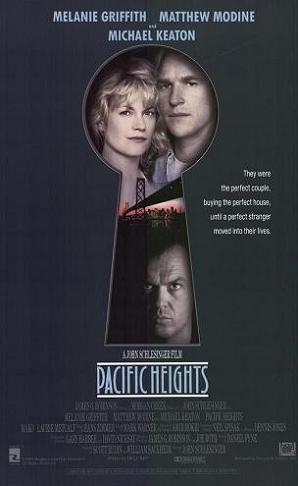
A Movie A Day #157: Pacific Heights (1990, directed by John Schlesinger)


Michael Keaton is the tenant from Hell in Pacific Heights.

In San Francisco, Patty (Melanie Griffith) and Drake (Matthew Modine) have just bought an old and expensive house that they can not really afford.  In order to keep from going broke, they rent out two downstairs apartments.  One apartment is rented by a nice Japanese couple.  The other apartment is rented by Carter Hayes (Michael Keaton).  Carter convinces Patty and Drake not to check his credit by promising to pay the 6 months rent up front.  The money, he tells them, is coming via wire transfer.

The money never arrives but Carter does.  Once he moves into the apartment, Carter changes the locks so that no one but him can get in.  At all hours of the day and night, he can be heard hammering and drilling inside the apartment.  Even worse, he releases cockroaches throughout the building.  When Drake demands that Carter leave, the police back up Carter.  After goading Drake into attacking him, Carter gets a restraining order.  Drake is kicked out of his home, leaving Patty alone with their dangerous tenant.

Pacific Heights is the ultimate upper middle class nightmare: Buy a house that you can not really afford and then end up with a tenant who trashes the place to such an extent that the property value goes down.  As a thriller, Pacific Heights would be better if Drake and Patty weren’t so unlikable.  (When this movie was first made, people like Patty and Drake were known as yuppies.)  Much like Drake’s house, the entire movie is stolen by Michael Keaton’s performance as Carter Hayes.  Carter was not an easy role to play because not only did he have to be so convincingly charming that it was believable that he could rent an apartment just by promising a wire payment but he also had to be so crazy that no one would doubt that he would deliberately infest a house with cockroaches.  Michael Keaton has not played many bad guys in his career but his performance as Carter Hayes knocked it out of the park.

One final note: Keep an eye out for former Hitchcock muse (and Melanie Griffith’s mother) Tippi Hedren, playing another one of Carter’s potential victims.  Her cameo here is better than her cameo in In The Cold of the Night.