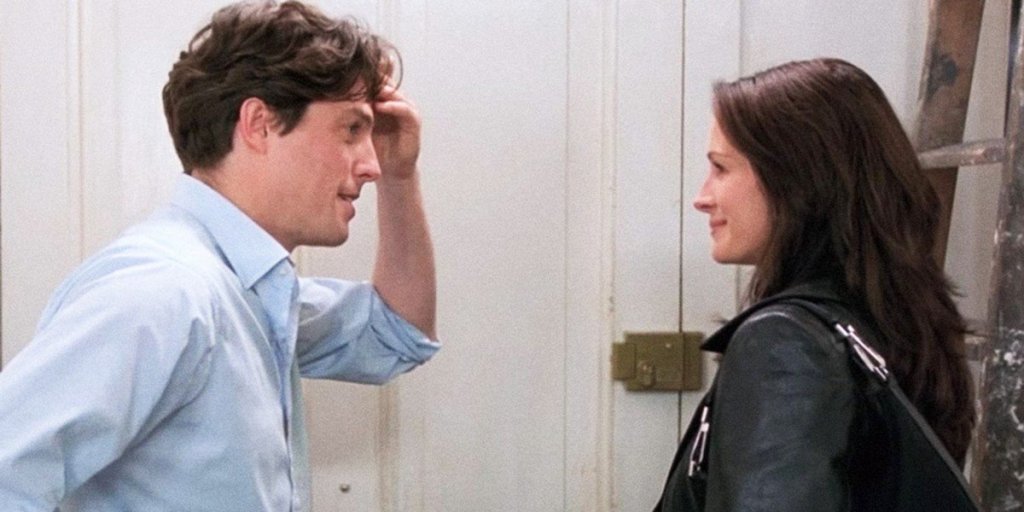
Brad reviews NOTTING HILL (1999), starring Julia Roberts and Hugh Grant!


Life takes an unexpected turn for the reserved Englishman William Thacker (Hugh Grant) when the hugely popular American movie star Anna Scott (Julia Roberts) wanders into his humble little travel book shop in the district of Notting Hill in West London. When the initial meeting is followed up by some coincidentally spilled orange juice and an unexpected kiss, William finds himself completely smitten. After Anna leaves, and still in a state of disbelief, William struggles focusing on his normal life with his eccentrically odd flat mate Spike (Rhys Ifans). When Anna surprisingly reaches back out to him wanting to get back together, the sweet and shy William is ecstatic, but he remembers that he’s already obligated himself to attend his sister Honey’s (Emma Chambers) birthday party that night. Wanting to be part of something normal, Anna goes to the party as William’s date, where she has a wonderful, relaxing evening with Honey and their close-knit group of best friends that includes Max (Tim McInnerny), Bella (Gina McKee) and Bernie (Hugh Bonneville), even if she did give them quite the shock when she walked through the door. Everything seems to be going beautifully, but the life of an international film icon tends to be complicated, and William soon finds himself caught up in a whirlwind that includes her “boyfriend,” the arrogant American actor Jeff King (Alec Baldwin). He’s not really her boyfriend anymore, but that seems of little consequence to the press. And then there’s the sudden emergence of racy pictures of Anna from her past in the British tabloids. As much as William loves Anna, will he ever be able to deal with life in Anna’s superstar spotlight?

NOTTING HILL is part of a trilogy of modern-day love stories that I’m sure to watch every year, with the other two being RETURN TO ME (2000) and HITCH (2005). I’ve noticed that these three movies have plot points in common that I find extremely appealing. First, both NOTTING HILL and RETURN TO ME feature main characters who have a group of loyal family and friends who offer uncompromising love and support. William Thacker’s sister and friends clearly care about him and want what’s best for him. If necessary, they’re willing to prove it by being honest with him when he’s unwilling to be honest with himself. One of the best scenes of the film occurs near the end when William tells his group of friends that he’s turned down Anna’s request to continue their relationship, even after she says the famous lines, “I’m also just a girl, standing in front of a boy, asking him to love her.” While his friends struggle to find the right words, the flaky Spike, played superbly by Rhys Ifans, rushes into the meeting and when asked his opinion, says these three words to William, “You daft prick!” A memorable song on the movie’s excellent soundtrack reminds us sometimes that “you say it best when you say nothing at all,” but sometimes words need to be spoken, and Spike cares enough to tell William what he needs to hear. I’ve said it before, but I love it when a movie surrounds its characters with the type of people we’d love to have in our corner in real life. Second, both NOTTING HILL and HITCH feature plot lines that show a “star” falling for a sweet nobody. Maybe it’s because I’m a nobody myself, but the idea of the rich and powerful falling in love with regular people like me always strikes a nerve. Sure, it may be a fantasy, but it’s a fantasy I’m perfectly willing to roll with. 

As far as I’m concerned, Julia Roberts and Hugh Grant have never been more appealing than they are in NOTTING HILL. Julia is so beautiful, and I fell in love with her myself for the first time when I watched this movie at the theater in 1999. There are scenes where William is watching Anna Scott on the big screen and the small screen, whether it be a love story or a science fiction movie, and he’s clearly in complete awe of her. As a film buff going back to my early teens, I can relate so easily to his character, whether it be my crush on Elizabeth Shue in the 80’s or Salma Hayek in 90’s. Heck, as recently as a couple of years ago, after interviewing the lovely Jan Gan Boyd who starred with Charles Bronson in ASSASSINATION (1987), I can still identify with a man completely smitten with a beautiful actress. And Hugh Grant is so sweet, witty and funny as William Thacker. This was a big film for Grant, as a few years earlier his promising Hollywood career had somewhat stalled due to his arrest on Sunset Strip in Los Angeles for “lewd conduct in a public place” with a prostitute named Divine Brown. With the irony not lost on me, if you’ve seen NOTTING HILL before you’ll understand that my inclusion of this matter of public record proves the character of Anna Scott to be correct when she explains to William just how difficult it can be to live life in the public eye. Regardless of all that, Hugh Grant is great in the film, and with a few years separating the events, it seems the filmgoing public was ready for forgiveness. NOTTING HILL was a runaway box office success, raking in $365 million dollars at the worldwide box office. 

The final thing I want to point out about NOTTING HILL is the incredible talent behind the scenes. Director Roger Michell helmed one of my very favorite Jane Austen adaptations, PERSUASION from 1995, starring Amanda Root and Ciaran Hinds. It’s a perfect movie as far as I’m concerned, and I watch it several times every year. Writer Richard Curtis has written the wonderful films FOUR WEDDINGS AND A FUNERAL (1994), BRIDGET JONES’S DIARY (2001), and LOVE ACTUALLY (2003), and he clearly knows how to push our love buttons. Both Michell and Curtis do the most successful work in their careers here. Now whether or not it’s their very best is a matter of opinion, but it’s definitely great work that I can confidently recommend to anyone. 
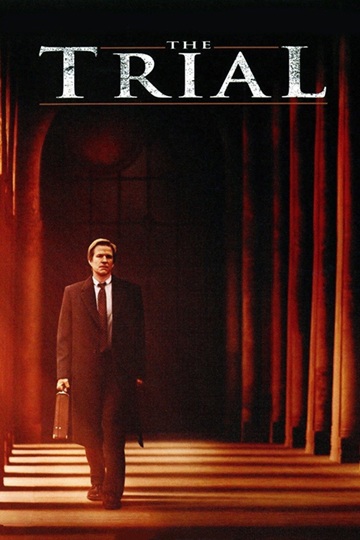
October Positivity: The Trial (dir by Gary Wheeler)


In 2010’s The Trial, Matthew Modine stars as Mac.

Mac is a Southern lawyer, even though it’s been a while since he practiced.  After his wife and children were killed in a car accident, Mac decided to retire from practicing law but he never surrendered his license.  A judge (Rance Howard) reaches out to him, asking him to serve as a public defender for Pete Thomason (Randy Wayne), a young man who has been accused of murdering his girlfriend.  The evidence is stacked against Pete and there are plenty of wealthy people who, for various reasons, want Pete to quickly be convicted.  Mac takes the case because he can tell that Pete is being railroaded.  When he discovers that Pete will possibly be facing the death penalty if he’s convicted, the case becomes very personal for Mac.

The prosecuting attorney (Bob Gunton) has managed to find a doctor (Brett Rice) who is willing to testify that Pete is a sociopath.  (The doctor has a reputation for finding just about anyone on trial to be a sociopath.)  Mac finds a doctor of his own, Dr. Anne Wilkes (Clare Carey), his testifies that Pete is nowhere near being a sociopath.  The problem is that Pete has no memory of what happened the night of the murder.  Mac may believe that Pete is innocent but can he convince the jury when the evidence all seems to suggest otherwise?

Like The List, The Trial was based on a novel by Robert Whitlow and it was directed by Gary Wheeler.  I was pretty hard on The List in last night’s review but I actually rather enjoyed The Trial, which was a solid and well-made legal thriller.  (The film’s status as a faith-based film largely comes from a scene in which Mac quotes the Book of Provers in regards to how, during a trial, it’s easy to believe the first person who speaks but it’s equally important to listen to how the accused replies.)  I enjoyed the twists and turns of the plot and the film’s ending worked well.  Though the film had a a made-for-television feel to it (despite having been a theatrical release), it still held and rewarded my interest.

It helped that the cast was well-selected and everyone gave good performances.  Matthew Modine, in particular, gave a strong performance as Mac, playing him not as being a saint but instead as being someone who was just determined to give his client the defense he deserved and to ultimately do the right thing.  Robert Forster played Mac’s brother-in-law and lead investigator and he brought his own brand of world-weary determination to the part.  Nobody plays a smug prosecutor as well as Bob Gunton, though it should be noted that the character himself never became a caricature.  Rance Howard was the ideal judge, tough but fair.  Randy Wayne was sympathetic as the confused Pete.  The cast really brought the film’s world to life.

I always enjoy a good legal thriller and The Trial was certainly that.

Brad’s Scene of the Day – “I’ve made the wrong decision” from NOTTING HILL (1999)!


I love the movie NOTTING HILL. Directed by Roger Michell and written by Richard Curtis, it’s one of my all time favorite romantic comedies. I especially enjoy the close relationships that William Thacker (Hugh Grant) shares with his group of friends. The movie creates a world where these people truly love and care about each other. We all need a group of friends like this. 

In honor of the late Roger Michell’s birthday, I share this clip from NOTTING HILL:

Film Review: Short Cuts (dir by Robert Altman)


Opening with a swarm of helicopters spaying for medflies and ending with an earthquake, 1993’s Short Cuts is a film about life in Los Angeles.

An ensemble piece, it follows several different characters as they go through their own personal dramas.  Some of them are married and some of them are destined to be forever single but they’re all living in varying states of desperation.  Occasionally, the actions of one character will effect the actions of another character in a different story but, for the most part, Short Cuts is a portrait of people who are connected only by the fact that they all live in the same city.  There are 22 principal characters in Short Cuts and each one thinks that they are the star of the story.

Jerry Kaiser (Chris Penn) cleans the pools of rich people while, at home, his wife, Lois (Jennifer Jason Leigh), takes care of their baby and works as a phone sex operator.  Jerry’s best friend is a makeup artist named Bill (Robert Downey, Jr.) who enjoys making his wife, Honey (Lili Taylor), looks like a corpse so that he can take her picture.  One of her photographs is seen by a fisherman (Buck Henry) who has already discovered one actual corpse that weekend.  He and his buddies, Vern (Huey Lewis) and Stuart (Fred Ward), discovered a dead girl floating in a river and didn’t report it until after they were finished fishing.  (The sight of Vern unknowingly pissing on the dead body is one of the strongest in director Robert Altman’s filmography.)

Stuart’s wife, Claire (Anne Archer), is haunted by Stuart’s delay in reporting the dead body.  A chance meeting Dr. Ralph Wyman (Matthew Modine) and his wife, artist Marian (Julianne Moore), leads to an awkward dinner between the two couples.  Claire works as a professional clown and Ralph ends up wearing her clown makeup while his marriage falls apart.

Earlier, Claire was stopped and hit on by a smarmy policeman named Gene Shepard (Tim Robbins), who just happens to be married to Marian’s sister, Sherri (Madeleine Stowe).  Gene is already having an affair with Betty Weathers (Frances McDormand), the wife of a helicopter pilot named Stormy (Peter Gallagher).  When Stormy discovers that Betty has been cheating, he takes a creative revenge on her house.

Doreen Pigott (Lily Tomlin) lives in a trailer park with her alcoholic husband, Earl (Tom Waits).  Driving home from her waitressing job, Doreen hits a young boy.  The boy says he’s okay but when he gets home, he passes out.  His parents, news anchorman Howard Finnegan (Bruce Davison) and his wife, Anne (Andie MacDowell), rush him to the hospital, where his doctor is Ralph Wyman.  As Howard waits for his son to wake up, he has a revealing conversation with his long-estranged father (Jack Lemmon, showing up for one scene and delivering an amazing monologue).  Meanwhile, a baker named Andy (Lyle Lovett) repeatedly calls the Finnegan household, wanting to know when they’re going to pick up their son’s birthday cake.

Based on the short stories of Raymond Carver and directed by Robert Altman, Short Cuts can sometimes feel like a spiritual descendent of Altman’s Nashville.  The difference between this film and Nashville is that Short Cuts doesn’t have the previous film’s satiric bite.  As good as Nashville is, it’s a film that can be rather snarky towards it character and the town in which it is set.  Nashville is used as a metaphor for America coming apart at the seams.  Short Cuts, on the other hand, is a far more humanistic film, featuring characters who are flawed but, with a few very notable exceptions, well-intentioned.  If Nashville seem to be a portrait of a society on the verge of collapse, Short Cuts is a film about how that society ended up surviving.

It’s not a perfect film.  There’s an entire storyline featuring Annie Ross and Lori Singer that I didn’t talk about because I just found it to be annoying to waste much time with.  (The Ross/Singer storyline was the only one not to be based on a Carver short story.)  The conclusion of Chris Penn’s storyline wasn’t quite as shocking as it was obviously meant to be.  But, flaws and all, Altman and Carver’s portrait of humanity does hold our attention and it leaves us thinking about connections made and sometimes lost.  Seen today, Short Cuts is a portrait of life before social media and iPhones and before humanity started living online.  It’s a time capsule of a world that once was.

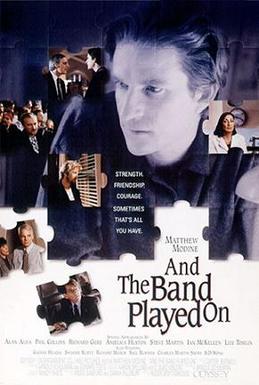
Film Review: And The Band Played On (dir by Roger Spottiswoode)


I live in a very cynical time.

That was one of my main thoughts as I watched 1993’s And The Band Played On.

Directed by Roger Spottiswoode and featuring an all-star cast, And The Band Played On deals with the early days of the AIDS epidemic.  It’s a film that features many different characters and storylines but holding it all together is the character of Dr. Don Francis (Matthew Modine), an epidemiologist who is haunted by what he witnessed during the Ebola epidemic in Africa and who fears that the same thing is going to happen in America unless the government gets serious about the mysterious ailment that is initially called “gay cancer” before then being known as “GRID” before finally being named AIDS.  Dr. Francis is outspoken and passionate about fighting disease.  He’s the type who has no fear of yelling if he feels that people aren’t taking his words seriously enough.  In his office, he keeps a track of the number of HIV infections on a whiteboard.  “Butchers’ Bill” is written across the top of the board.

Throughout the film, quite a few people are dismissive of Dr. Francis and his warnings.  But we, the audience, know that he’s right.  We know this because we know about AIDS and but the film also expects us to trust Dr. Francis because it’s specifically stated that he worked for the World Health Organization before joining the Center For Disease Control in Atlanta, Georgia.  As far as the film is concerned, that’s enough to establish his credentials.  Of course, today, after living through the excesses of the COVID pandemic and the attempts to censor anyone who suggested that it may have begun due to a lab leak as opposed to some random guy eating a bat, many people tend to view both the WHO and the CDC with a lot more distrust than they did when this film was made.  As I said, we live in a cynical time and people are now a lot less inclined to “trust” the experts.  To a large extent, the experts have only themselves to blame for that.  I consider myself to be a fairly pragmatic person but even I now find myself rolling my eyes whenever a new health advisory is issued.

This new sense of automatic distrust is, in many ways, unfortunate.  Because, as And The Band Played On demonstrates, the experts occasionally know what they’re talking about.  Throughout the film, people refuse to listen to the warnings coming from the experts and, as a result, many lives are lost.  The government refuses to take action while the search for a possible cure is hindered by a rivalry between international researchers.  Alan Alda gives one of the best performances in the film, playing a biomedical researcher who throws a fit when he discovers that Dr. Francis has been sharing information with French scientists.

It’s a big, sprawling film.  While Dr. Francis and his fellow researchers (played by Saul Rubinek, Glenne Headly, Richard Masur, Charles Martin Smith, Lily Tomlin, and Christian Clemenson) try to determine how exactly the disease is spread, gay activists like Bobbi Campbell (Donal Logue) and Bill Kraus (Ian McKellen) struggle to get the government and the media to take AIDS seriously.  Famous faces pop up in small rolls, occasionally to the film’s detriment.  Richard Gere, Steve Martin, Anjelica Huston, and even Phil Collins all give good performances but their fame also distracts the viewer from the film’s story.  There’s a sense of noblesse oblige to the celebrity cameos that detracts from their effectiveness.  All of them are out-acted by actor Lawrence Monoson, who may not have been a huge star (his two best-known films are The Last American Virgin and Friday the 13 — The Final Chapter) but who is still heart-breakingly effective as a young man who is dying of AIDS.

Based on a 600-page, non-fiction book by Randy Shilts, And The Band Played On is a flawed film but still undeniably effective and a valuable piece of history.  Director Roger Spottiswoode does a good job of bringing and holding the many different elements of the narrative together and Carter Burwell’s haunting score is appropriately mournful.  The film ends on a somber but touching note.  At its best, it’s a moving portrait of the end of one era and the beginning of another.

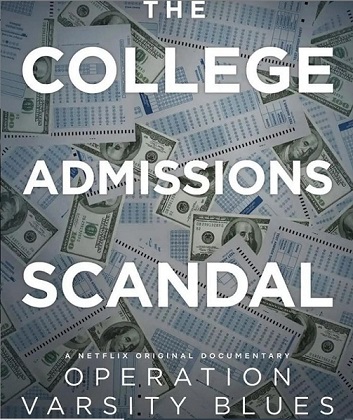
Film Review: Operation Varsity Blues: The College Admissions Scandal (dir by Chris Smith)


In Operation Varsity Blues, Matthew Modine plays Rick Singer, the real-life “college admissions consultant” who was one of the many people involved in the 2019 College Admissions scandal.

Singer was the former basketball coach who helped the rich and famous get their children into the right Ivy League schools. As the film shows (and as you probably already know), he did this by faking test scores, faking athletic activities, and often arranging for money to exchange hands. The film not only features Modine and others actors acting out the actual conversations that Singer was taped as having with his wealthy clients, it also features interviews with a few of Singer’s acquaintances and with the various journalists who covered the scandal. It’s a documentary with dramatic recreations.

And that’s fine. Modine does a good enough job portraying Rick Singer, playing him as essentially being a sleazy salesman who knew exactly what to say to the parents who were desperate to get their child into a prestigious university. (The film reveals that Singer would often lie to his clients, brainwashing them into believing that there was no way their children would be able to get into USC or Harvard without his help.) Unfortunately, with his gray hair and, his nervous smile, Matthew Modine as Rick Singer bares an odd but definite resemblance to the great Eric Roberts and, as I watched Operation Varsity Blues, I found myself thinking about how great it would be to see a film in which Eric Roberts did play Rick Singer. (I mean, seriously, Singer just seems like a perfect Eric Roberts role.) That may sound like a petty complaint but it does get at a bigger issue. Operation Varsity Blues is 100 minutes long but, despite its slightly different narrative format, it still doesn’t tell us anything that we couldn’t have learned from all of the other documentaries and dramatic adaptations based on the college admissions scandal. Even with the reenactments and the chance to hear Singer’s own words, Operation Varsity Blues still doesn’t tell us anything new about the scandal or why it happened. If nothing else, Eric Roberts and his neurotic screen presence would have put a new spin on a now-familiar story,

To be honest, the hybrid, docudrama format actually works against the film. On the one hand, you’ve got the real people telling their story in talking head interviews. But every time you start to get into their stories, the film cuts away to a reenactment and the film goes from being a documentary to being a low-budget Matthew Modine film. The film would have worked better if it had chosen to be either a documentary or a drama. By trying to be both, the end result is a movie that often seems disjointed and leaves you still feeling as if you haven’t actually gotten the entire story.

Finally, Lori Loughlin and her husband are featured in the documentary, though only in news footage. At one point, it’s revealed that after their daughter was accepted to USC, her high school guidance counselor called the college to tell them that Olivia Jade was never on her school’s rowing team, regardless of what her application said. Apparently, Lori and her husband got very angry about the counselor doing this and you know what? They had every right to be pissed off. Why is a guidance counselor trying to keep one of his students from getting into a good college? I mean, how was it really any of his business to begin with? That’s something that I would have liked to have seen explored in a bit more detail. Instead, the film just hurries along to another reenactment of Rick Singer explaining how to cheat on the ACT. (I’m still amazed that people spent that much money to do something as easy as cheat on a standardized test. I mean, it’s not that difficult.)

Unfortunately, the entire film is like that. It raises some interesting points but it ultimately leaves you frustrated by its refusal to do anything more than scratch the surface.

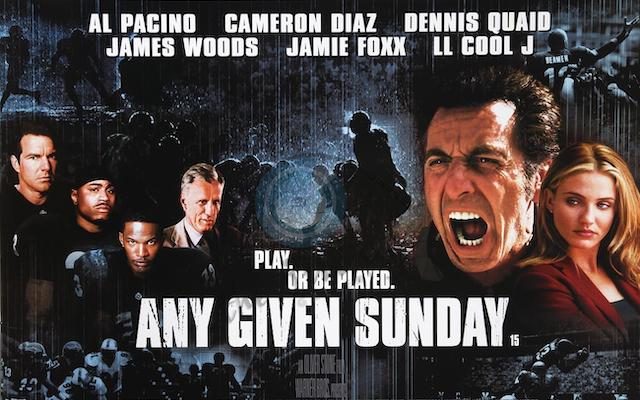
Any Given Sunday (1999, directed by Oliver Stone)


With Any Given Sunday, Oliver Stone set out to make the ultimate football movie and he succeeded.

Any Given Sunday is not just the story of aging coach Tony D’Amato (Al Pacino).  It’s also the story of how third-string quarterback Willie Beamon (Jamie Foxx) allows celebrity to go to his head while the injured starter, Cap Rooney (Dennis Quaid), deals with his own mortality and how, at 38, he is now over-the-hill.  It’s also about how the team doctors (represented by James Woods and Matthew Modine) are complicit in pushing the players beyond their limits and how the owners (Cameron Diaz) view those players as a commodity to be traded and toyed with.  It’s about how the Sharks represent their home city of Miami and how cynical columnists (John C. McGinley plays a character that is obviously meant to be Jim Rome) deliberately set out to inflame the anger of the team’s fans.  It’s about how politicians (Clifton Davis plays Miami’s mayor and asks everyone to “give me some love”) use professional sports to further their own corrupt careers while the often immature men who play the game are elevated into role models by the press.  It’s a film that compares football players to ancient gladiators while also showing how the game has become big business.  In typical Oliver Stone fashion, it tries to take on every aspect of football while also saying something about America as well.

In the role on Tony D, Pacino famously describes football as being “a game of inches” but you wouldn’t always know it from the way that Oliver Stone directs Any Given Sunday.  As a director, Stone has never been one to only gain an inch when he could instead grab an entire mile.  (Stone is probably the type of Madden player who attempts to have his quarterback go back and throw a hail mary on every single play.)  Tony tells his players to be methodical but Stone directs in a fashion that is sloppy, self-indulgent, and always entertaining to watch.  One minute, Al Pacino and Jim Brown are talking about how much the game has changed and the next minute, LL Cool J is doing cocaine off of a groupie’s breast while images of turn-of-the-century football players flash on the screen.  No sooner has Jamie Foxx delivered an impassioned speech about the lack of black coaches in the league then he’s suddenly starring in his own music video and singing about how “Steamin’ Willie Beamon” leaves all the ladies “creamin’.”  (It rhymes, that’s the important thing.)  When Tony invites Willie over to his house, scenes of Charlton Heston in Ben-Hur are on TV.  Later in the movie, Heston shows up as the Commissioner and says, about Cameron Diaz, “she would eat her young.”

Any Given Sunday is Oliver Stone at both his best and his worst.  The script is overwritten and overstuffed with every possible sports cliché  but the football scenes are some of the most exciting that have ever been filmed.  Only Oliver Stone could get away with both opening the film with a quote from Vince Lombardi and then having a player literally lose an eye during the big game.  Stone himself appears in the commentator’s both, saying, “I think he may have hurt his eye,” while the doctor’s in the end zone scoop up the the torn out eyeball and put it into a plastic bag.  Only Stone could get away with Jamie Foxx vomiting on the field during every game and then making amazing plays while a combination of rap, heavy metal, and techno roars in the background.  Stone regulars like James Woods and John C. McGinely make valuable appearances and while Woods may be playing a villain, he’s the only person in the film willing to call out the coaches, the players, the owners, and the fans at home as being a bunch of hypocrites.  Stone’s direction is as hyper-kinetic as always but he still has no fear of stopping the action so that Foxx can see sepia-toned images of football’s past staring at him from the stands.  Stone directs like defensive lineman on steroids, barreling his way through every obstacle to take down his target.  No matter what, the game goes on.

Any Given Sunday is the ultimate football movie and more fun than the last ten super bowls combined.

Film Review: Cutthroat Island (dir by Renny Harlin)


Today is Talk Like A Pirate Day which, let’s just be honest, is an extremely stupid holiday that mainly exists to remind us that “doubloon” is a deeply silly word.

Doubloons were a currency that were popular in Europe and South America back in the 18th century and pirates were always looking for doubloons.  If you listen to enough pirate talk, you’ll quickly discover that there’s a lot different ways to say the word doubloon.  Some people put the emphasis on the fist syllable while others emphasize the second.  Some people say Due-bloon while others say Duh-bloon.  Either way, it’s impossible to listen to pirates talk about doubloons without thinking that they sound very, very silly.  The secret behind the success of The Pirates of the Caribbean franchise is an understanding that it’s impossible to take pirates seriously.

Unfortunately, I chose not to watch The Pirates of the Caribbean for Talk Like A Pirate Day.  Instead, I watched 1995’s Cutthroat Island.

Cutthroat Island is a story of pirates, a lost treasure, and one big sea battle that literally seems to go on and on.  There is occasional talk of doubloons, though not enough for my liking.  Instead, most of the film deals with the efforts of Morgan (Geena Davis) to find a hidden treasure before her uncle, Dawg (Frank Langella), discovers it.  Morgan has one-third of a map.  It was originally tattooed on her father’s head.  After he died, she scalped him and took over his boat.  She also purchased a swashbuckling slave named Shaw (Matthew Modine) because Shaw is capable of reading Latin, the language in which the map is written.  Needless to say, Shaw and Mogan fall in love while Dawg teams up with corrupt colonial officials to not only track down the treasure but to also capture his niece.

The film starts out as a romance with a dash of comedy before eventually transforming into a standard action movie.  That means that boats get blown up and there’s a lot of scenes of people fencing.  There’s also a lot of slow motion footage of bodies plunging into the ocean.  The climatic battle goes on forever and it actually features Morgan hissing, “Bad dawg!” at her uncle.

(Amazingly, “Bad Dawg” isn’t the worst of the dialogue to be heard in Cutthroat Island.  Morgan has a habit of saying stuff like, “I will maroon you on a rock the size of this table, instead of splattering your brains across my bulkhead” and “Since you lie so easily and since you are so shallow, I shall lie you in a shallow grave.”)

Throughout the film, there are hints of what Cutthroat Island could have been, if it hadn’t been such a by-the-numbers action flick.  The fact that it was Morgan who was continually rescuing Shaw was a nice change-of-pace from the usual damsel-in-distress clichés that one finds in most pirate movies.  When Morgan effortlessly breaks the neck of a soldier and sets free her crew, it’s a great moment, comparable to Angelina Jolie taking out Liev Schreiber in Salt or Milla Jovovich kicking zombie ass in a Resident Evil film.  Unfortunately, director Renny Harlin (who was married to star Geena Davis, at the time) is usually too concerned with getting to the next action set piece to truly take advantage of the film’s subversive potential.

Frank Langella is smart enough to bellow his way through his villainous role while Matthew Modine appears to be so amused by the film’s terrible dialogue that it’s impossible not to like him.  Geena Davis is convincing when she’s breaking necks and swinging swords but she delivers her dialogue like someone who has already figured out that the movie was a bad idea and resigned herself to the fact that her film career will never recover.  She doesn’t appear to be having any fun, which kind of defeats the purpose of being a pirate.

Cutthroat Island was a huge and notorious box office flop and it’s still considered to be one of the biggest financial disasters in film history.  Apparently, Hollywood was so traumatized that it would be another 8 years before there was another major pirate production.  That production, of course, was Pirates of the Caribbean, a film that captured the fun that was so lacking in Cutthroat Island.

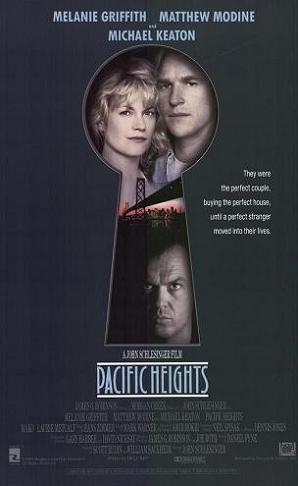
A Movie A Day #157: Pacific Heights (1990, directed by John Schlesinger)


Michael Keaton is the tenant from Hell in Pacific Heights.
In San Francisco, Patty (Melanie Griffith) and Drake (Matthew Modine) have just bought an old and expensive house that they can not really afford.  In order to keep from going broke, they rent out two downstairs apartments.  One apartment is rented by a nice Japanese couple.  The other apartment is rented by Carter Hayes (Michael Keaton).  Carter convinces Patty and Drake not to check his credit by promising to pay the 6 months rent up front.  The money, he tells them, is coming via wire transfer.

The money never arrives but Carter does.  Once he moves into the apartment, Carter changes the locks so that no one but him can get in.  At all hours of the day and night, he can be heard hammering and drilling inside the apartment.  Even worse, he releases cockroaches throughout the building.  When Drake demands that Carter leave, the police back up Carter.  After goading Drake into attacking him, Carter gets a restraining order.  Drake is kicked out of his home, leaving Patty alone with their dangerous tenant.

Pacific Heights is the ultimate upper middle class nightmare: Buy a house that you can not really afford and then end up with a tenant who trashes the place to such an extent that the property value goes down.  As a thriller, Pacific Heights would be better if Drake and Patty weren’t so unlikable.  (When this movie was first made, people like Patty and Drake were known as yuppies.)  Much like Drake’s house, the entire movie is stolen by Michael Keaton’s performance as Carter Hayes.  Carter was not an easy role to play because not only did he have to be so convincingly charming that it was believable that he could rent an apartment just by promising a wire payment but he also had to be so crazy that no one would doubt that he would deliberately infest a house with cockroaches.  Michael Keaton has not played many bad guys in his career but his performance as Carter Hayes knocked it out of the park.

One final note: Keep an eye out for former Hitchcock muse (and Melanie Griffith’s mother) Tippi Hedren, playing another one of Carter’s potential victims.  Her cameo here is better than her cameo in In The Cold of the Night.


Stranger Things: Season 1, Episode 8: The Upside Down, ALT Title: Hop’s Redemption


stranger things titles

Cold Open:  Evil Modine’s Government Facility:  Joyce is screaming and Evil Modine enters.  He conveys with cold calm that six people were taken this week and tries to bully Joyce like he did Karen.  Joyce isn’t having it.  Henchwoman is having people taser Hop … A LOT!  He tells them that he knows everything about they did.  They propose to have him overdose.  He counters that they arm him and let him and Joyce go.  How does Hop fit into his pants with balls that big?!

High school:  The boys are at the school and restless.  They realize that Nancy and Creeper are gone.

Joyce’s House: They set up several booby traps and the xmas lights, which sets up an inconsistency in the storytelling.

Evil Modine comes to Hop.  Hop convinces Evil Modine to to arm him, release him AND Joyce, and allow him to pursue the monster.  He offers to forget about him and their project and he’ll tell him where El is, if he agrees to his terms.

Hop and Joyce get spacesuited up and enter into the belching gate to the Upside Down.

ROLL CREDITS:

The Upside Down: Hop and Joyce are looking for Will.  The respirator noise causes Hop to Flash to happier times.

Hop is in the past… clean-shaven, with his wife and daughter, and happy.  His daughter starts to wheeze.

The Upside Down:  Nancy and Creeper cut themselves to draw out the Postmodern Vampire.  She wonders how she will know when the monster will be coming, which brings us to the story hole: Why would she be screwing the lights back in before if she didn’t know that they had a purpose? Steve bangs at the door and forces himself into the house. They both try to get him to leave and Nancy even pulls a gun on him, but then the lights flicker, the monster appears, and Steve’s brain breaks a little.  They run to Will’s room.

The Upside Down:  Hop sees the destroyed Castle Byers and a teddy bear causes him to FLASH.

Hospital Room:  He is reading to his daughter who is bald from cancer.  When he’s done reading, he goes into the hospital stairwell and sobs.  Poor Hop.

Joyce’s House: Steve freaks out and runs to his car, but he sees the lights flickering and decides to become a hero.  The monster appears behind Nancy and Creeper.  Steve jumps in and starts hitting the monster with an upgraded baseball bat.  The monster gets trapped in the bear trap.  They set the monster on fire and it disappears.  There is smoldering monster blood in the trap.  My best guess of what smoldering Vampire Monster smells like is anything on the Arby’s menu.  

The Upside Down:  Hop and Joyce are in her home and they see the blood from the monster.  The lights start turning on in Joyce’s house.

High School: Dustin finds pudding. We get it; he’s the fat kid!  Mike talks to El about how his family will quasi-adopt her. Jibber Jabber Jibber Jabber, they kiss.  Then, Evil Modine and his Goons arrive to retrieve El.  The boys and El run.   They make it into a hallway and are cutoff with ….Goons to the Left and Goons to the Right and she’s the only El in town! [Sung]

El uses her mojo and melts/explodes the brains and eyes of the Henchwoman and several goons.  This brings us to bad ideas: New Coke, The Edsel, Qwikster, The Zune, Grease 2, and cornering a pissed off teenager with lethal mental Superpowers.  Hop and Joyce pursue the monster and follow its bloodtrail to the library where Hop has looked for love.

High school: The boys get grabbed by goons and El is passed out from mental exertion. Evil Modine hugs her and promises to make everything better to make her better.   The lights flash.  Mike sees the blood, the monster breaks through the wall, and envelops Evil Modine.  Once again, it’s a monster, who hunts at night, and searches for blood.   NOSFERATU!!!!!

The Library:  Joyce and Hop are in the public library.  They see skulls everywhere and viney gooeyness.  Lastly, they see Will with a monster snake attached to his mouth.

Flash to Hop’s daughter’s Hospital Room:  We see his daughter intubated and dying.  She flatlines.  The scene is intercut with Hop watching his daughter dying and him removing Will’s monster snake from him.

High school:  The goons are fighting the monster and losing.  The monster enters the room where the boys are hiding and Lucas tries to kill the monster with the slingshot for some reason.  The monster is flung and pinned against the wall.  El is awake with red eyes and is really pissed.  She looks back at the one boy she ever loved, says good bye, and then using her mind – she creates a bright LIGHT ….AHEM … A Bright Light like the Sun and destroys the monster by disintegrating both herself and it.

Hop and Joyce:  Hop is doing CPR on Will with Joyce’s help to revive Will.  In saving Will, he will have also released himself from the prison of his grief. We flash to the Hop’s dying daughter with doctors failing to save her and we see the beginning of his beard.  However, in the Upside Down, Hop is able to save Will and, in doing so, himself as well.

High school: Karen arrives and hugs her son.

The Hospital:  Will awakens to his family.

The Waiting Room:  Everyone is waiting for Will to wake up in the hospital.  The tragedy has brought them together as one community, one tribe.  When the boys hear that Will is awake, they run in and jibber jabber a bit.  Hop goes outside and is picked up by goons, but in a friendly way.

ONE MONTH LATER:

Snow has begun.  The boys are playing D&D again.  Creeper picks up Will and gets a present from Nancy, but we rapidly see that she isn’t his girlfriend.  It’s a camera. HMMMMM, not sure if that will improve Creeper’s prospects of staying out of handcuffs. 

Hop Goes to the station and gets some food and makes some wise cracks.  He drops off some eggos in a dead drop, which is presumably for El.

Joyce’s House: It’s all fixed up because the town must have pitched in together.  Will heads to the bathroom and barfs up a slug monster, flashes into the Upside Down, and doesn’t tell anyone because I guess mash potatoes were all he could think about at that time.

ROLL CREDITS

This has been so much fun!  Demand more with all your might!!!