1980’s The Final Countdown opens with a series of stunning overhead shots of Pearl Harbor. Warren Lasky (Martin Sheen), a systems analyst for Tideman Industries, is sent by his mysterious employer to observe operations on the USS Nimitz. Captain Yelland (Kirk Douglas), the commanding officer of the Nimitz, is polite to Lasky, even if he doesn’t quite understand why he’s been sent. For that matter, Lasky’s not sure what he’s supposed to do either. When the Nimitz is surrounded by a sudden storm and programs from 1941 start playing over the radio, Yelland suspects that it’s some sort of test and that Lasky has been sent to see how they react. However, when two Japanese airplanes are spotted overhead, it becomes clear that the Nimitz has somehow traveled through time. The date is December 6th, 1941 and, in just 24 hours, the Japanese are going to attack Pearl Harbor.
Commander Dick Owens (James Farentino) argues that it would be dangerous to try to change history by attacking the approaching Japanese fleet. However, it appears that the Nimitz has already changed history by saving the life of U.S. Senator Samuel Chapman (Charles Durning), who Owens believes would have been Roosevelt’s running mate in 1944 if he hadn’t been killed the day before Pearl Harbor. With Chapman demanding that Pearl Harbor be warned and Lasky arguing that the Nimitz should try to change history by preventing the attack, Captain Yelland has a decision to make.
The Final Countdown was made with the full support of the U.S. Navy. The production was allowed to film on the Nimitz and, outside of the main stars, the crew of the Nimitz played themselves. As a result, there’s a lot of awkward line deliveries amongst the minor characters but there’s also an authenticity to the film that elevates the story. Even when it becomes obvious that the Nimitz has traveled back to 1941, the crew handles things in a professional manner. One comes into the film expecting a good deal of panic and freaking out and instead, the movie offers up a ship of people who play it cool and who get the job done and it’s kind of nice to see. As for the professional actors, they all play their parts well enough. Charles Durning gets to bluster a bit as the senator and Katharine Ross (playing the senator’s secretary) looks like she’d rather be anywhere but on a aircraft carrier but Kirk Douglas, Martin Sheen, James Farentino, and Ron O’Neal all give solid, if not particularly memorable, performances.
The film asks an interesting question. Would you change history? For that matter, can history actually be changed? If the Nimitz prevented the attack on Pearl Harbor, would it have changed history for the better (as Lasky suggests) or would it have just kept America out of the war for a longer period of time? Would Japan have given up its plans to attack America or would its leaders have tried again? On a personal note, I’ve been to Pearl Harbor and it’s a moving experience. It’s hard not to look down at the remains of the USS Arizona and not feel something. I remember that, when I looked down at the Arizona, the first thing that I felt was anger that a ship that was sunk in an unprovoked attack also served as the tomb so many men who served their country. But then I felt a certain pride in the fact that, in the 1940s, America didn’t take that attack lying down. America didn’t make excuses or surrender. America stood for itself and kicked some ass and the world was and is better for it.
As for The Final Countdown, Don Taylor’s direction is fairly stolid (Taylor was no visual stylist) and there’s never really any explanation as to why the Nimitz went into the past in the first place. That said, I enjoyed the film. The premise is an intriguing one and the final twist works far better than one might expect. The Final Countdown is a good film that gets the job done.
1976’s The Cassandra Crossing opens with a shot of the headquarters of the World Health Organization in Geneva, Switzerland. Though the film (and the shot) may be from the 70s, one look at the ugly brutalism of the WHO’s headquarters is all it takes to understand the mentality that, nearly 50 years later, would lead to the organization serving as China’s mouthpiece during the COVID pandemic.
Three Swedish terrorists attack the American mission at the WHO. One of them is killed by a guard. Another immediately falls victims to an unidentified disease that is apparently a new form of the Bubonic plague. The third (Lou Castel) escapes and boards a train that is heading for Sweden. Two Americans, Col. MacKenzie (Burt Lancaster) and Major Stack (John Phillip Law), and Swedish doctor Elena Stadner (Ingrid Thulin), try to figure out how to stop the spread of the infection.
While the infected terrorist lurches around the train, the passengers go through their own personal dramas. Renowned neurologist Jonathan Chamberlain (Richard Harris) flirts with his ex-wife, writer Jennifer Rispoli (Sophia Loren). Wealthy Nicole Dressler (Ava Gardner, whose voice sounds like a cigarette ad) boards the train with her heroin-addicted younger boyfriend, Robby Navarro (a long-haired, dark glasses-wearing Martin Sheen, acting up a storm and apparently having a lot of fun for once). Herman Kaplan (Lee Strasberg) is a regular on the train, a Holocaust survivor who enjoys a good chess game with the conductor, Max (Lionel Stander). Haley (OJ Simpson) is a narcotics agent who is disguised as a priest. Susan (Ann Turkel) is the hippie who just wants to have sex with her boyfriend (Ray Lovelock) but who keeps getting interrupted by other passengers. When she complains about already having had to already deal with one “sweaty pervert” during the day, Chamberlain replies, “Which sweaty pervert?” By this point, Chamberlain knows about the infected man and is trying to track him down before he can infect anyone else on the train.
The Cassandra Crossing is several films in one. It’s an all-star disaster film. It’s medical thriller. Once Col. MacKenzie decides that the best way to deal with the train (and to cover-up the fact that America was researching germ warfare) would be to send the train over the infamous Cassandra Crossing, an unstable bridge that is on the verge of collapse, it becomes a conspiracy thriller. It’s all a bit ludicrous, though in this post-pandemic age, there is definitely a renewed power to the images of Hazmat suit-wearing soldiers carrying submachine guns and threatening to kill anyone who resists going into quarantine. When it comes to films that make Hazmat suits look menacing, The Cassandra Crossing can proudly stand with George Romero’s The Crazies and Zombi 3.
Of course, with any disaster film, the real purpose of the movie is to gather together a collection of familiar faces and then allow the viewer to spend two hours trying to guess who will survive and who will not. The cast is full of actors who all probably deserved a better script. Richard Harris, Burt Lancaster, and Ingrid Thulin all look somewhat embarrassed. Ava Gardner and Martin Sheen fully embrace the melodrama. In fact, it’s hard for me to think of any other movie where Sheen actually seemed to be having as much fun as he does while playing the drug-addicted, prone-to-histrionics mountain climber in The Cassandra Crossing. As was typical of his film career, O.J. Simpson gives a very earnest performance. He’s not exactly good but it’s obvious that he’s trying really hard and it would make him likable if not for the fact that he’s O.J. Simpson, just 20 years away from getting away with murder. Out of the ensemble cast, Lionel Stander, Lee Strasberg, and Sophia Loren are the one who probably come the closest to actually giving good performances. Loren’s husband, Carlo Ponti, produced the film with Sir Lew Grade and Loren gives a performance that is blessed with the confidence of knowing her career had survived far worse than The Cassandra Crossing.
The Cassandra Crossing is the epitome of a film that’s not necessarily good but which is definitely entertaining. Between the drama-stuffed plot and the overwritten dialogue and the performances of Gardner and Sheen, it’s campy in the way that only an overproduced 70s disaster film can be. For certain viewers, there’s undoubtedly a lot of joy to be found in the scenes in which the passengers finally start to stand up to the authoritarians trying to force them into quarantine. That said, this is one of those films where we’re not meant to get particularly upset about hundreds of innocent people dying just because the main characters managed to come through unscathed. The film’s ending is right up there with Man of Steel as far as needless destruction is concerned. Fortunately, the ending also features some terrible miniature shots, all of which remind us not to take it all too seriously.
To paraphrase another 70s film: “Forget it, Jake. It’s The Cassandra Crossing.“
“Bless me, Father, for I have sinned. I had the power… and I tried to prevent what I saw.” — Johnny Smith
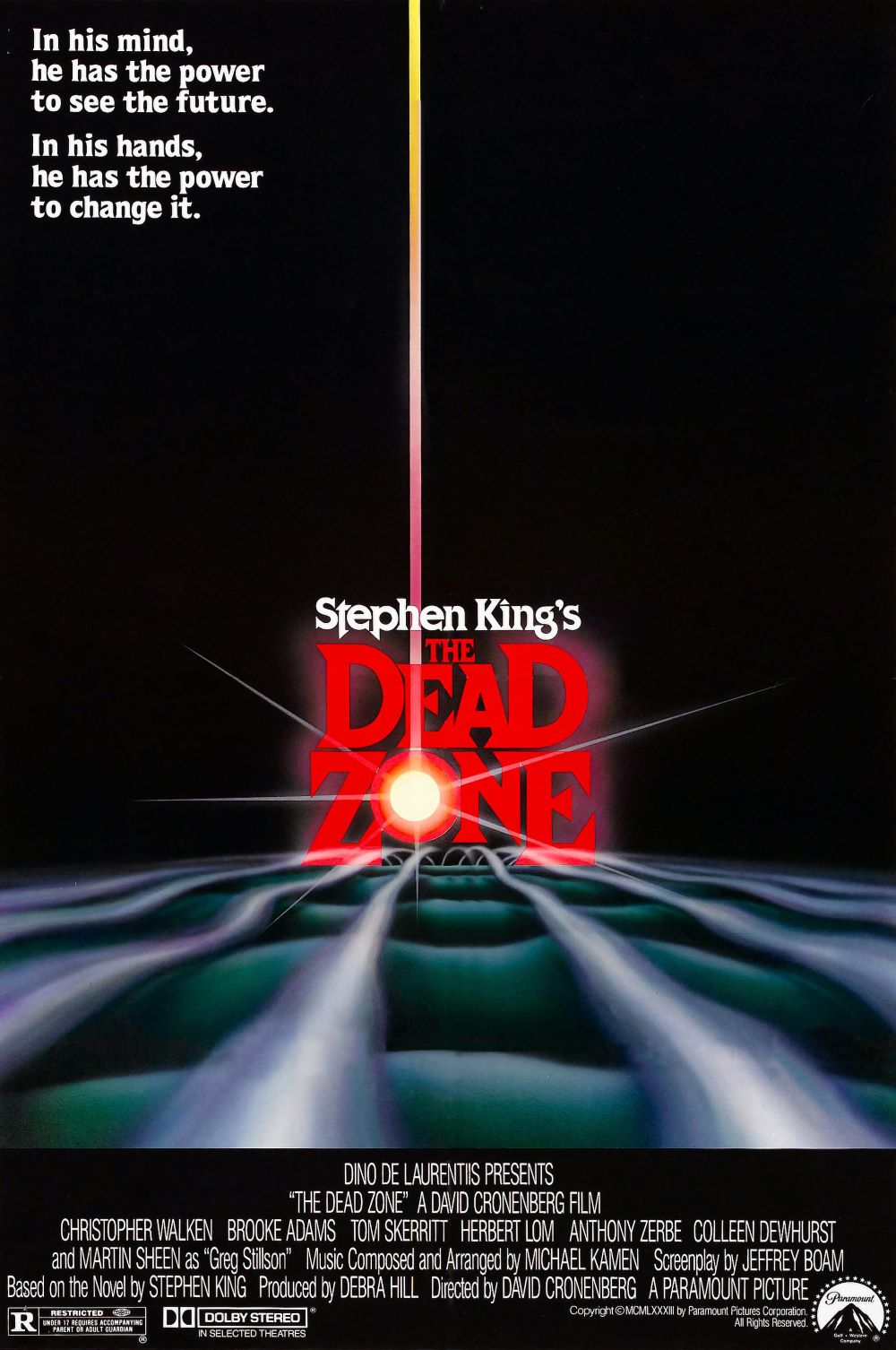
In 1983, David Cronenberg adapted Stephen King’s The Dead Zone with a distinctive emphasis on mood, morality, and psychological depth rather than traditional horror spectacle. The film follows Johnny Smith (Christopher Walken), a small-town schoolteacher whose life transforms irrevocably after a traumatic car accident leaves him in a five-year coma. Upon awakening, Johnny discovers he possesses psychic abilities that allow him to see the past and future by touch. Rather than a gift, this power becomes a heavy burden, isolating him and forcing him into wrenching moral choices.
Cronenberg’s direction is meticulous and deliberately restrained. The film’s muted color palette and stark winter landscapes visually echo Johnny’s emotional isolation and the fragility of human existence. His careful, often gliding camera movements create a mounting sense of quiet dread, while minimalistic sound design underscores moments of revelation with haunting subtlety. This subdued style elevates the film’s psychological impact, transforming it into a thoughtful and melancholy meditation on the cost of harrowing knowledge.
Significantly, The Dead Zone marks a departure from Cronenberg’s signature body horror. Instead of the grotesque physical transformations and visceral mutations that characterize much of his other work, here Cronenberg turns inward. The real horror lies in the malleability of the mind and the elusive nature of perception—how reality, memory, and the future are unstable constructs that can shift and fracture under psychic strain. This thematic focus on the impermanence and distortion of mental reality touches on some of Cronenberg’s deepest artistic fascinations.
The restrained treatment of body horror in The Dead Zone previews the director’s later, more psychologically driven films such as A History of Violence, Eastern Promises, and A Dangerous Method, where character studies and narrative depth take precedence over startling visuals. In this early pivot, Cronenberg demonstrates that his mastery lies not only in visual spectacle but in probing the profound emotional and moral dilemmas faced by his characters. The vision-focused horror here is cerebral and grounded, rooting supernatural phenomena in human frailty and ethical complexity.
Christopher Walken’s nuanced portrayal is the emotional heart of the film. He captures Johnny’s vulnerability, weariness, and profound solitude, portraying a man burdened by a cursed knowledge that isolates him from the world. Martin Sheen plays Greg Stillson, the ambitious and morally bankrupt politician whose rise Johnny must foretell and who embodies the film’s central threat. The supporting cast, including Brooke Adams as Johnny’s lost love Sarah and Tom Skerritt as Sheriff Bannerman, delivers compelling and authentic performances that humanize the film’s intimate, small-town environment.
Several changes from King’s novel sharpen the film’s thematic focus. The novel’s sprawling plot, including a serial killer subplot and a brain tumor storyline symbolizing Johnny’s mortality, is pared down or omitted. Despite this trimming, the serial killer element retained in the film remains chilling and effective. It highlights the darker repercussions of Johnny’s psychic gift and injects a tangible sense of dread, reinforcing the psychological weight Johnny carries. This subplot grounds the supernatural within a disturbing reality, illustrating the violent and tragic circumstances Johnny must grapple with as part of his burden.
The concept of the “dead zone” itself shifts in meaning. Originally, the term referred to parts of Johnny’s brain damaged by the accident, blocking certain visions. Cronenberg reinterprets it as a metaphor for the unknown and unknowable parts of the future—the gaps in psychic clarity that allow for free will and change. This subtle shift reshapes the narrative toward a more ambiguous, hopeful meditation on destiny and human agency.
Compared to King’s novel, Cronenberg’s Johnny is more grounded and isolated. The novel frames Johnny’s struggle within a broader spiritual and fatalistic context, highlighted by the looming presence of a brain tumor and a nuanced exploration of hope versus resignation. The film, by contrast, focuses on the emotional and moral fatigue induced by Johnny’s psychic gift, emphasizing his loneliness and reluctant responsibility rather than supernatural destiny.
Walken’s restrained, haunting performance strips away mythic grandeur to reveal a deeply human character. The film’s narrowed narrative tightens focus on Johnny’s internal anguish and his difficult ethical choices, making his plight intimate and richly relatable.
On a thematic level, The Dead Zone contemplates fate, free will, and sacrifice. Johnny’s psychic abilities act as a draining, almost chthonic force, transforming him into a reluctant prophet who is tasked with intervening in grim futures at great personal cost. The film’s bleak winter setting visually reflects Johnny’s alienation, while its deliberate pacing highlights the exhaustion and heartbreak that comes with such knowledge.
Ultimately, Cronenberg’s The Dead Zone goes beyond supernatural thriller conventions. It is a profound meditation on empathy, sacrifice, and the human condition—where the greatest horrors are internal, and the cost of knowledge is both psychic and emotional. Johnny Smith emerges as a tragic, flawed figure wrestling with unbearable burdens.
Cronenberg’s direction and the impeccable performances make The Dead Zone a standout in King adaptations. The film’s enduring impact lies in its rich thematic texture, its moral ambiguity, and its unflinching exploration of human frailty, all conveyed through a director shifting skillfully from physical body horror to psychological and existential terror. The film remains as haunting and resonant now as it was upon release, a testament to the synergy of Cronenberg and King’s extraordinary talents.
This 1991 made-for-TV movie opens with a murder in a Brooklyn park. The year is 1979 and a group of teenagers are accosted by two men carrying guns. The men rob the teenagers of their drugs and guns. One person is killed. When the police arrive, almost everyone says that it was too dark to see anything. However, a 15 year-old named Jimmy O’Neill (Tristan Tait) says that he saw the faces of the men.
At the police station, the detective (Mark Metcalf) shows him a picture of a man named Billy Ferro (Zachary Mott) and Jimmy identifies him as one of the gunmen. The detective then produces a picture of a 19 year-old named Bobby McLaughlin (Brendan Fraser) and asks if Bobby was the other man. When Jimmy hesitates, the detective says that McLaughlin has been arrested with Billy in the past.
Of course, the truth of the matter is that, while Bobby has been arrested in the past, he’s never been arrested for anything as serious as murder and he’s never met Billy Ferro. The man who had been arrested in the past with Ferro was named Harold McLaughlin. The detective accidentally grabbed the wrong picture.
Bobby, a high school drop-out who lives with his foster parents (played by Martin Sheen and Caroline Kava), is arrested and charged with second degree murder. It doesn’t matter that Bobby passes a polygraph because the results are not admissible in court. It doesn’t matter what Bobby has an alibi because the prosecutor portrays all of his friends as being a collection of stoners and losers. It doesn’t matter what Bobby has never even met Billy Ferro because Ferro isn’t going to help anyone out, even someone who he knows is being falsely convicted. Bobby is convicted of second degree murder and sent to prison.
For the next seven years, while Bobby tries to survive prison, his foster father attempts to prove his son’s innocence. With the police refusing to help, Bobby’s father is forced to launch his own investigation but it seems like no matter what he discovers, it’s not enough to get Bobby out of prison. Still, neither he nor Bobby gives up. Neither one will accept a system in which you’re guilty until proven innocent….
For most people who choose to watch this film, I imagine it will be because of that “Introducing Brendan Fraser” credit. Fraser gives a very good performance in this film, playing Bobby as basically well-meaning but directionless teenager who finds himself trapped in a nightmare. Of course, the majority of this film is Martin Sheen yelling about the injustice of it all. This is the type of crusader role that Sheen has played often. As was often the case when he was cast in films like this, there’s nothing subtle about Sheen’s performance but it’s not really a role that needs or demands subtlety.
Though this was made-for-television and, as such, is never quite as critical of the system as perhaps it should be (if anything, the film argues that one should trust the system to eventually do the right thing, even if it does so seven years too late), it still shows how one cop’s mistake can ruin an innocent’s man life. It’s all the more effective because it’s based on a true story. Of course, I immediately knew the cop shouldn’t be trusted because he was played by Mark Metcalf. Niedermeyer as a cop? That’s definitely not going to end well.
1979’s Apocalypse Now reimagines the Vietnam War as pop art.
Jim Morrison sings The End in the background as slow-motion helicopters pass in front of a lush jungle. The jungle erupts into flame while in a dingy hotel room, Captain Benjamin Willard (Martin Sheen) gets drunks, practices his karate moves, and smashes a mirror before collapsing to the floor in tears. The next morning, the hung-over and bandaged Willard ends up at a U.S. military base where he has a nice lunch with Lt. General Corman (G.D. Spradlin) and Col. Lucas (Harrison Ford) and a nearly silent man wearing an undone tie. Willard is asked if it’s true that he assassinated an enemy colonel. Willard replies that he did not and that the operation was classified, proving that he can both lie and follow military protocol. Willard is told that a Col. Walter Kurtz (Marlon Brando) has gone rogue and his mission is to go into Cambodia and terminate his command with “extreme” prejudice. It’s a famous scene that features G.D. Spradlin delivering a brilliant monologue about good and evil and yet it’s often missed that Willard is getting his orders from Roger Corman and George Lucas.
(Roger Corman was the mentor of director Francis Ford Coppola while the pre-Star Wars George Lucas was Coppola’s business partner. Indeed, Apocalypse Now was originally somewhat improbably planned to be a George Lucas film.)
Up the river, Willard heads on a patrol boat that is populated with characters who could have come out of an old World War II service drama. Chief (Albert Hall) is tough and no-nonsense. Lance (Sam Bottoms) is the goofy comic relief who likes to surf. Clean (Laurence Fishburne) is the kid who is obviously doomed from the minute we first see him. Chef (Fredric Forrest) is the overage, tightly-wound soldier who just wants to find mangoes in the jungle and who worries that, if he dies in a bad place, his soul won’t be able to find Heaven. The Rolling Stones are heard on the boat’s radio. Soldiers on the other patrol boats moon the boat and toss incendiary devices on the roof. It’s like a frat prank war in the middle of a war.
Colonel Bill Kilgore (Robert Duvall) is a badass calvary officer whose helicopter raids are legendary amongst the enemy and a dedicated surfer who tries to turn every night into the equivalent of an AIP Beach Party film. He’s a brilliant warrior who speaks with Malibu accent (“Charlie don’t surf!”) and who doesn’t flinch when a bomb goes off near him. “I love the smell a napalm in the morning,” he says and, for a few moments, you really wish the film would just abandon Willard so we could spend more time with Kilgore. “Some day this war is going to end,” he says with a reassuring nod, showing a non-neurotic attitude that is the opposite of Kurtz’s. Willard says that he could tell Kilgore was going to get through the war without even a scratch and it’s true. Kilgore doesn’t try to rationalize or understand things. He just accepts the reality and adjusts. He’s a true surfer.
The film grows progressively more surreal the closer the boat heads up the river and gets closer to Cambodia. A USO show turns violent as soldiers go crazy at the sight of the Playboy Bunnies, dressed in denim outfits and cowboy hats and twirling cap guns like the love interest in a John Wayne western. A visit to a bridge that is built every day and blown up every night is a neon-lit, beautiful nightmare. Who’s the commanding officer? No one knows and no one cares.
The closer Willard gets to Kurtz, the stranger the world gets. Fog covers the jungles. A tiger leaps out of nowhere. Dennis Hopper shows up as a photojournalist who rambles as if Billy from Easy Rider headed over to Vietnam instead of going to Mardi Gras. Scott Glenn stands silently in front of a temple, surrounded by dead bodies that feel as if they could have been brought over from an Italian cannibal film. Kurtz, when he shows up, is an overweight, bald behemoth who talks in riddles and who hardly seem to be the fearsome warrior that he’s been described as being. “The horror, the horror,” he says at one point in one of the few moments that links Apocalypse Now to its inspiration, Joseph Conrad’s Heart of Darkness.
Directed by near-communist Francis Ford Coppola and written by the unapologetically right-wing John Milius, Apocalypse Now is actually less about the reality of Vietnam and more about how the images of the war shaped pop culture the world over. It’s a reminder that Vietnam was known for being the first television war and that counterculture was not just made up of dropouts but also of writers, actors, and directors. Kurtz may say that Willard’s been sent by grocery store clerks but actually, he’s been sent by the B-movie producers who first employed and mentored the directors and the actors who would eventually become the mainstays of the New Hollywood. The film subverts many classic war film cliches but, at the same time, it stays true to others. Clean dying while listening to a tape recording of his mother telling him not to get shot and to come home safe is the type of manipulative, heart-tugging moment that could have appeared in any number of World War II-era films. And while Coppola has always said the film was meant to be anti-war, Col. Kilgore remains the most compelling character. Most viewers would probably happily ride along with Kilgore while he flies over Vietnam and plays Wagner. The striking images of Vietnam — the jungle, the explosions, the helicopters flying through the air — stay in the mind far more than the piles of dead bodies that appear in the background.
It’s a big, messy, and ultimately overwhelming film and, while watching it, it’s hard not to get the feeling that Coppola wasn’t totally sure what he was really trying to say. It’s a glorious mess, full of stunning visuals, haunting music, and perhaps the best performance of Robert Duvall’s legendary career. The film is too touched with genius to not be watchable but how one reacts overall to the film will probably depend on which version you see.
The original version, which was released in 1979 and was nominated for Best Picture, is relentless with its emphasis on getting up the river and finding Kurtz. Willard obsesses on Kurtz and really doesn’t have much to do with the other people on the boat. It gives the story some much-needed narrative momentum but it also makes Kurtz into such a legendary badass that it’s hard not to be disappointed when Willard actually meets him. You’re left to wonder how, if Kurtz has been living in the jungle and fighting a brutal and never-ending guerilla war against the communists, he’s managed to gain so much weight. Brando, who reportedly showed up on set unprepared and spent days improvising dialogue, gives a bizarre performance and it’s hard to view the Kurtz we meet as being the Kurtz we’ve heard about. As strong as the film is, it’s hard not to be let down by who Kurtz ultimately turns out to be.
In 2001 and 2019, Coppola released two more versions of the film, Redux and The Final Cut. These versions re-inserted a good deal of footage that was edited out of the original cut. Most of that footage deals with Willard dealing with the crew on the boat and it’s easy to see why it was cut. The scenes of Willard bonding with the crew feel out of character for both Willard and the rest of the crew. A scene where Willard arranges for Clean, Lance, and Chef to spend time with the Playboy bunnies seems to go on forever and features some truly unfortunate acting. Worst of all, Redux totally ruins Kilgore’s “I love the smell of napalm in the morning” monologue by having Willard suddenly steal his surf board. Again, it’s out of character for Willard and it actually feels a bit disrespectful to Duvall’s performance to suddenly turn Kilgore into a buffoon.
But then there are moments that do work. I actually like the lengthy French Plantation scene. By the time Willard, Lance, and Chef stumble into the plantation, the journey upriver has gotten so surreal that it makes a strange sort of sense that they would run into a large French family arguing politics while a clown tries to keep everyone distracted. The new versions of the film are undeniably disjointed but they also shift the focus off of finding Kurtz and place it more on Willard discovering how weird things are getting in Vietnam. As such, it’s less of a disappointment when Kurtz actually shows up. Much as with the French Plantation scene, the journey has become so weird that Kurtz being overweight and pretentious feels somehow appropriate.
What all the versions of the film have in common is that they’re all essentially a neon-lit dream of pop cultural horror. Is Apocalypse Now a horror film? Critic Kim Newman argued that it owed a lot to the genre. Certainly, that’s the case when Willard reaches the temple and finds himself surrounded by corpses and and detached heads. Even before that, though, there are elements of horror. The enemy is always unseen in the jungle and, when they attack, they do so quickly and without mercy. In a scene that could almost have come from a Herzog film, the boat is attacked with toy arrows until suddenly, out of nowhere, someone throws a very real spear. Until he’s revealed, Kurtz is a ghostly figure and Willard is the witch hunter, sent to root him out of his lair and set his followers on fire. If the post-60s American horror genre was shaped by the images coming out of Vietnam then Apocalypse Now definitely deserves to be considered, at the very least, horror-adjacent.
Apocalypse Now was controversial when it was released. (It’s troubled production had been the talk of Hollywood for years before Coppola finally finished his film.) It was nominated for Best Picture but lost to the far more conventional Kramer vs Kramer. Robert Duvall was the film’s sole acting nominee but he lost the award to Melvyn Douglas’s turn in Being There. Douglas was very good in Being There and I imagine giving him the Oscar was also seen as a way of honoring his entire career. That said, Duvall’s performance was amazing. In his relatively brief screen time, Duvall somehow managed to take over and ground one of the most unruly films ever made. The Oscar definitely should have gone to him.
As for the film itself, all three versions, flaws and all, are classics. It’s a film that proves that genius can be found in even the messiest of productions.
Today, the Shattered Lens wishes a happy birthday to Martin Sheen.
In this scene from 1979’s ApocalypseNow, Sheen shows the intensity that not only nearly killed him when he suffered a heart attack during filming but which also served to make Francis Ford Coppola’s Vietnam epic a true classic.
Composer Carmine Coppola, the father of Francis Ford Coppola, was born 115 years ago today.
Coppola composed music for almost all of his son’s films. To me, his best work was the menacing and dream-like score that he and Francis put together for 1979’s ApocalypseNow. Some of that score can be heard in today’s scene of the day, as Willard (Martin Sheen) and the boat approach a bridge that is built every day and destroyed every night.
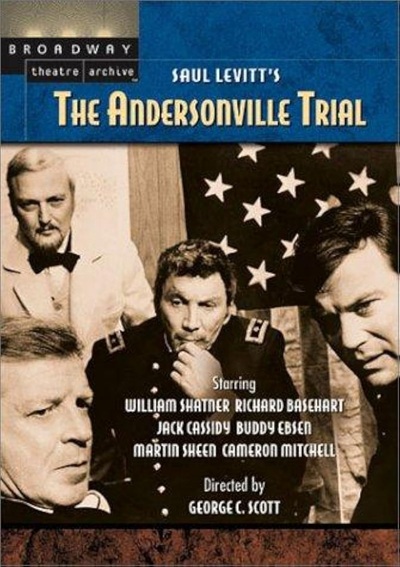
1970’s The Andersonville Trial takes place in one muggy military court room. The year is 1865. The Civil War is over but the wounds of the conflict are still fresh. Many of the leaders of the Confederacy are still fugitives. Abraham Lincoln has been dead for only a month. The people want someone to pay and it appears that person might be Captain Henry Wirz (Richard Basehart).
Originally born in Switzerland and forced to flee Europe after being convicted of embezzlement, Henry Wirz eventually ended up in Kentucky. He served in the Confederate Army and was eventually named the commandant of Camp Sumter, a prison camp located near Andersonville, Georgia. After the war, Captain Wirz is indicted for war crimes connected to his treatment of the Union prisoners at the camp. Wirz and his defense counsel, Otis Baker (Jack Cassidy), argue that the prison soon became overcrowded due to the war and that Wirz treated the prisoners as well as he could considering that he had limited resoruces. Wirz points out that his requests for much-needed supplies were denied by his superiors. Prosecutor Norton Chipman (William Shatner) argues that Wirz purposefully neglected the prisoners and their needs and that Wirz is personally responsible for every death that occurred under his watch. The trial is overseen by Maj. General Lew Wallace (Cameron Mitchell), the same Lew Wallace who would later write Ben-Hurand who reportedly offered a pardon to Billy the Kid shortly before the latter’s death. Wallace attempts to give Wirz a fair trial, even allowing Wirz to spend the trial reclining on a couch due to a case of gangrene. (Agck! The 19th century was a scary time!)
The Andersonville Trial started life as a 1959 Broadway production. On stage, George C. Scott played Chipman, an experience he described as difficult because, even though Chipman was nominally the play’s hero, Wirz was actually a much more sympathetic character. When the play was adapted for television in 1970, Scott returned to direct. Admittedly, the television version is very stagey. Scott doesn’t make much effort to open up the play. Almost all of the action is confined to that courtroom. We learn about the conditions at Fort Sumter in the same way that the judges learned about the conditions. We listen as the witnesses testify. We listen as a doctor played by Buddy Ebsen talks about the deplorable conditions at Fort Sumter. We also listen as a soldier played by Martin Sheen reports that Wirz has previously attempted to suicide and we’re left to wonder if it was due to guilt or fear of the public execution that would follow a guilty verdict. We watch as Chipman and Baker throw themselves into the trial, two attorneys who both believe that they are correct. And we watch as Wirz finally testifies and the play hits its unexpected emotional high point.
As most filmed plays do, The Andersonville Trial demands a bit of patience on the part of the viewer. It’s important to actually focus on not only what people are saying but also how they’re saying it. Fortunately, Scott gets wonderful performances from his ensemble cast. Even William Shatner’s overdramatic tendencies are put to good use. Chipman is outraged but the play asks if Chipman is angry with the right person. With many of the Confederacy’s leaders in Canada and Europe, Wirz finds himself standing in for all of them and facing a nation that wants vengeance for the death of their president. Wirz claims and his defense attorney argues that Wirz was ultimately just a soldier who followed orders, which is what soldiers are continually told to do. The Andersonville Trial considers when military discipline must be set aside to do what is morally right.
Admittedly, when it comes to The Andersonville Trial, it helps to not only like courtroom dramas but to also be a bit of a history nerd as well. Fortunately, both of those are true of me. I found The Andersonville Trial to be a fascinating story and a worthy production.
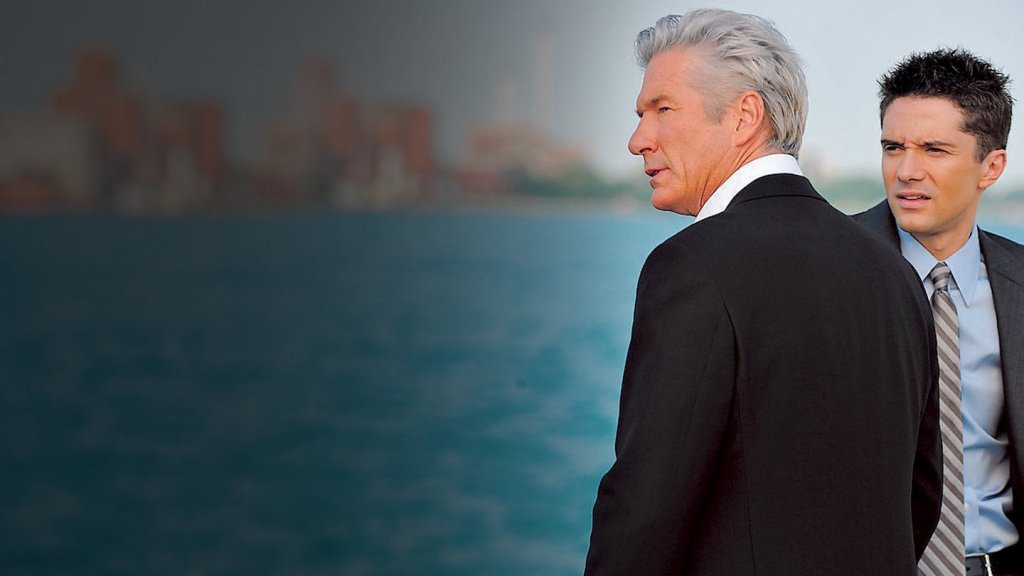
Every Monday night at 9:00 Central Time, my wife Sierra and I host a “Live Movie Tweet” event on X using the hashtag #MondayMuggers. We rotate movie picks each week, and our tastes are quite different. Tonight, Monday February 3rd, we’re watching THE DOUBLE starring Richard Gere, Topher Grace, and Martin Sheen.
Sierra had a day off from work last week and she watched this movie 3 times. Then she told me it would be her choice for the week! I’d say she really likes the movie!
THE DOUBLE is the story of a retired CIA operative (Gere), who’s paired with a young FBI agent (Grace), trying to solve the mystery of a senator’s murder. All of the signs are pointing towards an assassin from the Soviet Union!
Here is some interesting trivia about the film:
THE DOUBLE is directed and written by Michael Brandt. After directing this film, Brandt would be the driving force behind the various Chicago based TV series’ CHICAGO FIRE, CHICAGO P.D., and CHICAGO MED. He also wrote the screenplays to 3:10 TO YUMA (2007) and WANTED (2008). This is a talented man!
Filming was halted for six weeks after Richard Gere dislocated his shoulder during a fight sequence with actor Tamer Hassan.
If you enjoyed the TV show CASTLE, the beautiful Stana Katic is in this movie. She’s billed 5th, but she only has about 5 minutes of screen time. That shows you how popular that show was at the time of this films release in 2011.
So join us tonight to for #MondayMuggers and watch THE DOUBLE! It’s on Amazon Prime.
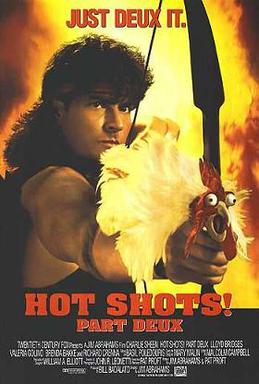
Topper Harley (Charlie Sheen) is back but instead of being a knock-off of Tom Cruise, he’s now Sylvester Stallone.
When two separate teams of U.S. soldiers fail to rescue a group of hostages who are being held by Saddam Hussein (Jerry Haleva, who built an entire career out of his resemblance to the Iraqi dictator), it not only embarrasses America but threatens the reelection campaign of President Tug Benson (Lloyd Bridges). President Benson can get away with throwing up on the Japanese ambassador and knocking over all the other Presidents with a shovel (though Gerald Ford falls on his own) but he can’t survive a hostage crisis. Colonel Denton Waters (Richard Crenna) and Michelle Huddleston (Brenda Bakke) attempt to recruit Topper Harley from the Buddhist monastery, where he’s been living since the disappearance of Ramada (Valeria Golino). Topper refuses to help with a third mission but, after Water is captured by Saddam, Topper does decide to lead the fourth mission. Working with Ryan Stiles and Miguel Ferrer, Topper heads into the jungle to save Colonel Waters, reunite with Ramada, and discover his destiny.
The sequel to Hot Shots! is more of the same, a non-stop cavalcade of jokes, movie references, and deadpan one liners. There are enough laugh out loud moments to make up for the jokes that don’t work. I’ll always like the moment when Charlie Sheen sees Martin Sheen on another patrol boat. (“Loved you in Wall Street!”) It’s a movie made in the vein of Airplane! but the jokes aren’t as timeless as in that classic. Everyone remembers Rambo enough to get the main joke and the interrogation scene in Basic Instinct has left enough of an impression that Topper’s “I know what to get your for Christmas,” comment to Michelle still draws a chuckle but do you remember Body of Evidence and the first President Bush vomiting at a state dinner? Not all of the jokes have aged well but Charlie Sheen does a decent Rambo impersonation and Lloyd Bridges’s dim bulb President is one of the more relatable parts of the movie. Fortunately, jokes about Saddam Hussein getting flattened by a piano will always be funny.



 Through the Shattered Lens