Review: By Dawn’s Early Light (dir. by Jack Sholder)


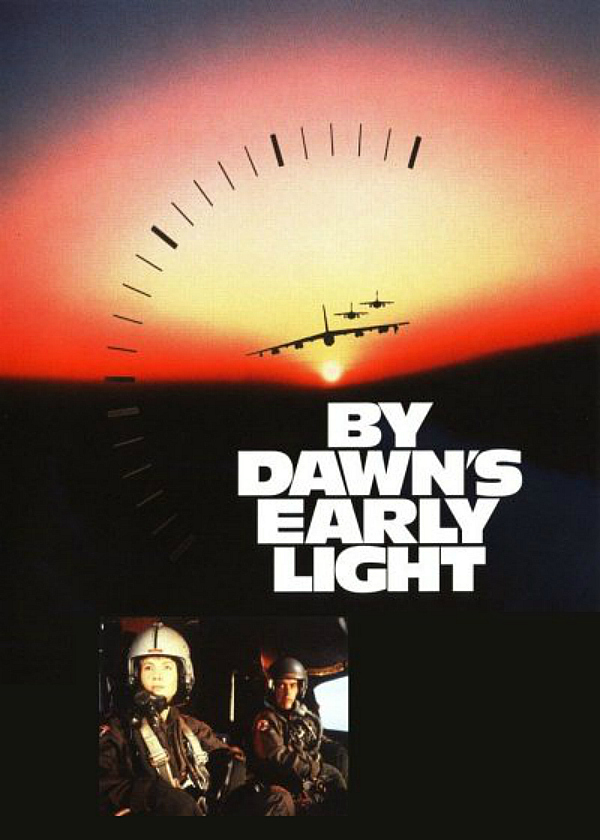
1990’s By Dawn’s Early Light is a film adaptation by HBO of William Prochnau’s novel Trinity’s Child. The film, when it first aired on HBO, seemed dated since the Soviet Union was ultimately going through its death throes as the military build-up initiated during the Reagan Administration crippled the USSR economically (they too tried to match the build-up in conventional and nuclear forces). Yet, despite the ending of the Cold War, recent events domestically and around the world has shown that the world never truly left behind the shadow of nuclear war.

The film is simplicity in the way the plot unfolds. A failed coup by dissident Soviet military commanders fails, but it’s after-effects of creating a “hot war” between the US and the USSR succeeds as both US President and Soviet Premiere make mistakes in their decisions. Decisions heavily influenced by their military commanders who see only black and white in how their respective nations should respond militarily. By Dawn’s Early Light shares some similarities to the classic 60’s Cold War films like Dr. Strangelove and Fail-Safe. Both films deal with the human frailties and flaws helping influence events that could lead to nuclear Armageddon for the whole planet. By Dawn’s Early Light concentrates on several storylines to highlight the stress and difficulties individuals must face to either follow their orders to their inevitable conclusion or allow their conscience to help make the moral decisions in trying to stop the madness spiraling out of control. Though some people’s decisions are left wanting, the film ends with a glimmer of hope that may just bring the world from the brink of annihilation.

The acting by the cast of Rebecca DeMornay, Powers Boothe, James Earl Jones, Darrin McGavin, Martin Landau and Rip Torn are well done. Rebecca DeMornay and Powers Boothe anchor one of the subplots as romantically involved B-52 crew pilots whose conflict comes from their own intimate closeness affecting command decisions and from the stress of families lost by the rest of the bomber crew. Darrin McGavin, Rip Torn and Martin Landau anchor the other subplot of competing Presidents. One a physically incapacitated US leader trying to avert escalating the conflict to the point of no return with another recently sworn in who fears of losing a nuclear war and thus wanting to strike back full and hard. In between these two leaders is the diabolical performance by Rip Torn as a warmongering Army colonel who sees only winning the war as the only objective. At times, the performances do become hampered by the simplicity of the script, but the cast power through to the end.

In the end, the film might look a bit dated in its production design (this was 1990 and many years before HBO became known for premiere television production) but the story itself is very current and relevant.  What might have been a nice Cold War relic fairy tale when it first aired in 1990 on HBO has taken on more of a cautionary tale as more nations begin to acquire nuclear weapons with some of these nations not just enemies of the US and the world in general, but also led by men whose hold on sanity seem tenuous at best. By Dawn’s Early Light is a great piece political “what if” that hopefully remains just that and not a prediction of reality to come.

Guilty Pleasure No. 83: Meteor (dir by Ronald Neame)


1979’s Meteor is about a big rock that is tumbling through space.  Earth is directly in its path and, if it hits the planet, it could be an extinction-level event.  Unfortunately, little bits of the rock keep breaking off and crashing into Earth, destroying cities and fleeing extras.  Goodbye, Hong Kong.  Goodbye, Switzerland, which is destroyed via stock footage lifted from Avalanche.  Goodbye, New York, which blows up in such spectacular fashion that the scene was later re-used in The Day After.

It might seem like the planet is doomed.  The meteor is unstoppable.  Bruce Willis hasn’t become a star yet.  But fear not!  Some of the brightest faces of the 70s have been recruited to stop the meteor.  Natalie Wood, in one of her final films, plays a translator and gets covered in muddy river water.  Sean Connery wears a turtleneck and curses in that Scottish way of his.  Karl Malden wears a hat and tells people to calm down while he calls the President.  Brian Keith plays a Russian with all the grace and skill of a cat trying to rip open a bag of treats.  Martin Landau is the military official who doesn’t think that the scientist know what they’re talking about.  Henry Fonda is the president.  That’s a lot of balding men for one movie and it’s hard not to notice that both Malden and Keith often seem to be wearing a hat whenever they share a scene with Connery.  My personal theory is that the production, having spent all of their money on blowing up New York, couldn’t afford more than two toupees so everyone had to take turns wearing them.  (The few scenes where Malden is hatless while in Connery’s presence are often oddly filmed, with either Connery on Malden standing with their back to the camera, almost as if the scenes were actually done with a stand-in.)

We’re supposed to breathe a sigh of relief when we see that Henry Fonda is playing the President but I’ve seen Fail Safe and I remember him allowing the Russian to nuke New York City.  Interestingly enough, New York gets destroyed in this film too.  Why didn’t President Fonda care about New York City?  Of course, the scientists and the military folks are all located in a control center that’s located under the city.  Malden mentions that they’re right next to the Hudson River.  It doesn’t seem to occur to anyone that this is a bad idea but, then again, they also elected Henry Fonda president again.

My late friend and colleague Gary Loggins described Meteor as being a “crashing bore.”  I have to admit that this is one of the few times that I have ever disagreed with Gary.  Meteor is a tremendous amount of fun, as long as you’re watching it with a group of people and nobody takes it seriously.  (The first time I saw it was at one in the morning while I was in college.  Jeff and I watched it in the lounge of one of the dorms.  We may be the only two people to have romantic memories of Meteor.)  Meteor features a cast of champion scenery chewers.  Karl Malden, Sean Connery, Martin Landau, Brian Keith, none of them were exactly subtle actors and giving them an excuse to argue about how to deal with a meteor allows for a lot of very enjoyable overacting.  As well, the special effects are so cheap and obviously fake that it’s hard not to laugh out loud whenever the film cuts to that shot of the meteor rolling through space or the incredibly shiny American and Russian missiles slowly heading towards it.

Meteor’s a lot of fun, even if it is one of those movies where no one points out that our heroes inevitably seem to make every situation worse with their own stupidity.  It’s very much at the tail-end of the 70s disaster boom.  Watch it for the stars.  Watch it for the rock.  And watch it for the hairpieces.

Previous Guilty Pleasures

  1. Half-Baked
  2. Save The Last Dance
  3. Every Rose Has Its Thorns
  4. The Jeremy Kyle Show
  5. Invasion USA
  6. The Golden Child
  7. Final Destination 2
  8. Paparazzi
  9. The Principal
  10. The Substitute
  11. Terror In The Family
  12. Pandorum
  13. Lambada
  14. Fear
  15. Cocktail
  16. Keep Off The Grass
  17. Girls, Girls, Girls
  18. Class
  19. Tart
  20. King Kong vs. Godzilla
  21. Hawk the Slayer
  22. Battle Beyond the Stars
  23. Meridian
  24. Walk of Shame
  25. From Justin To Kelly
  26. Project Greenlight
  27. Sex Decoy: Love Stings
  28. Swimfan
  29. On the Line
  30. Wolfen
  31. Hail Caesar!
  32. It’s So Cold In The D
  33. In the Mix
  34. Healed By Grace
  35. Valley of the Dolls
  36. The Legend of Billie Jean
  37. Death Wish
  38. Shipping Wars
  39. Ghost Whisperer
  40. Parking Wars
  41. The Dead Are After Me
  42. Harper’s Island
  43. The Resurrection of Gavin Stone
  44. Paranormal State
  45. Utopia
  46. Bar Rescue
  47. The Powers of Matthew Star
  48. Spiker
  49. Heavenly Bodies
  50. Maid in Manhattan
  51. Rage and Honor
  52. Saved By The Bell 3. 21 “No Hope With Dope”
  53. Happy Gilmore
  54. Solarbabies
  55. The Dawn of Correction
  56. Once You Understand
  57. The Voyeurs 
  58. Robot Jox
  59. Teen Wolf
  60. The Running Man
  61. Double Dragon
  62. Backtrack
  63. Julie and Jack
  64. Karate Warrior
  65. Invaders From Mars
  66. Cloverfield
  67. Aerobicide 
  68. Blood Harvest
  69. Shocking Dark
  70. Face The Truth
  71. Submerged
  72. The Canyons
  73. Days of Thunder
  74. Van Helsing
  75. The Night Comes for Us
  76. Code of Silence
  77. Captain Ron
  78. Armageddon
  79. Kate’s Secret
  80. Point Break
  81. The Replacements
  82. The Shadow

A Blast From The Past: The Mama Cass Television Program (dir by Sid Smith)


Normally, this is where and when I would post my weekly review of Fantasy Island but, due to this being a busy week, my Retro Television Reviews are on break until Sunday.  Fear not, though, we have alternative programming!

From 1969, it’s The Mama Cass Television Program!  This was actually meant to be a pilot for a variety show that would have been hosted by Mama Cass Elliott, formerly of the Mamas and the Papas.  For that reason, there’s some comedy bits along with Cass singing.  Keep an eye out for Martin Landau!  The comedy, to be honest, is a bit cringey but it really doesn’t matter when you’ve got Cass Elliott and her amazing voice.

Fantasy Island will return next week but for now….


Film Review: Tucker: The Man and His Dream (by Francis Ford Coppola)


First released in 1988, Tucker: The Man and His Dream is a biopic about Preston Tucker.

Tucker was an engineer in Detroit who went from designing vehicles for the Army during World War II to trying to launch his own car company.  His ideas for an automobile don’t sound particularly radical today.  He wanted every car to have seat belts.  He wanted a windshield that popped out as a safety precaution.  He want brake pads and he also wanted a car that looked sleek and aerodynamic, as opposed to the old boxy cars that were being pushed out be Detroit.  He wanted a car that got good mileage and he wanted one that could be taken just about anywhere.  Unfortunately, Tucker’s dreams were cut short when he was indicted for stock fraud, a prosecution that most people agree was a frame-up on behalf of the Big Three auto makers.  Tucker was eventually acquitted but his car company went out of business.  Of the 50 cars that Tucker did produce, 48 of them were still on the road and being driven forty years later.

The film stars Jeff Bridges as Preston Tucker, Joan Allen as his wife, Christian Slater and Corin Nemec as two of his sons, Lloyd Bridges as the senator who tried to take Tucker down, Martin Landau as Tucker’s business partner, and Dean Stockwell as Howard Hughes, who shows up for a few minutes to encourage Tucker to follow his dreams regardless of how much the government tries to stop him.  One gets the feeling that the film was a personal one for director Francis Ford Coppola, a filmmaker who has pretty much spent his entire career fighting with studios while trying to bring his vision to the screen.  Tucker fought for seat belts.  Coppola fought for a mix of color and black-and-white in Rumble Fish.  Tucker stood up for his business partner.  Francis Ford Coppola stood up for Al Pacino when no one else could envision him as Michael Corleone.  As is the case with many of Coppola’s films, Tucker: The Man And His Dream is a film that Coppola spent years trying to get made.  It was the film that Coppola originally intended to be the follow-up to The Godfather, with Marlon Brando projected for the lead role of Tucker.  After watching the Tucker, it’s hard not to feel that it worked out for the best that Coppola was not able to make the film in 1973.  It’s impossible to imagine anyone other than Jeff Bridges in the role of Preston Tucker.

“Chase that tiger….chase that tiger….chase that tiger….” It’s a song that Tucker sings constantly throughout the film as the camera spins around him and how you react to Tucker: The Man And His Dream will largely depend on how tolerant you are of Coppola’s stylistic flourishes.  Coppola directs the film as a combination of Disney fairy tale and film noir.  The opening of the film, with Tucker running around in almost a manic state and excitedly telling everyone about his plans, is presented with vibrant colors and frequent smiles and an almost overwhelming air of cheerful optimism.  As the film progresses and Tucker finds himself being targeted by both the government and the other auto companies, the film gets darker and the viewer starts to notice more and more shadows in the background.  The moments of humor become less and less and there’s a heart-breaking moment where Martin Landau, in one of his best performances, reveals just how far the government will go to take down Tucker’s company.  But, in the end, Tucker refuses to surrender and Jeff Bridges’s charming smile continues to fill the viewer with hope.  The film becomes about more than just cars.  It’s a film that celebrates all of the innovators who are willing to defy the establishment.

There’s a tendency to dismiss the majority of Coppola’s post-Apocalypse Now films.  However, Tucker: The Man And His Dream is a later Coppola film that deserves to be remembered.

The TSL’s Horror Grindhouse: Without Warning (dir by Greydon Clark)


1980’s Without Warning opens with a father (Cameron Mitchell) and his gay son (Darby Hinton) on a hunting trip.  The father taunts his son about not being what the father considers to be a real man.  He says that his son would have no chance of surviving in the wilderness.

“Why does it always have to be like this?” the son asks with a sincerity that will break your heart.

Suddenly, a bloodsucking starfish flies through the air, lands on the father, and starts to suck out his blood with a phallic stinger.  The father dies while his son watches.  The son picks up his rifle and prepares to fight back.  This will be the son’s chance to prove that his father was incorrect.  This is the son’s chance to prove that he can survive in the wilderness and….

Just kidding.  The son forgot to load the rifle and promptly gets a starfish to the eye.

That’s the type of film that Without Warning is.  Characters are introduced.  The majority of them are played by B-actor who have seen better days.  They get a few minutes of character development.  Then, they die and the viewer is left feeling a bit depressed because they all seemed like they deserved just a bit more screentime than they received.  Larry Storch shows up as a boy scout leader who gets a starfish to the back while trying to light a cigarette.  Neville Brand, Ralph Meeker, and Sue Anne Langdon hang out in a bar and refuse to believe that the Earth has been invaded by blood-sucking starfish.  Jack Palance plays a hunter and gas station owner who wants to capture an alien as a trophy.  Martin Landau plays Sarge, an unbalanced Vietnam Vet who has been telling people for years that there are aliens out there.  Everyone laughed at old Sarge but they won’t be laughing for long!  At the time this film was made, Palance was a two-time Oscar nominee.  He finally won his Oscar for City Slickers, a decade after Without Warning.  Martin Landau, for his part, won his Oscar 15 years after Without Warning.  Good for them.  If nothing else, this movie should remind everyone who has dismissed Eric Roberts’s chances that there’s still time!

That said, none of these familiar faces are the stars of the film.  Instead, the majority of the film follows four teenagers on a road trip, Sandy (Tarah Nutter), Greg (Christopher S. Nelson), Beth (Lynn Theel), and Tom (David Caruso).  David Caruso as a sex-crazed teenager sounds more amusing than it actually is.  If anything, the sight of him wearing shorts and t-shirt is almost blinding.  (As a fellow redhead, I sympathize.  We burn but we don’t tan.)  Tom and Beth die early on, leaving Greg and Sandy to try to escape from the alien (Kevin Peter Hall) who is tossing around the starfish.  Both characters are pretty generic but Christopher Nelson is at least likable.

Without Warning has a reputation for being the best film that Greydon Clark ever directed and I would agree that it’s one of his better ones, though I prefer The Forbidden Dance.  Then again, when you consider some of the other films that Clark directed, it’s easy to see that Without Warning didn’t exactly have a huge bar to clear.  Though the script borrows a bit too much from nearly every other horror film ever made, Without Warning is nicely paced and the killer starfish are genuinely frightening and their bloodsucking is almost Cronenbergian in its ick factor.  Just as he would for John Carpenter, cinematographer Dean Cundey gives us some nicely eerie shots of the alien.  Landau and Palance go all out, understanding that subtlety has no place in a film like this.  Without Warning is a dumb B-movie but it’s definitely entertaining.

Without Warning (1980, dir by Greydon Clark, DP: Dean Cundey)

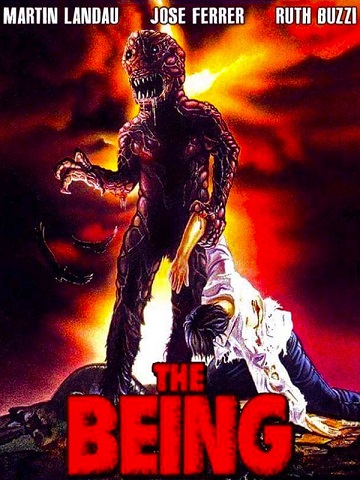
Horror Film Review: The Being (dir by Jackie Kong)


The 1983 film, The Being, takes place in the town of Pottsville, Idaho.

Pottsville is a small town with a quaint downtown, a drive-in that shows violent slasher films, and a group of neighborhood activists who have come together to take a stand against smut.  (Maybe they should start with that drive-in….)  It’s home to a quarry, several potato farms, a trailer park, a diner, a church, and a …. ahem …. nuclear waste dump.

Strange things are happening in town.  The young son of Marge Smith (Dorothy Malone) has vanished and Dorothy has become a familiar sight, wandering around the town in the middle of the night and searching for her child.  One person loses his head while fleeing an unseen assailant.  Two rednecks are killed while smoking weed at the drive-in theater.  People are dying and Detective Mortimer Lutz (Bill Osco) is determined to find out who (or what) is doing the killing.  He’s particularly concerned about the fact that a mysterious green slime is found at all of the crime scenes.

Meanwhile, Mayor Gordon Lane (Jose Ferrer) is more concerned with just covering up the crimes and the history of nuclear waste disposal because he’s got potatoes to harvest and he also hopes to be the first potato farmer in the White House.  (George Washington already beat him to that, though one could point out that Washington never actually lived in the current White House.)  While his wife (Ruth Buzzi) encourages everyone in town to take a stand against smut, Mayor Lane calls in a chemical safety engineer named Garcon Jones (Martin Landau) to investigate.

The Being is a bit of an oddity.  On the one hand, the title character is grotesque and the scenes in which the creature attacks its victims are notably gory.  On the other hand, the film has a strangely off-center sense of humor, starting with Bill Osco’s opening narration, which Osco delivers in the teeth-clenched rat-a-tat style of Rod Serling.  Halfway through the film, the action stops so that Lutz can have a rather bizarre dream in which he sees Garcon fall out of an airplane while the mayor’s wife flies by on a broomstick with blood flowing from her eyes.  This is the type of film in which the notably bloody conclusion is followed by satiric title cards that tell us what happened to each of the survivors.  The Being is a horror film that seems to be cheerfully aware of its budgetary limitations and, as a result, it’s full of moments in which it seems to wink at the audience and say, “Hey, don’t worry so much.  Sit back and have fun.”

For a low-budget, often poorly lit film about a killer mutant, The Being has an impressive cast.  Dorothy Malone, Jose Ferrer, and Martin Landau were all Hollywood veterans and all three of them give admirably straight-faced performances in their smallish roles.  (Ferrer and Malone won Oscars long before appearing in The Being.  Landau won his Oscar a decade after.)  Ferrer, in particular, does a good job of portraying the mayor’s irritation at having to actually deal with the people that he governs.  I also liked the performance of Ruth Buzzi.  Buzzi plays someone who should be very familiar to anyone who has ever lived in a small town, the person who has found a small amount of power and who is determined to never give up.

Low-budget aside, The Being is just odd enough to be watchable.

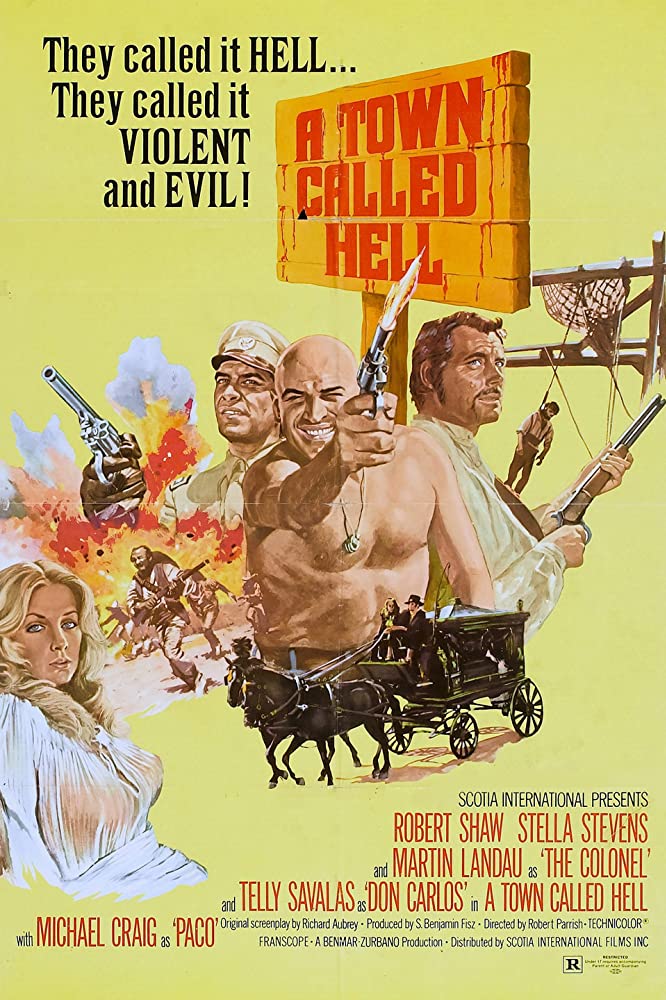
A Town Called Bastard (1971, directed by Robert Parrish)


A Town Called Bastard is a British-produced Western that was shot in Spain and which was obviously designed to capitalize on the popularity of the Spaghetti westerns of the two Sergios, Leone and Corbucci.  When the movie was released in the United States, the title was changed to A Town Called Hell because it was felt that Americans would find the word “bastard” to be too offensive.  I’m not sure how naming your town Hell is somehow an improvement on naming a town Bastard but apparently, that was the thinking.  Actually, the town is called Bastardo is both versions of the film so the American title makes less and less sense the more you think about it.

Of course, how you can expect a film to make sense when the opening scenes feature Martin Landau and the very British Robert Shaw as two Mexican revolutionaries who, in the year 1895, ride into the town town of Bastardo and murder almost everyone that they see.  Ten years later, Robert Shaw is still living in the town but he’s now a priest and he’s renounced his formerly evil ways.  The town itself is ruled by a ruthless outlaw played by Telly Savalas, who doesn’t bother to hide his New York accent despite playing a Mexican outlaw.

One day, a black carriage arrives in town.  Inside the carriage is a glass coffin and inside the coffin in Stella Stevens, who is very much alive.  Stevens’s husband was among those killed by Shaw and Landau back in the day and she offers gold to anyone who can avenge his death.  Savalas is interested in the gold but then his character literally disappears from the film.  Instead, Martin Landau rides back into town.  He’s now a colonel in the Mexican army and is searching for a fugitive.

A Town Called Bastard has potential but it’s done in by poor casting and Robert Parrish’s inconsistent direction.  The story is told so messily and the editing is so sloppy that it often feels like major scenes were left on the cutting room floor.  (Just try to figure out what’s going on with Telly Savalas’s character, for example.)  Stella Stevens has one or two good moments as the vengeful widow and her entrance into the town is one of the few interesting moments in the movie but both Savalas and Shaw overact in an attempt to hide just how miscast they are while Martin Landau’s main concern seems to be to get his paycheck and move on to the next movie.

In the end, A Town Called Bastard goes straight to Hell.

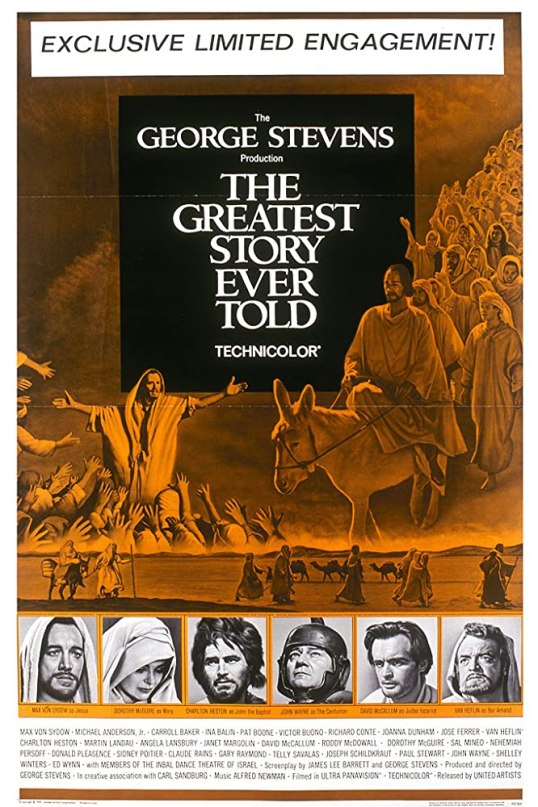
Film Review: The Greatest Story Ever Told (dir by George Stevens)


The 1965 biblical epic, The Greatest Story Ever Told, tells the story of the life of Jesus, from the Nativity to the Ascension.  It’s probably the most complete telling of the story that you’ll ever find.  It’s hard to think of a single details that’s left out and, as a result, the film has a four hour running time.  Whether you’re a believer or not, that’s a really long time to watch a reverent film that doesn’t even feature the campy excesses of something like The Ten Commandments.

(There’s actually several different version of The Greatest Story Ever Told floating around.  There’s a version that’s a little over two hours.  There’s a version that’s close to four hours.  Reportedly, the uncut version of the film ran for four hour and 20 minutes.)

Max von Sydow plays Jesus.  On the one hand, that seems like that should work because Max von Sydow was a great actor who gave off an otherworldly air.  On the other hand, it totally doesn’t work because von Sydow gives an oddly detached performance.  The Greatest Story Ever Told was von Sydow’s first American film and, at no point, does he seem particularly happy about being involved with it.  von Sydow is a very cerebral and rather reserved Jesus, one who makes his points without a hint of passion or charisma.  When he’s being friendly, he offers up a half-smile.  When he has to rebuke his disciples for their doubt, he sounds more annoyed than anything else.  He’s Jesus if Jesus was a community college philosophy professor.

The rest of the huge cast is populated with familiar faces.  The Greatest Story Ever Told takes the all-star approach to heart and, as a result, even the minor roles are played by actors who will be familiar to anyone who has spent more than a few hours watching TCM.  Many of them are on screen for only a few seconds, which makes their presence all the more distracting.  Sidney Poitier shows up as Simon of Cyrene.  Pat Boone is an angel.  Roddy McDowall is Matthew and Sal Mineo is Uriah and John Wayne shows up as a centurion and delivers his one line in his trademark drawl.

A few of the actors do manage to stand out and make a good impression.  Telly Savalas is a credible Pilate, playing him as being neither smug nor overly sympathetic but instead as a bureaucrat who can’t understand why he’s being forced to deal with all of this.  Charlton Heston has just the right intensity for the role of John the Baptist while Jose Ferrer is properly sleazy as Herod.  In the role Judas, David McCallum looks at the world through suspicious eyes and does little to disguise his irritation with the rest of the world.  The Greatest Story Ever Told does not sentimentalize Judas or his role in Jesus’s arrest.  For the most part, he’s just a jerk.  Finally, it’s not exactly surprising when Donald Pleasence shows up as Satan but Pleasence still gives a properly evil performance, giving all of his lines a mocking and often sarcastic bite.

The Greatest Story Ever Told was directed by George Stevens, a legitimately great director who struggles to maintain any sort of narrative momentum in this film.  Watching The Greatest Story Ever Told, it occurred to me that the best biblical films are the ones like Ben-Hur and The Robe, which both largely keep Jesus off-screen and instead focus on how his life and teachings and the reports of his resurrection effected other people.  Stevens approaches the film’s subject with such reverence that the film becomes boring and that’s something that should never happen when you’re making a film set in Judea during the Roman era.

I do have to admit that, despite all of my criticism of the film, I do actually kind of like The Greatest Story Ever Told.  It’s just such a big production that it’s hard not to be a little awed by it all.  That huge cast may be distracting but it’s still a little bit fun to sit there and go, “There’s Shelley Winters!  There’s John Wayne!  There’s Robert Blake and Martin Landau!”  That said, as far as biblical films are concerned, you’re still better off sticking with Jesus Christ Superstar.

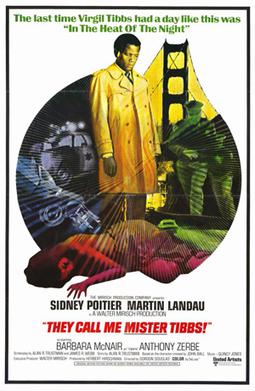
18 Days of Paranoia #13: They Call Me Mister Tibbs! (dir by Gordon Douglas)


The 1970 police procedural, They Call Me Mister Tibbs!, opens with a murder in San Francisco.

A prostitute has been found dead in a sleazy apartment building and, according to witnesses, she was visited, shortly before her death, by the Reverend Logan Sharpe (Martin Landau).  Rev. Sharpe is a prominent civic leader, an outspoken liberal who is a friend of the civil rights movement.  Sharpe is currently at the forefront of a campaign to pass a city referendum that will add a “mini city hall” to every neighborhood and will help to fight against the gentrification of San Francisco.  If Sharpe’s guilty, it will mean the death of the referendum.

Despite the fact that there’s a ton of evidence piling up against him and he kind of comes across as being a little bit creepy (he is, after all, played by Martin Landau), Rev. Sharpe insists that he’s innocent.  Yes, he’s been visiting prostitutes but he’s not a client.  No, of course not!  Instead, Sharpe explains that he’s simply counseling them and praying for their souls.  In fact, as far as Sharpe is concerned, this whole thing is just an attempt by the establishment to discredit his efforts to help the poor and underprivileged.

Heading up the investigation is a friend and supporter of Sharpe’s, Detective Virgil Tibbs (Sidney Poitier).  That may seem like a good thing for Sharpe, except for the fact that Tibbs is an honest cop and he’s not the type to let friendship stand in the way of doing a thorough investigation.  Tibbs admits that he supports Sharpe’s campaign and he wants the reverend to be innocent.  But Tibbs is all about justice.  Whether it’s teaching his son an important lesson about smoking or tracking down a potential serial killer, Virgil Tibbs is always going to do the right thing.

There are other suspects, all of whom are played by suitably sinister character actors.  Anthony Zerbe plays a criminal who lived near the prostitute.  Ed Asner plays her landlord, who may have also been her pimp.  Is Sharpe being set up by the powers that be or is Tibbs going to have to arrest a man whom he admires?

They Call Me Mister Tibbs! was the second film in which Sidney Poitier played Virgil Tibbs.  The first time he played the role was in 1967, when he co-starred with Rod Steiger in the Oscar-winning In The Heat of the Night.  In that film, Poitier was a Philadelphia cop in the deep south who had to work with a redneck sheriff.  In They Call Me Mister Tibbs!, Virgil is now working in San Francisco and he has to work the case on his own.

They Call Me Mister Tibbs! is a far more conventional film than In The Heat of the Night.  Whereas In The Heat of the Night had a wonderful sense of place and atmosphere, They Call Me Mister Tibbs! could just as easily have taken place in Los Angeles, Phoenix, or even Philadelphia.  With the exception of some slight profanity, They Call Me Mister Tibbs! feels more like a pilot for a TV show than an actual feature film.  Perhaps the biggest problem with the film is that there’s no real surprises to be found within the film.  You’ll guess who the murderer is within the first 10 minutes of the film and you’ll probably even guess how the movie will eventually end.

On the plus side, just as he did in In The Heat of the Night, Sidney Poitier brings a lot of natural authority to the role of Virgil Tibbs.  He’s actually allowed to show a sense of humor in this film, which is something that the character (understandably) couldn’t do while he was surrounded by bigots and rednecks during his previous adventure.  Virgil gets a few family scenes, where we watch him interact with his wife and his children.  The scenes feel out of place but, at the same time, Poitier plays them well.

With Sharpe attempting to get his referendum passed and the possibility that riots could break out if Sharpe is indeed guilty of murder, there’s a slight political subtext to They Call Me Mister Tibbs!  Sharpe’s argument that he was being set up by the establishment undoubtedly carried a lot of weight in 1970.  Still, this is ultimately a shallow (if adequately entertaining) film that, for the most part, is only made memorable by Poitier’s commanding performance.

Other Entries In The 18 Days Of Paranoia:

  1. The Flight That Disappeared
  2. The Humanity Bureau
  3. The Private Files of J. Edgar Hoover
  4. The Falcon and the Snowman
  5. New World Order
  6. Scandal Sheet
  7. Cuban Rebel Girls
  8. The French Connection II
  9. Blunt: The Fourth Man 
  10. The Quiller Memorandum
  11. Betrayed
  12. Best Seller

Black Gunn (1972, directed by Robert Hartford-Davis)


A war has broken out in Los Angeles.

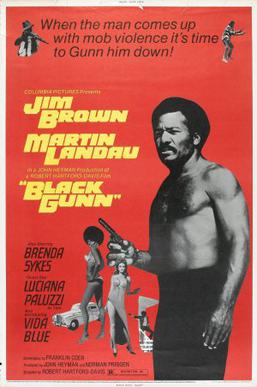
The Black Action Group (B.A.G.) has robbed a Mafia bookmaking operation.  The Mafia, led by used car dealer Russ Capelli (Martin Landau, in his slumming it years), is less concerned with the money as they are with the fact that one of the militants, a Vietnam vet named Scott Gunn (Herbert Jefferson, Jr.), has also stolen a set of ledgers that could reveal every detail of their organization.  Capelli sends the psychotic Ray Kriley (Bruce Glover, father of Crispin) on a mission to track down Scott and kill him.

What the Mafia didn’t count on is that Scott’s older brother, Gunn (Jim Brown), is the owner of Los Angeles’s hottest nightclub.  When Scott approaches his brother, Gun tells him that he doesn’t care about the B.A.G. or any of their politics.  Still, Gunn allows Scott to stash the ledgers at his club and to hide out at his place.  When Scott still ends up getting murdered by Kriley, Gunn sets out to get revenge.

For the most part, Black Gunn is a standard blaxploitation movie with all of the usual elements, a cool nightclub, the mob, black militants,an anti-drug scene and a speech about why it’s important to not sell out to the man, and a hero played by an actor who may not have been able to show much emotion but who still radiated coolness.  Not surprisingly, Jim Brown is the main attraction here and he delivers everything that his fans have come to expect from him.  Blaxploitation regulars Bernie Case and Brenda Sykes also appear in the film.  Casey plays the head of B.A.G. while Sykes is wasted in a one-note role as Gunn’s girlfriend.  Among the villains, it’s fun to watch the glamorous Luciana Paluzzi plays a gangster’s niece and Bruce Glover is just weird enough to make Kriley interesting.  Though Martin Landau would end his career with a deserved reputation for being one of America’s greatest character actors, he spent most of the 70s sleepwalking through roles in low-budget action and horror films and his performance in Black Gunn is no different.  Having Capelli be both a car salesman and a gangster is a nice touch but otherwise, he’s just not that interesting of a character and Landau is only present to get a paycheck.

Black Gunn has some slow spots but the final shoot-out between the militants and the gangsters is exciting and so brutal that it will be probably take even the most jaded blaxploitation fan by surprise.  Black Gunn is hardly a classic but, like its hero, it gets the job done.