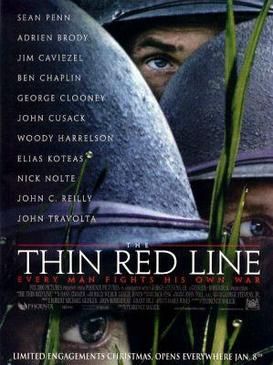
Lisa Marie Reviews An Oscar Nominee: The Thin Red Line (dir by Terrence Malick)


Based on a novel by James Jones (and technically, a sequel of sorts to From Here To Eternity), 1998’s The Thin Red Line is one of those Best Picture nominees that people seem to either love or hate.

Those who love it point out that the film is visually stunning and that director Terrence Malick takes a unique approach to portraying both the Battle of Guadalcanal and war in general.  Whereas Steven Spielberg’s Saving Private Ryan told a rather traditional story about the tragedy of war (albeit with much more blood than previous World War II films), The Thin Red Line used the war as a way to consider the innocence of nature and the corrupting influence of mankind.  “It’s all about property,” one shell-shocked soldier shouts in the middle of a battle and later, as soldiers die in the tall green grass of the film’s island setting, a baby bird hatches out of an egg.  Malick’s film may have been an adaptation of James Jones’s novel but its concerns were all pure Malick, right down to the philosophical voice-overs that were heard throughout the film.

Those who dislike the film point out that it moves at a very deliberate pace and that we don’t really learn much about the characters that the film follows.  In fact, with everyone wearing helmets and running through the overgrown grass, it’s often difficult to tell who is who.  (One gets the feeling that deliberate on Malick’s point.)  They complain that the story is difficult to follow.  They point out that the parade of star cameos can be distracting.  And they also complain that infantrymen who are constantly having to look out for enemy snipers would not necessarily be having an inner debate about the spirituality of nature.

I will agree that the cameos can be distracting.  John Cusack, for example, pops up out of nowhere, plays a major role for a few minutes, and then vanishes from the film.  The sight of John Travolta playing an admiral is also a bit distracting, if just because Travolta’s mustache makes him look a bit goofy.  George Clooney appears towards the end of the film and delivers a somewhat patronizing lecture to the men under his command.  Though his role was apparently meant to be much larger, Adrien Brody ends up two lines of dialogue and eleven minutes of screentime in the film’s final cut.

That said, The Thin Red Line works for me.  The film is not meant to be a traditional war film and it’s not necessarily meant to be a realistic recreation of the Battle of Guadalcanal.  Instead, it’s a film that plays out like a dream and, when viewed a dream, the philosophical voice overs and the scenes of eerie beauty all make sense.  Like the majority of Malick’s films, The Thin Red Line is ultimately a visual poem.  The plot is far less important than how the film is put together.  It’s a film that immerses you in its world.  Even the seeming randomness of the film’s battles and deaths fits together in a definite patten.  It’s a Malick film.  It’s not for everyone but those who are attuned to Malick’s wavelength will appreciate it even if they don’t understand it.

And while Malick does definitely put an emphasis on the visuals, he still gets some good performances out of his cast.  Nick Nolte is chilling as the frustrated officer who has no hesitation about ordering his men to go on a suicide mission.  Elias Koteas is genuinely moving as the captain whose military career is ultimately sabotaged by his kind nature.  Sean Penn is surprisingly convincing as a cynical sergeant while Jim Caviezel (playing the closest thing the film has to a main character) gets a head start on humanizing messianic characters by playing the most philosophical of the soldiers.  Ben Chaplin spends most of his time worrying about his wife back home and his fantasies give us a glimpse of what’s going on in America while its soldiers fight and die overseas.

The Thin Red Line was the first of Terrence Malick’s films to be nominated for Best Picture and it was one of three World War II films to be nominated that year.  However, it lost to Shakespeare In Love.
VAMPIRES (1998) – Happy Birthday, John Carpenter!


In celebration of the 77th birthday of the great Director John Carpenter, I decided to watch his 1998 film VAMPIRES, starring one of my favorite actors in James Woods. I specifically remember the first time I ever read that this movie was being made and that it would star Woods. It was 1996, and I had just been hired to work for a company called Acxiom Corporation in Conway, Arkansas. It was at this job that I first had access to this new thing called the Worldwide Web. As far as I know, it was the first time I had ever looked at the internet. Of course, I immediately started completing searches on some of my favorite actors, including James Woods, when I came across VAMPIRES as a movie currently in production. These were the first times in my life that I was able to find out about new film projects without looking in a magazine or watching shows like Entertainment Tonight.

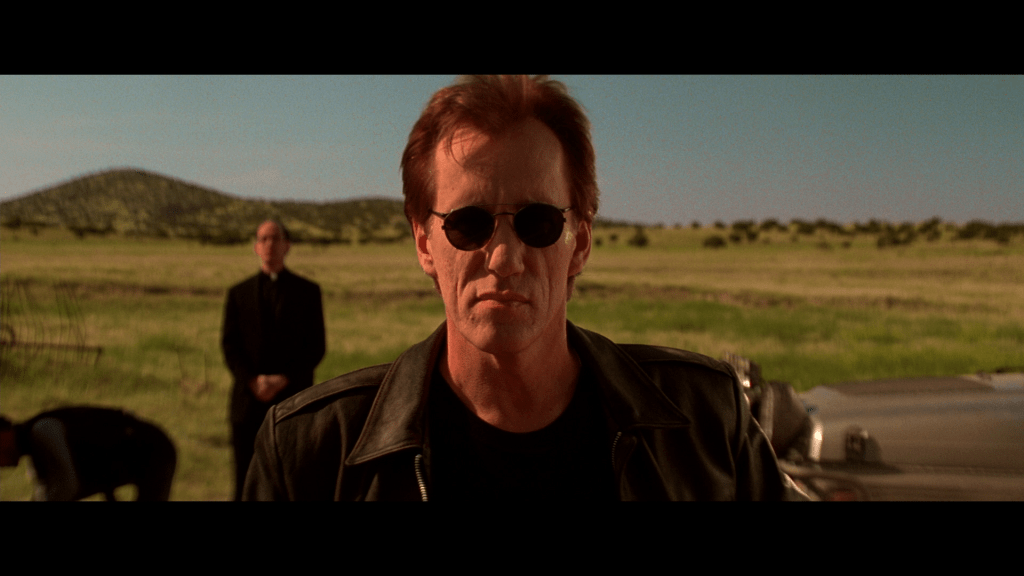
In VAMPIRES, James Woods stars as Jack Crow, the leader of team of vampire hunters who get their funding from the Vatican. We’re introduced to the team when they go into a house in New Mexico and proceed to impale and burn a nest of vampires. While the rest of the team celebrates the mission that night in a hotel filled alcohol, drugs, and whores, Jack can’t escape the feeling that something isn’t right, as he doesn’t believe they got the “master vampire” of the group. Unfortunately, Jack is right to worry. As they’re partying, the master vampire Valek (Thomas Ian Griffith) interrupts the fun and proceeds to kill everyone there, with the exception of Jack, his partner Tony (Daniel Baldwin), and Katrina (Sheryl Lee), a prostitute he decided to just bite on. Valek isn’t just a regular old master vampire, either. As it turns out, he’s the original vampire, and he’s on a quest to find the Berziers Cross, an ancient Catholic relic, that will allow him and other vampires to walk in the daylight. Against this backdrop, Jack, Tony, and a priest named Adam (Tim Guinee) use Katrina, who now has a psychic link with Valek, to try to kill the ultimate master vampire Valek, his cleric accomplice Cardinal Alba (Maximillian Schell), and just hopefully, save mankind in the process!

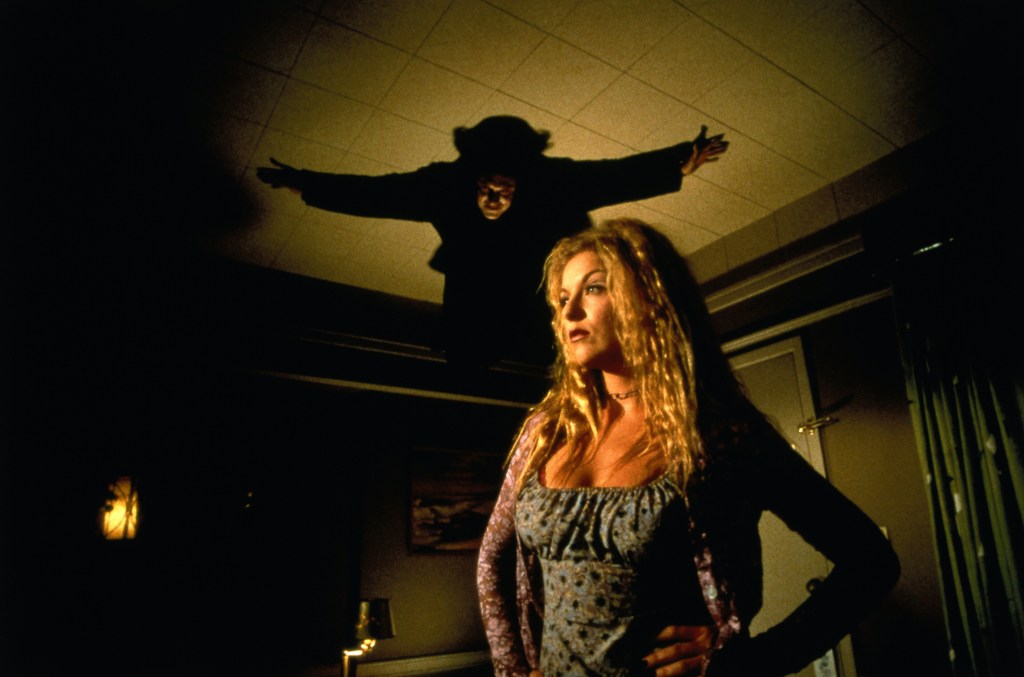
I know that VAMPIRES is not the most well-known or beloved John Carpenter film. He’s done so many great movies, but VAMPIRES is special to me as it was the first of his films that I ever saw in the movie theater. And the opening 30 minutes of the film is as badass as it gets. Carpenter is a master of the set-up. There’s lots of slow motion as Carpenter’s guitar riffs rock the soundtrack and the camera moves in on James Woods, with his cool sunglasses and black leather jacket, just before his team goes in and destroys a vampire nest at the beginning of the film. I also think the set-up of Thomas Ian Griffith as Valek is awesome, as he strolls up to the hotel room while the vampire hunters celebrate, completely unaware of the carnage about to befall them. Griffith has never looked cooler than he did in his long black coat and long hair, both blowing in the wind. These were awesome moments that illustrated Carpenter’s ability to project a sense of visual cool and power that I was mesmerized with. I wanted to see what happens next. And as a 25-year-old man at the time of VAMPIRE’s Halloween release in 1998, I also gladly admit that I really enjoyed the beauty of a 31-year-old Sheryl Lee. I would have definitely done everything I could do to save and protect her. The remainder of the film may have not been able to keep the same momentum as those first 30 minutes, but it’s a solid, enjoyable film, buoyed by the intense performance of Woods!

Vampires (1998) Directed by John Carpenter Shown: Thomas Ian Griffith, Sheryl Lee

There are several items of trivia that interest me about VAMPIRES:

  1. John Carpenter had a good working relationship with James Woods on the set, but they had a deal: Carpenter could film one scene as it is written, and he would film another scene in which Woods was allowed to improvise. The deal worked great, and Carpenter found that many of Woods’ improvised scenes were brilliant.
  2. VAMPIRES was John Carpenter’s only successful film of the 1990’s. Its opening weekend box office of $9.1 million is the highest of any John Carpenter film.
  3. The screenplay for VAMPIRES is credited to Don Jakoby. Jakoby has some good writing credits, including the Roy Scheider film BLUE THUNDER (1983), the Cannon Films “classic” LIFEFORCE (1985), and the Spielberg produced ARACHNAPHOBIA (1990). The reason Don Jakoby interests me, however, is the fact that he had his name removed from the film I’ve seen more than any other, that being DEATH WISH 3 (1985), starring Charles Bronson. Even though Jakoby provided the script for DEATH WISH 3, due to the drastic number of changes, Jakoby insisted his name be removed. The script is credited to the fake “Michael Edmonds” instead.
  4. As I was typing up my thoughts on VAMPIRES today, I learned of the death of the director David Lynch. This brings special poignancy to the fact that John Carpenter cast Sheryl Lee after seeing her on Lynch’s T.V. series TWIN PEAKS (1990).
  5. Frank Darabont, who directed one of the great films of all time, THE SHAWSHANK REDEMPTION (1994), has a cameo as “Man with Buick.” Fairly early in the film, after Crow, Montoya, and Katrina crash their truck escaping the hotel massacre, they encounter the man at a gas station and forcefully take the Buick. This is a strong sign of just how respected John Carpenter was by other great filmmakers at the time.

John Carpenter has directed some absolute classics like ASSAULT ON PRECINCT 13 (1976), HALLOWEEN (1978), ESCAPE FROM NEW YORK (1981), THE THING (1982), and BIG TROUBLE IN LITTLE CHINA (1986). There’s no wrong way to celebrate a man who has brought such joy into our lives through his work. Today, I’m just thankful that he has been given the opportunity to share his talents with us!   

LAST OF THE DOGMEN – One of my favorites!


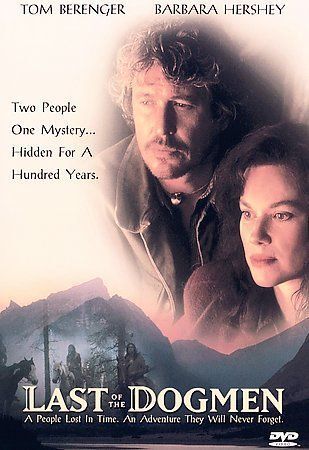
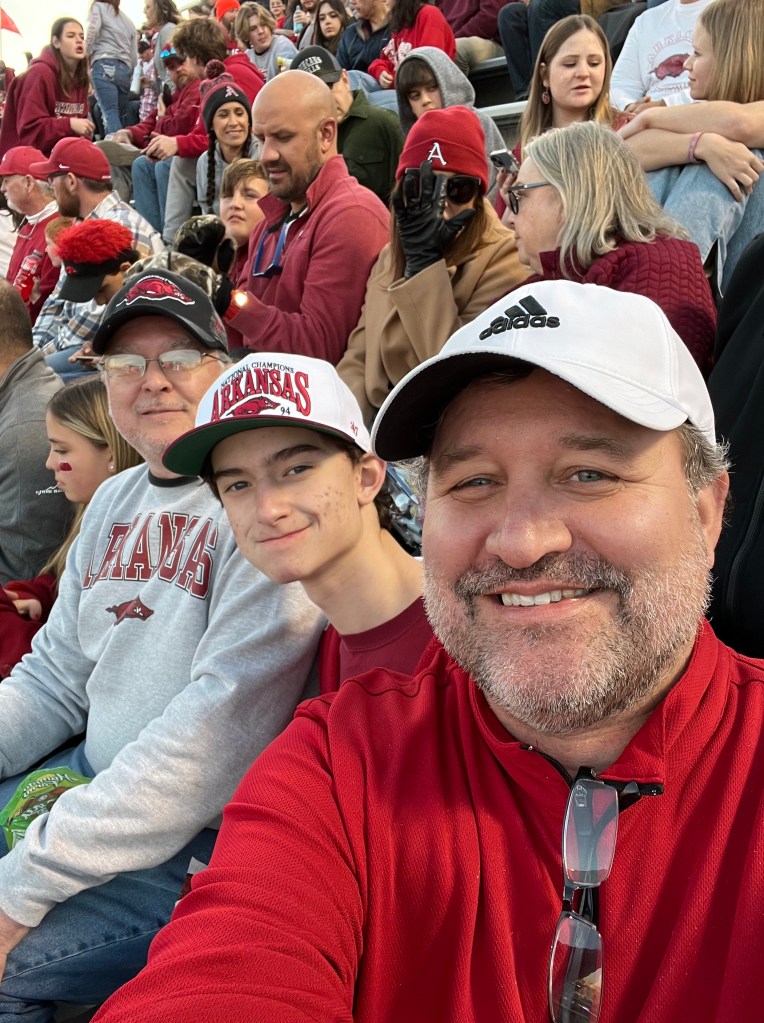
I don’t hear a lot about LAST OF THE DOGMEN, the 1995 modern day western starring Tom Berenger, Barbara Hershey and Kurtwood Smith. I love the movie, and I have for years. My buddy Chuck, his son Carter, and I recently drove up the hill to Fayetteville to watch the Arkansas Razorbacks play football. We had a great day! We ate at the Catfish Hole for lunch and then watched the Razorbacks beat Louisiana Tech 35-14. It was fun (See picture below for the happy crew). We had about a 3-hour drive home so we were talking about things we both love, like the Andy Griffith Show. Out of nowhere, Chuck said, “Do you want to know a movie I love? It’s called the LAST OF THE DOGMEN.” It was the last thing I was expecting to hear. I also love the movie. We talked about it and had a good time, but I made a mental note to watch it again soon. So here we are. 

LAST OF THE DOGMEN opens with Sheriff Deegan (Kurtwood Smith) trying to find three escaped convicts in Northwest Montana. Deegan calls in the best tracker he knows, Lewis Gates (Tom Berenger), to go into the mountains to find the convicts. The two men have a history as Gates was married to the sheriff’s daughter, and the daughter died. The sheriff clearly doesn’t like Gates and blames him for his daughter’s death, but he knows he’s the man for the job. With Gates and his genius dog Zip right on their tails, the convicts are mysteriously killed by a group of men on horses who shoot them with arrows. Gates see the men riding off through a fog and is convinced they are Indians. He ends up seeking out the help of Native American historian Lillian Sloan (Barbara Hershey) to help him understand what he may have seen. He’s able to convince Lillian to ride into the mountains with him because he needs a translator if he actually finds anyone, and the two head off into the Oxbow. After a week of roughing it, they’re about to give up when they suddenly find themselves surrounded by the Indian dog soldiers. They’re taken as prisoners to the Indian camp, where the leader of the dog soldiers, Yellow Wolf, has a sick son. It seems he was shot by one of the escaped prisoners. Gates heads back to town to get penicillin for the son, which ultimately saves his life. Gates and Lillian spend some time getting to know and respect this isolated Cheyenne tribe. Meanwhile, Sheriff Deegan, unable to forgive Gates for the death of his daughter, gathers a group of men and they head into the Oxbow to find Gates. Will the Indians be able to have peace and live their lives like they did in the 19th century, or will they be discovered and forced to live out the fates of their ancestors? Well, if you haven’t seen it, just watch and enjoy!

As I said earlier, I’m a big fan of LAST OF THE DOGMEN. I was initially interested in the movie because I like Tom Berenger as a leading man. His SHOOT TO KILL with Sidney Poitier is a big time personal favorite. I also like him in PLATOON, SOMEONE TO WATCH OVER ME, BETRAYED, MAJOR LEAGUE, SHATTERED, SNIPER and THE SUBSTITUTE. He had been a big sex symbol earlier in his career. By the time of this film, he’s getting a little too old and heavy to be a sex symbol. In THE LAST OF THE DOGMEN, he’s actually very funny, and I really enjoy watching him have fun on screen. I’ll also go ahead and say that I’ve never been a huge fan of the actress Barbara Hershey, but she keeps showing up in movies I love. Outside of this, she’s also in HOOSIERS, and it’s one of my favorites. While there’s something about her I don’t really like, she is pretty good, and I do like her chemistry with Berenger. When they finally share a big smooch towards the end of the film, I liked it. And what can I say about Gates’ Australian cattle dog Zip? He’s an integral part of the story and saves Gates & Lillian’s asses on multiple occasions. At one point in the story, Lillian says “it’s disconcerting to know that the smartest member in our expedition is a dog!” It’s true!

I think the thing I like the most about the LAST OF THE DOGMEN is the idea that a group of Cheyenne Indians could be living out their lives the way they did a century ago. Something about that is romantic and magical to me, and it gave me an emotional interest in the film. Isn’t that why we really love movies? The best ones can reach into our souls and find something that’s valuable to us. I love the idea of Cheyenne Indians living out their heritage and protecting it at all costs. There’s something simple and meaningful about that. Director Tab Hunter really leans into this emotional truth. It’s the only film he would direct, and it seems to share the one message that meant the most to him. Most of us would give anything to have an opportunity to share with the world who we really are. Hunter got that opportunity and shared this movie. That’s pretty cool to me.

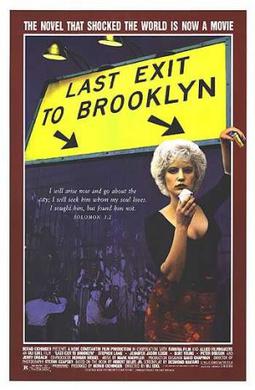
Icarus File No. 14: Last Exit To Brooklyn (dir by Uli Edel)


Welcome to Brooklyn!

The year is 1952 and one neighborhood in Brooklyn is on the verge of exploding.

A thug named Vinnie (Peter Dobson) holds court at a local bar.  (His associates include the moronic Sal, who is played by a very young Stephen Baldwin.)  Some nights, Vinnie and his associates mug people for money.  Sometimes, they just attack people for fun.

A strike at the local factory has entered its sixth month, with management showing no sign of compromising and Boyce (Jerry Orbach), the head of the union, showing little concern for the men who are now struggling to feed their families.  The local shop steward, Harry Black (Stephen Lang), is a self-important braggart who never stops talking about how he’s the one leading the strike.  At home, Harry ignores his wife, with the exception of a violent quickie.  On the streets, Harry embezzles money from the union and uses it to try to impress the men that he would rather be spending his time with.  But even the men who Harry considers to be friends quickly turn on him when he is at his most pathetic.

Big Joe (Burt Young) is a proud union member who is shocked to discover that his teenage daughter (Ricki Lake) is 8-months pregnant.  Despite being out-of-work and not caring much for Tommy (John Costelloe), Joe puts together the wedding that appears to be the social event of a shabby season.  But even at the reception, violence lurks below the surface.

Georgette (Alexis Arquette) is a transgender prostitute who loves Vinnie, even after he and his idiot friends stab her in the leg while playing with a knife.  Beaten at home by her homophobic brother (Christopher Murney), Georgette sinks into drug addiction.

Tralala (Jennifer Jason Leigh) is an amoral prostitute, one who specializes in picking up military men and then arranging from them to be mugged by Vinnie and his gang.  Sick of being exploited by Vinnie, Tralala heads to Manhattan and meets Steve (Frank Military), an earnest soldier from Idaho.  For the first time, Tralala is treated decently by a man but Steve is set to ship out to Korea in a few days and, as he continually points out, there’s a chance that he might not return.  For all of the happiness she finds in Manhattan, Tralala is continually drawn back to her self-destructive life in Brooklyn.

First released in 1989 and directed by Uli Edel (who directed another film about desperation, Christiane F.), Last Exit To Brooklyn is based on a controversial novel by Hubert Selby, Jr.  In fact, it was so controversial that the novel was banned in several countries and, for a while, was listed as being obscene by the U.S. Post Office.  I read the novel in the college and it is indeed a dark and depressing piece of work, one that offers up very little hope for the future.  It’s also brilliantly written, one that sucks you into its hopeless world and holds your interest no matter how bleak the stories may be.  Due to its reputation, it took over 20 years for Last Exit to Brooklyn to be adapted into a film.

The film is actually a bit more positive than the book.  One character who appears to die in the book manages to survive in the film.  The wedding subplot was a minor moment in the book but, in the film, it’s made into a major event and provides some mild comedic relief.  That said, the film is definitely dark.  Almost every character is greedy and angry and those who aren’t are victimized by everyone else.  Unfortunately, the film lacks the power of Selby’s pungent prose.  As a writer, Selby held your attention even when you want to put the book away.  When it comes to the film, the lack of Selby’s voice makes it very easy to stop caring about the characters or their stories.  Even with the attempts to lighten up the story, the film is still so dark that it’s easy to stop caring.  The non-stop bleakness starts to feel like a bit of an affectation.

And that’s a shame because there are some brilliant moments and some brilliant performances to be found in Last Exit To Brooklyn.  An extended sequence where the police fight the striking workers is wonderfully directed, with the police becoming an invading army and the men on strike being transformed from just factory workers to rebels.  The scene where Boyce informs Harry that he’s not as important as he thinks is wonderfully acted by both Jerry Orbach and Stephen Lang.  As Tralala, Jennifer Jason Leigh gives a raw and powerful performance, whether she’s shyly accepting Steve’s kindness or drunkenly exposing herself to a bar full of lowlifes.  In many ways, Tralala is the most tragic of all the characters to be found in Last Exit to Brooklyn.  She’s tough.  She’s angry.  But, in the end, she’s ultimately the victim of men who are too stupid to understand anything other than aggression.  The neighborhood applauds her when she confidently walks past a line of cops and strikebreakers but the same people who cheered for her later try to destroy her.

The film ends on an ambiguous note, with a peace that feels very temporary.  The message seems to be that men are at their worst when they’re bored so perhaps it’s best to keep them busy, whether with a job or perhaps a wedding.  It’s a flawed film but it sticks with you.

Previous Icarus Files:

  1. Cloud Atlas
  2. Maximum Overdrive
  3. Glass
  4. Captive State
  5. Mother!
  6. The Man Who Killed Don Quixote
  7. Last Days
  8. Plan 9 From Outer Space
  9. The Last Movie
  10. 88
  11. The Bonfire of the Vanities
  12. Birdemic
  13. Birdemic 2: The Resurrection 

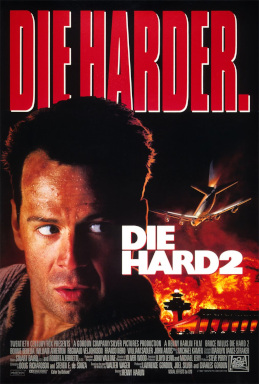
Holiday Film Review: Die Hard 2: Die Harder (dir by Renny Harlin)


During 1990’s Die Hard 2, John McClane (Bruce Willis) asks himself, “How can the same shit happen to the same person twice?” and he does have a point.

I mean, consider the situation.  In 1988, McClane spent his Christmas sneaking around a skyscraper and saving his wife from a group of sadistic mercenaries.  Two years later, John McClane spends his Christmas sneaking around an airport and saving his wife from a group of sadistic mercenaries.

There are a few differences of course.  In 1988, the mercenaries were only interested in stealing as much money as they could and each mercenary had his own properly ghoulish personality.  In 1990, the mercenaries are really more of a cult, led by the fanatical Col. Stuart (William Sadler).  And, along with trying to make some money, they are also trying to free General Ramon Esperanza (Franco Nero), a Central American drug lord and former CIA asset.  Despite the fact that the mercenaries are played by familiar actors (like Robert Patrick, John Leguizamo, Tony Ganois, and Vondie Curtis-Hall), none of them are quite as memorable as the henchmen that Alan Rickman commanded in the first film.  And while Sadler has charisma and makes a big impression during his first scene, his character is nowhere near as interesting or entertaining as Hans Gruber.  Franco Nero, it must be said, is as dashing as ever.  He really seems to be having fun in this movie.

A lot more people die in Die Hard 2 than died in the first Die Hard and the majority of them are innocent bystanders.  This isn’t like the first film, where Harry Ellis died because his coke-addled mind led him to believe that he could outsmart Gruber.  The victims in Die Hard 2 include a friendly church caretaker and over 200 passengers of an airplane that Stuart tricks into crashing on an airport runway.  The scene where the plane crashes remains disturbing no matter how many times that you see it and it truly makes you hate Colonel Stuart.  When the plane crashes, despite McClane’s futile efforts to warn the pilots, McClane sobs and it’s a powerful scene because it’s the first scene in which McClane has not had a quip or a one-liner ready to go.  In this scene, McClane fails to save the day and, for a few minutes, he’s helpless.  I usually end up crying with McClane.  Today, those tears are also a reminder of what a good actor Bruce Willis truly could be whenever he let down his defenses and allowed himself to be vulnerable on screen.

Die Hard 2 is usually dismissed as not being as good as the first movie and …. well, that’s correct.  It’s not as good but then again, few actions films are.  There’s a reason why Die Hard continues to be held in such high regard.  That said, Die Hard 2 is not bad.  The stakes are a bit higher and the action scenes a bit more elaborate, as you would expect from a film directed by Renny Harlin.  Bruce Willis plays McClane with the blue collar swagger that made his such an awesome hero in the first film.  Bonnie Bedelia and William Atherton also return from the first film and Atherton once again gets his comeuppance in a crowd-pleasing moment.  The cast is full of character actors, all of whom get a chance to make an impression.  Dennis Franz is the profane head of security who eventually turns out to be not such a bad guy.  John Amos is the major who eventually turns out to be not such a good guy.  Colm Meaney has a few heart-breaking moments as the pilot of the doomed airplane.  My favorite supporting performance is given by Fred Thompson, bringing his quiet authority to the role of tough but fair-minded Air Traffic Control director.  Watching Die Hard 2, it does feel as if the viewer has been dropped in the middle of these people’s lives.  Everyone seems real.  No one seems like a mere plot device.

Is Die Hard a Christmas movie?  You bet it is!  But so is Die Hard 2 and it’s not a bad one.

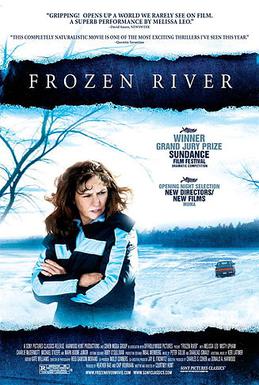
Ghosts of Sundance Past #4: Frozen River (dir by Courtney Hunt)


The 2008 film, Frozen River, tells the story of two desperate mothers.

Ray Eddy (Melissa Leo) has spent two years working as a clerk in a discount store and still cannot convince her boss to promote her to full time because, in his opinion, she’s just not “long-term employee” material.  Ray’s husband, a compulsive gambler, has vanished and taken the majority of their money with him.  Ray and her two sons live in a mobile home, where they subsist on a diet of popcorn and tang.  Every few days, a man comes by and threatens to repossess the home and leave Ray and her children homeless.  Ray always manages to talk him out of it.  If there’s anything that Ray can do, it’s talk her way out of trouble.

Lila Littlewolf (Misty Upham) is a Native American who lives on the St. Regis Mohawk Reservation and who works at a bingo parlor.  Because Lila is struggling financially and often resorts to illegal means to make ends meet, Lila’s mother-in-law has taken away her infant son.  If Ray’s defining characteristic seems to be her ability to talk her way out of trouble, Lila is quiet and often seems to be hiding from the world.

One day, while Ray is out looking for her husband, she spots Lila driving his car.  Lila claims that she found the car, sitting deserted at a gas station.  (It’s never established whether Lila is telling the truth or if she actually stole the car.)  Ray discovers that Lila makes her money by smuggling undocumented immigrants over the Canadian border and Ray soon joins her.

Frozen River takes place a few days before Christmas in Upstate New York.  There’s snow on the ground and a Christmas tree in the mobile home but there’s little holiday cheer to be found in the film.  In order to smuggle people across the border, Ray and Lila take them across the frozen St. Lawrence River and, just like the ice on the river, Ray’s occasional moments of happiness seem to be destined to only be temporary.  Just as the ice is eventually going to break, so is Ray and Lila’s operation.  One gets the feeling that it’s only a matter of time.  Ray and Lila almost immediately attract the attention of the stern State Trooper Finnerty (Michael O’Keefe).  Significantly , Finnerty’s suspicions are initially limited to only Lila and he even tries to warn Ray that she’s hanging out with a known smuggler.

Frozen River is dominated by two strong lead performances.  Melissa Leo is the one who was nominated for best actress but I actually think that Misty Upham (who tragically died a few years after this film was released) is even better.  Leo is the one who gets the big scenes and who gets to deliver all of the best lines and she does a great job with a richly written character.  Upham, meanwhile, has to largely create her character in silence.  She rarely speaks but, when she does, she makes it count.  When Ray and Lila get pulled over by Finnerty and Lila snaps that Ray will be okay because she’s white, the way Upham delivers that one line tells you so much about what has led her to be in her current situation.  When you see Upham in the background, watching Ray or Finnerty or anyone else who is standing in the way of her seeing her baby, her glare is worth a thousand monologues.  Both Leo and Upham are so good that they hold your interest even when the film’s script and direction veers towards the heavy-handed.  (Director Courtney Hunt, for the most part, does a good job of keeping things credible but it’s hard not to roll your eyes a bit when a duffel bag being carried by two refugees turns out to not contain, as Ray originally suspects, explosives but a baby instead.)

Frozen River was a hit at the 2008 Sundance Film Festival, where it won the U.S. Dramatic Grand Jury Prize.  Leo went on to receive an Oscar nomination for Best Actress, though she lost to Kate Winslet in The Reader.

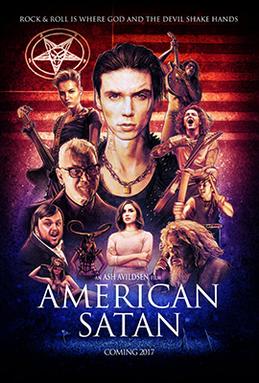
The Dirt On The Relentless: American Satan (2017, directed by Ash Avildsen)


The Relentless are the biggest band in the world, even though their music sounds like it belongs in the 80s.  Led by charismatic singer Johnny Faust (Andy Biersack), the Relentless have just released their debut album, American Satan.  Now, they’re touring the country, doing every drug they can get their hands on and every groupie that stops by their hotel.  The moral guardians say that The Relentless are a bad influence and are leading their children into Satanism.  For once, the moral guardians are right.  Back when they were just a struggling band in Los Angeles, The Relentless made a deal with Satan (Malcolm McDowell).  All they had to do was sacrifice the lead singer of a rival band (played by former teen idol Drake Bell) and all their dreams would come true.  However, if Johnny Faust had bothered to study his namesake, he’d know better than to make a deal with the devil.
The best thing about American Satan is that it was obviously made by people who know the music industry.  All of the details at the start of the film, with the Relentless struggling to get noticed and having to hit the streets and sell tickets to their own show, felt true.  It helps that most of the members of the Relentless were played by actual musicians.  What they lacked in acting talent, they made up for with authenticity.  The music industry is a tough business to break into, regardless of how good or bad your band is.  After watching Johnny and the Relentless struggle with crooked promoters and unsympathetic label owners, it was believable that they would consider signing a deal with the devil.

Much like the band, the movie lost its way after the contract with the devil was signed and official.  The rioting, the groupies, and the drugs were all too predictable and the movie just became The Dirt with Satan replacing Ozzy.  American Satan seems to be building up to an epic conclusion but it never seals the deal.  Instead, it just ends with a whimper, as if no one was sure where the story was supposed to be heading.  Still, any movie that finds roles for Malcolm McDowell, Bill Duke, Goldberg, and Denise Richards can’t be all bad.

At its worse, American Satan is an anti-climatic take on the Faust legend.  At its best, its Tipper Gore’s worst nightmare.

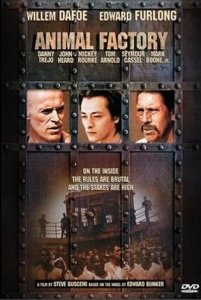
A Movie A Day #67: Animal Factory (2000, directed by Steve Buscemi)


Edward Furlong is Ron Decker, a spoiled 18 year-old from a rich family who is arrested and sent to prison when he’s caught with a small amount of marijuana.  Being younger and smaller than the other prisoners, Ron is soon being targeted by everyone from the prison’s Puerto Rican gang to the sadistic Buck Rowan (Tom Arnold).  Fortunately, for Ron, prison veteran Earl Copen (Williem DaFoe) takes him under his wing and provides him with protection.  Earl is the philosopher-king of the prison.  As he likes to put it, “This is my prison, after all.”  If he can stay out of trouble, Ron has a chance to get out early but, with Buck stalking him, that’s not going to be easy.
Based on a novel by ex-con Edward Bunker, Animal Factory was the second film to be directed by Bunker’s Reservoir Dogs co-stars, Steve Buscemi.  Though it was overlooked at the time, Animal Factory is a minor masterpiece.  Taking a low key approach, Buscemi emphasizes the monotony of prison life just as much as the sudden bursts of violence and shows why someone like Ron Decker can go into prison as an innocent and come out as an animal.  DaFoe and Furlong give two of their best performances as Earl and Ron while a cast of familiar faces — Danny Trejo, Mickey Rourke, Chris Bauer, Mark Boone Junior — make up the prison’s population.  Most surprising of all is Tom Arnold, giving Animal Factory‘s best performance as the prison’s most dangerous predator.

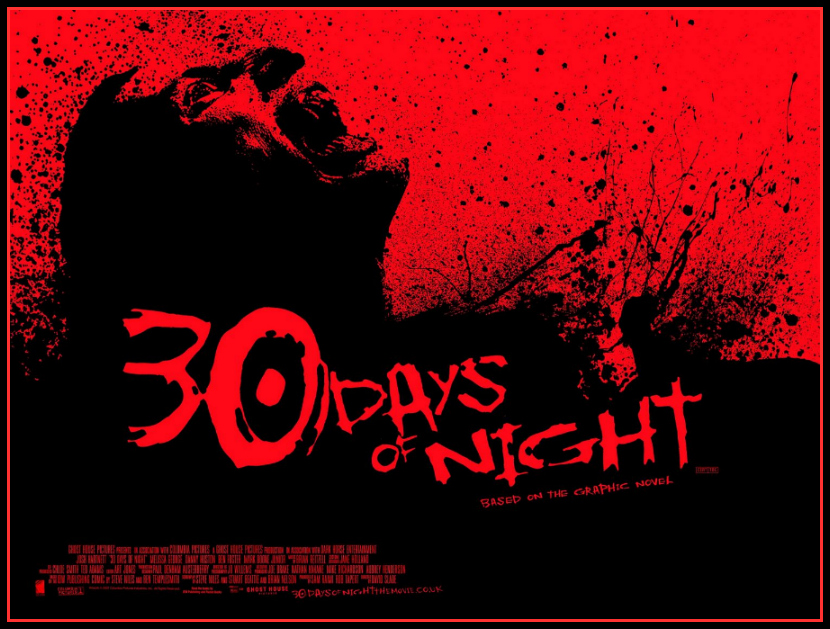
Quickie Review: 30 Days of Night (dir. by David Slade)


30 Days of Night is pretty much a siege movie with heavy elements of horror and gore. Siege movies always succeed and fail depending on whether the tension and dread built up from the beginning of the film suspends the audience’s disbelief. Siege films like The Thing and Romero’s Living Dead trilogy works well because right from the get-go we see the tension build not just on the location the cast are put in but within the besieged survivors as well. Survival becomes that much more difficult due to human frailties and an inability to work together bringing the whole group down. The monsters outside are bad enough, but sometimes it’s the survivors themselves who must share the blame.

David Slade’s (director of the excellent Hard Candy) movie does a very good job of bringing the initial tension and dread the comic brought to life in its first chapter. The story takes place in Barrow, Alaska which happens to be located within the Arctic Circle. This location allows it a very peculiar yearly event of having pitch-black night which lasts for a period of an entire month. The movie begins just as the town of Barrow prepares for this month-long prolonged night. Most of the town decide to move down south for the month where the night doesn’t last as long, but enough stay in Barrow to give it a semblance of life and activity.

The build-up of the characters in 30 Days of Night marks one of the weaknesses in the film. There’s barely much characterization in distinguishing one Barrow, Alaskan from another. The lack in character development from all the characters whether human or vampire doesn’t invest the film with anyone we want to see make it out through the night and into dawn. Even Danny Huston, a very underrated and overly capable actor in past films fails to elevate his lead vampire character Marlowe beyond it’s genre trappings. Known only as The Stranger in the credits, Ben Foster’s Renfield-like character edges between caricature and genuine creepiness in his performance. Foster knows he’s in a genre movie and has fun with the character. He’s the only one to truly take on his character and roll with it.

I now get to the subject of the vampires themselves. Most vampire movies seem enamored in portraying the vampire as some sort of seductive, fashion-obsessed, or in the case of the Anne Rice-type anachronistic in their dress, with an unnatural immortality they either live as hedonistically as possible or bemoan their cursed existence. Then there’s the more recent trend that Twilight has brought into the vampire mythology and it’s not good.  There’s never been a true portrayal of the vampire as a pure, hunger-driven monster with an appetite to match their status as one of folklore and legend’s top-tier boogeymen. Slade goes for speed and agility in his vampires instead of hypnotizing and mesmerizing their victims. The vampires in this movie owes much to the frenetic and over-amped infecteds of 28 Days Later.

The attack itself and the subsequent siege worked well enough in the early going. There were some great overhead shots of the town’s people losing it’s fight during the initial feeding frenzy as the camera shoots the scene high overhead. The only thing Slade had a misstep in terms of the siege itself was after those first couple of nights. The rest of the 30 days didn’t seem to show enough desperation on the faces and bodies of the last few survivors. Really, the only way the audience even knew a couple weeks have passed were the caption telling them how many days into the month-long night has passed. I think with some better editing and a better sense of structure in the middle section of the movie to show time actually progressing the movie would’ve been better on so many levels.

All in all, 30 Days of Night was just good enough to be a fun watch. The premise itself was original and put a new spin on the vampire genre that has rarely been tapped. The performances were pretty average with no one bringing the whole film down with a misstep performance or raising the bar with a great one. The final product had a chance to be something great, but just ends up being a good and original take on the vampire story with elements of Night of the Living Dead.