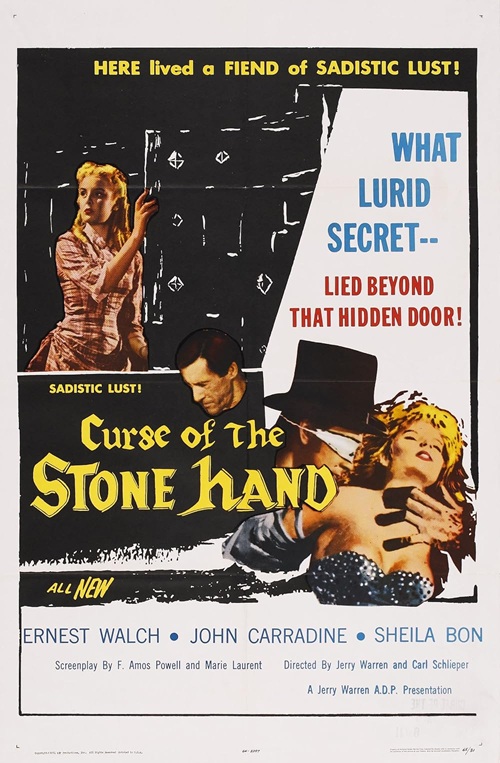
Horror Film Review: Curse of the Stone Hand (dir by Jerry Warren, Carlos Hugh Christensen, and Carlos Schlieper)


In 1965’s Curse of the Stone Hand, a dilapidated mansion sits deserted. Two men explore the grounds of the estate and one of them mentions that this house was once the finest in “Kent” but now the locals feel that it is cursed. There are mysterious stone sculptures of hands throughout the house. Some inhabitants think that the hands are the source of the curse. The first inhabitant of the house was a degenerate gambler named Robert Braun (Carlos Cores), who gambled himself into debt and, as a result, joined the Suicide Club as a way to try to win back his money. The hands, we are told, are somehow to blame for this, though it sounds like it’s more of a case of Robert needing to join Gamblers Anonymous. Once Robert was no longer in the house, the estate was claimed by another rich family. The family’s son was a sadist who had the power of hypnotism, which he used to torment his sister’s fiancé. Again, in my opinion, it’s open to debate as to whether or not the hands are to blame. To me, it seems more likely that the hypnotist is just a spoiled wastrel who wasn’t properly raised by his parents. The message seems to be less “Beware of the hands” and more “Don’t let your child grow up to be a hypnotist.”

If all of this sounds disjointed, that’s because it is. American film distributor Jerry Warren purchased two Chilean films and then edited them together to form what would become Curse of the Stone Hand. He dubbed over the dialogue to create some false connections between the two films and then he shot a few extra scenes with Katherine Victor and John Carradine. Victor and Carradine served to provide exposition, filling in the blanks that had been created by Warren’s mash-up. John Carradine’s character is especially interesting because he’s credited as being “The Old Drunk” but his character doesn’t ever appear to be drunk. Instead, he appears to just be one of the many people who works on the estate and who has opinions about the family that lives there. Carradine only has about two minutes of screen time. (Of course, Jerry Warren gave him top billing.) He’s not onscreen long enough to really give a performance that could be considered either good or bad. That said, it’s impossible not to smile whenever John Carradine shows up in one of these films. It’s always a little amusing how John Carradine effortlessly went back and forth from working with John Ford to working with people like Jerry Warren. Before there was Eric Roberts, there was John Carradine.

Curse of the Stone Hand is pretty much an incoherent film. It’s possible that the original Chilean films were good. Some of the shots do feature a bit of atmosphere. But, ultimately, it’s impossible to tell while watching this film, with its dubbed dialogue and its incomprehensible plot. That said, I’ll always have a spot in my heart for the shamelessness of filmmakers like Jerry Warren. Warren knew that you could get a lot out of a melodramatic title and a cameo from a name performer. Curse of the Stone Hand stands as a tribute to his never give up, never surrender spirit.

The TSL’s Horror Grindhouse: The House on Skull Mountain (dir by Ron Honthaner)


Before I say anything else about 1974’s The House on Skull Mountain, I just want to say how much I love the film’s poster.  Seriously, that poster is everything that you could hope for from an exploitation film print ad.  Everything about it, from the lightning to the giant skull to the mansion to the unfortunate person plunging to her doom is pure perfection.  I especially like the question at the bottom of the poster: “Which of these five will come down alive?”

And, to be honest, it’s actually a fairly honest poster.  The majority of the film really does take place in a house on a mountain that has features that look like a skull.  Of course, the skull in the movie is not quite as prominent as the one in the poster.  The house actually does look a lot like the one on the poster.  There’s also a lot of lightning in the movie.  It’s the same basic lightning stock footage that has appeared in almost every film ever produced by Roger Corman.  In The House on Skull Mountain, it’s used as a transitional device.  “Is that scene over?” you might find yourself wondering.  Well, don’t worry.  The lightning stock footage will let you know.

One reason that I’m focusing on the poster is because the film itself is kind of anemic.  In the movie, the house on top of Skull Mountains belongs to Pauline Christophe, a direct descendant of the first king of Haiti.  Upon her death, Pauline’s four great granchildren are invited to hear the reading of her will.  None of the four have ever met Pauline or each other.  Phillippe (Mike Evans) is an alcoholic who says stuff like, “Baby, what’s the scene?”  Harriet (Xernona Clayton) is fragile and nervous and it certainly doesn’t help her nerves when she briefly sees a hooded skeleton sitting a few rows in front of her on her flight to Atlanta.  Lorena (Janee Michelle) drives too fast but is otherwise responsible and mature.  And then there’s Dr. Andrew Cunningham (Victor French), who shows up late and turns out to be white.

“You’re the wrong color!” Phillippe snaps at him.

Andrew shrugs and says that he’ll explain it all later.  He does eventually tell a story about being abandoned on the front steps of an orphanage but the dialogue is so awkwardly-written and delivered that I’m not sure if he is being serious or if he is poking fun at Phillippe’s shock.

Because Andrew showed up late, the four of them have to stay in the house for a week until Pauline’s lawyer returns to read the will.  Keeping them company is the butler, Thomas (Jean Durand), and Loutte (Ella Woods) the maid.

And that’s not all!  It also appears that there is a robed skeleton wandering around the house as well!  Add to that, the relatives start having visions.  One falls down an elevator shaft.  Another has a heart attack after someone stabs doll with a pin.  Could all of this have something to do with the fact that Pauline and her servants were all dedicated practitioners of voodoo?

Sad to say but the House on Skull Mountain is pretty dull.  The film does provide a brief history lesson concerning how Haiti was the only nation to be formed as a result of a slave rebellion and how the real-life Henri Christophe went from being a slave to a king but the film doesn’t really do much with the information.  It’s tempting to look for some sort of subtext in the film’s plot but it’s really just not there.  Much like Andrew being the only white member of a historically important black family, the history of Haiti and the actual origins of Haitian voodoo are elements that are brought up and then quickly abandoned.   There is one good and lengthy voodoo ceremony but otherwise, the whole film is almost all filler.  When it’s not showing us the same lighting stock footage, it’s showing us Andrew and Lorena wandering around Atlanta.

But seriously, that movie poster is to die for.