As some of our regular readers undoubtedly know, I am involved in hosting a few weekly live tweets on twitter and occasion ally Mastodon. I host #FridayNightFlix every Friday, I co-host #ScarySocial on Saturday, and I am one of the five hosts of Mastodon’s #MondayActionMovie! Every week, we get together. We watch a movie. We snark our way through it.
It should make for a night of fun viewing and I invite all of you to join in. If you want to join the live tweets, just hop onto Mastodon, pull up Truth or Dare on YouTube, start the movie at 8 pm et, and use the #MondayActionMovie hashtag! Then switch over to twitter, pull Easy Money up on Prime, and use the #MondayMuggers hashtag!
Welcome to Retro Television Reviews, a feature where we review some of our favorite and least favorite shows of the past! On Mondays, I will be reviewing Miami Vice, which ran on NBC from 1984 to 1989. The entire show can be purchased on Prime!
This week, things get bleak.
Episode 2.9 “Bought For Paid For”
(Dir by John Nicolella, originally aired on November 29th, 1985)
This is a dark episode.
It opens with Gina’s friend, a Haitian immigrant named Odette (Lynn Whitfield), being attacked and raped in Gina’s apartment. The rapist is easily identified as Nico Arroyo (Joaquim de Almeida), the sociopathic son of a Bolivian general (Tomas Milian) who has been exiled to Miami after a failed coup attempt. Odette used to work as a maid in the general’s Art Deco mansion and Nico is obsessed with her.
Gina is able to convince Odette to testify against Nico but then the general brings Odette’s mother to America and offers her a good deal of money in return for Odette agreeing to testify that the encounter with Nico was consensual. Because her family is poor and desperately needs the money, Odette agrees. With the charges dropped, Nico goes to Odette’s home and kills her.
Gina goes to the general’s mansion and confronts Nico, knowing that it will lead to him trying to attack her in her apartment. When Nico shows up, he’s carrying a switchblade but he drops it as soon as he sees that Gina has a gun. Gina shoots him dead.
Watching this show, one gets the feeling that being a supporting player on Miami Vice could be a thankless task. Switek, Zito, Trudy, and Gina are in every episode but they rarely get to do much. This week Gina gets to have a moment and Saundra Santiago makes the most of it. This episode exists in the shadow of the first season’s Give A Little, Take A Little, in which Gina was raped by Burt Young and, at the end of the episode, shot him dead as well. At one point, when Sonny is arguing that Gina needs to accept that Odette is not going to press charges against Nico, Gina says that he knows why she can’t do that. Later, after Odette dies, Gina fears that, because of her own experience, she may have pushed Odette too hard. In the end, Gina shoots and kills an unarmed man, just as she did in Give A Little, Take A Little. It’s a ruthless move but both of the men were scum who totally deserved it. It’s hard not to appreciate the idea of Gina serving as Miami’s version of Ms. 45.
As I said at the start of this review, this is a dark episode. Nico’s father committed war crimes in Bolivia but now he’s remade himself as a respectable member of Miami society. Nico and his father live in a fabulous mansion and Nico spends his day lounging by the pool. Meanwhile, Odette struggles day-to-day and is essentially sold out by her own mother. (One of the things that gives Nico away as the rapist is the fact that Sonny recognizes the smell of his extremely expensive — and apparently rather pungent — cologne on Odette’s clothes.) Nico feels that he can do whatever he wants to Odette because he’s rich and she’s “bought and paid for.” The system fails and Gina is forced to put her life at risk to get some sort of justice for Odette. This is Miami Vice at its bleakest. The world under all of the glitz and glamour is a dark one.
There is one funny moment though. Gina and Sonny go out to a club with Tubbs and Odette. Sonny watches Tubbs dance with Odette and he starts laughing. And he simply can’t stop. It feels like such a spontaneous moment that I have to wonder if it was scripted or if Don Johnson really did think Philip Michael Thomas was just a terrible dancer.
As some of our regular readers undoubtedly know, I am involved in hosting a few weekly live tweets on twitter and occasion ally Mastodon. I host #FridayNightFlix every Friday, I co-host #ScarySocial on Saturday, and I am one of the five hosts of Mastodon’s #MondayActionMovie! Every week, we get together. We watch a movie. We snark our way through it.
Tonight, for #MondayActionMovie, the film will be Truth or Dare? A Critical Madness, from director Tim Ritter!
It should make for a night of fun viewing and I invite all of you to join in. If you want to join the live tweets, just hop onto Mastodon, pull up Truth or Dare on YouTube, start the movie at 8 pm et, and use the #MondayActionMovie hashtag!
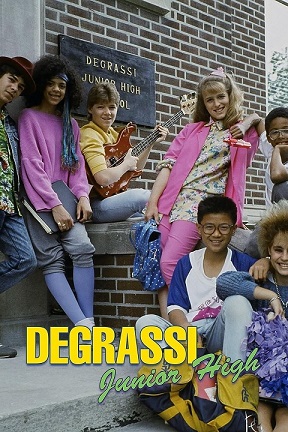
Welcome to Late Night Retro Television Reviews, a feature where we review some of our favorite and least favorite shows of the past! On Sunday, I will be reviewing the Canadian series, Degrassi Junior High, which aired on CBC and PBS from 1987 to 1989! The series can be streamed on YouTube!
The second season of Degrassi Junior High comes to a close with a historic episode!
Episode 2.13 “Pass Tense”
(Dir by Kit Hood, originally aired on March 28th, 1988)
The school year is nearly over and it’s time for the 8th Grade to graduate. Next year, they will all be going to high school except …. well, they won’t. Even while Stephanie and the Farrell Twins are making fun of the 7th Graders for having to do all the work to prepare for the big graduation dance, word comes down from the district that, starting next year, Degrassi Junior High will have a Grade 9. Even though most of the show’s characters are set to graduate and go to High School, they’ll still be attending classes at Degrassi Junior High next season school year.
(The official story is that the high school was overcrowded so adding a Grade 9 to Degrassi was the only option. The truth, of course, is that the show got popular and was renewed for a third season and the show’s producers didn’t want to lose 75% of their cast.)
However, one eighth grader will not be “graduating.” Joey Jeremiah has flunked! Oddly, Joey passed his final exams but, as Raditch puts it, he only scraped by and Raditch feels that Joey is too smart to only be scraping by. Mr. Raditch called Joey’s parents and told them that Joey could either go into the 9th Grade and be put in a low-academic program or he could repeat the 8th Grade and hopefully mature a little. Joey’s parents agreed that Joey should be held back. “Flunk our son!” they apparently said.
(To be honest, this seems like kind of an unfair move on the part of Mr. Raditch and I’m not really sure how Joey can be held back after passing all of his exams. It seems rather arbitrary.)
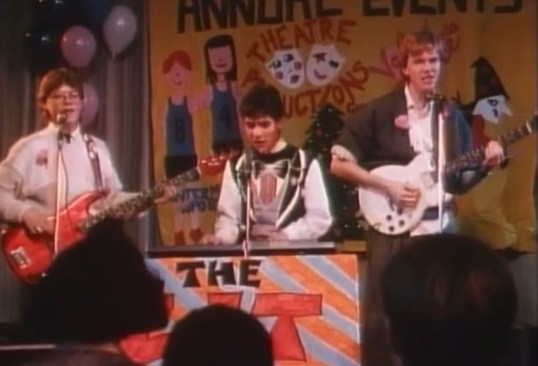
At first, Joey declares that he’s not going to go to the graduation dance, even though the Zit Remedy is scheduled to make their public debut. Wheels confronts Joey and tells him that he’s smart and that he owes it to his friends to show up. Wheels gets a bit judgmental, all thing considered. Joey is being held back on the whims of Mr. Raditch so Joey really has every right to be mad. Aren’t there any lawyers in Canada who can sue the school on Joey’s behalf?
(Add to that, I always smile a bit whenever Wheels gets judgmental of anyone. Hey, Wheels, Joey’s not the one who is destined to go to prison for killing someone while driving drunk.)
Joey eventually does show up at the dance, apparently having been convinced that his friends won’t be laughing at him behind his back. (From what we see, everyone is supportive. I guess they’re just nicer in Canada.) Greeting Snake and Wheels, Joey takes a moment to flirt, for the first time, with Caitlin, who is destined to become the love of his life. He then says that he’s ready to perform. This leads to a historic moment as the Zit Remedy takes the stage for the very first time. They perform their one and only song, the deathless Everybody Wants Something.
Everybody wants something
They’ll never give up
Everybody wants something
They’ll take your money
And never give up
Finally, Spike, who is allowed to attend the dance after not being allowed to attend class, goes into a labor as the episode’s end credits roll. This is a huge moment, both because Spike is giving birth to Emma Nelson, who will be the lead character for the first few seasons of Degrassi: The Next Generation. A running joke on DTNG would be Emma’s hatred of Everybody Wants Something so, for me, it was kind of fun to watch this episode and discover that this was the last song Spike listened to before giving birth.
(Speaking of Degrassi: The Next Generation, I had to smile at just how much Joey freaked out about getting held back. DTNG was infamous for using the flimsiest of excuses to keep its more popular characters from graduating on time. Ashley, Jimmy, Spinner, and a host of others were all held back. Spinner was actually held back twice.)
And so ends the second season of Degrassi Junior High. The second season was great and this finale did everything that a good finale is meant to do. It wrapped up two major storylines while also hinting at what the future held. It also gave Pat Mastroianni, Neil Hope, and Amanda Stepto a chance to show how much all three of them had developed as actors since the show’s first season. Mastroianni especially did a good job as Joey realized that his year of goofing off and not trying had finally caught up with him. That said, I still think he needs to sue both the school and Mr. Raditch. He probably needs to get emancipated from his parents as well. What type of mother or father says, “Flunk my child?”
On Monday, I spent 20 minute staring straight at the sun.
Before anyone freaks out, there was actually a lot of cloud cover so my eyes were protected. I mean, I don’t think my eyesight has gotten any noticeably worse over the last few days. The important thing is that I got to watch the solar eclipse. It was a beautiful moment, standing in my backyard as the afternoon suddenly went dark. A few minutes later, I experienced the world lighting back up. I’m glad I was able to witness it.
Here’s what I read, watched, and listened to this week.
Welcome to Retro Television Reviews, a feature where we review some of our favorite and least favorite shows of the past! On Sundays, I will be reviewing the made-for-television movies that used to be a primetime mainstay. Today’s film is 2000’s All-American Girl: The Mary Kay Letourneau Story! It can be viewed on YouTube.
In 1996, a 34 year-old teacher named Mary Kay Letourneau decided that she had fallen in love with someone who was not her husband.
A 34 year-old deciding that they are no longer happy in their marriage and subsequently deciding that that they’ve found love with someone else is hardly an unusual or even surprising occurrence. What made Mary Kay Letourneau’s case a national scandal was that the person that she decided that she was in love with was a 12 year-old student named Vili Fualaau. Mary Kay started her affair with Vili when she was his sixth grade teacher. When she was arrested and charged with two counts of second-degree rape of a child, Letourneau was pregnant with Vili’s child. Even after being arrested, Letourneau insisted that she and Vili were soulmates. After giving birth to Vili’s child, Letourneau was sentenced to six months of prison and somehow managed to avoid having to register as a sex offender. After serving her sentence, Letourneau was promptly arrested again with Vili and was sent back to jail, where she gave birth to Vili’s second child.
All-American Girl opens with Mary Kay Letourneau (Penelope Ann Miller) in jail, insisting that everything that happened between her and Vili was consensual and that their love is real. The majority of the film is shown in flashbacks. Some of those flashbacks deal with Mary Kay, her husband (Greg Spottiswood), and Vili (Omar Anguiano). Watching the flashbacks, I couldn’t help but notice that the film really did seem to be on Mary Kay’s side, to an almost ludicrous extent. Her husband is portrayed as being a soulless sociopath, even before Mary Kay starts sneaking around with Vili. As for Vili, he is presented as being the one who initiated his relationship with Mary Kay, flirting with her in class and comforting her when she starts crying in a school hallway. The actor playing Vili looked, acted, and sounded considerably older than just 12 years old. At times, he appeared to be nearly as old as Penelope Ann Miller. And I’ll admit that it’s totally possible that Vili could have looked older than his age and maybe he did have a surprisingly mature vocabulary. But still …. he was 12 years old! Apparently, Letourneau cooperated with the film’s producers and that’s pretty obvious from the first minute we see Vili giving Letourneau a wolfish smile in the 6th grade.
The flashbacks dealing with Letourneau’s childhood are a bit more interesting, if just because Letourneau was the daughter of a congressman who ran for president in 1972. (One of her brothers served in the first Bush White House. Another served as an advisor to the 2016 Trump campaign.) At one point, she taunts a group of protestors that have gathered outside of her family’s home and her father praises her courage. The film hints that it was the twin traumas of her brother’s death and the discovery that her beloved father had fathered two children with a mistress that led to Letourneau’s subsequent instability. Perhaps that’s true, though I think the film is a bit too eager to accept that as an all-purpose explanation.
You may have guessed that I had mixed feelings about this film. Penelope Ann Miller gave an excellent performance as Mary Kay but the film’s attempts to portray May Kay as being even more of a victim that Vili were undeniably icky.
As for the real Mary Kay, she married Vili four years after being released from prison. They separated a year before Mary Kay died in 2020. Their relationship inspired several films, most recently May/December.
Welcome to Late Night Retro Television Reviews, a feature where we review some of our favorite and least favorite shows of the past! On Saturdays, I will be reviewingthe Canadian sitcom, Check it Out, which ran in syndication from 1985 to 1988. The entire show is currently streaming on Tubi!
Season 2 continues with more inconsistent Howard and Edna weirdness.
Episode 2.2 “Edna’s Phantom Romance”
(Dir by Alan Erlich, originally aired on October 10th, 1986)
Howard Bannister is, once again, the most unromantic man who has ever lived.
Now, I know that goes against what we’ve recently seen of Howard. In fact, just last week, Howard agreed to go without a paycheck for two months so that he and Edna could have a vacation together. This show has never been particularly consistent when it comes to its portrayal of Howard and Edna’s relationship. When it first started, Howard was portrayed as being a jerk. Then, he became a romantic. Then he went back to being a jerk. And then he become, yet again, a romantic. And now, he’s back to being a jerk. And Edna has gone from being snarky to naive to intelligent to naive again that it’s next to impossible to really say for sure who she is supposed to be.
Edna and Howard’s anniversary is coming up. Edna wants him to take her to Hawaii. Howard would rather stay at home and watch bowling. It seems to be an impasse but myself, I’m wondering if Edna realizes that flying from Canada to Hawaii is not exactly something that one does on a whim. I mean, you don’t just hop down to Hawaii for a few hours and then fly back, especially not on a retail worker’s salary. Howard may be the manager but I doubt he has enough money to purchase a private jet. Plus, Edna and Howard just took a 2-month vacation. She could have gone to Hawaii then.
Edna, trying to get Howard’s attention, hires one of Leslie’s community theater friends to pretend to be her new boyfriend. Howard freaks out after he sees Edna and the actor together. Edna thinks that Howard is going to propose to her but instead, he breaks up with her. “Oh, Howard!” Edna says before explaining that she was just paying the other guy to pretend to be in love with her. Howard is surprisingly okay with that and the two of them get back together. It’s interesting that Howard doesn’t care that Edna has basically spent a week lying to and manipulating him.
This was one of those really annoying and dumb episodes where every problem could have been resolved by people just talking to each other and not making assumptions. Bleh. I hate episodes like this.
On the plus side, Marlene’s constantly changing hairstyle remains the best thing about the show. Here’s what she went with this week:
This episode was pretty dumb and I’m pretty sure that they already did a Howard-Screws-Up-His-Anniversary episode during the previous season. If Check It Out! is already repeating itself (and especially if its repeating itself to diminishing returns), that means I’ve got a long few months ahead of me as I make my way through seasons 2 and 3 of this show.
Other than the shows that I watch for my retro television reviews, I didn’t watch a lot this week. I was busy with other things. (Luckily, I did get to watch a few movies.) Here’s a few thoughts on what I did watch.
Abbott Elementary returned this week. Janine was offered a full-time job with the District and she accepted it, much to Gregory’s disappointment. To be honest, I’m kind of bored and more than a little frustrated with Janine and Gregory. Gregory’s inability to act on his feelings has crossed the line from being an sweet example of social awkwardness to just being annoying. My hope, as it has been from the start, is that Janine will realize that she is meant to teach and we’ll finally be done with all of this District nonsense. That said, I did enjoy the AI storyline and Jacob’s shock at discovering that no one was reading his emails. We’ve all known someone or had a friend like Jacob. I would totally subscribe to Mr. Johnson’s newsletter.
I watched an old episode of Night Flight on Friday. It dealt with androgynous rock stars so, not surprisingly, the majority of it was made up of videos from David Bowie and Queen.
Today, I binged the new Netflix reality show, Unlocked: A Jail Experiment. Shot in Little Rock, Arkansas, the show dealt with a sheriff who decided to give one cell block a good deal of freedom to see if they could handle it. It was an interesting show, though a lot of it seemed to be staged. It was hard not to notice that the camera was always in the perfect position to pick up the most drama. I also had to laugh at the inmates who said they were worried about getting caught doing something illegal but who then proceeded to make a shank or brew jail moonshine while the cameras were pointed straight at them. I mean, when Miller was making his shank and bragging about how he was going to use it against anyone who got on his nerves, did he not realize that show’s footage could probably be used in court? Unlocked was a slightly more amusing version of 60 Days In. Speaking of which, the sheriff on this show was surprisingly likable, especially when compared to the majority of the law enforcement people who have appeared on 60 Days In.
And that’s that, with the exception of the retro shows that I watch every week for this site. As I said, I didn’t watch a lot this week. I’m running behind on both Survivor and The Amazing Race. And, at some point, I’d like to watch the latest seasons of The Bachelor and Farmer Wants A Wife. Hopefully, I’ll soon be caught up.
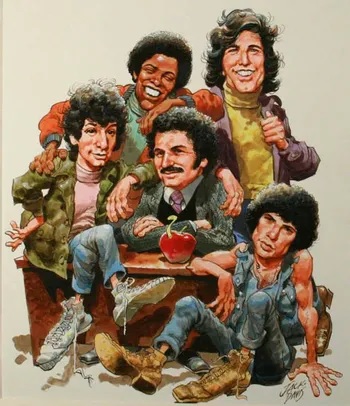
Welcome to Retro Television Reviews, a feature where we review some of our favorite and least favorite shows of the past! On Saturdays, I will be reviewing Welcome Back Kotter, which ran on ABC from 1975 to 1979. The entire show is currently streaming on Tubi!
This week, a computer tries to take over Gabe’s class. I wonder how Barbarino will react….
Okay, everyone, it’s Barbarino time!
Episode 3.17 “Meet Your New Teacher: Batteries Not Included”
(Dir by Bob Claver, originally aired on January 5th, 1978)
Barbarino’s not in this episode.
That may seem like an strange detail with which to lead off this review but, as far as the third season has been concerned, John Travolta’s performance as Barbarino has been one of the few consistently good things about Welcome Back, Kotter. I’m going to guess that Travolta was absent from shooting because of the success of Saturday Night Fever. Maybe he was off filming Grease. That’s all understandable but still, the show really suffers when he’s not around. Of the Sweathogs, he was the one who usually avoided turning into a cartoon. In his way, he was the anchor of the group. Plus, by this point, he was the only one who still looked young enough to be in high school.
Fortunately, John Sylvester White is in this episode. If Travolta played an important role in keeping the show grounded, White’s unhinged performance as Woodman did an equally good job of keeping the show funny. White could make even the simplest of lines hilarious by virtue of the incredible bitterness in Woodman’s voice.
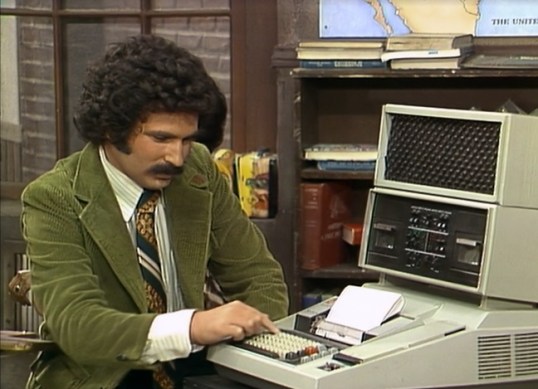
This week, Mr. Woodman is excited because he’s purchased a computer that can teach! He rolls it into Gabe’s classroom and informs Gabe that, from now on, he’ll be asking the computer for answers.
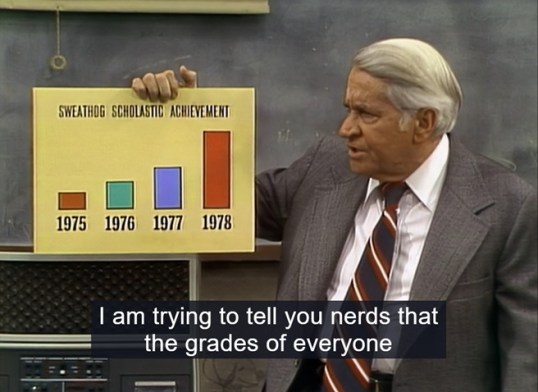
Obviously, it’s easy to roll your eyes at that bulky computer, especially since it appears to be more of a typewriter than anything else. (I’m going to assume that is was state-of-the-art for the 70s). Still, one could argue that this episode predicted the rise of A.I. Gabe types in his questions and then the computer gives him an answer. The computer has been programmed to always be correct. Gabe complains that the computer can’t tell jokes but the Sweathogs don’t care. They love the computer! And, after a few days, Woodman returns to the classroom with a chart that shows how everyone’s grades have improved.
Woodman thinks that the computer is his ticket to a promotion. He also thinks that the computer will finally allow him to fire Gabe. (Sometimes, Woodman likes Gabe and sometimes, he tries to get him fired. Normally, I’d complain about the inconsistency but the genius of John Sylvester White’s performance is that you just accept that Woodman’s insane and move on.) The Sweathogs fear that Gabe will lose his job so Epstein sabotages the computer so that it gives wrong answers when Woodman tries to demonstrate it to a district representative. Did you know the Harlem Globetrotters fought at the Battle of Waterloo?
It’s never really made clear how Epstein sabotaged the computer but no matter. One of the flaws of AI is that, even though it acts like its thinking, it’s actually just repeating whatever it’s programmed to do. This computer claims that the Globetrotters fought at Waterloo. Decades later, Google Gemini would become infamous for creating ahistorical images of black and female presidents who were all presumably elected at a time when only white men were allowed to vote or run for office. AI never changes.
I would have loved to have seen Barbarino interact with the computer. He was seriously missed in this episode. But Woodman’s unhinged personality made up for a lot of that. This was fun, even if it still wasn’t nearly as memorable as any of the episodes from the first two seasons of the show.
As for this episodes jokes, Gabe tried to tell Julie a joke about his Uncle Magnovich. Julie didn’t seem to care that much. At the end of the episode, Gabe tried to tell the computer a joke. The computer did not react. “Don’t you get it?” Gabe typed.