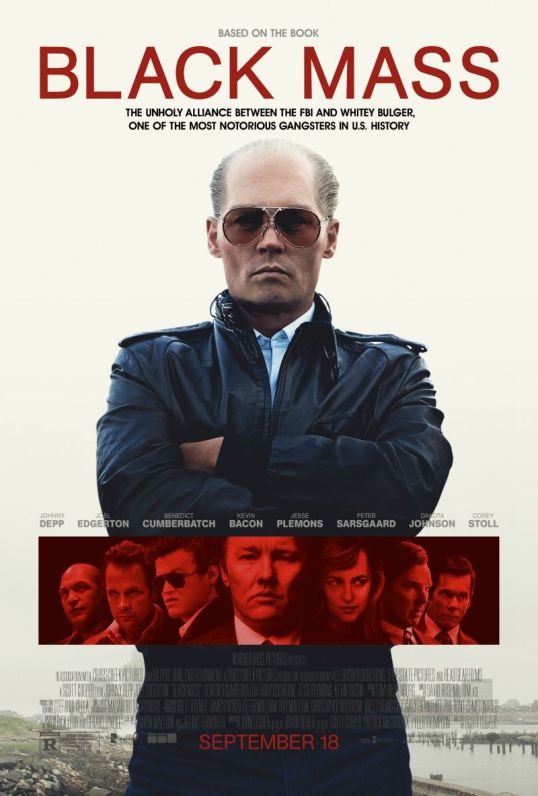
One of this year’s most-anticipated films (well, at least when it comes to award season) has a new trailer.
Black Mass stars Johnny Depp in the role of the infamous gangster Whitey Bulger who, as the film’s tagline states, became the most notorious gansgter in U.S. history. This is bold claim considering other gangsters in U.S. history such as Lucky Luciano, Bugsy Siegel, Vito Genovese and Meyer Lansky to name a few.
What makes this film so interesting is the fact that we finally get to see Depp return to acting real, complex characters instead of just acting like a character these past decade. Plus, have you seen this cast supporting Depp: Benedict Cumberbatch, Kevin Bacon, Joel Edgerton, Corey Stoll and Jesse Plemons just for starters.
Black Mass is set for a September 18, 2015 release date.
Seriously, I have yet to meet anyone who doesn’t have a positive reaction to seeing Kevin Bacon on screen. He may not be a star in the way that Bradley Cooper or Bollywood sensation Shah Rukh Kahn are stars but still, he is one of those actors that everyone just seems to instinctively like.
I think, to a large extent, that is because, despite the fact that he’s been around and acting forever, Kevin Bacon himself still comes across as being a normal, blue-collar sorta guy. Whenever you see him being interviewed, you get the feeling that Kevin Bacon basically shows up, does his job to the best of his ability, and, as opposed to many other actors, he doesn’t take himself or his movies too seriously. He’s justifiably proud of the good films that he’s appeared in and he’s never had any problem admitting that he’s been in a lot of bad films as well.
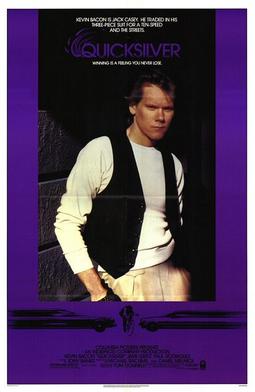
In fact, it was Kevin Bacon’s openness about his bad films that led to me discovering 1986’s Quicksilver. This is the film that, in a 2008 interview, Kevin Bacon referred to as being “the absolute lowest point of my career.” (Consider, for a minute, that this is being said by the same Kevin Bacon who had an arrow shoved through his throat in the original Friday the 13th and that will give you some clue of how much disdain Kevin seems to have for Quicksilver.)
Naturally, having read that, I knew that I simply had to see Quicksilver. I’ll admit right now that I was hoping to discover that it was some sort of loss and unappreciated classic. I wanted this to be the review where I defended the unacknowledged brilliance of Quicksilver. I wanted to say, “Don’t be so hard on yourself, Kevin! Give Quicksilver another chance!”
But no.
Quicksilver doesn’t quite suck but it definitely comes close.
At the same time, it is interesting as a classic example of what happens when a filmmaker tries to assign some sort of deeper meaning to or find inherent nobility in an activity or job that really isn’t that interesting. Often times, this will happen with sports movies. A director or producer will make the mistake of thinking that just because he’s obsessed with beach volleyball that means that there’s a huge audience out there just waiting for someone to make the ultimate beach volleyball film. Or, you’ll get a film like 1999’s Just The Ticket, where Andy Garcia is described as being the “world’s greatest ticket scalper” and the audience is supposed to be impressed.
In the case of Quicksilver, it’s all about being a bicycle messenger. I’m assuming that, one day, director Thomas Michael Donnelly was stuck in traffic and he happened to see a bike messenger rushing down the street, whizzing past all of the stalled commuters. And Donnelly probably thought, “I wish I was that guy right now!” Every day after that, whenever Donnelly was stuck in traffic, he thought back to that bike messenger and slowly he grew obsessed. All of his friends and his family got sick of listening to him talk about how much he envied the freedom of that bike messenger. Finally, a little light bulb turned on over Donnelly’s head and he said, “I’ve got to make a movie out of this!”
And then the bulb burned out but nobody noticed.
Kevin Bacon plays Jack Casey. When we first meet Jack, he’s a successful stock broker and he’s got a really bad, porn-appropriate mustache. One day, he’s sitting in the back of a cab and he goads his driver into getting into a race with a bike messenger. The messenger beats the cab. Jack is amazed!
And then, perhaps the very same day (the film is so poorly edited that it’s hard to tell), Jack not only loses all of his money but all of his parents’ money as well. Since poor men couldn’t afford facial hair in the 1980s, he shaves off his mustache. Desperately needing work, Jack applies to be a — you guessed it! — bicycle messenger.
The rest of the film is basically Jack delivering messages and talking about how he’s free now to live the life that he’s always wanted to live. And the thing is, you like Jack because he’s being played by Kevin Bacon. I mean, Kevin Bacon is so inherently likable that audiences even liked him when he was trying to kill Professor X and Magneto in X-Men: First Class. But, at the same time, you listen to Jack go on and on about how much better his life is now and you just want to say, “Who are you kidding?”
Needless to say, Jack has a group of quirky coworkers. Of course, by quirky, I mean that they are all quirky in a very predictable Hollywood sort of way. For instance, there’s the crusty old veteran and the goofy fat guy and the hard-working Mexican guy who wants to start his own business in America and the cocky black guy who is mostly notable for being played by Laurence Fisburne. One thing they all have in common is that they all love and damn near worship Jack, who has quite the common touch despite having formerly been a super rich stock broker with a bad mustache.
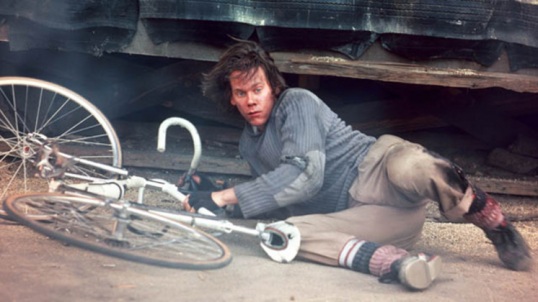
Anyway, Terri (Jami Gertz) also wants to become a bicycle messenger but she’s being used to deliver drugs by Gypsy (Rudy Ramos). She and Jack fall in love and, along with helping out his quirky coworkers and finding a way to make back his fortune, Jack also has to deal with Gypsy. It’s all very dramatic (though the drug dealer subplot feels as if it was awkwardly inserted into the film at the last moment) but mostly, the plot is just an excuse for scenes like the one below:
Quicksilver is … well, it’s not particularly good. It has a few good bike weaving in and out of traffic scenes but it’s definitely no Premium Rush. But it is kinda fun, in a “Oh my God, look at the 1980s” sorta way. And, for what it’s worth, it’s a film that proves that Kevin Bacon can be likable in almost anything.
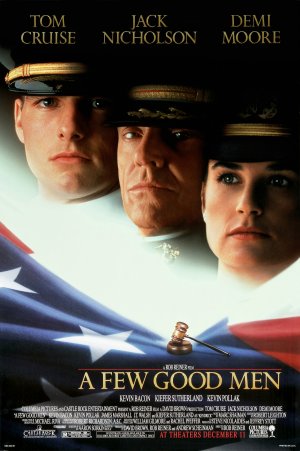
So, late Saturday night, I turned over to TCM’s 31 Days Of Oscar and I was watching the 1992 best picture nominee, A Few Good Men, and I noticed that not only was there only one woman in the entire film but she was also portrayed as being humorless and overwhelmed. While all of the male characters were allowed to speak in quippy one liners and all had at least one memorable personality trait, Lt. Commander Joanne Galloway (Demi Moore) didn’t get to do much beyond frown and struggle to keep up.
“Hmmmm…” I wondered, “why is it that the only woman in the film is portrayed as basically being a humorless scold?” Then I remembered that A Few Good Men was written by Aaron Sorkin and it all made sense. As I’ve discussed on this site before, Aaron Sorkin has no idea how to write woman and that’s certainly evident in A Few Good Men. Joanne (who goes by the masculine Jo) is the one character who doesn’t get to say anything funny or wise. Instead, she mostly serves to repeat platitudes and to be ridiculed (both subtly and not-so subtly) by her male colleagues. You can tell that Sorkin was so busy patting himself on the back for making Jo into a professional that he never actually got around to actually giving her any personality. As a result, there’s really not much for her to do, other than occasionally scowling and giving Tom Cruise a “that’s not funny” look.
(“C’mon,” Tom says at one point, “that one was pretty good.” You tell her, Aaron Tom.)
A Few Good Men, of course, is the film where Tom Cruise yells, “I want the truth!” and then Jack Nicholson yells back, “You can’t handle the truth!” At that point in the film, I was totally on Nicholson’s side and I was kinda hoping that the scene would conclude with Cruise staring down at the floor, struggling to find the perfect come back. However, this is an Aaron Sorkin script which means that the big bad military guy is never going to have a legitimate point and that the film’s hero is always going to have the perfect comeback. Fortunately, the scene took place in a courtroom so there was a wise judge present and he was able to let us know that, even if he seemed to be making the better point, Nicholson was still in the wrong.
As for the rest of the film, it’s a courtroom drama. At Guantanamo Bay, a marine (Michael DeLorenzo) has died as the result of a hazing. Two other marines (Wolfgang Bodison and James Marshall) have been accused of the murder. Daniel Kafee (Tom Cruise), Joanne Galloyway (Demi Moore), and Sam Weinberg (Kevin Pollack) have been assigned to defend them. Jack Ross (Kevin Bacon) is prosecuting them. Kafee thinks that the hazing was ordered by Col. Nathan Jessup (Jack Nicholson) and Lt. Kendrick (Kiefer Sutherland).
We know that Kendrick’s a bad guy because he speaks in a Southern accent and is religious, which is pretty much the mark of the devil in an Aaron Sorkin script. We know that Jessup is evil because he’s played by Jack Nicholson. For that matter, we also know that Kafee is cocky, arrogant, and has father issues. Why? Because he’s played by Tom Cruise, of course. And, while we’re at it, we know that Sam is going to be full of common sense wisdom because he’s played by Kevin Pollack…
What I’m saying here is that there’s absolutely nothing surprising about A Few Good Men. It may pretend to be about big issues of national security but, ultimately, it’s a very slick and somewhat hollow Hollywood production. This, after all, is a Rob Reiner film and that, above all else, means that it’s going to be a very conventional and very calculated crowd pleaser.
Which isn’t to say that A Few Good Men wasn’t enjoyable. I love courtroom dramas and, with the exception of Demi Moore, all of the actors do a good job. (And, in Demi’s defense, it’s not as if she had much to work with. It’s not her fault that Sorkin hates women.) A Few Good Men is entertaining without being particularly memorable.
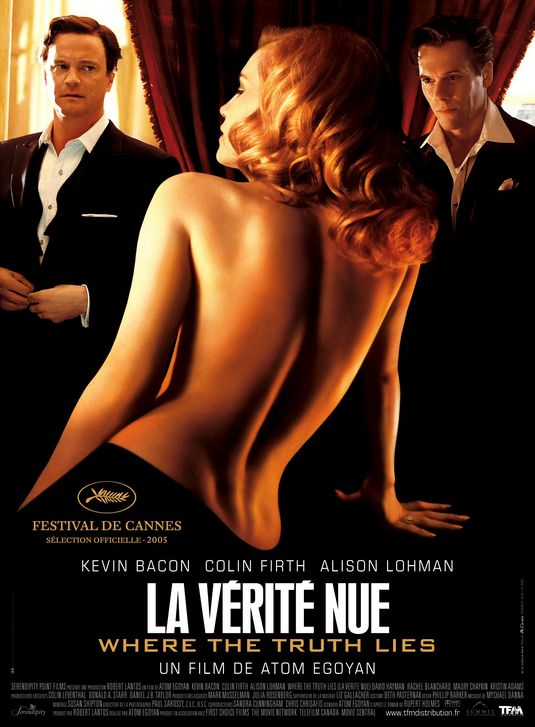
Atom Egoyan’s 2005 showbiz melodrama Where The Truth Lies is a historic film for me.
First off, it’s the first film that I ever saw at the wonderful Dallas Angelika theater, which would quickly become my favorite place to watch movies in the Dallas/Ft. Worth metroplex. And I have to say that, as much as I love the Alamo Drafthouse that opened up last year, the Angelika will always hold a special place in my heart.
Secondly, and perhaps even more importantly, Where The Truth Lies was the first NC-17 film that I ever actually watched in a theater. In fact, I went into Where The Truth Lies knowing next to nothing about it. I just saw that it was an NC-17 film that was playing in a “real” theater and that was pretty much all I needed to call up some friends and head down to Dallas.
I felt terrifically grown up until I tried to buy the ticket and I was asked to show ID. I handed over my driver’s license. The ticket seller stared down at it for what seemed like an eternity. She looked up at me and then back down at the license a few times. Finally, she said, “Are you sure you’re 19?”
“I’m going to be 20 in November,” I replied.
She squinted at me for a few minutes and then said, “If you say so,” before handing me my license and a ticket.
And so, on that day, I managed to cross one goal off my list (See an NC-17 movie in a theater) and replaced it with another (Buy a ticket for an R-rated or NC-17 movie without being asked for ID). I’m still working on that 2nd goal but I have to admit that I’m starting to dread the idea that one day, I’ll be able to pass for an adult.
But what about Where The Truth Lies?
Well, the main question that I had, in 2005, as I sat down to watch this movie was why exactly was it rated NC-17. Having watched the movie in the theater and then on cable a few times after, I still honestly have no idea why the rating was as harsh as it was. Yes, there’s a lot of sex in the movies. You see a lot of boobs and you see a lot of bare asses but — well, so what? It’s really nothing wore than what you have seen in countless red band trailers for various R-rated comedies. Add to that, in Where The Truth Lies, all of that skin is on display for a reason. The film may be explicit but it’s never gratuitous.
As for the film itself, it’s technically a murder mystery but the mystery is really only an excuse for Egoyan to take a look at the seamier side of show business. In the 1950s, entertainers Lanny Morris (Kevin Bacon) and Vince Collins (Colin Firth) are the nation’s top comedy team. However, after co-hosting a 39-hour polio telethon in Miami, Lanny and Vince fly to New Jersey to do a few shows at a hotel owned by a local mobster. When the naked body of Maureen O’Flaherty (Rachel Blanchard) is found in their room, the scandal destroys both of their careers.
Fifteen years later, in the early 1970s, Lanny Morris has written a book about his life and career. Vince decides to retaliate by writing his own book. Karen O’Connor (Alison Lohman) is hired to be his ghostwriter. Karen, however, has her reasons for being obsessed with Lanny and Vince and she is also determined to discover whether Maureen truly did die of a drug overdose or if she was murdered.
Where The Truth Lies is, in many ways, an uneven film but I like it. The mystery of who killed Maureen is intriguing and, unlike a lot of viewers (check out the film’s entry at the imdb if you really need to know how much some people hate this film), I actually appreciated Egoyan’s hallucinatory and disjointed approach to telling his story. Kevin Bacon and Colin Firth both give excellent performances, both cast in the type of roles that you might not normally expect to see them playing. As a character, Karen is frustratingly inconsistent but Alison Lohman does the best that she can with the role.
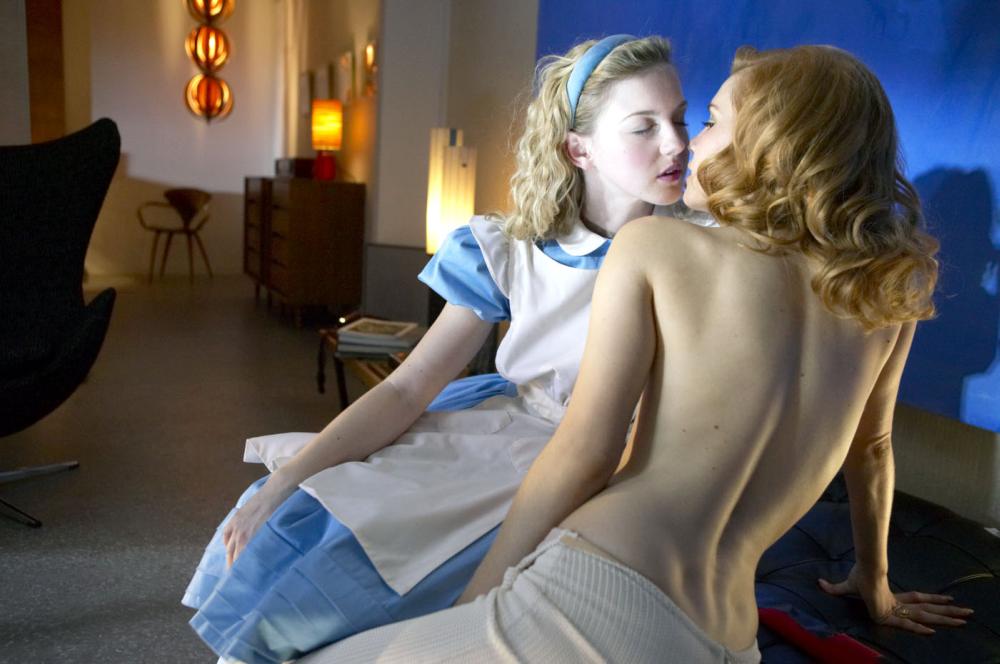
Finally, Where The Truth Lies does contain one undeniably brilliant scene, in which a drugged Karen watches as an actress dressed to look like Alice in Wonderland sings White Rabbit. It’s a wonderfully strange scene, all the more so become it comes almost out of nowhere.
Where The Truth Lies is not a perfect film but, for my first experience seeing an NC-17 film in a theater, it wasn’t bad at all.
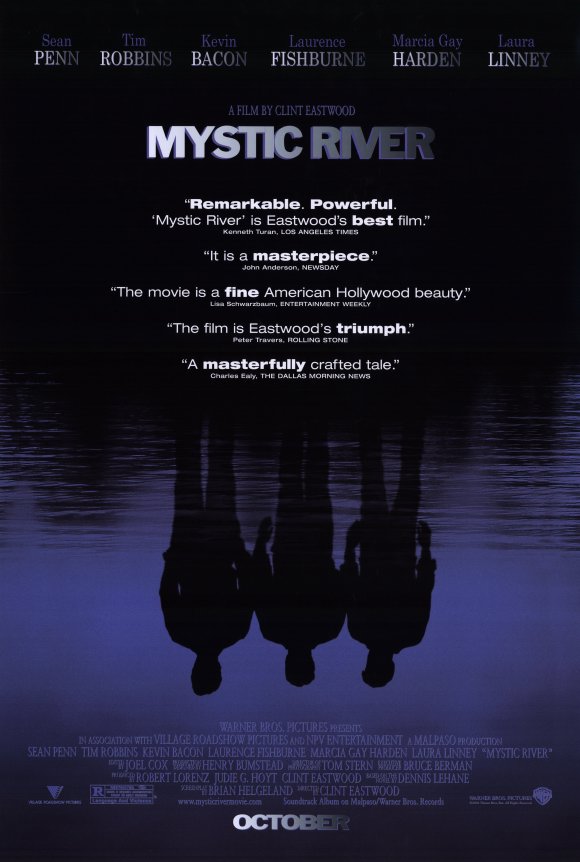
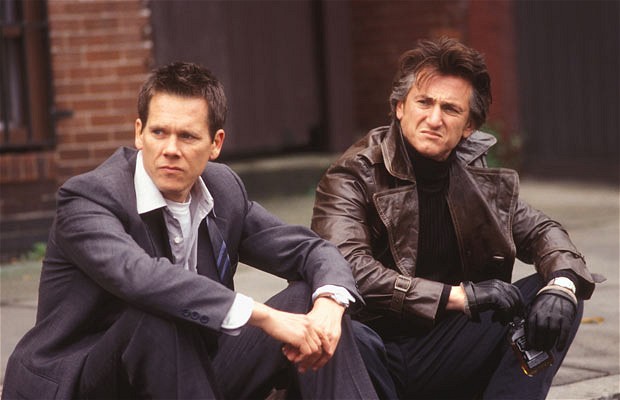
Much like In The Bedroom, 2003’s Mystic River is a film that deals with guilt, murder, and vengeance in New England. Whereas In The Bedroom deals with the guilt of just four people, Mystic River deals with the guilt of an entire neighborhood.
Mystic River opens in Boston in 1975. Three young boys are writing their names in wet cement when a car pulls up beside them. An angry-looking man (played by the always intimidating John Doman) gets out of the car and announces that he’s a police officer and that the three boys are under arrest. He orders them to get in the car. Of the three boys, Jimmy and Sean refuse but meek Dave gets into the car, where he’s greeted by a leering old man. Jimmy and Sean watch as the car drives away with their friend trapped in the back seat. Dave is held prisoner and abused by the two men for four days until he finally manages to escape.
Twenty-five years later, the three boys have grown up but are still haunted by what happened. Sean is now a detective with the Massachusetts State Police. Jimmy is an ex-con who now owns a local store and who, despite being married to Annabeth (Laura Linney), the daughter of a local gangster, is trying to lead a law-abiding life. As for Dave (Tim Robbins), he is married to Celeste (Marcia Gay Harden) and manages to hold down a job but he’s also the neighborhood pariah.
When Jimmy’s daughter Katie (Emmy Rossum) is brutally murdered, Sean and his partner Whitey Powers (Laurence Fishburne) are assigned to the case. The distraught Jimmy, however, starts to investigate the murder himself and, after talking to Celeste, he discovers that, on the night Katie died, Dave came home with blood on his clothes and claiming that he had a fight with a mugger. That’s all the evidence that Jimmy and his friends need to believe that Dave is the murderer…
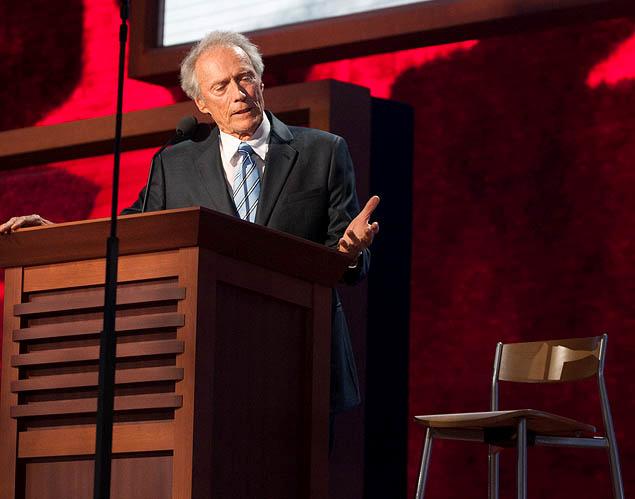
I have a lot of friends who will probably never forgive Clint Eastwood for not only endorsing Mitt Romney in 2012 but for also giving the “empty chair” speech at the Republican Convention. From the way that a lot of them reacted, you would think that Eastwood had filmed himself drowning puppies as opposed to simply expressing his own cantankerous opinions about current events. (Honestly, do you know any 82 year-olds who weren’t disgruntled in 2012?) Myself, I thought the empty chair speech was an act of brilliant performance art, one that not only highlighted the fact that most politicians really are just empty chairs but also exposed just how humorless most political activists truly are. (Admit it — if John Fugelsang had done that same routine at the 2004 Democratic convention and referred to the empty chair as being President Bush, most of the people who went on and on about how terrible it was that Eastwood was being disrespectful to the President would still be using it to create Facebook memes.)
Unfortunately, I sometimes find myself wondering why Clint Eastwood the director sometimes seem to struggle to be as interesting, innovative, and thought-provoking as the empty chair speech. It sometimes seems that for every Eastwood film that works, there’s a handful films like Hereafter, Changeling, and Jersey Boys. These aren’t bad films as much as they’re just uninspired films. (Well, Hereafter is pretty bad…) Ultimately, Eastwood is more of a storyteller than a Martin Scorsese-style innovator. If Eastwood has a good story to tell, the film will work. If he has a weak story — well, then the film will be weak.
Fortunately, with Mystic River, Eastwood has a good story and the end result is one of the best films of his uneven directorial career. Eastwood uses a fairly standard murder mystery to explore themes of guilt, redemption, and paranoia. Jimmy may be looking for revenge and Sean may be doing his job but ultimately, both of them are trying to absolve themselves from the consequences of their childhood decisions. If Dave is guilty, then Jimmy will justified in having let him get in that car. If Dave is innocent, Sean can finally step up and save him.
And complicating all of this is the Neighborhood, which is as much a character in this film as Jimmy, Dave, and Sean. The Neighborhood will never allow anyone to forget or live down the past. When, towards the end of the film, Jimmy is declared to be the “king of the neighborhood” by Annabeth, there’s little doubt that she’s right. The question is whether Jimmy’s kingdom is one worth ruling.
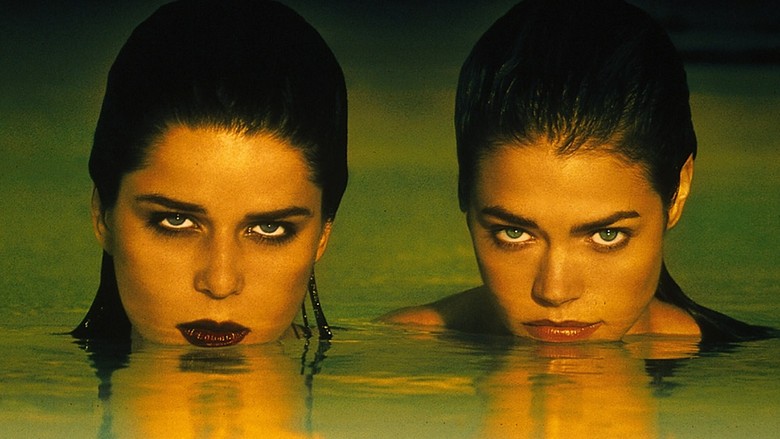
The 1998 film Wild Things starts out like a standard B-movie. It take place in Florida so, of course, we get a lot of shots of the sun setting on the bayous and crocodiles staring at the camera as if to ask, “What are you looking for?” Boats skim the water. High school guidance counselor Sam Lombardo (Matt Dillon) walks across campus while all of the toned and tanned students stop to admire him. Local rich girl Kelly Von Ryan (Denise Richards) smirks and says something snarky. Detective Ray Duquette (Kevin Bacon) shows up in the background and stares at the world from behind dark glasses and a serious expression. Meanwhile, local poor girl Suzie (Neve Campbell) goes back to her home, which happens to be located right behind an alligator farm.
Judging from the first few minutes, Wild Things could just as easily be an episode of CSI Miami.
But then Bill Murray shows up as Kenneth Bowden, a hilariously sleazy attorney who spends most of the movie wearing a neck brace, just in case the insurance company is watching him.
And then Theresa Russell shows up Kelly’s mother, standing on a balcony in a gold bikini and hitting on every passing man like the world’s most hyperactive cougar.
And then Carrie Snodgress shows up as Suzie’s mother, complete with an over-the-top white trash accent.
By the time that Robert Wagner shows up and literally growls at Matt Dillon: “You’re finished, Lombardo! Finished!,” you realize that Wild Things is probably the most self-aware B-movie ever made and it’s all the better for it.
As for the plot — well, let’s see if I can keep track. Suzie and Kelly both accuse Sam of rape. Sam claims to be innocent but nobody in town believes him. Sam is forced to hire the disreputable Kenneth Bowden to defend him. During the trial, Kenneth is able to prove that Kelly blamed Sam for the suicide of her father while Suzie is angry that Sam once refused to bail her out of jail on a drug charge. To get revenge, Kelly and Suzie decided to frame Sam. Sam is acquitted and, again with Bowden’s help, is able to negotiate an 8 million dollar settlement for defamation. True, Sam does lose his job but at least he’s a rich man now…
But wait a minute.
The movie still has a little over an hour to go.
Could it be that there’s more to this story?
Well, of course, there is. It turns out that Sam, Kelly, and Suzie have been working together all the time. The accusations, the trial, the defamation suit — it was all a part of a grand scheme to get the money. Sam, Kelly, and Suzie celebrate their success with champagne and a threesome.
While everyone else in town seems to be ready to move on from the entire scandal, Detective Ray Duquette is telling anyone who will listen that he thinks that Sam, Kelly, and Suzie were all in on it together. Even when Ray is ordered by his superiors to back off, Ray continues to investigate the case.
And why?
Because Ray Duquette is a cop who gets results!
Well, maybe.
Actually, it doesn’t take long to realize that there’s something off about Ray. For one thing, his obsession with Sam really does seem to be a personal thing. On top of that, Ray has a past connection with Suzie…
Wild Things has everything that you could hope for from a good exploitation film: a script that is full of double and triple crosses, unapologetically pulpy dialogue, over-the-top performances, and lots of sex. Yesterday, I reviewed Normal Life and praised John McNaughton’s decision to play up the banality of the film’s characters and locations. With Wild Things, McNaughton takes the exact opposite approach, playing up every sordid and tawdry detail to such an extent that the film itself eventually transcends such mundane concepts as good and bad.
Wild Things is a lot of fun and it’s also one of the best films of the 1990s.
When I first decided to do this series of reviews of conspiracy-themed films, I knew that I would eventually have to review the 1991 Oliver Stone film JFK.
JFK is one of those films that continues to divide audiences. Those who think that John F. Kennedy was killed by a conspiracy tend to love this film and are given to describing JFK as being “one of the most important films ever made.” Those who believe that Lee Harvey Oswald was the lone assassin dismiss Stone’s film as being left-wing propaganda. Just check out the message board at the imdb if you need evidence of just how worked up people get over this film and its subject matter.
It seems that very few of the people who criticize or praise JFK ever review it as a work of cinema. Instead, they focus on the film’s politics. If I criticize the film for wasting the talents of Sissy Spacek or featuring one of Kevin Costner’s least interesting performances then I’m running the risk of having to deal with angry conspiracy theorists telling me that I need to open my eyes to the reality of American history. On the other hand, if I praise Tommy Lee Jones’s wonderfully decadent turn as one of the film’s conspirators, chances are that someone is going to accuse me of being a naive leftist.
Then again, perhaps that reaction is to be expected. Oliver Stone is one of our most political and least subtle filmmakers. His movies are specifically designed to challenge the status quo. For that reason, it’s not surprising to discover that Stone considers JFK to be the best of all of his films.
JFK is based (rather loosely, some claim) on the true story of New Orleans District Attorney Jim Garrison (played by Kevin Costner) and how, in 1967, he charged businessman Clay Shaw (played by Tommy Lee Jones) with being a part of a conspiracy to kill John F. Kennedy. Shaw was eventually acquitted and both Jim Garrison and his investigation remain controversial to this day.
JFK courts controversy immediately with its portrayal of Jim Garrison. I’ve read several accounts of the Garrison investigation and the one thing that they all seem to agree on is that Jim Garrison was a flamboyant, bigger-than-life figure who enjoyed publicity. Even among those who believe that Garrison uncovered some valuable evidence as a result of his investigation, there is a good deal of ambiguity about Garrison’s motives. However, in Stone’s film, Jim Garrison is played by Kevin Costner and is portrayed as being an incorruptible, all-American idealist. It’s not that Costner gives a bad performance. Instead, it’s just a rather uninteresting one, especially when one compares Costner’s Garrison to some of the stories about the real-life Garrison.
However, as the film unfolds, it becomes obvious that Stone is using Costner’s blandness to the film’s advantage. Over the course of three hours, JFK slowly peels back layers of secrecy and cover-ups and reveals the shadow world that, according to Stone, lurks underneath everyday reality. Costner’s Garrison might not be interesting but he is a stable presence. He anchors the film, giving us someone to relate to while the film itself grows more and more bizarre.
While Costner’s might give the least interesting performance of his career in this film, the same cannot be said of the rest of the cast. JFK is full of familiar faces, many of whom are only on-screen for a few minutes but all of which play an important role in creating Stone’s shadow universe. Kevin Bacon, Gary Oldman, Joe Pesci, Michael Rooker, Donald Sutherland, and Tommy Lee Jones; they all have small roles but every single one of them makes an undeniable impression. Whether you agree with the film’s conclusions are not, it’s impossible not to enjoy JFK for the chance to spot a bunch of familiar faces giving memorably bizarre performances.
But ultimately, its impossible to review JFK without considering the film’s conclusions. JFK makes the case that John F. Kennedy was killed as the result of a massive right-wing conspiracy that involved the military, business interests, the CIA, the FBI, anti-Castro Cubans, and the mafia. By the end of the film, the question becomes less who killed JFK and more who didn’t kill JFK.
Myself, I’m not going to claim to be enough of an expert on the Kennedy assassination to argue whether JFK is accurate or if it’s just propaganda. However, as a film reviewer, I can say that it’s a very well-made and powerful film but it’s also one of those films that works better the first time you see it than the second time.
The first time you see it, the film overwhelms you. It leaves you convinced that yes, there was a conspiracy and yes, everyone was involved and yes, Jim Garrison was right! It convinces you so thoroughly that you end up using exclamation points, just to make sure everyone knows how convinced you are.
However, with each subsequent time that you view JFK, you became a bit more aware of just how manipulative and one-sided it truly is. You become a bit more aware of the technique underneath the outrage and, if you’re a smart film watcher, you remember that JFK is a recreation as opposed to being a historical document. You become more and more aware that Stone approached the material with a destination in mind and, like any good director, he has specifically shaped the material to make sure that you reach that destination at the end of the journey.
That was certainly my experience with JFK. I first saw it in high school and it convinced me that JFK was the victim of a conspiracy. Then, when I was in college, I watched it for a second time and, though I still believed the film’s conclusions, I also found myself much more aware of how the film’s length and Stone’s direction were designed to beat the audience into submission. When I saw the film a third time, I found myself resenting the film’s manipulative nature and, as a result, I found it a lot more difficult to accept Stone’s conclusions.
However, when I rewatched the film last night for this review, I was surprised to discover that JFK actually holds up pretty well. It’s still way too long (and, unlike a lot of other reviewers, I am not impressed by the droning speech that Costner delivers at the end of film) and Stone’s lack of subtlety does backfire on a few occasions. However, perhaps because I was finally watching the film as entertainment as opposed to judging the film on its political or historical merits, I discovered that JFK is a watchable and entertaining film, one that does a pretty good job of making Stone’s case. If nothing else, it’s worth watching just for the chance to see the wonderfully snarky performances of Tommy Lee Jones, Kevin Bacon, and Gary Oldman.
Perhaps the best thing that I can say about JFK is that its the type of film that will inspire smart people to do their own research and come to their own conclusions, which may or may not be the same conclusions that Oliver Stone reaches.
And, honestly, isn’t that the most that we can ask of any film?
After spending two weeks researching the career of Jason Voorhees, I am in the mood for some movies that feature absolutely no one getting brutally murdered. That’s why this edition of Lisa Marie’s Favorite Grindhouse and Exploitation Trailers is dedicated to some of the most light-weight comedies ever made.
(Yes, I realize that these films aren’t exactly grindhouse films but they’re close enough.)
1) Making the Grade (1984)
This trailer almost feels like a parody, doesn’t it? In fact, it very well could be. Has anyone ever actually seen this Making the Grade movie?
2) White Water Summer (1987)
This is a weird movie that, for some reason, tends to pop up on TV every few months or so. Kevin Bacon is a nature guide who appears to be sociopath and Sean Astin is the kid that he bullies nonstop. Eventually, Bacon breaks his leg and Astin saves his life or something like that. The whole movie just has a really weird feel to it.
3) Private Lessons (1981)
These next three trailers form a trilogy of sorts. We start off with Private Lessons, which — let’s be honest — is a pretty creepy trailer.
4) Private School (1983)
The 2nd part of the private trilogy was directed by Noel Black who also directed one of the best films of the 60s, Pretty Poison.
5) Private Resort (1985)
And then we come to this…Private Resort. Much like White Water Summer, Private Resort used to always show up on Sunday afternoon TV and I’ve never really understood why. That said, I watched it a few times because I’ll watch Johnny Depp in anything.
6) Fraternity Vacation (1985)
And finally, let’s wrap things up with Fraternity Vacation, starring future Oscar winner Tim Robbins.
This month, the 13th is going to fall on a Friday so I figured what better time would there be to watch and review the Friday the 13th franchise? Through April 13th, I’ll be reviewing each film in the franchise. Some of these reviews will be positive and quite a few of them will not. Let’s get things started with the one that started it all, the original 1980 Friday the 13th.
Is there anyone out there who does not know the plot of Friday the 13th? For those who don’t, here’s a spoiler-filled refresher. In the late 50s, at the rather crummy looking Camp Crystal Lake in New Jersey, two counselors sneak off from a sing-along so that they can do whatever it was that young people used to do in the 50s. Suddenly, someone else walks into the room. “Uhmm, we weren’t doing anything,” one of the counselor says right before a machete is plunged into his stomach.
Jump forward 25 years. Annie (Robbi Morgan), a bubbly young woman who won’t stop talking about how much she loves children, hitchhikes into Crystal Lake. She tells the townspeople that she’s looking for a ride to Camp Crystal Lake and everyone give her that “Oh no you didn’t” look. Crazy old Ralph (played by Walt Gorney) tells her, “You’re doomed.” Since this is a slasher film, Annie ignores him and ends up getting her throat slashed in the woods by an unseen assailant wearing black gloves.
Meanwhile, at Camp Crystal Lake, the somewhat jerky Steve Christy (played by an actor named Peter Brouwer who never gets enough credit for giving a good performance here) is working hard to get the long-since deserted camp up and ready for its grand reopening. Helping him out are his fellow camp counselors — lovers of life and fun Marcie (Jeannine Taylor) and Jack (The Kevin Bacon, who is like such a total hottie in this film I don’t even know where to start), boring Bill (Harry Crosby), bossy meanie Brenda (Laurie Bartram), obnoxious practical joker Ned (Mark Nelson), and finally Steve’s girlfriend, Alice (Adrienne King). Steve tells his counselors to get the camp ready and then heads off to pick up supplies in town. (Or at least, that’s what Steve says he’s doing. As far as I can tell, the only thing he does when he gets to town is head over to the local diner and start flirting with the 90 year-old waitress…)
With jerky old Steve gone for the day, the counselors decide to spend their time swimming (and, in Ned’s case, pretending to drown), having sex, smoking pot, and eventually getting killed one-by-one by an unseen murderer. Eventually, once Alice is the only counselor left alive, she runs into a nice, older woman named Pamela Voorhees (played, with a lot of genuine menace, by Betsy Palmer). When Alice explains that everyone’s dead, Pamela responds by mentioning that her own son — Jason — drowned at the camp 25 years ago because the counselors were too busy “making love.” Pamela then tries to kill Alice and Alice ends up chopping Pamela’s head off and then floating out onto the lake in a canoe. (Meanwhile, the camp is nowhere close to being ready for opening day.)
The next morning, Alice wakes up in the canoe and spots a bunch of police officers on the shore. As she starts to call out to them, a deformed boy suddenly jumps out of the water and grabs her. This, of course, is one of the most famous scenes in the history of horror and one that has been parodied and ripped off numerous times. However, when I first saw Friday the 13th, that scene made me scream and, even today, I still find my heart racing just a little bit faster whenever I know that it’s coming up.
The first time I ever saw the original Friday the 13th, I was either 8 or 9 and it was all incredibly daring because I was staying up way too late with my older sisters and watching a cable station for grownups that I knew I wasn’t supposed to be watching. We didn’t want to wake up mom or dad so we had the volume turned down as low as it would go and we whispered our comments of “Ewwww!” and “Agck!” (Yes, even at the age of 8, I was already saying “agck.”) Even though I couldn’t hear the film, I could see it and the end result was thatm when I did eventually go to sleep, I was awake after about an hour, screaming because I had a Friday-inspired nightmare. I doubt that the movie would scare me as much today because today,I know who Tom Savini is and, if I need proof that Kevin Bacon was actually not killed by Mrs. Voorhees hiding underneath the bed, I can watch my DVD of Crazy,Stupid Love. But when I was younger, Friday the 13th was the fuel of nightmares and, seeing as I’ve always had my little morbid streak, I think that’s why the franchise continues to interest me.
If there’s one thing that everyone seems to agree about when it comes to Friday the 13th, it’s that the true stars of the film were the disturbingly plausible gore effects designed Tom Savini. Even when I rewatched the film before writing this review, I was surprised by not only just how bloody a movie Friday the 13th was but also at how realistic it all looked (especially when compared to the intentionally over-the-top gore effects that Savini provided for Dawn of the Dead). There’s a surprising brutality to the film that reminds us that — unlike future installments in the franchise — the original Friday the 13th was not made for mainstream audiences but instead for the audiences who populated New York grindhouses and dark Southern drive-ins. The special effect that every other reviewer always seems to point out is the scene where the arrow bursts through Kevin Bacon’s neck. While that scene is indeed shocking (and sad too, because it’s Kevin Bacon dying), I’m always more disturbed by the scene that immediately follows, where Marcie gets hit in the face with the axe. That’s the scene that showed up in my nightmare after I watched the film for the first time.
Director Sean Cunningham has said, in numerous interviews, that he was inspired to make Friday the 13th largely because of the box office success of Halloween and there are some pretty obvious similarities between the two films. What is less often commented upon is just how much of the original Friday the 13th was inspired by the Italian giallo films of Mario Bava and Dario Argento. Whether it’s the focus on the killer’s black gloves or the use of Harry Manfredini’s iconic theme to signal when something bad is about to happen, the giallo influence is pretty obvious. Sean Cunningham was hardly an innovative director but when he stole, he stole from the best and the end result, crude as it may have sometimes been, was undeniably effective.
In Peter Bracke’s fascinating history of the franchise, Crystal Lake Memories, there’s an interesting quote from Jeannine Taylor, the actress who played Marcie. When discussing her reaction after first reading the script, Taylor says, “To me, this was a small independent film about some very carefree teenagers who are having a great time at summer camp where they happen to be working as counselors. Then they just happen to get killed.” Taylor’s comment gets at one reason why Friday the 13th — out of all the slasher films to come out after Halloween — continues to be watched by even people like me who weren’t even alive when it was first released. Uniquely among the films in the franchise, Friday the 13th is a true ensemble film and, though the performances are somewhat uneven and the characters are pretty one-dimensional, the cast has an easy and likable chemistry. Watching the film today, it’s a bit hard not to concentrate on the fact that you’re seeing Kevin Bacon in a low-budget slasher film but once you get over that, you realize that Bacon and the entire cast are totally believable as bunch of likable, carefree kids who end up in the wrong place at the wrong time. A lot of critics have complained that the first half of the film drags as we just watch everyone goofing off around camp. To me, those early scenes make the film because they get us to care about the characters just enough so that we don’t necessarily want to see them killed.
Another frequent critical complaint is that it’s difficult to have much sympathy for characters who consistently do stupid things that ultimately lead to them getting killed. Viewers tend to shake their heads as they watch Ned go wandering into a deserted cabin or when Brenda just happens to wander out on the archery range. Myself, I always tend to roll my eyes whenever the film reaches the point that Marcie decides to run out into the rainy night in just her panties and a shirt. I always find myself going, “Yeah, like anyone’s really that stupid…”
Of course, even as I type this review, I’m thinking about how, a few nights ago, I thought I heard a catfight at 3 in the morning and my immediate response was to run outside and walk up and down in the alley, wearing only a t-shirt and a thong, calling my cat’s name.* Even as I searched for our cat, I found myself muttering, “This is like a slasher movie waiting to happen.” However, I still kept wandering around that alley in my half-naked state because, at the time, I was pretty confident that there weren’t any masked maniacs around.
That’s what people who criticize films like Friday the 13th for featuring stupid characters refuse to admit. We all do more stupid things than we care to admit because we’re usually pretty confident that there won’t be any negative consequences to our stupidity. We all know that there are evil psychopaths out there but we’re also confident that we won’t run into them. The reason why the slasher genre has remained popular is because it forces us to confront our deepest fear, which is that we might not be as safe or have as much control over our fate as we tell ourselves.
Not surprisingly, Friday the 13th and its subsequent sequels has never been as popular with critics as they have with audiences. In fact, critical reaction upon the initial release of Friday the 13th was so hostile that one critic even printed Betsy Palmer’s address and invited outraged filmgoers to write her letters of protest. The standard critical complaint about Friday the 13th was that it presented death as a punishment for having sex and smoking weed and here I would say that the critics were mistaken. While it is true that Jack and Marcie die after doing both of these things, I think there’s actually a far more relevent message to be found within the film. Consider this: Ned dies after he spots someone in a deserted cabin and says, “Can I help you?” Steve Christy is killed because he spots someone out in the rain and approaches them, saying, “What are you doing out in this mess?” Brenda thinks that she hears a child crying for help outside of her cabin and foolishly goes walking around in the middle of hurricane in her nightgown, calling out, “Hello!?” until she’s killed off-screen. What the critics, so caught up in their moral panic, failed to understand was that the message of Friday the 13th is not that people shouldn’t have sex. The message is that people shouldn’t offer to help random strangers.
Despite the amount of critical scorn heaped upon it, Friday the 13th was a box-office success and the 18th highest grossing film of 1980. At the time, for a low-budget, independent film, this was highly unusual. Despite the fact that Friday the 13th ended with Mrs. Voorhees losing her head and Jason still in that lake, there would be a Friday the 13th Part 2.
We’ll deal with that tomorrow. Until then, don’t help any random strangers…
——
*Doc, our cat, was fine, by the way. It turned out, he was sitting in the kitchen the whole time I was outside desperately searching for him.
During my sophomore year of college, I had a political science professor who, every day of class, would sit on his desk and ramble on and on and on about his past as a political activist. He protested Viet Nam, he hung out with revolutionaries, he loved Hugo Chavez, and I assume he probably had a Che Guevara poster hanging in his office. Whenever he wanted to criticize George W. Bush, he would compare him to Richard Nixon and then pause as if he was waiting for the class to all start hissing in unison. He always seemed to be so bitterly disappointed that we didn’t. What he, and a whole lot of other people his age, didn’t seem to understand was that Richard Nixon was his boogeyman. The rest of us could hardly care less.
That was the same problem that faced the 2008 best picture nominee Frost/Nixon.
Directed rather flatly by Ron Howard, Frost/Nixon tells the true story about how a light-weight English journalist named David Frost (played by Michael Sheen) managed to score the first televised interview with former President Richard Nixon (Frank Langella). Both Frost and Nixon see the interviews as a chance to score their own individual redemptions while Frost’s assistants (played by Oliver Platt and Sam Rockwell) see the interview as a chance to put Richard Nixon on trial for Watergate, the Viet Nam War, and every thing else under the sun. That may not sound like a very exciting movie but it does sound like a sure Oscar contender, doesn’t it?
I’ve always secretly been a big history nerd so I was really looking forward to seeing Frost/Nixon when it was first released in 2008. When I first saw it, I was vaguely disappointed but I told myself that maybe I just didn’t know enough about Richard Nixon or Watergate to really “get” the film. So, when the film later showed up on cable, I gave it another chance. And then I gave it a chance after that because I really wanted to like this film. Afterall, it was a best picture nominee. It was critically acclaimed. The word appeared to be insisting that this was a great film. And the more I watched it, the more I realized that the world was wrong. (If nothing else, my reaction to Frost/Nixon made it easier for me to reject the similarly acclaimed Avatar a year later.) Frost/Nixon is well-acted and slickly produced but it’s not a great film. In fact, Frost/Nixon is epitome of the type of best picture nominee that inspires people to be cynical about the Academy Awards.
Before I get into why Frost/Nixon didn’t work for me, I want to acknowledge that this was a very well-acted film. By that, I mean that the cast (Frank Langella, Michael Sheen, Kevin Bacon, Sam Rockwell, and Oliver Platt) all gave very watchable and entertaining performances. At the same time, none of them brought much depth to their characters. Much like the film itself, nobody seems to have much going on underneath the surface. Frank Langella may be playing a historic figure but, ultimately, his Oscar-nominated performance feels like just a typically grouchy Frank Langella performance. Michael Sheen actually gives a far more interesting performance as David Frost but, at the same time, the character might as well have just been identified as “the English guy.” In fact, a better title for this film would have been The Grouchy, the English, and the Superfluous.
For all the time that the film devotes to Rockwell and Platt blathering on about how they’re going to be giving Richard Nixon “the trial he never had,” this film is ultimately less about politics and more about show business. Ron Howard devotes almost as much time to the rather boring details of how the interviews were set up and sold into syndication as he does to the issues that the interview brings up. Unfortunately, for a movie about show business to succeed, the audience has to believe that the show is one that they would actually enjoy watching, This, ultimately, is why Frost/Nixon fails. While the filmmakers continually tell us that the Frost/Nixon interviews were an important moment in American history, they never show us. Yes, everyone has hideous hair and wide lapels but, otherwise, the film never recreates the period or the atmosphere of the film’s setting and, as a result, its hard not to feel detached from the action happening on-screen. For all the self-congratulatory claims made at the end of the film, it never convinces us that the Frost/Nixon interviews were really worth all the trouble. Much like my old poli sci professor, Frost/Nixon never gives us a reason to care.
For a far more interesting and entertaining look at the Watergate scandal, I would recommend the 1976 best picture nominee All The President’s Men. Recreating the story of how two Washington Post reporters (played by Robert Redford and Dustin Hoffman) exposed the Watergate scandal that eventually led to Nixon’s resignation, All The President’s Men is the movie that Frost/Nixon wishes it could be. Despite being made only two years after Watergate, All The President’s Men doesn’t take the audience’s interest for granted. Instead, director Pakula earns our interest by crafting his story as an exciting thriller. Pakula directs the film like an old school film noir, filling the screen with menacing shadows and always keeping the camera slightly off-center. Like Frost/Nixon, All The President’s Men is a well-acted film with a bunch of wonderful 70s character actors — performers like Ned Beatty, Jason Robards, Jack Warden, Martin Balsam, and Robert Walden, and Jane Alexander — all giving effectively low-key and realistic performances. The end result is a film that manages to be exciting and fascinating to those of us who really don’t have any reason to care about Richard Nixon or Watergate.
Both of these two films were nominated for best picture. Frost/Nixon quite rightly lost to Slumdog Millionaire. All The President’s Men, on the other hand, lost to Rocky.



 Through the Shattered Lens