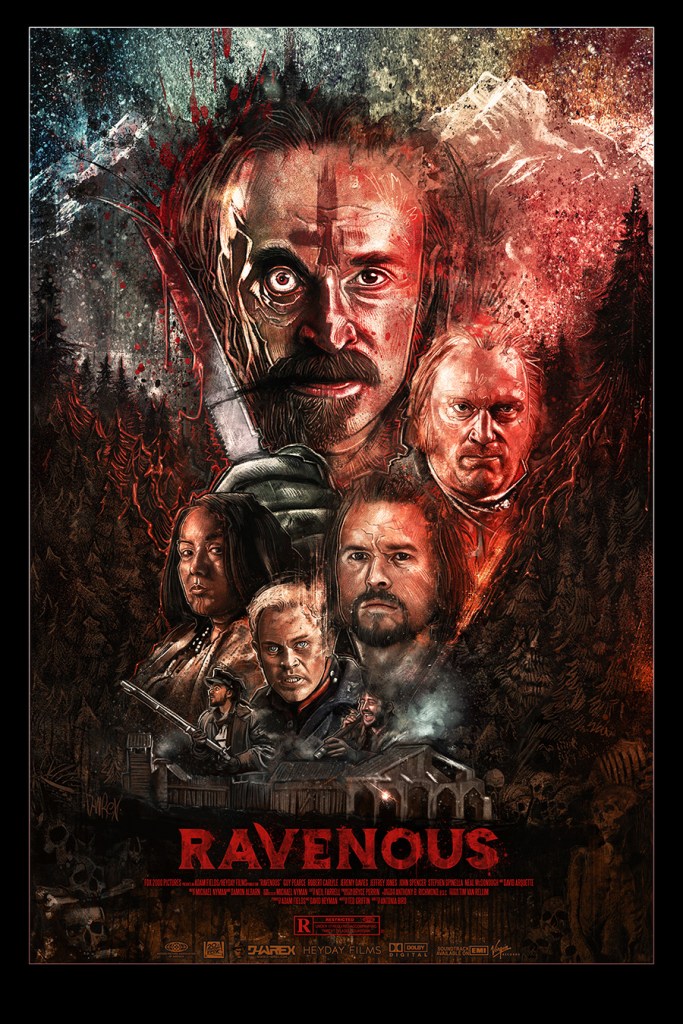
Horror Review: Ravenous (dir. by Antonia Bird)


“Morality… is the last bastion of a coward.” — Colonel Ives

Ravenous remains one of the most fascinating and thematically daring horror films of the late 1990s—a layered meditation on hunger, morality, and the consuming appetite of empire disguised as a tale of survival. Set against the punishing winter backdrop of the Mexican-American War, the film centers on Lieutenant John Boyd, a soldier burdened by cowardice and guilt, sent to an isolated military outpost in the Sierra Nevadas. When a frostbitten stranger stumbles into camp with a horrifying tale of survival, the line between the living and the devoured—and between humanity and monstrosity—begins to blur.

At first glance, Ravenous is a dark horror film about cannibalism in a remote frontier fort. What distinguishes it is the way it transforms that premise into a meditation on civilization and consumption. The screenplay, written by Ted Griffin, draws inspiration from historical accounts such as the Donner Party and Alfred Packer—stories of pioneers who resorted to cannibalism to survive brutal winters. Griffin threads these historical horrors into a broader allegory about 19th-century American expansionism: a national hunger for land, power, and progress that consumes everything in its path, including its own humanity.

The mythological backbone of Ravenous lies in the inclusion of the wendigo, a spirit from Native American folklore. In Algonquin and Ojibwe tradition, the wendigo is born of greed and gluttony, a monstrous being that grows stronger and more grotesque with each act of consumption. The tale served as a warning against selfishness, warning that those who devour others—figuratively or literally—lose their humanity in return. Bird and Griffin seamlessly integrate this legend into the film’s themes, using the wendigo to mirror the psychological and cultural costs of empire. The story implies that the wendigo is not confined to mythic forests but lives in the blood of every nation that feeds on others to survive.

The fort where the story unfolds functions as both a stage and symbol: an outpost of civilization planted in the wilderness, claiming righteousness while sustained by exploitation. As starvation and moral decay take hold, the soldiers’ pretense of order crumbles. The isolated setting reflects the broader American project—civilization advancing through conquest yet losing its moral center in the process. The Native nations displaced and destroyed during expansion, reduced to resources or obstacles, become the unseen victims of this devouring drive. The film reframes cannibalism as a metaphor for Manifest Destiny itself—the act of consuming people, land, and spirit under the guise of progress.

That central metaphor gains power through the film’s performances. Guy Pearce delivers a subdued yet deeply expressive performance as Boyd, embodying the moral paralysis of a man trapped between guilt and survival. His silences, glances, and hesitations speak louder than any dialogue, conveying an internal conflict between virtue and instinct. Through him, the film explores how the will to endure can erode the boundaries of conscience.

Robert Carlyle, as Colonel Ives, stands in vivid contrast—charismatic, witty, and terrifyingly self-assured. He plays the role with the infectious energy of a man liberated by his own monstrosity, wearing sin as philosophy. For Ives, cannibalism is not horror but a revelation—a means to transcend weakness and embrace dominance. His eloquent justifications turn atrocity into ideology, echoing the rationalizations of expansionist politics. It is no coincidence that his confidence parallels Boyd’s doubt; the two men form mirror halves of a single corrupted ideal.

Director Antonia Bird’s touch elevates Ravenous from a historical thriller to a surreal moral fable. She handles violence and absurdity with equal precision, oscillating between grim horror and deadpan humor in a way that keeps viewers uneasy yet enthralled. Her direction never treats the horror as spectacle alone—every moment of gore carries weight, testing the limits of empathy and survival. Moments of unexpected humor punctuate the brutality, serving as a reminder that even atrocity can become ordinary when normalized by power.

While the fusion of dark comedy and horror lends the film its originality, it may also unsettle some viewers. The tonal shifts—helped by Michael Nyman and Damon Albarn’s strange, minimalist score—create an atmosphere that feels intentionally dissonant. This mix may challenge those expecting a traditional horror film, but it reinforces Bird’s vision of moral chaos. The unease generated by those shifts mirrors the absurdity of history itself: how horrors can coexist with banality, how laughter can accompany destruction.

The wendigo myth binds all these elements together. Bird portrays it less as a creature and more as a condition—one that spreads through ideology, greed, and the illusion of progress. The spirit of the wendigo thrives wherever ambition turns men into predators and justifies their violence as destiny. In this sense, every character becomes a reflection of national hunger, caught in a metaphorical cycle of consumption. The act of eating flesh becomes a stand-in for the broader devouring inherent in colonization: of land, of native culture, of moral identity.

By framing the frontier as an arena of both physical and spiritual starvation, Ravenous reimagines American history as a feast of self-destruction. It suggests that survival is often indistinguishable from conquest—both are rooted in the urge to consume. Even at its most surreal or ironic moments, the film refuses to let its viewers forget that the hunger at its center is not merely for sustenance but for dominion.

Though underappreciated upon release, Ravenous has since earned recognition as a rare film that wields gore and satire to expose deeper truths. Bird’s control of tone, Griffin’s allegorical writing, and the actors’ opposing energies fuse into something that transcends genre. The result is a story that both horrifies and compels, holding a cracked mirror to the myth of progress.

The wilderness of Ravenous is vast, beautiful, and pitiless—a perfect reflection of the American spirit it depicts. It is a land that promises renewal but demands devouring, a landscape haunted by the ghosts of all it has consumed. The film endures not simply as a parable of survival, but as a meditation on empire, appetite, and the fragile line separating civilization from savagery.

Both grotesque and profound, Ravenous gnaws not only at flesh but at the conscience, forcing us to confront what happens when hunger—whether for life, for power, or for victory—becomes the only morality left.

Presumed Innocent (1990, directed by Alan J. Pakula)


Harrison Ford stars as Rusty Sabich, a smart and ambitious prosecutor who is accused of murdering his former mistress, Carolyn Polhemus (Greta Scacchi).

A lot of people were taken by surprise when Presumed Innocent first came out in 1990.  After a career of always being the hero and the type of person who took his fate into his own hands, Presumed Innocent featured a passive Harrison Ford whose fate was in the hands of his lawyer, Sandy Stern (Raul Julia) and in the prosecutors who are trying to send him to prison.  For most of the movie, the audience doesn’t know if Rusty is innocent and a lot of what Rusty does makes him seem to be guilty.  Just the fact that Harrison Ford was playing someone who would cheat on his wife (played by Bonnie Bedelia, who everyone had last seen sticking up for Bruce Willis in Die Hard) was considered to be shocking at the time.  It says a lot about Ford’s appeal as an actor that he remains sympathetic even though he’s playing a character who does a lot of bad things.  He remains compelling, even though Rusty is forced to spend a good deal of the movie as a passive spectator.  To anyone who underrates Harrison Ford an actor, this is the film to show them.

Presumed Innocent is a murder mystery but it’s also a sad-eyed look at a corrupt judicial system.  Rusty is accused of murder largely due to the whims of fate.  If Raymond Horgan (Brian Dennehy), Rusty’s former patron, had been reelected as district attorney, Rusty would never have been charged.  When the trial moves to the courtroom, the Judge (Paul Winfield) himself is revealed to have been compromised by his own relationship with Carolyn, something that Sandy is willing to use to the defense’s advantage.  John Spencer plays a detective who is willing to hide evidence to protect Rusty.  Joe Grifasi plays a former detective who is motivated less by the evidence in the case and more by a personal grudge against Rusty.  The idea of getting justice for Carolyn is pushed to the side by everyone’s personal drama.  The ending challenges all of our preconceived notions about Rusty and the meaning of guilt and innocence.

Intelligently directed by Alan J. Pakula and featuring an excellent cast, Presumed Innocent is a top-notch legal thriller and also one of Harrison Ford’s best films.


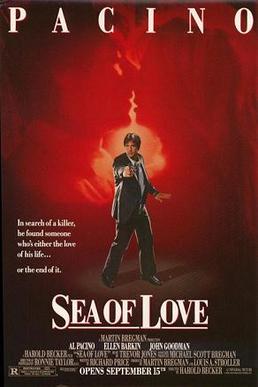
Sea of Love (1989, directed by Harold Becker)


In New York City, someone is ritualistically murdering the men who are placing rhyming personal ads in a tabloid newspaper.  Assigned to the case is Frank Keller (Al Pacino), an alcoholic burn-out whose wife just left him for another cop.  Keller and his partner (John Goodman) decide to go undercover.  Frank places a rhyming personal ad of his own and then goes to a restaurant to see who shows up.  When Helen Cruger (Ellen Barkin) answers the ad, it leads to a relationship between Frank and Helen.  Frank is falling for Helen but what if she’s the murderer?

Sea of Love is a superior thriller, even though it doesn’t really work as a mystery.  As soon as you see a certain person’s name in the cast list, you’re going to guess who the killer is because that person is always the killer.  Sea of Love isn’t really about the mystery, though.  It’s about people looking something that’s missing from their lives and realizing that the world is passing them by.  The movie works because of the performances of Al Pacino and Ellen Barkin, cast as two lonely middle-aged people who are desperately looking for some sort of connection.  Helen and Frank are both in their 40s and wondering if their current situation is really as good as it’s going to get.  The film uses Frank’s fear that Helen could be the killer as a metaphor for the fear that anyone feels when they are first starting to open up to someone.  Both Pacino and Barkin give emotionally raw and poignant performances.  I don’t think I’ve ever seen Al Pacino look as miserable as he did for the majority of Sea of Love.  This was Pacino’s first film role after the disaster of Revolution and the movie’s box office success was revived Pacino’s career and convinced him to give movies a try again.

Director Harold Becker captures the feel of New York at its grittiest and least welcoming and Richard Price’s script is full of priceless dialogue.  This is one of the rare films in which everyone has something intelligent or meaningful to say.  Featuring a strong supporting cast and career-best performances from Ellen Barkin and Al Pacino, Sea of Love is much more than just another cop film.

Retro Television Review: Miami Vice 3.5 “The Good Collar”


Welcome to Retro Television Reviews, a feature where we review some of our favorite and least favorite shows of the past!  On Mondays, I will be reviewing Miami Vice, which ran on NBC from 1984 to 1989.  The entire show can be purchased on Prime!

This week, even more innocent lives are destroyed by an unwinnable war on drugs.

Episode 3.5 “The Good Collar”

(Dir by Mario DiLeo, originally aired on October 24th, 1986)

This week’s episode of Miami Vice tells the story of several wars playing out on the streets of Miami.

One of the wars is the skirmish between two street gangs, made up exclusively of teenagers.  Led by Count Walker (Samuel Graham), the Regular Fellas are pushing drugs and even forcing a promising football star named Archie Ellis (Keith Diamond) to deliver a package of black tar heroin for them.  The Regular Fellas are at war with The Apostles.  Among the members of the Apostles is Ramirez (Jsu Garcia), an undercover cop who is actually 23 but who is pretending to be seventeen.

When Crockett and Tubbs bust Archie, all three of them find themselves dragged into the National War On Drugs.  Assistant State Attorney William Pepin (Terry Kinney) wants to take Count Walker down, if just so he can claim a rare victory.  When Archie helps Crockett and Tubbs make a bust and also saves them from getting shot in a back alley, Pepin agrees to drop all the charges against Archie.  But after Ramirez is blown up by the Regular Fellas, Pepin decides that he’s going to go ahead and charge Archie unless Archie wears a wire and gets Count Walker to confess to his crimes.

Crockett, the former football star, is outraged by Pepin’s decision to put Archie in danger.  Crockett even offers to doctor the records so that Archie’s arrest will be dismissed by the courts.  However, Archie refuses.  Archie says that he’s responsible for his own mistakes and he’ll deal with the consequences.  Unfortunately, in this case, the consequences involve Archie being shot and killed by Count Walker, though not before getting Walker to confess on tape.  Walker is arrested and his gang is destroyed but at the cost of Archie’s life.  Pepin is happy.  Ramierz’s supervisor, Lt. Lee Atkins (John Spencer), is happy.  But social worker Ed McCain (Charles S. Dutton) blames Crockett for Archie’s death.  And Archie’s grandmother slams the door in Crockett’s face when he attempts to come by to pay his final respects.

What a dark episode!  However, it does get to the truth of the matter.  There was no way to win the War on Drugs.  Even the victories in this episode feel hollow.  Regular viewers of Miami Vice would have understood that someone else would eventually step into the vacuum left by Walker’s arrest.  Meanwhile, Archie — a good kid with the athletic talent necessary to win a college scholarship and have a chance to escape from the poverty that he grew up in — is shot and killed because a state’s attorney needed to notch up at least one victory.  Miami Vice was at its best when it was cynical and it doesn’t get much more cynical than this heartbreaking episode.

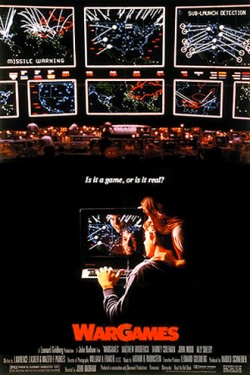
Film Review: Wargames (dir by John Badham)


If you thought Tom Cruise nearly started a war in Top Gun, you should see what Matthew Broderick did three years earlier in Wargames!

In Wargames, Broderick plays David Lighter, a dorky but likable teenager who loves to play video games and who spends his spare time hacking into other computer systems.  (Of course, since this movie was made in 1983, all the computers are these gigantic, boxy monstrosities.)  Sometimes, he puts his skills to good use.  For instance, when both he and Jennifer (Ally Sheedy) are running the risk of failing their biology class, he hacks into the school and changes their grades.  (At first, Jennifer demands that he change her grade back but then, a day later, she asks him to change it again.  It’s kind of a sweet moment and it’s also probably the way I would have reacted if someone had done that for me in high school.)  Sometime, David’s skills get him into trouble.  For instance, he nearly destroys the world.

Now, keep in mind, David really didn’t know what he was doing.  He was just looking for games to play online.  He didn’t realize that he had hacked into NORAD and that Global Thermonuclear War was actually a program set up to allow a gigantic computer named WOPR to figure out how to properly wage a thermonuclear war.  David also doesn’t know that, because humans have proven themselves to be too hesitant to launch nuclear missiles, WOPR has, more or less, been given complete control over America’s nuclear arsenal.

(Wargames actually starts out with a chilling little mini-movie, in which John Spencer and Michael Madsen play two missile technicians who go from joking around to pulling guns on each other during a drill.  Of course, Madsen’s the one ready to destroy the world.)

Of course, the military folks at NORAD freak out when it suddenly appears as if the Russians have launched a nuclear strike against Las Vegas and Seattle.  (Not Vegas!  Though really, who could blame anyone for wanting to nuke Seattle?)  In fact, the only thing that prevents them from launching a retaliatory strike is David’s father demanding that David turn off his computer and take out the trash.  However, WOPR is determined to play through its simulation, which pushes the world closer and closer to war.  (One of the more clever — and disturbing — aspects of the film is that, even after the military learns that the Russians aren’t planning the attack them, they still can’t go off alert because the Russians themselves are now on alert.   Once the war starts, it can’t be stopped even if everyone knows that the whole thing was the result of a mistake.)

With the FBI looking for him, David tries to track down the man who created WOPR, Dr. Stephen Falken (John Wood).  However, Falken is not easy to find and not as enthusiastic about saving the world as one might hope….

Watching Wargames was an interesting experience.  On the one hand, it’s definitely a dated film.  (Again, just look at the computers.)  At the same time, its story still feels relevant.  In Wargames, the problem really isn’t that WOPR wants to play a game.  It’s that men like Dr. John McKittrick (well-played by Dabney Coleman) have attempted to remove the human element and have instead put all of their faith in machines.  The appeal of a machine like WOPR is that it has no self-doubt and does whatever needs to be done without worrying about the cost.  But that’s also the reason why human beings are necessary because the world cannot be run on just algorithms and cold logic.  That’s a theme that’s probably even more relevant today than it was in 1983.

Wargames is also an exceptionally likable film.  In fact, it’s probably about as likable as any film about nuclear war could be.  On the one hand, you’ve got everyone at NORAD panicking about incoming missiles and then, on the other hand, you’ve got David and Jennifer having fun on his computer and trading flirty and silly quips.  Matthew Broderick and Ally Sheedy are both likable in the two main roles.  Broderick brings a lot of vulnerability to the role of David.  (David Lightner is a far more believable teenager than Ferris Bueller.)  He handles the comedic scenes well but he’s even better as David grows increasingly desperate in his attempts to get the stubborn adults around him to actually listen to what he has to say.  When it appears the only way to save the world is to swim across a bay, David is forced to admit that he’s never learned how to swim because he always figured there would be time in the future.  Yes, it’s a funny scene but the way Broderick delivers the line, you understand that David has finally figured out that there’s probably not going to be a future.  It’s not that he doesn’t know how to swim.  It’s that he’ll never get the chance to learn or do anything else for that matter.

Wargames is definitely a film of its time but its themes are universal enough that it’s a film of our time as well.

Stallone Acts: Cop Land (1997, directed by James Mangold)


Garrison, New Jersey is a middle class suburb that is known as Cop Land.  Under the direction of Lt. Ray Donlan (Harvey Keitel), several NYPD cops have made their home in Garrison, financing their homes with bribes that they received from mob boss Tony Torillo (Tony Sirico).  The corrupt cops of Garrison, New Jersey live, work, and play together, secure in the knowledge that they can do whatever they want because Donlan has handpicked the sheriff.

Sheriff Freddy Heflin (Sylvester Stallone) always dreamed of being a New York cop but, as the result of diving into icy waters to save a drowning girl, Freddy is now deaf in one ear.  Even though he knows that they are all corrupt, Freddy still idolizes cops like Donlan, especially when Donlan dangles the possibility of pulling a few strings and getting Freddy an NYPD job in front of him.  The overweight and quiet Freddy spends most of his time at the local bar, where he’s the subject of constant ribbing from the “real” cops.  Among the cops, Freddy’s only real friend appears to be disgraced narcotics detective, Gary Figgis (Ray Liotta).

After Donlan’s nephew, Murray Babitch (Michael Rapaport), kills two African-American teenagers and then fakes his own death to escape prosecution, Internal Affairs Lt. Moe Tilden (Robert De Niro) approaches Freddy and asks for his help in investigating the corrupt cops of Garrison.  At first, Freddy refuses but he is soon forced to reconsider.

After he became a star, the idea that Sylvester Stallone was a bad actor because so universally accepted that people forgot that, before he played Rocky and Rambo, Stallone was a busy and respectable character actor.  Though his range may have been limited and Stallone went through a period where he seemed to always pick the worst scripts available, Stallone was never as terrible as the critics often claimed.  In the 90s, when it became clear that both the Rocky and the Rambo films had temporarily run their course, Stallone attempted to reinvent his image.  Demolition Man showed that Stallone could laugh at himself and Cop Land was meant to show that Stallone could act.

For the most part, Stallone succeeded.  Though there are a few scenes where the movie does seem to be trying too hard to remind us that Freddy is not a typical action hero, this is still one of Sylvester Stallone’s best performances.  Stallone plays Freddy as a tired and beaten-down man who knows that he’s getting one final chance to prove himself.  It helps that Stallone’s surrounded by some of the best tough guy actors of the 90s.  Freddy’s awkwardness around the “real” cops is mirrored by how strange it initially is to see Stallone acting opposite actors like Harvey Keitel, Robert De Niro, and Ray Liotta.  Cop Land becomes not only about Freddy proving himself as a cop but Stallone proving himself as an actor.

The film itself is sometimes overstuffed.  Along with the corruption investigation and the search for Murray Babitch, there’s also a subplot about Freddy’s unrequited love for Liz Randone (Annabella Sciorra) and her husband’s (Peter Berg) affair with Donlan’s wife (Cathy Moriarty).  There’s enough plot here for a Scorsese epic and it’s more than Cop Land‘s 108-minute run time can handle.  Cop Land is at its best when it concentrates on Freddy and his attempt to prove to himself that he’s something more than everyone else believes.  The most effective scenes are the ones where Freddy quietly drinks at the local tavern, listening to Gary shoot his mouth off and stoically dealing with the taunts of the people that he’s supposed to police.  By the time that Freddy finally stands up for himself, both you and he have had enough of everyone talking down to him.  The film’s climax, in which a deafened Freddy battles the corrupt cops of Garrison, is an action classic.

Though the story centers on Stallone, Cop Land has got a huge ensemble cast.  While it’s hard to buy Janeane Garofalo as a rookie deputy, Ray Liotta and Robert Patrick almost steal the film as two very different cops.  Interestingly, many members of the cast would go on to appear on The Sopranos.  Along with Sirico, Sciorra, Patrick, and Garofalo, keep an eye out for Frank Vincent, Arthur Nascarella, Frank Pelligrino, John Ventimiglia, Garry Pastore,  and Edie Falco in small roles.

Cop Land was considered to be a box office disappointment when it was released and Stallone has said that the film’s failure convinced people that he was just an over-the-hill action star and that, for eight years after it was released, he couldn’t get anyone to take his phone calls.  At the time, Cop Land‘s mixed critical and box office reception was due to the high expectations for both the film and Stallone’s performance.  In hindsight, it’s clear that Cop Land was a flawed but worthy film and that Stallone’s performance remains one of his best.


Playing Catch-Up: Crisscross, The Dust Factory, Gambit, In The Arms of a Killer, Overboard, Shy People


So, this year I am making a sincere effort to review every film that I see.  I know I say that every year but this time, I really mean it.

So, in an effort to catch up, here are four quick reviews of some of the movies that I watched over the past few weeks!

  • Crisscross
  • Released: 1992
  • Directed by Chris Menges
  • Starring David Arnott, Goldie Hawn, Arliss Howard, Keith Carradine, James Gammon, Steve Buscemi

An annoying kid named Chris Cross (David Arnott) tells us the story of his life.

In the year 1969, Chris and his mother, Tracy (Goldie Hawn), are living in Key West.  While the rest of the country is excitedly watching the first moon landing, Chris and Tracy are just trying to figure out how to survive day-to-day.  Tracy tries to keep her son from learning that she’s working as a stripper but, not surprisingly, he eventually finds out.  Chris comes across some drugs that are being smuggled into Florida and, wanting to help his mother, he decides to steal them and sell them himself.  Complicating matters is the fact that the members of the drug ring (one of whom is played by Steve Buscemi) don’t want the competition.  As well, Tracy is now dating Joe (Arliss Howard), who just happens to be an undercover cop.  And, finally, making things even more difficult is the fact that Chris just isn’t that smart.

There are actually a lot of good things to be said about Crisscross.  The film was directed by the renowned cinematographer, Chris Menges, so it looks great.  Both Arliss Howard and Goldie Hawn give sympathetic performances and Keith Carradine has a great cameo as Chris’s spaced out dad.  (Traumatized by his experiences in Vietnam, Chris’s Dad left his family and joined a commune.)  But, as a character, Chris is almost too stupid to be believed and his overwrought narration doesn’t do the story any good.  Directed and written with perhaps a less heavy hand, Crisscross could have been a really good movie but, as it is, it’s merely an interesting misfire.

  • The Dust Factory 
  • Released: 2004
  • Directed by Eric Small
  • Starring Armin Mueller-Stahl, Hayden Panettiere, Ryan Kelly, Kim Myers, George de la Pena, Michael Angarano, Peter Horton

Ryan (Ryan Kelly) is a teen who stopped speaking after his father died.  One day, Ryan falls off a bridge and promptly drowns.  However, he’s not quite dead yet!  Instead, he’s in The Dust Factory, which is apparently where you go when you’re on the verge of death.  It’s a very nice place to hang out while deciding whether you want to leap into the world of the dead or return to the land of the living.  Giving Ryan a tour of the Dust Factory is his grandfather (Armin Mueller-Stahl).  Suggesting that maybe Ryan should just stay in the Dust Factory forever is a girl named Melanie (Hayden Panettiere).  Showing up randomly and acting like a jerk is a character known as The Ringmaster (George De La Pena).  Will Ryan choose death or will he return with a new zest for living life?  And, even more importantly, will the fact that Ryan’s an unlikely hockey fan somehow play into the film’s climax?

The Dust Factory is the type of unabashedly sentimental and theologically confused film that just drives me crazy.  This is one of those films that so indulges every possible cliché that I was shocked to discover that it wasn’t based on some obscure YA tome.  I’m sure there’s some people who cry while watching this film but ultimately, it’s about as deep as Facebook meme.

  • Gambit
  • Released: 2012
  • Directed by Michael Hoffman
  • Starring Colin Firth, Cameron Diaz, Alan Rickman, Tom Courtenay, Stanley Tucci, Cloris Leachman, Togo Igawa

Harry Deane (Colin Firth) is beleaguered art collector who, for the sake of petty revenge (which, as we all know, is the best type of revenge), tries to trick the snobbish Lord Shabandar (Alan Rickman) into spending a lot of money on a fake Monet.  To do this, he will have to team up with both an eccentric art forger (Tom Courtenay) and a Texas rodeo star named PJ Puznowksi (Cameron Diaz).  The plan is to claim that PJ inherited the fake Monet from her grandfather who received the painting from Hermann Goering at the end of the World War II and…

Well, listen, let’s stop talking about the plot.  This is one of those elaborate heist films where everyone has a silly name and an elaborate back story.  It’s also one of those films where everything is overly complicated but not particularly clever.  The script was written by the Coen Brothers and, if they had directed it, they would have at least brought some visual flair to the proceedings.  Instead, the film was directed by Michael Hoffman and, for the most part, it falls flat.  The film is watchable because of the cast but ultimately, it’s not surprising that Gambit never received a theatrical release in the States.

On a personal note, I saw Gambit while Jeff & I were in London last month.  So, I’ll always have good memories of watching the movie.  So I guess the best way to watch Gambit is when you’re on vacation.

  • In The Arms of a Killer
  • Released: 1992
  • Directed by Robert L. Collins
  • Starring Jaclyn Smith, John Spencer, Nina Foch, Gerald S. O’Loughlin, Sandahl Bergman, Linda Dona, Kristoffer Tabori, Michael Nouri

This is the story of two homicide detectives.  Detective Vincent Cusack (John Spencer) is tough and cynical and world-weary.  Detective Maria Quinn (Jaclyn Smith) is dedicated and still naive about how messy a murder investigation can be when it involves a bunch of Manhattan socialites.  A reputed drug dealer is found dead during a party.  Apparently, someone intentionally gave him an overdose of heroin.  Detective Cusack thinks that the culprit was Dr. Brian Venible (Michael Nouri).  Detective Quinn thinks that there has to be some other solution.  Complicating things is that Quinn and Venible are … you guessed it … lovers!  Is Quinn truly allowing herself to be held in the arms of a killer or is the murderer someone else?

This sound like it should have been a fun movie but instead, it’s all a bit dull.  Nouri and Smith have next to no chemistry so you never really care whether the doctor is the killer or not.  John Spencer was one of those actors who was pretty much born to play world-weary detectives but, other than his performance, this is pretty forgettable movie.

  • Overboard
  • Released: 1987
  • Directed by Garry Marshall
  • Starring Goldie Hawn, Kurt Russell, Edward Herrmann, Katherine Helmond, Roddy McDowall, Michael G. Hagerty, Brian Price, Jared Rushton, Hector Elizondo

When a spoiled heiress named Joanne Slayton (Goldie Hawn) falls off of her luxury yacht, no one seems to care.  Even when her husband, Grant (Edward Herrmann), discovers that Joanne was rescued by a garbage boat and that she now has amnesia, he denies knowing who she is.  Instead, he takes off with the boat and proceeds to have a good time.  The servants (led by Roddy McDowall) who Joanne spent years terrorizing are happy to be away from her.  In fact, the only person who does care about Joanne is Dean Proffitt (Kurt Russell).  When Dean sees a news report about a woman suffering from amnesia, he heads over to the hospital and declares that Joanne is his wife, Annie.

Convinced that she is Annie, Joanne returns with Dean to his messy house and his four, unruly sons.  At first, Dean says that his plan is merely to have Joanne work off some money that she owes him.  (Before getting amnesia, Joanne refused to pay Dean for some work he did on her boat.)  But soon, Joanne bonds with Dean’s children and she and Dean start to fall in love.  However, as both Grant and Dean are about to learn, neither parties nor deception can go on forever…

This is one of those films that’s pretty much saved by movie star charisma.  The plot itself is extremely problematic and just about everything that Kurt Russell does in this movie would land him in prison in real life.  However, Russell and Goldie Hawn are such a likable couple that the film come close to overcoming its rather creepy premise.  Both Russell and Hawn radiate so much charm in this movie that they can make even the stalest of jokes tolerable and it’s always enjoyable to watch Roddy McDowall get snarky.  File this one under “Kurt Russell Can Get Away With Almost Anything.”

A remake of Overboard, with the genders swapped, is set to be released in early May.

  • Shy People
  • Released: 1987
  • Directed by Andrei Konchalovsky
  • Starring Jill Clayburgh, Barbara Hershey, Martha Plimpton, Merritt Butrick, John Philbin, Don Swayze, Pruitt Taylor Vince, Mare Winningham

Diana Sullivan (Jill Clayburgh) is a writer for Cosmopolitan and she’s got a problem!  It turns out that her teenager daughter, Grace (Martha Plimpton), is skipping school and snorting cocaine!  OH MY GOD!  (And, to think, I thought I was a rebel just because I used to skip Algebra so I could go down to Target and shoplift eyeliner!)  Diana knows that she has to do something but what!?

Diana’s solution is to get Grace out of New York.  It turns out that Diana has got some distant relatives living in Louisiana bayou.  After Cosmo commissions her to write a story about them, Diana grabs Grace and the head down south!

(Because if there’s anything that the readers of Cosmo are going to be interested in, it’s white trash bayou dwellers…)

The only problem is that Ruth (Barbara Hershey) doesn’t want to be interviewed and she’s not particularly happy when Diana and Grace show up.  Ruth and her four sons live in the bayous.  Three of the sons do whatever Ruth tells them to do.  The fourth son is often disobedient so he’s been locked up in a barn.  Diana, of course, cannot understand why her relatives aren’t impressed whenever she mentions that she writes for Cosmo.  Meanwhile, Grace introduces her cousins to cocaine, which causes them to go crazy.  “She’s got some strange white powder!” one of them declares.

So, this is a weird film.  On the one hand, you have an immensely talented actress like Jill Clayburgh giving one of the worst performances in cinematic history.  (In Clayburgh’s defense, Diana is such a poorly written character that I doubt any actress could have made her in any way believable.)  On the other hand, you have Barbara Hershey giving one of the best.  As played by Hershey, Ruth is a character who viewers will both fear and admire.  Ruth has both the inner strength to survive in the bayou and the type of unsentimental personality that lets you know that you don’t want to cross her.  I think we’re supposed to feel that both Diana and Ruth have much to learn from each other but Diana is such an annoying character that you spend most of the movie wishing she would just go away and leave Ruth alone.  In the thankless role of Grace, Martha Plimpton brings more depth to the role than was probably present in the script and Don Swayze has a few memorable moments as one of Ruth’s sons.  Shy People is full of flaws and never really works as a drama but I’d still recommend watching it for Hershey and Plimpton.

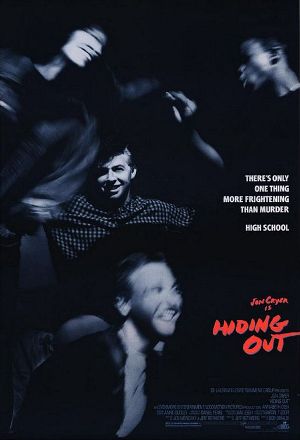
A Movie A Day #342: Hiding Out (1987, directed by Bob Giraldi)


Andrew Morenski (Jon Cryer) is a stockbroker in the 1980s.  What could be better than handling large amount of money during the decade of excess, right?  The only problem is that Andrew and two of his colleagues have gotten involved with Mafia.  And now, the Mafia wants them all dead.  On the run from both the FBI and the Mob, Andrew tries to change his appearance.  He shaves off his beard.  He gives himself a bad dye job.  No sooner has Andrew traded clothes with a homeless person than he is mistaken for a high school student.

What better place could there be for Andrew to hide than a high school?  Despite being 29 years old, Andrew fits right in and soon becomes one of the most popular students at the school.  Andrew not only gets a girlfriend (Annabeth Gish) but he is even nominated to run for student body president.  As Andrew discovers, the mob may be ruthless but they’re nothing compared to the student council.

Hiding Out may begin like a violent action thriller but it quickly reveals itself to be yet another John Hughes-influenced high school movie.  Andrew starts out as a sleazy stockbroker but, by the end of the movie, he has transformed himself into Ferris Bueller.  After spending his teenage years as a self-described “short, horny, hopeless dork,” Andrew is finally getting his chance to be cool.  (“Well, I’m not short,” Andrew says.)  The best scenes are the ones where Andrew occasionally forgets that he’s just supposed to be an apathetic teenager, like when he gets into a fierce argument with his history teacher over whether Richard Nixon should have been forced out of office or when he meets his girlfriend’s father and ends up giving him stock advice.  There’s no denying that the plot is frequently dumb and features some massive plot holes but, largely due to Jon Cryer’s likable and energetic performance, Hiding Out is also a breezy and enjoyable movie.