It’s shaping up to be a strange Oscar race. Here we are halfway through the year and, yet, there are no front-runners. Some very acclaimed films have been released this year and yet, few of them seem to be getting the type of buzz that usually accompanies a surprise Oscar nomination. Last year at this time, there was cautious buzz for Grand Budapest Hotel while almost everyone felt pretty safe assuming that Sundance favorites like Boyhoodand Whiplash would be players in the Oscar race and many of us were highly anticipating the release of films like Birdman and The Imitation Game. (For that matter, a lot of people were also still convinced that Unbroken would win best picture. The buzz is not always correct but still, the buzz was still there.)
This year, some people are hoping that Mad Max: Fury Road will somehow break through the Academy’s aversion to “genre” filmmaking. (And seriously, the Doof Warrior deserves some sort of award, don’t you think?) Quite a few are hoping that Ex Machina will not be forgotten. Personally, I have high hopes for Inside Out.The buzz around Bridge of Spies is respectful, largely because it seems like the type of film that usually would be be nominated. (That said, this film also seems like it could bring out the worst impulses of both Steven Spielberg and Tom Hanks, leading to a movie that will have more in common with The Terminal than with War Horse.) Carol was beloved at Cannes.
So there are definitely possibilities out there. When I made my Oscar predictions for this month, I didn’t quite have to blindly guess as much as I did way back in January. But still, it cannot be denied that — as of right now — this race is wide open and there’s a lot of room for surprise.
Below, you’ll find my Oscar predictions for July. You can also check out my previous Oscar predictions for January, February, March,April, May, and June!
It’s time for our monthly edition of Lisa’s Too Early Oscar predictions!
This is our first entry since the Cannes Film Festival. As a result of Cannes, former contenders like The Sea of Trees have been dropped from the predictions. Meanwhile, new contenders like Michael Caine and Sicario have emerged. I have also added Pixar’s Inside Out to my list of predictions because a 98% rating on Rotten Tomatoes demands the consideration.
(Unfortunately, adding Inside Out meant dropping The Good Dinosaur. Though it could happen, I find it hard to imagine two animated films receiving best picture nominations.)
If you want to see how my feelings on the race have developed, be sure to check out my predictions for January, February, March, April, and May!
And without further ado, here are Lisa’s Too Early Oscar Predictions for June!
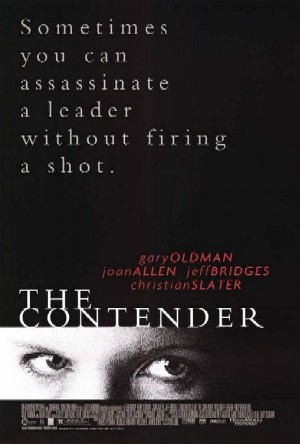
The 2000 political melodrama The Contender is one of the most hypocritical films that I’ve ever seen.
The Contender tells the story of what happens when U.S. Sen. Laine Hanson (played by Joan Allen) is nominated to be vice president by President Jackson Evans (Jeff Bridges). During Laine’s confirmation hearings, Rep. Shelly Runyon (Gary Oldman) dredges up rumors that, at a college frat party, Laine took part in a threesome in exchange for money.
When Runyon asks Laine about the rumors, she replies that she refuses to answer any questions about what she may or may not have done while she was younger. She replies that it is “simply beneath my dignity” and you know what? She’s absolutely right. First off, if someone could be disqualified just because of what they did in college then nobody would eve be eligible to be President. Secondly, and far more importantly, nobody would care about Laine’s sexual history if she was a man.
For over two hours, Laine refuses to answer any questions about the allegations and instead, she turns the tables on her attackers. And while this alone would not have made The Contender a good film (because, after all, The Contender was written and directed by Rod “Straw Dogs” Lurie), it at least would have been a film that I could respect.
But, Rod Lurie being Rod Lurie, he just couldn’t help but fuck it all up.
Towards the end of the film, Laine is attending a White House reception. She and President Evans sit down on the White House lawn and, as the stars shine above them, Evans says, “Just between us, is it true?”
Now, there’s two things that Laine could have said here that would have kept this film from falling apart. Laine could have said, “It’s none of your business.” And that would have been the right thing to say because, quite frankly, it is none of the President’s business. The whole point of the movie has been that it’s not anyone’s business.
Or, if the film actually had any guts, Laine could have said, “Yes, it’s totally true. Like most people, I experimented when I was in college. But that doesn’t have anything to do with whether or not I’m qualified to be your vice president.”
But no. Instead, Laine smiles and says, “Nothing happened. Two guys propositioned me, I said no, and they spread rumors.”
So, basically, the film is saying, “It’s nobody’s business if Laine was sexually active in college but don’t worry, Mr. and Mrs. American Audience, she was a virgin until she turned 30. So, it’s still okay for you to like her…”
And that’s the thing about The Contender. It’s a film that doesn’t have the courage of its own convictions. It’s a film that drags on for over two hours and it expects you to forgive it just because it pretends to have good intentions. As a woman, there’s nothing I hate more than being pandered to and, for all of its attempts to come across as being feminist, The Contender is all about pandering.
What makes The Contender an interesting bad film — as opposed to just your usual bad film — is how even the littlest details feel false. It’s obvious that Lurie knew all of the legal details that go into confirming a Vice President but he didn’t know how to make any of those details dramatically compelling. So, the film becomes a bit of a know-it-all lecture. By the time that Saul Rubinek popped up and said, “Do you know what Nelson Rockefeller said about the vice presidency?,” I found myself snapping back, “No, what did Nelson Rockefeller say about the Vice Presidency? Please tell because ah am so sure that it is just goin’ to be the most fascinatin’ thang that ah will ever hear in mah entire life!”
(The more annoyed I get, the more pronounced my Texas accent.)
There’s a lot of weird little things about The Contender that just don’t work. They may not sound like major problems but when combined together, they start to add up. For instance, there’s a long shot where we see U.S. Rep. Reginald Webster (Christian Slater) and his blonde wife at a White House reception and the shot just lingers on them for no particular reason. Long after you would expect the shot to end, it’s still going. This wouldn’t be an issue if there was some narrative reason for that shot. Instead, it’s just randomly dropped in there.
And then, after Laine is nominated, we see the front page of a newpaper and there, in the middle of the page, is a headshot of Joan Allen. Underneath it, a small headline reads, “It’s Laine!” It just feels so fake. Wouldn’t the nomination of the first female vice present actually rate a bigger headline and a more dynamic picture?
Speaking of fake, towards the end of the film, President Evans picks up a framed magazine cover and stares down at it. The magazine, itself, looks like one of those joke “Man of the Year” pictures that people pose for at a state fair. On the cover is a picture of Last Picture Show era Jeff Bridges. The headline on the magazine reads: “President Jackson Evans. His ideas have changed the world.” Not his actions, mind you. Not his policies. Instead, his ideas have changed the world. But the film shows us no evidence of this and, during Laine’s confirmation hearings, everyone spends the whole time debating the same old shit that they always seem to be debating in Washington.
(Of course, if you’re lucky enough to have a name like Jackson Evans, I guess you might as well become President.)
Of course, when it looks like Laine might not be confirmed, President Evans speaks before Congress. “For the first time, a woman will serve in the executive!” he declares, which seems like a hilariously awkward way to put it. (People in this film don’t talk like human being as much as they talk like characters in some fucked up Washington D.C. fanfic.) He then adds, “There are traitors among us!”
So, I guess the message here is yay for demagogues.
And don’t even get me started on Kathryn Morris, as the cheerful FBI agent who investigates Laine’s past and who, at one point, announces, “Laine is hope!” Would a male FBI agent ever have to deliver a line that stupid?
And also don’t even get me started on the subplot about Gov. Jack Hathaway (William Petersen), who stages an auto accident in an attempt to convince President Evans to nominate him for vice president.
The Contender is not a good film but it could have at least been a respectable film. But then, Rod Lurie had to have President Evans ask whether it was true or not.
Perhaps being a hypocrite was the idea that changed the world.
For our latest entry in the 44 Days of Paranoia, we take a look at Oliver Stone’s 1995 presidential biopic, Nixon.
Nixon tells the life story of our 37th President, Richard Nixon. The only President to ever resign in order to avoid being impeached, Nixon remains a controversial figure to this day. As portrayed in this film, Nixon (played by Anthony Hopkins) was an insecure, friendless child who was dominated by his ultra religious mother (Mary Steenburgen) and who lived in the shadow of his charismatic older brother (Tony Goldwyn). After he graduated college, Nixon married Pat (Joan Allen), entered politics, made a name for himself as an anti-communist, and eventually ended up winning the U.S. presidency. The film tells us that, regardless of his success, Nixon remained a paranoid and desperately lonely man who eventually allowed the sycophants on his staff (including James Woods) to break the law in an attempt to destroy enemies both real and imagined. Along the way, Nixon deals with a shady businessman (Larry Hagman), who expects to be rewarded for supporting Nixon’s political career, and has an odd confrontation with a young anti-war protester who has figured out that Nixon doesn’t have half the power that everyone assumes he does.
Considering that his last few films have been W., Wall Street: Money Never Sleeps, and Savages, I think it’s understandable that I’m often stunned to discover that, at one point in the distant past, Oliver Stone actually was a worthwhile director. JFK, for instance, is effective propaganda. Nixon, which feels a lot like an unofficial sequel to JFK, is a much messier film than JFK but — as opposed to something like Savages — it’s still watchable and occasionally even thought-provoking. Thanks to Hopkins’ performance and, it must be admitted, Stone’s surprisingly even-handed approach to the character, Nixon challenges our assumptions about one of the most infamous and villified figures in American history. It forces us to decide for ourselves whether Nixon was a monster or a victim of circumstances that spiraled out of his control. If you need proof of the effectiveness of the film’s approach, just compare Stone’s work on Nixon with his work on his next Presidential biography, the far less effective W.
(I should admit, however, that I’m a political history nerd and therefore, this film was specifically designed to appeal to me. For me, half the fun of Nixon was being able to go, “Oh, that’s supposed to be Nelson Rockefeller!”)
If I had to compare the experience of watching Nixon to anything, I would compare it to taking 10 capsules of Dexedrine and then staying up for five days straight without eating. The film zooms from scene-to-scene, switching film stocks almost at random while jumping in and out of time, and not worrying too much about establishing any sort of narrative consistency. Surprisingly nuanced domestic scenes between Anthony Hopkins and Joan Allen are followed by over-the-top scenes where Bob Hoskins lustily stares at a White House guard or Sam Waterston’s eyes briefly turn completely black as he discusses the existence of evil. When Nixon gives his acceptance speech to the Republican Convention, the Republican delegates are briefly replaced by images of a world on fire. Familiar actors wander through the film, most of them only popping up for a scene or two and then vanishing. The end result is a film that both engages and exhausts the viewer, a hallucinatory journey through Stone’s version of American history.
After completing The Bourne Ultimatum, Director Paul Greengrass and Actor Matt Damon were probably asked if they’d ever come back to do another. When you look at the overall story, Bourne’s journey was pretty complete, and Damon voiced that he’d only consider doing another if Greengrass did. After Greengrass bowed out, the notion of another chapter in the Bourne saga was dead in the water.
Universal had other ideas, deciding on moving forward and having the trilogy’s screenwriter, Tony Gilroy direct The Bourne Legacy. No stranger to making films, Gilroy is more known for making “slow burn” features like Duplicity and one of my favorites, Michael Clayton. If he were working on a remake to “All the President’s Men”, I’d be certain it was a perfect fit. For Bourne, however, we get something of a different result. Not a terrible one, but possibly not the one that everyone was hoping for. This almost makes sense, considering that even the Bourne novels themselves were taken over by Eric Van Lustbader after Robert Ludlum’s death.
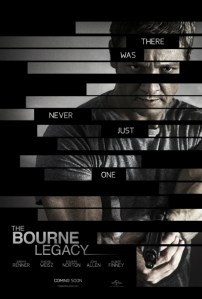
The Bourne Legacy takes place during the same time period as The Bourne Ultimatum. The story expands not on what happened to Bourne post Ultimatum, but what happened to the programs in place in the aftermath of Bourne’s visit to New York. We find Aaron Cross (Jeremy Renner), part of a separate program that goes beyond Treadstone and Blackbriar, making his way through a snowy Alaskan wilderness. The new breed of agents (assets, as they’re referred to in the Bourne Universe) are genetically augmented by way of meds they call “Chems”. The Chems give the assets the edge they need to do what they do.
This bothered me a little, because Jason Bourne got by with none of that for years, but I chalk that part of the storyline to the notion that Gilroy has this thing for Pharmaceuticals and Chemicals. Michael Clayton’s antagonist worked for a Chemical Company. Duplicity’s spies were trying to steal secrets from a pair of what seemed like pharmaceutical companies. The reasoning behind Cross’ need for the Chems is made clear through the story, but it was a strange angle to go on, I felt.
During the course of Aaron’s trip, the Powers That Be, played by, Stacy Keach, Donna Murphy and an underused Edward Norton decide that Bourne’s actions (along with Joan Allen’s Pamela Landy) are going to cause all of their programs some serious trouble and decide to wipe the slate clean. Cross needs to both escape this while still finding a way to get a hold of the Chems he needs to stay at peak performance. That’s the idea behind the Bourne Legacy in a nutshell.
On a casting level, The Bourne Legacy is actually very good. Both Renner and Rachel Weisz handle their parts well, I thought (for what they were given). A few of the cast members return from the previous Bourne films, but their appearances are so brief that it may leave you feeling as if they were just a piece of leftover film from the Original Trilogy. If there’s anyone who feels out of place, it would have to be Edward Norton. He comes across in this movie like he wasn’t sure what he wanted to take on and decided to just do this to pass the time.
The action in the Bourne Legacy is on par with the other films, but this being Gilroy, there’s more of a distance between the action and the drama. When I really think about it, there’s about the same amount of it as there was in The Bourne Identity or Supremacy – neither one of those were die hard action films – but the potential to wish for more is greater with Legacy. This is especially true with the way it was advertised. Just about every action scene in the film is in the trailer. That said, Gilroy has gotten better at being able to handle these scenes. A few more films like this and he should do really well in the future.
Just like Michael Clayton, however, the movie ends so abruptly that you may blink a few times in protest. Gilroy needs to work on that part.
So overall, The Bourne Legacy wasn’t a story that was needed, nor does it really add too much more to the Bourne Universe over all, but it’s nice to return to the espionage that surrounds it. Here’s hoping that this could give something more for Renner, Gilroy and the rest of the team.
When Paul Greengrass completed The Bourne Ultimatumit looked like a perfect ending to the Bourne Series. Despite an ending that could be seen as a way to leave the door open to continue the series most people were content with the series ending as trilogy. That sort of thinking never enters the mind of studio executives who saw the success of this particular trilogy as still bankable even if it meant the filmmaker (Greengrass) and the series’ lead star (Matt Damon) weren’t going to participate.
What we ended up getting was a new lead in Jeremy Renner as another Treadstone-like agent, but one who didn’t have all the glitches that Jason Bourne had. Let’s just say that Renner’s character Aaron Cross would be Jason Bourne 2.0. I wasn’t convinced that a Bournefilm minus Greengrass and Damon would work, but after seeing this latest official trailer from Universal Pictures I’m quite excited about this latest film.
With the success of The Avengersand Mission Impossible: Ghost Protocolwhere Renner had substantial roles in it looks like this latest film in the series could get a nice uptick in the amount of interest it gets from the public. The sort of action Renner’s character goes through in this film one could easily call this Hawkeye: The Early Years. All his character would need would be a nice hi-tech bow.
The Bourne Legacyis set for an August 17, 2012 release date.


 Through the Shattered Lens