Film Review: The FBI Story (dir by Mervyn LeRoy)


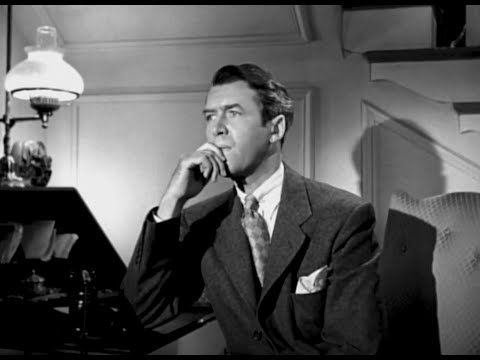
In 1959’s The FBI Story, veteran FBI agent Chip Hardesty (James Stewart) delivers a lecture to a group of new FBI recruits.  He tells them the story of both the FBI and his time as a member of the agency.  Somewhat implausibly, it turns out that Chip was involved with nearly every major FBI operation, as we discover while watching this flashback-filled, episodic film.

Battling the Ku Klux Klan in the Deep South?  Chip was there.

Investigating the Oklahoma Indian murders?  Chip was not only there but he was also the one who solved them through handwriting analysis!  (Decades later, the crimes and the investigation would serve as the basis of Martin Scorsese’s Killers of the Flower Moon.)

During the public enemy era, Chip was there.  He was there when Baby Face Nelson killed several unarmed FBI agents, including Chip’s best friend (Murray Hamilton).  He was there when John Dillinger was gunned down in Chicago.  He was there when my distant ancestor “Pretty Boy” Floyd was killed in Ohio.  He wasn’t there when J. Edgar Hoover personally arrested Alvin Karpis or when “Machine Gun” Kelly said, “Don’t shoot, G-Man!” but Chip still makes sure to tell the recruits about it.  He also talks about the gunfight that killed Ma Barker, presented her as being a machine gun-toting madwoman.

Chip investigates subversives during World War II and helped to round up Americans of German and Japanese descent during the internment era.  (Chip insists that they weren’t rounded up because of their ancestry but because the FBI had gotten reports that they might be disloyal.)   When the war wraps up, Chip turns his attention to fighting the international communist conspiracy and good for him.  (Communism sucks!)

Strangely enough, it appears that Chip also tells the recruits a good deal about his personal life because we certainly do see a lot of it.  Chip marries a librarian named Lucy (Vera Miles), who struggles with the demands of being an FBI agent’s wife but who ultimately accepts that Chip has to do his duty.  Sometimes, Lucy wants Chip to quit and sometimes, Chip is tempted to get out.  But they always remember that Chip and the FBI have a job to do.  They raise a family.  They lose a son at Iwo Jima.  Their faith in God and country remains undiminished.

The FBI Story was made with the full cooperation of the FBI, with J. Edgar Hoover personally approving the script and making suggestions.  Hoover even appeared as himself in the film, accepting a report about an airplane bombing with a grim look on his face.  At one point, Chip is prepared to quit the FBI until he hears a speech from Hoover and he’s so inspired that he keeps his resignation letter tucked away in his suit pocket.  Since this film came out in 1959, there’s no details of the FBI tapping the phones of Martin Luther King or Hoover collecting dirt on his political opponents.  Instead, The FBI Story is pure propaganda, your reminder that law enforcement never makes mistakes and civil liberties can be always be sacrificed for the greater good.

It’s simplistic propaganda and it’s overlong and it promotes a few falsehoods as facts.  (Despite what the film says, Pretty Boy Floyd had nothing to do with the Kansas City Massacre and most historians agree that Ma Barker was not the criminal mastermind that Hoover made her out to be after she was caught in the crossfire between her sons and law enforcement.)  The film rather casually dismisses the concern over the World War II internments of American citizens.  To me, something like that is a big deal but the film insists to us that it was all blown out of proportion.  That’s the one moment when not even the film itself seems to be totally sold on what it’s selling.

Fortunately, the film stars the ever-reliable James Stewart, who brings his natural mix of charm and gravity to the role of Chip Hardesty.  Stewart was a bit too old to play Chip as a bumbling young man in the early part of the film but, as the character grows up, so does Stewart’s performance.  The scene where he and Vera Miles learn that his son has been killed in combat feels like it’s from a different and far better movie.  I guess my point here is that James Stewart was one of those actors who could make even questionable material watchable and that’s certainly what he does with The FBI Story.  The FBI, at a time when Hoover was aging and the excesses of the McCarthy era had left many Americans uneasy about the government, decides to borrow James Stewart’s credibility to boost their own.  You may not like the FBI but how can you not love Jimmy Stewart?

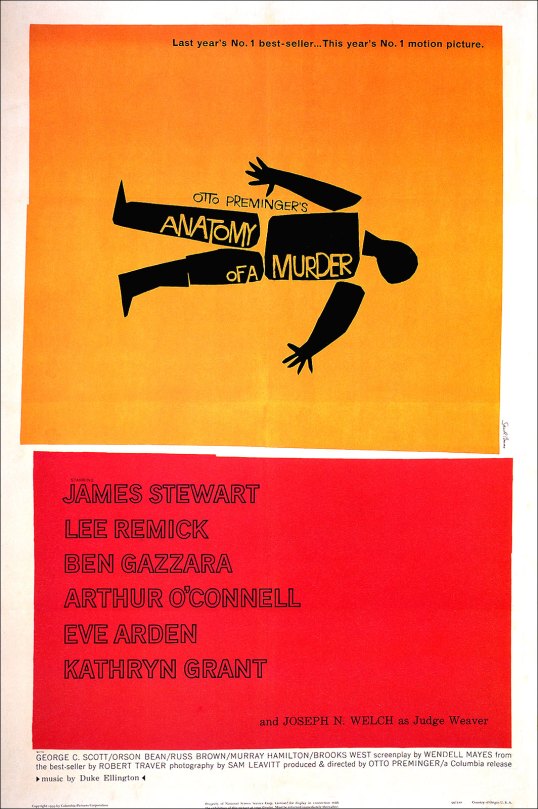
The FBI Story came out the same year as one of Stewart’s best films, Anatomy of a Murder, a film that was a complicated as The FBI Story was simplistic.  Stewart gives one of his best performances in Anatomy of a Murder, playing the type of character that Chip Hardesty probably wouldn’t want to have much to do with.  With these two films, Stewart showed us both sides of the American justice system, the men who are tasked with enforcing the law and, even more importantly, the men who are tasked with making sure that law was enforced fairly.  Whichever side your on, you have to be happy to have Jimmy Stewart there.

Scenes I Love: Jimmy Stewart Sings Somewhere Over The Rainbow in The Philadelphia Story


Today’s scene that I love comes from the 1940 film, The Philadelphia Story, and it features my favorite Golden Age actor, James Stewart, carrying Katharine Hepburn and singing a song that might sound a bit familiar to our readers.

This is the performance, by the way, that won Stewart an Oscar.  Stewart himself often said that he felt the Academy rewarded him to make up for not giving him the Oscar for Mr. Smith Goes To Washington.  That’s probably true but still, this film features Jimmy Stewart at his most charming.  Teaming Stewart up with not just Katharine Hepburn but also Cary Grant makes The Philadelphia Story one of the best romantic comedies to come out of Hollywood’s pre-war era.

(Before the war, Stewart was Jimmy.  After he served bravely in World War II and returned to America, he was definitely James.)

4 Shots From 4 Films: Special James Stewart Edition


4 Shots From 4 Films is just what it says it is, 4 shots from 4 of our favorite films. As opposed to the reviews and recaps that we usually post, 4 Shots From 4 Films lets the visuals do the talking!

Today, we celebrate the birthday of one of the greatest American actors of all time, the wonderful James Stewart!  It’s time for….

4 Shots From 4 James Stewart Films

Mr. Smith Goes To Washington (1939, dir by Frank Capra, DP: Joseph Walker)

It’s A Wonderful Life (1946, dir by Frank Capra, DP: Joseph Walker and Joseph Biroc)

Rear Window (1954, dir by Alfred Hitchcock, DP: Robert Burks)

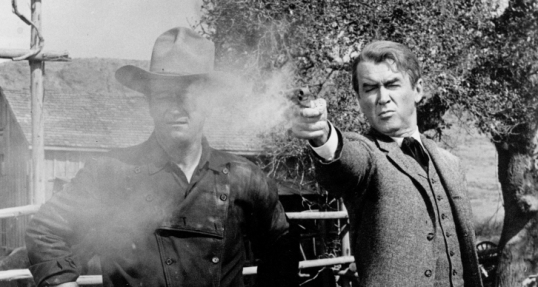
The Man Who Shot Liberty Valance (1962, dir by John Ford. DP: William H. Clothier)

Scenes I Love: James Stewart Explains The Four Ways To Defend Murder In Anatomy of a Murder


On this date, in 1908, James Stewart was born in Pennsylvania.  Over the course of a long career that saw him become a favorite of every director from Frank Capra to John Ford to Alfred Hitchcock to Anthony Mann, Jimmy Stewart gave a series of amazing performances.  My favorite Stewart film is, of course, It’s A Wonderful Life.  But I also love Stewart’s performance in 1959’s Anatomy of a Murder.  Playing a somewhat cynical attorney, Stewart received his final Oscar nomination for Best Actor for his work in this classic and influential film.

In today’s scene that I love, James Stewart explains to his client (played by Ben Gazzara) that there are four ways that he can defend a murder charge.  The contrast between Stewart’s classic style and Gazzara’s intense method style makes for an intense scene between two very talented and unique actors.

Scenes That I Love: Senator Smith Tells Off The Establishment In Frank Capra’s Mr. Smith Goes To Washington


Today is Frank Capra’s birthday!  Capra was born 126 years ago, on this date, in Sicily.

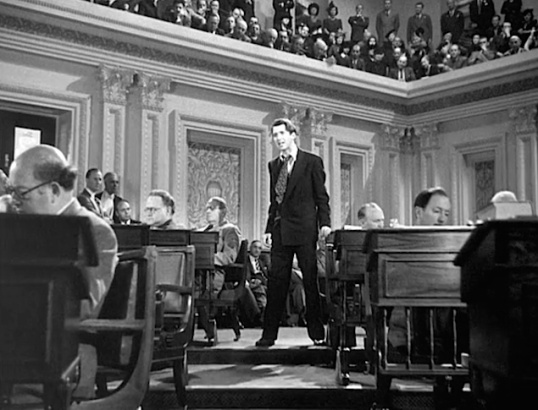
Now, if you’ve been reading this site for a while, you should know that my favorite Capra film is It’s A Wonderful Life.  However, a close second is 1939’s Mr. Smith Goes To Washington.  In today’s scene that I love, Sen. Jefferson Smith (Jimmy Stewart) holds the Senate floor as he denounces the corruption that he sees all around him in Washington.  There’s a reason why Senator Smith is still held up as the ideal public servant.  It’s just a shame that he was a fictional character.

Scenes I Love: The Cross-Examination From Anatomy of a Murder


Since today is Otto Preminger’s birthday, I figured that this would be a good time to share a scene that I love from one of my favorite movies, Preminger’s 1959 film, Anatomy of a Murder.

In this scene, prosecutor Claude Dancer (played, in one of his first screen roles, by George C. Scott) cross-examined Laura Manion (Lee Remick), the wife of a man who has been accused of murder.  Playing the role of the defense attorney is James Stewart.  This scene is a master-class in great acting.  Preminger could be a bit of an inconsistent director but his willingness to take on controversial subjects set him apart from many of his contemporaries.  When he had the right material, as he did here, he could create the perfect mix of melodrama and art.  Preminger’s best films, like Anatomy of a Murder, stand the test of time.

Scene That I Love: The Run From It’s A Wonderful Life (In Memory of James Stewart)


114 years ago today, James Stewart was born in Indiana, Pennsylvania.  In honor of the birth of one of my favorite actors, here is a scene that I love.

From It’s A Wonderful Life:

Suspense Film Review: Rope (dir by Alfred Hitchcock)


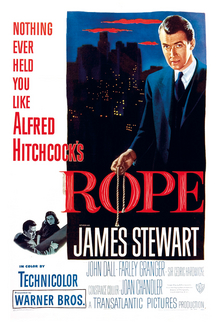
Rope, an odd little 1948 experiment from Alfred Hitchcock, opens with a murder.

Two wealthy young men, Brandon (John Dall) and Philip (Farley Granger), invite their friend, David Kentley (Dick Hogan), up to their apartment.  When David arrives, they strangle him and hide his body in a wooden chest.  As quickly becomes obvious, Brandon and Philip killed David largely to see if they could pull off the perfect murder.  Brandon is sure that they did and, that by doing so, they proved the concept of Nietzsche’s Übermensch,  The alcoholic Philip is less sure and starts drinking.

Brandon and Philip don’t just have murder planned for the day.  They’re also planning on throwing a little dinner party and, among those on the guest list, are David’s parents, his girlfriend, and his girlfriend’s former boyfriend.  Also attending will be Brandon and Philip’s former teacher and housemaster, Rupert Cadell (James Stewart).  In fact, Brandon regularly claims that he got the idea to commit the perfect murder as a result of discussing philosophy with Rupert.  Apparently, Rupert turned Brandon onto Nietzsche….

AGCK!  JIMMY STEWART LEADING YOUNG MEN TO FASCISM!?  SAY IT’S NOT SO!

Well, fortunately, the dinner party conversations reveals that Brandon and Philip misunderstood what Rupert was trying to tell them.  They assumed, using the same type of logic that currently fuels most debate today, that just because Rupert mentioned something that meant that he approved of it.  As it becomes clear that Rupert would not approve of what his students have done and as Rupert himself starts to suspect that something bad has happened at the apartment, Brandon and Philip start to plot against their former mentor….

Now, it can be argued that Rope is not a horror movie.  And indeed, if your definition of horror is ghosts, vampires, werewolves, or any other type of paranormal creature than yes, Rope has none of those.  Instead, the horror of Rope is the horror of human cruelty.  It’s the horror of two privileged young men who have so twisted the words of their mentor that they’ve become monsters.  The horror in Rope comes from the fact that, in 1948, Brandon and Philip have embraced the same philosophy that, only a few years earlier, had plunged the entire world into war.  While families mourned their dead and Europe struggled to rebuild, Brandon and Philip showed that they had no understanding of or concern for the trauma that humanity had just suffered.  And making it even more disturbing is that they found the justification for their crimes in the lessons taught by the epitome of American decency, Jimmy Stewart.  The idea of that is more terrifying than any Hammer vampire flick.

Of course, Rope is best known for being a bit of an experiment.  Hitchcock edited the film to make it appear as if it was all shot in one take and events, therefore, played out in real time.  It’s an interesting idea and, as always, you have to admire Hitchcock’s ingenuity and, even in a film as grim as this one, his playfulness.  At the same time, Hitchcock’s technique makes an already stagey story feel even stagier.  Some of the actors — like James Stewart, John Dall, and Cedric Hardwicke in the role of David’s father — are able to give naturalistic and convincing performances despite the staginess of the material. Others, like poor Farley Granger, find themselves overshadowed by the film’s one-shot gimmick.

Rope is an experiment that doesn’t quite work but flawed Hitchcock is still a pleasure to watch.  The final few minutes, with Stewart and Dall finally confronting each other, are among the best that Hitchcock ever put together.  I appreciate Rope, even if it doesn’t quite succeed.

Scenes That I Love: The Phone Call From Sam Wainwright From It’s A Wonderful Life


Tonight, NBC will be airing It’s A Wonderful Life.

Watching It’s A Wonderful Life on Christmas Eve is a tradition for many people.  It definitely is for me and my family.  I’ve watched It’s A Wonderful Life so many times that I’ve practically got the entire movie memorized.  It’s not only my favorite Christmas movie but also one of my favorite movies of all time.

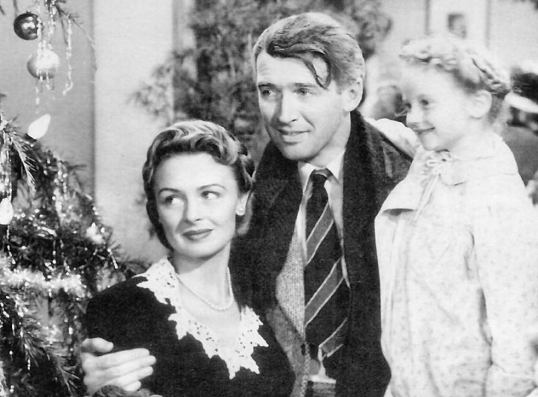
Everyone knows, of course, that It’s A Wonderful Life is a film about a man named George (played by Jimmy Stewart) who gets a chance to see what the world would be like without him.  What I think is often overlooked is that it’s also a powerful and poignant love story and that the scenes between George and Mary (Donna Reed) are some of the most intensely romantic ever filmed.

In the scene below, George and Mary get a phone call from Mary’s ex, Sam Wainwright.  Sam has a business opportunity but George has more on his mind than staying in Bedford Falls and making money.  This scene, which begins with Mary upset and George feeling lost, ends with one of the most powerful kisses of the 1940s.

This is a scene that I love from a movie that I love and I look forward to watching it tonight!

The Stratton Story (1949, dir. by Sam Wood)


Monty Stratton was one of the greats.

He was a Texas farmboy who knew how to throw a baseball.  Recruited by the Chicago White Sox, he spent five years in the majors.  From 1934 through 1938, he compiled a 36–23 record with 196 strikeouts and a 3.71 ERA in 487.1 innings.  In 1937, he won 15 games with a 2.40 ERA and five shout-outs.  The next season, he won another 15 games and completed 17 of his 22 starts.  For those of you who might not speak baseball, that all means that he was a really good right-handed pitcher.

When Stratton wasn’t playing baseball, you could find him down on his farm in Greenville, Texas.  He lived there with his wife, Ethel.  On November 27th, 1938, Monty Stratton was hunting rabbits when he accidentally shot himself in his right leg.  While Stratton survived the shooting, his leg was amputated, bringing Stratton’s major league career to an end.

No longer able to play in the majors, Monty Stratton spent the next few years as a pitching coach and helping to start a semi-pro team in Greenville.  With the help and encouragement of his wife, he continued to practice his pitching and he eventually trained himself to the point where he could transfer his weight effectively onto his artificial leg so that he could effectively throw a baseball.  In 1947, Monty Stratton made a comeback, pitching in the minors and ending the season with an 18–8 record and a 4.17 earned run average.  Stratton spent the next six years pitching in the minors before retiring from the game.  He went on to start the Greenville Little League program.  If you go to Greenville, you can still find Monty Stratton Field near Greenville High School.

The Stratton Story was made in 1949, shortly after Stratton’s comeback and while he was still playing in the minors.  James Stewart plays Monty Stratton while June Allyson plays his wife.  The movie follows Stratton from his early days on the farm through his major league career, his accident, and his eventual comeback.  Though the real Monty Stratton served as a technical advisor to the film, I don’t know how historically accurate it was.  The movie, for instance, seemed to condense the timeline so that it seemed like Stratton went straight from losing his leg to practicing for his comeback when it actually took ten years for Stratton to eventually get signed to a minor league team.  Even if it does take some liberties from the facts, The Stratton Story is still a good movie.  The baseball scenes are great and Jimmy Stewart is convincing when he’s throwing the baseball.  He’s also convincing in the scenes where Stratton sinks into a dark depression after losing his leg.  Stewart was so good in the role that, when Stratton finally started to practice his pitching again, I wanted to jump up and cheer.

I liked The Stratton Story.  It probably helps that I love baseball but it’s also a good movie about an inspiring story.