Masters of the Universe (1987, directed by Gary Goddard)


On the distant planet Eternia, the evil Skeletor (Frank Langella) has finally taken over Castle Grayskull and imprisoned the Sorceress (Christina Pickles).  When He-Man (Dolph Lundgren) and his allies Teela (Chelsea Field), Man-At-Arms (Jon Cypher), and Gwildor (Billy Barty) launch a rescue mission, they find themselves overwhelmed by Skeletor’s forces and are forced to use an interdimensional key to escape.

He-Man and his friends end up in 1980s California.  The key is lost in the process and discovered by two teenagers, one of whom is played by a pre-Friends Courteney Cox.  Skeletor sends Evil-Lyn (Meg Foster), Beast Man (Tony Carroll), and a host of other henchmen after the key.

The first (and, as of this writing, only) live action film to be based on the famous Mattel action figures, Masters of the Universe was produced by Cannon and it should have been a lot better than it actually was.  The idea of He-Man and Skeletor in modern-day California was a good one and it’s easy to imagine scenes of He-Man and Skeletor wandering around downtown Los Angeles and being as shocked by the locals as the locals are by them.  Big, blonde Dolph Lundgren seemed like the ideal pick for the role of He-Man.  Best of all, from the perspective of many, is that there was no Orko.  The most annoying member of the He-Man ensemble was left out of the film.  (Billy Barty’s Gwildor may have sometimes been annoying but he was still better than Orko.)

Unfortunately, the movie did not live up to anyone’s expectations.  Taking more inspiration for Star Wars and Conan than from any of the He-Man mythology, Cannon’s version of Masters of the Universe is a generic action movie in which He-Man is reduced to being just another forthright hero with a sword.  (He’s not Prince Adam in this movie.  He’s just He-Man.)   Teela doesn’t even wear her famous costume.  The main problem with Masters of the Universe is that so few of the Masters actually appear in the movie.  This was a Cannon/Mattel co-production but apparently, Mattel was stingy when it came to delivering their half of the budget.  There wasn’t enough money to bring He-Man’s rogue’s gallery (not to mention the majority of his allies) to life.  The means no Trap-Jaw and no Mer-Man.  Not even Ram Man makes the cut and this movie could have really used Ram Man.

Fortunately, Skeletor and Evil-Lyn are present to pick up the slack.  (When it came to the Masters of the Universe franchise as a whole, the villains were always more entertaining than the heroes.)  With the help of a surprisingly convincing makeup job that give him a skull face, Frank Langella appears to be having the time of his life as the evil Skeletor and I wasn’t surprised to recently read that this was one of Langella’s favorite roles.  Langella seems to having a blast playing such a thoroughly evil and cartoonish character and his scenes have a playful energy that the rest of the film is lacking.  Meg Foster, she of the piercing eyes, is the perfect choice for Evil-Lyn and is magnetically evil.  They provide some of the most entertaining villainy since Max von Sydow announced, “Klytus, I’m bored,” at the start of Flash Gordon.

Masters of the Universe was a critical failure when it was released in 1987, which isn’t a surprise.  A film based on a toy line and a children’s cartoon?  Maybe that would be an Oscar nominee today but, in 1987, there was no way the critics were going to go for it.  But Masters of the Universe was also a box office failure, one of many high-profile Cannon films that failed to score when it was first released.  (It did find a cult following when it was released on video.)  A proposed sequel — in which Lundgren would be replaced as He-Man by surfer Laird Hamilton — was abandoned.  The sets that had been built for Masters of the Universe 2 were instead used for Cyborg, starring Jean-Claude Van Damme.

A new live action Masters of the Universe film is scheduled to be released in 2026.  Jared Leto will be playing Skeletor.  That is probably all that needs to be said.


Days of Paranoia: Serpico (dir by Sidney Lumet)


In 1973’s Serpico, Al Pacino plays a cop who doesn’t look like a cop.

Indeed, that’s kind of the start of Frank Serpico’s problems.  He’s a New York cop who doesn’t fit the stereotype.  When we see him graduating from the Academy, he’s clean-shaven and wearing a standard patrolman uniform and he definitely looks like a new cop, someone who is young and enthusiastic and eager to keep the streets safe.  However, Serpico is an outsider at heart.  The rest of the cops have their homes in the suburbs, where they spend all of their time with their cop buddies and where they go also go out of their way not to actually live among the people that they police.  Serpico has an apartment in Greenwich Village and, as a plainclothes detective, he dresses like a civilian.  He has a beard.  He has long hair.  He has a succession of girlfriends who don’t have much in common with the stereotypical (and there’s that word again) cop’s wife.  Serpico is an outsider and he likes it that way.  In a world and a career that demands a certain amount of conformity, Frank Serpico is determined to do things his own way.

However, the real reason why Serpico is distrusted is because he refuses to take bribes.  While he’s willing to silently accompany his fellow officers while they collect their payoffs from not only the people that they’re supposed to be arresting but also from the storeowners that they’re meant to be protecting, Serpico refuses to take a cut.  Serpico understands that the small, everyday corruption is a way of forcing his silence.  The corruption may help the cops to bond as a unit but it also ensures that no one is going to talk.  Serpico’s refusal to take part makes him untrustworthy in the eyes of his fellow cops.

Serpico and Bob Blair (Tony Roberts), a politically-connected detective, both turn whistleblower but it turns out that getting people to listen to the truth is not as easy as Serpico thought it would be.  The Mayor’s office doesn’t want to deal with the political fallout of a police conspiracy.  Serpico finds himself growing more and more paranoid, perhaps with good reason.  When words gets out that Serpico has attempted to turn into a whistleblower, his fellow cops start to turn on him and, during a drug bust, Serpico finds himself deserted and in danger.

Serpico opens with its title character being rushed to the hospital after having been shot in the face.  This actually happened to the real Serpico as well.  What the film leaves out is that hundreds of New York cops showed up at the hospital, offering to donate blood during Serpico’s surgery.  That’s left out of the film, which at times can be more than a little heavy-handed in its portrayal of Serpico as an honest cop surrounded by nonstop corruption.  Filmed just three years after Serpico testified before New York’s Knapp Commission (which was the five-man panel assigned to investigate police corruption in the city), Serpico the movie can sometimes seem a bit too eager to idealize its title character.  (Vincent J. Cannato’s excellent look at the mayorship of John V. Lindsay, The Ungovernable City, presents far more nuanced look at the NYPD corruption scandals of the early 70s and Serpico’s role as a whistleblower.)  Director Sidney Lumet later expressed some dissatisfaction with the film and even made other films about police corruption — The Prince of the City, Q & A, Night Falls On Manhattan — that attempted to take a less heavy-handed approach to the subject.

That said, as a film, Serpico works as a thriller and as a portrait of a man who, because he refuses to compromise his ideals, finds himself isolated and paranoid.  Al Pacino, fresh from playing the tightly-controlled Michael Corleone in The Godfather, gives an intense, emotional, and charismatic performance as Serpico.  (One can see why the image of a bearded, hippie-ish Pacino was so popular in the 1970s.)  Sidney Lumet brings the streets of New York to vibrant and dangerous life and he surrounds Pacino with an excellent supporting cast, all of whom bring an authentic grit to their roles.  Serpico may not be a totally accurate piece of history but it is a good work of entertainment, one that works as a time capsule of New York in the 70s and as a portrait of bureaucratic corruption.  It’s also the film in which Al Pacino announced that he wasn’t just a good character actor.  He was also a movie star.

Retro Television Review: Miami Vice 4.2 “Amen …. Send Money”


Welcome to Retro Television Reviews, a feature where we review some of our favorite and least favorite shows of the past!  On Mondays, I will be reviewing Miami Vice, which ran on NBC from 1984 to 1989.  The entire show can be purchased on Prime!

This week, Miami Vice takes an unwelcome detour.

Episode 4.2 “Amen …. Send Money”

(Dir by James Quinn, originally aired on October 2nd, 1987)

This was pretty dumb.

Tubbs, working undercover, busts Leona Proverb (Anita Morris), who just happens to be the wife of Billy Bob Proverb (Brian Dennehy).  Billy Bob is a television preacher who continually asks his followers to send him cash so he can live the lifestyle that he says God wants him to live.  On paper, this sounds like a great role for Brian Dennehy but this episode’s script lets him (and, for that matter, everyone else in the cast) down.  Somehow, the fact that the guy is named Billy Bob Proverb is the least heavy-handed aspect of this episode.

Faye Nell (Jo Anderson), who is one of Billy Bob’s followers, calls Tubbs to the studio and says she has information on what the Proverbs are doing.  As soon as Tubbs shows up, Faye tosses herself on him, rips her dress, and starts to yell, “Rape!”  Tubbs finds himself being investigated by Internal Affairs while Faye claims that God told her to call Tubbs down to the studio and she even passes a lie detector test.

“I’m being set up by a preacher!” an angered Tubbs says but it turns out that Billy Bob Proverb is not the one behind all of Tubbs’s problems.  In fact, Billy Bob is actually sincere, in his own strange way.  Instead, the villain turns out to be another television preacher, Mason Mather (James Tolkan).  Mather has the ability to make himself go into a coma, which makes it difficult to arrest him.

Before I started watching this season, I read online that season 4 featured some of Miami Vice‘s worst episodes.  Amen …. Send Money feels almost like a parody of Miami Vice.  The episode itself is meant to be largely comedic and perhaps if this episode had centered on Switek and Zito instead of Crockett and Tubbs, it would have worked.  Unfortunately, the show killed off Zito last season so instead, it’s Crockett and Tubbs making odd jokes and rolling their eyes in shock.  The thing is, Miami Vice has — up until this episode — been a show about ruthless dealers and the futility of the War on the Drugs.  The thing that set Miami Vice apart from other 80s cop shows was that it was thematically dark, the endings were frequently unhappy, and Crockett and Tubbs were always the epitome of cool, no matter what happened.  This episode features cartoonish villains and a silly plot and both Crockett and Tubbs come across as being a little …. well, dorky.

(On the plus side, the show does continue its tradition of featuring future stars by giving Ben Stiller a small role as a con artist.)

Oh well.  Not every episode can be a great one.  Hopefully, next week will be an improvement.

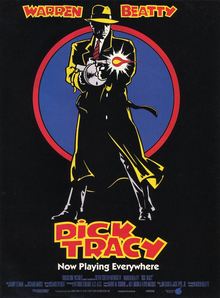
Dick Tracy (1990, directed by Warren Beatty)


The year is 1937 and “Big Boy” Caprice (Al Pacino) and his gang of flamboyant and often disfigured criminals are trying to take over the rackets.  Standing in their way is ace detective Dick Tracy (Warren Beatty), the yellow trench-wearing defender of the law.  Tracy is not only looking to take down Caprice but he and Tess Trueheart (Glenne Headly) are currently the guardians of The Kid (Charlie Korsmo), a young street kid who witnessed one of Caprice’s worst crimes.  Tracy’s investigation leads him through a rogue’s gallery of criminals and also involves Breathless Mahoney (Madonna), who has witnessed many of Caprice’s crimes but who also wants to steal Tracy’s heart from Tess.

Based on the long-running comic strip, Dick Tracy was a labor of love on the part of Warren Beatty.  Not only starring but also directing, Tracy made a film that stayed true to the look and the feel of the original comic strip (the film’s visual palette was limited to just seven colors) while also including an all-star cast the featured Madonna is an attempt to appeal to a younger audience who had probably never even heard of Dick Tracy.  When Dick Tracy was released, the majority of the publicity centered around Madonna’s participation in the film and the fact that she was dating Beatty at the time.  Madonna is actually probably the weakest element of the film.  More of a personality than an actress, Madonna is always Madonna no matter who she is playing and, in a film full of famous actors managing to be convincing as the members of Dick Tracy’s rogue gallery, Madonna feels out of place.  Michelle Pfeiffer would have been the ideal Breathless Mahoney.

It doesn’t matter, though, because the rest of the film is great.  It’s one of the few comic book films of the 90s to really hold up, mostly due to Beatty’s obvious enthusiasm for the material and the performances of everyone in the supporting cast who was not named Madonna.  Al Pacino received an Oscar nomination for playing Big Boy Caprice but equally good are Dustin Hoffman as Mumbles, William Forsythe as Flaptop, R.G. Armstong as Pruneface, and Henry Silva as Influence.  These actors all create memorable characters, even while acting under a ton of very convincing makeup.  I also liked Dick Van Dyke as the corrupt District Attorney.  Beatty knew audience would be shocked to see Van Dyke not playing a hero and both he and Van Dyke play it up for all its worth.  Beatty embraces the comic strip’s campiness while still remaining respectful to its style and the combination of Danny Elfman’s music and Stephen Sondheim’s songs provide just the right score for Dick Tracy’s adventures.  The film can be surprisingly violent at times but the same was often said about the Dick Tracy comic strip.  It wasn’t two-way wrist radios and trips to the Moon.  Dick Tracy also dealt with the most ruthless and bloodthirsty gangsters his city had to offer.

Dick Tracy was considered to be a box office disappointment when it was originally released.  (Again, you have to wonder if Beatty overestimated how many fans Dick Tracy had in 1990.)  But it holds up well and is still more entertaining than several of the more recent comic book movies that have been released.

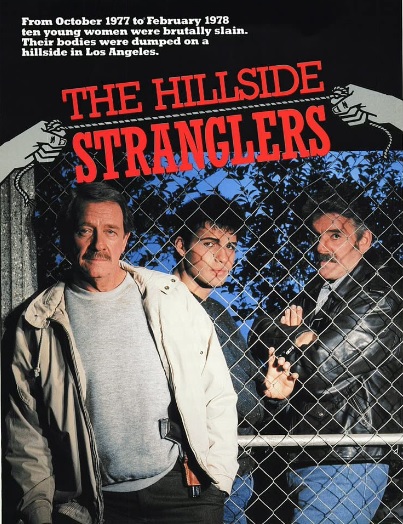
October True Crime: The Case of the Hillside Stranglers (dir by Steve Gethers)


1989’s The Case of the Hillside Stranglers is based on the killing spree of Angelo Buono and Kenneth Bianchi, two cousins who terrorized Los Angeles in the late 70s.  Buono owned his own garage and aspired to be a tough and macho pimp.  Bianchi was an aspiring police officer who supported himself as a security guard.  Over the course of just five months, they murdered ten women.  They probably would never have been caught if not for the fact that Buono eventually tired of Bianchi and kicked him out of his house.  Bianchi moved up to Washington where he committed two murders on his own.  When he was arrested, he attempted to convince the cops that he was suffering from dissociative identity disorder and that the murders were committed by his other personalities.

The Case of the Hillside Stranglers starts with the murder spree already in progress.  Buono is played by Dennis Farina while Bianchi is played by a very young Billy Zane.  Both of them are well-cast, with Farina especially making an impression as a misogynistic bully who thinks that he is untouchable.  (In real life, Farina spent 18 years as a Chicago cop and, watching his performance in this film, it’s hard not to get the feeling that he had to deal with more than one guy like Angelo Buono over the course of his time on the force.) For all of their cockiness, the film emphasizes that neither Angelo nor Kenneth were particularly clever.  The fact that they got away with their crimes for as long as they did was largely due to a combination of luck and witnesses who did not want to get involved.  Early on in the film, one woman who is harassed and nearly abducted by Buono and Bianchi refuses to call the police afterwards because she doesn’t want to relive what happened.

That said, the majority of the film actually focuses on Bob Grogan (Richard Crenna), the tough veteran detective who heads up the Hillside Strangler taskforce and who becomes so obsessed with tacking down the elusive killers that he soon finds himself neglecting both his family and his own health.  Whenever we see Grogan trying to enjoy any quality time with his children, we know that his beeper is going to go off and he’s going to have to search for a telephone so that he can call into headquarters.  (Remember, this film was set in the 70s.)  His children are a bit miffed about it, which I can understand though I really do have to say that his son, in this film, really does come across as being a brat.  (“Just ignore it, Dad,” he says, as if there aren’t two serial killers murdering innocent people in the city.)  The recently divorced Grogan pursues a tentative romance with a woman (played by Karen Austin) who, at one point, decides to investigate Angelo on her own.  Crenna, not surprisingly, is sympathetic as Grogan.  The film works best as an examination of what it does to one’s soul to spend all day investigating the worst crimes that can be committed.  Grogan gets justice but, the film suggests, he does so at the sacrifice of his own peace of mind.

It’s a well-made and well-acted film, one that will probably appeal more to fans of the police procedural genre as opposed to those looking for a grisly serial killer film.  In real life, Bianchi is serving a life sentence and Angelo Buono died in prison.  And the real Bob Grogan?  He appeared in this movie, slapping the handcuffs on Billy Zane.

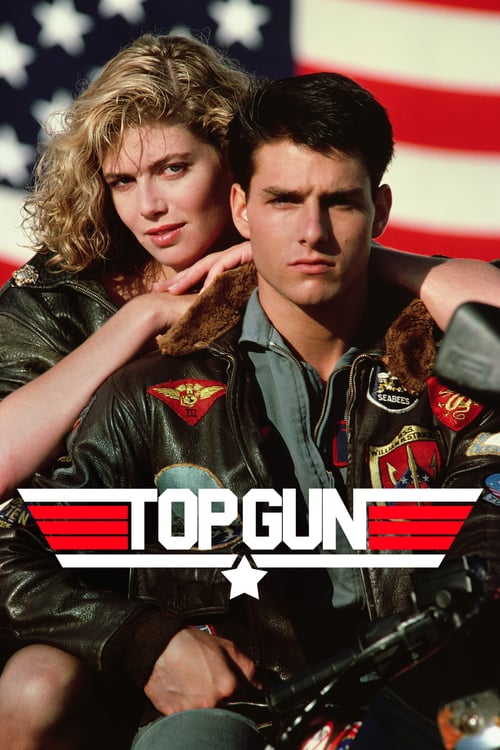
Film Review: Top Gun (dir by Tony Scott)


Oh, where to even begin with Top Gun?

First released in 1986, Top Gun is a film that pretty much epitomizes a certain style of filmmaking.  Before I wrote this review, I did a little research and I actually read some of the reviews that were published when Top Gun first came out.  Though it may be a considered a classic today, critics in 1986 didn’t care much for it.  The most common complaint was that the story was trite and predictable.  The film’s reliance on style over substance led to many critics complaining that the film was basically just a two-hour music video.  Some of the more left-wing critics complained that Top Gun was essentially just an expensive commercial for the military industrial complex.  Director Oliver Stone, who released the antiwar Platoon the same year as Top Gun, said in an interview with People magazine that the message of Top Gun was, “If I start a war, I’ll get a girlfriend.”

Oliver Stone was not necessarily wrong about that.  The film, as we all know, stars Tom Cruise as Pete “Maverick” Mitchell, a cocky young Navy flyer who attends the TOPGUN Academy, where he competes with Iceman (Val Kilmer) for the title of Top Gun and where he also spends a lot of time joking around with everyone’s favorite (and most obviously doomed) character, Goose (Anthony Edwards).  Maverick does get a girlfriend, Charlie (Kelly McGillis), but only after he’s had plenty of chances to show both how reckless and how skilled he can be while flying in a fighter plane.  Though the majority of the film is taken up with scenes of training and volleyball, the end of the film does give Maverick a chance to prove himself in combat when he and Iceman end up fighting a group of ill-defined enemies for ill-defined reasons.  It may not be an official war but it’s close enough.

That said, I think Oliver Stone was wrong about one key thing.  Maverick doesn’t get a girlfriend because he started a war.  He gets a girlfriend because he won a war.  Top Gun is all about winning.  Maverick and Iceman are two of the most absurdly competitive characters in film history and, as I watched the film last weekend, it was really hard not to laugh at just how much Cruise and Kilmer got into playing those two roles.  Iceman and Maverick can’t even greet each other without it becoming a competition over who gave the best “hello.”  By the time the two of them are facing each other in a totally savage beach volleyball match, it’s hard to look at either one of them without laughing.  And yet, regardless of how over-the-top it may be, you can’t help but get caught up in their rivalry.  Cruise and Kilmer are both at their most charismatic in Top Gun and watching the two of them when they were both young and fighting to steal each and every scene, it doesn’t matter that both of them would later become somewhat controversial for their off-screen personalities.  What matters, when you watch Top Gun, is that they’re both obviously stars.

“I’ve got the need for speed,” Tom Cruise and Anthony Edwards say as they walk away from their plane.  The same thing could be said about the entire movie.  Top Gun doesn’t waste any time getting to the good stuff.  We know that Maverick is cocky and has father issues because he’s played by Tom Cruise and Tom Cruise always plays cocky characters who have father issues.  We know that Iceman is arrogant because he’s played by Val Kilmer.  We know that Goose is goofy because his nickname is Goose and he’s married to Meg Ryan.  The film doesn’t waste much time on exploring why its characters are the way they are.  Instead, it just accepts them for being the paper-thin characters that they are.  The film understands that the the most important thing is to get them into their jets and sends them into the sky.  Does it matter that it’s sometimes confusing to keep track of who is chasing who?  Not at all.  The planes are sleek and loud.  The men flying them are sexy and dangerous.  The music never stops and the sun never goes down unless the film needs a soulful shot of Maverick deep in thought.  We’ve all got the need for speed.

In so many ways, Top Gun is a silly film but, to its credit, it also doesn’t make any apologies for being silly.  Instead, Top Gun embraces its hyperkinetic and flashy style.  That’s why critics lambasted it in 1986 and that’s why we all love it in 2020.  And if the pilots of Top Gun do start a war — well, it happens.  I mean, it’s Maverick and Iceman!  How can you hold it against them?  When you watch them fly those planes, you know that even if they start World War III, it’ll be worth it.  If the world’s going to end, Maverick’s the one we want to end it.


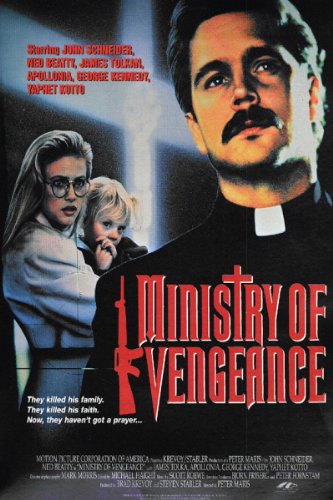
Ministry of Vengeance (1989, directed by Peter Maris)


David Miller (John Schneider) is a former soldier who served in the Vietnam War.  Though David managed to survive the war, the majority of his platoon did not and he is still haunted by the day when he was forced to blow up a kid who was working for the VC.  After getting out of the army, David renounces violence and war and he becomes an Episcopal priest.  (His denomination is never really made clear but he wears a collar and he’s got a family so I assume he’s Episcopal.)  He marries Gail (Meg Register) and they have a daughter named Kim (Joey Peters).  Eventually, the Millers find themselves in Rome, where David works with a kindly minister named Hughes (George Kennedy) and preaches the word of the God and the gospel of nonviolence.

Unfortunately, the Millers just happen to be in an airport when it’s attacked by a group of terrorists led by Ali Aboud (Robert Miano).  As David watches, Aboud personally executes his wife and daughter.  Though David survives the attack because Aboud says, “Leave the priest alive!,” his faith is shaken and he goes from renouncing violence to renouncing peace.  After the local CIA agent (Yaphet Kott) refuses to tell David the name or the location of the terrorist who killed his family, David just happens to open up a magazine and finds himself staring at a picture of Ali Aboud.  Ministry of Vengeance may claim to be about faith but it’s mostly about coincidence.

After David discovers that Aboud is in Lebanon, he decides it’s time for him to fly over and dispense some “eye for an eye” justice.  First, David has to get trained by his old drill instructor (James Tolkan).  Once he’s back in fighting shape, David heads off to Lebanon, little aware that Aboud is actually a CIA informant and that the agency is prepared to kill to protect its assets.

Ministry of Vengeance is one of those direct-to-video films where the majority of the budget was spent on getting a handful of “name” actors to make a brief appearance and give the entire production the feel of being a legitimate movie.  So, along with George Kennedy and Yaphet Kotto, Ned Beatty shows up as a quirky minister in Lebanon while Prince’s former protegee, Apollonia Kotero, plays Beatty’s daughter.  None of them get to do as much as you might like.  It’s always good to see Kotto, even if he’s appearing in a bad film, but his role here is mostly just a glorified cameo.  Most of the film is about John Schneider, trying to balance his faith with his desire for vengeance.  That’s a potentially interesting angle to bring to the story but the movie’s handling of the issue is shallow.  David has doubts about his mission but only when it’s convenient for the film’s narrative.

There are a few good action scenes.  James Tolkan is a blast in the R. Lee Ermey roll of the hardass drill sergeant.  Otherwise, Ministry of Vengeance is as forgettable as a guest sermon.

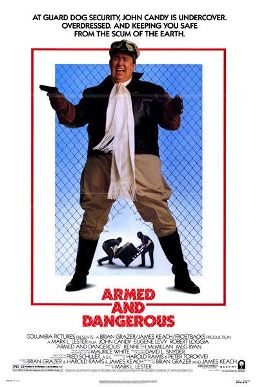
A Movie A Day #224: Armed and Dangerous (1986, directed by Mark L. Lester)


John Candy and Eugene Levy make a great team in the underrated comedy, Armed and Dangerous.

John Candy plays Frank Dooley, a member of the LAPD.  One of the first scenes of the movie is Frank climbing up a tree to save a little boy’s kitten and then getting stuck in the tree himself.  When Frank discovers two corrupt detectives stealing televisions, Frank is framed for the theft and kicked off the force.

Eugene Levy plays Norman Kane, a lawyer whose latest client is a Charles Manson-style cult leader who has a swastika carved into his head.  After being repeatedly threatened with murder, Norman asks for a sidebar and requests that the judge sentence his client to life in prison.  The judge agrees on the condition that Norman, whom he describes as being “the worst attorney to ever appear before me,” find a new line of work.

Frank and Norman end up taking a one day training course to act as security guards and are assigned to work together by their tough by sympathetic supervisor (Meg Ryan!).  Assigned to guard a pharmaceutical warehouse, Frank and Norman stumble across a robbery.  The robbery leads them to corruption inside their own union and, before you can say 80s cop movie, Frank and Norman are ignoring the orders of their supervisors and investigating a crime that nobody wants solved.

Armed and Dangerous was one of the many comedy/cop hybrid films of the 1980s.  Like Beverly Hills Cop, it features Jonathan Banks as a bad guy.  Like the recruits in Police Academy, all of Frank and Norman’s fellow security guards are societal misfits who are distinguished by one or two eccentricities.  There is nothing ground-breaking about Armed and Dangerous but Mark Lester did a good job directing the movie and the team of Candy and Levy (who has previously worked together on SCTV) made me laugh more than a few times.

Armed and Dangerous was originally written to be a vehicle for John Belushi and Dan Aykroyd.  It’s easy to imagine Belushi and Aykroyd in the lead roles but I think the movie actually works better with Candy and Levy, whose comedic style was similar to but far less aggressive than that of Belushi and Aykroyd.  One of the reasons that Armed and Dangerous works is because John Candy and Eugene Levy seem like the two last people to ever find themselves in a shootout or a car chase.  With Belushi and Aykroyd, it would have been expected.  After all, everyone’s seen The Blues Brothers.


A Movie A Day #164: Split Decisions (1988, directed by David Drury)


Craig Sheffer seeks symbolic revenge and Gene Hackman picks up a paycheck in Split Decisions!

Ray McGuinn (Jeff Fahey) is a contender.  Ever since he let his father’s gym and signed with a sleazy boxing promoter, Ray has been waiting for his title shot.  His father, an ex-boxer turned trainer named Dan (Gene Hackman), has never forgiven Ray for leaving him.  Meanwhile, his younger brother — an amateur boxer and Olympic aspirant named Eddie (Craig Sheffer) — worships Ray and is overjoyed when Ray returns to the old neighborhood to fight “The Snake” Pedroza (Eddie Velez).  But then Ray is told that if he doesn’t throw the fight, he’ll never get a shot at a title bout.  When Ray refuses, The Snake and a group of thugs are sent to change his mind and Ray gets tossed out of a window.

Eddie is determined to avenge his brother’s death.  Does he do it by turning vigilante and tracking down the men who murdered his brother?  No, he turns pro and takes his brother’s place in the boxing ring!  Dan reluctantly trains him and Eddie enters the ring, looking for symbolic justice.  Symbolic justice just doesn’t have the same impact as Charles Bronson-style justice.

The idea of a barely known amateur turning professional and getting a chance to fight a contender feels just as implausible here as it did in Creed.  The difference is that Creed was a great movie so it did not matter if it was implausible.  To put it gently, Split Decisions is no Creed.  The boxing scenes are uninspired and even the training montage feels tired.  Look at Craig Sheffer run down the street while generic 80s music plays in the background.  Watch him spar in the ring.  Listen to Gene Hackman shout, “You’re dragging your ass out there!”  In the late 80s, Gene Hackman could have played a role like Dan in his sleep and he proves it by doing so here.  Underweight pretty boy Craig Sheffer is actually less convincing as a boxer than Damon Wayans was in The Great White Hype.

Split Decisions is another boxing movie that should have taken Duke’s advice.

A Movie A Day #104: True Blood (1989, directed by Richard Kerr)


Ten years after being wrongly accused of murdering a cop, Raymond Trueblood (Jeff Fahey) returns to the old neighborhood.  Ray has just finished a stint with the Marines and he is no longer the irresponsible hoodlum that he once was.  He wants to rescue his younger brother, Donny (Chad Lowe), from making the same mistakes that he made.  But Donny now hates Ray and is running with Ray’s former friend, Spider Masters (Billy Drago).  Spider is also responsible for framing Ray for killing the cop.  When he is not trying to save his brother, Ray falls in love with Jennifer Scott (Sherilyn Fenn), a tough waitress who is soon being menaced by Spider.

Like Crime Zone, True Blood is typical of the type of B-movies that Sherilyn Fenn was stuck in before being cast as Audrey Horne in Twin Peaks.  It’s a nothing part but Fenn is authentic and sincere in the part and, as usual, Fenn’s performance is one of the best things about the movie.

Overall, True Blood is predictable but it is still better than the typical late 80s B-movie.  Chad Lowe is never believable as a member of a street gang but Jeff Fahey does a good Clint Eastwood impersonation as Ray and Billy Drago is, as always, a great villain.  Fans of Dawn of the Dead will want to keep an eye out for Ken Foree as one of the detectives investigating Ray.