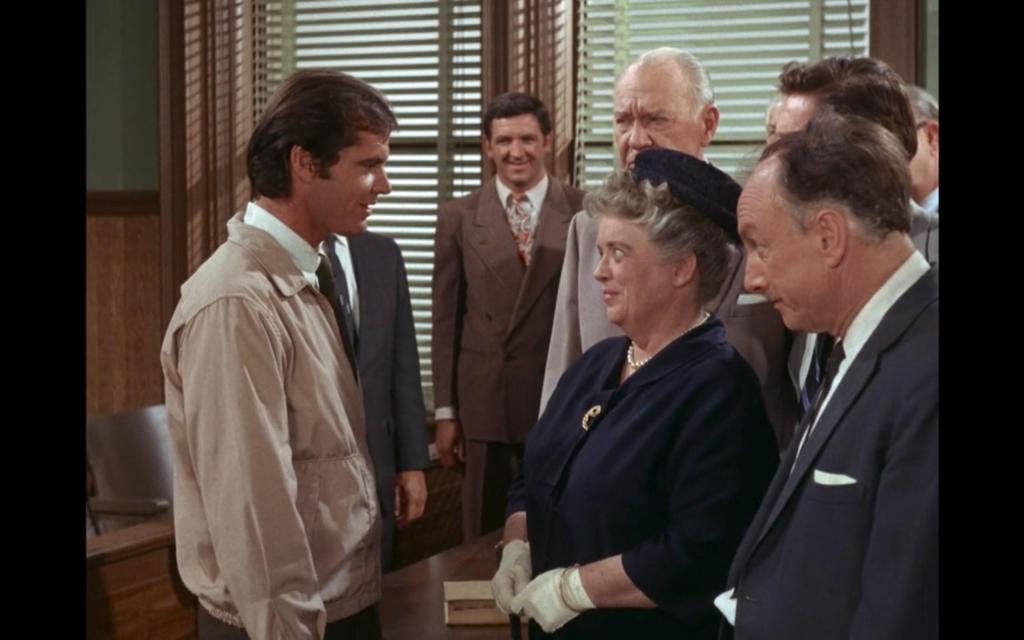
Aunt Bee (Frances Bavier) serves on a jury where the case involves a man named Marvin Jenkins (Jack Nicholson) who’s been accused of stealing appliances from a department store in Mount Pilot, North Carolina. While the evidence against Mr. Jenkins appears to be overwhelming, Aunt Bee isn’t ready to convict him because he “seems like such a sweet man.” The rest of the jury is getting sick of her so they press her to explain why she doesn’t think he’s guilty. Her answer, “have you noticed his eyes, pure hazel! I just don’t feel like he did it.” The jury decides to take a break for the evening. The next day she brings brownies and wants to continue discussing the case. Needless to say, the remaining jury members aren’t happy as they are ready to be done. They’re quite rude to Aunt Bee and the case finally ends with a hung jury because Aunt Bee refuses to give in to their pressure. Marvin Jenkins, happy to be free, thanks Aunt Bee for believing in him. Meanwhile there’s a guy hanging around the court that seems way too interested in the outcome of the case, especially when Jenkins gets set free. Based on a couple of things he says, Andy (Andy Griffith) figures out that he’s the one who actually stole the items at the store, and it turns out that Aunt Bee was right the whole time. Even better, the episode ends with the judge writing a letter to Aunt Bee requesting her recipe for brownies!
“Aunt Bee, the Juror” is the second of two episodes where Jack Nicholson appeared on The Andy Griffith Show. He first appeared in season 7, episode 10, “Opie Finds a Baby.” It’s a very short appearance where he shows up at the very end as the father of the found baby. In this episode, Nicholson again has a pretty small role as the man on trial. He answers some questions from the lawyers and Aunt Bee believes him even though no one else does. At the end he happily thanks Aunt Bee for thinking the best of him and not finding him guilty. Most of the episode focuses on Aunt Bee holding out for what she believes in. Based on his short appearance in this episode, it’s hard to believe that Nicholson was on the verge of superstardom. He had already filmed THE SHOOTING (1966), RIDE THE WHIRLWIND (1966), and HELL’S ANGELS ON WHEELS (1967), with EASY RIDER (1969) and FIVE EASY PIECES (1970) just a couple of years away. For me, it’s just fun to see an actor of his caliber on one of my favorite shows of all time.
Happy 88th Birthday, Mr. Nicholson. Thanks for a lifetime of wonderful performances!
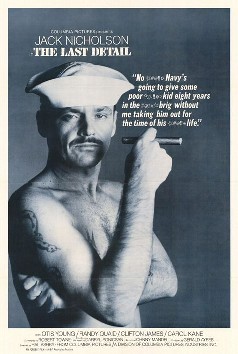
Billy “Badass” Buddusky (Jack Nicholson) and Richard Mulhall (Otis Young) are two Navy lifers stationed in Virginia. On shore patrol, they’ve been assigned to transport a 18 year-old seaman to a Naval prison in Maine. The kid has been dishonorably discharged and sentenced to eight years in the brig for trying to steal $40 from a charity box. (The charity was a favorite of the wife of his commanding officer.) Buddusky and Mulhall are expecting to find a hardened punk but instead, they end up escorting Larry Meadows (Randy Quaid), a timid teenager who suffers from kleptomania and who doesn’t seem to understand just how bad things are going to be for him for the rest of his life. Not only is he going to do eight years in the brig, surrounded by hardened criminals, but his dishonorable discharge is going to follow him for the rest of his life.
Resenting having to take Meadows to prison and also feeling that he’s getting a raw deal, Buddusky and Mulhall decide to make a few stops on their way to Maine, so that Larry can enjoy what little time he has left and hopefully lose his virginity before being locked up. In between brawling with Marines, visiting a brothel (where a young Carol Kane plays one of the prostitutes), and hanging out with a group of hippies (one of whom is played by Gilda Radner), Meadows comes to think of Buddusky and Mulhall as being his best friends. Unfortunately, for Meadows, both Buddusky and Mulhall have their job to do.
Hal Ashby’s road picture is a character study of three men who are all lifers, even if they don’t realize that. Both Buddusky and Mulhall hate the Navy but they also can’t relate to anyone who isn’t a member of the service. Meadows’s entire future has been pre-determined because he tried to steal $40 but he doesn’t realize it until its too late. When the film came out, it was controversial due to its “colorful” language. In an interview, screenwriter Robert Towne defended the frequent profanity because, as he put it, when you’re in a situation you hate, “that’s what you do. You bitch.” Hal Ashby’s loose direction captures the road trip feel as the three leads reluctantly head to their ultimate destination.
The Last Detail features one of Jack Nicholson’s best performances. Buddusky is cynical and doesn’t trust anyone other than Mulhall but even he knows that Larry Meadows deserves better than to spend eight years in the brig. Along with lending his star power to the film and standing by director Hal Ashby when Ashby was arrested for marijuana possession, Nicholson also played a big role in the casting of Randy Quaid as Larry Meadows. (The other final contender for the role was John Travolta but Nicholson insisted on Quaid). The 6’5 Quaid towers of Nicholson and Young, making him look as if he could escape any time that he wants. But Larry is so naive that he doesn’t want to make any trouble for his “friends.” Though this wasn’t his first film, The Last Detail is the film that made Quaid one of the busiest character actors of the 70s and 80s and it also, at least temporarily, made him a part of the Jack Nicholson stock company.
Both sad and funny, The Last Detail is one of the best films of the 70s and features Jack Nicholson at his most unforgettable.
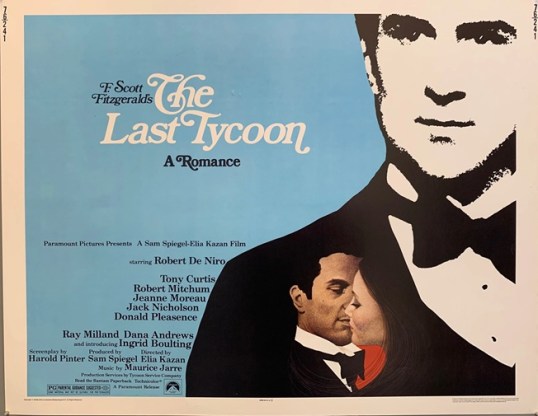
Based on the final (and unfinished) novel by F. Scott Fitzgerald, 1976’s The Last Tycoon tells the story of Monroe Stahr (Robert De Niro).
Monroe Stahr is the head of production at a film studio during the early days of Hollywood. Stahr is an unemotional and seemingly repressed man who only shows enthusiasm when he’s talking about movies. He may not be able to deal with real people but he instinctively knows what they want to see on the big screen. Stahr is a genius but he’s working himself to death, ignoring his health concerns while trying to create the perfect world through film. He’s haunted by a lost love and when he meets Kathleen Moore (Ingrid Boulting, giving a remarkably dull performance), he tries to find love with her but, naturally, he doesn’t succeed. Meanwhile, he has to deal with his boss (Robert Mitchum), his boss’s daughter (Theresa Russell), a neurotic screenwriter (Donald Pleasence), an impotent actor (Tony Curtis), and a lowdown dirty communist labor organizer (Jack Nicholson)! Sadly, for Stahr, McCarthyism is still a few decades away.
There’s a lot of talented people in The Last Tycoon and it’s undeniably interesting to see old school stars — like Mitchum, Curtis, Dana Andrews, Ray Milland — acting opposite a Method-driven, 30-something Robert De Niro. This is one of those films where even the minor roles are filled with name actors. John Carradine plays a tour guide. Jeff Corey plays a doctor. This is a film about Golden Age Hollywood that is full of Golden Age survivors. It’s a shame that most of them don’t get much to do. The Last Tycoon is a very episodic film as Stahr goes from one crisis to another. Characters show up and then just kind of disappear and we’re never quite sure how Stahr feels about any of them or how their existence really shapes Stahr’s worldview. Robert De Niro may be a great actor but, as portrayed in this film, Monroe Stahr is a boring character and De Niro’s trademark tight-lipped intensity just makes Stahr seem like someone who doesn’t have much to offer beyond employment. This is one of De Niro’s least interesting performances, mostly because he’s playing a not-particularly interesting person. Mitchum, Pleasence, and the old guard all make an impression because they’re willing to coast by on their bigger-than-life personalities. De Niro is trapped by the Method and a total lack of chemistry with co-star Ingrid Boulting.
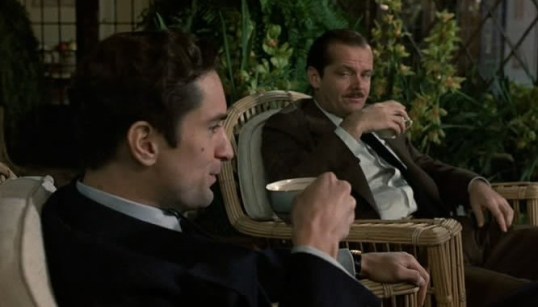
Still, this is the only film to feature both De Niro and Jack Nicholson. (The Departed was originally conceived as a chance to bring De Niro and Nicholson together, with De Niro being the original choice for the role eventually played by Martin Sheen.) Nicholson’s role is small and he doesn’t show up until the film is nearly over. He and De Niro have an intense table tennis match. Nicholson doesn’t really dig deep into Brimmer’s character. Instead, he flashes his grin and let’s the natural sarcasm of his voice carry the scene. It’s nowhere close to being as emotionally satisfying as the De Niro/Pacino meeting in Heat. That said, Jack Nicholson at least appears to be enjoying himself. His natural charisma makes his role seem bigger than it actually is.
Why was The Last Tycoon such a disappointment? Though unfinished, the book still featured some of Fitzgerald’s best work and there’s a huge amount of talent involved in this film. The blame mostly falls on Elia Kazan, who came out of retirement to direct the film after original director Mike Nichols left the project. (Nichols reportedly objected to casting De Niro as Stahr. While it’s tempting to think that Nichols realized that De Niro’s intense style wouldn’t be right for the role, it actually appears that Nichols and De Niro sincerely disliked each other as Nichols also abandoned the next film he was hired to direct when he was told that De Niro wanted the lead role. Nichols choice for Monroe Stahr was Dustin Hoffman, which actually would have worked. If nothing else, it would have provided a Graduatereunion.) Kazan later said that he did the film solely for the money and it’s obvious that he didn’t really care much about the film’s story. The film has some good scenes but, overall, it feels disjointed and uneven. Kazan doesn’t really seem to care about Monroe Stahr and, as a result, the entire film falls flat.
Today’s scene that I love comes from 1975’s Tommy. Based on The Who’s rock opera and directed by Ken Russell, Tommy featured several actors who weren’t necessarily known as singers. Oliver Reed is the most obvious example.
And then there’s Jack Nicholson! Jack’s role is pretty small. He’s the therapist who examines Tommy and who eye flirts with Ann-Margaret. And, of course, he gets his check.
4 Shots From 4 Films is just what it says it is, 4 shots from 4 of our favorite films. As opposed to the reviews and recaps that we usually post, 4 Shots From 4 Films lets the visuals do the talking!
Today is Jack Nicholson’s 88th birthday!
Though he has pretty much retired from acting, Jack Nicholson remains a screen icon with a filmography that is a cinema lover’s dream. He’s worked with everyone from Roger Corman to Stanley Kubrick to Milos Forman to Martin Scorsese and, along the way, he’s become a symbol of a very American-type of rebel. Though often associated with the counter-culture, his style has always been too aggressive and idiosyncratic for him to be a believable hippie. Instead, he’s one of the last of the beats, an outsider searching for meaning in Americana.
Over the course of his career, Nicholson has won three Oscars and been nominated for a total of 12. He’s the only actor to have been nominated in every decade from the 1960s to the 2000s. He is an actor who epitomizes an era in filmmaking, actually several eras. It’s been 15 years since he last appeared in a movie but Jack Nicholson will never be forgotten.
4 Shots From 4 Jack Nicholson Films
Psych-Out (1968, dir by Richard Rush, DP: Laszlo Kovacs)
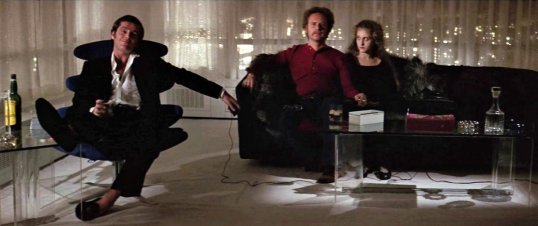
Carnal Knowledge (1971, dir by Mike Nichols, DP: Giuseppe Rotunno)
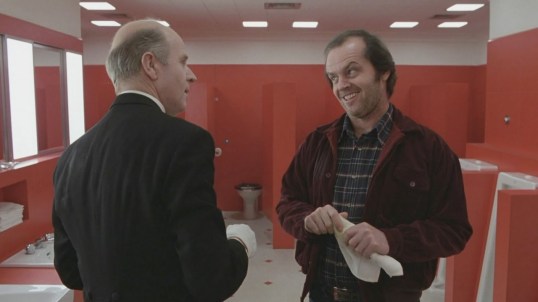
The Shining (1980, dir by Stanley Kubrick, DP: John Alcott)
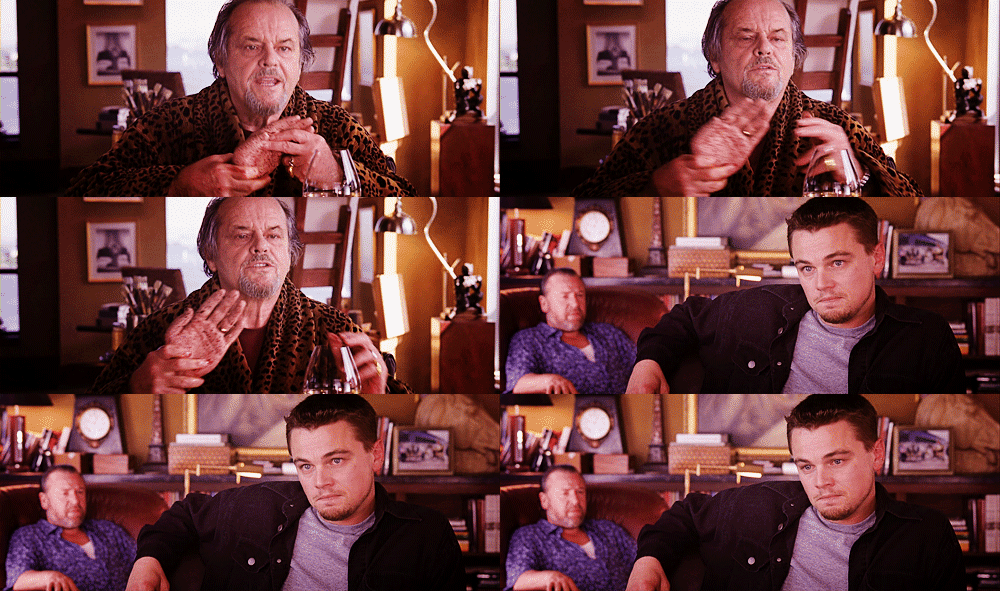
The Departed (2006, dir by Martin Scorsese, DP: Michael Ballhaus)
Today would have been the 101st birthday of character actor Philip Stone. While Stone appeared in a lot of films, he’ll probably always be best-remembered for his subtly menacing turn as the ghostly Grady in 1980’s The Shining. Here he is, having a conversation with Jack Torrance (Jack Nicholson) and letting him know that he’s always been caretaker.
(Fair warning to those who may not have seen this scene before or who perhaps have forgotten about it, Grady does use a racial slur at one point. It’s a moment that’s true to his villainous character, even if it’s a bit jarring to hear today.)
In the 1981 film Reds, Warren Beatty plays Jack Reed, the radical journalist who, at the turn of the century, wrote one of the first non-fiction books about Russia’s communist revolution and then went on to work as a propagandist for the communists before becoming disillusioned with the new Russian government and then promptly dying at the age of 32.
Diane Keaton plays Louise Bryant, the feminist writer who became Reed’s lover and eventually his wife. Louise found fame as one of the first female war correspondents but then she also found infamy when she was called before a Congressional committee and accused of being a subversive.
Jack Nicholson plays Eugene O’Neill, the playwright who was a friend of both Reed and Bryant’s and who had a brief affair with Bryant while Reed was off covering labor strikes and the 1916 Democratic Convention.
Lastly, Maureen Stapleton plays Emma Goldman, the anarchist leader who was kicked out of the country after one of her stupid little dumbass followers assassinated President McKinley. (Seriously, don’t get me started on that little jerk Leon Czolgosz.)
Together …. well, I was going to say that they solve crimes but that joke is perhaps a bit too flippant for a review of Reds. Reds is a big serious film about the left-wing activists at the turn of the century, one in which the characters move from one labor riot to another and generally live the life of wealthy bohemians. Reed spends the film promoting communism, just to be terribly disillusioned when the communists actually come to power in Russia. For a history nerd like me, the film is interesting. For those who are not quite as obsessed with history, the film is extremely long and the scenes of Reed and Bryant’s domestic dramas often feel a bit predictable, especially when they’re taking place against such a large international tableaux. At its best, the film is almost a Rorschach test for how the viewer feels about political and labor activists. Do you look at Jack Reed and Louise Bryant and see two inspiring warriors for the cause or do you see two wealthy people playing at being revolutionaries?
Reds was a film that Warren Beatty spent close to 20 years trying to make, despite the fact that the heads of the Hollywood studios all told him that audiences would never show up for an epic film about a bunch of wealthy communists. (The heads of the studio turned out to be correct, as the film was critically acclaimed but hardly a success at the box office.) It was only after the success of the 1978, Beatty-directed best picture nominee Heaven Can Wait that Beatty was finally able to get financing for his dream project. He ended up directing, producing, and writing the film himself and he cast his friend Jack Nicholson as O’Neill and his then-romantic partner Diane Keaton as Louise Bryant. (Gene Hackman, Beatty’s Bonnie and Clyde co-star, shows up briefly as one of Reed’s editors.) One left-wing generation’s tribute to an early left-wing generation, Reds is fully a Warren Beatty production and, for his efforts, Beatty was honored with the Oscar for Best Director. That said, the Reds lost the award for Best Picture to another historical epic, Chariots of Fire. Chariots of Fire featured no communists and did quite well at the box office.
The film is good but a bit uneven, especially towards the end when we suddenly get scenes of Louise Bryant trudging through Finland as she attempts to make it to Russia to be reunited with Reed. The film actually works best when it features interviews with people who were actual contemporaries of Reed and Bryant and who share their own memoires of the time. In fact, the interviews work almost too well. The “witnesses,” as the film refers to them, paint such a vivid picture of the Reed, Bryant, and turn of the century America that Beatty’s attempt to cinematically recreate history often can’t compete. One can’t help but feel that Beatty perhaps should have just made a documentary instead of a narrative film.
(Interestingly enough, many of the witnesses were people who were sympathetic to Reed’s politics in at the start of the century but then moved much more to the right as the years passed. Reed’s friend and college roommate, Hamilton Fish, went on to become a prominent Republican congressman and a prominent critics of FDR.)
That said, Jack Nicholson gives a fantastic performance as Eugene O’Neill, adding some much needed cynicism to the film’s portrayal of Reed and Bryant’s idealism. Keaton and Beatty sometime both seem to be struggling to escape their own well-worn personas as Bryant and Reed but Beatty does really sell Reed’s eventually disillusionment with Russia and the scene where he finally tells off his Russian handler made me want to cheer. Fans of great character acting will want to keep an eye out for everyone from Paul Sorvino to William Daniels to Edward Herrmann to M. Emmet Walsh and IanWolfe, all popping up in small roles.
Reds is not a perfect film but, as a lover of history, I enjoyed it.
First off, we’ve got the trailer for Head, starring the Monkees! This film was co-written by Jack Nicholson.
2. The Great Rock and Roll Swindle (1980)
In the first film that Julien Temple made about the history of the Sex Pistols, Malcolm McLaren presents himself as being the genius behind the group and tries to keep viewers from noticing that Johnny Rotten refused to have anything to do with the film.
3.Stunt Rock (1978)
I know next to nothing about this film but it was directed by Brian Trenchard-Smith and that’s often a good sign.
4, Sgt. Pepper’s Lonely Hearts Club Band (1978)
Featuring Donald Pleasence singing the longest version of I Want You ever recorded!
5. The Decline of Western Civilization (1981)
From director Penelope Spheeris comes the ultimate documentary about 1980s Los Angeles punk rock.
6. The Decline of Western Civilization Part 2: The Metal Years (1988)
I’ve always felt that Barry Nelson’s performance as Ullman is one of the best parts of the early part of the film. Whereas Ullman was presented as being a stereotypical jerk in King’s novel, the film presents him as a blandly friendly bureaucrat who can talk about what happened with the previous caretaker and make it sound like the most normal thing in the world. The scene were he interviews Jack Torrance for the caretaker job is wonderfully ominous, even if it’s hard to describe why. I know that Stephen King disliked this scene because it made Jack look unbalanced from the start but, personally, I think it does a wonderful job of setting the mood.
Finally, Ullman’s office reminds me of Ben Horne’s office in Twin Peaks, right down to the somewhat campy name plate on his desk.
Have you ever woken up and thought to yourself, “I’d love to see a movie where a youngish Jack Nicholson played a French soldier who, while searching for a mysterious woman, comes across a castle that’s inhabited by both Dick Miller and Boris Karloff?”
Of course you have! Who hasn’t?
Well, fortunately, it’s YouTube to the rescue. In Roger Corman’s 1963 film The Terror, Jack Nicholson is the least believable 19th century French soldier ever. However, it’s still interesting to watch him before he became a cinematic icon. (Judging from his performance here and in Cry Baby Killer, Jack was not a natural-born actor.) Boris Karloff is, as usual, great and familiar Corman actor Dick Miller gets a much larger role than usual. Pay attention to the actress playing the mysterious woman. That’s Sandra Knight who, at the time of filming, was married to Jack Nicholson.
Reportedly, The Terror was one of those films that Corman made because he still had the sets from his much more acclaimed film version of The Raven. The script was never finished, the story was made up as filming moved alone, and no less than five directors shot different parts of this 81 minute movie. Among the directors: Roger Corman, Jack Hill, Monte Hellman, Francis Ford Coppola, and even Jack Nicholson himself! Perhaps not surprisingly, the final film is a total mess but it does have some historical value.
(In typical Corman fashion, scenes from The Terror were later used in the 1968 film, Targets.)