Cleaning Out The DVR #24: Cries and Whispers (dir by Ingmar Bergman)


Cries-and-Whispers-31

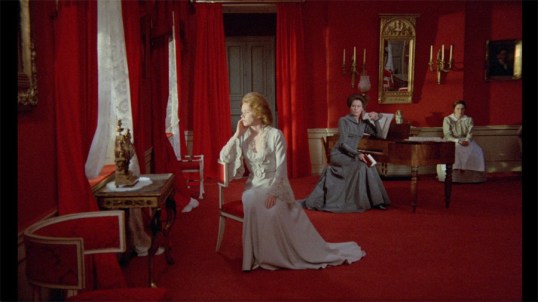
The time is the 19th century.  The country is Sweden.  The setting is a mansion that is decorated with red carpet, red walls, and almost blindly white statues.  But beyond that setting, the 1973 film Cries and Whispers is really set in the hearts and minds of four women.  One of them is selfless.  Two of them are bitter and uncaring.  And one of them is slowly dying.

Agnes (Harriet Andersson) is the one who is dying.  She spends her time laying in bed and screaming in pain.  A doctor (Erland Josephson) provides her with no hope and can only promise that the end will come soon and a priest (Anders Ek) coldly goes about planning for her funeral and offering up empty promises of a final reward.  Occasionally, through her diary and flashbacks to her youth, we get glimpses of who Agnes was before her life become dominating by her impending death.

Agnes’s sisters have come to the house to wait out her death.  Though they’ve arrived to provide comfort, neither is capable of it.  The youngest sister, Maria (Liv Ullman), was her mother’s favorite and has grown up to be coldly self-centered.  Through flashbacks, we see the details of her affair with Agnes’s doctor.  When Maria’s husband (Henning Moritzen) reacts to her infidelity by stabbing himself, Maria can only dispassionately watch.  Meanwhile, the oldest sister, Karin (Ingrid Thulin) has grown up to be bitter and sexually repressed.  In a truly shocking scene, Karin mutilates her vagina with a shard of glass and, after smearing the blood on her face, lies in bed and smirks at her husband.

In the end, only Anna (Kari Sylwan) can provide Agnes with any comfort.  Anna is Agnes’s maid.  Deeply religious and mourning the loss of her own daughter, only Anna is willing to reach out and hold Agnes while Agnes is in pain.  And, after Agnes dies, Anna seems to be the only one who shows any real grief.

There are depressing movies and then there’s Cries and Whispers.  Cries and Whispers is such an emotionally raw and dark movie that it was difficult for me to watch.  It’s also difficult to review because just thinking about the movie brings up so many emotions.  It’s just such a well-made and extremely painful movie.

It’s also an Ingmar Bergman film and that’s fortunate because Bergman somehow had an instinct for how to keep audiences watching even when the images on screen were amazingly painful.  Visually, Cries and Whispers is as beautiful as it is thematically cold.  By emphasizing the color red (not only is the entire house decorated in red but scenes often end by fading to red as opposed to black), Bergman makes the audience feel as if they truly have been transported into the human soul.  Red, after all, is the color of blood and life.

And really, Cries and Whispers is one of those films that makes you wonder what exactly the point of life is.  While the dream-like flashbacks give us clues as to how the three sisters became who they are, they also suggest that it really doesn’t matter.  In the end, regardless of whether they’re in love or alone or happy or sad, they’re all going to die and that’s going to be it.  All stories and issues will be left unresolved.

And, in the end, the best we can hope for is that someone like Anna will mourn us.

Cries and Whispers is one of the few foreign language films to be nominated for best picture.  It’s also the only Ingmar Bergman film to be so nominated (though Bergman had more success in the Best Foreign Language Film category).  It lost to The Sting, a far happier film.
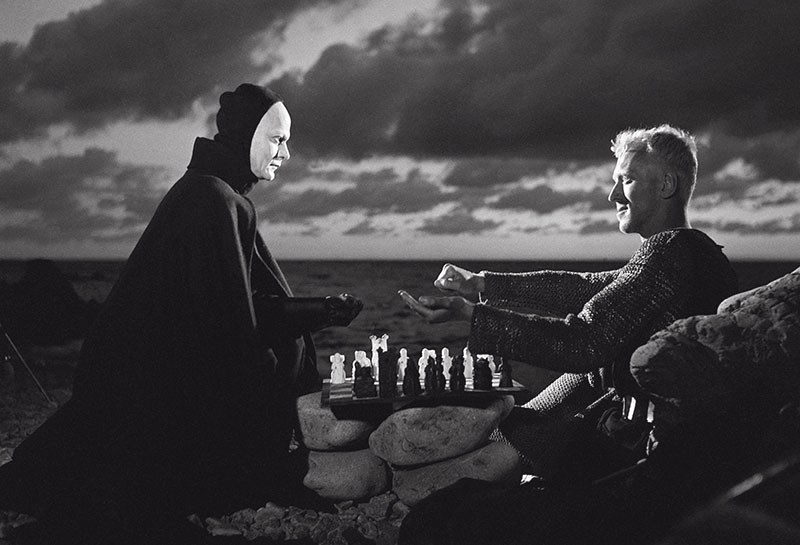
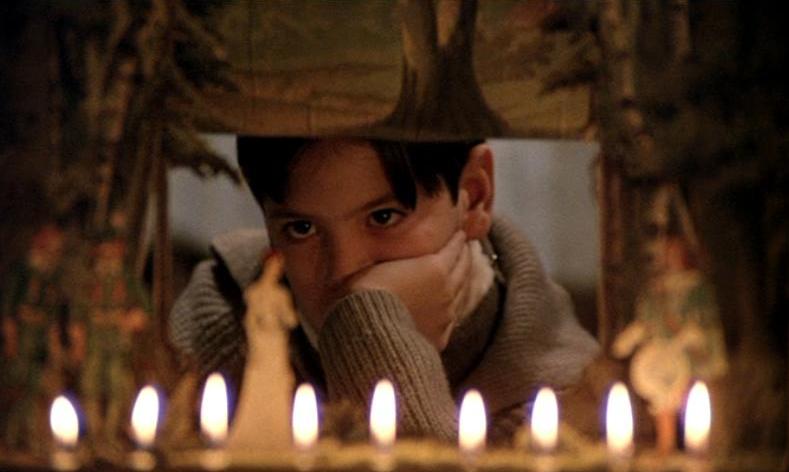
4 Shots From 4 Films: The Seventh Seal, Persona, Scenes From A Marriage, Fanny And Alexander


Happy birthday, Ingmar Bergman.

4 Shots From 4 Films


The Seventh Seal (1957, directed by Ingmar Bergman)

The Seventh Seal (1957, directed by Ingmar Bergman)

Persona (1966, directed by Ingmar Bergman)

Persona (1966, directed by Ingmar Bergman)

Scenes From A Marriage (1973, directed by Ingmar Bergman)

Scenes From A Marriage (1973, directed by Ingmar Bergman)

Fanny and Alexander (1982, directed by Ingmar Bergman)

Fanny and Alexander (1982, directed by Ingmar Bergman)


6 Trailers For 6 Films That Were Snubbed By The Academy


Seeing as how the Oscar nominations are due to be announced on Tuesday, I thought I would devote this edition to Lisa Marie’s Favorite Grindhouse and Exploitation trailers to films that were snubbed by the Academy.  Remember them while you’re watching Rooney Mara accept best actress.

1) A Life of Ninja (1983)

Despite the colorful trailer, this film was not nominated for best Costume Design, Art Design,  or Cinematography.  Instead, all three of those awards went to Ingmar Bergman’s Fanny and Alexander.

2) The Shark Hunter (1979)

Franco Nero was not nominated for best actor for his performance here.  Instead Dustin Hoffman won for Kramer vs. Kramer.

3) The Terrornauts (1967)

The true terror is that the 1967 Oscar for Special Visual Effects went to Doctor Dolittle and not The Terrornauts.

4) Americathon (1979)

The Academy has never really appreciated hard-hitting political satire which perhaps explains why the previously mentioned Kramer Vs. Kramer won best picture while Americathon was not even nominated.

5) Don’t Torture A Duckling (1972)

The Oscar for Best Foreign language film of 1972 was given to Luis Bunuel’s The Discreet Charm of the Bourgeoisie and not to Lucio Fulci’s classic giallo Don’t Torture A Duckling.

6) The Hills Have Eyes (1977)

And yet somehow, Annie Hall was named best picture.

Rooney Mara as Lisbeth Salander?


It’s official.  The role of Lisbeth Salander in the thoroughly unnecessary and borderline insulting American remake of The Girl With The Dragon Tattoo will be played by Rooney Mara.

It’s hard for me to say how I feel about this casting.  When I first heard about it, my initial thought was, “Who’s that and how could she be better suited for the role than Jena Malone?”  However, after talking to Arleigh, I realized that I actually do know Rooney Mara.  She was the lead in another remake, this year’s Nightmare on Elm Street.  In that movie, Mara was a likable presence but she was no Lisbeth.  Then again, woman like Lisbeth Salander — independent women who refuse to be solely defined as either a good virgin or a bad whore — don’t appear in slasher films.  What is important is that Mara has proven she can carry a film.  She hasn’t proven that she can carry The Girl With The Dragon Tattoo.

Then again, considering just how iconic a figure as Lisbeth has become (both in the original novel and in the original film) it’s probably for the best that director David Fincher went with an unknown.  Rooney appears to be a talented young actress but she’s got a very difficult job ahead of her.

It’s probably not a coincidence that Rooney also has a small role in Fincher’s upcoming film, The Social Network (which is going to suck, by the way).  It’s possible that Fincher saw something in Rooney that she hasn’t been allowed to show the rest of the world.  Me, I’m just happy that if there is going to be an American version of Lisbeth Salander, at least she’s going to be played by an Irish-American.  At heart, Lisbeth is as Irish as a Swede can get.

(Though again, the ideal Irish-American to play Lisbeth would have been and still is Jena Malone.)

As I’ve stated before, I have mixed feelings about the remake of the Girl With The Dragon Tattoo.  (And yes, it is a remake regardless of what they’re saying over at Awardsdaily.com.)  On the one hand, the entire literary Millenium Trilogy (of which The Girl with the Dragon Tattoo was the 1st part) is one of the best recent works of pop cultural fiction.  Lisbeth Salander is destined to be an iconic noir figure.  On a personal note, even though she’s ultimately just a fictional character, she is a fictional character who has provided a great deal of strength and hope to abuse survivors (such as myself).  When we read about her and her refusal to allow herself to be victimized or to be dependent on even as well-meaning a man as Mikael Blomkvist, the book’s nominal hero, Lisbeth Salander becomes the vehicle for our own wish-fulfillment fantasies.  She is a character who transcends the page to become a role model in real life as well.  In many ways, she is the 21st century version of Scarlett O’Hara.  Scarlett gave hope to aging Southern belles.  Lisbeth gives hope to bipolar neurotics like me.  And much as everyone couldn’t wait to see Scarlett on-screen, a lot of us couldn’t wait to see Lisbeth on-screen.

And that is the biggest hurdle that director David Fincher and Rooney Mara are going to face with this much-hyped remake of The Girl With The Dragon Tattoo.  We’ve already seen Libseth onscreen and, in our mind’s eye, she’s not Rooney Mara.  Instead, she’s Noomi Rapace.  Both Fincher and Mara have a difficult task ahead of them.  Not only do they have to meet the expectations of the people who have read the original novel, they have to exceed the expectations of the people who have seen the original Swedish film.

And that, to me, is the issue that is being avoided, the proverbial Elephant in the room.  For all the wannabe, internet-based film critics who are currently gleefully devouring any crumbs of information concerning Fincher’s production, nobody has yet to answer the question as to why this film needs to be made at all?  (Beyond the obvious fact that there’s money to be made…) 

I found it interesting that, at the end of the EW article concerning Mara’s casting, it is mentioned that the film is set to begin filming in Sweden.  Why exactly?  Hasn’t a film about a girl with a dragon tattoo who helps a smug journalist investigate a disappearance in Sweden already been made?  It would seem that the “American version” has little to offer beyond offering up a fantasy Sweden where everyone speaks English and those viewing the film are freed from having to try to read subtitles and rattle their jumbo tubs of popcorn at the same time.  Or are we just sending David Fincher over to Sweden because we think we’ve got a thing or two to teach the nation that gave us Ingmar Bergman?

It’s easy to find a lot of people trying to convince themselves that this film is a guaranteed classic.  (“I’m so happy they cast Robin Wright!” they exclaim.  “I usually hate remakes but with David Fincher aboard, I’m looking forward to this,” another one will say.  And, of course, my favorite: “This movie is not a remake!”)  But nobody seems to be willing to address just why exactly we would need a new Lisbeth Salander when she’s already been created to perfection by Noomi Rapace.

Seriously, both Rapace and Lisbeth deserves better.

For that matter, so does Rooney Mara.