First released in 1970, Brewster McCloud takes place in Houston.
A series of murders have occurred in the city. The victims have all been older authority figures, like decrepit landlord Abraham Wright (Stacy Keach, under a ton of old age makeup) or demanding society matron Daphne Heap (Margaret Hamilton, who decades earlier had played The Wicked Witch in The Wizard Of Oz). The victims all appear to have been killed by strangulation and all of them are covered in bird droppings. Perplexed, the Houston authorities call in Detective Frank Shaft (Michael Murphy) from San Francisco. Shaft only wears turtlenecks and he has piercing blue eyes. He looks like the type of guy you would call to solve a mystery like this one. It’s only later in the film that we discover his blue eyes are due to the contact lenses that he’s wearing. Frank Shaft is someone who very much understands the importance of appearance. As one detective puts it, when it comes to Shaft’s reputation, “The Santa Barbara Strangler turned himself in to him. He must have really trusted him.”
Perhaps the murders are connected to Brewster McCloud (Bud Cort), who lives in a bunker underneath the Astrodome and who seems to be fascinated with birds. Brewster dreams of being able to fly just like a bird and he’s spent quite some time building himself a set of artificial wings. A mysterious woman (Sally Kellerman) who wears only a trenchcoat and who has scars on her shoulder blades that would seem to indicate that she once had wings continually visits Brewster and encourages him to pursue his dream. However, she warns him that he will only be able to fly as long as he remains a virgin. If he ever has sex, he will crash to the ground.
Brewster thinks that he can handle that. Then he meets a tour guide named Suzanne Davis (Shelley Duvall, in her film debut) and things start to change….
Brewster McCloud is a curious film. The story is regularly interrupted by a disheveled lecturer (Rene Auberjonois) who is very much into birds and who, over the course of the film, starts to more and more resemble a bird himself. The film is full of bird-related puns and there are moments when the characters seem to understand that they’re in a movie. Frank Shaft dresses like Steve McQueen in Bullittand his blue contact lenses feel like his attempt to conform to the typical image of a movie hero. (A lengthy car chase also feels like a parody of Bullitt’s famous chase scene.) When the old woman played by Margaret Hamilton dies, the camera reveals that she’s wearing ruby slippers and a snippet of Somewhere Over The Rainbow is heard. As played by Bud Cort, Brewster is the perfect stand-in for the lost youth of middle class America. He knows that he’s rebelling against something but he doesn’t seem to be quite sure what. Brewster, like many idealists, is eventually distracted by his own desires and his once earnest plans come cashing down. Brewster becomes an Icarus figure in perhaps the most literal way possible, even if he doesn’t come anywhere close to reaching the sun. As with many of Altman’s films, Brewster McCloud is occasionally a bit too esoteric for its own good but it’s always watchable and it always engages with the mind of the viewer. One gets the feeling that many of the film’s mysteries are not necessarily meant to be solved. (Altman often said his best films were based on dreams and, as such, used dream logic.) With its mix of plain-spoken establishmentarians and quirky misfits, Brewster McCloud is not only a classic counterculture film but it’s also a portrait of Texas on the crossroads between the cultures of the past and the future.
Though it baffled critics when it was released, Brewster McCloud has gone on to become a cult film. It’s a bit of a like-it-or-hate-it type of film. I like it, even if I find it to be a bit too self-indulgent to truly love. Quentin Tarantino, for his part, hates it. Brewster McCloud was released in 1970, the same year as Altman’s Oscar-nominated M*A*S*H. (Both films have quite a few cast members in common.) Needless to say, the cheerfully and almost defiantly odd Brewster McCloud was pretty much ignored by the Academy.
In 2021, I finally saw the infamous film, The Bonfire of the Vanities.
I saw it when it premiered on TCM. Now, I have to say that there were quite a few TCM fans who were not happy about The Bonfire of the Vanities showing up on TCM, feeling that the film had no place on a station that was supposed to be devoted to classic films. While it’s true that TCM has shown “bad” films before, they were usually films that, at the very least, had a cult reputation. And it is also true that TCM has frequently shown films that originally failed with audiences or critics or both. However, those films had almost all been subsequently rediscovered by new audiences and often reevaluated by new critics. The Bonfire of the Vanities is not a cult film. It’s not a film about which one can claim that it’s “so bad that it’s good.” As for the film being reevaluated, I’ll just say that there is no one more willing than me to embrace a film that was rejected by mainstream critics. But, as I watched The Bonfire of the Vanities, I saw that everything negative that I had previously read about the film was true.
Released in 1990 and based on a novel by Tom Wolfe, Bonfire of the Vanities stars Tom Hanks as Sherman McCoy, a superficial Wall Street trader who has the perfect penthouse and a painfully thin, status-obsessed wife (Kim Cattrall). Sherman also has a greedy mistress named Maria (Melanie Griffith). It’s while driving with Maria that Sherman takes a wrong turn and ends up in the South Bronx. When Sherman gets out of the car to move a tire that’s in the middle of the street, two black teenagers approach him. Maria panics and, after Sherman jumps back in the car, she runs over one of the teens. Maria talks Sherman into not calling the police. The police, however, figure out that Sherman’s car was the one who ran over the teen. Sherman is arrested and finds himself being prosecuted by a power-hungry district attorney (F. Murray Abraham). The trial becomes the center of all of New York City’s racial and economic strife, with Sherman becoming “the great white defendant,” upon whom blame for all of New York’s problems can be placed. Bruce Willis plays an alcoholic journalist who was British in the novel. Morgan Freeman plays the judge, who was Jewish in the novel. As well, in the novel, the judge was very much a New York character, profanely keeping order in the court and spitting at a criminal who spit at him first. In the movie, the judge delivers a speech ordering everyone to “be decent to each other” like their mothers taught them to be.
Having read Wolfe’s very novel before watching the film, I knew that there was no way that the adaptation would be able to remain a 100% faithful to Wolfe’s lacerating satire. Because the main character of Wolfe’s book was New York City, he was free to make almost all of the human characters as unlikable as possible. In the book, Peter Fallow is a perpetually soused opportunist who doesn’t worry about who he hurts with his inflammatory articles. Sherman McCoy is a haughty and out-of-touch WASP who never loses his elitist attitude. In the film, Bruce Willis smirks in his wiseguy manner and mocks the other reporters for being so eager to destroy Sherman. Hanks, meanwhile, attempts to play Sherman as an everyman who just happens to live in a luxury penthouse and spend his days on Wall Street. Hanks is so miscast and so clueless as how to play a character like this that Sherman actually comes across as if he’s suffering from some sort of brain damage. He feels less like a stockbroker and more like Forrest Gump without the Southern accent. There’s a scene, written specifically for the film, in which Fallow and Sherman ride the subway together and it literally feels like a parody of one of those sentimental buddy films where a cynic ends up having to take a road trip with someone who has been left innocent and naïve as result of spending the first half of their life locked in basement or a bomb shelter. It’s one thing to present Sherman as being wealthy and uncomfortable among those who are poor. It’s another thing to leave us wondering how he’s ever been able to successfully cross a street in New York City without getting run over by an angry cab driver.
Because the film can’t duplicate Wolfe’s unique prose, it instead resorts to mixing cartoonish comedy and overwrought melodrama. It doesn’t add up too much. At one point, Sherman ends a dinner party by firing a rifle in his apartment but, after it happens, the incident is never mentioned again. I mean, surely someone else in the apartment would have called the cops about someone firing a rifle in the building. Someone in the press would undoubtedly want to write a story about Sherman McCoy, the center of the city’s trial of the century, firing a rifle in his own apartment. If the novel ended with Sherman resigned to the fact that his legal problems are never going to end, the film ends with Sherman getting revenge on everyone who has persecuted him and he does so with a smirk that does not at all feel earned. After two hours of being an idiot, Sherman suddenly outthinks everyone else. Why? Because the film needed the happy ending that the book refused to offer up.
Of course, the film’s biggest sin is that it’s just boring. It’s a dull film, full of good actors who don’t really seem to care about the dialogue that they are reciting. Director Brian De Palma tries to give the film a certain visual flair, resorting to his usual collection of odd camera angles and split screens, none of which feel at all necessary to the story. In the end, De Palma is not at all the right director for the material. Perhaps Sidney Lumet could have done something with it, though he would have still had to deal with the less than impressive script. De Palma’s over-the-top, set piece-obsessed sensibilities just add to the film’s cartoonish feel.
The film flopped at the box office. De Palma’s career never recovered. Tom Hanks’s career as a leading man was momentarily derailed. Bruce Willis would have to wait a few more years to establish himself as a serious actor. Even the normally magnanimous Morgan Freeman has openly talked about how much he hated being involved with The Bonfire of the Vanities. That said, the film lives on because De Palma allowed journalist Julie Salomon to hang out on the set and the book she wrote about the production, The Devil’s Candy, is a classic of Hollywood non-fiction. (TCM adapted the book into a podcast, which is how The Bonfire of the Vanities came to be featured on the station.) Thanks to Salomon’s book, The Bonfire of the Vanities has gone to become the epitome of a certain type of flop, the literary adaptation that is fatally compromised by executives who don’t read.
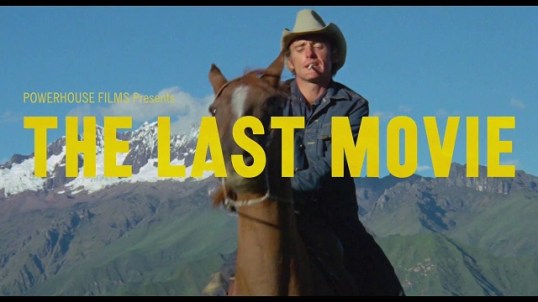
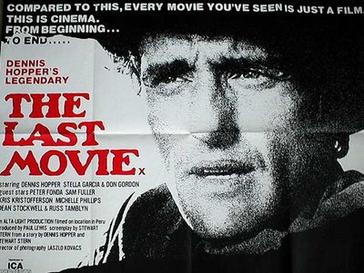
The story behind the making of 1971’s The Last Movie is legendary. It’s also a bit of a cautionary tale.
In 1969, Hollywood was stunned by the box office success of an independent, low-budget counter-culture film called Easy Rider. Easy Rider not only made a star out of Jack Nicholson but it was also the film that finally convinced the studios that the way to be relevant was not to continue to crank out big budget musical extravaganzas like Doctor Doolittle and Hello, Dolly! Instead, it was decided that the smart thing to do would be to hire young (or, at the very least, youngish) directors and basically just let them shoot whatever they wanted. The resulting films might not make much sense to the executives but, presumably, the kids would dig them and as long as the kids were paying money to see them, everyone would continue to get rich. Because Dennis Hopper had directed Easy Rider, he suddenly found himself very much in demand as a director.
Of course, almost everyone in Hollywood knew Dennis Hopper. Long before he became an icon of the counter-culture, Dennis Hopper had been a part of the studio system. John Wayne even referred to Hopper as being his “favorite communist.” Everyone knew that Dennis could be a bit arrogant. Everyone knew that Dennis was very much into drugs and that, as a result, he had a reputation for being a bit unstable. Everyone knew that Dennis Hopper deliberately cultivated an image of being a bit of a wild man and a revolutionary artist. But Dennis Hopper had just directed Easy Rider and Universal was willing to give Hopper some money to go down to Peru and direct his follow-up.
The Last Movie was a film that Hopper had been planning on making for a while. The film’s original script told the story of an aging and broken-down stuntman named Kansas who retires to Mexico and searches for a gold mine with a friend of his. Hopper first tried to get the film going in 1965, with Montgomery Clift in the lead role. After Clift died, Hopper tried to interest John Wayne in the starring role but, though Wayne enjoyed having Hopper in his films so that he could threaten to shoot him whenever Abbie Hoffman said something shocking, he had no interest in being directed by him. When Universal finally agreed to put up the money for the film, Hopper offered the lead role to Jack Nicholson. Nicholson turned it down and told Hopper that it was obvious that Dennis wanted to play the role himself. Dennis decided that he agreed with Nicholson and he cast himself as Kansas. Dennis also made the fateful decision to not only change the story’s setting to Peru but to also film on location.
Dennis and a group of friends flew down to Peru, which, at that time, was the cocaine capitol of the world. Drug use was rampant on the set, with Dennis reportedly being one of the main offenders. The cast and crew filmed during the day and partied at night and no one was particularly sure what the film was supposed to be about. Amazingly, Hopper finished filming on schedule and within budget but, much as he did with Easy Rider, he also overfilmed and ended up with 40 hours of footage. Not wanting to be bothered by the studios, Hopper edited the footage in his compound in Taos, New Mexico. Working slowly and continuing to consume a large amount of drugs and alcohol, Hopper still managed to put together a film that had a straightforward storyline. When Hopper showed his initial cut to filmmaker Alejandro Jodorowsky, the director of El Topo accused Hopper of being too conventional in his approach, which led to Hopper chopping up the film and reassembling it. Finally, after spending over a year working with the footage, Hopper turned in his final edit.
Universal had no idea what to make of the film that Hopper delivered to them. Still, they released it with the hope that the same crowd that loved Easy Rider would embrace The Last Movie. While the film did win an award at the Venice Film Festival, critics hated it and, even worse, audiences stayed away. The film’s reception was so overwhelmingly negative that Hopper found himself largely exiled from Hollywood, with only a few directors (like Francis Ford Coppola) willing to take the chance of working with him. It wasn’t until the 80s, when he finally got clean and sober, that Dennis Hopper was able to reestablish himself as a character actor and, ultimately, a beloved cultural institution.
But what about The Last Movie? Was is it really as bad as the critics claimed? Or was it, as some more recent reviewers have suggested, an unacknowledged masterpiece that was ahead of its time? I recently watched The Last Movie to find out for myself.
Despite its reputation, The Last Movie gets off to a pretty strong start. Samuel Fuller (playing himself) is directing a hilariously over-the-top and violent western in the mountains of Peru. Kansas (Dennis Hopper) is working as a stuntman. He’s fallen in love with a local sex worker named Maria (Stella Garcia). Kansas is meant to be an aging Hollywood veteran, someone who has broken a lot of bones and who carries a lot of aches as a result of his line of work. (One can see why Hopper initially imagined an actor like John Wayne in the role.) He knows that this is going to be his last job and, as we see over the first 25 minutes of the film, he feels alienated from the rest of the cast and crew. Admittedly, Hopper does appear to be a bit too young for the role. The ideal Kansas would have been someone like Ben Johnson, L.Q. Jones, or perhaps Warren Oates. But, still, Hopper does a good job of capturing Kansas’s mixed feelings about the western that’s being filmed around him.
A lot of familiar faces pop up in the film’s fictional western. Dean Stockwell plays an outlaw. Jim Mitchum, Russ Tamblyn and Kris Kristofferson plays his associates. Peter Fonda is the youthful sheriff. Michelle Phillips is the daughter of the town’s banker and apparently, she’s also the girlfriend of one of the outlaws. We watch as the actors pretend to shoot guns and kill each other while the cameras are rolling, just to get up off the ground once “Cut” is yelled. When a local Indian who has been cast as an extra grows upset at the violence, an assistant director explains to him that no one really dies while the cameras are rolling. When shooting wraps, the film company goes home but Kansas stays behind with Maria. One day, the local priest (Tomas Milian) warns Kansas that the local indigenous people have moved into the abandoned film set and are trying to shoot their own movie. Kansas discovers that they have built wooden cameras and wooden boom mics and that their chief is giving orders in the style of Sam Fuller. They’re also firing the guns that the Americans left behind.
The first part of the film works quite well. Hopper’s camera captures the beautiful and isolated Peruvian landscape. The violent western is a pitch perfect and affectionate parody of a generic studio film. Though Hopper is a bit too young for the role, he still does a good job of capturing Kansas’s alienation from his fellow Americans. Even more importantly, the first part of the film seems to have an identifiable theme. The American film crew invaded an isolated part of Peru and changed the culture of the natives without even realizing it. Now, they’ve left but the natives are still dealing with the after effects of the American “invasion.” It’s easy to see, within that part of the story, a critique of both American culture and American foreign policy.
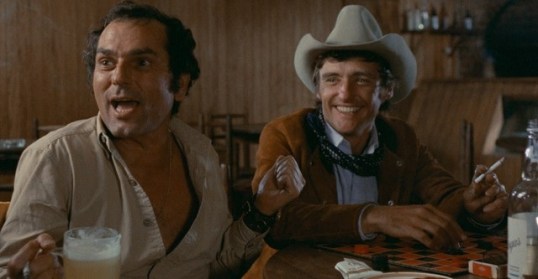
The second part of the film is where things start to fall apart. Kansas meets an old friend named Neville (Don Gordon). Neville has discovered a gold mine in the Peruvian mountains. With Kansas as his partner, he tries to get a businessman named Harry Anderson (Roy Engel) to invest in it. Kansas and Neville try to impress Harry and his wife (Julie Adams, best-known for being stalked by The Creature From The Black Lagoon). Kansas and Neville take the Andersons to a brothel and, in the process, Kansas offends Maria. Kansas then paws Mrs. Anderson’s fur coat and mentions that human beings are covered in hair. For all of their efforts, Harry will not invest, no matter how desperately Neville begs him to reconsider.
The second part of the film drags, with many of the scenes being obviously improvised between Hopper, Gordon, Garcia, Engel, and Adams. Unfortunately, the improved conversations aren’t particularly interesting and they tend to go on forever. Usually a reliable character actor, Don Gordon ferociously chews the scenery as Neville and it doesn’t take long before one grows tired of listening to him yell. (Gordon was far more impressive in Hopper’s Out of the Blue.) With the use of improvisation and overlapping dialogue, the second half of the film tries to feel naturalistic but instead, it’s a migraine-inducing method exercise gone wrong. It’s also during the second part of the film that a “scene missing” title card flashes on the screen, an indication that the discipline that Hopper showed as a director during the beginning of the film is about to be abandoned.
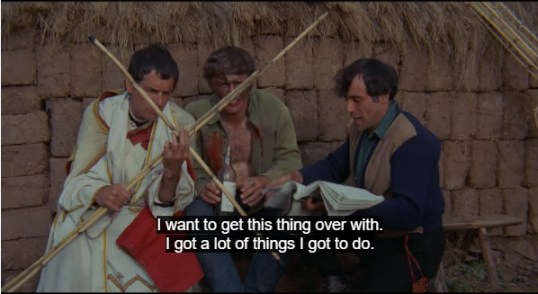
Finally, the third part of the film — well, who knows? The final 25 minutes of the film is collection of random scenes, some of which may be connected and some of which may not. The natives have decided that the only way to properly end their “film” is to kill Kansas. Kansas is shot several times and rides away on his horse. Suddenly, Kansas is back at his home and Maria is taunting him for getting shot. Then, Kansas is riding his horse again. Then suddenly, Dennis Hopper and Tomas Milian are laughing at the camera. A script supervisor tries to get Dennis to look at the shooting schedule while Dennis drinks. This happens:
Milian points out that the blood on Hopper’s shirt is dry. Hopper looks at his shoulder, where Kansas was previously shot, and says that someone needs to add his scar before he can shoot the scene. Ah! So, now we’re acknowledging that it’s all just a movie. Thanks, Dennis! Suddenly, Dennis is Kansas again and he’s collapsing over and over again in the dust. He appears to be dead but no, now he’s Dennis again and he’s standing up and smiling at the camera. And now, he’s singing Hooray for Hollywood. And now, suddenly, Kansas and Neville are talking about The Treasure of the Sierra Madre and then….
Well, let’s just say that it goes on and on before finally ending with a scrawled title card.
It’s a disjointed mess and it’s all the more frustrating because the first 30 minutes of the film is actually pretty good. But then, Dennis apparently remembered that he was supposed to be the voice of the counter-culture and he gave into his most pretentious impulses. Of course, just because a film is a mess, that doesn’t mean that it can’t be entertaining. And again, the first part of the film is entertaining and third part of the film is weird enough that it’ll hold most people’s attention for at least a few minutes. But the middle section of the film is so slow and pointless that it pretty much brings down the entire film.
In the end, what is The Last Movie about? In The American Dreamer(a documentary that was filmed while Hopper was editing The Last Movie in New Mexico), Hopper spends a lot of time talking about revolution and taking over Hollywood but The Last Movie is hardly a revolutionary film. The film is at its most alive when it is focused on the shooting of its fictional western. For all the satirical pokes that The Last Movie takes at the studio system, it’s obvious that Hopper had a lot of affection for Old Hollywood and for directors like Sam Fuller. Kansas may say “Far out,” but he’s hardly a hippie. Even the film’s jumbled finale seems to be saying, “It’s all Hollywood magic!” In the end, the film’s call for a new style of cinema is defeated by its love for the old style of cinema.
Instead, I think The Last Movie works best when viewed as a portrait of paranoia. Hopper himself admitted that he was naturally paranoid and the heavy amount of drugs that he was doing in the 70s didn’t help. One reason why Hopper filmed in Peru and edited in New Mexico was so the studios couldn’t keep track of him and, while directing, he worried about being arrested by the Peruvian secret police. As an actor, Hopper plays Kansas as being someone who views the world with caution and untrusting eyes. He doesn’t trust the other members of the film crew. He loves Maria but he’s still convinced that she’s going to betray him. Even the natives ultimately try to destroy him and the script supervisor tries to get him to stick to the shooting schedule. The film works best as a disjoined portrait of one man’s paranoid and fatalistic world view.
The Last Movie pretty much ended the studio’s attempts to harness the counter-culture by giving money to self-described revolutionaries. The new wave of directors — like Spielberg and Lucas — may have shared Hopper’s then-politics but they weren’t looking to burn down the system. (Hopper himself later became a Republican.) The Last Movie may not have been the literal last movie but it was, for a while at least, the last of its kind.
Ed Wood’s Plan 9 From Outer Space is the worst film of all time.
Everyone says it’s true
Well, you know what? Everyone is wrong! Plan 9 From Outer Space may be a low-budget film with some …. well, awkward performances. And the script may have some odd lines. And the story might not make any sense. And yes, there’s a scene in an airplane where the doorway to the cockpit is clearly a shower curtain. And yes, the spaceships are paper plates with strings attached. And Criswell’s campy narration makes no sense. And the guy that they brought in to serve as a stand-in for Bela Lugosi was clearly too tall and too young to be credible in the role. And the whole thing about bringing the dead back to life to keep Earthlings from developing the Solarnite bomb …. well, who knows where to even start with that? And….
Wait, where was I?
Oh yeah. Plan 9 From Outer Space. It’s not that bad, I don’t care what anyone says.
Here’s the thing with Plan 9. It’s about as personal an expression of an American director’s vision as we’re ever likely to get. Ed Wood was a pacifist who wanted to end the arm races. His way of trying to spread world peace was to make a movie about aliens so concerned about mankind’s warlike tendencies that they raised the dead. Somewhat subversively, Ed Wood makes it clear that he’s on the side of the aliens from the beginning. When the alien Eros explains that humans are about to build a bomb that can blow up sunlight and destroy the universe, the humans aren’t horrified. Instead, they’re intrigued. Eros says that humans are stupid and immature. The hero of the film promptly proves Eros to be correct by punching him out.
And so, the aliens fail. Even though they brought Tor Johnson, Bela Lugosi, and Vampira back from the dead, they still fail to change the terrible path of human history. Plan 9 From Outer Space is not just a weird sci-fi film. It’s a sad-eyed plea for peace and understanding. It’s a film that possesses it’s own unique integrity, one that sets it apart from all other cheap sci-fi films.
Of course, it’s also a lot of fun to watch on Halloween. Watch it, won’t you? And remember that Ed Wood, above all else, tried his best. Ed Wood wanted to save the world on a budget and, to do so, he made a science fiction film with his friends and he put a bunch of homemade UFOs on a string. He also wanted to give Bela Lugosi one great role and, indeed, Plan 9 would go on to become one of Lugosi’s best-known, non-Dracula films. Ed Wood had a lot of ambition and, in pursuing that ambition, he flew straight for the sun and dared the Solarnite bomb to take him down. Ed may have crashed into the sea but his vision will never be forgotten.
Plan 9 From Outer Space (1956, dir by Edward D. Wood, Jr)
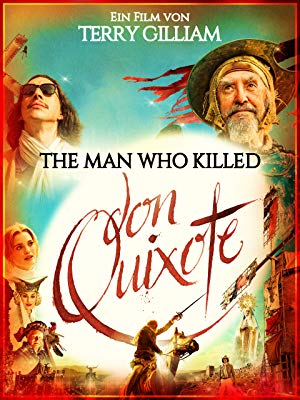
For many years, The Man Who Killed Don Quixote was a film best known for not having been made.
In the past, we’ve used the Icarus Files as a way to write about filmmakers who flew too close to the sun of their own ambition and who plunged down to the sea as a result. However, in the case of The Man Who Killed Don Quixote, the sun is not director Terry Gilliam’s ambition. Instead, the sun is a combination of shady financiers, natural disasters, and film industry silliness that seemed to all conspire to keep Gilliam from making his film. And yet, unlike the real Icarus, Gilliam insisted on continuing to fly, regardless of how many times he crashed into the ocean.
Terry Gilliam first started to talk about adapting Migel de Cervantes’s Don Quixote into a film in the late 80s. The tale of a Spanish nobleman who becomes convinced that he’s fighting giants when he’s actually only jousting with windmills, Don Quixote sounded like an obvious project for Gilliam. Gilliam’s films have always dealt with the power and importance of imagination. However, it’s often forgotten that Gilliam’s protagonists are often both saved and eventually destroyed by fantasy. (One need only think about the end of Time Bandits, in which the young main character goes on the journey of a lifetime but then watches as his parents blow up in front of him.) It’s easy to forget that Don Quixote dies at the end of Cervantes’s tale, having regained his sanity and having announced that his niece will be disinherited if she marries a man who has ever read a book about chivalry.
From 1990 to 1997, Gilliam started pre-production on his version of Don Quixote several times, just for the production to be canceled. Sometimes, this was due to Gilliam not being able to get the budget that he felt would be necessary to bring his vision to life. Frustrated with the Hollywood studio system, Gilliam wanted to raise the money for and make his movie in Europe but this turned out to lead to a whole new set of financial and regulatory complications.
Filming finally started on the film in 2000, with Jean Rochefort playing a former film actor who thinks that he’s Don Quixote and Johnny Depp playing the director who fills the role of Sancho Panza. Unfortunately, as shown in the poignant documentary Lost in La Mancha, the production seemed to be almost cursed from the start. The footage from the first day of shooting was unusable, due to planes flying overhead. The 2nd day of shooting was ruined by a flash flood that swept away much of the set. Jean Rochefort injured himself and, despite his best efforts to act through the pain, he had to step away from the role. Filming was suspended in 2000 and, for the next 16 years, Gilliam tried to find a way to get the stalled film started up again. Many actors came and went, including Robert Duvall and, most promisingly, John Hurt. Hurt agreed to play the role of Quixote but, just when it seemed that the film was finally going to go into production, Hurt passed away from pancreatic cancer. A few months later, the original Quixote, Jean Rochefort, also passed away. The film went back into limbo.
Finally, in 2016, a producer named Paulo Branco offered to fund the film. Pre-production started up again, this time with Adam Driver in the Sancho Panza role and Michael Palin playing Quixote. However, the project was soon once again stalled, as Branco wanted creative control of the film. When Branco slashed both the budget of the film and Palin’s already reduced salary, Gilliam denounced Branco’s actions. Branco suspended production but, by this point, Gilliam had already hooked up with another set of producers. Jonathan Pryce replaced Michael Palin as Don Quixote and, finally, Terry Gilliam’s The Man Who Killed Don Quixote was filmed!
Once filming was complete, however, Paulo Branco popped up yet again. Claiming that he owned the rights to the story and not Terry Gilliam, he sued to keep the film from being distributed. The courts ruled in Branco’s favor but Gilliam countered that he hadn’t used one frame of footage that had been shot while Branco was serving as producer and that, while Branco had the rights to his version of The Man Who Killed Don Quixote, he did not have the rights to Gilliam’s. While the lawyers argued, Amazon Studios withdrew from an agreement to distribute the film. Once the case was finally settled, The Man Who Killed Don Quixote was finally given a haphazard release in a few countries, often in edited form.
And that’s a shame because The Man Who Killed Don Quixote is a delight. It’s a film that is both playful and snarky, a celebration of imagination that also serves as a satire of Hollywood narcissism. Adam Driver plays Toby Grummett, a director who returns to a Spanish village to direct an big-budget, epic adaptation of Don Quixote. Ten years earlier, as a student filmmaker, Grummett shot a previous adaptation of Don Quixote in the same village. When he tracks down the old shoemaker (Jonathan Pryce), who starred in his student film, he discovers that the shoemaker thinks that he is Quixote and that he’s become something of a tourist attraction.
And from there, the film follows Don Quixote as he takes Toby on a quest to fight giants and protect the helpless and to live a life of chilvary. Along the way, Toby finds himself getting caught up in Quixote’s elaborate fantasy world. It leads to a lot of comedy but there’s also something rather poignant about the old shoemaker’s attempts to be a hero and Toby rediscovering the love of fantasy and the imagination that he had when he was a film student. And yet, it would be a mistake to assume that this film is simply a light-hearted fantasy. The laughs are tinged with melancholy. The enemies that Quixote and Toby meet are not just imaginary giants. This a film that mixes comedy and tragedy in a way that few other films have the courage to do so.
As is typical with Gilliam’s later films, it bites off a bit more than it can chew but it’s still hard not to get caught up in it. Driver and Pryce are both wonderfully cast and the film’s satire of the film business carries a sting to it. Watching the film, it becomes apparent that Gilliam sees himself as being both Quixote and Toby. The film’s ending seems to be Gilliam’s defiant message that he will always choose to fight the giants.
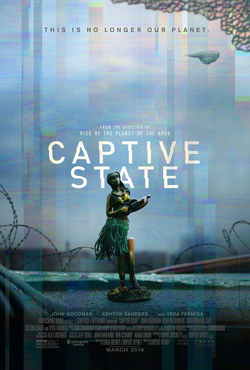
Captive State came out in March and, before it was released, it seemed like it had the potential to be something special. The trailer looked good. The cast was impressive. Perhaps even more importantly, the film was directed by Rupert Wyatt, who did such a good job with Rise Of The Planet Of The Apes. Surely, if anyone had the talent to create a convincing film about life under an alien dictatorship, it would be Rupert Wyatt!
In fact, my only reason for concern had to do with when the film was being released. March seemed like a very strange time to be releasing a big “event” film. Don’t get me wrong. A March release isn’t as bad as a January or even a February release. I mean, unless your film is a romantic comedy, you definitely do not want it to be released in either one of those two months. Those months are where studios dump their worst films so that they can die a quiet death. March, on the other hand, is when the studio releases films that have the potential to be a success but which they’re still not expecting to set the world on fire.
Of course, there have been exceptions to that rule, as both Wes Anderson (Grand Budapest Hotel) and Jordan Peele (Get Out) can tell you. So, as Captive State’s release date approached, we were left to wonder. Would this be another case of a film being better than it’s release date or would this be just another forgettable but not terrible movie that the studio probably spent a bit too much money on?
Captive State, sadly, turned out to be more of a case of the latter than the former.
The film opens with Chicago being invaded in 2019. Significantly, unlike other recent invasion films, this one doesn’t spend too much time on the invasion itself or Earth’s initial attempts to fight back. Instead, it jumps forward eight years, to 2027. The aliens are in control of Earth, though the aliens themselves claim to only be “legislators” who are governing the planet for our own good. While the majority of Earthlings just seem to be resigned to accepting being conquered as their new normal, there are a few resistors. There’s also quite a few collaborators. The tricky part of life in 2027 is figuring out who you can and can not trust.
There’s a lot of characters in Captive State and, at times, it can be difficult to keep track of how everyone’s related and who is working for who. However, that seems to be intentional on the film’s part. Rather than telling a conventional tale of alien conquest, Captive State sets out to be a serious exploration of what life would be like for the people living under the thumb of not just an intergalactic dictatorship but actually any dictatorship. The Legislators rule by fear. The collaborators have their own individual reasons for collaborating but, now that they’ve declared which side they’re on, there’s no going back for them. One way or another, they’ve sealed their fate. The same can be said for those in the rebellion. Meanwhile, most people are just trying to not get caught in the crossfire.
And the thing is …. you want the film to work. It’s an intriguing idea and how can you not respect that fact that Wyatt wanted to try to do something a little bit different with his story of alien invasion? But sadly, the film never works the way that you’re hoping it will. The film tries to do a lot in just 109 minutes. In fact, it probably tries to do too much and, as a result, there’s little time to get to know the characters, the majority of whom come across as being underwritten and with murky motivations. Captive State hinges on the actions of a detective played by John Goodman but the film itself doesn’t seem to be sure of who Goodman’s supposed to be. Hence, the film’s final twist seems to come out of nowhere. It’s hard not to feel that the ideal way for Captive State to have told its story would have been as a 10-episode miniseries on HBO. Trying to stuff all of this into under two hours of running time just doesn’t work.
And it’s a shame, that it doesn’t. Ambition should never be faulted. If only the results, in this case, lived up to the ambition.
There is exactly one effective sequence to be found in Maximum Overdrive, a horror film from 1986 that attempts to show us what would happen if all of Earth’s machines decided to destroy humanity.
It takes place at the end of a little league game. The coach, happy that his team has won, declares soda for everyone! He walks over to the soft drink machine and puts in his coins and…nothing happens. The coach stares at the machine perplexed. His team gathers around him.
Suddenly, a can flies out of the machine and hits the coach in the groin. Coach falls to his knees, just to get another can driven straight into his skull, leaving him with a big bloody hole in his head. As the coach twitches, his teams starts to run away. Suddenly, the machine is shooting cans out at them. Some of the kids escape but quite a few don’t.
Suddenly, as the kids flee, a driverless steamroller crashes through a fence and drives across the field, graphically flattening one of the players…
It’s over-the-top, it’s kind of scary, it’s fun in a naughty sort of way, and it’s exciting to watch. It’s totally absurd and yet it’s effective at the same time. It’s a really brilliant scene, one that hints at what Maximum Overdrive could have been. It hints that Maximum Overdrive‘s first-time director did have some potential and watching it, one is tempted to feel a pang of regret over the fact that he never directed another film after this one.
However, then you watch the rest of Maximum Overdrive and you realize that one effective scene was a total fluke. To your horror, you realize that this film’s director (and screenwriter) has decided to set nearly the entire film in the ugliest and most disgusting truck stop in the world. You realize that the director has no idea how to maintain suspense and that his idea of horror appears to be having a lot of trucks constantly circling the truck stop. And then, worst of all, you realize that the unlikable caricatures inside the truck stop are meant to be our heroes!
And you find yourself wondering if things could possibly get any worse. Well, believe me — they can.
First off, a guy named Camp Loman (Christopher Murney) shows up and reveals himself to be a total lech and then starts trying to sell bibles and really, what do you expect from someone named Camp Loman? And, what’s annoying, is that the film’s director seems to think that he’s blowing our mind by presenting us with an hypocritical bible salesman. I mean, seriously — the amount of time devoted to Camp Loman will make you nostalgic for scenes of a steamroller crushing a child.
And then Emilio Estevez shows up as our hero but he scowls through the entire movie and delivers all of his lines through gritted teeth, as if he’s pissed off about appearing in Maximum Overdrive and really, who can blame him? That said, it doesn’t really make for an enjoyable performance.
But hey — Emilio’s not the only person in the truck stop. There’s also Pat Hingle, playing the owner of the truck stop. He’s overweight, wears a tie, smokes a cigar, and speaks with a vaguely Southern accent. Hmmmmm, do you think he’s going to be a bad guy?
Oh! And let’s not forget the waitress played by Ellen McElduff. “WE MADE YOU!” she shouts at the machines and then she shouts it again and again and again and again and it’s almost as if the film is being directed by a guy so in love with his own dialogue that he doesn’t realize how annoying the same line gets when it’s screeched over and over again.
And I haven’t even gotten to the helium-voiced newlyweds yet…
When I recently watched Maximum Overdrive on Encore, there were a lot of things that annoyed me, such as the bad pacing, the bad acting, the bad dialogue, the bad special effects, the bad cinematography, and the bad everything else. But what really got to me was just how inconsistent this movie was. Some machines turned into killers but oddly, others did not. At one point, a machine gun starts shooting at the people in the truck stop but the weapons that Pat Hingle keeps in the truck stop never turn on their human masters. Seriously, if you’re going to make a terrible movie, at least be consistent.
So, you may be asking, why is this an Icarus File? Well, it was directed by Stephen King, the writer who is routinely called the “master of horror.” King may be a great writer but, judging from this movie, he was a really crappy director. I imagine, when the film was in pre-production, the logic was that if King could write a scary book then he could definitely direct a scary movie.
Nope.
It turns out that, just as Icarus should never have gotten so close to the sun, Stephen King should never have directed a movie.
“My life amounts to no more than one drop in a limitless ocean. Yet, what is any ocean, but a multitude of drops?” — David Mitchell
Let me tell you about Icarus. He took flight with wings of feather and wax. Warned not to fly too low so as not to have the sea’s dampness clog his wings or to climb too high to have the sun melt the wax. Icarus heeded not the latter and tried to fly as close to the sun. Just as his father had warned him the wax in his wings melted as he flew too close to the sun and soon fell back to earth and into the sea.
A tale from Greek mythology that taught has taught us about ambition reaching so high that it’s bound to fail. One such ambitious failure of recent times has been the epic science fiction film Cloud Atlas directed by The Wachowskis and Tom Tykwer.
The film was adapted from the novel of the same name by author David Mitchell which looked to take six stories set in 19th-century South Pacific and right up to a distant, post-apocalyptic future. Each story’s characters and actions would connect with each other through the six different time and space. The film attempts to do what Mitchell’s novel did through several hundred dense and detailed pages.
Just like Icarus The Wachowski and Tom Tykwer’s attempt to connect the lives and actions of all six stories amounts for what admirers and detractors can only agree on as an admirable and ambitious failure.
The film boasts a large ensemble cast led by Tom Hanks, Halle Berry, Jim Broadbent, Hugh Grant and Hugo Weaving. More than one of the actors in the cast would perform characters in each and every six interconnecting stories in the film which added a sense of rhythmic continuity to the whole affair, but also made for some very awkward and uncomfortable scenes of what could only amount to as “yellowface”. This was most evident in the story set in 22nd-century Neo Seoul, South Korea where actors such as James D’Arcy, Jim Sturgess, Keith David and Hugo Weaving have been heavily made-up to look Asian.
Cloud Atlas was and is a sprawling film that attempts to explore the theme that everything and everyone is connected through time and space. It’s how the action of one could ripple through time to have a profound effect on others which in turn would create more ripples going forward through time. The film both succeeds and fails in portraying this theme.
It’s the film’s narrative style to tell the six stories not in a linear fashion from 19th-century to the post-apocalyptic future, but instead allow all six tales to weave in and out of each other. At times this weaving style and how it would seamlessly go from one time location to another without missing a beat made for some very powerful and emotional moments. But then it would also make these transitions in such a clunky manner that it brings one out of the very magical tale the three directors were attempting to weave and tell.
Yet, even through some of it’s many faults and failings the film does succeed in some way due to the performances of the ensemble cast. Even despite the awkwardness of the “yellowface” of the Neo Seoul sequence the actors in the scenes perform their roles such admirable fashion. One would think that someone like Tom Hanks who has become such a recognizable presence in every film he appears in wouldn’t be able to blend into each tale being shown and told, but he does so in Cloud Atlas and so does everyone else.
It helps that the film was held up from a very hard landing after reaching so high with an exquisite and beautiful symphonic score composed by Tom Tykwer, Reinhold Heil and Johnny Klimek. It’s a score that manages to accentuate the film’s exploration of emotions and actions rippling through time without ever becoming too maudlin and pandering to the audiences emotions.
Cloud Atlas was hyped as the next epic science fiction film from The Wachowskis and Tom Tykwer leading up to it’s release. This hype was further built-up with thundering standing ovation during it’s screening at the 37th Toronto International Film Festival. But once the film finally was released and more critics and the general public were able to see it for themselves the reaction have been divisive. This was a film that brooked no middle-ground. One either loved it flaws and all or hated it despite what it did succeed in accomplishing amongst the failures.
Just like Icarus, Cloud Atlas and it’s three directors had high ambitions for the film. It was a goal that not many filmmakers seem to want to put themselves out on the limb for nowadays because of how monumental the failure can be if their ambitions are just too high. It’s been the reputation of The Wachowskis since they burst into the scene with their Matrix trilogy. Their eclectic and, somewhat esoteric, storytelling style have made all their films an exercise in high-risk, high reward affairs that makes no apologies whether they succeed or fail. Each of their films have a unique vision that they want to share with the world and they make no compromises in how this vision is achieved.
One could call Cloud Atlas an ambitious failure. It could also be pop, New Age psychobabble wrapped up in so-called high-art. Yet, what the two siblings and Tom Tykwer were able to achieve with the film has been nothing less by brave and daring. If more filmmakers were willing to allow their inner Icarus to fly then complaints of Hollywood and the film industry not having anymore fresh new ideas would fade.









 Through the Shattered Lens