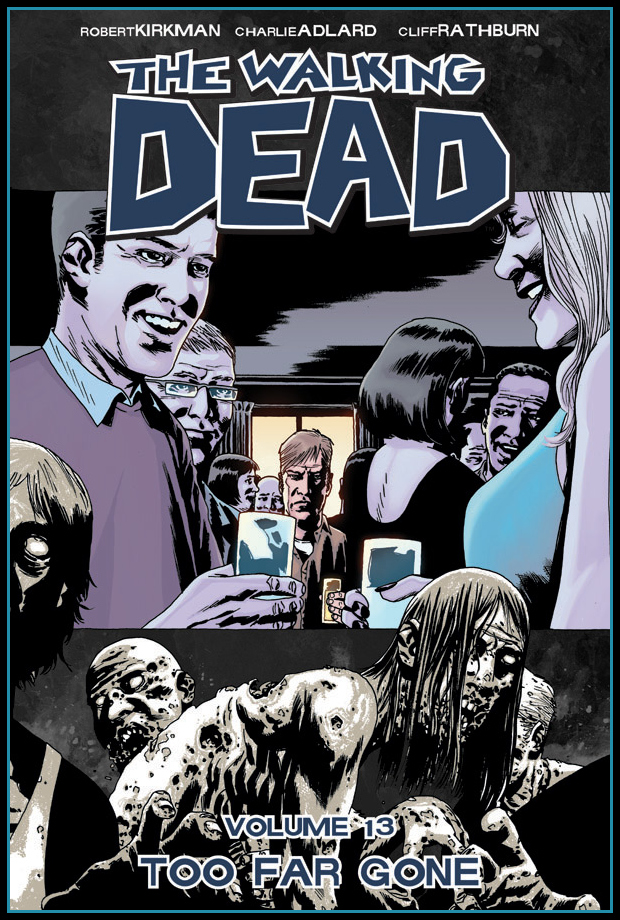
It’s been almost a month since the final episode of the first season for the tv series adaptation of this comic book aired on AMC. The Frank Darabont and Gale Anne Hurd produced series became a major hit not just for the channel but also for everyone involved. While the adaptation deviated from the comic’s path at times in the end it helped established the post-apocalyptic world creator Robert Kirkman had been working five years to create. This is a world that is still on-going and, just weeks earlier, released the thirteenth volume of collected issues 73 thru to 78.
The 13th volume is aptly titled, Too Far Gone, as it continues where the previous trade paperback left off and that’s Rick and his group of survivors trying to settle in the safe, walled community in Alexandria, VA. This wasn’t the respite Rick and his group were hoping for, but it is as close to one as they’ll get as their original destination of Washington, DC resembles much of everything else they’ve seen and that’s unsafe devastation.
As Rick gradually gets used to going back as a lawman for the community everyone else do their part in doing the new jobs handpicked for them by the community’s leader Douglas. Through the first half of the volume we see through the point of view of certain character that this safe haven they’ve joined has it’s fair share of secrets and that not everything was as stable as they’ve been led to believe. While some of the revelations the reader will read as the volume unfolds doesn’t bring back images of Woodbury and The Governor, they do show that the underbelly of the Alexandria community is just as rotten but in other ways.
The title of the volume is in regards to Rick as a character and to a small degree the rest of his group. Here they are in a safe place with other survivors who just want to try and get back to living life the way it used to be. The paranoia and mistrust Rick has built within himself after the long journey from his hospital bed to this place has begun to chip away at not just his sanity but his humanity as well. He hasn’t turned the corner to become another Governor, but his actions in regards to trying to safeguard their new found safety does show that Rick and some in his group do not trust all the smiles and well-wishes thrown their way.
Rick knows that as safe as they all might seem now it doesn’t take much for all of it to come crashing down. It’s this looming threat that forces Rick to behave in ways which does have people question if he’s lost it and has he become a danger not just to their new benefactors but to his own people as well. The answer to this question wasn’t clear and remains, like all of Kirkman’s answer to certain moral question throughout the series, ambiguous and left up to the reader to decide if what Rick has done for the safety of his son and the others keep him in the role of hero or villain.
The volume ends in relatively safe conditions, but clues of an ominous consequence at the solution to some of the community’s outside problems may just bring a much bigger one in the next volume.
For those who are fans of the comic book the last two volumes has been slower affairs with quick bursts of action and horror. Like volume 6 and 7 previously, this relative calm before the storm may just bring about another major change to the roster of characters we’ve been following since the battle at the prison. Will we see another major kill-off of characters? Only Kirkman can answer that and it will be another 4-5 months before the next volume hits the streets. It will be a long wait indeed.
I will admit that I’m not the biggest fan of Kevin Smith as a filmmaker though I don’t dislike or even loathe the man the way some film bloggers seem to. He’s definitely much more talented than Uwe Boll despite what some people may say. I just think that Kevin Smith had ended up listening too much to his own press about how he was the indie darling of the 90’s. He lived too much in his past glories and stagnated as a creative artist.
His last few films were either bombs financially and/or critically. Smith just tried too much to replicate what he had done in the past when he should’ve been trying to expand his horizons and attempt new things. To say that his Cop Out was awful would be an understatement. One of the worst films of recent memory, but for some reason actors still want to work with the guy.
It’s a good thing that good actors still want to work with him because his upcoming film, a horror film at that and a straight out one, in 2011 looks to be Smith reinventing himself beyond his “Jay and Silent Bob” era.
Red State looks like it’s just plain horror and the teaser trailer doesn’t seem to show any black humor or any humor at all that seem to be part and parcel of any Kevin Smith production. The teaser has a fundamentalist eerie vibe to it and with Michael Parks in what looks to be a Fred Phelps of Westboro Baptist Church infamy has definitely peaked my interest.
If Neil Gaiman, who has already seen the finished product (or close to being finished), was shaken by the experience but in a good way then my optimism for this film may not result in another Kevin Smith disappointmen. One can only hope.
I went to see Harry Potter and the Deathly Hallows, Part One earlier today and, before the film started, I saw the trailer for the upcoming Red Riding Hood. The trailer itself gives off a definite Twilight vibe, which isn’t surprising since both films were directed by Catherine Hardwicke and, regardless of what we may think of them, the Twilight films have made a lot of money. So, it makes sense that the trailer would be designed to bring in as many Twilight fans as possible…
Still, I’m looking forward (though admittedly, with a certain amount of caution) to Red Riding Hood. Why? Well, first off, Gary Oldman’s in it and Gary Oldman would have made Twilight a lot better as well. Plus, both of the leads are pretty to look at. (And, it should be noted, if Amanda Seyfried could give a good performance in a terrible film like Chloe than she can probably give a good performance in anything.) And finally — Catherine Hardwicke made her debut with Thirteen back in 2003 and I love that film so much that I can even forgive her for a hundred Twilights.
So, we’ve finally reached the season finale of a very short inaugural season of Frank Darabont’s tv adaptation of Robert Kirkman’s critically-acclaimed and very popular comic book series, The Walking Dead. AMC ordered an initial 6-episode for this season which made setting up the world for the non-fans of the comic book a top priority. This could be seen in the first five episodes as each one explained the rules of this new post-apocalyptic world and how it has changed how people have now begun to behave.
The tv series has stayed mostly loyal to its comic book source, but some divergence from the source material has caused some grumblings amongst the comic book’s legions of fans. It doesn’t matter to them that the comic book’s creator has been ok with the changes and actually an active participant with said changes. These changes have been somewhat minor in the show’s five episodes but as episode five rolled to an end we got a major departure to the source material. Rick has taken his band of survivors back to Atlanta where the CDC (Center for Disease Control) is headquartered at. This never happened in the comic book and it’s inclusion to the story has driven many a fan of the source material batshit crazy.
They ask why make the changes, both minor and major, to a story that was already full of story-arcs, subplots aplenty and enough characters down the line that new ones weren’t needed. I can’t blame them for asking such questions for I, too, are a major fan of the comics right from the very beginning. But these changes is exactly why the story being told by this tv adaptation look and seem fresh to me. The end of the last episode was such a major departure that I can now honestly say that I have no idea what Darabont and Kirkman have in store for Season Two. It’s that element of the unknown and the surprise of not knowing what’s around the corner why I don’t rail against these changes. If I wanted a page-by-page, panel-by-panel adaptation then I’d rather just bring out the comics and re-read them for the umpteenth time.
Now we get to the season finale and whether the major change will actually improve or just ruin the series.
I must say that I was guarded in my optimism about this major departure and the inclusion of the CDC. What I’ve liked about some of the best zombie stories ever put on film or on paper is that the zombie apocalypse never truly gets a definite explanation as to how it began or what caused it in the first place. This season finale episode titled “TS-19” seemed like Darabont’s attempt to try and explain the cause of the zombies and who or what let it loose in the first place. Very bad zombie stories try to over-explain and end up tripping over themselves in the process and thus ruining the experience.
With “TS-19” we get Dr. Edmund Jenner (Noah Emmerich), last surviving researcher in the CDC, give a brief explanation as to the process of when a person goes from living to dead to reanimated corpse. While the fancy computer-enhanced imagery seemed to explain much it really doesn’t. It just scientifically showed what everyone already knew. They still don’t know if it’s a viral or bacterial disease or if it’s even a disease at all. Even Jenner doesn’t discount Jacqui (one of those new characters added in that fans of the comics railed against) mentioning that it could be the wrath of God. The sequence even answers viewers’ question about how long it takes for a recently dead to return back as a “walker”. The answer to that is that they don’t know.
This episode highlighted how ineffectual the very institutions people depended on for help, security and safety when the zombie apocalypse finally hit critical stage. We see this in the show’s cold start prologue as we go back in time to see the final moments at the King’s County Hospital where a comatose Rick Grimes was being kept at for observations. Shane, his partner and best friend, sees the brutal solution the military has for those either infected but alive and/or unwilling to vacate the hospital as it began to be overrun by the “walkers”.
This sequence answered questions about why the military was so inefficient. It’s also a damning condemnation about the rigidity of such a major governmental institution unable to adapt to an ever-changing situation where the enemy didn’t sleep, didn’t stop to rest or wasn’t afraid about being fired on. This was an enemy that was conducting the true meaning of “total war” on a people who were already on the ends of their last rope. The fact that their solution only swelled the ranks of those they fought just showed how doomed the world is when something this apocalyptic occurs without warning and without a means to fully understand and combat.
Even Jenner doesn’t know what made the zombie apocalypse begin and the source of what scientists thought was something they could find a cure for. This ambiguity needed to be shown to stop question from the audience about the “why’s” and “how’s” and instead get the series back onto the road where survival and holding onto their humanity remains their ultimate struggle.
This episode does get them back onto that lonely road with some deciding to stay as the facility began a countdown towards a final decontamination. We get also get a nice scene between Jeffrey DeMunn’s Dale and Laurie Holden’s Andrea that should make fans of the comics happy. The same goes for showing just how ineffectual Rick has been as their leader as every decision he has made has put the group in danger. It shows Rick’s intractable belief in doing the right things and holding on to the vestiges of civilized behavior could be just a front to give his wife and son hope that things will be better. This episode shows Rick that what’s better is to stay for that final decontamination instead of going back on the road where only death and suffering will await him and his group. Jenner’s comment that was heard was like a prophetic announcement that Rick will regret going back out.
So, we finally end Season One of The Walking Dead and have a very long wait (hopefully AMC make the decision to air Season Two not on October but at least a month sooner, if not a couple of months.) til the series picks up again with the convoy of survivors headed to parts unknown. Parts unknown not just for the characters in the series but for fans of the comic book as well. Here’s to hoping that while Darabont and Kirkman uses the comic book as the main path for the series moving forward that they also deviate from it from time to time if there’s a good story to tell on those small paths and tributaries.
Extras
* “Dude, you are such a buzzkill.” – Glenn finally gets backhis witty ways as he reacts to Shane’s questioning of Jenner during a celebratory dinner.
* “Man, I’m going to get shitfaced drunk, AGAIN.” – Daryl’s reaction to Jenner’s news that there may be no one left anywhere.
* I found it quite ironic that of all the people to hold out the longest as the rest of the world gave up it would be the French.
* There was quite the Lost In Translation moment towards the end as Jenner whispers something into Rick’s ear before the group bolted to escape. Theories on what already has odds on Lori’s physical situation after the tests Jenner gave the group.
* As a military nut I smiled at the use of the acronym H.I.T. to literally mean a hit of a high-impulse thermobaric high explosive. That’s what I call a hit.
* Scene as Rick tries to plead with Jenner to let them go one can see Daryl still axing away at the blast doors.
* “The world runs on fossil fuel. How stupid is that!” – Jenner pointing out that places still doing research to find a solution failed because the power grids which run on fuel stopped due to lack of it.
* “This is what takes us down. This is our extinction event.” – Jenner finally voicing what everyone in the show has been avoiding and should give a clue as to the true meaning of the show’s title.
* The episode ends with a Bob Dylan song, Tomorrow Is a Long Time, that was very appropriate.
Season One of The Walking Dead is just days away from concluding. The show has been a runaway hit for AMC. It’s ratings since the pilot premiered on Halloween night has tripled the numbers posted by AMC’s other critically-acclaimed hits like Mad Men and Breaking Bad. It’s showrunner in Frank Darabont with veteran Hollywood producer Gale Anne Hurd the show had the firepower to allow a basic cable network to take a chance on a tv series based on a long-running comic book series about survivors in a post-zombie apocalypse world.
With Season 2 already approved for a 13-episode pick-up the only question now is whether the show will be able to take the foundations laid by Darabont and his writers this first season and continue to improve on the product. This question may have just taken on a certain significance as Deadlinehas reported that Frank Darabont has fired all the writers of this first season and plans on writing the second season by himself with freelance writers being brought in to work on each episode’s scripts.
For a show that has garnered great reviews from critics and fans alike, not to mention ratings that it’s sister shows on the network could only wish for, this change in how the upcoming season would be written might just put the shadow of worry over it’s growing legion of fans.
For some, this news might seem like a panic move designed to placate the vocal minority of blog reviewers who have pointed out how the show’s writing didn’t pass muster after a powerful pilot episode. How the series’ first season seem to have a Jekyll and Hyde tone to it. One episode being great then the next just so-so. Could the negative criticism (some justified and others just criticism for criticism’s sake) have reached the heads of AMC and the show’s producers and a decision for a change was made off the cuff.
This report, if confirmed by Darabont and the network as true, does mean Darabont becomes the sole writer for the show with hired freelancers doctoring finished scripts then it could be a blessing for the show moving forward. There will now be a singular voice that will dictate how the show goes forward. Some will think this may just ruin the quality of the show not having a staff of established writers on-board like the first season had, but it’s those very same writers who the show’s detractors have been blaming for the show’s missed opportunity to create a brave new show on tv.
Also, it’s not such a rare thing to have a show written by one individual and for a series that’s really one long story with some very complicated subplots thrown. Having that one writer could keep things from getting too confusing. It could also solve the up and down nature of the episode quality.
AMC, hasn’t stated that the show will not have a staff of writers. There’s a chance that Darabont will hire both freelance and series writers to help smooth the transition from Season One to Season Two. The good thing is that the network and the producers pretty much have 11 months to decide on exactly how to proceed.
We’ve now come to the penultimate episode of The Walking Dead‘s first season. If there’s been one thing about this tv adaptation — of the Robert Kirkman comic book series which it’s based on — has proven it’s that the show is willing to go off the reservation when it comes to following the source material. The show has made some interesting storytelling and character choices right from the start. Scenes which occur later in the comic book have been moved up and combined with others. New characters, both recurring and disposable ones, have been introduced to the original numbers from the book.
Some of these changes have been welcomed by old fans of the book, but there’s a vocal minority who don’t see why there’s a need for such changes and additions. To new fans whose experience with this franchise has been just through the show the changes don’t mean a thing. They’re coming into this fresh and with open eyes. For long-time fans this need to watch this show with open eyes instead of clutching at the strict canonical material that are the books it would be a hard time going. I’m one of those who have been reading the books since the beginning and for the most part I’ve accepted these changes. Even the major departure introduced to end this episode I find quite interesting and with guarded optimism that it will lead to a surprising season finale and set-up season two properly.
We begin the show the very morning after the zombie attack on the camp which ended the previous episode. The survivors are cleaning up the bodies of both the “walkers” put down and those people they lost. The scenes showing how both Carol deals with her abusive husband’s corpse and how Andrea deals with her younger sister Amy were quite powerful in their own way. In one scene, we see an abused and beaten down wife taking out her anger and relief on the source of her problems with a pickaxe. In another, we see an older sister remembering past regrets of never being there for her much younger sister despite promises to do so. The scene with Andrea goes against much of what most zombie survival aficionados would do, but it brings to light just how much the Andrea loved her sister and even if it means seeing her come to a semblance of life just one more time to say her goodbyes she would do it. Knowing what she would need to do in the end just made her tearful final goodbye that more powerful.
The third farewell doesn’t happen until 3/4’s of the way into the episode (though we do see Morales and his family go their own way. Going to miss him going for the fences with that baseball bat) and involves Jim. An injury incurred from the fight during the night leaves him and the group with a problem that gets resolved in one of the more poignant scenes in this series, so far. As Morgan Jones from the pilot episode instructed Rick the “walkers” and their bites are a death sentence. The two competing leaders of the group in Rick and Shane want to solve their Jim problem using different methods. Rick wants to take the group to the one place he thinks could still help Jim and that’s the CDC near Atlanta. While Shane, with enthusiastic support from Daryl, wants to put Jim down before he becomes a dangerous liability.
In a scene reminiscent of a similar one from Romero’s original Dawn of the Dead, Jim makes the final and ultimate decision about his life. The goodbyes made by everyone to Jim after he’s made his decision to be left behind was very heartbreaking. Jim might have been a secondary support character but the last couple episodes have fleshed out his character enough that we care what happens to this man who has lost everything and thinks his predicament will reunite him with those he has lost.
The growing schism between best friends Rick and Shane gets a few more nails added to it as we see Shane gradually losing his command of the group. The group looks to be gravitating towards Rick as their leader now and even the wildcard in Daryl seem to look to Rick for the answers. The scene between the two as they patrol the woods near the camp definitely widens the gulf between the two even if Rick looks to be unaware of what’s really going on with Shane. The sudden appearance of ever stalwart and ever watchful Dale sure thinks something is amiss.
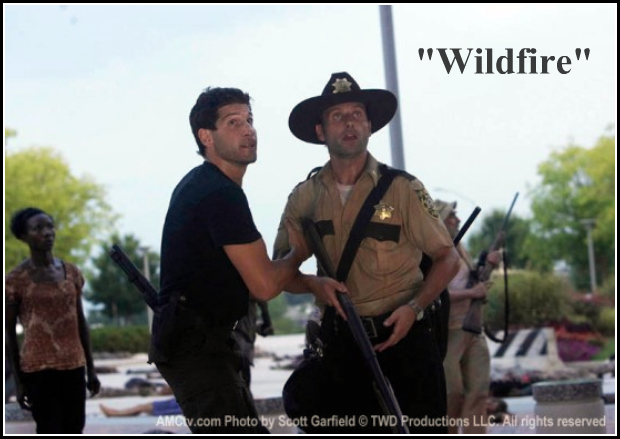
It’s the final ten minutes of the show where we finally know why the episode was titled “WildFire”. In another departure, one that would be called huge by fans of the comic books, we see the lone surviving researcher within the CDC sending video reports on what’s being called “Wildfire” and how research on the so-called “disease” has remained useless with no answer in sight.
The whole entire sequence reminds me of the early parts of Stephen King’s own apocalyptic epic novel, The Stand, as scientists desperately try to stem the tide of the approaching apocalypse to no avail. It’s little subtle references to other apocalyptic stories and tales like this which keeps some of the changes and departures from the source material bearable and, at times, even welcome.
It’s this major departure that will send some long-time fans of the comic book apoplectic. The vocal minority will definitely get even louder as to why Darabont and the writers are messing with the timeline and the stories in the original comic book. As one of those fans I should be screaming just as loudly, but the zombie and apocalyptic genre fan in me actually like how this show has gone off the beaten path of the original source material.
If they had stayed word-for-word and panel-for-panel true to the comic book then there’s no surprises to be experience. Knowing how everything unfolds right from the start could get boring even if it is about something read and re-read with love. There’s still no guarantee that the final pay-off of this particular major detour from the comic book will end in a good way, but the possibility of not knowing how this story-arc will end this first season is both exciting and tense-inducing. It could succeed in the best way, but also fail in an epic one. Either way the path now is not set in stone and everything moving forward will be undiscovered country.
Extras
* Quote of the night: “I think tomorrow I’m gonna blow my brains out, I haven’t decided. But tonight, I’m getting drunk!” – nameless CDC researcher.
* For once Glenn doesn’t have a witty quip or remark which just highlights the somber mood of this episode.
* There’s still no news on the whereabouts of one Merle Dixon though he gets name-dropped a couple times.
* A sneaking suspicion that Merle will not appear again this season, but may in the next or later ones.
* Bear McCreary’s score and choices of music for the episode the best in the series, so far to date. Especially, the use of John Murphy’s Adagio in D Minor from the sci-fi drama Sunshine which was recently used in Kick-Ass.
Cigarette Burns was John Carpenter’s episodic contribution to the Showtime series, Masters of Horror. This 13-episode horror anthology thought up by Mick Garris (a fellow horror director best known for adapting Stephen King stories) which includes eleven other directors known for their work in the horror genre.
John Carpenter works off of a screenplay that posits an interesting premise about an infamous film that caused the audience it was shown to the first time to go homicidal. The story itself involves a man known in the film community as someone who can find and hunt down any copy of film no matter how rare. Norman Reedus (he of Blade II, The Boondock Saints) plays the cinephile who takes on the job to hunt down a copy of this infamous film titled Le Fin Absolue Du Monde. His client was played with relish by resident weirdo Udo Kier. Really, Kier could be given any role and he’ll add his brand of idiosyncracy and weirdness to the part. In Cigarette Burns he plays an obsessive fan of the rare film to the hilt. His contribution to the the climactic ending will bring a smile to gorehounds everywhere. Alas, it’s Kier’s performance that’s the highlight of the acting in Cigarette Burns. Reedus’ performance as Kirby Sweetman the cinephile leaves much to be desired. The screenplay itself was already average, but with genuine ideas that could be explored if the acting could raise it beyond its C-grade pedigree, but Reedus wasn’t up to it.
Carpenter’s directing really can’t be faulted for the major flaws in the screenplay and in his lead’s performance. It’s not early Carpenter, but his work in Cigarette Burns was much better than what he’s done in his last couple films. In fact, this tv show entry in Carpenter’s body of work resembles one of his more underrated films. I am talking about his ode to Stephen King and H.P. Lovecraft with In the Mouth of Madness. Instead of a book influencing the sanity of the reader, its a film that does it instead. A film that may or may not have divine origins that doesn’t just turn its viewers homicidal but bend their sense of reality.
I think with a better cast and a screenplay that’s worked on a bit more by its writers, Cigarette Burns could’ve been a great episode in the Masters of Horror anthology or, better yet, become a full-fledged feature film. Instead, it’s just a very good work from Carpenter with great gore sequences (courtesy of KNB EFX), but brought low due to a very rough screenplay and a lead actor in Norman Reedus who seemed stoned, drunk or both throughout his entire performance. It’s not something great, but a good showing from Carpenter that said he’s not as washed-up as many seem to be calling him.
We’re now into the first episode of the second half of this initial season. The Walking Dead has been a definitive hit for cable network AMC who has been hyping up the show every week for months. The pilot episode has been hailed as one of the best premiere shows and it helped that showrunner Frank Darabont wrote and directed it. Then we had the follow-up episode which have been hit-or-miss for some people with the second one being a miss for some who began to question whether Robert Kirkman’s comic book series will have the legs to last several seasons and beyond. The third episode allayed some of those fears, but still some people were still doubting whether the show can truly balance the intense drama and character interaction with the zombie mayhem and gore.
Now we’re on the fourth episode and when people heard that creator Robert Kirkman would be writing the episode more doubts started to creep in. I say this because as critically-acclaimed and popular the comic book series is there’s a vocal segment of the fans who think the book succeeds despite Kirkman’s writing which tend to be heavy on the exposition. They see him not knowing the concept of “less is more”. As a long-time fan I can see what these fans mean, but I also think he’s quite good in creating the scenarios his characters must navigate through.
With this fourth episode titled “Vatos” we get Robert Kirkman writing not as a comic book writer but as someone who knows its a new medium and must write accordingly. In what I consider the best episode since the Darabont written and directed pilot, Robert Kirkman has shown just why millions of fans have flocked to read the comic book and why millions more have fallen in love with it’s tv adaptation.
The episode begins with a beautifully shot prologue of Amy and Andrea sitting in a boat fishing in the quarry lake and reminiscing about their father. It’s a nice tender moment which takes on a sad note as they finally voice every survivor’s fear. Are their parents alive? Maybe where they lived wasn’t hit hard. It’s survivor’s guilt to the nth degree as we and these characters know that the odds of any of the camp’s loved ones in far off places being alive are miniscule to none.
We also see a disturbing portent of what may yet come to pass as Jim, the mechanic from the past episode, seem to be losing his edge. It falls to Dale to notice Jim’s erratic behavior and then down to Shane to take care of things before Jim finally goes over the deep end and hurts not just himself but everyone else. I liked how Jim’s little revelation about what happened to his family arrived quite naturally and the effect it had on Lori and the others. Lori, Carol and Andrea may still have a semblance of a family, but Jim is the prime example of someone who has lost everything and may not have anything left to live for.
Now, we ended the third episode with Rick and his little band of Merle rescuers finding their quarry missing and not just from the roof but the hand he was cuffed with. We see the aftermath of Merle’s improbable, but quite the badass, escape from the roof. While we don’t see Michael Rooker as Merle in this episode his presence looms over everything and everyone. It’s during Rick and the groups attempt to find not just where Merle went but also the bag of guns Rick dropped in the pilot episode that we finally meet the episode’s title characters.
At first, it seemed like another attempt by Kirkman and the writers to drop stereotypical characters into an already crowded plate. Latino gangbangers becoming an immediate threat to Rick and his group. They even had a smooth-talking and intelligent leader that some may see as the show’s attempt on the typical drug lord. The confrontation between the two groups don’t come off so smoothly the first, second and third time, but it takes the intervention of the kindly grandma-type to ease the tensions. Tensions which reveals that people shouldn’t judge a book by it’s covers.
I definitely think this is like Kirkman’s shot across the bow of his detractors who think he cannot write beyond wordy exposition. The dialogue in this episode was some of the strongest and I’d say just slightly above of the pilot’s. There were more characters involved with two paralleling storylines to manage. Kirkman has shown with this episode that he actually knows the concept of “less is more” and that his true calling may not be writing comic books but writing teleplays for tv. I wouldn’t mind if all the episodes of The Walking Dead were written by just Darabont and Kirkman. I truly believe that this episode won’t be last time we see a Kirkman-written episode and that’s a good thing to look forward to.
In the end, “Vatos” more than lives up to the high standard the pilot episode set. It was an episode which was able to combine not just the dramatic interaction between character and groups (and not just conflicts, but the quieter moments) but also the very zombie mayhem and carnage fans of the genre expect the show to have. The episode which begins so calm and serene ends on a horrifying and sad way. This episode has finally illustrated what the comic book was all about. A story and journey of survivors living day by day trying to retain a semblance of their old lives only to have the ever-present threat of the zombie apocalypse shatter such misguided attempts.
Extras
* KNB EFX founder Greg Nicotera makes an appearance as a zombie in the second-half of the episode.
* Merle Dixon never appearing on-screen but still ends up being the badass of the episode.
* Guillermo’s (leader of the Vatos) hounds from hell.
* “Admit it, we only came back to Atlanta for the hat” (Glenn seeming to be the one person in every episode with the witty quip and remark to lighten things a bit)
* Breakin’ Bad veteran-director Johan Renck’s masterful handling of the episode’s climactic scene in the camp.
* The show loses a regular character and one of the cardboard ones.
Ok, the second episode of The Walking Dead was seen by some as being too much like every past zombie films and stories that’s ever been told. It was too much about the typical zombie siege of a group of survivors inside a building with little to no way out of the predicament. Now add in the elements of infighting within the group not to mention a dangerous wild card of a character and some viewers were turned off by it. The fact that the episode was one of the goriest episodes of any show ever put on non-premium cable never got much press.
One character introduced in episode 2 which really polarized viewers was the one played by veteran genre actor Michael Rooker. The character was one Merle Dixon and he instantly appeared in the show as an uncouth, loud, abrasive redneck racist that for some the only thing missing was the song “Dixie” playing in the background. I must admit that the character of Merle Dixon was written and introduced rather awkwardly, but to say that the zombie apocalypse wouldn’t include such blatant racists individuals have way too an optimistic view of humanity.
It is how we start the third episode, titled “Tell It to the Frogs”, that has redeemed the character of Merle Dixon to some skeptics. I wouldn’t say redeemed as in they accepted the racist but that he might still have a part to play in this 6-episode first season of the show. In the second episode Merle was left behind by Rick and the group handcuffed on the roof of the very building which was now overrun by “walkers”. Fortunately for Merle, T-Dog (who had happened to drop the cuff keys down the drain in his attempt to free Merle) had chained and padlocked the door to the roof to keep Merle from becoming the next sun-burned meal for the walkers. Unfortunately for Merle the chain and padlock had some slack to it that the door could be opened with enough of a gap for a walker to stick its head through.
Merle opens the third episode talking to himself as he reminisces about punching some Army officer in the past. Right from the get-go we see Merle might have lost his mind somewhat. But as soon as his trip down racist memory lane ends he finally snaps back to reality and realizes he’s cuffed to the roof, no key to the cuffs and the zombies as working their damndest to push the chained roof door wide enough to get through. Before the scene moves to the intro credits me last see Merle trying to use his belt to pull the steel hacksaw to him while praying and condemning Jesus in equal amounts.
That was some fine acting from Michael Rooker and was one of the highlights of the episode. While it still doesn’t answer the question of how such a racist was even with the group in the building, it does confirm that Merle might not be all there mentally. The appearance of his brother Daryl halfway through the episode and showing the younger Dixon to be as racist but not as unhinged reminds me of the two characters from Of Mice and Men except these two are of the racist variety. George being the younger Dixon and the Lennie role taken on by Merle. It’ll be interesting how these two new characters to the series will unfold as the first season rushes towards its conclusion. The scene in the end with Daryl finding the aftermath of Merle’s attempts to escape his cuffs was another fine moment in an episode that was more about character interaction and drama than about violence and gore (thought there’s some of that in the episode).
While the episode begins and ends with the fate of Merle Dixon the bulk of the episode was the reunion of the Grimes family and how Rick’s miraculous arrival has changed the camp’s group dynamics with Shane Walsh (Jon Bernthal in a performance which turned his character of Shane from hated “black hat” of the show to one that was a complex character who may or may not still be a simple “black hat”) and his wife Lori.
The scene where Rick slowly makes himself seen by the camp was very touching and showed hints of the love triangle the show will be exploring between Rick, Lori and Shane. The fact that Shane’s the first to see Rick and his expression turns from curiosity about who this new survivor was to one of shocked disbelief that the man he had spoken of as being dead has come back to his life. A life he seemed to be remaking with Lori as his partner and him a surrogate father to Rick’s son Carl. The reaction by Lori to suddenly seeing her husband back in her life healthy and alive ran the spectrum of surprise, shock and guilt.
Even the complex reactions from Shane and Lori didn’t diminish the heartwarming reunion between father and son as Rick literally fell to his knees in tears to hug his son Carl. That scene definitely was a tearjerker for many and Lincoln’s performance was very believable. One could almost see the burden and tension drain away from Lincoln’s Rick. The goal he had set for himself since episode 1 was now complete and nothing else mattered at that moment.
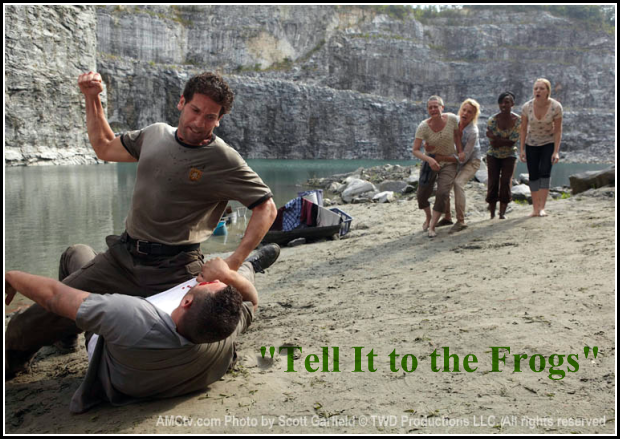
The show did have some moments which showed Darabont and the writers still feeling their way around Kirkman’s source material. One of it being the introduction of an abusive husband for one of the book’s regular faces in Carol. In the book the husband was only mentioned as not having survived the trip to Atlanta but no mention of him ever being abusive. Like the introduction of Merle in the previous episode, the appearance of Ed as the caveman husband was done too haphazardly. Almost like someone out of stereotype casting call, Ed bullied his way around the women in the camp until Shane had to step in and put on an epic beating that added some depth to the character of Shane but also made one wonder if the addition of Ed was just as a way to give Shane an outlet for the anger and frustration he was feeling from the return of Rick and the subsequent frosty attitude by Lori towards him.
In the end, “Tell It to the Frogs” was a much stronger return for the show after a second episode that some thought was being too stereotypical of a zombie story. I enjoyed the second episode but understand why some reacted to negatively to it after such a powerful initial pilot episode. The crew of Darabont, Kirkman and the other writers definitely have a balance to do between dramatic storytelling and zombie mayhem as the show continues through this first season and into the next. While some of the characters, both new and old, do seem too one-dimensional and more like plot devices for the main characters the show is only in its third episode and to judge the whole thing on such a small sampling is not fair to the show and the people behind it. I think the show has hit a nice balance of drama and mayhem. Time will tell if the show will live or die by balancing the two or finally landing on one side or the other.
PS: Oh yeah, anyone who happens to be fans of Bambi and her mom will have a hard time watching this episode.
The second episode of The Walking Dead just aired and while it didn’t have the emotional impact the Frank Darabont-directed pilot episode had it still more than held its own. It was an episode that more than lived up to it’s title and for zombie fans and gorehounds this episode should assuage any thoughts that the series will be heavy on emotional themes and scenes while lacking on any sort of zombie mayhem and bloody good horror (shout out to the Bloody Good Horror Crew). With an apt title of “Guts” the follow-up episode of this series looks to move the story forward now that we’ve gotten some of the basics of this new zombie apocalyptic world and its rules out of the way in the pilot episode.
When last we left our intrepid hero, Rick Grimes, he had gotten himself into quite a pickle. Mode of transportation was now chow for the zombies he had cantered into and he was now stuck inside a tank with no idea of how to get himself out of the situation until he hears a voice over the tank’s radio. One would think that we’d see the start of the second episode starting up from this very last moment in the pilot, but instead we get a quieter, but more disturbing sequence to begin the show. It involves Rick’s wife Lori out in the woods near their make-shift camp outside Atlanta. The scene is set-up to almost be a jump scare scene and for some I’m sure the pay-off in the end probably made them jump, but instead we get another glimpse into Lori Grimes’ current situation and expands on what she has been doing since leaving their Kentucky town with her son Carl and Shane Walsh, Rick’s partner. This opening scenes really paints Lori in a bad light and I’m not sure it needed to be handled so heavily. I’ll reserve a bit of judgement on this development on Lori and Shane as characters. The pilot episode seem to have hinted to something like this maybe happening already before the zombie apocalypse dropped in their laps which would definitely diverge this series from the original comic book source. Only time will tell if the planned triangle-drama will pay off in the long-run or ruin a major character’s growth with audiences in this show’s future.
This brief interlude leads up to where we last left Rick and his mysterious friend on the other end of the tank’s radio. From the moment this scene starts the show puts the episode on high gear and never lets up. The pilot episode was all about quiet desolation and isolation for our main character. This second offering is all about adrenalin and desperation as Rick goes from one dangerous situation into another. We also get to meet his benefactor who had been helping him by way of radio. In a role that should make Steven Yeun a fan favorite at comic book and fan conventions starting now, we meet a fan favorite of the comic book.
The character of Glenn has always been one of the constants in the comic book series. He has been with Rick since the very beginning and while his character doesn’t have the emotional and/or dramatic gravitas as the others he does prove himself to be voice of reason when everyone around him seem to be on the verge of losing their minds from the constant barrage of danger not just from the zombies but from other people as well. It was good to see Glenn portrayed early on as the snarky character the original source material had him before he become just a tad domesticated as the series went along. The fact that he was the one who seem to know how to truly survive in this new world while those around him seem to be making mistakes after mistakes should make fans of his character very happy.
We meet the rest of Glenn’s group which includes original character from the comic book in Andrea with four new additions created just for the series. All these new characters almost have “red-shirt yeoman” tattoed to their foreheads with the exception of Michael Rooker’s blatant racist redneck role of Merle Dixon. Rooker takes this over-the-top character and drives it into the ground. I thought the character could’ve used just a tad bit of subtlely in how he was written, but Rooker definitely looked liked he was having fun with the character. In any other actor’s hand the character of Merle Dixon would’ve looked just foolish, but the Rook’s manic intensity in playing the role made me hope the situation the group left him in wouldn’t be the last we see of Merle. Rook needs to get some more screen time to either play his character’s racist personlaity to the very end or at least time to round him out a bit before he finally gets his just desserts.
Laurie Holden as Andrea seemed like she was still searching for her character’s main focus. We find out that her younger sister is back at the camp with Lori and Shane and that she’s very knowledgeable with firearms. Her Andrea also seem to be slightly prone to panicking (though with zombies having destroyed one’s world panicking seems like a natural thing to do). I hope Daradont and his writers (Robert Kirkman being one of them) don’t mess with Andrea too much, but just expand on the type of person she is and how it will grow in time to be the Andrea everyone who are fans of the comics see as one kick-ass lady.
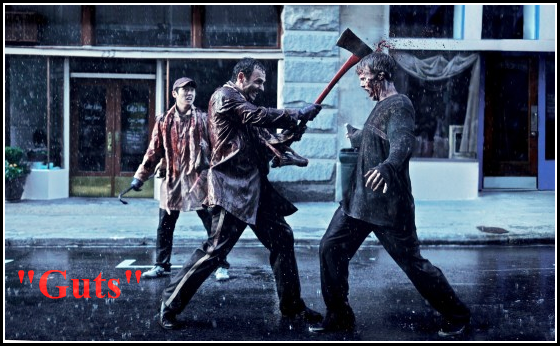
Now, the aforementioned episode title and what it means. It literally means guts. One could see the word used metaphorically to describe Glenn’s character finding his inner courage to follow Rick into one crazy and dangerous plan to save everyone in the group. Or one could see it in the way everyone who saw the episode saw it. Rick, Glenn and their group hacking a zombie to pieces to use it’s guts to camouflage themselves. This sequence is in line with how the comic book handled it but was moved up in the story’s timeline. This slight adjustment tells me that Darabont and crew look to be mixing and matching some of the original source’s narrative to create something more dramatic on the tv screen. Either way the sequence was the best one in the episode. It had the gross out factor zombie and gorehounds love. It also had tension and white-knuckle terror as we wonder if their trick will fool the zombies and when nature throws a curvebal their way while their in the middle of a horde I could almost sense millions of viewers shouting at Glenn and Rick to drop their shit and run (for people in the same situation they may literally drop their shit before running).
While the second episode didn’t have the quieter and emotional moments as the pilot episode it did have the adrenalin boost some horror fans were missing from the first one. Some have called this episode a let-down from the pilot because it played off as your typical zombie siege story. From group members bickering to rehashing scenes from other zombie films to solve their problem. I can’t say I disagree with them, but I didn’t see it as being a bad thing. I understand some critics and non-zombie fans want something new and fresh to be done in the zombie genre. Again I wholeheartedly agree, but one also cannot forget that this is a zombie horror series and zombies will still be on the forefront of what makes the show tick. A zombie story with no guts and in-group bickering is not a zombie story. How they handled it in this episode show that the writers know how to take the usual zombie story tropes and do it well.
Now, if the series is just all about gore or interpersonal drama then it will lose people. The writers definitely have their work cut out for them about balancing what horror fans want and what fans of dramatic storytelling want. So far, they’ve done a good job, but with four more episodes left in this freshman season the question now is will they be able to pull it off and end the season on a high note. Official word that AMC has announced the series has been renewed for a second 13-episode season should make fans of the show happy and make the writers get somne of the burden off their shoulders. They now have some leeway in terms of time to go at their pace. I do think even episode that skew more towards the dramatic need at least a couple exploding headshots and one gore scene just to keep the horror fans sated til the next gore-heavy episode.
Extras
This episode also had some memorable lines to remember and repeat…
Glenn: “He’s also an organ donor.” (right before Rick takes a fireaxe into one of the truely dead “walkers”)
T-Dog: “Yeah, dead puppies and kittens.” (after Rick tells a visibly sick Glenn to think of puppies and kittens to take his mind off the gore)
Rick: “We need more guts.” (realizing that he and Glenn need more zombie guts and viscera after already wearing almost a full body suit of it. Still best line of the episode.)