Horror Film Review: Delirium (dir by Lamberto Bava)


Delirium1987

“I warn you, the hate of a woman can be very bad!” 

— Dialogue from Delirium (1987

The 1987 Italian film Delirium is an odd combination of soapy melodrama and giallo horror.  Someone is murdering models and taking pictures of their corpses.  Some other people are plotting to take over a magazine.  Obscene phone calls are received.  Recorded taunts are heard.  Oh, and one unlucky model is attacked by a swarm of bees.

That’s right — Delirium is the first and probably the only giallo to feature bees used as a deadly weapon.

Gioia (Serena Grande) is a former prostitute-turned-model-turned-men’s-magazine-publisher.  When we first meet Gioia, she’s sitting out at her pool and watching a photo shoot.  Her neighbor — a teenage boy who is confined to a wheel chair — calls her.

“You make my member hard with desire!” he tells her, “It wants to penetrate your flower and explode!”

Gioia calmly tells him to stop bothering her and then hangs up on him.  And really, this scene pretty much establishes everything that we need to know about Gioia.  She is a successful businesswoman who is just as comfortable dealing with the pervert next door as she is making high power deals.  You think Donald Trump’s ruthless?  Well, he’s got nothing on Gioia!

The other thing that you notice about Gioia is that she has an extremely voluptuous figure.  There’s not a single scene that isn’t shot to emphasize that fact and yet, the unapologetic pride that Gioia (and actress Serena Grande) took in her body was actually very empowering and one of the better aspects of the film.  Far too often, movies associate being busty with either being stupid or slutty and women are told that they have to hide their figure to be taken seriously.  (Traditionally, in horror films, it seems like the bigger an actress’s cup size, the less likely she is to survive until the end of the film.)  Speaking as someone who shares Gioia’s struggle, I was happy to see a woman with big boobs being portrayed as both an intelligent businesswoman and a tough, strong survivor.

Gioia has more than just the pervert next door to deal with.  There’s also the fact that her models are being murdered and she’s receiving photos of their dead bodies in the mail.  Who is killing Gioia’s employees?  Could it be a rival publisher (played by Capucine)?  Could it be Gioia’s neurotic assistant (played by Daria Nicolodi)?  Could it be George Eastman, who plays Gioia’s former lover?  Actually, it’s made pretty clear that it’s not George Eastman, which is odd when you consider how many movies have featured Eastman as a killer.  (Eastman and Grandi also co-starred in the infamous cannibal epic Anthropophagus, in which Eastman was the killer and Grandi was the center of one of the most infamous scenes in the history of Italian horror.)  Or could the killer by the pervert next door?

As is typical of films in the giallo genre, most of the murders are filmed from the killer’s point of view.  What’s interesting is that, when the killer looks at his victims, he literally sees them as twisted monsters.  It’s a neat little technique that leads to scenes like this:

Delirium-1

Delirium was directed by Lamberto Bava, who has never quite gotten the attention that he deserves.  Despite the fact that he directed such classics as the two Demons films and A Blade In the Dark, I’ve always felt that Lamberto is often overshadowed by the achievements of his father, Mario Bava.  However, Lamberto Bava’s films are almost always entertaining when taken on their own terms.  Delirium may not reach the heights of A Blade In The Dark or even Demons but it’s still an entertaining giallo.  It’s perhaps not the film to use to introduce a newcomer to the genre but, those of us who are familiar with giallo, Delirium is an enjoyably crazed offering.

fotodigioia7

Lisa Reviews on Oscar Nominated Horror Film: The Sixth Sense (dir by M. Night Shyamalan)


The_sixth_sense

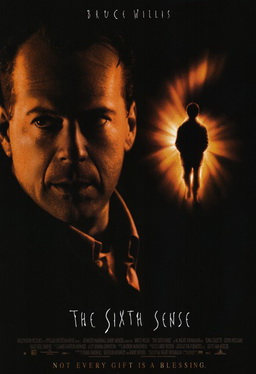
Before I talk about the 1999 best picture nominee, The Sixth Sense, I have to ask — is it really necessary to give a spoiler warning?  I mean, everyone knows that this film has a big twist at the end and everyone’s aware of what that twist is, right?  I’m going to assume that’s the case because, quite frankly, it’s kind of pointless to talk about this film without talking about the twist.  I mean, the Sixth Sense has been around for 16 years and it’s still a film that people seem to frequently talk about.  (For instance, “Why aren’t any of M. Night Shyamalan’s other films as good as The Sixth Sense?”)  If you’re over the age of 20, you really have no excuse for not knowing the twist ending of The Sixth Sense.

But, fair is fair — THIS REVIEW CONTAINS SPOILERS!  

Anyway!  The Sixth Sense is the story of a 9 year-old named Cole Sear (Haley Joel Osment).  Cole lives in Philadelphia with his harried but devoted mother, Lynn (Toni Collette).  Cole is a withdrawn child, haunted by the fact that he’s constantly seeing and hearing people that nobody else can hear.  As Cole explains it to his psychologist, Dr. Malcolm Crowe (Bruce Willis), “I see dead people.”

(And you know what?  That line has been quoted and parodied a thousand times since The Sixth Sense was released but that’s because it’s a great movie moment.  Haley Joel Osment was a great child actor and did deserve the Oscar nomination that he received for his performance in this film.)

Malcolm has some issues of his own.  The previous year, one of his former patients (Donnie Wahlberg) broke into his house and shot him, while Malcolm’s terrified wife (Olivia Williams) watched.  Malcolm feels that he was shot because he failed that patient and that he can achieve some sort of redemption by helping Cole.  Of course, as Malcolm devotes more and more time to Cole, he finds it harder and harder to speak to his wife.  In one scene, Malcolm sits down across from her and tells her all about Cole.  She responds by ignoring him and then standing up and walking out of the room.

And when she does that, your natural response is to go, “What a bitch!” and feel sorry for Malcolm.  Except, of course, Cole really does see dead people.  And, as we discover in the film’s twist ending, Malcolm is one of them.  If his wife seemed distant, it was because she didn’t know he was there.  If she seemed emotionally withdrawn, it was because she was deeply mourning him.  Everyone — including Cole — knew that Malcolm was dead.  Everyone but Malcolm.

And you know what?  Film bloggers like me spend a lot of time making snarky comments about M. Night Shyamalan and his twist endings but the ending of The Sixth Sense works beautifully.  It worked when I first saw it and it has worked every time that I’ve seen it since.  Even knowing that Malcolm is dead, it’s still incredibly poignant to watch him realize it.

And that’s why I’d love to have a time machine.  I would love to be able to hop into my time machine and go back to 1999 and see what it was like for the very first audience that watched this film.  How did they react when they discovered — for the very first time — that Bruce Willis was a ghost?  I’d love to find out.

But, even without that time machine, The Sixth Sense holds up surprisingly well.  Haley Joel Osment and Bruce Willis tend to get so much attention for their excellent performances that I’m instead going to praise Toni Collette, who does great work as Cole’s loving but overwhelmed mother.  She didn’t get a great catch phrase nor was she a part of a huge twist but the heart of the film is to be found in her performance.

The Sixth Sense was nominated for best picture of 1999.  It lost to one of the worst films to ever win an Oscar, American Beauty.


Horror Scene That I Love: The Monster and Maria from Frankenstein (1931, directed James Whale)


This scene that I love comes from the classic 1931 horror film, Frankenstein.  In this poignant scene, Frankenstein’s Monster (Boris Karloff) meets young Maria.  Maria is the first human to treat the Monster with true kindness.  Unfortunately, the Monster does not understand that, unlike flower petals, Maria does not float.

This scene features Karloff at his absolute best!

Horror on the Lens: Death Ship (dir by Alvin Rakoff)


Today’s Horror on the Lens comes to use from 1980.  In Death Ship, a cruise ship collides with a mysterious black freighter.  When the survivors board the freighter, they discover that it appears to be deserted.  But is it really?  As the survivors explore, they start to suspect that they might not be alone.  Even worse, the already unstable captain (George Kennedy) starts to hear a mysterious German voice, encouraging him to kill everyone else and stay on the freighter forever.

It’s kinda like The Shining, except it takes place on a boat and it’s not as good.

But then again, very few horror films are as good as The Shining!  Death Ship is an enjoyably pulpy exercise in ghostly horror and it can actually be quite scary, especially if you have an obsessive fear of drowning, like I do!

Plus, George Kennedy really puts his heart and soul into being possessed.

Watch Death Ship below!


Horror on TV: Buffy the Vampire Slayer 3.16 “Doppelgangland”


Buffy_the_Vampire_Slayer_title_card

Let’s continue our look at Horror on TV with another classic episode of Buffy the Vampire Slayer! Just as yesterday’s episode focused on a supporting character (Xander), this episode focuses on Willow!

I was going to say that Doppelgangland was one of my favorite episodes of Buffy the Vampire Slayer but then I realized that everyone would probably say that. This is an episode that truly shows why countless fans continue to love the show after all these years.

The Daily Horror Grindhouse: I Hate You (dir by Nick Oddo)


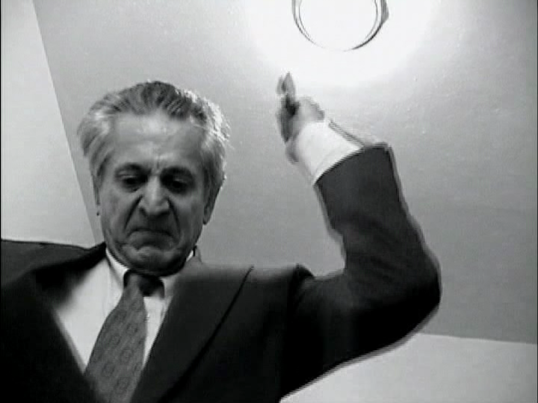
i hate you

“Murder is fun and doesn’t cost a thing!”

So says aging stand up comedian Norman (Marvin W. Schwartz).  Though we don’t learn much about Norman’s background, it’s obvious that he’s been pursuing his career for a while and he has yet to achieve much in the way of success.  With his dark suit, gray hair, and sarcastic delivery, he really does seem like he should be working in a cheap casino or a Catskills resort or maybe on a cruise ship.

But then you hear his act and you discover that he spends most of his time talking about how better the world would be if we just killed each other.  At one point, he even mentions that he’s working on a new act in which he’ll basically order the people in the audience to kill anyone sitting near them.  Eventually, he offends the wrong person and he’s told that he’ll no longer be allowed to perform at the local comedy club.  Norman replies by saying that the club’s owner probably would have hated Lenny Bruce as well.

And so Norman wanders around New York City.  He talks to a fellow comedian and notes that Jack the Ripper only killed five people but yet he’s had more books written about him than any president.  Everyone that Norman talks to nods along, humoring him.  It’s the same basic approach that Peter Boyle took to Robert De Niro in Taxi Driver and look how well that turned out.

Eventually, still wearing his black suit, Norman tries to play in the park.  For a few minutes, Norman is actually enjoying himself.  Of course, this is when Norman has a heart attack and nearly dies.  Norman, who dreams so much of being famous, is forced to consider his own mortality.

And, while all this is going on, Norman also finds the time to brutally murder 11 people.  That’s right.  Norman’s a serial killer.  If he can’t find fame as a stand-up comedian, he’ll find fame as a murderer.  However, as Norman discovers, even killers have to struggle to get the recognition they think they deserve.  Norman’s comedy is ignored and his crimes are only listed in the back pages…

I Hate You was released in 2004 and has been included in several box sets.  (I saw it as a part of the same Decrepit Crypt Of Nightmares box set that included Burning Dead and Dead 7.)  It’s a low-budget film that really doesn’t go anywhere but I have to admit that I actually liked it.  Marvin W. Schwartz (who also co-wrote the script) gives a good performance as Norman and the movie, which is shot in wonderful black-and-white, provides a lot of wonderful shots of New York City.

Plus, it’s barely an hour long!  So, right when you’re getting tired of it, it ends.  That’s a lesson that many movies could stand to learn from I Hate You.

ihy

Horror Film Review: Rosemary’s Baby (dir by Roman Polanski)


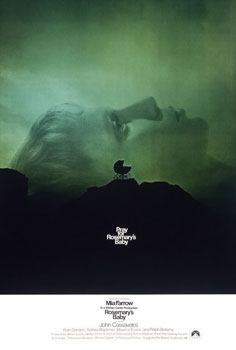
Rosemarys_baby_poster

“This is no dream!  This is really happening!”

— Rosemary Woodhouse (Mia Farrow) in Rosemary’s Baby (1968)

Yes, Rosemary, it is.

The classic 1968 horror movie Rosemary’s Baby is probably best remembered for a lengthy and wonderfully surreal “dream” sequence in which naive newlywed Rosemary Woodhouse (Mia Farrow) is raped by the Devil while a bunch of naked old people stand around her and chant.  At one point, she sees her husband, Guy (John Cassavetes), saying that she’s awake and that she knows what’s going on.  Their neighbor, Minnie Castevet (Ruth Gordon), tells him that Rosemary can’t hear anything and that it’s like she’s dead and then snaps at him, “Now, sing!”  It’s a great sequence, one of the greatest of Roman Polanski’s career, a perfect blending of horror and dark comedy.

For me, the most interesting part of that dream sequence comes at the start.  Rosemary envisions herself naked on a boat and, as she tries to cover herself, who is sitting next to her?  None other than John F. Kennedy!  Suddenly, Rosemary is wearing a bikini and she’s relaxing out on the deck with a glamorous group of people who I assume were meant to be Kennedy relatives.  As the boat leaves the dock, Rosemary sees that her friend and protector, Hutch (Maurice Evans), is standing on the dock.

“Isn’t Hutch coming with us?” Rosemary asks.

“Catholics only,” John F. Kennedy hisses in that famous accent, “I’m afraid we are bound by these prejudices.”

“I understand,” a dazed Rosemary replies.

And it’s a wonderful little moment, though I have to wonder if I’d react as strong if my own background wasn’t Irish Catholic.  But still, there’s something so wonderfully subversive about a bunch of elderly Satanists pretending to be the Kennedys.

And really, Rosemary’s Baby is a wonderfully subversive film.  I imagine it was even more subversive when it was first released back in 1968.  It’s been ripped off and imitated so many times that it has undoubtedly lost some of its impact.  (That’s one reason why I wish I had a time machine, so I could go back in the past and see it was truly like to see a classic film for the first time.)  But still, 47 years after it was initially released, Rosemary’s Baby is still a surprisingly effective horror film.

The film opens with newlyweds Rosemary and Guy moving into the Bramford, an exclusive New York apartment building.  Guy is an actor who, despite having appeared in two off-Broadway shows (one of which was entitled Nobody Likes An Albatross and really, that is so true) and a few motorcycle commercials, is still waiting for his big break.  There are hints that, before she married Guy, Rosemary had a very active and interesting life (when we briefly meet her old friends, they all seem to be a lot more exciting than boring old Guy) but, when we meet her, Rosemary appears to have happily settled into a life of domesticity.

Life at the Bramford is strange.  For one thing, Guy and Rosemary appear to be the only young people living in the entire building.  (There is a young woman named Terry but she ends up jumping out of a window.)  The Woodhouses befriend elderly Minnie Castevet and her husband, Roman (Sidney Blackmer.)  Roman claims to have traveled all over the world and embarrasses the Catholic Rosemary by criticizing the Pope.  Minnie, meanwhile, is the noisiest person in the world.  Guy makes fun of both of them and, yet, he still decides to spend his free time with Roman.

One day, Guy gets a role that he had previously lost.  Why?  Because another actor is struck by a sudden case of blindness.  Shortly afterward, Rosemary has her “dream.”  She wakes up and discovers that her body is covered with red scratches.  Guy claims that he had sex with her while she was asleep and promises to cut his fingernails.

Soon, Rosemary is pregnant but the Castevets insist that she use their doctor, the firm and sinister Dr. Saperstein (Ralph Bellamy, who just 8 year earlier had played FDR in Sunrise at Campobello).  Rosemary knows that something is wrong with the baby but she can’t get anyone to listen to her.  It all leads to one of the best and most iconic endings in the history of horror cinema.

Rosemary’s Baby is a classic of fear and paranoia and it holds up surprisingly well.  See it this October, whether you’re Catholic or not.

(However, do not see the needless 2014 remake.  Seriously, what the Hell was up with that?)

(By the way, is anyone else amazed that I made it through this entire review without making a single joke about either Ronan Farrow or Mia’s lame Sharknado live tweet?  I am shocked.)


Horror on the Lens: Sisters of Death (dir by Joseph Mazzuca)


Sisters of Death, which is included in a countless number of Mill Creek box sets, is not necessarily the greatest film ever made but it is a personal favorite of mine.

This 1977 film opens with a very baroque sorority initiation that ends with one of the sisters being killed in a game of Russian Roulette.  A few years later, the surviving sisters are invited to an isolated and lavish estate where it turns out that the dead girl’s father (well-played by Arthur Franz) is looking for revenge.  This film is predictable and a lot of the plot depends on people refusing to use any common sense but Sisters of Death is such a fun little melodrama that I can’t complain too much.  The film plays out like a surprisingly violent Lifetime movie and it has one of those wonderfully cynical 1970s endings.

Enjoy!

Horror on TV: Buffy The Vampire Slayer 3.13 “The Zeppo”


Buffy_the_Vampire_Slayer_title_card

OH MY GOD, IT’S BUFFY!

I love Buffy The Vampire Slayer and it’s always bothered me that I haven’t been able to share any episodes on this site. But, fortunately, this Halloween, Hulu has come to the rescue!

The Zeppo is one of my favorite episodes. While Buffy and the Scooby Gang save the world in the background, Xander (Nicholas Brendon) finally gets an adventure of his very own! Actually, there’s a lot of things that Xander finally gets to do in this wonderful episode!

(On a personal note, it breaks my heart whenever I read about Nicholas Brendon getting arrested and I’m reminded that Xander was just a fictional character.)

Seriously, enjoy Buffy the Vampire Slayer!

The Daily Horror Grindhouse: Burning Dead (dir by George Demick)


BDMany years ago, a teenager named Jim Reed was one of the few people to survive a fire that burned down the entire town of Maxwell and killed nearly the entire population, including his parents.  As you might guess, even after he grows up, Jim has some issues.  He feels tremendous guilt.  He has nightmares.  He feels he’s responsible for the deaths of thousands.  And even worse, he can’t really remember how the fire started or why.  All he knows is that he keeps seeing terribly burned people and they all keep telling him that it’s all his fault.

After spending years just drifting, an adult Jim (played by D. Vincent Ashby) returns to the town of Maxwell.  It’s been rebuilt and, amazingly enough, there seems to be next to no sign that it was ever the site of a huge apocalyptic fire.  (I suspect this has more to do with the film’s budgetary limitations than anything else.)  He ends up staying with his brother and occasionally, he seems to be possessed by some unseen force.  (For example, there’s the time that he wanders into his nephew’s bedroom while wielding a hammer.)  Jim meets his ex-girlfriend Shelly and an old friend named Bill.  And, through it all, he continues to have visions of horribly burned zombies telling him that everything is all his fault…

It’s always tempting to get snarky when talking about a movie like 2004’s Burning Dead.  This is a microbudget film that was obviously made with a largely amateur cast, the majority of whom are quite stiff as they deliver their overdramatic dialogue.  Yes, it would be easy to make fun of Burning Dead but you know what?  For what it is, it’s not that bad.  It’s a horror film that had a lot of interesting ideas but not the budget to really execute them.  But there are films with huge budgets that have absolutely no interesting ideas.  Ridicule the limitations of Burning Dead if you must but, as far as I’m concerned, the filmmakers deserve some credit for trying to create something more than just your standard low-budget zombie film.

Add to that, I am an admirer of the stoned nonchalance of D. Vincent Ashby’s lead performance.  It may be a the result of a lifetime of trauma but Jim, at times, seems to be one of the most mellow in protagonists in the history of horror cinema.  No matter what he’s confronting or explaining, Jim retains the same casual attitude.

My favorite moment in the film came when Bill asked Jim if his parents lost anything in the fire.

“Their lives,” Jim replies with a slight shrug.

Obviously, Burning Dead is not the easiest of films to find.  It’s included in the Decrepit Crypt of Nightmares Boxset and that’s where I found it.

(One final bit of trivia: according to his imdb page, director George Demick previously played a zombie in George Romero’s Day of the Dead.)

D. Vincent Ashby considers Burning Dead.

D. Vincent Ashby considers Burning Dead.