When I first decided to feature episodes of televised horror, I very much wanted to include the classic Twilight Zone episode, Nightmare At 20,000 Feet. However, the full episode wasn’t available on YouTube and that was truly unfortunate. Along with being a scary episode of classic show, Nightmare at 20,000 Feet was all about flying, which is something that scares me.
However, as I was searching through YouTube, I did come across an episode of Ghost Stories entitled Last Flight Out, which also deals with this very primal fear that so many of us have. It’s no Nightmare at 20,000 Feet but it’s effective in its own way.
As for Ghost Stories, it was a horror anthology series that aired from 1996 to 1997 on the Fox Family Channel. As you can probably guess, each episode told a story about ghosts and, in the great anthology tradition, each story ended with a twist. Each episode was narrated by Rip Torn.
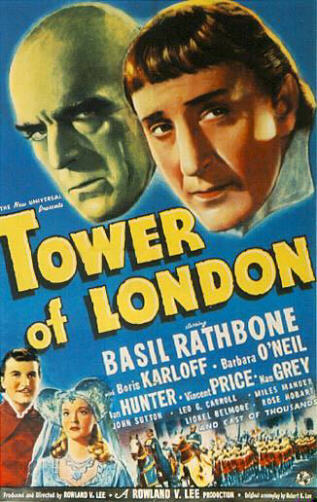
Today’s horror movie comes from 1939 and is presented in glorious black-and-white. Tower of London tells the famous (and historically controversial) story of King Richard III (Basil Rathbone). With the help of the club-footed executioner Mord (Boris Karloff), Richard murders his way to the throne of England.
Technically, The Tower of London is more of a historical film than a horror film but, in order to tell its story, it uses many of the techniques that had been previously perfected by the famous Universal monster movies. Rathbone turns Richard III into a chilling and plausible human monster while Karloff is obviously having a lot of fun in the role of the twisted Mord.
Also of historical interest is the fact that Vincent Price plays the Duke of Clarence, making Tower of London his first horror film and the first film in which he would appear alongside fellow horror icon, Boris Karloff.
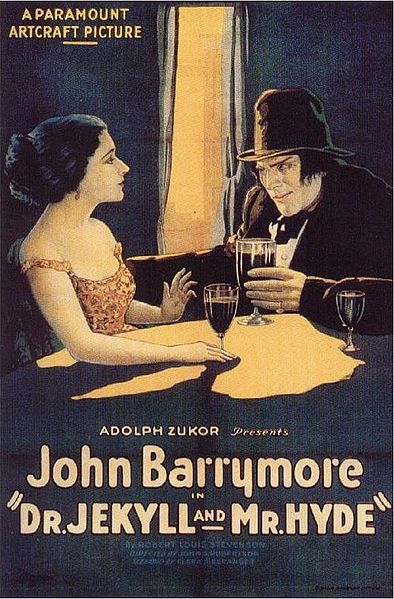
Ever since the birth of film, Robert Louis Stevenson’s Dr. Jekyll and Mr. Hyde has been a popular subject for adaptation. Not only does the classic story of a good doctor who unleashes his evil instinct via potion serve as a potent metaphor for everything from sexual repression to drug addiction, but the dual role of Dr. Jekyll and Mr. Hyde has provides an excellent opportunity for an actor to show off.
The first film adaptation of Dr. Jekyll and Mr. Hyde is believed to have been made in 1908. Two more version followed in 1912 and 1913 and then, suddenly, 1920 saw three different film versions.
The best known of the 1920 version is our film for today. This version is best remembered for John Barrymore’s powerful performance in the title role but it also holds up remarkably well as a work of cinematic horror.
William Peter Blatty took on the directing reins for the third film in the series. I’m going to take a huge leap of faith that he was none too happy with how the first sequel turned out.
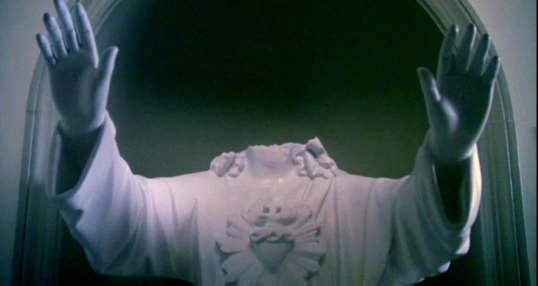
The latest “Scenes I Love” the Horror Edition comes from Blatty’s The Exorcist III and it’s actually a very effective jump scare that truly comes out of nowhere. I chose this particular clip because of how well Blatty frames and sets up the pay off. Some may argue that this third film in the series was a mixed bag but one thing it had was genuine scares making up for not being as disturbing as the first film.
I recommend watching this particular scene in a darkened room with headphones on to better appreciate the sound.
The previous “Song of the Day” was Polymorphia and comes courtesy of one Krzystof Penderecki. Why stop a good thing and go with someone else for the latest one when Penderecki continues to bring in the horror.
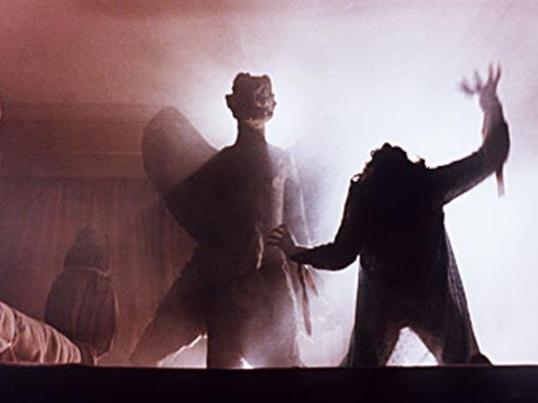
“Kanon For Orchestra and Tape” was also used in William Friedkin’s The Exorcist and one could tell just from listening to it that it fit perfectly. Like Polymorphia, this particular piece uses the string section to help create that encroaching dread and horror while adding some nontraditional sounds to keep the listener off-balance.
Just listening to this piece one could be made to believe that there is a Hell and the Devil’s just waiting to get out and play.
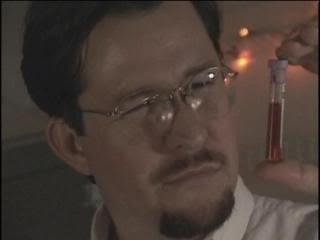
In 2003’s This Darkness, Dr. Van Helsing VII (played by the film’s director Dylan O’Leary) is a world-famous genetic engineer who is developing a serum that can cure all known diseases and perhaps grant immortality. Meanwhile, cheerleaders and surfers are being attack in broad daylight and having their blood drained. Among those killed is the daughter of Van Helsing’s friend Ron, who happens to own a martial arts studio. Could all of these events be connected? Your guess is as good as mine but eventually, a vampire named Tarquin does show up and demands that Van Helsing create a mate for him.
I’ve always found low-budget ambition to be very likable and, by that standard, This Darkness is probably one of the most likable films that I’ve seen. The film’s script has a few interesting ideas, O’Leary makes for an unconventional but effective hero, and the film actually looks pretty good for its budget. Especially towards the end of the film, This Darkness makes effective use of some unconventional locations. Add to that, it’s hard not to admire the everything-but-the-kitchen-sink approach that O’Leary took to putting his film together.
Add to that, how can you not enjoy a film directed by someone with as Irish a name as Dylan O’Leary?
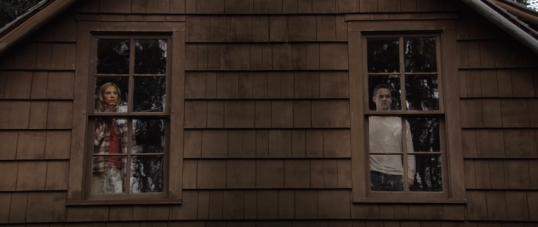
The Presence opens with nearly 20 minutes of near-silence. We watch as an unnamed and emotionally unstable woman (Mira Sorvino, who is literally listed in the credits as having played The Woman) arrives at an isolated cabin. As she settles in for what is obviously a very needed vacation, she goes about her business without saying a word. This is because she believes herself to be alone. However, those of us watching know that this isn’t true. She is sharing her cabin with a silent and initially passive ghost (Shane West) and, though she can’t see him, those of us in the audience can.
Eventually, the silence is broken as other visitors come to the cabin. There’s the boatman, Mr. Browman (Muse Watson). There’s the woman’s boyfriend (Justin Kirk) who unexpectedly shows up to ask the woman to marry him, a proposal which visibly upsets the ghost. Finally, there’s the Man In Black (played by Tony Curran). Though the woman cannot see the Man In The Black, she can hear him when he whispers dark thoughts into her ear.
The ghost, however, can see the Man in Black. The Man In Black offers the ghost a proposition. If the ghost kills the woman’s boyfriend, the Man In Black will allow the ghost to leave the cabin.
First released back in 2010, The Presence is a film that got (and gets) next to no love from the critics and from the type of people who specialize in leaving snarky comments over at the imdb. However, I rather like it. Director Tom Provost makes the risky choice to emphasize atmosphere over easy scares. The end result is a film that is full of striking images but which requires a bit more patience than most audiences are probably willing to give. When I think about The Presence, I think about the sight of Shane West passively watching Mira Sorvino, obviously wishing he could reach out but knowing that he cannot. It’s a haunting image, one that perfectly captures both the fear and the pathos of a good ghost story.
And that, ultimately, is what The Presence is. It’s a good ghost story and what better time for a good ghost story but Halloween?
Today’s horror film comes to use from 1976. In Dogs, man’s best friend decides to terrorize an isolated college campus and the fate of the student body is in the hands of two professors (bearded David McCallum and non-bearded George Wyner).
In many ways, Dogs is a pretty basic revenge-of-nature film but it still made me nervous when I watched it on YouTube. As our regular readers may know, I used to be terrified of dogs. In just the past few years, I’ve managed to overcome a lot of my phobia but, on the whole, dogs still make me nervous. And this movie definitely played on those nerves!
Interesting note: according to the trivia section over at the imdb, Dogs was originally going to be followed up by a sequel called Cats. However, Dogs failed at the box office and, as a results, Cats was cancelled.
When I first started searching YouTube for episodes to use in this feature, I came across quite a few episodes of an old black-and-white TV show called One Step Beyond. Running for three seasons (from 1959 to 1961), One Step Beyond was hosted by John Newland. Every week, Newland would tell the audience about some sort of possible paranormal phenomena. Then, a dramatization of a “real” event would be shown and occasionally, the show would end with Newland interviewing the real people whose story we had just watched.
To me, that all sounds like a lot of fun.
The 16th episode of One Step Beyond was called The Burning Girl and it dealt with a teenage girl who, whenever she got upset, could apparently cause fires to spontaneously erupt. It was written by Catherine Turney and directed by John Newland himself.
It was originally broadcast on May 5th, 1959 — presumably long before Stephen King even had the idea to write about a girl named Carrie.
First released in 1961 and directed by Curtis Harrington, Night Tide stars a young Dennis Hopper as Johnny, an awkward sailor. Johnny meets Mora (Linda Lawson), who works as a “mermaid” on the pier. For Johnny, it’s love at first sight. However, the more that Johnny pursues her, the more he learns about both her mysterious past and the dark fate of her previous boyfriends.
Night Tide is low-key and atmospheric gem of a movie, one that serve as an inspiration for low-budget filmmakers every where. Lawson is perfectly cast as the enigmatic Mora but the film really belongs to Dennis Hopper. Hopper’s naturally off-key presence made him perfect for the role of Johnny.
Night Tide is one of those low-budget movies that, because it’s in the public domain, has been released on DVD (often in inferior form) by dozens of different companies. Often times, films like this turn out to be fairly forgettable. Night Tide, however, is an exception.


 Through the Shattered Lens